"Media tablet hype around devices such as the iPad has also affected consumer notebook growth by delaying some PC purchases, especially in the U.S. consumer market. Media tablets don't replace primary PCs, but they affect PC purchases in many ways," Ms. Kitagawa said. "At this stage, hype around media tablets has led consumers and the channels to take a 'wait and see' approach to buying a new device."
Fascinating. I'd love to hear more about the non-iPad "media tablets" that delayed PC purchases last quarter. Maybe I don't get out enough.
But more to the point, let's combine the data from Gartner and the forecast for iPad.
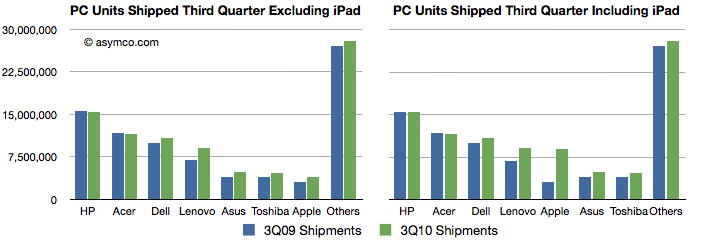
I show below the impact of the iPad on PC vendor sales. I'm using my own estimates of world-wide PC sales (you can see other estimates here (Apple 2.0))
The world-wide PC units shipped without and with iPad:
When including the iPad Apple goes from 7th to 5th ranked, and with 50% growth clearly within shot of top rank next year.
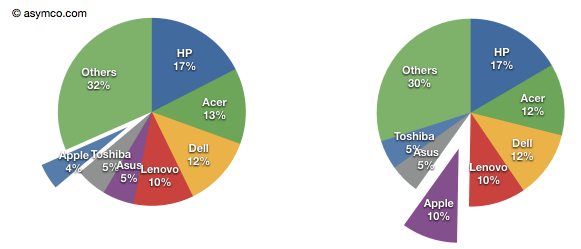
Now I look at PC unit shares:
With the iPad Apple goes from 4% share to 10% share. Again, within striking distance of number one or two in a year.
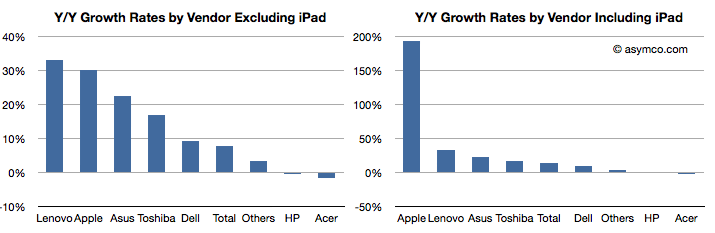
Finally, growth rates:
Apple's share growth goes from second to first but also several times higher than any of the others.
When Gartner spins the iPad as a "Media Tablet" it's clear that the device is disruptive. Reminds me of what Gartner thought about Smartphones four years ago.
I cannot think of a better endorsement for an investment than a snub from Gartner.
"Interest in Windows Mobile 5.0 has grown steadily, and it now attracts far more developers than any rival mobile operating system. This should improve the likelihood of IT directors being able to buy line-of-business mobile applications for the Microsoft platform. More than 10,000 developers are currently working on applications for Windows Mobile 5.0. Part of the reason for this developer momentum is Microsoft's programming model. Nick Jones, vice-president at analyst firm Gartner, said, "Every device using Windows Mobile 5.0 has the same interfaces, but that is absolutely not the case with other operating systems, such as Symbian."
A piece by Gartner that has a typical Gartner conclusion: WM 5 is going to grow the WM Developer community because of device-by-device similarities, and more freedom than RIM or Nokia devices can give.
Love the "every device using Windows Mobile 5.0 has the same interfaces" dig at Symbian. That was four years ago. This week Gartner predicts the fragmented but magically open Android will dominate four years from now.
I had to do some digging to find this to contrast to the recent Gartner prediction that Symbian will be the market share leader in 2014.
The following article appeared in 2003:
Symbian will lose smartphone battle
By Rob Jones at Gartner Symposium ITxpo, Cannes [07-11-2003]
Microsoft's standardised handsets will win the day, says Gartner
Analyst Gartner has warned that, without a concerted effort by Symbian and its backers, Microsoft will sweep them aside in the smartphone business.
Redmond's ability to offer standardised handsets which are easier for businesses to support and use will help the software giant win corporate approval, the market watcher predicted.
Nick Jones, vice president and research fellow at Gartner, said that, while Microsoft did not have a good corporate smartphone today, he believed it would do by the end of 2004.
The analyst predicted that Microsoft will ship a phone boasting strong integration of a range of packages, such as Exchange and Outlook.
Symbian, he added, needed to resolve a number of issues to be a credible, corporate alternative. Its platform and menus differ slightly on various handsets, which means that they often do not have the same user interface.
"Symbian is not very committed to fixing this problem. So Microsoft is getting stronger and Symbian is not addressing the corporate market," explained Jones.
"This is unattractive for chief information officers. They need standard systems and that's what Microsoft will provide.
"If by the end of next year Symbian hasn't solved its problems, Microsoft will be a very strong competitor for a standard corporate smartphone.
"Symbian could lose the battle and at the moment I'd have to say it will probably happen."
Lots of people apparently think it’s a big deal that Gartner is predicting Android will surpass iOS for second place. But why is that necessarily a good thing, given that they’re predicting Symbian will remain in first place? Who thinks Symbian is actually doing well? Nokia’s board sure doesn’t.
I also noted with amusement that by 2014 "other" is slated to sell 85 million units or nearly 10% share, up from 6.1% in 2009. These "others" will be selling more than twice what Apple is expected to sell this year. Is "other" WebOS, Bada, MeeGo, LiMO? If so they're in for a healthy future.
But dwelling on details like these is missing the point. To see how improbable this prediction is, let's go back to 2006 and ask what Gartner was forecasting would happen now.
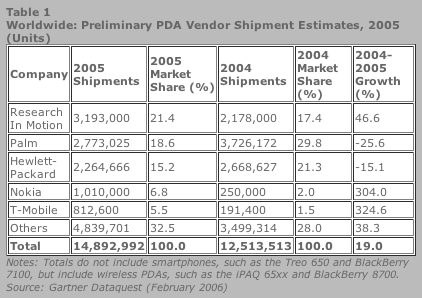
First thing to note is that in 2006 Gartner was busy tracking PDA sales. You might wonder why this is relevant. The reason is because a significant proportion of RIM's Blackberries counted as wireless PDAs and were therefore considered to compete with Palm's Treos, HP's iPaq and Dell's famous Axim. Nokia was in the running with its Communicators. Here is how Gartner characterized the equivalent market in early 2006:
So I'll just come out and say it: In 2006 Gartner did not have a clue what a smartphone was. By their admission:
Gartner defines a PDA as a data-centric handheld computer weighing less than one pound that is primarily designed for use with both hands. These devices use an open market operating system supported by third-party applications that can be added into the device by end users. They offer instant on/off capability and synchronization of files with a PC. A PDA may offer WAN support for voice, but these are data-first, voice-second devices.
In other words, in 2006 Gartner was splitting phones with operating systems into two separate markets: data-oriented wireless PDAs and voice-oriented smartphones. The split was mostly based on the judgement of the analyst on whether a device was "voice" or "data" oriented. I suppose they used the primary input method as a proxy: numeric keypads meant the device was one-handed and therefore voice-oriented. If the device had a full keyboard and/or a stylus-actuated touch screen then it was a two-handed data-oriented device. But even this proxy was not quite enough, sometimes devices were classified whimsically.
To make it more complicated, they bundled non-cellular but Wi-Fi enabled PDAs with wireless PDAs. This made some sense from a corporate IT point of view (their primary customer base) as these data-oriented devices would be used either on a LAN or a WAN (Wide Area Networks: what Gartner anachronistically called cellular networks.)
The presence or absence of a cellular radio did not enter into their view of these devices. So if you asked Gartner in 2006 to forecast smartphones (as we know them now) in 2010, I suppose you'd get what they forecast for "data-centric" devices.
So assuming that today's smartphones are mostly "data-centric" we would have to look back on their view of that market and not the voice market which was seen as an entirely different thing. Their answer should have had something to do with the market leaders and participants in 2006. As the table above shows Gartner showed that RIM, Palm and HP led in 2005 with Nokia and T-Mobile[1] pulling up the rear.
However, from a platform point of view, at the beginning of 2006
Microsoft Windows CE was the No. 1 PDA operating system (OS) in 2005 as 7.05 million PDAs were loaded with the OS, up 33 percent from 2004 shipments of 5.28 million units. Palm OS PDA shipments declined 34 percent to 2.96 million units in 2005.
In late 2006, Gartner made further predictions for the year:
In 2006, Gartner expects the PDA market to increase by 6.3 percent to 16 million units. The market will continue to be driven by broader availability of cellular-enabled PDAs from wireless carriers. Gartner estimates that 53 percent of all PDAs shipped in the first half of 2006 featured integrated cellular capability, up from 46 percent during the same period in 2005. “The share of PDAs purchased by enterprises will continue to increase; it accounted for 49 percent of all PDA shipments in the second quarter of 2006 and Gartner expects that the enterprise market will account for 52 percent of all PDA shipments in 2006,” said Todd Kort.
At this time I have not yet dug up a Gartner "Wireless PDA OS" four year forecast from the year 2006 but I suspect it would not show devices running Google's Android operating system or any running something called iOS.
[1] T-mobile is in the list because it was common practice in 2006 for operators to market Pocket PC Phone Edition devices made by HTC under their own name. Orange, Vodafone and Verizon also had own-brand HTC Windows touch-based devices. Now what does that strategy remind me of?
According to Gartner, mini notebooks constituted less than 18.0% of the total mobile PC market in the second quarter of 2010, down from 20.0% of the total market at 2009-end. Gartner expects mini notebooks market share to drop to approximately 10.0% by 2014.
However, worldwide PC shipments are projected to total 367.8 million units for the full year 2010,
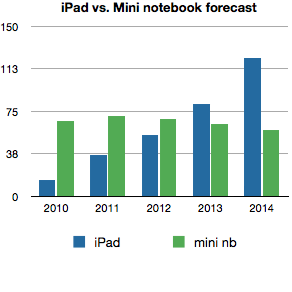
Speculation about the iPad production ramp indicates that the iPad will ship about 14 million units this year and 36 million next year. Projecting a forward growth rate of 50% and adding the Gartner forecast above gives us the graph on the left.
The iPad (plus competitors) will likely overtake the sales of mini notebooks as soon as 2012. The collapse in netbook sales is likely to be much more rapid than Gartner suggests.
Gartner explicitly explained so in its press release: "Gartner's PC group does not track media tablet sales in this PC shipment data, so iPad sales are not included in these results
The reluctance of industry analysts to measure the iPad as a computer is a fascinating and vivid symptom of how analysts conspire with their customers to smother visibility of impending failure.
Before we dive into the motivation to ignore iPads, we need to understand how analysts in general and companies in particular group products into comparable piles. This process of grouping is called categorization. It should be distinguished from segmentation which groups buyers in a market. Categorization is essential for competitive analysis and measurement of the performance of a product (relative to other products).
Categorization is a challenging problem for most companies. To illustrate why, consider four possible methods for categorizing products:
By product attributes. The assumption here is that products with similar attributes compete in the same market. As an example hard disk drives might be categorized by dimensions of the cases and sub-categorized by capacity and perhaps transfer speeds.
By user attributes. This method is similar to segmentation where products are grouped by the type of buyer. Magazine titles might be properly categorized by the age and gender of the readers. This can also cover geographic data.
By user behavior. This method, sometimes called psychographics is a more advanced method than demographics where user personality, values, attitudes, interests or lifestyles are measured. You might have seen examples where users are defined with a "prototype" person and the products are attached to this prototype. This is a common way to categorize mobile phones (Nokia is a known leader in this method).
By modes of consumption. Determine what products are hired to do the same job. In this case you have to have real insight into what people actually do with their products and try to look broadly at what they substitute. The classic example of this is to understand that a power drill competes with products what make holes in walls not just with other drills.
When reading this list, it's easy to see that it's ranked in order of difficulty. The easiest thing to do is group according to things you can measure easily. Products are easier to measure than demographics which are easer to measure than psychographics and that's easier to capture than observed behavior.
Consider how you would structure a study to capture this data.
In the first case, you need an analyst to collect products (or just their descriptions) and record values in a spreadsheet.
In the second case, users need to be surveyed for basic data. This is hard because you have to find users and then you have to get a statistically significant unbiased sample.
In the psychographic study you need to ask a lot more questions about lifestyle in your survey and hope that the subject answers honestly. You still need a large sample.
In the case of consumption analysis you need to observe a subject use a product for a prolonged period of time in the usual context where the product is used and be able to interject questions when certain behavior is encountered. The observation of one person can take one research person-day per subject. To get statistically significant data requires literally man-years of work.
Now it should be clear why an analyst will only categorize according to product attributes. It's not only economically and temporally expensive to perform research on methods 2 to 4 but it also requires interpretation and insight into study development.
A few companies go beyond buying analyst market data and do their own research. As far as I know user studies are more commonly done by consumer products companies. But it's extremely rare to see this research done by low-margin technology companies. They don't have the budgets or skill sets to do any research.
However, in my experience, nobody performs the fourth, most difficult, form of categorization.
The result is that good, smart managers trained to always base their decisions on hard facts, pick up these lowest-deonominator analyst reports to help decide which products to develop. And it should be obvious why they are surprised when products that did not show up on any market study suddenly take all their profits away.
On May 5th, I tried to fill in the blanks on Global smart phone OS shares | Asymco. I estimated that the shares for the mobile OS's were as follows (based on Canalys partial data):
Symbian (Nokia): 42%
Blackberry OS (RIM): 19%
iPhone OS (Apple): 16%
WinMo (Microsoft): 10%
Android (Google): 10%
WebOS (Palm): 2%
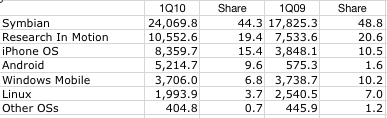
Now Gartner has published their sell-through estimates:
Symbian (Nokia):: 44%
Blackberry OS (RIM): 19%
iPhone OS (Apple): 15%
Android (Google): 10%
WinMo (Microsoft): 7%
Linux: 4%
Other OSs: 1%
My estimates were within 1 or 2 percent of actuals except for Windows Mobile where I over-estimated by 300 basis points.
This question sounds like a tautology. It's like asking "Will Apple rule the iPod market?" But redundancy has not stopped WSJ journalist Benjamin Pimentel from asking. His answer to the question is below:
But while Apple apparently has the edge in the emerging tablet war, it is unclear if the company will end up dominating the market the way it has come to rule the digital music player market with the iPod.
Gartner's Fiering said the iPad has "raised the bar and suppliers are now scrambling to make sure they get it right."
IDC now projects 6 million tablet devices to ship this year, including 4 million iPads, Shim said. But while Apple has taken the lead, he added, the company faces the "burden of lifting or defining this entire new market," because there are no other competitive devices available.
"In the iPhone market, they learned from everybody else," he added in a video interview. "In this new space, there's nobody else to kind of bounce ideas of so to speak."
But Apple may not have to feel so alone for long.
Fiering specifically pointed to H-P's as the best positioned challenger, given its scale, reach and its upcoming merger with Palm.
"There are not too many suppliers that can pull all those pieces together," she said. "H-P could if they integrate the Palm acquisition properly."
Another IDC analyst, Crawford Del Prete, agreed saying, while the "buzz" from H-P had generally been defensive in relation to the iPad, "the longer term story is far more interesting."
"Given H-P's massive scale, I think they have the ability to drive new price points for this kind of product," he said. "With a lower price point, the category becomes far more interesting."
Before diving into the statements above it's worth noting where the journalist went to get opinions to fill his column. He called Gartner and IDC. Quoting industry analysts is a standard operating procedure to fill column-inches with material that does not offend. But how good are they?
In my years of watching those who watch markets I formed a ranking of analyst types and their likely accuracy with respect to prognosticating a market shift. In order from most accurate to least accurate:
The most accurate are rank amateurs (deagol, Muller, et. al). Independent bloggers who do some fact checking tend to make the boldest but most accurate forecasts.
The next most accurate are sell-side analysts (purveyors of analyst reports from established brokerages). They follow financials for individual companies. You might think their record is quite poor, but in fact they are much better than..
Industry analysts (like Gartner, IDC). Their forecasts and sensitivity to disruption are often off by an order of magnitude. This is partly because they forecast a bit further out than Wall St. but also because they are closer to their industry clients-- the source of their ideas. They spend a lot of time talking to the least accurate forecasters...
The corporate analysts. They are typically hired to advise management in the incumbent companies. These are people who have the most information about the way the industry is performing on a daily basis.
You might notice a pattern here: the closer you are to the market, the less likely you are to observe how that market is crumbling around you. You cannot see the forest for the trees.
How could this be? How can having more access give you a poorer picture? The answer lies in the asymmetry of a disruptive attack. The more you know about how things are the less you know about how things could be.
In practice, the analyst information value chain works like this:
Corporate analysts feed information to management that management is comfortable digesting. Those managers then hire industry analysts to validate their opinions. Industry analysts are keen to maintain a relationship with those firms and so they listen carefully to the prejudices of their clients. They then hold up a mirror to those myths and consolidate those opinions for wider distribution and quotation by journalists at respectable publications.
Stock analysts listen with one ear to the chatter but with the other to the way the wind blows with the stock market. Sometimes they actually sample the data in the value chain directly by calling acquaintances in the market and hire interns to watch what's happening in the shops. They then build an opinion that has some level of surprise but that they hope will not stray too far into controversy so that they can keep their jobs in case they are wrong. The safe bet is always to say that things will stay mostly the way they are, but to say it in clever ways.
So that just leaves only one group of analysts with independence from a paycheck who can make an opinion on the basis of facts alone.
This post has become longer than I planned, so I'll dive into the exact answer to the article claims in part II.
Symbian will lose smartphone battle By Rob Jones at Gartner Symposium ITxpo, Cannes [07-11-2003] Microsoft's standardised handsets will win the day, says Gartner
Analyst Gartner has warned that, without a concerted effort by Symbian and its backers, Microsoft will sweep them aside in the smartphone business.
Redmond's ability to offer standardised handsets which are easier for businesses to support and use will help the software giant win corporate approval, the market watcher predicted.
The analyst predicted that Microsoft will ship a phone boasting strong integration of a range of packages, such as Exchange and Outlook.
Symbian, he added, needed to resolve a number of issues to be a credible, corporate alternative. Its platform and menus differ slightly on various handsets, which means that they often do not have the same user interface.
So spoke Nick Jones, vice president and research fellow at Gartner in 2003.