Asymco

Asymmetric Intelligence

Windows Mobile

  1. Android remains the only mobile OS still patterned after Microsoft's 2002 vision of the mobile value chain

    Research · 52 comments

    Belfiore wasn’t shy about criticizing Google’s Android OS. Even though Google currently dominates the mobile OS market, its strategy of licensing the Android OS to manufacturers is similar to Microsoft’s previous approach with Windows Mobile: It’s open-ended, and there are few restrictions on how manufacturers can use or modify the OS.

    As a result, Android is suffering from some of the same issues as Windows Mobile did: Android works better on some phones than others, manufacturers are shipping different versions of the OS on different phones, some Android phones are shipping with bloatware made by carriers, and some app developers complain that it’s difficult to make software because of the hardware and OS fragmentation.

    via How Microsoft Hit CTRL+ALT+DEL on Windows Phone | Gadget Lab | Wired.com.

    Android was initially an attempt to commoditize Windows Mobile with a symmetric but "free" alternative. The idea was to conform to OEMs and operator business models. This was directly copied from Microsoft's early 2000's playbook for entry into mobile.

    Trouble is that Microsoft realized their purely modular, operator and OEM centric approach was failing to be competitive on the user experience and decided to move into a more integrated approach, closer to Apple's integrated model.

    But while Microsoft dropped their vision, Android was still patterned after their approach.

  2. IDC: I Dream of Claim Chowder

    Research · 3 comments

    A few eyebrows were raised when Microsoft presented a slide at a French event where they made the claim that 30 Million Windows Phone devices would be sold by the end of 2011.  Given that the first Windows Phone won't ship until October 2010 at the earliest, or, according to Mr. Ballmer, "by Christmas," count me among the skeptics.

    However, the claim was later retracted by Microsoft stating that they mis-quoted IDC, the original source for the forecast.  The correction was perhaps meant to put an end to the credibility crisis.

    However, the actual forecast from IDC was even more preposterous. Apparently IDC makes the forecast that 32 million "Windows Mobile" devices will sell during all of 2011--a combination of both Windows Mobile and Windows Phone devices.

    Instead, the research company forecast 2011 sales of 32 million devices running all Windows Mobile operating systems. This includes expected sales of devices with Windows Mobile 6.5, which is already on the market. IDC has not given any sales estimate for Windows Phone 7, which Microsoft has said will be available in the fourth quarter.

    Their report showed about 16 million Windows Mobile devices shipped in 2009, with a forecast of 22 million this year and 32 million next year.

    Windows Mobile shipped a total of 3.7 million phones in 1Q10, so in order to reach 22 million this year they need to ship 18.3 million for the rest of the year or, on average, 6.1 million phones a quarter.  That's a higher number than what Android shipped in Q1 with BOGO promotions (5.2m units). That's almost as high as the launch quarter for the iPhone 3G.  And all this (mostly) with WinMo 6.5!

    Alternatively perhaps IDC foresees a huge launch for Windows Phone. Assuming an erosion of the WM6.5 to 2.7 m this quarter, 2 million in Q3 and 2 million in Q4, then Windows Phone would somehow need to ship 12 million units during the last quarter.  This number is higher than what iPhone sold in its highest ever quarter.

    This sounds sillier than 30 million Windows Phones in 2011.  By claiming that Microsoft's combination of deprecated Windows Mobile (6.5) and unreleased Windows Phone 7 will continue to sell at a growth of 38% this year, they are actually suggesting an acceleration in sales going into the second half at a rate higher than what the market is likely to grow at.

    In other words, they are suggesting that Microsoft will gain share during the rest of this year. Share gains for a platform that has declined in share in Q1 from 10.2% to 6.8% with 3.7 million units sold on the back of further share losses the quarter prior. Share gains against Android that competes with a free license. Share gains with a new platform that has no clear differentiation vs. the iPhone.

  3. HP on Windows Mobile/Phone

    Research · 1 comment

    Will webOS replace Windows on all of your smartphones?

    Microsoft will continue and will always be a huge strategic partner for Hewlett-Packard. Our focus is to create choice for customers around those products and services that will allow them to connect to the information they need as quickly and as safely as they can.

    via HP Gets Its Hands on Palm - BusinessWeek.

    Sounds like a definite non-answer.  My bet is that they have not decided but that when they will decide it will be to show Microsoft the door.

  4. Google and Microsoft swap mobile share

    Research

    according to a report published Monday. ComScore reported that Google's share of smartphone subscribers rose to 9%, compared to 3.8% at the end of November. Meanwhile Apple's share fell 0.1 points to 25.4%, while Microsoft's share fell 4 points to 15.1%.

    via Google's share of mobile market grows: report - MarketWatch.

    Seems Google's gain is Microsoft's loss.

    BlackBerry, saw its share rise 1.3 points to 42.1%, according to the data. The number of owners of smartphones rose 21% in the U.S. in the three months ended in February compared to the prior period.

  5. Microsoft Leaks Details of WP7 Platform

    Research

    Charlie Kindel on Windows Phone Development : Different Means Better with the new Windows Phone Developer Experience

    • There's zero backwards compatibility with Windows Phone 6.5 applications.
    • It's still based on Windows CE underneath (version 6 in this case)
    • Developers are going to need to re-code their apps.
    • So what will they code it in? So far, we've been told Silverlight and XNA.
    • Kindel's post also mentions Web 2.0 Standards and Microsoft developer tools, along with .Net.
    • Nothing about C++ or native code versus managed code, but expect managed code to be de rigeur.

    Check out some of the comments in the link above.

  6. Windows Phone Classic Phones not upgradeable to Windows Phone 7 Series

    Research

    "Because we have very specific requirements for Windows Phone 7 Series the current phones we have right now will not be upgradable,"

    Microsoft cuts off Win Phone 7 upgrades for all WM6 devices | ElectronistaInvites ‹ Asymco — WordPress

    Now why would anyone buy a WinMo 6.x (aka Windows Phone Classic) phone today? Is this is a classic example of the Osbourne effect?

    Maybe there is more to this story. Buried in the WP7 launch was news that Classic would carry on and a new "starter" edition would also be made available. Said Starter edition would be sold only in emerging countries and target 2G and 2.5G networks.

    Furthermore, Ballmer made it clear in a Q&A that they would "continue to invest" in "Classic" WinMo/Windows Phone.

    So Microsoft is not quite foolish enough to ignore the consequences of an orphaned platform. The impact of the dual platforms on the ecosystem is another story.

  7. Skype and Adobe Jump off WinMo Ship

    Research

    Weak spin from both on reasons to leap off a sinking ship.

    Skype has just discontinued Windows Mobile version of Skype client:

    We’ve chosen to withdraw Skype Lite and Skype for Windows Mobile because we want to offer our new customers an improved mobile experience – much like the version that has proved so popular on the iPhone, and which is now available on Symbian phones.

    Meanwhile, Adobe was promising to bring Flash 10.1 to Windows Mobile but now Adobe is leaving Windows Mobile 6.x:

    As for WinMo, we have made the tough decision to defer support for that platform until WinMo7. This is due to the fact that WinMo6.5 does not support some of the critical APIs that we need.

  8. Microsoft's standardised handsets will win the day, says Gartner

    Research

    Symbian will lose smartphone battle By Rob Jones at Gartner Symposium ITxpo, Cannes [07-11-2003] Microsoft's standardised handsets will win the day, says Gartner

    Analyst Gartner has warned that, without a concerted effort by Symbian and its backers, Microsoft will sweep them aside in the smartphone business.

    Redmond's ability to offer standardised handsets which are easier for businesses to support and use will help the software giant win corporate approval, the market watcher predicted.

    The analyst predicted that Microsoft will ship a phone boasting strong integration of a range of packages, such as Exchange and Outlook.

    Symbian, he added, needed to resolve a number of issues to be a credible, corporate alternative. Its platform and menus differ slightly on various handsets, which means that they often do not have the same user interface.

    So spoke Nick Jones, vice president and research fellow at Gartner in 2003.

  9. Windows Mobile renamed Windows Phone Classic

    Research · 1 comment

    The mobile operating system formerly known as “Pocket PC 2000/2002, Pocket PC 2000/2002 Phone Edition, Smartphone 2002, Windows Mobile (2003/5.0) for Pocket PC, Windows Mobile (2003/SE/5.0) for Pocket PC Phone Edition, Windows Mobile (2003/SE/5.0) for Smartphone, Windows Mobile 6[.1/.5] Professional/Classic/Standard” will now be known as Windows Phone Classic.

    The last “Classic” nomenclature lasted from Windows Mobile 6 Classic to Windows Mobile 6.1 Classic and denoted the OS for Microsoft’s PDAs. It disappeared after version 6.5.

    Windows Phone Classic will co-exist with Windows Phone 7 Series.

    Simple.

  10. Into the Mind of a Windows Mobile User

    Research

    What are we to make of the new Windows Phone 7 Series?

    First, we have to distinguish it as a new platform. Let’s use Microsoft’s new naming conventions and call it “WP7S” as distinct from the current Windows Mobile 6.5 aka “WinMo”.

    Steve Ballmer said they will continue to “invest” in WinMo presumably in parallel to the WP7S platform. This is an interesting development since although there might be some interoperability of applications, the new platform will likely have a new set of APIs.

    What strikes a follower of the WinMo platform is that the new WP7S is orthogonal in its positioning. Whereas WinMo was for either hard core, ROM burning, .cab-editing geeks, or for corporate suits, the new WP7S is going for the Xbox, Facebook ADHD hipster user. Perhaps Microsoft is also going for the “average” user though that did not come through the presentations.

    So these two constituencies (geek vs. socialite) are quite distinct and a product that pleases one won’t please the other. Evidence of this is the fact that many existing users are feeling dejected over the absence of true multi-tasking, the locked memory cards, the lack of compatibility with the old UI and apps, and the overall “dumbing down” of what they thought was a haven of nerdiness in a sea of iPhone hype.

    If Microsoft pours more resources into the new WP7S at the expense of the WinMo platform then we can assume they are “firing” their loyal geek users. Frankly, they are a difficult set of customers whose advice tends to steer a product into ever-more complexity and over-service.

    This sets up a potential schism repelling the geek set toward Android and the corporate set perhaps sliding toward iPhone.

    That would leave Microsoft in a quixotic pursuit of iPhone users without the benefit of an ecosystem.

  11. HTC: Hard to Compete

    Research

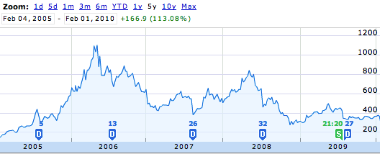
    HTC is the world’s fourth largest smartphone company. It ships 80% of all Windows Mobile and probably a similar proportion of Android devices. Like Microsoft in 2003, Google turned to HTC for its first smartphone, the G1 and its latest, the co-branded Nexus One. The company shipped a total of 11.7 million mobile phones in 2009.

    It would appear that HTC is very well positioned in what amounts to be the best industry in technology.

    However, not all is well. A few days ago HTC issued revenue guidance below analyst estimates and its stock price is at 2005 levels, 70% off its peak (see graph--source: Google finance).

    Part of this could be explained by its continuing reliance on Windows Mobile which is fading fast, but also it’s because, as management acknowledged, there is significant price pressure.

    HTC prides itself with having a “premier” product with typically high-end feature sets and positioning. HTC invested in its own UI to differentiate its products and has mounted a branding campaign to move away from being a white-label ODM.

    It seems all for nought. The rules of the smartphone market do not favor modular component players. As HTC does not front its own OS, it still struggles to stand out in the eyes of the consumer.

    Looking at the list of top 3 vendors: Nokia, RIM and Apple, we see hardware companies that field an integrated OS/service bundle.

    It’s hard to compete against this.