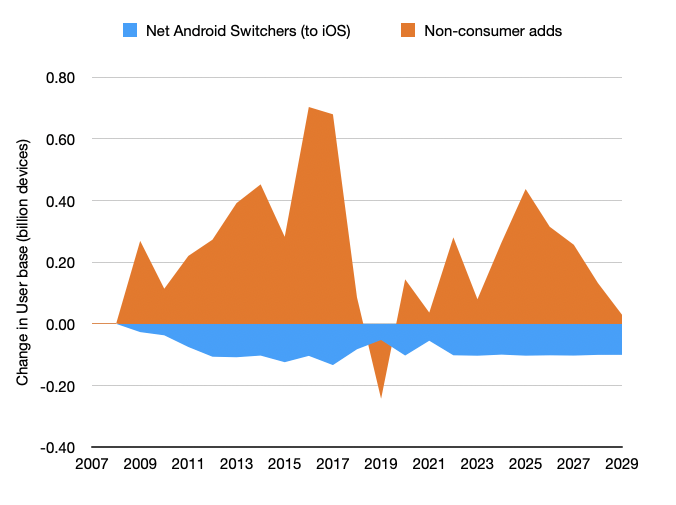
NB: I did a deep dive into the data and came up with graph above. The original report shows intention numbers which seem quite high. For instance, the net switching rate between iOS and Android is 10% in favor of Apple. This would imply that the entire user base would flip in 10 years. It would also imply...
As time goes on and saturation is reached (near 5 billion active smartphones) then the churn will imply that Android will eventually become a net user loser.
That probably won't happen before 2030. When saturation does happen however, I will be watching to see if Apple chooses a different strategy to accelerate switching similar to what it is doing with the MacBook Neo at a time of PC market saturation.
The lesson here is that switching intention surveys showing a net 10% churn rate don't mean that the actual switching rate is net 10%. The intention to switch is a sentiment but actual switching is often more difficult than a wish to do so.
I think actual net churn is 1.7% of the base each year. That's still 100 million a year. For now it seems Apple is happy to maintain that rate.
Ben Thompson of the Stratechery interviews Horace on the Stratechery Plus Podcast to discuss Horace's journey to become an influential tech analyst: early career in research, business school under Clayton Christensen, and his time at Nokia during the rise of the iPhone.
The conversation further explores Disruption Theory in the context of both smartphones and AI, why Christensen misjudged Apple, and whether AI could challenge today’s tech giants. It also marks the launch of Dediu’s new paid service Asymco One and reflects his continued conviction in Apple Inc. at its 50-year milestone.
Apple Business isn’t so much a new thing as a consolidation of what used to be two separate products–Apple Business Manager and Apple Business Essentials–into one. The new platform includes device management, company email and calendar at your own domain, an employee directory, and brand management tools across Maps, Mail, Wallet, and Siri.
The device management piece used to cost money and was only available in the U.S. While you still pay if you want to add iCloud storage or AppleCare+ for business, the core business tools are now free. “We’ve unified Apple’s strongest business offerings into one simple, secure platform,” said Susan Prescott, Apple’s vice president of Enterprise and Education Marketing.
There are a number of ways this is a smart play for Apple. The company has been growing its share of small businesses, and having a suite of tools to help those businesses manage devices and software is a big part of that. And it’s even smarter than it might look, because the goal is to make Apple devices the default option at work. Once your company email, device management, and employee directory all run through Apple, leaving gets a lot harder.
All of that is actually helpful context for the new thing Apple announced: ads are coming to Apple Maps this summer in the US and Canada. That means that local businesses with a physical location can claim their listing through Apple Business, upload photos, set a budget, and run a campaign. Apple’s automated system runs an auction and delivers ads, much in the same way ads work on Google or Instagram. Advertisers only pay when someone views or taps their ad.
What’s most notable, however, is how Apple is approaching ads in its Maps app differently from Google Maps. The company says it will only show one ad per search, and won’t allow competitor search targeting, meaning you can’t buy an ad that shows up when someone searches for the coffee shop down the street.
“A user’s location and the ads they see and interact with in Maps are not associated with a user’s Apple Account,” Apple said in its announcement. “Personal data stays on a user’s device, is not collected or stored by Apple, and is not shared with third parties.”
That’s a distinction that means a lot because, generally, consumers aren’t huge fans of ads. Partly that’s because they’re usually just in the way of finding whatever you were actually looking for, and partly because where there are ads, there’s usually data tracking.
Apple’s model is meaningfully different from how Google Maps advertising works. If you’ve opened Google Maps lately and searched for a local business, it’s not uncommon to see several sponsored results for other businesses before you see the one you actually searched for. I get that there’s money there, but it’s an absolutely garbage experience. If I type in the name of a business, there should never be paid results before the thing I asked you to show me.
Says Neal Stephenson who first coined the term “metaverse”
This revelation came soon after Meta canceled the Metaverse.
My thought was immediately, will Meta rename itself back to Facebook? We'll get to that soon, but first let's look into Neal Stephenson's mea culpa:
When I was working at Magic Leap, and people asked me why I thought that [Metaverse] was a good idea, I would ask the rhetorical question: “do you really think that twenty years from now everyone is still going to be going around all day staring at little rectangles in their hands?” At the time it seemed obvious to me that the answer was no.
Reader, I have changed my mind. Twenty years from now, everyone is still going to be staring at handheld rectangles. Or at least that is the case if the only alternative is wearing things on their faces. Maybe this should have been obvious to me given the amount of time, effort, and money people put into making their faces look as good as possible.
A possible workaround is to keep refining and miniaturizing the devices to the point where they just look like eyeglasses. This, however, turns out to have the unintended side effect of making these things seem sinister. It happened with Google Glass, which instantaneously spawned the term “glasshole,” and it has happened again with Meta’s product that looks like normal, albeit heavy-framed glasses.
When someone around you is staring at a rectangle in their hand, it might be incredibly annoying, but at least you can tell they’re doing it. When someone’s wearing a head-mounted display, on the other hand, you don’t know whether they are looking at you or not.
Likewise, when someone holds up their phone and aims it at you, it’s obvious that you are on camera. That’s not true in the case of glasses or goggles. So it’s creepy.
Timing is everything and 20 years is always kicked around as some "infinite time horizon". It's notoriously difficult to predict when a transition happens and too many times we give up because we were certain how long it would take. That's rather the story of my life.
To remedy this, first, I never thought Magic Leap was interesting. Nor did I bother even skimming stories about Google Glass. I went nowhere near anything made by Facebook/Meta. Did not even try to use any one product, did not read specs, reviews or any other commentary.
I knew the products would not be very good being not much more than demos or experiments. To understand the market, you first need to make a marketable product and these were not good enough.
The goodness here was defined in the absence of creepiness. I've always argued that wearables are easily categorized: just look for places on the body where jewelry is placed and you'll know where wearables will be worn.
Jewelry has been developer for thousands, perhaps hundreds of thousands of years and it is inextricably connected to our psyche. Glasses do pass for jewelry but only if they conform to high standards of style. Functional objects rarely are granted status as ornament. Finding that balance is the key. It happened with watches and maybe ladies' hats.
Stephenson is right in saying that face ornaments are difficult "given the amount of time, effort, and money people put into making their faces look as good as possible."
That does not disqualify face wearables entirely. It simply needs design thinking and that's what was always what I expected from Apple. The Apple Vision Pro was not meant to be used socially. It does not even work outdoors.
It's a productivity product and one aimed at professionals. Apple will release a face wearable only when it conforms to its principles of user-centric design.
That was not the case for Meta because it is not a company concerned with customer satisfaction. Its business model is to sell users to advertisers and was motivated to enter device development only so as to disintermediate the smartphone. Doing so would remove any impediments to harvesting users data. The priority of user affinity and affection was nice to have but it requires a maniacal attention to even have a chance of success at being loved.
Rebranding around a hypothesis like the metaverse was impulsive but Facebook was a dying brand anyway and having diversified well beyond it, deprecating it was no great loss. Slapping on the Meta moniker was a bark up the wrong tree but not much was lost. I doubt there will be another change unless Zuckerberg falls in love with another way to get rid of its distributors.
NB: Apple never chose to use Metaverse branding. What it developed was spatial computing. It approached the problem not as a content but as a platform and user interface. Will we move to spatial computing en masse to the detriment of "rectangles in our pockets". I don't think that the right question. In reflecting on the past of computing, a new platform did not just replace the previous but created new markets altogether.
Each new interface was an order of magnitude more popular than its predecessor. Keyboard, mouse, touch, each added a few zeroes to the number of users. We are now at nearly 1:1 machine to human. I don't think that this is the limit.
We are entering the n:1 machines to human and wearables are the only way we get there. And as I said, where there is jewelry there will be a machine. Spatial interfaces are more natural as far as our perceived reality is concerned. The rest is engineering.
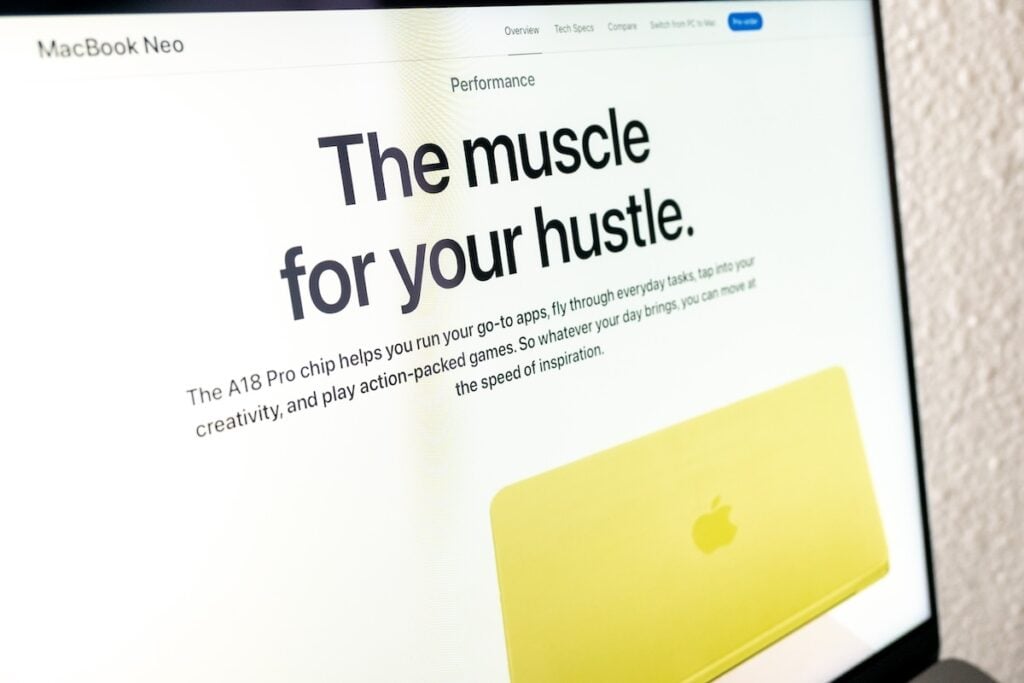
Francisco Jeronimo, Vice President of Client Devices at IDC, told Benzinga, "The MacBook Neo will have a significant impact on the low-end PC segment, particularly in education, which accounts for 6.7% of global PC shipments, or 13.4 million units in 2025."
He said that the market is currently dominated by Windows notebooks, with an average selling price of $682 and Chromebooks, which average at $362.
"Apple's ASP in Education was $1,425 in 2025 and accounted for only 5% of the segment," he said.
He echoed the statements by the above analysts while adding that MacBook Neo will allow Apple to acquire users early in their digital lives.
"Omdia’s February 2026 forecast shows Windows OEMs facing component cost increases of $90 to $165 per unit, pushing average notebook selling prices from approximately $850 toward $915," the research firm stated.
It went on to say that to maintain margins after these cost increases, many Windows laptops would need to be priced above $1,000 to "stay profitable."
On the other hand, Apple benefits from higher margins, making it easier for the iPhone-maker to sell the product at low-cost while still maintaining profitability.
In the education segment, the $499 price for students removes the cost barrier. However, the firm noted that the price isn't the only hurdle.
"Displacing Chrome in K-12 would require Apple to match Google’s admin tooling and institutional relationships, not just its price point," Canalys stated.
David Naranjo, associate director at Counterpoint, told Benzinga that Apple's real opportunity lies in higher education.
It is because the launch comes when Google continues to dominate the K-12 sector through Chromebooks, Google Workspace and school-managed devices.
"The MacBook Neo is unlikely to displace Chromebooks at scale in the K-12 market in the near term. Schools remain highly price-sensitive and deeply integrated into the Google ecosystem," Naranjo stated.
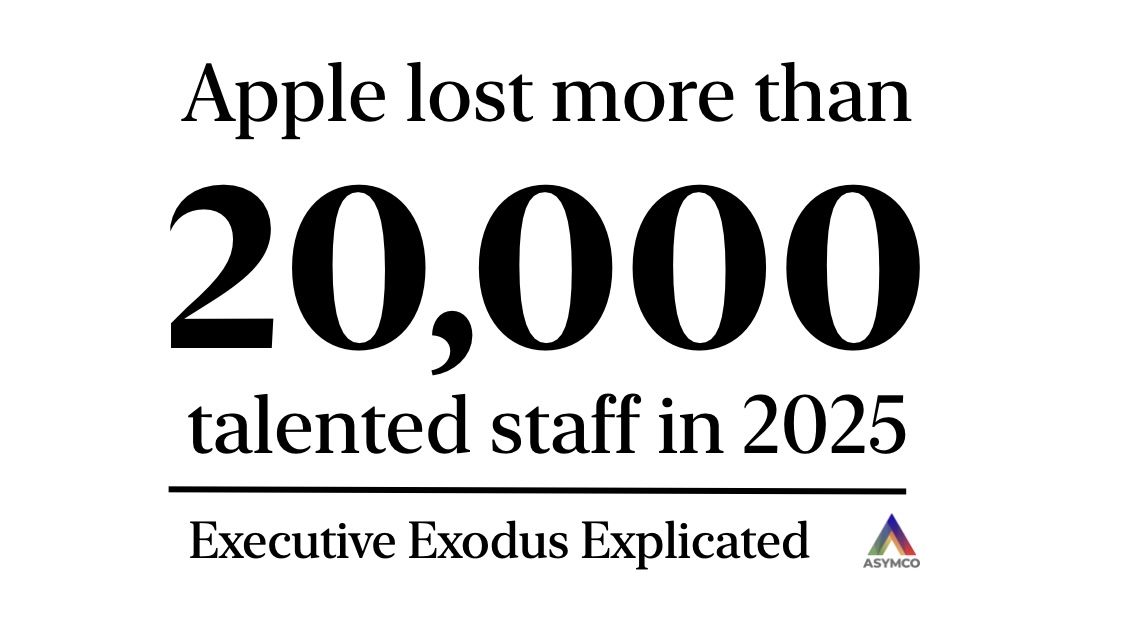
In December, the company lost AI chief John Giannandrea, its top lawyer and a key design executive in a single week. Other recent headlines: "Apple faces unprecedented executive exodus", "Apple rocked by executive departures, with chip chief at risk of leaving next." "Apple home devices executive leaves for Finland's Oura" "Lisa Jackson is set to retire late January 2026, while Kate Adams will retire in late 2026".
That's just the names we hear about. They represent senior executives. But the harsh truth is that Apple lost tens of thousands of talented developers, marketers and mangers last year and this year the numbers will be even higher. Is this indicative of an existential crisis in Cupertino which Tim Cook can't contain? Tim's head alone should be the first to roll to reverse this crisis in headcount.
Alas, math rears its ugly head.
Apple has over 166,000 employees including retail staff. According to one measure, Apple sees 58% of its staff turn over each year, having an average tenure of only 1.7 years, the worst in the tech world. That would imply 96,000 employees leave each year.
That seemed excessive to me and I assumed retail skews the total significantly. Retail, according to comments on Reddit, sees a few months of work per employee. So what is the turnover for its more "permanent" talent?
Let's assume that Apple can hold on to people as well as Alphabet/Google. We don't hear about the crisis of retention at Google. Their average tenure is 3.7 years, implying 27% would quit each year and indicate 49,000 Googlers leaving each year.
That rate applying to Apple would imply 45,000 Apple employees leaving each year. Having twice the tenure of Google would still mean 20,000 Apple employees quit each year.
A headline that screamed that between 20,000 and 30,000 Apple employees [quit, flee, abandon, escape] Apple each year would be perfectly reasonable and suggest a strong degree of loyalty. Moreover, next year the number will be higher because next year there will be more employees.
Of those tens of thousands, surely a few are senior managers. In fact, surveys show that 60% of executives plan to change roles in 3 years. The fact that we only hear of a handful of departures each year implies that Apple is far better at retention than average.
In a bold departure from its Big Tech peers, Apple sidestepped the $650 billion AI infrastructure spending frenzy. While Amazon, Google, Microsoft, and Meta funneled cash into data centers, bleeding cash flow and adding debt, Apple maintained a consistent $14 billion capital budget. This strategic choice reflects Apple’s belief that AI models are rapidly commoditizing, as evidenced by DeepSeek’s $6 million model rivaling $100 million counterparts. Instead of building proprietary models, Apple licensed Google’s Gemini, reserving the option to switch vendors as superior models emerge.
Apple’s genius lies in leveraging its ecosystem—2 billion devices transforming into a distributed AI powerhouse. Apple silicon on device enables local AI processing, bypassing the need for colossal server farms. This approach not only conserves capital but also amplifies customer loyalty, as Apple uniquely protects privacy. Ultimately, Apple bets on owning the customer experience, positioning itself to thrive regardless of infrastructure ownership. →
Apple's recent product launches, including the 17e and MacBook Neo, have sparked speculation about a strategic shift towards low-end markets. However, this view overlooks Apple's fundamental approach to market segmentation, which eschews simplistic price categorizations. Instead, Apple focuses on the "job-to-be-done," understanding that consumer purchases are driven by desired outcomes rather than affordability alone. This perspective reveals that performance and quality are crucial, transcending income levels. For instance, affluent individuals may opt for simpler devices, while budget-conscious consumers might invest in high-performance tools to meet specific needs, like content creation.
Historically, Apple has aimed to deliver superior experiences to a broad audience, refusing to compromise on quality with budget-friendly products like Chromebooks. While cost can limit access, as seen with the Vision Pro, Apple prioritizes profitability as a validation of its value proposition. The MacBook Neo exemplifies this ethos, leveraging efficient mobile chipsets to redefine laptop capabilities at a competitive price point. This innovation blurs the lines between mobile and traditional computing, underscoring Apple's commitment to crafting products tailored to diverse tasks. Ultimately, Apple's strategic depth, powered by Silicon advancements, positions it to serve an expansive global market by addressing a wide array of functional needs. →
Nota Bene
Rosenblatt Lifts Price Target on Apple by $1, Maintains Netural Rating → On March 5, Rosenblatt's Barton Crockett slightly raised Apple's price target to $268 while maintaining a Neutral stance, optimistic about Apple's budget product launches and steady high-end performance, despite trading at a modest premium compared to peers, as analysts foresee robust revenue growth for FY2026. →
How many employees does Apple have? What do they do? → Apple, despite its marketing reputation, is fundamentally an engineering powerhouse with nearly half its workforce dedicated to engineering roles, driving its substantial revenue growth and global employment expansion. →
First footage of X-Plane 12 on Vision Pro → X-Plane 12 on Apple Vision Pro leverages ARKit to seamlessly integrate physical controls into a mixed reality flight simulation streamed from a Mac, showcasing advanced professional-grade AR capabilities. →
iPhone production in India increases by 53% in 2025 → Apple's strategic shift to ramp up iPhone production in India by 53% last year, aiming not just to sidestep tariffs but to cultivate a vast new customer base, underscores a long-term vision mirroring its successful penetration of the Chinese market. →
The 3rd? most valuable company on Earth watched as its rivals lit $650 billion on fire and did nothing. The biggest cash bonfire in history, by far, eagerly fed by all the usual suspects but one.
It's either the dumbest or the most brilliant move in corporate history.
Apple used to be the biggest capex spender, mainly because it paid for most of the property plant and equipment in the factories that made its phones and computers. The so-called tooling or equipment spending plus its leased store renovations and some data centers were costs no other tech giants had and so Apple was an outlier. It was, as I wrote at the time, equivalent to buying a few aircraft carriers every year.
But that all changed with AI. Amazon is spending $200 billion this year on AI data centers. Google, $185 billion. Microsoft, $114 billion. Meta, $135 billion. Combined: $650 billion. [Not including OpenAI, Anthropic and SpaceX/XAI.] That is like buying the US Navy every year. And yet Apple's capital budget is still a modest $14 billion, oscillating with new hardware tooling cycles.
Apple is refusing to transfer its cash flow to Nvidia. Curiously, it believes that its cash flow belongs to its shareholders, not to Nvidia's.
The hyperscalers are now spending 94% of their operating cash flows on AI infrastructure. Amazon is projected to go negative free cash flow this year with as much as $28 billion in the red. Alphabet's free cash flow is expected to collapse 90% from $73 billion to $8 billion. These companies used to be the greatest cash machines ever built. Now they're borrowing money to keep the data center lights on.
The Big Five raised $121 billion in bonds in 2025 alone. Morgan Stanley projects $1.5 trillion in tech debt over the coming years. For the first time in history, hyperscalers hold more debt than cash. Perhaps this is why their P/E ratios slumped from mid thirties to mid twenties.
And what are they getting for that $650 billion? AI services generate roughly $35 billion in total revenue or 5% of what's being spent on infrastructure. There are dreams of more of course, but the business models of AI have yet to resonate, especially for consumers.
Now here is where Apple's bet becomes genius. AI models are commoditizing faster than anyone predicted. Software and hardware both have tendencies to commodify. Protections exist but they have to do with integration and distribution. DeepSeek built a model for $6 million that matches systems costing $100 million. Open source models now power 80% of startups seeking VC funding. The moat these companies are spending hundreds of billions to build is evaporating.
Apple understood this before anyone else. It didn't build its own AI model, it licensed Google's Gemini for about $1 billion a year. Why spend $100 billion building a factory when outsourcing costs a billion? And if a better model appears next year, Apple just switches vendors.
But Apple is not sitting still. It just dropped the M5 chip with a 16 core Neural Engine and Neural Accelerators built into every GPU core. It runs 70 billion parameter AI models locally, eventually even on your phone. The M5 delivers 4x the AI performance of the M4 and Apple doesn't need $200 billion in data centers.
Because Apple turned 2 billion devices into the data center. Every iPhone, Mac, iPad gets distributed AI at a scale no server farm can match. While its rivals burn cash, Apple is doing the opposite. $90.7 billion in stock buybacks last fiscal year. Its competitors? Combined buybacks collapsed 74% from their peak.
Apple didn't miss the AI revolution. It just bet that the winners won't be the ones who build the infrastructure. They'll be the ones who own the customer and no one else on Earth owns the best customers.
But consider an alternative reading. The foundation model market is beginning to exhibit classic signs of commoditisation. When one company introduces agentic capabilities, the others follow within months. Benchmark leadership changes constantly, with no provider establishing a durable lead. Prices are collapsing: Anthropic recently cut prices by 67%, Google has slashed rates by 70%-80%, and OpenAI has repeatedly reduced costs on successive models. This is textbook commodity market behaviour.
If foundation models are heading toward commodity status, then the strategic value shifts to whoever controls the integration layer and the user relationship. Apple has 2.4 billion active devices. It has the most valuable distribution channel in technology. And its recent moves suggest a deliberate strategy: rather than building frontier models, source them from whoever is best at any given moment.
This is precisely what Apple has done. It partnered with OpenAI in 2024, then switched to Google’s Gemini to power the next generation of Siri. The company is not building the engine; it is curating the best available engine at any given moment, wrapping it in Apple’s privacy architecture, and integrating it across the ecosystem. Own the experience, outsource the commodity.
According to JP Morgan analyst Samik Chatterjee, citing Sensor Tower, Apple's App Store revenue for May 2025, increased by 4.9% month-over-month (which compares to an average sequential increase of 2.3%) and an acceleration of year-over-year revenue to 13.0% in May versus up 11.8% in April. On a year-over-year basis, the App Store downloads increased by 3.1% in May (versus +5.8% in April) according to Chatterjee.
This analysis is based on app download sampling and may be indicative of the activities of consumers on the App Store. Services revenue in the first calendar quarter was $26.6 billion, up 12% year-over-year and at an all-time revenue record. Services gross margin was 75.7%, up 70 basis points sequentially, also an all-time record.
The world however seems to be having a problem with Apple Services. After years of skepticism of its relevance, now that it has achieved a run level above $100 billion/yr., it's being criticized for being harmful to competition.
The comments that it's unfair to developers or that it deters innovation are uninformed to say the least. What is missing from that analysis is that the App Store is only a small fraction of the entire ecosystem around Apple's platforms and that the economic activity the platforms enable is immense.
Let's learn.
Over the last year Apple reported a bit more than $102 billion in revenues for Services at a very high margin. The reason it was such a high margin was partly due to the fact the Services does book all payments from customers through the App store as revenues. In other words it does not include payments to developers as either revenue or costs. Those payments pass through but they are certainly part of the economic activity on the store. It would be indeed unusual for a physical store not to report what it pays for what it sells as part of revenues. But this is the basis Apple chose (or was obligated to choose) as the way to report App Store revenues.
Thus considering the payments to developers, the economic activity directly related to the App Store amounts to $120 billion/yr which includes commissions of about $30 billion/yr (last 12 months) and payments to developers of about $90 billion/yr (implying about 25% blended average commission rate.)
So including payments to developers the Services business grosses $186 billion/yr. of which 102 billion is reported as revenue, with the 75% gross margin and $90 billion is paid to developers "off the books".
But that $102 billion in revenues is only about 30% App Store commissions. The rest includes many types of income: It includes:
Advertising which consists of Apple's own advertising services and third-party licensing arrangements notably the distribution fees for Google search (accounting for most of Googles "TAC" or traffic acquisition costs.
AppleCare, Apple's own extended warranty service.
Cloud Services which provide content synchronization.
Digital Content which not only includes the App Store but also stores for books, music, video, games and podcasts. Apple also offers digital content through subscription-based services, frequently bundled, including Apple Arcade, essentially a game subscription service; Apple Fitness, a personalized fitness service; Apple Music, which offers music streaming and on-demand radio stations; Apple News, a subscription news and magazine service; and Apple TV, which offers exclusive original content produced by Apple and live sports access licensed sometimes exclusively by Apple.
Payment Services which offers Apple Card, a co-branded credit card, and Apple Pay, a cashless payment service.
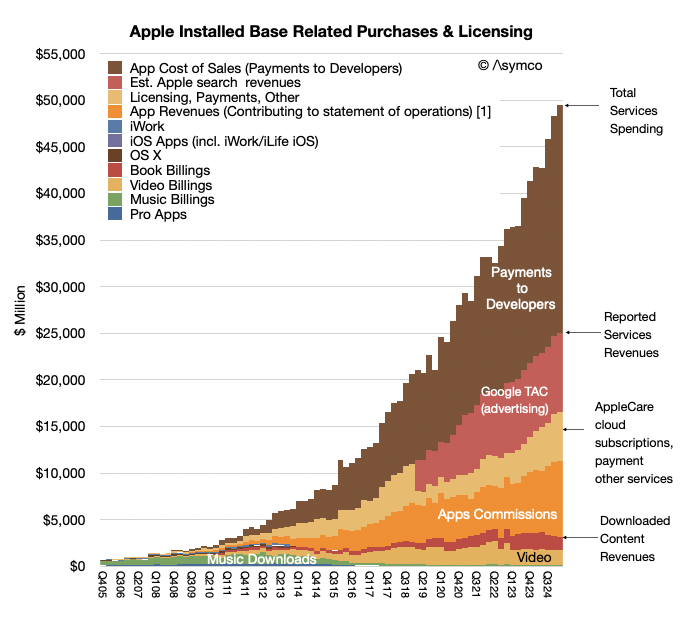
The quarterly view is summarized in the graph above. So a fixation on the commission is only a view into 16% of Services as an economic foundation (the orange area in the graph above).
But that's still only a sliver of the whole picture.
A report written by Jessica Burley, Analysis Group and Professor Andrey Fradkin, Boston University Questrom School of Business has estimated that the global App Store ecosystem facilitated $1.3 trillion in developer billings and sales in 2024. As the report writers say: "For more than 90% of the billings and sales facilitated by the App Store ecosystem, developers did not pay any commission to Apple."
How is this not visible? The reason is that this economic activity is distributed over the millions of purchases Apple users make through its iOS Apps every day. This includes traditional App Store "Billings" including paid downloads and in-app purchases, including subscriptions, that use Apple’s in-app purchase system and “Sales” which includes money spent by customers purchasing goods and services in general using any iOS and iPad OS apps. Apps developed by Apple such as Apple Music, Safari or browser apps such as Chrome are excluded from this analysis.
The economic activity unleashed by the App Store now reaches well over $1.3 trillion/yr. As the authors further explain,
While the present analysis captures the major app monetization strategies available to developers, the full economic impact of the App Store ecosystem extends beyond the estimates provided in this report, as the current methodology does not capture all of the ways in which the App Store ecosystem facilitates sales, or all of the benefits created by apps. For example, the App Store supports “companion apps” that raise the value of a company’s goods and services, including smart home apps and health apps. In addition, many apps now use different monetization strategies. As such, this analysis does not account for all the ways in which the App Store ecosystem creates value.
Furthermore the report breaks down the categories as Digital Goods and Services, Physical Goods and Services, M-Commerce (General Retail, Travel, Food Delivery and Pickup, Grocery, Ride Hailing), Digital Payment and In-App Advertising.
In addition the report estimates these categories from 2019 as well as 2024 providing a growth perspective: Over the past five years, the App Store ecosystem has more than doubled in size, increasing from $514 billion in 2019 to nearly $1.3 trillion in 2024.
It also identifies regional dynamics between the US, China, Europe (with select countries) and Rest of World (with select Asian countries).
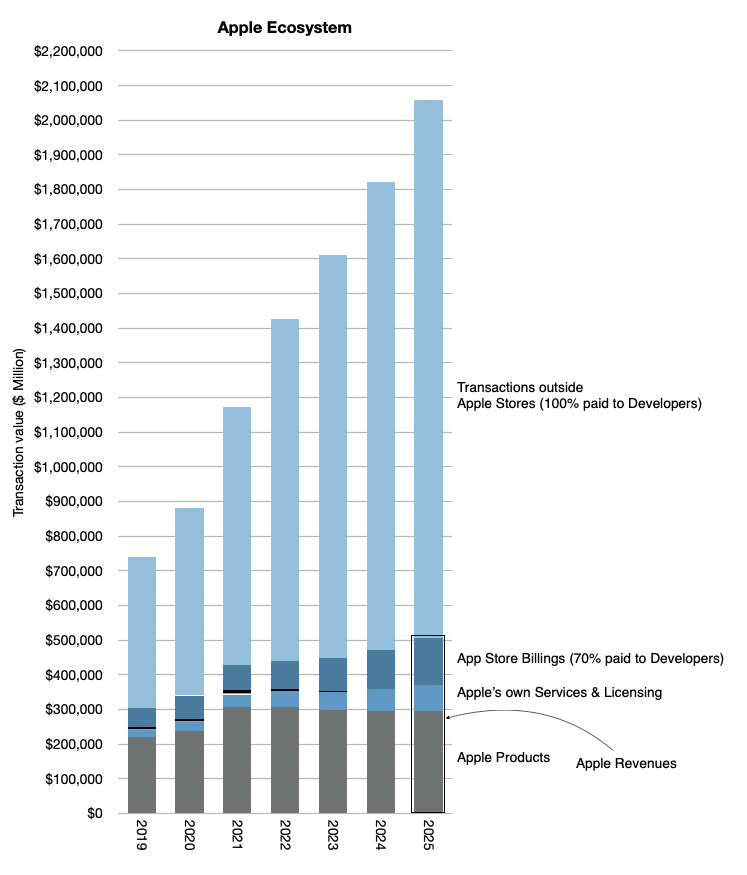
I've been keeping my own analysis of what I called the Apple Economy and it includes these transactions outside the App Store and Apple's own products and services. If I were to subtract Apple's own revenues from the total, for 2024 I was getting about 1.4 trillion (out of a total of over 1.8 trillion).
My point was always to estimate the economic impact of Apple beyond its own sales. This gave us perspective to assume that in 2025 the total would reach over $2 trillion. The graph below gives the perspective which also implies a doubling since 2020 to 2024.
The new report from Burley and Fradkin is a detailed, bottom-up analysis which quantifies what was perceived as the economic value of Apple being far more than what the financial data records.
Bill Gates once stated in reference to Zuckerberg's assertion that Meta was developing a "platform" that it's not a platform unless the economic value of everybody that uses it exceeds the value of the company that creates it.
Apple captures about $30 billion as sales but delivers over $1.3 trillion in sales, a multiple of 43! I would call that generous. In addition it doubles the market in 4 to 5 years. I'd call that market expanding not constraining. Finally, it's a market that Apple created out of nothing. I'd call that market creation not destruction.
If judged on the question of creation and satisfaction of the customer, i.e. the ultimate purpose of the firm, the App Store and Services in general has satisfied 1.4 billion people. That they are spending over $1.3 trillion and doubling in 4 years is nothing short of astonishing.
We'll discuss this topic and other topics related to Apple at ACTIVE: The Apple Investor Conference, which takes place on next Tuesday, June 10th, the day after the WWDC25 keynote.