Asymco

Asymmetric Intelligence

Google

  1. What's an Android user worth?

    Research · 130 comments

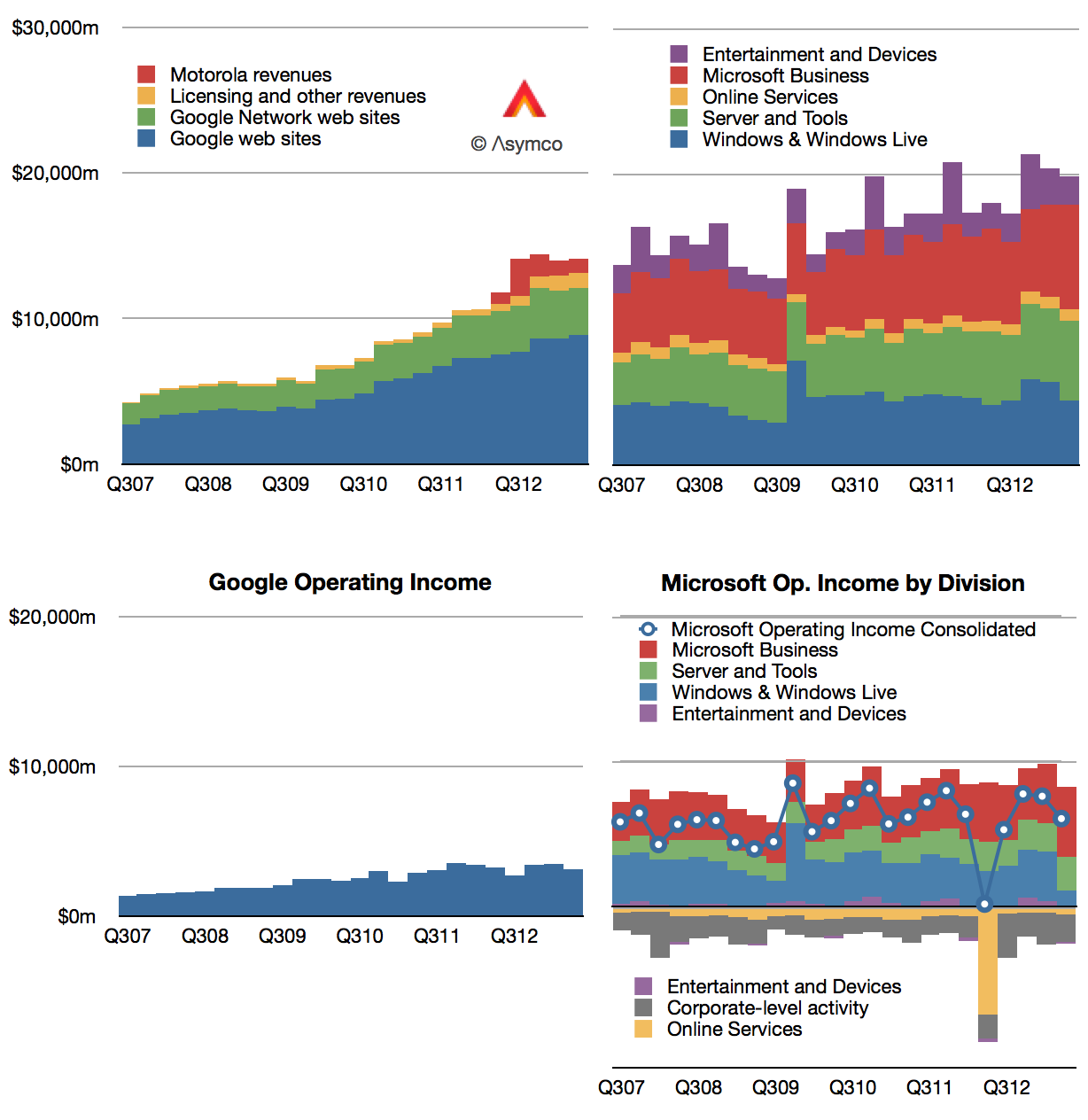
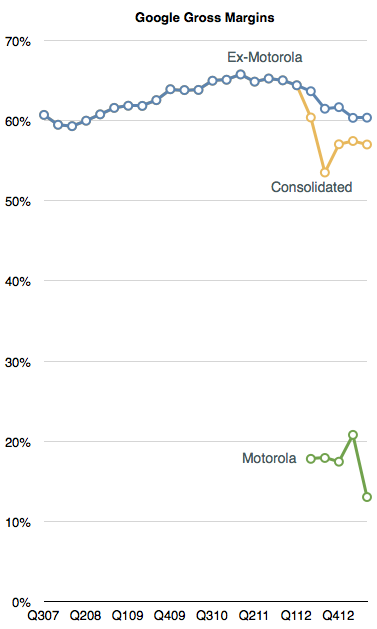
    Excluding Motorola, Google's gross margins have dropped for six out of the last nine quarters. They peaked at 65.8% in early 2011 but have now dropped to 60.4%. Including the drag from Motorola they are down to 57%.

    Screen Shot 2013-07-20 at 7-20-9.52.38 AM

    Gross margins include the effect of price, volume and direct costs of sales. Although sales have grown (see graph below), the pricing Google has been able to obtain (CPC) has fallen. The cause is unknown but there is a strong correlation between the growth in their mobile channel. For their part, management cites mobile as having an effect in reducing CPC though they caution that it's one of many factors.

    Screen Shot 2013-07-19 at 7-19-8.52.10 AM


    The elephant in the room is indeed the effect of 900 million activated Android devices (with 1.5 million added each day.) These nominal billion devices are a new channel that could be said to have doubled Google's addressable market in only the last three years. The effect of this doubling is perhaps partly underlying the top line growth shown above.

    How can we test this?

    I placed Google's performance alongside Microsoft's for a reason. Since Microsoft has had precisely zero benefit from any new mobile channels, and since its software is broadly tied to business spending (as is Google's), we can consider Microsoft as a control in what baseline non-mobile growth could be. From Q2 2010 to the present (the Android epoch), Microsoft's consolidated revenues grew by 24% (31% if we exclude Windows).  In contrast, Google's advertising revenues (excluding Motorola and licensing) have increased by a more robust 83%.

    So it's possible that mobile contributed to top line growth. The effect could be 50% over three years. The downside is of course that this comes from a doubling of the channel. The new channel is therefore half as engaging. In terms for bottom line, the effect would be seen as more subdued growth. Overall, income increased 32% for a nominal doubling of usage.

    Not that there's anything wrong with that.

    Expansion of user base usually comes with lower engagement and margins. I demonstrated the same effect with the vast expansion of iTunes customers.

    The only difference seems to be that markets reward Google's margin dilution but punish Apple's.

    Put another way, hypothetically, as she spends slightly less, the market value for an Apple user is disappearing while as he spends a lot less, the value placed on a Google user is increasing.

  2. Interview with Chosun Daily of Korea about Apple

    Research · 65 comments

    The following interview took place by email on April 15th, 2013.

    1. What are the truth and false about the 'Apple shock' currently? In what perspective should we see this?

    First, I'd point out that during Steve Jobs' time the company suffered many such shocks. The stock fell many times far further than it just did for trivial and irrational reasons. Recently Warren Buffett himself pointed out that his own company had 50% drops in value four times in the past. Share prices are not always good indicators of potential and markets are not always efficient. I catalogued the dramatic share price declines in Apple during the last decade here.

    Second, I'd point out that the number of people watching and commenting on Apple has grown almost as fast as its sales and earnings. When Apple was small the people who studied Apple were few. (You could see this today for other, modest tech companies. There aren't 50 analysts writing reports every day and 2000 bloggers tweeting about Lenovo even though it's a successful and growing PC company.) Because of this growth, I would guess 80% of the observers have not observed Apple's prior painful episodes first hand. For them this is the first time a "dominant" Apple has slowed. The amplification of so many voices raising alarm makes it seem truer, but it isn't.

    Third, the failures being cited are not significant. In terms of increased competition, before Samsung there was Nokia and Motorola and the mobile Operators and Microsoft and Dell and many others long forgotten. They were all about to "defeat" Apple. As a quick example when Apple was "the iPod company," iTunes was considered vulnerable and fragile due to DRM concerns or the Beatles not being on it. Microsoft was launching "Plays for Sure" and Zune and Creative was suing Apple over patents. These battles are long forgotten. Before those there were concerns about the viability of the Mac that go back decades. At the time those were actually very valid concerns. At the time Apple did not have half a billion users. It depended on one product. But what saved them was a process of development of new products not the products themselves. iPod faded, Mac faded. What mattered is that they created new things to replace them.

    Finally, what is not commonly understood is that the mechanism for creating things at Apple is unchanged. Its functional organization is inherently unstable and chaotic, sometimes looking like it will derail. But that's the way it was designed to be. You just have to have faith that it's a system that works. Those who did in the past were well rewarded.

    2. What possibilities out of 1~10, do you think, Apple will suffer the same downfall as Steve jobs has left the company in the past in current?

    The threat is negligible. During the first departure of Jobs, the intention of management was to make the company into "a proper company." The plan was, essentially, to remove the chaotic model that Jobs had put in place and replace it with something more "rational" and "grown up." After he returned he set about not just returning the company to the way it was but to also codifying and identifying exactly what that was so that it did not happen again. You have to appreciate that the greatest thing Jobs ever created was not a product but Apple itself.

    Note that Apple managers stay in their roles the whole time they are there, sometimes for decades. There is no "general purpose" manager and the whole company has been organized along these functional lines. The way to think about it is that during his first departure the new management tried to undo what Jobs had built which is why it became dysfunctional: the DNA did not match the body it was operating. His return re-aligned the culture and operations to what was originally developed. As long as new management does not try to undo that, they'll be all right.

    3. Apple is now defined by some people, as 'the company who modifies well', not 'the company who innovates' well. What they made was ipad, ipod, iphone, apple tv and all the modifiers of the original products. Do you agree? If you do why?

    Innovation is not invention. Innovation is the application of invention in ways that solve new needs. I'm always amazed at how misunderstood this term is even though the definition is easy to understand:

    ("Innovation differs from invention in that innovation refers to the use of a better and, as a result, novel idea or method, whereas invention refers more directly to the creation of the idea or method itself.")

    Apple is an innovation machine. It does invent but that's not valuable in itself. Not all inventions are applied and not all innovations depend on internal inventions. Innovation is applied invention just like engineering is applied science. A better way to think about Apple is to think about Pixar. It's a blockbuster manufacturer. It makes blockbusters and nothing else. That means it does not make many of them and not always regularly and that the ideas may not be original, but the results are always very popular. Pixar is not like any other studio that makes some hits and some flops. Pixar is also a functional organization. It's not an accident that they were both built by the same person and that they are both successful after he left.

    4. Google is forecasted to release lots of products this year, but Apple isn't really looking forward to so many innovations. Inside Apple, is the innovation team really making a new innovative product? what are their longterm plans to fight with Google, or Samsung and the rest of the competitors?

    People outside of engineering organizations, especially large ones, don't appreciate the time scales involved. Products you see today were designed, planned and developed many years ago. We see plenty of evidence of this but we tend to ignore it. Consider that some prototypes end up on ebay showing they were built years before launch. It is the same with evidence presented in trials proving work on the product 4 to 5 years before it was launched. This is not the case just for Apple but all other technology companies.

    For this reason, what is happening in the market and what is happening inside the company are two completely different universes. The tendency is to assume a direct relationship between market momentum and current management decisions. These are connected but with many years in-between.

    For example, globally accurate Maps require a minimum of five years of development. Decisions on what ended up being Apple Maps had to have been made by Jobs himself. Namely, he must have decided whether to buy or build Maps. Contrast with Nokia's decision in 2007 to buy maps for a cost of $8 billion; instead Apple licensed and then decided to build later. In 2007 Jobs decided that it was more important to work on the product itself, meaning the iPhone (while Nokia didn't prioritize product innovation.) The results are visible today: Apple is behind and needs to accelerate with Maps and Nokia with its great maps must find a way of staying in business.

    Apple is not only working on the next product but probably 15 new products, of which 14 will be discarded. Again, I cite Pixar. Each movie is produced with multiple stories, multiple character decisions and different plots in parallel. Much ends up being thrown away. We don't see any of that.

    Apple is extremely "myopic" in that it is very concerned with execution and there is no visible "strategy plan".  That's by design. The product comes first and then comes the market and then comes strategy. To create great products you need to tune out almost everything else. However, they do have a "strategy" and that has to do with which problems they should attack and which they shouldn't. Usually they are successful because what they can attack nobody else can. That is due to their integrated, functional approach.

    5. Isn't Apple, relying too much on semiconductor manufacturers? Meaning, isn't Apple only try to be 'stable company' to supply their products on time? sometimes when companies have disruptive technologies, they have hard time supplying products.

    You're touching on the question of the problems of integration. Yes, there are vulnerabilities but that's the way it has to be. To mitigate this Apple is increasing its integration of the value chains. For example developing its own chip design and owning a lot of capital equipment.

    6. If you were Tim Cook, what would you do?

    I'd buy Intel and turn them into Apple's microprocessor design and manufacturing group. They won't have much to do in a few years and they'll be cheap.

    7. what are the reasons that Apple try to make a 'apple watch', 'apple bicycle'? How do you define these products, since, watchs and bicycles are a total different paradigm which is a totally different industries? Is Apple realizing that smartphone industry is hard for them to innovate?

    Computers are becoming more personal, intimate. It's a natural evolution from large to mini to micro to portable to handheld. I don't see this slowing and Apple should re-define the user experience during every such shift. Here again integration is essential.

    8. what are some of the stuff that we don't know about Tim Cook?

    I can't help you there. Only thing I can say is that people who know him have told me he's not soft and gentle as a manager. He's tough.

    9. How will Samsung and Apples patent fight come to conclusion?

    Again, I can't add much to this. Litigation is often a decision made outside of market conditions so it can be arbitrary.

    10. how does employees or executives inside apple think about their company?

    It's hard to describe this without sounding soft, but the employees at Apple tend to love the brand. You can't measure that but I can think of one proxy: the number of applicants to retail jobs are in the hundreds for each opening.

    [Update: Bono made an important observation regarding Jony Ive which was published after this interview: What the competitors don’t seem to understand is you cannot get people this smart to work this hard just for money. Jony is Obi-Wan. His team are Jedi whose nobility depends on the pursuit of greatness over profit, believing the latter will always follow the former, stubbornly passing up near-term good opportunities to pursue great ones in the distance]

  3. Making rain

    Podcast · 72 comments

    The following is a slightly edited transcript of a portion of the Critical Path podcast #79. I am reproducing it here for the sake of brevity and focus of discussion.

    ---

    I'm going to try to put together an analogy together here that maybe will help us think through the Facebook Home and the Google Fiber issue.

    I've been thinking a lot about how to illustrate Google's business model. The problem is that discussion has been polarized: Two camps have formed. One camp suggests that Google is a benevolent entity that does great things and only asks that we indulge their hobby of a business model called advertising. Fundamentally they are about pushing the envelope on technology, making wonderful things happen.

    That is one camp. I call them the utopians. It may not be a nice thing to call them but I frame it as being exceedingly idealistic.

    The anti-utopian camp is one that suggests that Google is an advertising company primarily, and fundamentally and overwhelmingly. And anything they do technologically is in support of that. The implication is that Google is sinister and manipulative, bent on getting away with as much privacy extraction as possible.

    I believe that the anti-utopians dismissing Google as an advertising company sounds a bit incomplete. It's not incorrect. It's not erroneous. It's just not a complete story.

    And also the utopian view that they do everything for us out of the goodness of their hearts and that advertising is something that they are reluctant to do, saying in effect, "We only do it because it earns us enough money so that we can do good deeds." That too is not an accurate picture. Google is a business and its business management team is hard nosed and knows what they're doing and they are not purely idealistic in that sense.

    And so the question could be where across this spectrum does Google lie? Possibly it moves around between these points. Where they are becomes a question of motivation and what they want to become.

    But this is only one dimension. It does not help us answer the question of Home, or Fiber or Reader or Blink. Their actions seem contradictory. Holistic or selfless in one case, greedy and capricious in another.

    Let's step out of this spectrum and try to think of different ways which can describe the situation.

    I propose a way to think about it as: Google tries to make a business succeed through having a huge amount of _flow_ in terms of data, traffic, queries and information that is indexed. So think about this idea of them tapping into a vast stream. The more volume that is flowing through the system the more revenue they generate.

    As so given this very rough analogy I try to sharpen it up by saying: imagine it more as a river. And even more than a river, as a watershed, a river basin. Perhaps a giant basin the size of a continent. The business is, let's say, capturing fish at the mouth of the biggest river, before it exits into the ocean at its delta.

    And so your job (as Google) is to catch fish mostly at one point. It's the most efficient way to catch fish because you have the most flow of water at that point and building nets is not trivial.

    But in order for you to improve your business, to create more opportunity, presumably, you want to essentially have more water flowing.

    And so how would you do that? Think of the Mississippi river. If you've got a net down at the bottom of the river, the question is how would you engineer, through civil engineering, or shaping the earth itself, a way of catching more fish.

    The answer I think, in terms of the way Google might be thinking, is that they want to create more sources of water. So they would look to connect tributaries and lakes. "How about having another river join our river?" Let's make sure that we have "everything east of the Rockies" flow into our river system.

    Now, think of it this way: After you've gotten all the tributaries, what are the remaining sources?

    First, you'll want to make sure that no-one can dam or stop the flow of water into your main channels. And so you become extremely anxious about people building dams. That's the number one concern.

    So your strategy becomes one of "how do we avoid dam building"?

    That's one part of your strategy.

    The other thing you could do to improve your business would be to make it rain more. So there's the question in your mind of: If we had more rainfall, then everything will flow more rapidly and we'll get many more tiny rivers forming and joining together into our main river.

    Android and the Fiber business and even Facebook fit into this analogy rather well. In this context more rainfall means more people using the Internet. If you have more people you'll have more rivers and you'll have more water and hopefully more fish. Fiber means the water will flow more rapidly: you're essentially dredging the riverbed.

    But the two are very disconnected (rain, dredging and fish). So your strategy amounts to not really worrying about the ratio. You don't create incentives to people who make rain in the form of fish catch quotas next quarter.

    In other words, your performance as a manager of cloud seeding efforts should not be measured in fish.

    Leadership should instead simply put out the mandate of "Go out and make it rain".

    So that's the notion of Google going out on these projects and doing all these "great things" for us. They make it rain. The Internet expands. There is minimal censorship.

    By the way, censorship is a dam. Being blocked out of a country is a huge dam. It's actually more like building a mountain range that diverts water flow away from your watershed.

    And so they have these notions of how to prevent these things from happening.

    So it sounds like they are doing good things. It sounds like asking for it to rain; they want to make sure that people don't divert resources; they want to make sure that there are no barriers between the raindrop and getting access to the channel to the ocean.

    So it sounds like they're doing all the good things like a good civil engineer. Like the US Army Corps of Engineers who developed the irrigation, flood control, energy generation and waterway transportation of the United States.

    Google seems to be the world's "internet civil engineer". They are building all these things to make sure that we have good water (i.e internet) supply. That we have plenty of navigable channels. That's the analogy.

    But let's not forget that the only reasons those things are happening is because they are catching fish at some point down the Mississippi.

    From that point of view you have to ask yourself: do they deserve this concession? Because they are ultimately affecting the environment to such a degree; and the environment is the internet; and the whole scope is how the world operates.

    That is where people have to step back and ask themselves: Even a group of civil engineers that have all the best intentions may realize that they didn't think of all the consequences of their actions. A lot of the criticisms may come decades later. From people who'll note an effect on the environment. Dams get silted, a lack of floods reduces nutrients to crops which then need fertilizer, which has a whole other set of problems.

    That is when you have to reflect more deeply on what is right and what is wrong. So saying, as the City Council of Austin might: thank you for coming and paying for installing broadband for us. Fine, but we just don't know what the unintended consequences might be. It all _sounds_ good but we don't know if it _is_ good.

    And similarly, in the case of Facebook, there is a subtle hijacking going on where Android creates more rain, and Facebook and Amazon are essentially putting down nets and catching fish upstream. They're not damming the tributaries. They're not putting up mountain ranges and saying they'll make sure the water flows away from the Mississippi. But rather they are putting nets and saying "Thanks for the rain". They took advantage of what amounts to a public resource. Here the failure of anticipating consequences falls on Google. But they could not have possibly foreseen all that? Or could they?

    Then there is the question of measuring success. It's complicated and hard to measure performance. Even Google's own performance. We don't really know if the cloud projects work. We don't get to run this as an experiment that can be tweaked as data comes in.

    Google does not report performance. When they go off on these rain making projects, it's natural to ask how many fish were caught as a result. Is that incremental new rainfall causing more fish to get caught. And Google won't say anything about the profitability of rain making. They will never give you a profit and loss statement for all these projects: the dam eradication project, the project dredge a channel, the project to seed clouds. They will say that these are projects that will result in only one thing, which we do measure, which is the number of fish we catch in the delta of the Mississippi down by New Orleans. But so far although rainfall seems to be increasing exponentially there are not that many new fish.

    So that's where we struggle as analysts: is rainmaking good? Is the dam destruction process working? We can't answer these question. And we don't even know if Google themselves can. They might think of it as a strategic thing: it's always better to have more rain than less and more water flowing. End of discussion.

    To borrow a phrase from Zuckerberg, it's above my pay grade to know what all the consequences are. I have opinions as environmentalists have opinions and sometimes they have some data to back up those opinions. For instance whether a dam project is a good thing on balance. But they are bound to have partial answers because the cost/benefit analysis is definitely missing a lot of the costs and missing a lot of the benefits as well. You can't put a number on a lot of these things.

    That's where we are today. Google and Android are forces which are are very powerful but which are, to a large degree, uncontrolled, even by their own managers.

     

  4. Samsung vs. Google: an Interview with Rafael Barbosa Barifouse of Redacao Epoca

    Research · 60 comments

    On Mar 18, 2013, Rafael Barbosa Barifouse - Redacao Epoca - Editora Globo asked (and I answered):

    Q: Why is Samsung creating Tizen?

    A: I believe they are collaborating on Tizen development because they want an alternative to Android and because Bada was not good enough to meet that goal. Tizen's roots include contributions from Intel, Nokia and several Japanese companies so it's not Samsung's OS per se. Historically it was the "open" alternative operating system for embedded and mobile systems. See https://github.com/kumadasu/tizen-history/blob/master/tizen-history.pdf for a historic perspective.

    In some ways Tizen seems to be a blend of several pieces of code including proprietary Samsung user interfaces. Samsung is presumably interested in having a unique, differentiated experience. This is something every device maker seeks. Put another way, if they did not seek this then it's unlikely that they would be profitable which would also imply that they would not invest in marketing and development of products. As Samsung invests both in marketing and development it can be concluded that they seek to offer a unique value proposition and, in today's market, that means a unique experience.

    Does it make sense to create a new mobile OS when it has had so much success with Android?

    Samsung would argue that the success it's had is not due to Android but to its products. Arguably they are right because if Android were the valuable component in a phone then buyers would buy the absolute cheapest device that runs Android regardless of brand. That is not the case. People still seek out a particular brand of phone because of the promise it offers. Consumers have been buying more Galaxies than no-name Android phones.

    Why is Samsung the most successful company between the Android devices makers?

    In my opinion it's due to three reasons:

    1. Distribution. Success in the phone business depends in having a relationship with a large number of operators. Samsung had these relationships prior to becoming a smartphone vendor [because it sold all other kinds of phones]. Few alternative Android vendors have the level of distribution Samsung has. For comparison Apple has less than half the distribution level of Samsung and most other vendors have less than Apple.
    2. Marketing and promotion. Samsung Electronics spent nearly $12 billion in 2012 on marketing expenses of which $4 billion (est.) was on advertising. Few Android vendors (or any other company) has the resources to match this level of marketing. For comparison, Apple's 2012 advertising spending was one quarter of Samsung's.
    3. Supply chain. Samsung can supply the market in large quantities. This is partly due to having their own semiconductor production facilities. Those facilities were in a large part built using Apple contract revenues over the years they supplied iPhone, iPad and iPod components. No Android competitors (except for LG perhaps) had either the capacity to produce components or the signal well in advance to enter the market in volume as Samsung did by being an iPhone supplier.

    Tizen was being treated as an OS for low and mid level devices, but recently Samsung said that it will launch a high-end device with Tizen on Q3, an area where it's very successful with Android. What has changed? What does this announcement mean?

    Planning for these product launches is done a few years prior to launch. I believe alternatives to the Android line (i.e. Galaxy) have been planned for a long time. Note that Samsung also has a line of Windows Phones and historically has supported Bada, Windows Mobile, Symbian, PalmOS and LiMo smartphone platforms. Samsung's involvement with Android is only about three years old, and arguably only enjoyed two years of prominent growth. That's less than one product launch cycle and far less than a platform or OS development cycle.

    I believe the company has a long term perspective and that includes a time span beyond the likely lifetime of Android [Note that platforms do have finite lives]. Keep in mind that phones last less than two years. If users are not loyal to a platform then they will very quickly move on. The "stickyness" of a platform depends on media or software consumption by the user. That level of consumption is not particularly high for most Android users. The same phenomenon happened with Symbian and BlackBerry and Windows Mobile users. Hundreds of millions switched or will switch out of those platforms. This happens far less with iOS, Mac OS X and Windows because of the significant investments users make in the ecosystems above the OS.

    Is Google dependent on Samsung's sucess with Android? Or Samsung is more dependent on Android since its the most popular mobile OS nowadays?

    Google is not dependent on Samsung because it's not dependent on Android. Samsung is not dependent on Google because Samsung is not dependent on Android. Android is valuable in theory but in practice its value is hard to identify. Historically it was planned as a defense against the hegemony of Windows, BlackBerry and iOS. In that respect it has succeeded. But playing defense is not enough to win a game. For Google to truly succeed in mobile it needs to define a better business model.

    So far its profitability from mobile is very weak and has not shown up in the bottom line. Furthermore, it's probable that Google has 'control' over only about 40% of Android devices in use. Control here means a guarantee that users will use those devices for the benefit of Google, and, more importantly, not for the benefit of its competitors.

    You can also think of it this way: If they "divorced" there would be minimal to no impact to their fortunes in the foreseeable future. Buyers of Samsung phones will still buy Samsung phones because they will look and feel very similar and Google services will still be available through browsers or apps (e.g. Google maps on iOS). Conversely, users of Google services will continue to use them because they will be available on Samsung devices, no matter what OS is running. The services Google offers are independent of Android and are cross-platform. They will make sure they are available on all major platforms (as they were before and during Android). Google is far more loyal to Search and Maps and Gmail and YouTube than they are to Android.

    Do you think Google is going to merge Android with Chrome OS?

    Google's chairman said they would so I assume they will.

    If so, how this could make an impact on Samsung?

    It depends on how the new OS would enforce licensing terms. If the result would be a restriction on Samsung services like S Pen, AdHub, Samsung Wallet, SmartTV, ChatON etc. then Samsung might reject the OS and either fork Android or move to Tizen more broadly.

  5. Apple retail vs. Amazon retail

    Research · 55 comments

    As part of a continuing series on the iTunes economy I described how iTunes fits within Apple's overall revenue and cost structure. The operation is a modest contributor accounting for single-digits percent of revenue and operating margins.

    One additional question is how does iTunes compare with other non-Apple retail businesses. The obvious comparable businesses are Google Play and Amazon's digital content businesses. Unfortunately we can't compare iTunes with Google Play because Google does not reveal any details about Play revenues (or units sold/downloaded or payments to developers or any other data.)

    Also unfortunately, we can't compare iTunes with Amazon digital sales because Amazon does not provide that detail either.

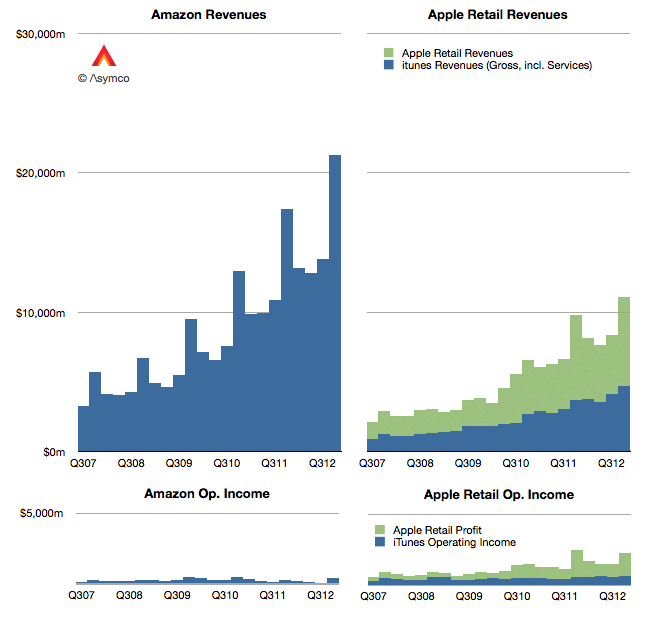
    What we do have is Amazon's overall revenues (and operating margin.) So that's what I have compared:

    Screen Shot 2013-03-27 at 3-27-2.09.30 PM

    Since we have Amazon's overall retail revenues it seemed fitting to also add Apple's physical store retail data on top of iTunes for additional perspective.

    Here are some observations:

    1. Since 2008, Amazon's sales grew by a factor of 2.18. Apple's combined iTunes+Retail grew by 2.14x.
    2. Apple's gross retail revenue was $11.1 billion in Q4, 52% of Amazon's overall revenues.
    3. Apple's operating income from retail in 2012 was $6.8 billion, over ten times Amazon's $676 million.

    Although Apple's overall retail operations are only about half of Amazon's they are far more profitable on an operating level. They are also growing at a similar pace. Amazon as an equity is priced at approximately twice sales. By that ratio, Apple's retail business would be worth $70 billion. Of course, that valuation presumes that, as with Amazon, operating profits are disposable.

  6. An update on Android activations

    Research · 51 comments

    Two days after I posted a reminder that Google had not updated their Android activations for five months, Google updated their Android activations.

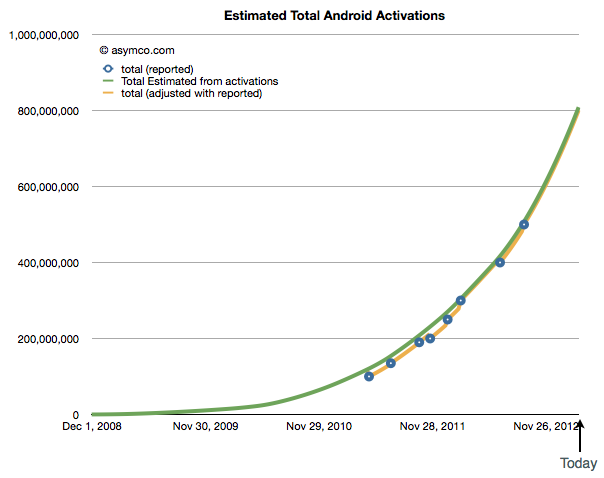
    The new total is 750 million. My expectation (based on a rate of activation acceleration of 30,000 activations/day/week) was 800 million. Google did not update their download rate but it can be derived. Between September and March the average has been about 1.4 million/day. I had previously estimated that the rate of activation was 2 million/day.

    This is a modest increase from the 1.3 million/day that was reported in September implying that activation acceleration has slowed.

    After resetting the acceleration to 5,000 activations/day/week my new forecast for 1 billion activations moves to the end of August.

    Coincident with this update on activations, Google reported that Andy Rubin has stepped aside as the head of Android and that Android and Chrome would be under the same management.

    Putting aside the exit of the founder, the implications of the merger with Chrome will need significant contemplation.

  7. Where are the Android users?

    Research · 172 comments

    Google occasionally reports data regarding Android. Very occasionally. The last time we had some data was in September 2012 when we learned that activations were running at 1.3 million per day and that a total of 500 million total activations had taken place.

    As of today, being March 2013, the time between updates has reached five months. It's the longest gap so far. Benedict Evans also notes that it's been five months since the data regarding screen size stats has been updated on the Android developer site.

    But we have to live with what we get and, in the absence of an update, the pattern of growth in Android, if sustained, looks like this:

    Screen Shot 2013-03-10 at 3-10-11.05.14 PM

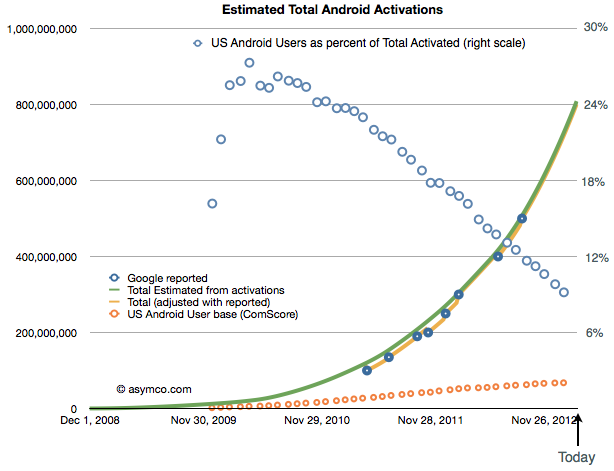
    It implies that 800 million Android activations have taken place to date and the rate is about 2 million per day. One billion activations could thus happen by June.

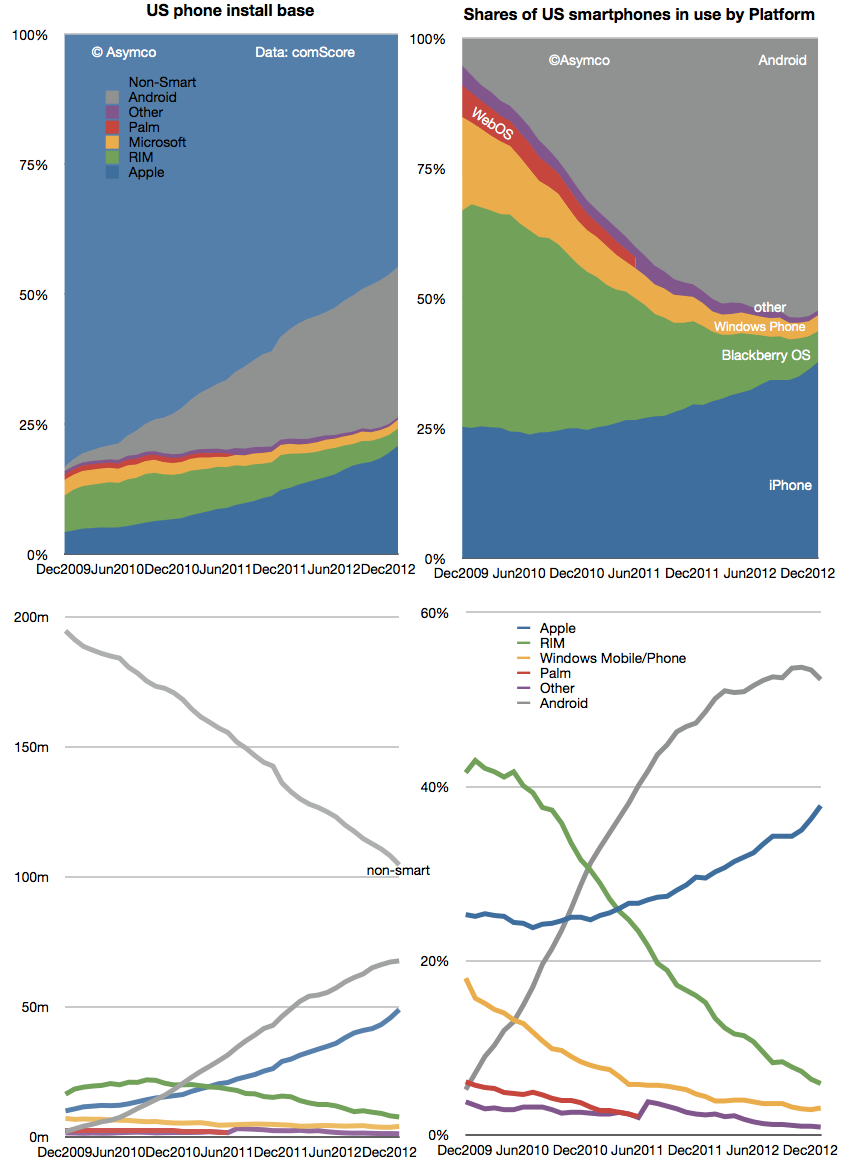
    There is however another set of data regarding Android which is updated more frequently. The comScore mobiLens survey covers the US and provides updates on a monthly basis. That data shows that Android users in the US reached about 68 million as of the end of January. See the updated data below:

    Screen Shot 2013-03-11 at 3-11-10.26.01 AM

    I included the install base and share of total users as reported. Combining the comScore data with Google's activations gives the following picture of US as a percent of global Android (orange circles represent US base and blue circles the precent of total activations that the US might represent)[1].

    Screen Shot 2013-03-10 at 3-10-11.44.34 PM

    The data implies about 9% of Android usage is in the US. The more startling thing is the difference in growth: it implies that with a US growth rate of only about 13.3k/day, global growth is 150 times faster than US growth. In other words, that 0.6% of new users are in the US and that 99.4% of Android growth is outside the US.

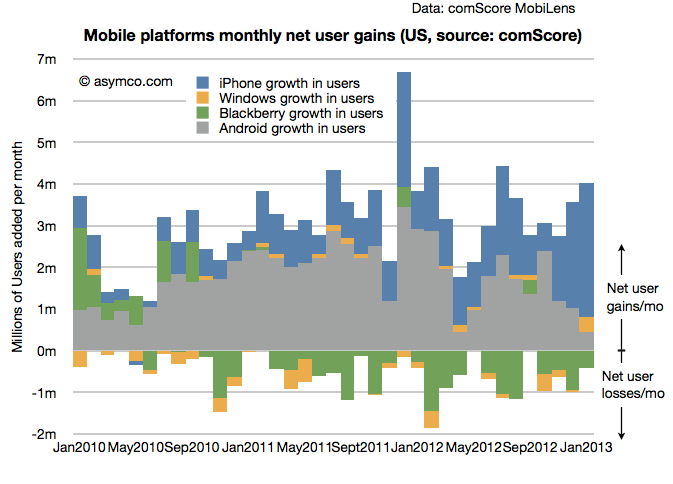
    That's an interesting story. But it's even more interesting that this is not the case with the iPhone. The iPhone is growing considerably faster in the US than Android. One can see this more easily with a graph of the US mobile platform net user gain rate as shown below:

    Screen Shot 2013-03-11 at 3-11-10.32.23 AM


    Looking at the the same contrast between global and US, from Apple's financial reports, in the fourth quarter the global "activation rate" (i.e. sales rate) for iPhone was 525k/day (nearly one quarter of the extrapolated Android rate). The comScore data suggests the US gains are running at 106k/day. Therefore we can calculate that about 20% of iPhone growth is in the US and 80% is outside the US.

    Even accounting for some potential error in the Android estimates, the contrast is quite stunning: 1% vs. 20% share of growth suggests something is very different about the US with respect to the two platforms.

    My suspicion is that it has something to do with the fact that the US is one of the few (but largest) market where the iPhone is available as a "low end" offering. At a minimum price of $0 (with a contract) many consumers are finding the iPhone attractive relative to a $0 (with a contract) Android phone. This price parity (illusory as it may be) allows iPhone to grow even faster than Android in this particular market.

    One wonders what would happen if such price parity were present globally.

    ---

    Notes:

    1. Android activation data as reported by Google includes tablets but excludes many unofficial Android builds e.g. Amazon Kindle and many Chinese phones and tablets that don't register with Google services. comScore data includes only primary devices used by consumers and excludes corporate purchases and devices whose primary users are younger than 13 years.
  8. Bits v. Bytes: Follow the money

    Research · 68 comments

    Google announced its first computing product: the Pixel. It's not the first Chromebook but it is the first device which is uniquely branded as a Google product (Motorola notwithstanding.)

    It's a curious choice given that companies which have "crossed-over" from being service or software oriented to hardware have started with more "mobile" devices. Amazon launched the Kindle as a low-end product and gradually moved it up-market. Microsoft launched with the Surface tablet and then followed with the Pro version as a hybrid laptop/tablet.

    It's also curious since Google has spent years contributing to the development of mobile phones and tablets under the Nexus sub-brand. This was an approach consistent with earlier Chromebooks as well.

    But the Pixel is a high-end product. It's priced at the top of the range of what a laptop computer might cost (given the dimensions).  Perhaps it's part of a pattern where Google will hone its hardware skills toward releasing a phone or tablet it can call its own. Starting with a more traditional computer is "easier" than trying to deliver on the more demanding smaller form factors.

    And yet, the more obvious question is why would Google want to be in the hardware business? Isn't being a web-focused company implicitly suggesting that hardware is a commodity to be farmed off to perpetually impoverished and violently abused OEMs?

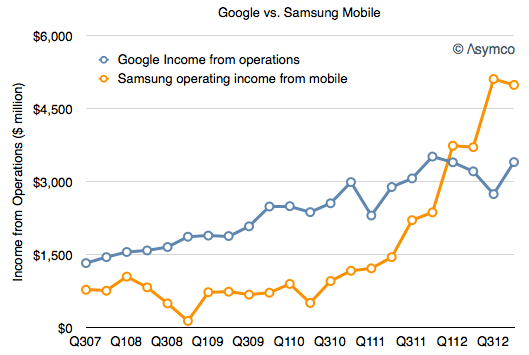
    The truth is quite different from this. Samsung currently makes far more operating profit from Android phones than Google does from all its operations. 

    Screen Shot 2013-02-22 at 2-22-3.47.58 PM

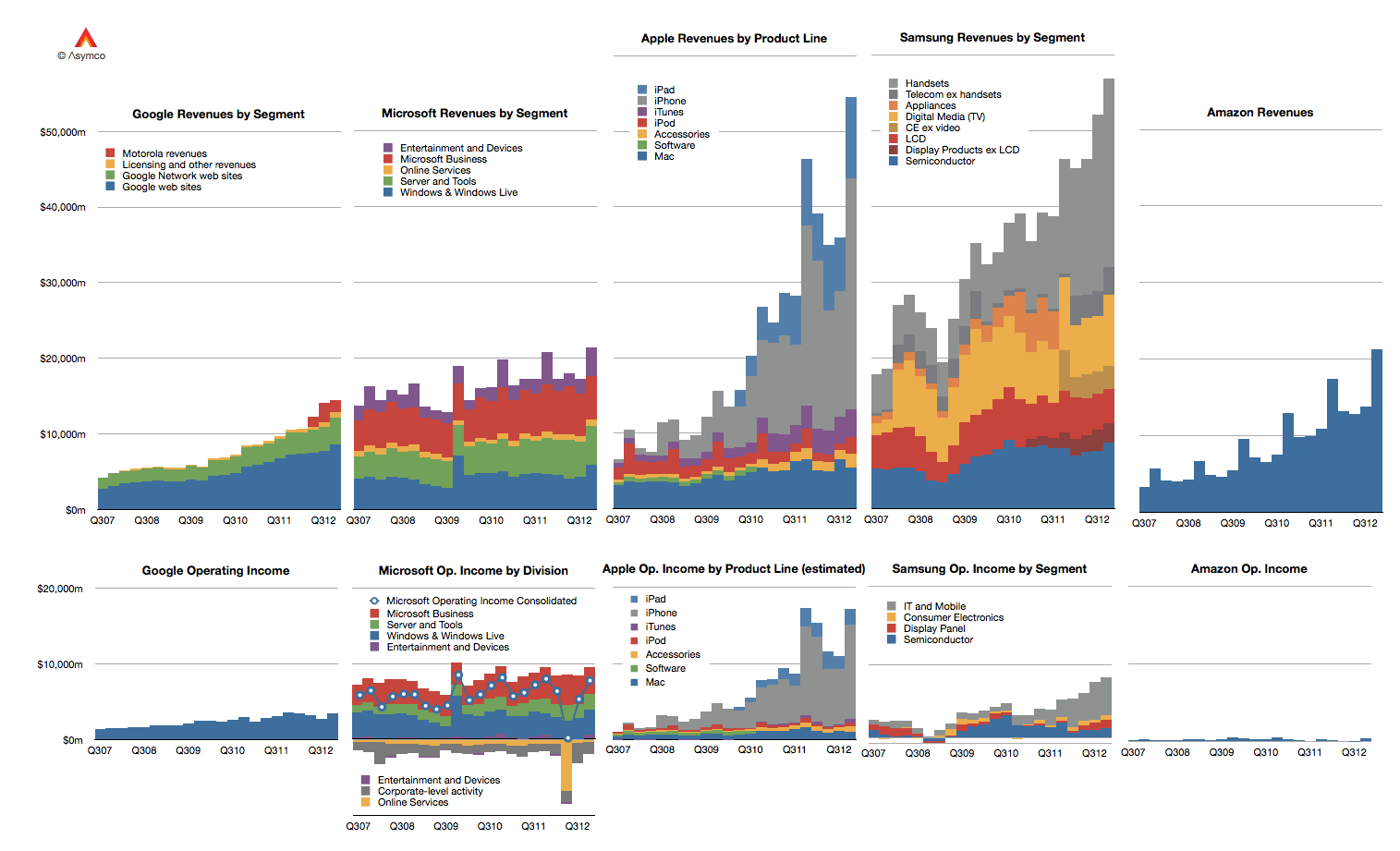
    When looking at the patterns of sales and profit capture for hardware vendors since 2007 the contrast is stark:

    Screen Shot 2013-02-22 at 2-22-3.32.46 PM

    Apple and Samsung tower over the fortunes for software only Microsoft or service-oriented Google and Amazon. Although all companies are growing, the value, as defined by the buyer, resides in the whole product. Putting aside all the theory, the numbers are staggering. Google, Microsoft and Amazon are skimming profits but they are not particularly efficient at profit generation vis-a-vis the integrated Apple (and increasingly integrated Samsung.)

    The question is which of the companies illustrated above will prosper from the value chain evolution under way?

  9. The new age of Capital Intensity

    Research · 117 comments

    In the post reviewing Samsung's Capital Structure I noted that its component divisions have historically taken 90% of capital investments and that the overall capital intensity for Samsung Electronics has increased in proportion to its component revenues.

    In another post regarding the capital structures of other technology companies with different business models I noted that Apple has changed its capital structure to a significant degree over the previous three years.

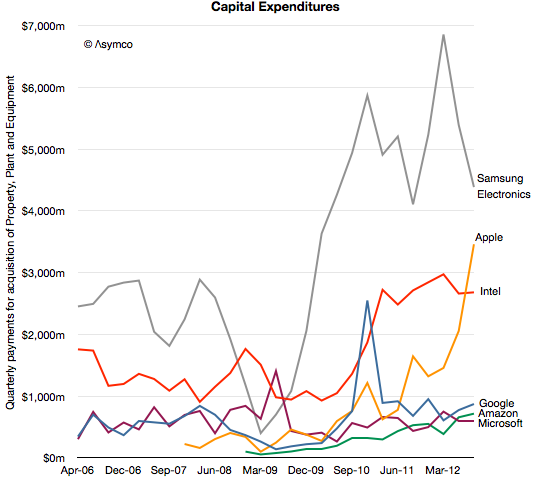
    In the following graph I combined these observations to show how capital expenditure patterns may be used to discern the underlying business model.

    I would group "cloud" or "platform" based companies like Google, Amazon and Microsoft as a cohort which, although spending significant amounts on capital equipment, do so mainly to support services. Their primary employment of capital is to sustain the infrastructure of data centers necessary to deliver the services underpinning their business models.

    I would group Intel and Samsung as "component" based companies which use capital to build production capacity that delivers, hopefully, a control point in the value chains they participate in. Note that I am assuming that Samsung Electronics' CapEx primarily targets semiconductors and displays as it did during the 2006 and 2007 period when data was available.

    Therefore, given the patterns over the last six years, it might be possible to classify a company's core business by just looking at its CapEx: The services group showing growth but relatively stable patterns and the components group showing more volatility, macroeconomic sensitivity and an overall higher level of spending, especially as a percent of sales.

    The question that pops up then is in what category does Apple fall?

    My observations for over a year have been that Apple is increasing its capital spending to such a degree that it is neither fish nor fowl. It operates data centers but presumably does not operate fabrication plants. And yet it spends more than Intel and Google combined.

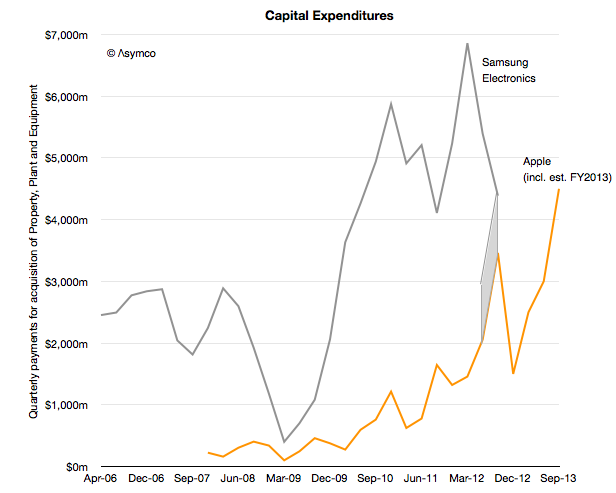
    Contrasting Apple and Samsung Electronics tells an even more interesting story. In the following graph I've added two additional items of information: First, although CapEx spending is recorded in the cash flow statement, Apple reported in its yearly (10K) report that it spent an additional $2 billion for equipment which did not pass through cash flow.

    If we were to add $1 billion to each of the previous two quarters, the graph would look like this:

    The second piece of information is that Apple projected its spending for the following fiscal year. I've added that spending in a pattern matching the last fiscal year.

    Apple is still spending less than Samsung. In its fiscal year 2012 Apple spent about $10 billion while during the same time frame Samsung spent nearly $22 billion. However, Apple has begun to bump against Samsung's spending level on a quarterly basis.

    I consider this extraordinary evidence of an extraordinary shift in strategy.

    For a year we've been debating here to what degree Apple has a "capital intensive" business and what exactly could it be spending capital on. One early hypothesis has been that it's on data centers or on real estate for spaceship campuses. These can be easily dismissed on the knowledge that they can't cost that much (and that the spending happens gradually). Another hypothesis is that the tooling for milled aluminum cases and other mechanical components is expensive and Apple has to buy a lot of it. But, again, the level of expenditure is in the league of Intel and Samsung which make vast quantities of semiconductors in very expensive plants. It's hard to imagine milling machines being cost equivalent to chip foundries.

    The comparison with Samsung, whose vast capital commitments are legendary and are its primary strategic asset puts Apple in a new light. Perhaps we can't yet call Apple a semiconductor company or even a fabricator but they are putting their "money where their mouth isn't". We can infer that it's not going where the company currently operates. The capital is being deployed almost silently and, though vast in scale, barely gets a mention from analysts. Not even a single question has been raised at any earnings call about this spending.

    So what tale does this capital tell?

    One interpretation is to apply the value chain disruption theory and ask whether Apple is acting to counter a potential disruption. In other words, that this is a specific threat response from an incumbent. There is some logic to this because  the antagonism between Samsung and Apple is so strong that it might justify a reaction of this kind.

    However, I believe that there is a more measured process at work over a long period of time. The one distinguishing advantage and attribute that Apple has  is its preference for integration. This preference is not a secret and Tim Cook repeats it often. The integration is evident with their move into retail and component design, in other words in both directions along a value chain. So my hypothesis is that this is part and parcel of an ongoing re-alignment of their role in the value chain.

    This second explanation suggests that Apple simply wants to control all the areas which affect the value they produce. First because they feel that there are areas that are not good enough and the product/experience cannot be good enough if its constituent parts are not good enough. Second because without control there are constraints to what it can do strategically.

    Whatever the reason, I read the evidence of increasing commitment and engagement in parts of the value chain as part of a continuous evolution of Apple's role. Furthermore, it's something that should be seen as a signal of a new era in how technology companies operate. We see hints of "vertical integration" with Microsoft building hardware, and Google buying Motorola and Amazon selling devices. Apple did all these things and now it casts an eye over the next frontier: components.

    ---

    If you want to learn more about the future of the technology industries and the evolution of value chains, consider participating in Asymconf.

  10. The real threat that Samsung poses to Apple

    Podcast · 430 comments

    [The following is a post written by James Allworth.

    James is the co-author of How Will You Measure Your Life?. He has worked as a Fellow at the Forum for Growth and Innovation at Harvard Business School, at Apple, and Booz & Company. It follows and builds on a discussion we had on the 56th Critical Path podcast.

    You can connect directly with James on Twitter at @jamesallworth -ed]

    A lot of ink has been spilled in the wake of the recent Apple Samsung patent disputes, and the legal wars see no sign of abating any time soon. The rise of Samsung's phone business has been meteoric, and Apple is right to be concerned. But the real threat that Samsung poses to Apple has very little to do with the copying (or not) of Apple's designs. The lawsuits have simply been a convenient (if expensive and risky) way to attempt to quash a threat that is of Apple's own making. While there's no doubt that Google has played a key role in Samsung's success by handing out a free mobile operating system to pretty much anyone who wants to build one — it is actually Apple, more than any other company, that is responsible for Samsung's present success.

    How? By outsourcing as much work to Samsung as they have. And it's impossible not to wonder whether Tim Cook's announcement yesterday on bringing back Apple's manufacturing to the USA is the beginnings of an attempt to rectify the problem.

    But first, I want to establish why copying is actually less of a threat to Apple than you might think. Daring Fireball's John Gruber wrote last year on what he termed "The New Apple Advantage". Like most people who appreciate Apple and its products, the starting point for Gruber's appreciation of Apple is its design — he says as much in the article. But the realization that Gruber has in the article on Apple's true competitive advantage is what's really interesting:

    So let’s be lazy for a second here, and attribute all of Apple’s success over the past 15 years to two men: Steve Jobs and Tim Cook. We’ll give Jobs the credit for the adjectives beautiful, elegant, innovative, and fun. We’ll give Cook the credit for the adjectives affordable, reliable, available, and profitable. Jobs designs them, Cook makes them and sells them.

    It’s the Jobs side of the equation that Apple’s rivals — phone, tablet, laptop, whatever — are able to copy. Thus the patents and the lawsuits. Design is copyable. But the Cook side of things — Apple’s economy of scale advantage — cannot be copied by any company with a complex product lineup. How could Dell, for example, possibly copy Apple’s operations when they currently classify “Design & Performance” and “Thin & Powerful” as separate laptop categories?

    This realization sort of snuck up on me. I’ve always been interested in Apple’s products because of their superior design; the business side of the company was never of as much interest. But at this point, it seems clear to me that however superior Apple’s design is, it’s their business and operations strength — the Cook side of the equation — that is furthest ahead of their competition, and the more sustainable advantage. It cannot be copied without going through the same sort of decade-long process that Apple went through.
    (emphasis mine)

    The argument is beautifully made. The design part of Apple's equation is to their ability to redefine new industries as they did with the iPhone. Whether they go after the TV market next, or something else, it's this integrated design component that will be crucial to their initial success. But compared to the business side of Apple, design actually generates much less sustained strategic advantage in any one product category, once performance in that category becomes "good enough". The tech industry has always revolved around copying. Once folks work out how it's done, everyone piles on. And at that point, it becomes much less about design than it does about how you operate your business.

    It is the last part of the Gruber quote that really drives things home. "It cannot be copied without going through the same sort of decade-long process that Apple went through". He's right — it's very hard for a competitor to outright replicate what Apple has achieved without going through all the same steps. But it got me thinking of a concept — and a related story — that I learned from someone I was fortunate enough to have as a teacher: Clayton Christensen. Perhaps a competitor didn't have to copy Apple.

    What happens if Apple had already taught them?

    Christensen first wrote about the dangers of outsourcing in The Innovator's Solution, explaining how seeking to maximize efficiency by employing third party vendors to do the "low value-add" work for you can be a lethal strategy. In the Solution, Christensen and Michael Raynor gave the example of two fictional corporations—"Component Corporation" and "Texas Computer Corporation". I had the good fortune to work with Clay on his most recent book, How Will You Measure Your Life?, and we recount a similar story; only without any of the players being disguised. The story is that of Asus and Dell, and how by outsourcing its work—starting with just basic circuit boards—Dell equipped a competitor:

    Asus came to Dell and said, “We’ve done a good job fabricating these motherboards for you. Why don’t you let us assemble the whole computer for you, too? Assembling those products is not what’s made you successful. We can take all the remaining manufacturing assets off your balance sheet, and we can do it all for 20 percent less.”

    The Dell analysts realized that this, too, was a win- win...

    That process continued as Dell outsourced the management of its supply chain, and then the design of its computers themselves. Dell essentially outsourced everything inside its personal-computer business—everything except its brand— to Asus. Dell’s Return on Net Assets became very high, as it had very few assets left in the consumer part of its business.

    Then, in 2005, Asus announced the creation of its own brand of computers. In this Greek-tragedy tale, Asus had taken everything it had learned from Dell and applied it for itself. It started at the simplest of activities in the value chain, then, decision by decision, every time that Dell outsourced the next lowest-value-adding of the remaining activities in its business, Asus added a higher value-adding activity to its business.

    There are two sides to this story: the part that relates to Dell, and the part that relates to Asus. Dell, in its quest to maximize its financial efficiency, continued to outsource way beyond manufacturing components and assembly. They outsourced a long way up the value chain. But there's also the side of the story that relates to Asus — a small components manufacturer that was, in effect, nursed to success by Dell. The extent of the schooling delivered by Dell to Asus was pretty profound, given how far up the value chain Dell outsourced its operations.

    But here's a question: at what point did Dell seal its fate? When was it that Dell had outsourced enough that Asus, with a desire to simply get out of the low-value work, could have made it all the way to the point that it did? I'm beginning to wonder whether just component development and assembly was enough. In the case of Samsung, it seems that everything else they needed to learn, they did by entering the emerging market, which Apple has largely left alone.

    Now, it's obvious that there are some very clear differences between the decisions that Apple have made in terms of outsourcing, and the decisions Dell have made. Dell outsourced its business all the way up to the design of its products. In many respects, Apple is doing the opposite — going so far as to even bring chip design in house. Horace has done some fantastic work detailing the extensive amount of investment Apple has made in its supply chain and it's clear that they've spent a lot of money investing in equipment used in production.

    But there's also no denying that Apple has begun to rely extensively on a network of suppliers across Asia.

    It's when you start putting the two arguments together that you realize that Apple may have a more serious problem on its hands. I want to again recount the final two lines of Gruber's argument:

    It’s their business and operations strength — the Cook side of the equation — that is furthest ahead of their competition, and the more sustainable advantage. It cannot be copied without going through the same sort of decade-long process that Apple went through.

    He's right — generating that scale requires a long gestation period — one that Apple went through. And it can't be copied without significant time and effort on the part of a competitor. But there's one big implicit assumption here — that suppliers won't turn around and start developing their own offering. Because when Apple went through this transformative process, where the design whittled down the broad range of offerings to just a few, and they generated the scale on the business side that accompanied that — they weren't actually the only one to go through that process. Apple's partners — their suppliers — went through it with them. And they've got very big, and very good at what they do. Samsung, obviously, is among those partners.

    Now, the response I often hear to this line of reasoning is: Apple hasn't outsourced anywhere near as much as Dell has. How are the situations analogous? But I think it's actually the wrong question. Instead, the question is: has Apple already outsourced too much?

    For all intents and purposes, we're at a level of maturity in the smartphone market where I believe design — particularly on the hardware side — has largely become commoditised. Performance is now "good enough". Whereas it was not so long ago that consumers sat on the edge of their seats to find out what the new iPhone had to offer ("please, fix the battery life", or "please, make it faster") the recent release of the iPhone 5 seemed not to generate the same intense reaction. Now, I'm not saying it won't sell well — in fact, it will probably become the best selling phone of all time — but people aren't making these decisions based on huge design differences between the devices. The basis of competition has shifted. HTC recently learned this the hard way when it introduced the One X — a phone that, to the critics, at least, was considered the best Android phone available — "a masterpiece",  "one of the best mobile devices I've ever used". Yet it has been absolutely crushed in the marketplace by Samsung.  How? Well, Samsung used its business scale to, as Horace put it on Twitter, "invite operators to a better party with an eye-watering marketing budget". This has nothing to do with Samsung making a better phone (they probably didn't), or Samsung copying Apple (indeed, HTC may have just done a better job of copying Apple). Instead, it has everything to do with the fact that Samsung has had its business sucked along in Apple's slipstream.

    There's another way of seeing just how deep the problem lies. Jobs promised "thermonuclear war" on the copied devices, and so far, the biggest target of Apple's many legal warheads has undoubtedly been Samsung. Getting a $1 billion judgement certainly proves Apple was serious about it. But doesn't it seem strange to you that the target of such a devastating strategy on the legal side, just so happens to be… one of the most important suppliers for Apple's new phone?

    The problem that Apple is facing right now has nothing to do with their designs being copied. There is a long history of copying in the tech industry; patents being deployed in lawsuits by giants often signify desperation more than anything else. Rather, the problem that Apple faces is that it now is going up against at least one competitor that has been a beneficiary of the scale that Apple has achieved on the business side. Samsung has clearly demonstrated that, like Asus, it was not satisfied being a low-margin ODM — of doing all the menial work while somebody else made the big bucks. Suing Samsung over Android patents isn't going to change that — if Google's operating system gets too expensive to use, there'll be a switch made to Microsoft. Or to another operating system altogether. It doesn't really matter, because design in the smartphone space has been commoditized. It's good enough. Manufacturers are now creating performance that most consumers aren't able to absorb. Instead, as we've moved into a world where performance is now "good enough", the world has flipped into one where it's the business side — operational scale — that matters most.

    Apple have taken steps to minimize the ability of competitors to duplicate their business advantage. There's a great post here on Quora describing how Apple has used its supply chain as a competitive advantage and how competitors end up subsidizing Apple's use of the technology. But the approach of "locking in" key new technology so nobody else can get them works best in a world where consumers need more performance from their devices — a world is rapidly slipping away.

    So, what's Apple got to do? In so much as it is able to trust its suppliers of key components not to become competitors, it can continue to use them. But where it can't, or where those suppliers have already become competitors, it has only one sensible choice — replace them. It has two choices here: the first (and obvious one) is with another supplier. But that risks the same thing happening all over again — Apple nursing another supplier into a competitor. The second choice: for components and services that are critical to maintaining competitive advantage in the markets which Apple plays, Apple needs to build the components themselves.

    Most companies wouldn't be in a position do that. But Apple is almost already there. I also hear that there might be a country out there with relatively high unemployment rate, looking for some jobs to be brought back home. Funnily enough, it seems that's just what Tim Cook is doing right now. This approach might just be a good way of on-shoring some of those untaxed offshore profits (I imagine the tax benefits for building a few factories in the US would be quite high), all the while taking away business from competitors — both current and future.

    But there's one question that still remains. In the instance of the threat that Samsung poses to Apple: is it already too late?

    –

    Looking for more information on the renaissance of production and its effect on the technology industries? Then come to Asymconf and take part in the debate.


  11. The cost of selling Galaxies

    Research · 234 comments

    In the post "Google vs. Samsung" I compared the profits of Google and Samsung Electronics' mobile (aka Telecoms) division. It showed how Samsung has grown its mobile business to such a degree that, if sustained, could conceivably influence the way Android is controlled.

    However, we should not analyze Samsung's mobile group in isolation of the entire company. Samsung relies on internal transfer of technology and capacities of production which are quite unique for device vendors today. In other words, Samsung is a relatively integrated enterprise. Understanding the whole is necessary before understanding the part.

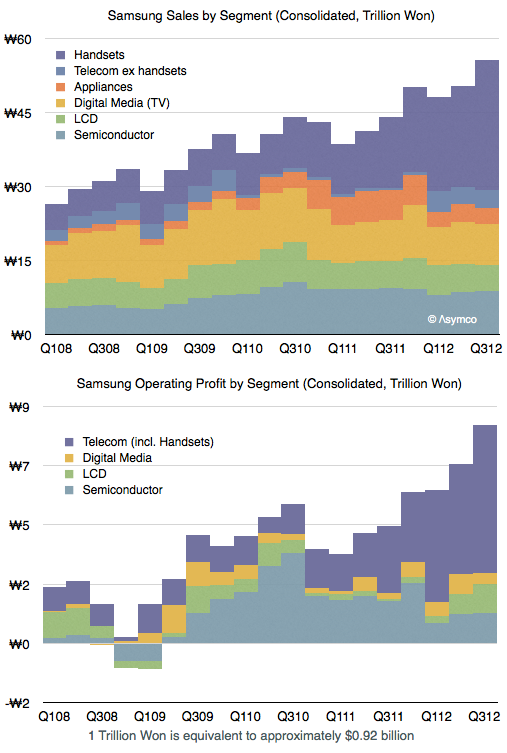
    The following graph shows the sales and operating profit for  Samsung Electronics as a composite of its divisions since early 2008.

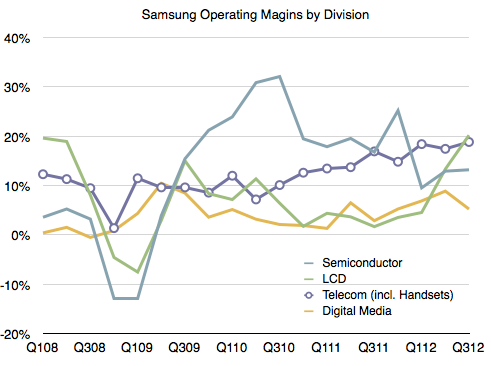
    As one would expect, the mobile group (Telecom) is the source of both top and bottom line growth. The group has also been leading in terms of margins and increasing those margins steadily. 

    The margins averaged 11% during 2007 and 17% during the trailing four quarters. This 54% increase in margin has been matched by a 55% increase in average selling price (from $151 in 2007 to $234 in the latest quarter).

    One could argue however that a 17% operating margin from a group that is now leading in volume and price is still a bit weak. At its peak Nokia enjoyed a 25% operating margin, RIM 30% and HTC 27%. Apple's iPhone operating margin is around 45%.

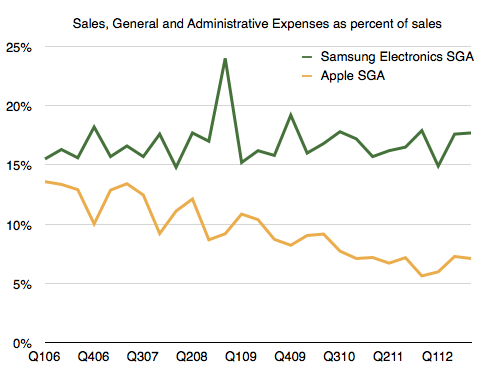
    I think a large part of the margin story is a relatively high level of spending on SG&A (Sales, General and Administrative) which includes advertising, sales promotion and commissions. In the case of Samsung Electronics, as sales has grown these expenses have grown in proportion. As a percent of sales SG&A have held relatively steady at around 17%.

    Note that as Apple's sales have grown its SG&A has grown less rapidly resulting in a smaller percent over time. We might see Apple's SG&A drop to 5% during the present quarter, an all-time low.

    So one of the more remarkable aspects of Samsung's success has been their willingness to increase promotional spending. Considering that their other divisions don't require as much "marketing expense" (semiconductors, LCD certainly, and TVs and Appliances to a lesser degree due to a smaller sales growth) we can imagine that the vast majority of this promotional spending has been in support of their mobile brands, Galaxy in particular.

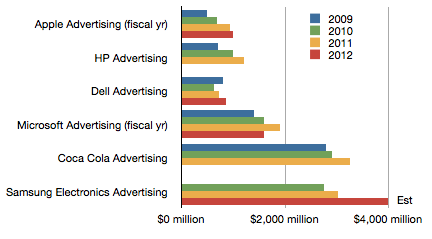
    In fact, we can obtain advertising spend data from annual reports.

    The chart above shows comparable ad spending from a cohort of technology companies as well as Coca Cola and Samsung Electronics.

    It might be surprising to note that Samsung spends considerably more than Apple and Microsoft. But it also spends more than Coca Cola, a company whose primary cost of sales is advertising.

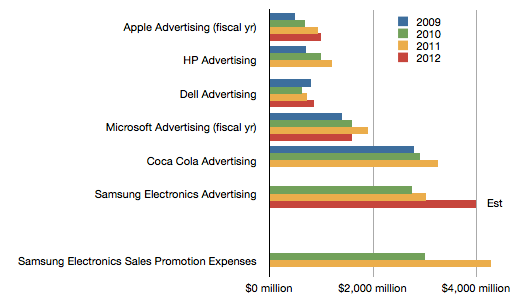
    However, advertising is not the only form of promotional spending. Samsung also pays commissions and "sales promotion". The following chart shows the value of these sales promotions relative to the ad spending budgets above.


    We don't have data on the current year since that is released after year's end, but it's interesting to note that promotions cost more than ads, which themselves are substantial relative to other companies.

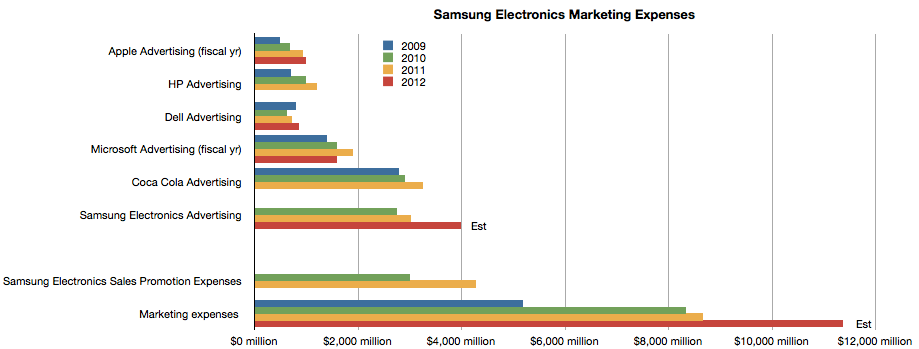
    The company also reports "Marketing Expenses" every quarter[1]. These figures appear to be the sum of Ad spending, Sales Promotions, Public Relations and a portion of "other" expenses as a part of SG&A.

    When considering all marketing expenses, Samsung Electronics' sales efforts begin to look quite astonishing.

    ---

    Notes:

    1. The data used in the latter three charts are available as a Google spreadsheet here.