Asymco

Asymmetric Intelligence

Google

  1. The cost of mobile clicks

    Research · 26 comments

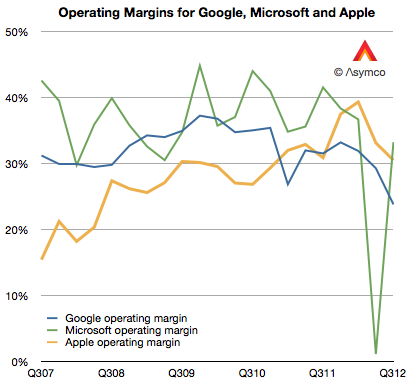
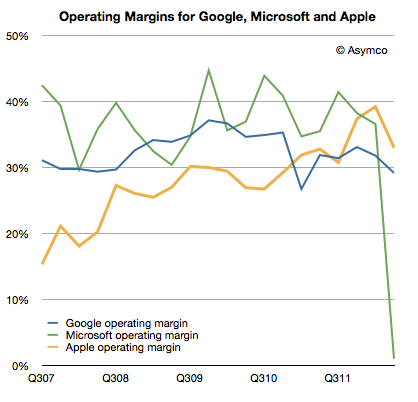
    Google's operating margins fell to 23.7% last quarter. This level is the lowest I'm aware of. From 2007 to late 2009 margin went from about 31% to about 37%.  Then from early 2010 until present they fell. The history is shown the the following graph.

    [I included Microsoft and Apple operating margins for comparison.]

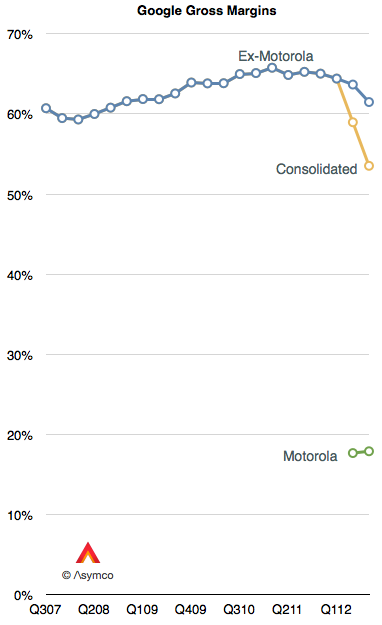
    Some of the recent decline is due to the inclusion of Motorola into consolidated earnings. Motorola gross margins were therefore 18%. Excluding Motorola, Google gross margins (Revenues-Cost of Revenues) were 61.5% of revenues.  However, even excluding Motorola, Google's core margins dropped.

    One reason for the decline in core margins is the reduction in cost per click (-16% for search and -18% for network sites.) This is what Google pays to partners for access to traffic. The trend is not new. It was first discussed in January.

    The bottom line is that an individual click is not as valuable as it used to be. Would a larger volume of mobile usage be a reason? Google won't say.

    The overall result in the bottom line is shown below. Microsoft and Apple are again put forward for comparison.

    Reminder: Register for Asymconf.

  2. Google vs. Samsung

    Research · 283 comments

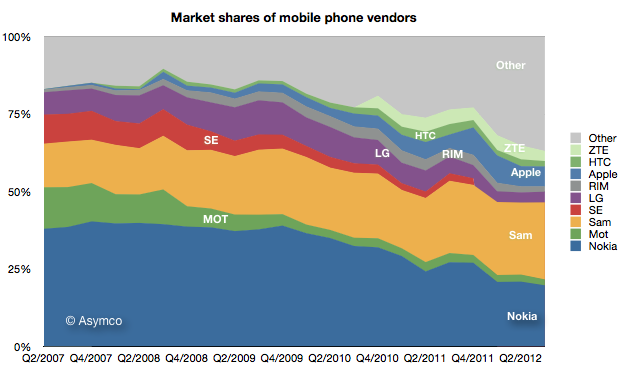
    Samsung's recent success in mobile phones has been spectacular. It overtook Nokia for the top spot in overall unit sales. 

    It went from having almost no smartphone sales to selling over 50 million units per quarter in a matter of two years.

    It now accounts for nearly 40% of all industry profits.

    A key decision which made this success possible was to shift its portfolio to smartphones and to offer a large variety of such phones.

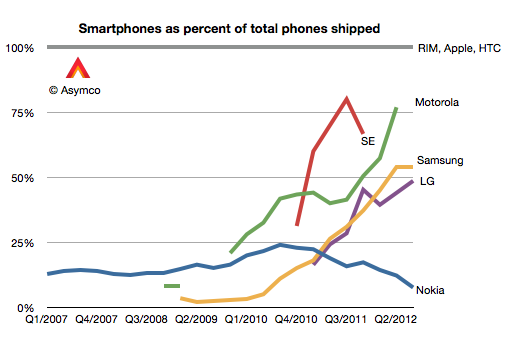
    In Q1 2010 only 3% of the phones Samsung sold were smartphones. In the latest quarter the ratio was 54%. 

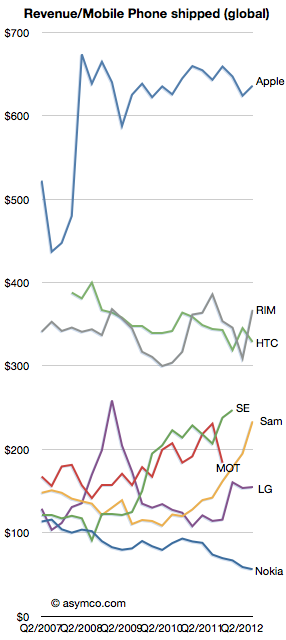
    As a result the average selling price more than doubled, from $115 to $234.

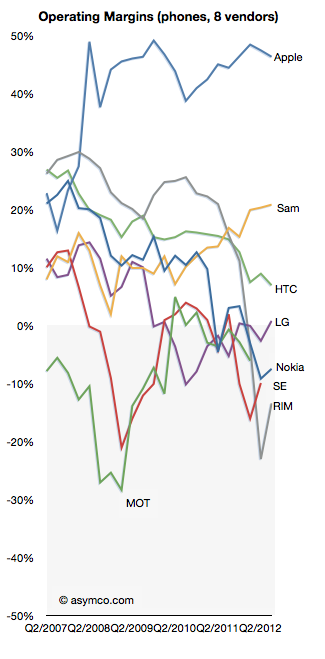
    Profit margins also soared in proportion: from 12% to 21%.

    All this plus an overall growth in volumes from 64 million to over 100 million per quarter has meant that the company is raking in enormous profits. Not only did it overtake Nokia, the market share leader for 14 years, but is making more profits than Nokia ever did.

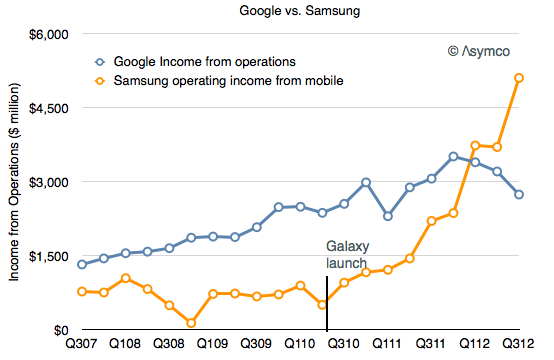
    So much profit in fact that it has overtaken Google's decisively.

    The reason I point this out is that Samsung's success is dependent on having ridden on the back of Android. Samsung's ascent can be precisely timed to their adoption of Android. The groundbreaking Samsung Galaxy launch was the Galaxy S which shipped in June 2010.

    Meanwhile, indications are that "mobile" is causing a contraction in Google's margins.

    If nothing else, Android has created a very interesting industry. There are many questions of course: Is Samsung's trajectory sustainable? Why aren't there other vendors successful with Android? Why isn't Google successful with Android? Why isn't Google's Motorola successful with Android? What would happen if Samsung soaks up so much profit from mobile that it's in a position to acquire Google and control the trajectory of their enabling platform?

  3. Hey Big Spender

    Research · 64 comments

    In previous posts I described the patterns of asset value growth for Property Plant and Equipment at Apple and how that change has been thus far correlated to the production of iOS devices.

    The analysis was based on looking at the declared value of the PP&E assets on Apple's balance sheet. These values include depreciation so they reflect not only the "spending" on new assets but also the value lost due to wear and tear. As such it's not a perfect measure of investment.

    The better approach is to use declarations on the cash flow statement. Apple reports a specific cash flow related to PP&E: Under Investing Activities, Payments for acquisition of property, plan and equipment.

    In the latest 8-K the amount for the 12 months ended September 29 the value was $8.295 billion.

    Compare this with the statement in the Annual Report from one year ago:

    The Company anticipates utilizing approximately $8.0 billion for capital expenditures during 2012, including approximately $900 million for retail store facilities and approximately $7.1 billion for product tooling and manufacturing process equipment, and corporate facilities and infrastructure, including information systems hardware, software and enhancements.

    Compare also with the PP&E net asset value on the Balance Sheet currently at $15.452 billion but valued at $7.777 billion a year ago (an increase of $7.7 billion).

    This means that Apple intended to spend $8 billion, actually spent $8.3 billion and realized a net asset gain (after depreciation) of $7.7 billion.

    So there are no major surprises. The spending was only about 4% above expectations a year earlier.

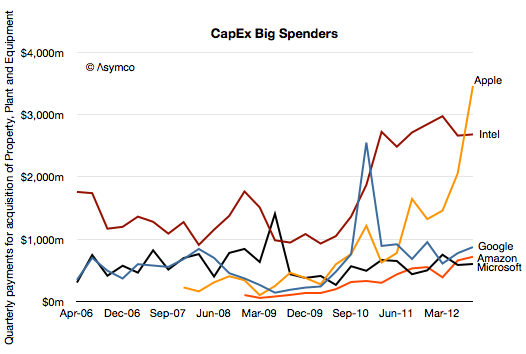
    The other pattern to observe is that the spending rose dramatically into the fourth quarter. The fiscal quarterly spending was:

    1. $1.32 billion
    2. $1.46 billion
    3. $2.06 billion
    4. $3.46 billion

    I illustrate this pattern (and previous quarterly spending) in the following chart.

    The question remains what is this $8.3 billion being spent on?

    To help answer I also added the comparable spending (from cash flow statements) of a few other technology companies. Google, Amazon and Microsoft have been spending in the same range of $500 million per quarter. Over the past eight quarters the average spending of these companies has been:

    • Amazon $487 million
    • Microsoft $583 million
    • Google $800 million

    Intel is different. Its average spend level has been $2.6 billion/quarter.

    But Apple has just spent about 30% more than Intel. And it spent three times in Q3 than Google, 4.8x Microsoft and 3.8x Amazon.

    The level of spending and growth from a far lower level implies to me that Apple is spending primarily on process equipment (aka tooling) rather than servers. Data centers are expensive at $1 billion for a large one, but they are not being built fast enough to account for $3.5 billion in one quarter.

    Note that Apple's CapEx is above that of Intel whose fab-based semiconductor production method is known as particularly capital intensive. And Intel's Capital Expenditures have been increasing to all-time highs.

    If Apple spent at Google levels on server infrastructure it would only be spending a quarter of what it's actually spending. If Apple spent on production at Intel levels it would only be spending three quarters of what it's spending.

    In other words, Apple is spending at the equivalent of one Intel of fabrication and one Google of server infrastructure.

    In a few days we will learn what the plan for expenditure for fiscal 2013 is. Historically, the company has roughly doubled spending for each year of the iOS platform. If that continues then Apple will be spending the equivalent of several Intels and several Googles.

  4. The beloved hobbies of Google and Amazon

    Podcast · 40 comments

    Tim Cook speaking about the Apple TV product:

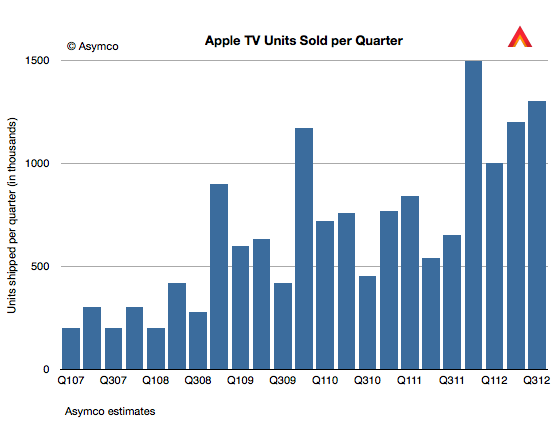
    For Q4 we sold 1.3 million. That is up over a 100% year-on-year. We sold more than 5 million Apple TVs during the fiscal year, which is almost double the previous year, when we sold 2.8 million. So the business continues to do very well, but if you look at the size of revenue of this business versus our other businesses, it’s quite small and so it still has the hobby label, however it’s a beloved hobby and we continue to focus on it and continue to believe there is something more there and continue to pull the string to see where it takes us.

    Five million Apple TVs per year is a half-billion dollar hobby. As such it quintupled from the first year (calendar 2007).

    The value for hardware is, of course, only a part of the story. It is accounted for as part of peripherals revenue and amounts to 18% of total peripherals revenues. Last May I estimated that the installed base of Apple TVs was 10 million. I'd estimate current total to be closer to 12 million. Assuming $10/month in content sales per Apple TV results in $1.4 billion of which 30% might be retained by Apple as revenue (agency fee).

    The yearly revenue thus could be as high as $900 million. Therefore it seems plausible that Apple TV is on the verge of being a billion dollar business.

    It may be a hobby to Apple but I've noted before on my podcast that Apple TV is a mirror image of the Kindle business model: Sell hardware at low margins and experiment with content sales as a profit model. The "hobby" moniker means that it's not a big business but how big is Kindle or Nexus 7 for their respective owners?

    Kindle may sell up to 10 million units at nearly break-even but is the average revenue per user much higher than Apple TV? What about the Nexus franchise? Is the loss on hardware leading to revenue to Google+OEMs above $10/month? I doubt it.

    I can't be precise or absolute about it since we don't have data from Amazon or Google about units or from any of the platforms' margins or attach rates for content, but I'm doubtful that they qualify for more than hobby status according to Apple's definition. At least in terms of profitability, Apple TV could be bigger than either Kindle or Nexus tablets.

  5. The omnivorous app

    Research · 67 comments

    Marc Andreessen famously coined the phrase "software is eating the world." It's an apt observation. If you look back on the history of computing you're likely to measure computers sold or devices sold or users harvested or productivity gained. These things are measured because they can be measured. But the greatest cause of value created and captured has been the development of software. An ephemeral product whose value is often ignored in analytical discourse.

    Software is not easily measured and it's not easily valued due to its intractable nature. Firstly, because businesses that make software tend to have weird cost structures--absurdly high fixed costs and operating margins: They operate without income for years and then suddenly are massively profitable with a minimal set of resources. They have a non-linear, "big bang" trajectory.

    Secondly, software companies tend to capture revenues from something other than the direct sale of the good. Software is rarely sold. Services sometimes are sold on the basis of software but more likely audiences for services are sold to a set of bidders, or revenue is obtained in even more circuitous ways.

    Thirdly, because there are curious multi-sided markets for software platforms. Charlie Kindel hints strongly at how difficult it is to understand the dynamics of software platforms. There is the prospect of lock-in of users and data. There are relationships to nurture with developers and there's the principle of an ecosystem that creates network effects. The virtuous/vicious cycles are non-linear and unpredictable even for the experts who have been at it for decades (e.g. Microsoft).

    Given these difficulties, software is seldom seen as the core value proposition for a particular business. But make no mistake about it, Apple, Google, Microsoft, Facebook and Amazon are all software companies. They "monetize" or integrate software differently but software is causal to their profits. Their use of software has also made them all disruptive. Software enabled the disruption of consumer electronics, retail, computers, advertising and broadcast media.

    But we have not seen anything yet. There is another class of software that is poised to lay waste to a new set of industries. The lowly app coupled with cloud-based services[1] is the termite that is set to eat the foundations of the largest of the industries still standing.

    Consider the following:

    • Games. A software industry in itself, the app versions are attracting non-consumers and eventually will get good enough to absorb all  usage and profits. Games merged with "entertainment" concepts will lead to new models of user recreation leading to new global brands that could challenge even Disney.
    • TV. As apps come to the big screen TV will never be the same. Not only will show creators build directly for an audience but advertisers that currently sponsor shows will produce them instead and package the result as an app.
    • Shopping/dining/entertainment/hospitality are changing with location services and with novel "bits to bricks" purchase options (e.g. PassBook). Increasingly services will exploit handheld devices to enable product discovery--the main job retailers are tasked with.
    • Communications. The observation that "phone" is just an app and that messaging can be done in dozens of ways depending on message, relationship, context or even custom is possible because apps conform to the user's needs rather than the user conforming to the tools they get from the network service provider.

    Although these are enormous opportunities in themselves, this is in addition to several industries that are already crumbling (photography, book publishing, to name two).

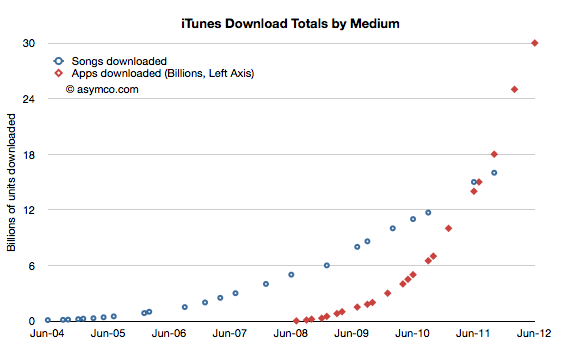
    I don't need to rely on prose alone to make the point. A graph can also lend a hand.

    Consider that Apple's App Store and Google Play together have had over 50 billion installs in less than four years and that the number of users of apps is at least 750 million. Furthermore, consider that apps have moved from a smartphone phenomenon to tablets and even PCs using OS X or Windows. Within one year these software capsules are going to be in use by one fourth of the global population.

    Nothing has this kind of reach or engagement, not even browsers. What makes the app disruptive, even ahead of a browser-based service, is that it includes incentives for developers (or, more precisely, app producers) to get paid and to have a relationship with the buyer. These two value propositions, in isolation or in combination, are available to millions and consumable by billions. The most democratized market that can be imagined. An unbounded set of producers and an unbounded set of consumers and a persistent connection after the purchase with nothing in between them except a payment mechanism

    The world has never seen such an opportunity.

    The consequences are unforeseeable. Apps are a form of software that goes beyond its ancestral "application" as a product and as a business model. It's the software that will take in and assimilate everything in sight.

    ---

    Notes:

    1. I have a simple rule to distinguish between an app and a service. If you have to supply a username and password to an app, it's a service.
  6. The Interlopers

    Research · 48 comments

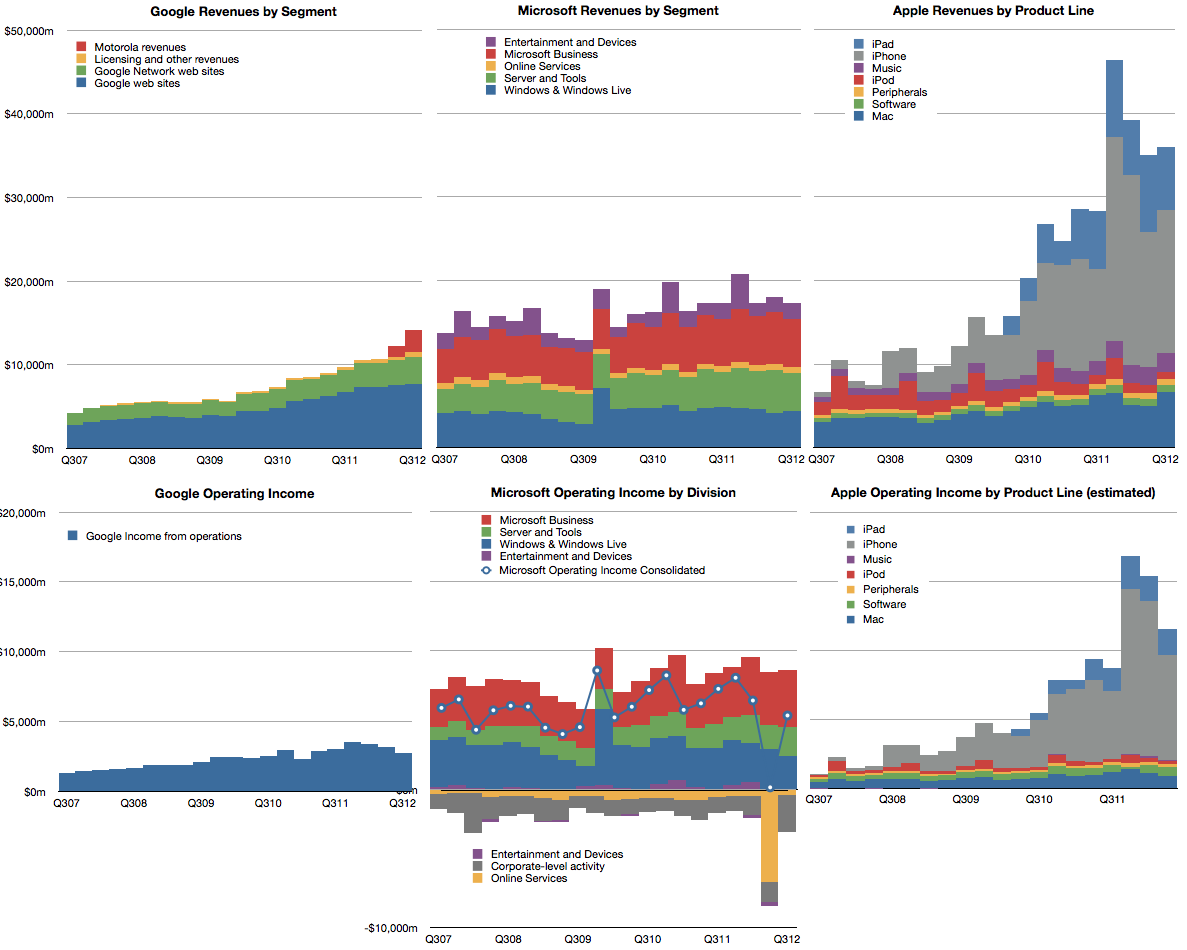
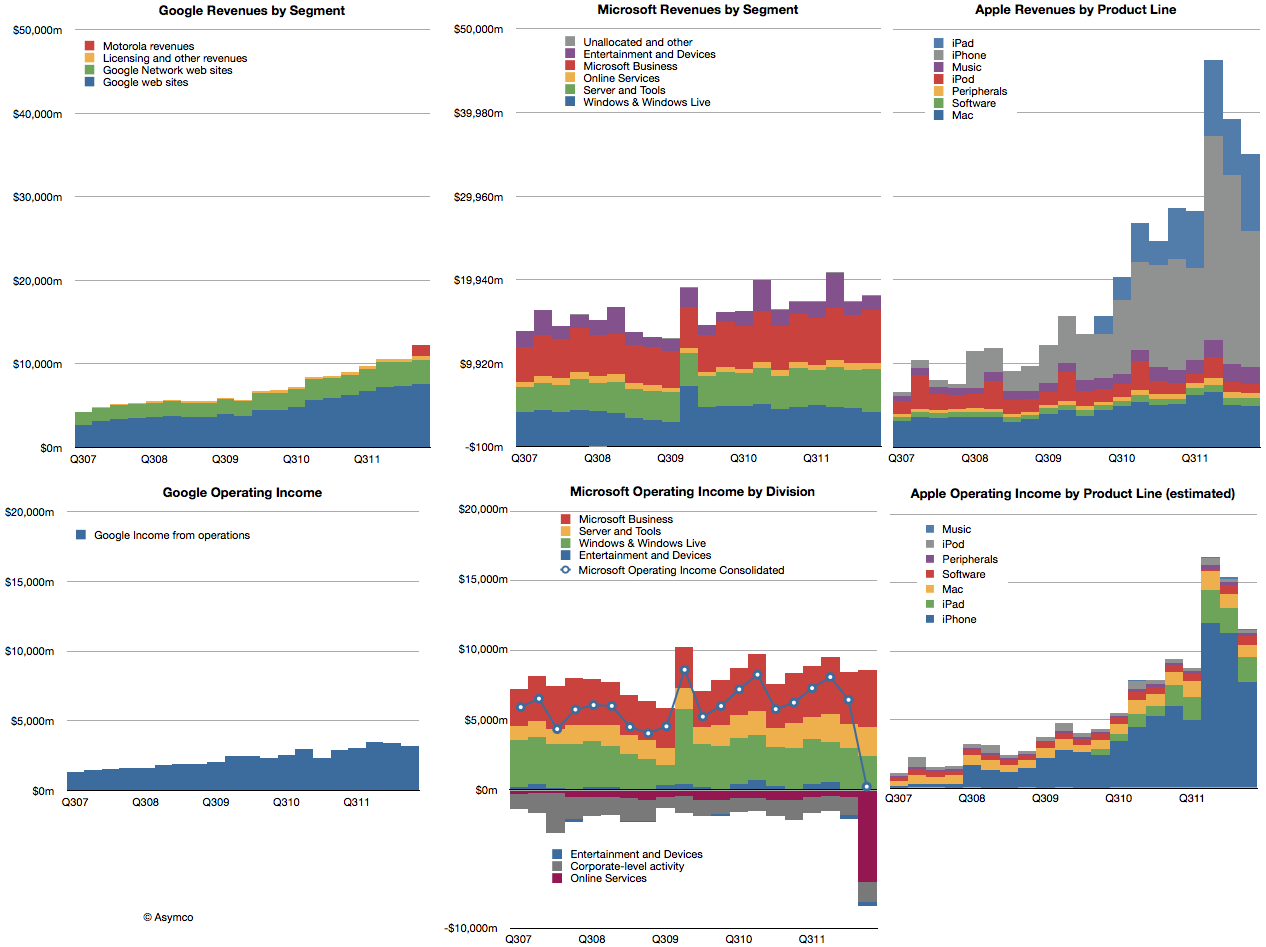
    Google, Microsoft and Apple all had reasonably good second quarters. Microsoft's revenues grew by 4%, Google's by about 22% and Apple by 23%. Apple's growth was disappointing but the other companies weren't. The revenues for the three companies are shown in the following charts:


    I also showed the performance of each company's operating income in the bottom three charts.

    Microsoft did declare a one-time write-off of $6.2 billion which it spent on aQuantive a few years ago. That was booked as contributing to a loss of $6.67 billion for its Online Services division. Without that one-time charge consolidate operating income would have grown at about 3.6%. Google's operating income grew at a rate of 11% and Apple grew (again, disappointingly) at 23.4%.

    Apple's operating margin fell to 33.1% while Google's fell to 29.2%. Microsoft's margin evaporated due to the one-time charge. If we back that charge out, the margin would have slightly topped 35%.

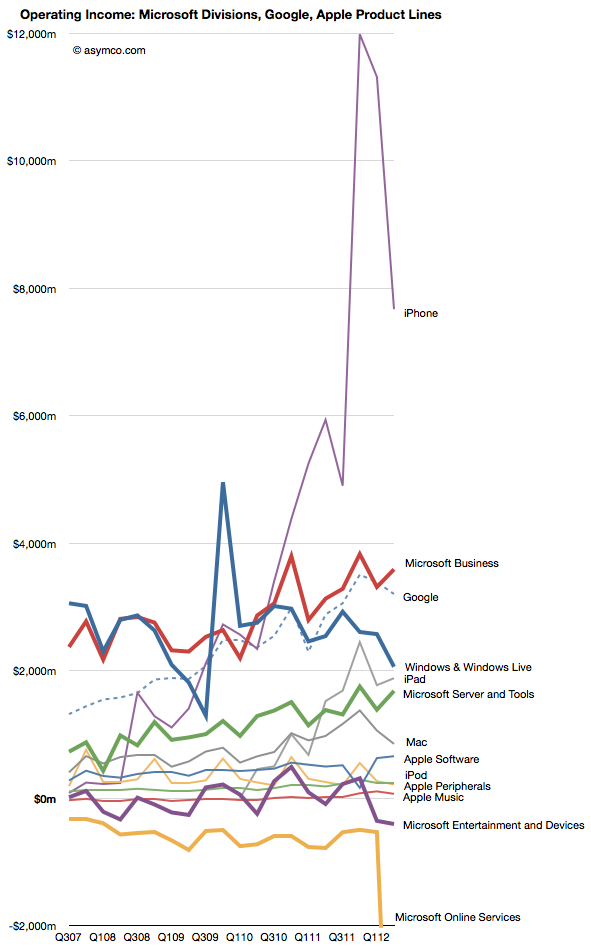
    Comparing the contribution (in operating income) for each division or product line (where possible) gives the following view:

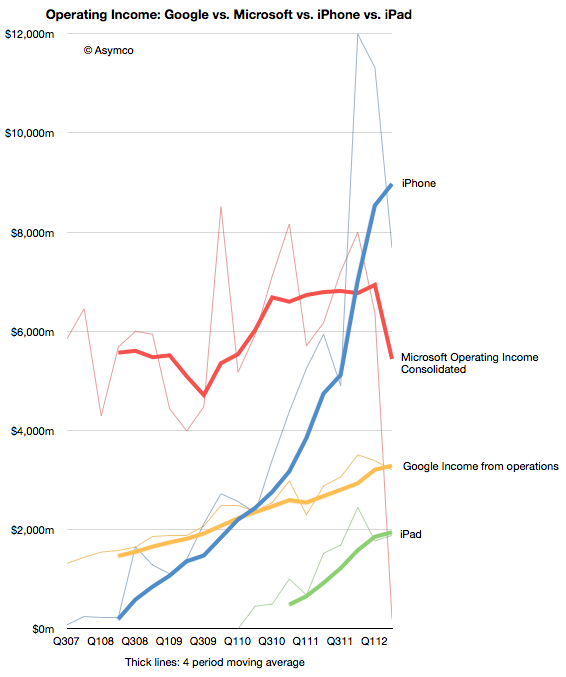
    I tried to remove some noise by isolating the iPhone and iPad and consolidating Microsoft overall and Google.

    By also smoothing out seasonality with a four-period moving average we can observe the pattern of growth for the iPhone and iPad relative to the other companies' overall performance.

    The crucial question remains if and when the iPad will be a bigger business than Google and/or Microsoft. The iPhone climbed over both some time ago.

  7. It’s costly and has unpredictable consequences

    Research · 26 comments

    ``It’s costly and has unpredictable consequences. That makes it a very bad business model. I suppose both companies have agendas that are not visible in court and perhaps Apple is signaling to other parties, and perhaps Samsung is using it to raise its profile. It still seems that unintended consequences may arise and the result could be very bad for everybody,’’ said Horace Dediu, founder of equity-research firm Asymco, in an e-mail interview with The Korea Times.

    The above was a quote from the article  Samsung can’t afford to lose Apple fight by Yoo-chul Kim from The Korea Times. Yoo-chul contacted me via email with a series of questions. I want to share all his questions and my answers as well:

    Samsung wides market gap with Apple, according to research firms. You think the gap will further be widen and please tell me why

    As Samsung converts its phone portfolio to be all smartphones, it is very likely to reach much higher smartphone volumes. One year ago Samsung sold about 56 million feature phones. Last quarter it sold about 43 million. The smartphone portion increased from 20 million to 50 million. At the same time, Apple has maintained a growth in its smartphone business of about 100% on a yearly basis. I expect that to continue into 2013 as well. Therefore it's possible that Samsung could sell 290 million smartphones in the next 12 months and Apple could sell about 200 million in the same time frame.

    However, it's important to understand that the companies compete on different bases. What I mean is that what generates a profit (i.e. payment by the consumer above what a product costs) is different for each company. Apple is a platform company that sells access to the iOS ecosystem across many other device types. Samsung sells consumer electronics with limited "network effects" but desirable features. In this view, the gap in device sales is "asymmetric" and not reflective of the actual competition which is between Google's Android and Apple's iOS as forms of access.

    Samsung's rapid rises mainly due to the company's heady dependence
    on Google Android. If Google applies better software for Motorola,
    then you think Samsung will face difficulties?

    Think of Google as a supplier to Samsung. No manufacturer wants to have a situation where they are dependent on only one supplier, especially when there are huge substitution costs for another supplier. And even more especially if that supplier owns one of your competitors. However, it's unlikely that Motorola will become a strong competitor to Samsung. I also don't expect Google will damage their OEM "customers" by favoring Motorola. Motorola can't become big enough quickly enough to be a threat to Samsung. What is more likely to be a problem for Samsung is ZTE and Huawei. They are on the same trajectory that Samsung was on 10 years ago. For Samsung to beat them in the future it will need to develop products that nobody can copy.

    How about software? Samsung is good to roll out price competitive
    models, however, software is always problem. Any advice for this
    issue?

    Software is hard and expertise can't be quickly acquired. It takes time. Only advice [I have] is that efforts must be patient and there need to be many experiments like Bada and Tizen. Google started with Android in 2005 and Apple started with iOS in 2003 or 2004.

    How about the patent dispute with Apple and Samsung. The patent war
    is helping Samsung see a rise in its brand awareness and that also
    worked for Samsung to grab more shares in smartphones?

    It's very difficult to measure the impact of litigation, both in the positive and negative. It's costly and has unpredictable consequences. That makes it a very bad "business model". I suppose both companies have agendas that are not visible in court and, perhaps, Apple is signaling to other parties and perhaps Samsung is using it to raise its profile. It still seems that unintended consequences may arise and the result could be very bad for everybody.

    Samsung wants to become a market creator not just a fast follower.
    For me, it's quite negative for Samsung to create a wholly-new
    eco-systems because Samsung's edges are coming from manufacturing, not creative thinking. What do you think? If Samsung wants to be a
    creator, what conditions should Samsung need and what things should
    the company do?

    Unfortunately, manufacturing excellence is not enough to remain successful long term. US companies were successful, then the Japanese, Taiwanese, Hong Kong, and now Chinese. Companies either adapt or become irrelevant. Building ecosystems is the new basis of competition but it's not the only option. Unfortunately we don't know what will be necessary to build the next basis. What matters is experimentation and the building of new businesses. I can't offer specific recommendations as there is no recipe book for how to create new markets.

    For your views, who is much better so far since the trial has begun
    in the US. Samsung or Apple?

    I cannot comment on this. Performance in court can only be judged by those present and I'm sure everybody present disagrees.

    You think Apple is enjoying its so-called a homeground advantage
    for the trial and is there any possibility that the issue to go for
    the highest court in the US. My Samsung contacts say that's the
    possibility, though.

    Again, I don't have an opinion on legal matters. Broadly speaking, IP litigation is similar to playing the lottery.

    Need your perspectives about Google's support for Samsung. Google
    confirms its supports for Samsung for an united front against Apple
    because the fight between Samsung and Apple is a kind of version that
    represents Google and Apple fight.
    Any comments about that?

    I believe Google does support Samsung. I question however how this relationship will develop over time. I attached below commentary from a researcher at Deutsche Bank on Android in China. I think it has some clues about how Google treats its partners.

    What are pre-conditions before Samsung making an action to sign a
    peace treaty with Apple?

    It depends on the motives behind Apple's actions. I think they want to see a "no copying" rule. They don't mind competition and Android could be a help in the long run by moving users from feature phones to basic smartphones which could later be upgraded to Apple phones. But what I think they want is to signal to others that direct copying is unacceptable. Essentially, the work of their designers is very important to them and copying destroys [the designers'] incentives to do breakthrough products.

    ---

    See also: Who Cares If Samsung Copied Apple? by James Allworth - Harvard Business Review

  8. Asymmetric Competition

    Research · 57 comments

    Thanks to Angel Lamuno for sending me to a dry and boring lecture by Dr. Israel Kirzner from Feburary 1988. It got me thinking again about competition and how confusing it can be.

    The lecture was in part about how the word "competition" is used by economists with directly opposing meaning from that of the layman and how that leads to confusion about the role of free markets.

    I won't dwell on that, but instead I want to explain how this word can also be contradictory in meaning when applied in everyday usage in business analysis. Nowhere is this more evident than when we argue whether Apple competes with X or Y or Z.

    Does Apple compete with Android or Google or Samsung? How could Apple compete with Google and yet cause it to be the default search engine in Safari thus enriching their competitors? How could Apple compete with Samsung and yet select their semiconductors for the heart of its most important and profitable product? And how could the people across the table from Apple agree to terms on these deals while being sued by them?

    Some have tried to characterize this situation as "coopetition" or the co-habitation of conflicting strategies for a balanced optimum. I find this characterization uncomfortable and unsatisfying. The balance sought will be very fragile and change daily and no optimization is practically possible. It seems contrived.

    Rather, I think about these situations as examples of asymmetric competition. This is competition where companies are rivals but they have different definitions of the basis of competition. In a way, they are like gladiators who have weapons which cannot be brought to bear or wielded effectively to counter the opponent's.

    Consider the following question: does the iPhone compete with the Galaxy SIII? Well, obviously it does. The products have similar attributes. If we define competition as rivalry in a market for similar products then, by default, they compete.

    But what about non-consumption? What if there aren't enough of either product to go around and people cannot actually face a purchase decision where both products are in front of them at the same time, under identical terms and conditions, waiting for a purchase to be made.

    It gets worse. What if there are network effects related to each product such as brand loyalty, platform switching costs, media and data tied to either one that make them impossible to switch? What if advertising spending is skewing the buyer's knowledge of competing products?

    If a product is unavailable, invisible or requires burdensome switching, does it really compete? When these exceptions are raised, you'll hear people say that Apple (or Samsung) don't compete with X or Y. They compete with themselves or with products outside the category. There may be many ways of rationalizing that  what appear to be similar products don't compete because of "differentiation" or "positioning".

    In fact, jobs-to-be-done theory suggests that the only successful competition is against non-consumption, especially if you're an entrant. Non-consumption is easy to beat (because the alternative is no solution to the job) while an entrenched incumbent is very difficult to beat, and it's often inefficient to even try even if you have the resources. This is what I describe in talks as the "David vs. Goliath" approach vis-à-vis the "Charge of the Light Brigade" approach.

    So the theory that competition exists on the de-facto basis of a similar feature set fails a whole series of tests in the real world. Consumers decide based on complex criteria and businesses actually conspire to make the choices as complex as possible reducing the decision to a single option.

    But I want to step back and think about the situation from the competitors' point of view. In other words, how should management think about competition? Is it possible to develop a competitive strategy or should one even bother with competitive response?

    Let's take a basic question: Does Apple think of Samsung as a competitor? When did it begin to think about it as such? What can it do to win?

    Let me answer this by asking another hypothetical question. Assume it's 2008 and Apple is in the process of planning its product roadmap. Whom would they decide to count as competitors? Android devices have not yet shipped and the gorilla in the space is the BlackBerry with Symbian still overhanging the market with a huge volume lead. Should they then build products to compete with RIM and Nokia?

    Assume further that their decision will define how developers will build apps and content makers will target your product. They have to account for the time scales that developers think about and they have to match hardware innovation to the rate of OS innovation and API innovation and toolchain innovation, etc.

    So did Apple consider Samsung a competitor in 2008? A time when Samsung did not actually make smartphones? It seems hard to believe they did. Now you may answer that things have changed since 2008 and they have. But the decisions made in 2008 regarding the platform remain in place today.

    Furthermore if you happen to look at the dozens of hardware designs that are making the rounds today (as evidence for a trial with Samsung) you'll see familiar designs first penned in 2004 or 2006. You quickly realize that the product design process is lengthy and largely isolated from the froth of main street (or mall) sales fistfights.

    Few people appreciate the disconnect between the design process and competition. This because few people have spent time in an organization building mass market consumer phones. The time scales are staggering. If your product is a platform product you make decisions six years in advance. If you are a "fast follower" you can make decisions six months in advance. This is maddening, asymmetric competition.

    One competitor sees one basis of competition and another sees it completely differently or sees a completely different basis. They are competing with each other but more as a guerrilla fighter competes with a nuclear missile.

    Which brings me to another discipline. In military circles asymmetry has been noted as a valid form of warfare for some time. At least since 1975. It was in use long before it was recognized or studied, (e.g. in the American Revolution.) But the situation now exists where it's taken for granted that modern conflicts are almost always asymmetric. Drones vs. insurgents and citizens vs. armor and, the most sinister of all, unarmed-but-tightly-integrated-through-communication protest against established regimes. The impact of this realization is affecting governments around the world.

    So it's time to elevate our thinking about business competition along the same lines. Yes, Apple competes with Samsung but it does so asymmetrically (as it does against Google and dozens of others). It's a multi-dimensional rivalry and one which requires a different form of analysis. It is something which I do instinctively but it's not something that is easily explained. Disruption theory helps. It turns out that asymmetric competition is the only form of competition that matters in a rapidly disrupting industry.

    It is also why this site is called Asymco.

  9. From bad to worse and from good to great

    Research · 128 comments

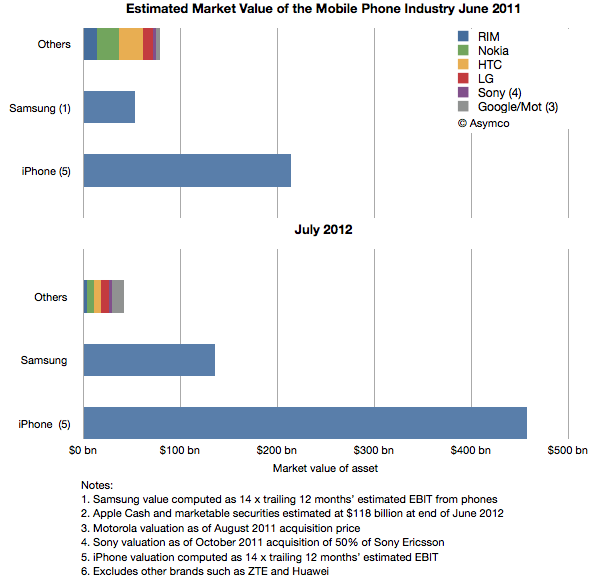
    A year ago I noted that Apple could buy most of the mobile phone industry with cash on hand (excluding Samsung's operations).

    Since then Apple's cash has grown significantly and the value of all phone vendors except Samsung has gone down significantly. The following chart shows the year ago and present day estimated market value of the industry participants.

    Phone brands other than Samsung and iPhone have seen a reduction in market value of a combined 47%. That's actually being quite generous since I'm valuing Motorola and Sony's businesses at their acquisition prices. The operations of both those companies have continued to stagnate.

    Based on the same multiple of estimated earnings Samsung grew its value by 157% and iPhone by 114% (note this excludes iPad).

    In absolute terms the iPhone franchise created $244 billion in value while Samsung created $83 billion. The others destroyed $37 billion.

    The good news is that the industry has had net value creation--always a healthy sign that innovation is being valued and absorbed.

    The bad news is that there is vast income inequality. The rich are getting richer and the poor are getting destitute. This is an unhealthy sign. The concentration of power and wealth may indicate a peaking of experimentation and discovery of new opportunities.

    Also noteworthy is that almost all the value from the Android ecosystem is concentrated in Samsung. I did not include Google in this analysis since its mobile is so small as to be not visible in its accounting. A separate analysis of Android economics shows that Google's benefit from the platform is modest. In contrast, Samsung, and Samsung alone, is benefitting greatly. It could even be said that today Samsung is the only Android profit engine.

  10. Who will be Microsoft's Tim Cook?

    Research · 88 comments

    As previously noted, Apple has overtaken Microsoft (and Google) in operating margin percentage. This is an astonishing statistic as Apple is still largely perceived to be a "hardware company" while Microsoft is a "software company" and Google is a "services company."

    To suggest that "hardware" could be more operationally profitable than either software or services is akin to heresy in technology analysis. This reversal is newsworthy indeed. However, even the most casual observer would note that Apple does not derive its market power from hardware alone. It is, in fact, an integrated hardware, software and services company (with a few more roles besides.)

    So the emergent successful business architecture in this technologically transitional period is of integration and completeness of solutions.

    This shift explains at least at a conceptual level Microsoft's tectonic Surface shift.

    But what about another point of view? What does integration mean for Microsoft's income, cost and profit structure? Is integration self-disruptive to Microsoft?

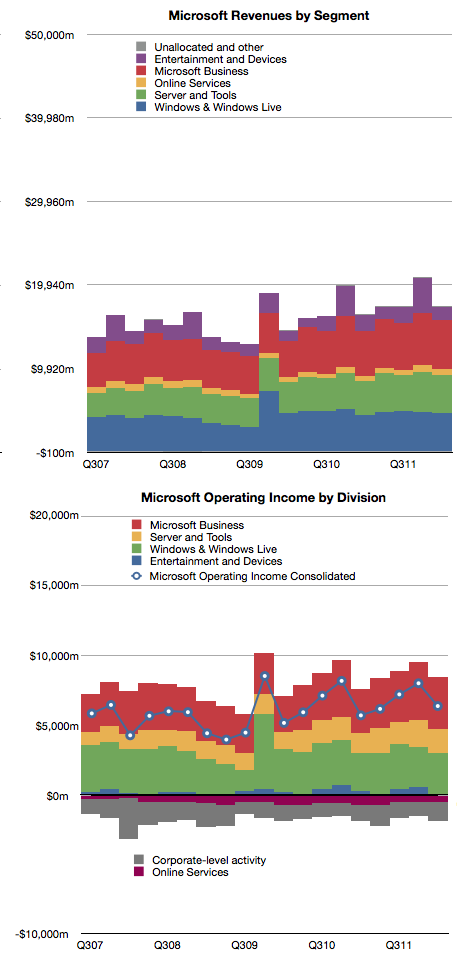
    Here's a reminder of Microsoft's revenues and operating income by division:

    The challenge of devices for Microsoft is that the licensing of software for devices is very difficult to sell.

    In 2011 Microsoft received about $18.7 billion in Windows revenues and $23 billion in Office revenues. The chart shows that this is a fairly steady growth business. According to Gartner, in 2011 there were about 336 million Windows PCs sold and that this too is a fairly stable and mature business.

    If we simply divide revenues by PCs sold we get about $55 Windows revenues per PC and $68 of Office revenues per PC sold [1]. The total income for Microsoft per PC sold is therefore about $123. If we divide operating income by PCs as well we get $35 per Windows license and $43 per Office license. That's a total of $78 of operating profit per PC.

    Now let's think about a post-PC future exemplified by the iPad. Apple sells the iPad with a nearly 33% margin but at a higher average price than Microsoft's software bundle. Apple gives away the software (and apps are very cheap) but it still gains $195 in operating profit per iPad sold.

    Fine, you say, but Microsoft make up for it in volume. Well, that's a problem. The tablet volumes are expanding very quickly and are on track to overtake traditional PCs while traditional PCs are likely to be disrupted and decline.

    So Microsoft faces a dilemma. Their business model of expensive software on cheap hardware is not sustainable. The future is nearly free software integrated into moderately priced hardware.

    For Microsoft to maintain their profitability, they have to find a way of obtaining $80 of profit per device. Under the current structure, device makers will not pay $55 per Windows license per device and users will not spend $68 per Office bundle per tablet. Price competition with Android tablets which have no software licensing costs and with iPad which has very cheap software means that a $300 tablet with a $68 software bill will not be competitive or profitable.

    However, if Microsoft can sell a $400 (on average) device bundled with its software, and is able to get 20% margins then Microsoft is back to its $80 profit per device sold. This, I believe, is a large part of the practical motivation behind the Surface product.

    The challenge for Microsoft therefore becomes to build hundreds of millions of these devices. Every year. Sounds like they need a Tim Cook to run it.

    ---

    Notes:

    1. Microsoft accounts for revenues using deferrals due to Software Assurance pre-payment models for many corporate customers so this figure is not a precise value for each license sold.


  11. The evolution of the computing value chain

    Research · 34 comments

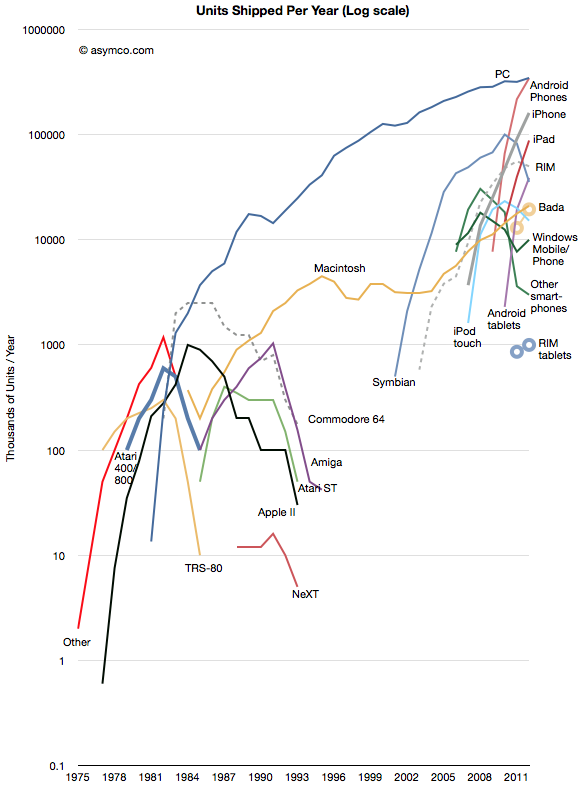
    The history of personal computing has come to be defined as the history of Microsoft. At least since 1981 Microsoft's operating systems have been the consistent market share leaders, and by a very large margin. That is about to change. This year Android will be on more devices sold than Windows. iOS is also set to also overtake Windows next year. The following chart illustrates the wave of mobile platforms that has emerged, and in spite of some notable failures, is overtaking traditional computing.

    Of course we should remember that PC themselves overtook entrenched predecessors like minicomputers and mainframes which themselves overtook business computing systems based on adding machines, typewriters and slide rules. This is the cycle of disruption and there is nothing new about it.

    However, it always seems to take people by surprise. This is because it happens in unforeseen ways and at unpredictable rates. And so it is that we are surprised by Microsoft's seeming abandonment of a business model that has sustained it for three decades.

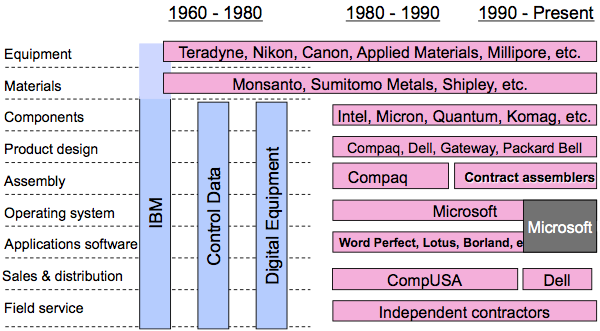
    Yesterday's reveal of Surface, Microsoft's first personal computer, was a watershed event in the evolution of value chains around computing. In a famous slide Clay Christensen illustrated (in 2004) the value chain evolution in computing from the 1960s to 2000.

    As computing moved from the desktop to the pocket the industry re-integrated. First, Apple moved from Product Design into Sales & Distribution with its stores. Then it moved into service with Genius bar. Then it moved into component design with the A series chips and unique batteries. Then it moved into materials with exclusive licensing of LiquidMetal. It also began to own the equipment used in its manufacturing. This in addition owning the operating system.

    Now we see Microsoft following in the same footsteps. First applications came early then stores, then service, and now product design. Google is also tracking closely behind as well with its acquisition of Motorola, the results of which have yet to be revealed.

    And so we can see value chains evolving in real time before our very eyes. They have always evolved but in technology industries they evolve far more rapidly and will continue to accelerate.

    Whether Microsoft or Google will be successful in their integration efforts remains to be seen. The challenges are immense as the value of the existing chains are enormous and the bonds that tie the company to them very strong. Breaking these ties will seem like value destruction and corporate antibodies will be set loose to kill the transitions. HP, RIM, Nokia and Dell are vivid examples of what happens when the response mechanisms have their way.