Asymco

Asymmetric Intelligence

hardware

  1. The poetry of Steve Ballmer

    Research · 121 comments

    Steve Ballmer July 9th, 2012 on competing with Apple:

    We are trying to make absolutely clear:
    We are not going to leave any space uncovered to Apple
    We are not.
    No space uncovered that is Apple’s
    We have our advantages in productivity
    We have our advantages in terms of enterprise management, manageability
    We have our advantages in terms of when you plug into server infrastructure in the enterprise.
    But we are not going to let any piece of this [go uncontested to Apple]
    Not the consumer cloud
    Not hardware software innovation
    We are not leaving any of that to Apple by itself
    Not going to happen
    Not on our watch.

    Steve Ballmer, July 2010 on competing with Apple's iPhone and iPad:

    Today, kind of I'd say one of the top issues on my mind, let alone on your minds, one of the top issues on my mind, is, hey, there is a category that we've had Windows on for actually a long time. We've had Windows 7 on, tablets and slate machines now for a number of years, and Apple has done an interesting job of putting together a synthesis and putting a product out, and in which they've -- they sold certainly more than I'd like them to sell, let me just be clear about that.

    We think about that. We think about that in competitive sense. And for us, then, the job is to say: Okay, we have a lot of IP, we have a lot of good software in this area, we've done a lot of work on ink and touch and everything else -- we have got to make things happen. Just like we had to make things happen on netbooks, we've got to make things happen with Windows 7 on slates. And we are in the process of doing that as we speak. We're working with our hardware partners, we're tuning Windows 7 to new slate hardware designs that they're bringing them to market. And, yeah, you're going to get a lot of cacophony. There will be people who do things with other operating systems. But we've got the application base, we've got the user familiarity. We've got everything on our side if we do things really right.

    So, we think about these devices and I don't think there really is one size that fits all. I don't think everybody wants a slate. I've been to too many meetings with journalists who'd spend the first 10 minutes of the meeting setting up their iPad to look like a laptop...

    Laptops actually are well designed for a lot of things. I notice they are all light. In fact, if you look around this room, they all weigh zero pounds, because they're just sitting on the table, you are not holding them and you don't set them up when you want to type, and they prop up -- they have good attributes. But some people are going to want that form factor. Some people are going to want probably a screen that they take with them and maybe they throw it back into the keyboard. Some people are going to want a device that is screen and keyboard that spins around for inking purposes. Some people are going to want things very light or very cheap or very expensive or very powerful. All of those things are going to be important, and we've got a push right now -- right now -- with our hardware partners.

    ... We're coming full guns. The operating system is called Windows. No -- there's -- let me be unambiguous. A new Windows Phone for screen sizes that, let me just say, are, you know, sort of bigger than three or four inches -- the answer is Windows Phone. We are in the game. We're all in the game today with Intel architecture machines. We've got improvements coming from Intel. We're driving forward. We're unambiguous about that. Now, where we'll go and what's going to matter -- I said also in my remarks that in no way will we allow hardware to be the impediment. We will embrace what we need to embrace over time in terms of hardware evolution.

    But you say to me are we going to see slate? Yes. What processor are they going to have? They are going to have an Intel architecture processor at least in any foreseeable future. Are they going to run Windows? Yeah. Will it be tuned? Yes! And we are going to sell like crazy. We are going to market like crazy. We have devices that will run more applications, that have as much content, that have anything you want on the planet.

    And we have an ecosystem of developers that know how to write applications for that thing. Believe me, as I think everybody knows, you can buy two PCs for the price of one iPad -- two netbooks today for the price of one iPad. So, people are sitting there over-celebrating BOM costs and blah, blah, blah. We and Intel can get our job done and know how to make money. There's good money for everybody in the ecosystem to go make.

    I talked about power. We've got work we have to do with hardware partners, with Intel. There's certainly some work to be done there. And over time where we go is where we go. But at least in the timeframe that which anybody does these models, for example, let's go. Let's go and we'll be in market as soon as we can with new devices, whether that's, you know, really, really soon or just really pretty soon. I'm going to wait until I have the device that I want to hand you and tell you to go use, or a collection of devices. I think that would be the appropriate time to say it is time. But it ain't a long time from now. Pardon my English...

    On the netbook, nor the slate, if it's two weeks one way or the other, or it's a month, I mean, let's not speculate, let's merely say when you get your Windows 7 machine, it will print. Let's just start with that. I mean some people actually like to print every now and then. Ours will print. I'm not trying to say that other guys aren't doing good work. I'm not saying that. We've got to ‑‑ come on, every day. Every day you come to work you have to prove yourself, prove yourself, prove yourself. We'll prove ourselves. ...

    I relish the competition. I relish holding up those couple of machines today that I wanted to hand you. It's not today. I'll relish doing it tomorrow. Bring on ‑‑ particularly if with the application base, with the tools that we have, with the user understanding and momentum and everything going on, we can't compete with ‑‑ particularly whatever the weird collection of Android machines is going to look like, shame on us.

    Apple is Apple. They're always a little tougher to compete with. They're a really good competitor, and tend to be a really high-priced competitor. People worried a little bit about our bottom costs. They've got a lot of margin in those devices, which creates a lot of room in which to operate. Okay. We've competed with Apple before. I talked about that.

    We've been competing with Macs, and I notice in this audience you get one profile for the 93 percent of people almost who agree with us every day about laptops. We're going to have things that should be interesting to them. That doesn't mean it's not going to be exciting. That doesn't mean you're not going to have to pay attention to shareholders. It certainly means we've got to pay attention. But, at the end of the day kind of what makes life kind of interesting, kind of fun, and you're going to see very interesting things.

    Steve Ballmer, January 2007 on competing with Apple's iPhone and iPod:

    Right now, well let’s take phones first Right now we’re selling millions and millions and millions of phones a year. Apple is selling zero phones a year. In six months they’ll have the most expensive phone by far ever in the marketplace and let’s see. You know what’s so special...? Let’s see how the competition goes.

    In the case of music and entertainment players Apple absolutely has the preeminent position We said we want to be in this market. There’s a lot of reasons why. There’s synergy with other things that we’re doing. We’ve got some neat innovations. In particular, what we’re doing with community, with wireless networking. And we came into a market in which they’re very strong and we took, you know, about, by most estimates, I would say we took about twenty, twenty-five percent of the high-end of the market. We weren’t down at some of the lower price points but for devices 249 dollars and over we took, you know, let’s say about twenty percent of the market. So I feel like we’re in the game. We’re driving our innovation hard. Ok, we’re not the incumbent. He’s the incumbent in this game but, uh, at the end of the day he’s gonna have to keep up with an agenda that we’re gonna drive as well.

  2. RIM's tailspin

    Research · 63 comments

    The number of BlackBerry phones sold fell 41% year-on-year in the last RIM fiscal quarter. Sequentially the fall was 30%. Though surprisingly poor, I note that Nokia's smartphone business fell even more dramatically last quarter (down 50% y/y and 39% sequentially). LG also saw a 44% decline in unit shipments in Q1.

    The history of smartphone shipments for the largest vendors is shown in the following chart:

    From forecasts made by Huawei it's probable that they overtook RIM in the last quarter, dropping RIM to 5th or 6th ranked vendor in smartphone units.

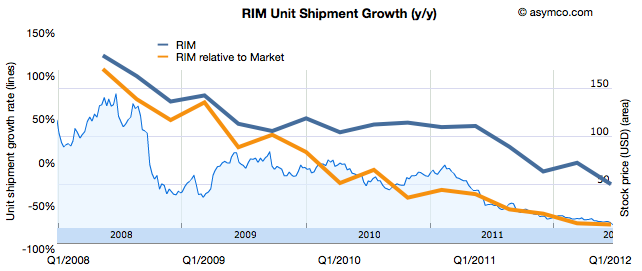
    RIM's 7.8 million units is the same level of sales as it had in early 2009. The total market was only about 250 million units per quarter then. It's around 400 million today. A quick calculation shows that RIM's smartphone market share has fallen from a peak of 22% to about 6%.

    RIM's stock performance reflects this performance relative to the market.

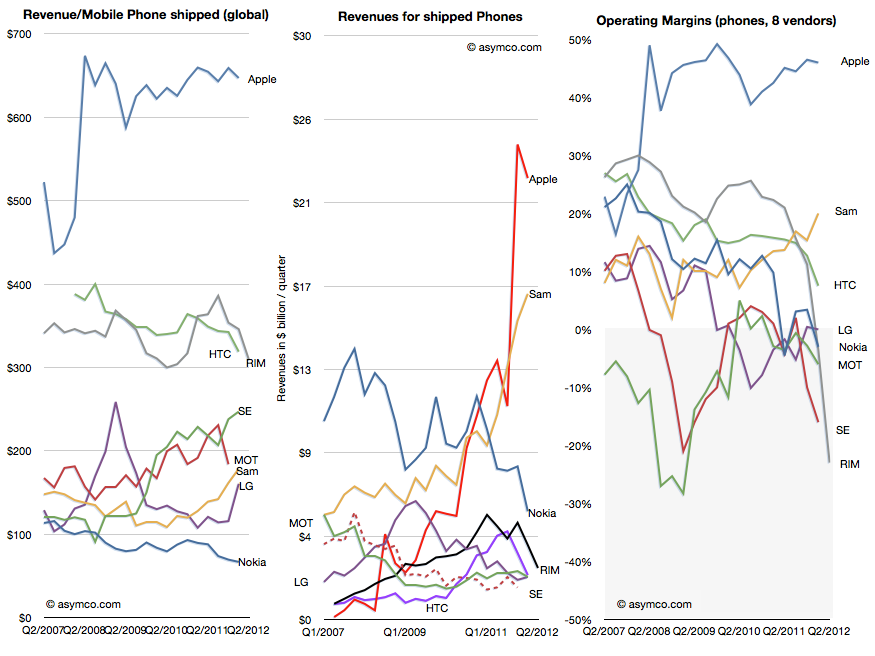
    Hardware revenues were $1.652 billion. Matt Richman calculates the average hardware revenues for the BlackBerry of $203. I include service revenues in my ASP calculations (for Nokia and Apple these are also significant values) yielding $309 per BlackBerry. The history of total revenues, revenues per phone and operating margins are shown below relative to competitors.

    Operating margin tells the most sobering story. As I've often repeated, historically no company has survived dipping into the grey zone.

    To reiterate, the logic of irrevocability in this industry is as follows:

    Success depends on three conditions being met by the vendor's products:

    • consumers trust the platform's promise
    • operator see the product as creating value to their core business
    • developers offer investment to innovate on top of the platform

    If all these factors are present, the vendor enjoys a virtuous cycle of growth. If any of these is lost, the others are also likely to be lost as well creating a vicious cycle of decline.

    Loss of operating margin is an early indicator that at least one condition is not met. Usually, a failure of consumer trust leads to a drop in purchases which leads operators and distributors and retailers to flee and then developers defect.

    It's been impossible to recover from this tailspin so far. There is a procedure which works in theory: accelerate downward by investing in a new platform. The move is counter-intuitive but essential in re-building trust, quality and relationships.

    However, the reason it does not work in practice is that this struggle is not with gravity alone. While spinning downward, the company is also subject to competitive attack. Competitors fill the void and take customers into locked-in ecosystems. There is neither the time nor the ability to defend.

    Cash runs out and customers are divided up between the survivors. Nokia and RIM face this scenario today.

  3. What will happen to Nokia?

    Research · 42 comments

    There is no shortage of information about what happens to companies in distress. The cause of distress varies widely and is often not well understood but the actions and symptoms of distress are very consistent. We can look at examples in each industry, even in each product category for a rich set of distressed company data.

    For over a year I've been chronicling the decline of incumbents in the mobile phone industry. However, decline cannot continue indefinitely. At some point a company "exits" the industry. Either through a sale or divestiture or, rarely bankruptcy. The list of exits is already long. The length and the correlation between exit and the lack of recovery implies that Nokia will also exit.

    But how, exactly?

    Will Nokia be acquired? If so, then by whom? What other options exist? How can we analyze this?

    The easiest way to guess is to look at what happened to other companies in similar circumstances. The clearest and easiest comparison to apply is Motorola. Motorola was at one time the largest phone vendor and it went through a violent decline. Like Nokia, it was diversified into networks and a few other businesses. Unlike Motorola it's not an American company. This matters because American companies are more comfortable targets for corporate raiders. The legal and boardroom mechanics are not "better" or "easier" in the US than in Europe but they are more familiar to those who might engage in it.

    So one avenue that Motorola traveled on was the intervention of activist investors who forced management change, affected strategy and pushed some tactical initiatives. This external pressure was successful in the case of Motorola. The company was split up, it was re-purposed and re-focused and, with a bit of good luck, was acquired.

    The process however still took two years. In that time the company languished but stayed alive. Its headcount was reduced by nearly two thirds. It was in a precarious situation throughout. Its story is not over but ownership did change hands and those who took a risk with it while in distress managed to get a reward.

    This example (and Sony's acquisition of Sony Ericsson and HP's acquisition of Palm) cannot apply to Nokia.  An activist investor is unlikely and the company has not yet made itself attractive to a buyer. So what would Nokia need to do to  be acquired?

    The first step toward an acquisition will be divestiture of its Nokia Siemens venture. The second will be a spinoff or sale of its non-smart phone division. The third might be the allocation of its IP across these separate entities or in a separate holding.

    As the company is broken up, value can be released. Investors will be able to value it better and make appropriate assessments of risk. Only at this point would an acquirer perhaps buy the "rump" Nokia smartphones group.

    However, even this scenario is not without huge risks. By the time the split is completed, the operating companies could have deteriorated to such a degree that they are no longer viable. Timing is critical.

    So if the smartphone group is isolated and made available, who could buy it? Microsoft is always cited as the primary buyer. I've been skeptical of this as Microsoft has found it difficult to make hardware work. It acquired Danger leading to Kin which failed. It has struggled with Xbox for a decade and has yet to recover all its costs for the effort. It has failed embarassingly with Zune. It also has shown no particular success with its original Surface table computer.

    But management has re-committed itself to a new hardware effort with the new Surface. This renewed potential opens up the possibility of entering into the integration of a phone again into their business, and Nokia would be remarkably well positioned to help.

    At this time, the possibility still seems remote. The company has dismissed speculation of building phones again and again. Unlike PCs, the phone platform is not yet mature and volumes and distribution are very different.

    However, there is one other option.

    Microsoft has historically "rescued" technology companies in distress with cash infusions for minority equity stakes. It injected some cash into Apple, Barnes & Noble and even Facebook. It did so not because they wanted to own these companies but because they wanted them to survive or thrive. The move acts as a signal to the industry, partners and developers. So what I see more likely than an acquisition is Microsoft capitalizing a spun-off Nokia Smartphones company in exchange for a small equity stake.

    The valuation of this stake will be huge as I expect billions of dollars for single digit share ownership. However, Microsoft would not be doing it to get a return from those shares. It would probably later sell them at a loss. But it would be buying a strategic option whose value may be far greater.

  4. Who will be Microsoft's Tim Cook?

    Research · 88 comments

    As previously noted, Apple has overtaken Microsoft (and Google) in operating margin percentage. This is an astonishing statistic as Apple is still largely perceived to be a "hardware company" while Microsoft is a "software company" and Google is a "services company."

    To suggest that "hardware" could be more operationally profitable than either software or services is akin to heresy in technology analysis. This reversal is newsworthy indeed. However, even the most casual observer would note that Apple does not derive its market power from hardware alone. It is, in fact, an integrated hardware, software and services company (with a few more roles besides.)

    So the emergent successful business architecture in this technologically transitional period is of integration and completeness of solutions.

    This shift explains at least at a conceptual level Microsoft's tectonic Surface shift.

    But what about another point of view? What does integration mean for Microsoft's income, cost and profit structure? Is integration self-disruptive to Microsoft?

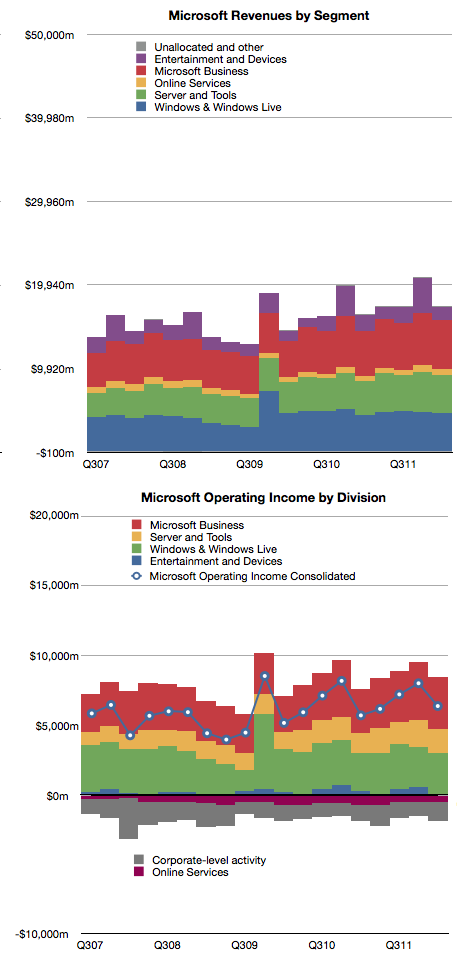
    Here's a reminder of Microsoft's revenues and operating income by division:

    The challenge of devices for Microsoft is that the licensing of software for devices is very difficult to sell.

    In 2011 Microsoft received about $18.7 billion in Windows revenues and $23 billion in Office revenues. The chart shows that this is a fairly steady growth business. According to Gartner, in 2011 there were about 336 million Windows PCs sold and that this too is a fairly stable and mature business.

    If we simply divide revenues by PCs sold we get about $55 Windows revenues per PC and $68 of Office revenues per PC sold [1]. The total income for Microsoft per PC sold is therefore about $123. If we divide operating income by PCs as well we get $35 per Windows license and $43 per Office license. That's a total of $78 of operating profit per PC.

    Now let's think about a post-PC future exemplified by the iPad. Apple sells the iPad with a nearly 33% margin but at a higher average price than Microsoft's software bundle. Apple gives away the software (and apps are very cheap) but it still gains $195 in operating profit per iPad sold.

    Fine, you say, but Microsoft make up for it in volume. Well, that's a problem. The tablet volumes are expanding very quickly and are on track to overtake traditional PCs while traditional PCs are likely to be disrupted and decline.

    So Microsoft faces a dilemma. Their business model of expensive software on cheap hardware is not sustainable. The future is nearly free software integrated into moderately priced hardware.

    For Microsoft to maintain their profitability, they have to find a way of obtaining $80 of profit per device. Under the current structure, device makers will not pay $55 per Windows license per device and users will not spend $68 per Office bundle per tablet. Price competition with Android tablets which have no software licensing costs and with iPad which has very cheap software means that a $300 tablet with a $68 software bill will not be competitive or profitable.

    However, if Microsoft can sell a $400 (on average) device bundled with its software, and is able to get 20% margins then Microsoft is back to its $80 profit per device sold. This, I believe, is a large part of the practical motivation behind the Surface product.

    The challenge for Microsoft therefore becomes to build hundreds of millions of these devices. Every year. Sounds like they need a Tim Cook to run it.

    ---

    Notes:

    1. Microsoft accounts for revenues using deferrals due to Software Assurance pre-payment models for many corporate customers so this figure is not a precise value for each license sold.


  5. Beneath contempt: The Apple TV business model

    Research · 98 comments

    Last year we sold ... 2.8 million Apple TVs. This year, just in the first six months of our year we've sold 2.7.

    Tim Cook at D10 1:45.

    I note the "our" in "our year". This implies fiscal year (that and the fact that he spoke in the past tense before six months had passed in the calendar year.)

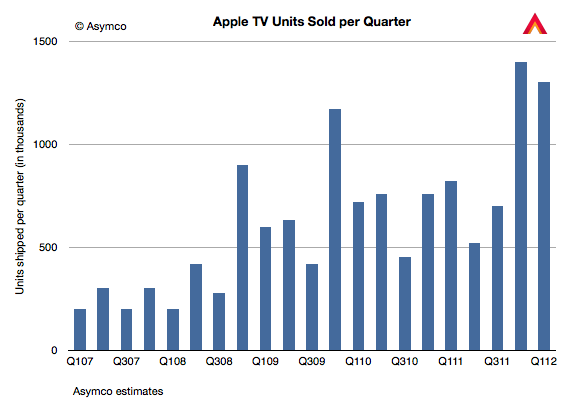
    Given the public information we have so far, it's now possible to estimate with some confidence the sales history of Apple TV. The following chart is my estimate. It includes all the known data so far with some interpolations to fill in the gaps.

    Assuming average revenues per device of $100, we can get an estimate of about $344 million in Apple TV hardware revenues for calendar 2011. This is not a large amount relative to Apple's other lines of business. It is, for example, only 14% of the overall Peripherals revenues and only 5% of the iPod.

    However hardware revenues are not the whole story. The business model for the device is in many ways the polar opposite of the business model of the iPhone. Whereas the iPhone employs "break-even" iTunes App Store (and the Music and Video and Book stores) in order to sustain its high hardware margins, the Apple TV business has low hardware margins that sustain content.

    The complete picture therefore has to include an assessment of the content attach rates and the agency fees that Apple gets for that content.

    Let's assume that each Apple TV is used to generate $10/month in content sales. This is not a lot. It's equivalent to 5 TV shows or one movie purchased or two movie rentals per month. The model I have shows that the installed base of Apple TVs was about 10 million by the end of 2011. That means that the run rate is $1.2 billion in content sales for the Apple TVs in use.

    Now Apple does not book all that. They book only about 30% as revenues as their agency fee. That means that Apple TV could be generating revenues at a run rate of $360 million (to Apple.)

    If we add that to the $344 million in hardware revenues we get about $704 million for 2011. This is still not a huge business. It is about equal to the revenue from iPad Smart Covers[1]

    Looking forward, if Apple TV units sell at double the rate of last year and we increase the footprint accordingly, we could see a revenue rate of $1.2 billion for 2012.

    Now this is not a high margin business. The margin on the content may be less than 50%--depending on transaction costs and hosting/traffic fees. The margin on the hardware is also likely to be below 40%. So the business is not wildly profitable. But it probably is profitable. Which means it makes sense to keep it running while waiting for other pieces to fall into place.

    As Tim Cook repeated, they are very interested in this space. However, any discussion of the future must include an analysis of the business model and the sustainability in terms of profit that keeps long term development focused on getting the product to be good enough for the right jobs to be done.

    What we should think about however is this "polar opposite" business model. Apple is running this as a "hobby" or as an internal experiment. Sales are (relatively) tiny but it generates some profit. Volumes are small but they are growing. It's taking a heck of a long time. It's asymmetric to the prevailing model the company relies upon. It's beneath contempt from all observers. Sounds familiar?

    ---

    Notes:

    1. In 2011 there were about 40.5 million iPads sold. If we assume half of those purchases also resulted in a Smart Cover purchase and if the average revenue per Smart Cover was $35 then total Smart Cover revenues were $709 million.
  6. Shipped and sold: A brief introduction

    Research · 42 comments

    Markets are difficult to measure. Mainly because the information is not easy to obtain and that which is obtained is not made public. Collecting, analyzing and filling in the gaps is big business with many firms involved in selling it.

    However, with all the analysts and companies selling and promoting their "numbers" it's important to understand the difference between the methods used. There are for instance at least the following measurements:

    1. Units sold to end users. For example NPD or GfK data of retail transactions. Also Gartner's estimates for phone units sold.
    2. Units sold to the channel. For example units recognized on income statements usually reported by companies. Also IDC's estimates for phone units sold.
    3. Units in use. For example comScore and Nielsen survey data.
    4. Units "activated". The measurement Google uses to describe Android performance.
    5. Intent to buy. For example ChangeWave surveys of early adopters.
    6. Utilization rate. For example browser statistics.

    Each measurement tells a different story about the market but the best story is told when all data is analyzed in a combined integrated market review.

    Before diving into that it's important to understand the difference between the first and second measurements or the difference between shipped and sold.

    What does "Sold" mean?

    Let’s say that you sell a phone to another party. What constitutes a sale? The sales agreement? That you shipped it? That he wanted it? That you were paid for it?

    What if he changes his mind and returns it? Is it still a sale? What if a manager's bonus depends on these sales? What if the company’s share price depends on these sales? Is there a way to rig the accounting?

    As it turns out, yes there are; many ways. Unethical and fraudulent practices happen surprisingly often. A classic instance would be: A customer is shipped ten phones, though he only wants one, and he gets paid to ship the other nine back, after the close of the year.

    The sales manager records ten times the sales he actually made, making ten times the commission and the company’s stock price rises. To compound the offense, the manager could also tip his friends to short the stock at the end of the year, leaving investors “holding the bag” when the inevitable correction follows.

    There have been so many cases of this kind of accounting fraud that the FASB (GAAP), SEC, and IFRS have placed a very stringent definition on “revenue recognition”. This means that although you can sell all you want, the company can only recognize the proceeds and profit in the financial statements according to strict rules.

    In the case of hardware (Sales of Goods), the customer must receive it (“delivery has occurred”), and like it enough to not return it (“amount to be refunded”), and be able to pay for it (“collection is probable”). If some are projected to be returned or unpaid, that percent is subtracted from total revenue. In the case of software (Sales of Services), it is generally accounted for over a time period. And because it is customary to send the customer upgrades, the revenue must be spread out over the time the service is provided. (“upgrade rights … 24 to 48 months.”)

    It gets complicated when a piece of hardware has upgradeable software. The rules used to stipulate that the hardware, in its entirety, must be accounted for as a service and have subscription accounting. This is how Apple had to report sales during the first few years of the iPhone. It still defers some revenues for its hardware, mainly on account of iCloud, but the vast bulk of hardware revenue (96%) is now accounted upfront, recognized upon the product's acceptance by customers. 4% is for software upgrades and is accounted for over a specific lifetime of the product (24 months in the case of the iPhone).

    What does "Shipped" mean?

    The discussion so far implies that if a product that is accounted for as "Sold" on an income statement does not mean that it's in the hands of an end user. These "revenue recognized" products are sold to a distributor, typically for a phone that's an operator.

    These sales satisfy the requirements for financial reporting as revenues booked. But they are not in the hands of users. Nor are they "activated" and they don't generate page views that are measured by web analytics companies. Most analysts and companies now use the phrase "Shipped" to describe these revenue-recognized units though it's also common to hear "sold".

    When a product sells to end users it's sometimes called "sell-through". It's counterpart is "sell-in" which is sales to the channel distributors.

    A big gap between sell-in and sell-through might imply large amounts of in-channel inventory. This is product that is sitting either in stores or in warehouses or on trucks in transit. If sales are steady, the inventory is measured in time as in "weeks of inventory". This means that the excess is expected to be sold within a fixed time frame if shipments were to end. The smaller this amount, the better or "tighter" the operations are. Inventory, as Tim Cooks says, is fundamentally evil. It eats capital and erodes profitability.

    Sometimes miscalculation of sell-through could result in vast amounts of inventory that has to be returned by distributors. That inventory is either written off or sold at fire sale prices resulting in a "write-down". This happened recently with both the HP TouchPad and with the RIM PlayBook. This special charge against income is a one-time (usually) incident but it can also affect a firm's reputation with channel partners for a long time. This type of failure is very costly.

    Therefore what matters most is to keep the difference between Sell-in and Sell-through as small as possible. However, it can't be too small. Sometimes if Sell-through is too fast, you get stock-outs which means that there is more demand than supply and sales opportunities are missed. This has happened many times with iPhones and iPads. This is also an unwanted situation (unless there was too much inventory in the channel during the previous period and thus it was being drained in the current period.)

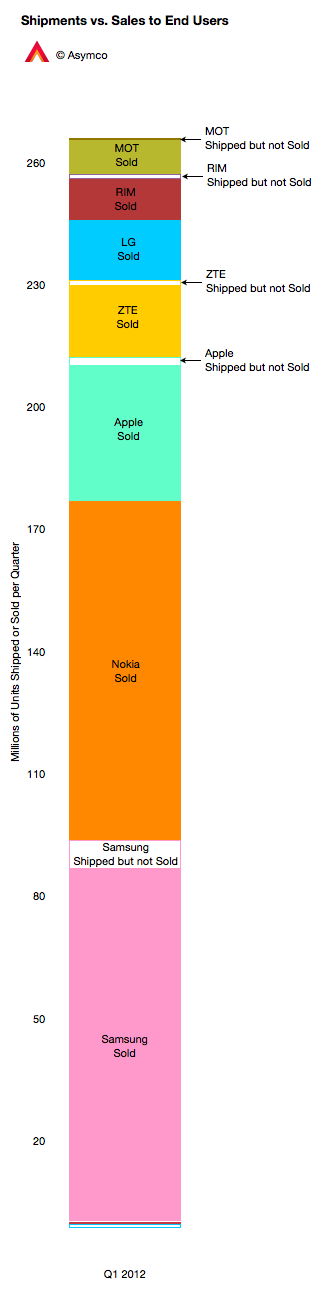
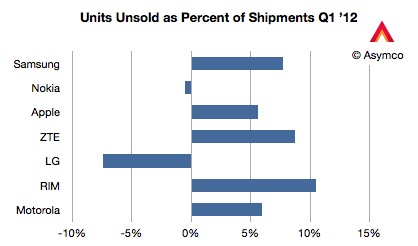
    The chart to the left shows how the phone market looked for various vendors last quarter. I compiled the data based on Gartner's "sales to end users" and IDC's "shipments" data. Two vendors had higher sell-through than sell-in (Nokia and LG) probably because they were draining excess inventory. The others had channel inventory of between 5% and 10% of units shipped.

    This ratio is shown below in a chart comparing the largest phone vendors.

    Management is often rated for performance on this metric, as they should be, since it's a measure of operational skill. However, there are many factors that affect overall performance.

    New product launches, windows of opportunity related to seasonal buying patterns, anticipating macroeconomic slowdowns, even natural disasters and legal challenges can affect this metric.

    Understanding the overall market requires an appreciation of this distinction but also an understanding of all the other metrics listed above and what stories they tell.

    ---

    Notes: My thanks to Michael Dediu for input on this discussion.

  7. An interview with Kenney Ho of The Chosun Daily of Korea

    Research · 21 comments

    Kenney Ho, a staff reporter from Korean newspaper The Chosunilbo (The Chosun Daily) sent me a set of delightful questions.

    According to Kenney, The Chosunilbo "has a history of 90 years, has been the most dominant, and influential paper of all time in Korea. It is the No.1 newspaper company in Korea with more than 1.8 million circulation, firmly holding the largest market possession. The paper is recognized Asianwide, where there are many readers in Japan and China."

    -You said "All mobile device vendors experiencing losses are not likely to really recover". Even though, it wouldn't mean that the employees, executives of Nokia has completely nothing in hands for recovery. If you are the CEO of Nokia right now, What are your steps to make Nokia recover its deficits?

    My statement was based on the historic data which shows that 14 phone vendors have either exited the business or lost their independence during the last decade. No vendor that has reached a period of prolonged loss making has recovered. These are just observations and it's possible that Nokia may be the first to recover. However, going by the patterns of the past, it would be very unlikely. When I thought about the reasons why companies have not been able to recover I came to the second observation about the way phones are sold. Once a brand reaches a point where it's considered "risky" for distributors and operators to range they tend to defer purchases which leads to a spiral of continuing losses and more damage to the brand. The market amplifies "distress" and recovery becomes impossible.

    If I were the CEO of Nokia I would set course for turning the company into a new business. I would approach the market asymmetrically and not try to compete directly with the other vendors. I would look toward services, platforms and software solutions and de-emphasize hardware.

    -Many experts say that because Nokia dominated phone making industry in the 2000s, they maintained a corporate culture of complacency, which led them to decline. Do you agree with this? If you agree, Can you point out the examples of Nokia's complacency?

    Complacency would mean that Nokia would not invest or try new things. This is not quite right. The company invested in software, services and platforms. It tried many new things and had a large R&D budget. It was the leader in mobile software for many years. There was, however, a culture of arrogance about their position. This meant that they did not think the basis of competition would change. They thought they were too big to fail. They did not challenge the core business model of hardware-first and try to find an internal disruptive business.

    -Experts note that Nokia should have reacted directly to Apple's iPhone appearance at 2007. What should have Nokia have done at that time?

    The iPhone showed that software and experiences matter more than operator relationships. Nokia did a lot of research on user experiences and software but when the decision came to implement the ideas, the constraints of hardware and logistics and operator preferences took precedence and the software was compromised. What Nokia needed to do is build product around software not software around the hardware and the market.

    -Since Apple's iPhone appeared in 2007, Samsung took a Fast-follower tactics which made them successful, which Nokia could not. Do you think Fast-follower have advantage over first-mover?

    I don't consider first-mover or fast-follower to be accurate descriptions of strategy. Success follows from innovation and only from innovation. There are various forms of innovation: there is new market creation, new business models, low cost or distribution innovation. Nokia tended to create low cost innovations which opened new, low-end markets. Apple created a new market for browser-based devices and for app-based experiences. These were enabled by an ecosystem that benefited from integration.

    Samsung implemented a portfolio strategy with a large number of devices and price points which allowed them to find market niches that could be exploited. This was a distribution innovation. Each strategy has advantages and disadvantages and each strategy is usually linked to company core priorities and processes. There are times during a technology cycle when one strategy is better and another is worse. This is why companies find themselves successful and then fail. Their processes don't match the technology adoption cycle.

    For example, in the PC market there is little potential for new experiences tied to an integrated device (except for tablets) and hence there is little growth opportunity for an Apple-like approach. The innovation that matters in the PC market is mostly cost reduction. Nokia was doing cost reduction at a time when voice products were commoditizing. Cost reduction does not work when the basis of competition is new experiences and new business models. As smartphone hardware commoditizes, it's unlikely that Samsung will have an advantage unless is goes to a low-cost approach and enters into direct competition with low-end devices.

    -Can you predict the 'Big 5' in handset industry 10years from now? Many people think the list will include Apple, Samsung. Who else might be on the lists?

    There is no guarantee that Apple or Samsung will be the top vendors 10 years from now. I expect Chinese brands to become dominant in market volumes. I expect online service companies like Amazon, Baidu, Facebook to create new platforms which and have their own devices, perhaps in large volumes. I expect new input methods (like voice) to create new opportunities and perhaps new platforms and ecosystems. I expect Google may make a lot of money. One thing is for sure, being a hardware-oriented company without software and services and platforms and ecosystems is a sure path to becoming disrupted.

    -Nokia was the leading company in Finland. What are the reactions of Finland towards Nokia's downfall?

    People tend to blame each other for failures and this is the main discussion topic in Finland: who's to blame. The failure of a company is rooted in complex decision processes which usually take years to run their course. It's quite futile to lay blame on persons, especially since the same persons were celebrated for their wisdom at another point of time. At the same time as Nokia is failing however, another Finnish startup is celebrated world-wide and about to go public: Rovio, the maker of Angry Birds. It will be bigger than Nokia. Finland should make sure there are more Rovios to come.

  8. Which is best: hardware, software or services?

    Research · 43 comments

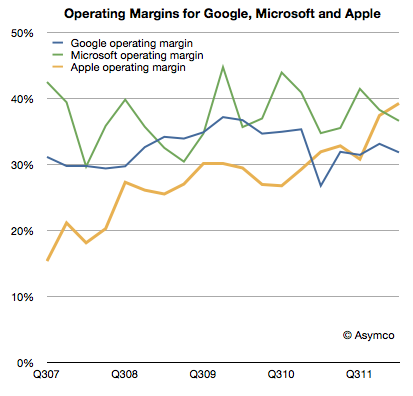
    Apple's recent margins are nothing short of spectacular. It's hard to convey just how remarkable 47% gross margin and 39% operating margins are. For a company that sells hardware these are simply unheard-of numbers.

    The best way I can illustrate this is by comparing Apple's operating margins with those of two other platform-based companies, Google and Microsoft.

    Microsoft invented the software-as-a-business model and, as software is easily reproduced, their margins are phenomenal. The gross margins are typically in the 80% range for software. Overall, the company had higher R&D and SG&A expenses so their operating margins are a more modest 37% on average. However, Apple managed to exceed this value even though it has the disadvantage of actually having to build things made of atoms.

    Google also has led a charmed life free of inventory and factories. Its operating margins have been however hurt by investments needed to sustain the infrastructure for indexing the internet. That means that their margins have hovered around 33%.

    As the chart above shows, Apple has been creeping up on both these benchmark companies with exceptional operational leverage and, as of this last quarter, overtaken them.

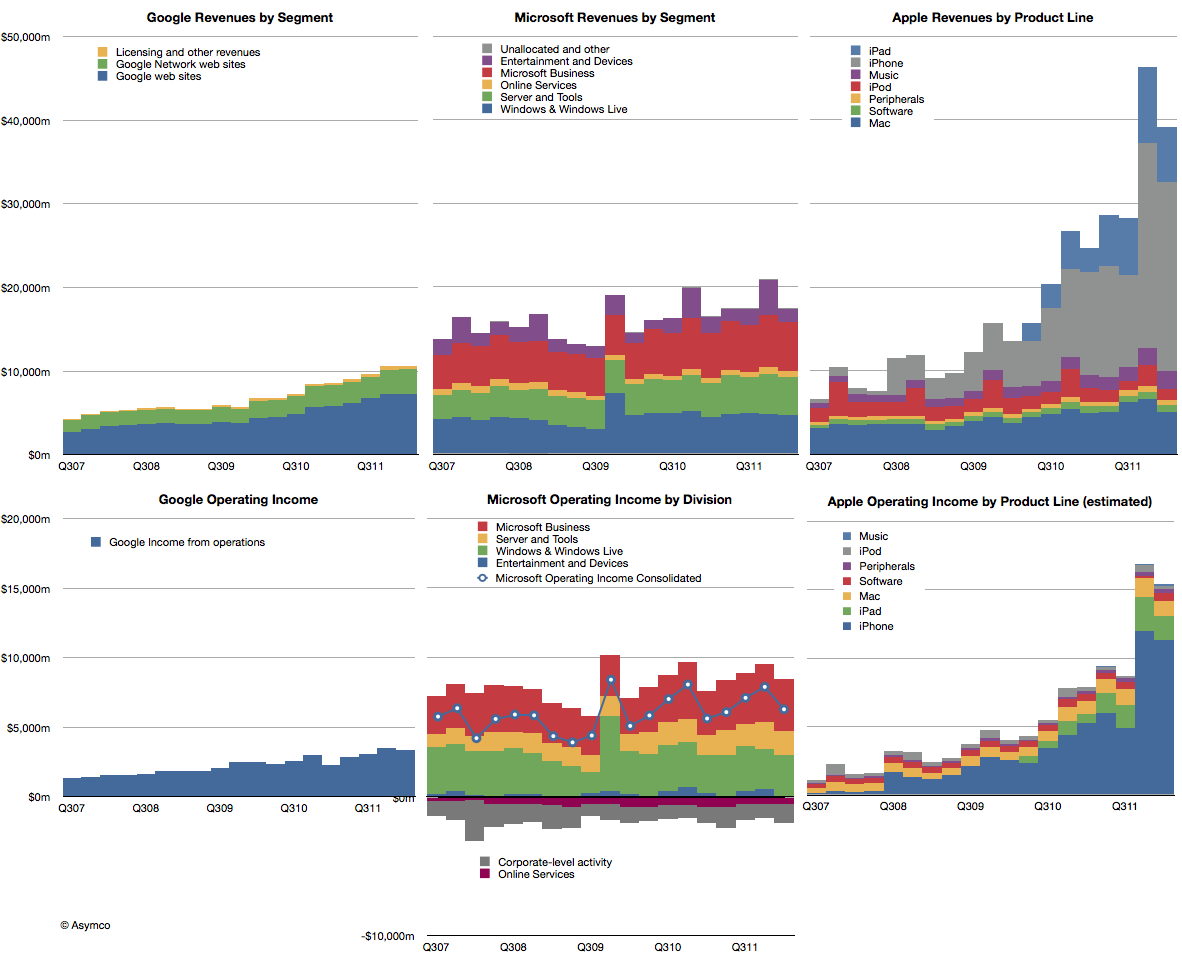
    The reason Apple is able to do this is that its iOS businesses are extremely profitable and, as those businesses grow in absolute terms and relative to its other businesses, the overall margins are reaching into the stratosphere.

    The impact of iOS on Apple is shown in the right-most two charts below. The difference in growth relative to these other great companies makes Apple all the more impressive.

    But the temptation is to compare the "core" business models and ask which is best: hardware, software or internet services. It would seem that hardware is winning, suddenly getting the best margin and best growth--a dramatic reversal with prior technology business dogma.

    However, it would be a mis-reading of what allows Apple to succeed. Apple is the most valuable company in technology (and indeed in the world) because it integrates hardware, software and services. It's the first, and only, company to do all these three well in service of jobs that the vast majority of consumers want done.

  9. Jim Zellmer interviews me about my life

    Research · 45 comments

    This is a transcript of a voice interview conducted April 19th 2012.

    The interview is available as an audio file here.

    --

    Jim Zellmer: I thought we'd start by describing your education from the beginning, Horace.

    Horace Dediu: OK, that's good, yeah. I like to say I'm the product of the public school systems. I went to public schools in three different countries, and probably maybe a dozen different schools altogether because we moved a lot, moved over 30 times.

    My family emigrated, and we were what you might call political refugees for a while. We were stateless. We didn't have passports. We were officially not citizens of any country. So, for a period of about four or five years, that was the case. I started having regular schooling in Romania, and then moved to Italy and was enrolled in a school, actually, in the city of Verona, which is where "Romeo and Juliet" was originally set.

    I was saying...my background. I spent a year in school in Italy, and I went to school in the north of Italy, in Torino. The thing was that I didn't know Italian, so I actually had to learn. But that's a lot easier for children. I was about nine, I think. And so, I learned Italian, was able to have a good school year. But then we moved.

    In the summer, we moved again, and we emigrated to the United States. It took about a year to get the paperwork for that--because that was our ultimate goal was to be in the US. I was enrolled in the public schools. First, in Cleveland, where we found someone to help us. I actually went to, I guess, elementary school in the city of Cleveland, where we lived.

    And then, later on, for middle school... What happened in Cleveland around that time was that busing started, desegregation. It would have meant, for me, more than one-hour journey across the whole city, from the west end to the east end of Cleveland, and my parents would have none of that. So, we moved to a suburb, immediately adjacent, which is called Lakewood. I went to middle school and high school in Lakewood, Ohio, for three years in high school.

    And then, we actually moved yet again, to Boston. My father got a job in the booming tech sector at the time, which was in the early '80s. I ended up in a suburb of Boston called Medford. We didn't know much. Again, we were flying pretty blind here. We weren't familiar with neighborhoods or what were good schools or anything like that--"good schools." Mostly it was a question of, "Can we find affordable housing?"

    Medford turned out to be a pretty lucky choice. In one hand, at the time, it was a blue-collar town. It was one of the near suburbs. So the closer to the city, it tends to be the older the immigrant generations are. It was settled mostly by Italian Americans. And so, a lot of the children I met in school were of some ethnic background.

    Again, in the Midwest, that was a bit more rare. So East Coast, for me, was a little bit more vibrant in the sense that there were more interesting ethnic backgrounds and people from different histories and so on.

    I enjoyed it, but I only had one year at Medford High School. It was actually more enjoyable, that year, I would say, than my years in Ohio. I have friends that I retained from that one year, and I don't have friends I stay in touch with from Ohio.

    But it has changed. The city since has become much more, I would say, a lot of those families moved yet again, probably to a further suburb, and has changed character. I think it's more Hispanic now, the city overall. Nothing wrong with that, it just probably would feel different to anyone there now.

    I was, again, in Medford. My choice, my next question, was where to go to college. I had been doing OK in school. And that was an interesting puzzle to solve as a kid, because you don't quite know how to fit in, the usual problems. Fortunately, having moved around so much, I had a pretty thick skin, and having had an accent or a strange background just made you a little bit tougher. And so, I was pretty immune to some of the high-school politics.

    I focused on studies, and my parents are both educators. My father has a PhD in mathematics, and my mother had a Master's in mathematics and she taught. Actually, her job was as a teacher. They both got certified as teachers in the United States. My father had taught, also, university in Romania, but he ended up teaching high school and other two-year colleges in the US. It's very hard to go into academia from another country.

    In any case, the fact that I had such devoted, academically inclined parents helped in focusing me on academics. That also, I think, was my nature. As far as college, my concern, we always had financial concerns, right?

    Jim Zellmer: Right.

    Horace: So, for me, I wasn't interested in the social aspect of college. For us, really, the decision was, "Can we keep expenses down?" I was accepted at Tufts University and also at Brandeis, which were local. That was important to me, that it would be near to my home and I could actually commute to these places.

    Tufts was slightly better. It was a little bit closer. It was actually in Medford. So, I almost went to the college that was nearest to me. It had a very good program, also, in both engineering and computer science.

    The odd thing is now, in college for me, was that - it's almost accidental - but, they had an option for you to take two degrees. The dual degree program was meant for people to study liberal arts and engineering. The idea would be you'd be a well-rounded individual.

    The weird thing is that when I went there, which is 1985 to 1989, the School of Liberal Arts included the mathematics department and included the computer science department, which is a spinoff of the math department. So, computer science was a Liberal Arts degree; whereas, engineering was like electrical, mechanical, and so on, the traditional subjects.

    I enrolled in the dual degree program with the intention of obtaining a computer science degree from the Liberal Arts School and a computer engineering degree from the School of Engineering. That meant that I would essentially take about 30 percent more courses. I think it was 50 credits versus the standard 30, or so. So, I was going for incrementally more material, but I would end up with two bachelor's degrees.

    That's what I did. I actually also did it in an accelerated fashion. I ended up doing that in three and a half years, rather than what they expected it to take, five years.

    Jim Zellmer: Wow.

    Horace: That involved a lot of summer school. I was actually going through taking some of the requirement courses in the summer. So, I was basically a student 365 days a year and I managed to get the two degrees.

    In the third year, there was one of these internship opportunities for research in a lab, GTE Laboratories.

    Jim Zellmer: I'm sure.

    Horace: GTE Labs was, again, local, which was important to me. They actually put us up in the dorms. So, the only time I spent living in a dorm was during the summer of my internship because it was paid for by the employer.

    That was a great time. I loved it. I absolutely adored it. Those years right at... In my third year, which actually was my, I guess, my second year as I was a junior a bit early, I was going through this internship and I was studying, I was going working in the research lab. Then I ended up doing my senior year, my last year, I kept going back there. Somehow they kept me around as a part time employee because the project I had been on turned out to be useful.

    It was in the library. I was actually working on indexing, which turned into search, which turned into Google later on, but we didn't know what it was then. We called it information retrieval. The algorithms, so we now do search intuitively when it actually became a commercial product, but it was something we did as research back then.

    It was great because I was getting the experience I wanted desperately, loved it, and then I was still in school and I managed to get my degree. I was even earning money while I was doing this. It worked out very well, but it was a very tough period.

    I graduated with not the highest scores, but I think I was magna cum laude, or something like that, which is not summa cum laude, but it's pretty good. It's like 3.8 GPA, or something like that. That's it. I don't know if that's what you wanted to hear. Then, of course, I did grad school.

    Two years, while I was still employed. I took a full time job at the labs, then essentially I did two years. In '92, I got my Master's in computer engineering. Then I spent about a year or two figuring out what to do next. I went to New York to have a bit of experience. Oh yeah, I remember. I applied to Harvard because I wanted to go to business school. The reason I wanted to go to business school was I didn't understand business.

    Jim Zellmer: [laughs] How did that play out? MBA's are often criticized.

    Horace: Yeah, I'll tell you how it played out. Well, first thing is this. I'm sitting with my friends. We're all engineers, hackers, if you will. We're like, "We don't understand. We don't understand how we get funded."

    Here we are sitting in these nice offices, but how does this company, who's basically a boring utility, how are they going to fund us to do cool stuff? We just compared notes and nobody knew. I realized none of us knew how business worked.

    I said, "Well, I better learn about this." To me, I had been so focused in engineering that all this business stuff, the only thing I knew was because I would read the "Wall Street Journal." I didn't have either friends, acquaintances, families. All my friends were nerds. All my family were educators. I knew nobody, literally not one person, who could tell me how the stock market worked.

    I would pick up the Wall Street Journal, read it cover to cover, and I wouldn't understand what the heck they were talking about. It sounded very abstract to me. It sounded like I need to learn something that there was something missing in my education.

    I felt that the only way to get that training was to go to business school. And so, I applied. I was rejected, and the assumption was, in my mind, that I was too technical, too focused in a very, very narrow niche. Back then, there were headhunters that were trying to headhunt people. So, one headhunter got a hold of me and they said they had an opportunity in New York. I said, "Oh, New York. I know they do business in New York. So I better learn more from going to New York."

    And so, I took a job with Chase Manhattan, at the time. It's called something else now, but it was Chase Manhattan. The job was also in IT, but at least it was IT, more pragmatic--corporate technology they call it. But I was there trying to understand more about business. I would still read the "Wall Street Journal" every day, still wouldn't understand it.

    I reapplied to business school. I told them what I did. I said, "Look, I took this job because I wanted to learn business." I think I somehow convinced them the second time because I was so mad to do these things.

    Jim Zellmer: Persistent.

    Horace: Persistent. Somehow, I got accepted. I'll never know how they made that mistake.

    Jim Zellmer: [laughs] Yes, of course.

    Horace: But, anyway, once I went there, I was like, "OK, teach me." Now, the problem was that you start to learn with the case method, and you realize pretty quickly that there is no real curriculum. This is actually a lot of examples you're being given. It's not even empirical. It's like, "Let's throw a lot of examples and see if something makes sense in a pattern somewhere."

    Jim Zellmer: This was Harvard?

    Horace: Yeah. So, Harvard Business School. It was the only school I applied to, because I felt I didn't know how to qualify quality in terms of business. It was just a brand name. If you know nothing about phones, you just buy the iPhone because you know it's the best, right? So that was me, very naive. And throughout the school, it wasn't as rigorous.

    In many ways, it was easy, because in engineering, engineering is very hard. You have to take test and you have to get answers right. And then in business school, it seemed like you just had to talk and you had to be articulate and you had to somehow be sufficiently smart-sounding to succeed.

    Jim Zellmer: The theater, aesthetics.

    Horace: Yeah. They drilled that into you. They said, "This is what we're teaching you is how to basically be a leader," and that leadership meant being proactive, not being passive. It meant getting in, if you will, on the discussion. I got that. I got it. It made sense to me because, yeah, in the meeting, if you sit there and say nothing, probably no one pays attention to you. You won't go anywhere in life.

    So that was one of lessons. The other ones were about vocabulary. What we're not learning here, however, is that there's axioms. There's no specific rules of business. In fact, if you were to put rules down, there'd be many which would contradict each other. One of the classics is that money now is better than money later. But you need spend money now in order to have money later.

    Jim Zellmer: [laughs]

    Horace: So these two things are contradictory. There were no rules in business that made any sense as if you were proving a theorem or something like that. I decided all right, let's just go with the flow. I met nice people. I learned more from a lot of people.

    The best thing that happened to me is that I had Clay Christensen as a professor. He was the nicest guy. The way he taught, it just resonated with me. He hadn't yet published "The Innovator's Dilemma." He was only teaching us operations, which is a first year course.

    It's the only technical course in the sense that you do some process diagrams and you do some analysis. Finance is another analytical course, but the math is pretty straightforward. It's not very conceptual, in a way. Accounting is not either. It's interpretation.

    But the professor, Christensen, he had a way of speaking to me that made sense as an engineer. It wasn't just me, there were a lot of people in the class who just felt that this guy was getting to the heart of a lot of the questions that we had. I took him as much as I could. I also had the option to take him in the second year. But, unfortunately, there was change in the dean and I think he had to change courses that he was teaching in the second year.

    In any case, we had a good two years there. My question was, what do I do after I graduate? This was 1996. The Internet, at the time, was just emerging. Netscape existed as of 1994 or 1995. There were no Internet business models per se. Certainly, there was a technology industry. But it was pretty much boring and either IBM or commodity PCs and you had a bunch of software companies like Microsoft and Adobe.

    It was already getting a little bit tired as an industry. As an MBA, it wasn't really that exciting. Everybody was doing either consulting or investment banking. Those were the typical ways of getting out of school. I had, of course, done something different. I did a startup. And nobody...

    In fact when I told people I wanted to do a startup everybody said "You came to the wrong school. No one goes to Harvard to learn how to do a startup. There are specific schools that  train you for entrepreneurship." Like for example, Simmons or something. I forgot the names now. Maybe that's a women's college. I don't remember the names.

    But the point is guys were saying "No, when you come out of here, you are either going to become a CEO of a Fortune 500 company or you're going to be a consultant for life or you're going to be in finance, managing other people's money or in private equity." I was like "Oh man. All right, well, whatever."

    Jim Zellmer: [laughs]

    Horace: I went and did this startup. I did a startup with no VC money. It was done with a partner in California who had raised money from the government using SBIR grants.

    We're talking the Department of Defense, and we were doing algorithms research. I went back to my university and recruited an engineer who I worked with in a basement office right off of Massachusetts Avenue. That was in '96. We built a system. We ended up licensing it to Adobe. It was a plugin to Acrobat. We didn't benefit much from it financially. Other people made a lot of money but not us.

    But we did learn a lot. So I'm thinking: In business school, I didn't really learn how business works, but I have this degree which gives me credibility. Now, I'm going to do my own business...

    Jim Zellmer: It's a ticket horse, yes.

    Horace: Yeah, but I did my own business. I threw away the ticket.  It didn't help me at all. What I was realizing, for example ... I didn't know how to do sales. I thought when you're doing your own business, you actually need to know how to do sales, and they don't teach you that at business school. I actually went and took a sales course, like they do in a daylong seminar.

    I'm saying there are so many pieces that are missing. I didn't know how VCs, how to handle VCs and how to do pitches and do all these things. And none of that was taught, so I thought, OK, what I'm going to do? I'm going to do on-the-job training. I'm going to figure this out. And [learn from] networking with people in technology.

    Eventually, I decided from the learning we had in the first startup to do another one, to do e-books! That was 1999. I'm trying to do an e-book startup in 1999. [So] I get on a standards body. I'm doing something with folks and I'm actually in a standards group that includes people from Microsoft, from Adobe, from a bunch of other startups, and from Nokia.

    Actually that's where I met someone from Nokia, who...

    At the time--it was 1999--I realized at that moment, with or without Nokia, I said, all computers are going to be handheld devices. This is so obvious. I can't express how obvious it is. I was interested, because Nokia had pretty much at the time the best mobile devices.

    Jim Zellmer: Yeah, they were the player, no doubt.

    Horace: I was asking myself, look, everybody in the U.S. doesn't get mobile. It's obvious that either it's Japan or Europe. And so, the question in my mind was, do I stay with the technology industry and try to figure out how this mobile computing will play out, or do I go to somebody who really knows mobile and expect that they will actually figure out how to become a computing company?

    I chose the latter, partly because they also offered me a job and the dot-com bubble burst, and I wasn't ever going to get funding for my e-book business, which was called Handheld Media by the way. It was a great idea, great business idea, that we would actually help publishers convert books. Because at the time, the publishing workflow didn't include exporting tools. You either went to print or PDF, and we had this tool that would reformat a PDF book into a publishable format, like what e-pub is now.

    Jim Zellmer: E-pub, right.

    Horace: At the time, it was called OEBF, Open E-Book Format. It was using HTML, a variant. I actually had a workflow I could execute on my own and I could basically produce e-books. I did a couple of dozen, mostly as trials. I remember them even now, actually going through and manually extracting hundreds of pages, fairly quickly though.

    But, anyway, that all came crashing down because although e-books were still interesting, there was no more funding in the docket. I had the opportunity to work with Nokia because they were actually very interested in launching something, not necessarily in e-books, but in media distribution. They wanted to sell music. They wanted to sell video. They wanted all those things in 2000. I came to them. Now, I'm playing my ticket, my bus ticket.

    [The job] was something about how to do business strategy. They hired me. I had this technical background as well. One year I spent based in Boston. But then I was fairly quickly moved to Finland because that's really where you need to be to have any career opportunities. I was young. I was not married. Finland has its charms.

    [I met] another American ex-pat who had moved there before I did and he extolled its virtues. I was pretty sold on that. Even though you pay more taxes, you get less wages, everything I did was economically the wrong thing to do.

    Jim Zellmer: [laughs] That's a learning, though, too. You've learned a lot. Looking back on all that, Horace, what might have been better or more effective? When you think about your kids today...?

    Horace: I don't know. I'm probably having too long of a chat on this, I mean fooling around this. But yeah, I'm very conscious of education, as I said. I realized pretty much after a year after leaving ... When I started Asymco, it's very weird. Again, you never know when you start down a journey where you're going to end up.

    It was purely going to be app development because apps were just starting out. Apps were really almost invisible or there was no development going on in Europe. So my idea was why don't I bring iPhone apps into the land of Nokia, because here it's a green field site.

    Jim Zellmer: Yes.

    Horace: But it was a tough sell. I got one customer, but it was very, very tough. I wanted to bring apps to small and medium companies. I was going to essentially do apps as marketing material, like apps that are essentially a branding thing.

    I was naïve also about the Finnish business culture because I think Finnish businesses are extremely conservative and that wasn't playing out. But the fortunate thing was that I began to blog because I had blogged while I was inside Nokia. I told that story about how I started doing it because I realized I wanted a bigger audience.

    Then when I left, people kept saying "Why don't you do that while you're on the outside, just for fun?" I took that year to figure things out. I  went back to writing my blog. Then, literally, everything was happening in 20 minutes. It was like a fire hose. I had to learn everything. I kept asking: OK, how do I do this?

    So, I am learning every single thing, because I had done it inside Nokia where it was movable type. It was a completely different system. I didn't have to set up anything. It was very simple. It was done for me.

    But on the outside, I am having to do it all myself. I started using actually iWeb, which at that time had a blogging tool. So, I opened an account on MobileMe. I was just putting everything through the desktop tools. They were right under my nose. Then I realized the limitations of that, and I moved to the next thing. I was like, "Oh! Seems like WordPress is something people use. Let's go to that." So, I went to WordPress.

    Then I realized, "Oh! Hang on! If they are hosting me, they are going to put ads in my stuff, and I don't know what they put there. So, I better host myself...how do you do that? " I need to find a hosting provider. How do you do that?"

    So, every technology, every bit of knowledge I had to have, I obtained strictly on my own. I say that every single character written in Asymco and every single mouse click that made it possible was performed by me.

    I had no technical support at all. It helps maybe to have a computer science background, but years had passed. So, I was able to... Here the key to the whole thing is that, every step, I am learning, and it keeps me motivated. I am like, "Oh! I understand how this works."

    I had some friends, who were more technical, and I would ask them, and they would say, "Oh! You are wasting your time. You can't get any traffic. This won't work." I would ask: "Tell me about Twitter", and they would say, "Oh! You're better off on Facebook." I was like, "Oh! Man!" Every single thing that I was given as advice turned out to be...

    Jim Zellmer: Wrong?

    Horace: Yes, doing the opposite would actually be the right thing. And so, I started learn about stats, the numbers game of blogging. So, how does that work? What does it mean to have good traffic?

    I didn't expect to get advertising revenue, but I was thinking: what does it mean to be successful? So, I would go to John Gruber's site. John puts up his own rates, and I am like, "Oh wow! Look at the numbers." He actually tells you how much he charges per week, and then he says he is fully booked. So, you know what his income is. And so, from that, I was like wow! That's my goal I said to myself.

    If I can get the traffic that Gruber gets, then I can charge these rates. I was trying to figure out how much traffic he was getting. He was getting like four million page views a month. I said, "I don't know if that's a lot or not." It certainly is a lot to get money, but you know, how do I get from zero to four million? So, what happened is that also when I was starting out, I reached out to John by email, directly by email.

    Some time before I mailed him and said, "I used to work at Nokia and there's a couple of things you're writing about that I wanted to amplify or I wanted to give you some background." He has great stuff, and he actually used my material in one or two blog posts. I wasn't blogging at that moment.

    But once I started blogging I mentioned to him, I said "Remember me? I sent you that info, and now I have my own blog." He didn't say anything. But then I wrote, I think the first piece that I wrote that was provocative. It was why someone at Microsoft had been fired or something like that. He linked to me. Then I saw. Then my eyes were open, because then my traffic... from zero to 12,000 a day.

    Jim Zellmer: Yeah.

    Horace: 12,000 views, for me, was like infinity. My server crashed and all that. I went back [to him] and I said "Thanks for the traffic. Now what do I do because I need money to be able to get this traffic managed." He said "No, you don't need money." You need to turn on caching." I was like "Oh."

    Jim Zellmer: [laughs]

    Horace: That solved the problem. But then I was asking him "So where do I go from here? Should I think about putting ads on my site? Is that the right thing," because I was so naïve. And he said "No, no, no."

    He gave me one piece of advice. This is the only piece of advice I ever got from and from anybody that was useful. He said "Don't put ads. Just do what you do. Your value is in the future. Just keep doing what you're doing." That's all he said, one line.

    I said "OK. If he says that, I believe it. That makes sense. Let's do it." I kept getting better at what I was doing, basically writing as well as I could, getting the feedback from comments and learning every step of the way.

    This is still going on. One year on, I learned what Twitter really meant. I didn't know Twitter. The first thing I learned at Asymconf was what a hash tag is good for. [I mean] I knew what they were. But I did not use them. I never used a hash tag before Asymconf because I don't use Twitter that way. I don't use it to look up stuff. I mostly use it as a way to get my word out and get feedback, just like a mini micro blog.

    But then I didn't understand the potential of a hash tag. It dawned on me when people were writing about Asymco and using a hash tag and if I searched on that I could find out everything that everybody said about it, a great idea.

    But that I learned again just a few days ago. So many things I learned, thousands and thousands of details. So many things that the tables are now turned. Now people expect me to teach them about blogging.

    Jim Zellmer: Yeah. [laughs]

    Horace: For example, how to get traffic. A lot of people are sending me emails with paragraphs and paragraphs of effusive, "Oh you are so great. Thank you so much. Can you help me with this?" I'm like "Well, you don't need to say any of those thank you things, just tell me what you need."

    A 15 year old sent me a request for an online interview. He made it easy. Five questions. So sure, I'll answer five questions. I treat everybody equally. Whether it's the Wall Street Journal or a 15 year old. I give them equal attention. I learn as much from both. The kids will teach you more, actually.

    Jim Zellmer: Given all of that, if you were entering college today, what would you study?

    Horace: I would still study engineering, absolutely. I am at heart an engineer. My son, I hope he does the same things I do. When I was a kid  I loved building things.

    I loved building Lego, although I didn't have money for a lot of them. I loved building model kits, the little plastic model kits, planes, and so on. That's not fashionable anymore, and mostly, it's old men who do it nowadays.

    Jim Zellmer: [laughs]

    Horace: [But] I'm trying to teach my kid. I actually bought a whole bunch of kits and began to model again so he could see me do it so he would get a passion for it.

    I think building things with your hands, learning how things work, being passionate about numbers and about technology and things that are tangible is the only way to really create if your mind works that way. I'm not saying it's for everyone. To me, that's the heart and soul of progress.

    By the way, I didn't mention this, but my parents also infused in me a love for the arts, and not "modern music". Being Romanians and of a certain age, they weren't ever part of the Rock and Roll, if you will, generation, although they knew of the Beatles.

    So, they listened to classical music. Throughout my life I was exposed. I was taken to the theatre, opera, ballet. I used to sit in these performances since I was five years old. I maybe didn't get it. I wasn't talented. I tried to play the violin. I wasn't good at it, but I understood, after repetition, I understood the value of that.

    When I went to that liberal arts college and got my degree, even though it was in computer science, I had a lot of requirements. I had to take English poetry. I had to take Japanese art. I had to take a lot of courses that were basic requirements. At the time, they were a burden, but in retrospect, they actually taught me a great deal. I'm very proud of having that background.

    I'm not saying to not have an arts education, but absolutely, if you have the skills and can execute or can perform as an engineering student, do that and do the other things. Do the other things which develop the other half of your brain.

    Jim Zellmer: Where did you learn to write, Horace? You write very well. Especially given that English is not your first language, you're able to be succinct and you have a wide ranging command of the language. So, where did you learn that?

    Horace: Reading, partly. OK, so I have to give a lot of credit, and I did once on Twitter, give a credit to my English high school teacher. I said if you like the writing I have on Asymco, you should thank her.

    Actually I wrote to her. She had seen my work in "The Boston Globe." It had been syndicated from that or something.

    Jim Zellmer: [laughs] Wow.

    Horace: She wrote me an email saying me an email saying, "I'm so proud to see your work and I sent it to your calculus teacher, as well."

    They were both retired. The calculus teacher had seen my work in the financial section, actually. He sent her a note saying, "Check out the. . ." They read the paper. These are from that generation, right?

    Jim Zellmer: Yes.

    Horace: I've never seen my work in print. I've seen it online, but there it was. I thanked her. What I said is this: What she taught me was to write plainly and write clearly. This was Medford High School, a working class neighborhood, nothing special about it.

    The teachers I had in English in Ohio didn't instill in me the same passion. The same books were read. Right? The same classics.

    Jim Zellmer: Classics, yeah.

    Horace: Twain and Conrad and all those classics, but the teacher in Medford, when I would write an essay, and also, I think, there was positive feedback because I was perhaps a little bit better than average in her class. Better than I was in Ohio. There I was about average, maybe.

    I had good grades, but I didn't feel like I was great at it. I was nervous because a lot of the tests were vocabulary, or a lot of the tests were not essays.

    This teacher instilled in me the passion for writing good essays. She kept telling me how great my essays were.  I was writing somehow, and I loved reading the books. That's the other thing, the other kids would cheat. They would read the Cliff Notes.

    Jim Zellmer: Yes.

    Horace: They would copy from each other or do all these things. I was like, "No, no. I want to go home and I really want to read this book. These are really nice books." So, a lot of reading, a lot of passion for reading and I think practicing with essays. Practicing, also, in the writing of work online.

    Now, again, when I look back at my early stuff, I cringe. It took me a while to find my voice. I didn't know what a voice was. I figured that out quickly. Then I had this challenge of working in the rigor of data. I realized the way to make my stuff stand out is to avoid opinion, to avoid hyperbole, to avoid all these things which bloggers seem to do.

    So, anyway, it took some time. I think there's both a lot of ability, like, Einstein said, "It's 20 percent ability, 80 percent perseverance or perspiration." It's just practice. The other thing is it's like an athlete, right? An athlete gets good because they practice every day.

    When I set out I said, "This is so much fun. I want to keep to it. I want to write a story every day. I want to write a blog post every day. I pretty much stuck to that. I was even writing on weekends, but I stopped because time, family. But, I write every day. I think of it as mental athleticism. You've got to go running every day if you want to be an athlete. You've got to write every day if you want to be a writer.

    I heard, later on, that Jerry Seinfeld said he wrote every day. That was his key to success. He always tried to write jokes every day. That, to me, is what I learned. You bite your tongue sometimes, you learn how to deal with comments. Through comments, you see exactly how people make mistakes. They make mistakes by getting ahead of their thoughts, or they are too impulsive.

    You get this great sense of what makes it good and I thought myself being able to write things. I write email in a good way, crisp in the email. You get a sense for it. For example, if somebody sends me ad copy, like a sponsor, and they send me a copy, I sometimes cringe when I look at it.

    Jim Zellmer: I noticed that!

    Horace: I can't help myself, I edit their copy, and even though they probably don't want me to, there is no time to go back and do feedback. But it's something you learn as a skill.

    Some other people have asked me, "How can I teach my son to write well?" To me, it's not about being able to do more, it's actually being able to cut stuff out, and just go straight to thought. Maybe it takes practice.

    Jim Zellmer: Now that you are a parent in Finland, your children are in Finland, so what choices do you have for your kids'?

    Horace: We are very conscious of that. So, I like [Finland]. Well, I came for one reason, because, it was a wonderful place to play. But I stayed because it's a wonderful place for families.

    What Finland's known for, among other things, is that it has the best scoring students on tests ...So, their educational system is considered absolutely in the top, literally top of the world.

    There's a lot of mystery about why that is, and you can't really put your finger on it. A lot of educators from Finland have been on world tours trying to explain what they do, and everybody comes away scratching their heads.

    I think this actually goes back to Christiansen theory, because when you study it people want to see a formula or an algorithm, but in fact, what is happening is, is something about whether the system is integrated or modular.

    Whether the system is centralized or decentralized. So, it's not a question of process. It's like when he approaches health care, he comes  at it from these two different angles. He says, "It's not about being public or private. It's being modular or integrated."

    The assumption in other countries is always that everything is modular, and it cannot be anything else. So, in a sense, you need to question down at the deeper roots of causality.

    So, my son, just to give you some perspective. He is now in pre-school.

    He is six now or he is in grade zero, as they call it here, and he is going to a French school, meaning that they speak French in class.

    Jim Zellmer: An immersion school. Yes.

    Horace: There are several language schools like this. We're going to the French one partly because his mother went to a French school, his uncle went to a French school and they have loyalty to it, but also because I'd personally like for him to learn a romance language because I knew one. I still know Romanian. I had learned Italian, and I took French in school myself.

    The thing is that it doesn't cost any more to go to that school than any other school. All education is free. Not everybody can get into any school, but it isn't about money. The other thing is that it's a small nation.

    There's only about five million people, so all the decision-making can be centralized. There is no local school boards. There's no organization down to the smaller units that you might imagine. It's very simple and it's top down.

    If you were to try to do a top down approach for a country as big as the United States it wouldn't work. You can't really transplant this system. People are very wary of centralization and control and the decision-making at the top that is incompetent. I completely understand that.

    However, this being a small nation, it works and it's central. There's a question of optimum size. I mean, in some sense five million might be the right, maybe 8, even 10 million maybe works. I don't know  beyond that.

    There's also the question of how different the people are in terms of homogeneity. Although Finns are fairly homogeneous, there are minority groups as well and there's been plenty of immigrants. I'm not an expert on any of this, but I'm just pointing out some minor details.

    I really like the school system. We actually had a parent teacher meeting this morning. They're very relaxed. Children seem to be much more relaxed. This is one thing that came across from the educators meeting and discussing around the world.

    There's no pressure. Even though they're performing exceptionally well, there doesn't seem to be that pressure on testing, on measurement, on all these things that supposedly correlate with performance. In many ways, it's asymmetric, or doesn't make sense to people who are steeped in education theory.

    I don't know if that's advisable, though. The problem, again, is that it may only work in this context. It may only work in the Nordic country, but we're very happy with the way it works. It's the same thing, by the way, with healthcare. Healthcare here is also centralized. It is a public resource.

    Jim Zellmer: Yeah. What's your sense of the teachers you've encountered? One of the things "The Economist" reported a couple years ago was that Finland requires master's degrees from teachers. Contrasting that with what you experienced in America and Verona and Romania, do you have a sense of differences in the teacher capabilities, or no?

    Horace: Because here mostly all degrees are considered Master's, it's essentially, I think, five years of school, of education. There's so many differences I can't even begin.

    My wife, for example, she has a master's degree. A bachelor's degree would be more equivalent to like a two year college in perception.

    Jim Zellmer: OK.

    Horace: So, if you have a technical degree...a lot of people drop out. They get out because it is somewhat  long and tedious and it is also not conducted in the American's style of valuing... It's so hard to explain. I actually would like him to go to university in the U.S., but I'd like him to go to every other school in Europe, or in Finland, more specifically.

    I think the U.S. higher education system is better. It's better because it actually doesn't teach you according to a cookbook. It's actually much more open. In a way, that's the opposite in the lower grades.

    Jim Zellmer: Yes.

    Horace: The lower grades are open and the students are given a lot more freedom, and the teachers are given a lot more freedom. So, it's the opposite.

    You'll see this, also, in Japan. Japan's educational system is a bit of a joke because they drill so hard in order to get good scores and get into a good university, but once they get into the university, they do nothing.

    The entry is your ticket. After that there's hardly any effort. I've heard from others that the way university programs here are, many students will stay in for 6, even 10 years. It takes a long time because they'll drop in and out. They'll take a couple of courses. They'll do something else.

    It isn't rigorous in the sense of, "Hey, the clock is running. This burns a lot of money. You've got to get a job to pay off loans." Because you've got that pressure on you in American universities, I think people actually are faster. It's more efficient. It tends to also draw more talent into it. The professors are more ambitious.

    So, there's something I like about the U.S. higher education system, although if you listen to Clay, he'll say that it's also being disrupted, and he's probably right, especially the bigger names are going to be pressured from online education.

    Jim Zellmer: Given your steep experience in technology and engineering, what is the role or is there a role for technology in education? Certainly in America and other countries we have all these people who say "Gee, our kids don't have iPads, they're just falling behind," among other things. So what is your perspective on that, Horace?

    Horace: Well, technology is useless without the software. Hardware is useless without software. Computers are useless without a job to be done.

    Jim Zellmer: Yes.

    Horace:  I believe technology will help, but we have to make sure that we solve the job problem with technology, rather than saying that technology itself is this answer. I think the iPad has potential because it enables the content to come through again. What you might learn by using it is focused on the content itself.

    In other words, a computer was always hard to use. Most of the time you spent using it was actually learning how to use it. So you have to fight through it to get to the actual content and material was supposed to teach you something. Even the way that it used to be, that there was a computer room or a computer lab and you would go and sit in front of these computers and there were all these things considered.

    In other words, it got in the way. I think that what the content needs to do is be more pervasive. You need to give the platform to someone who can build something on top of it, someone who can actually create new content, new material, new ways of teaching.

    The real innovations that I've seen have been the Khan Academy or even Ted Talks or something along the lines of video content that is packaged in small pieces that people can take and learn at the rate that they're comfortable with. That makes a lot of sense to me. I don't know how that can be worked to the K-12 system because that is so regimented. But I think kids having iPads seems to be potentially a breakthrough opportunity there for how to really teach.

    It's all going to come down to the materials. Is this a platform that teachers can build stuff on? The only thing I have to criticize the system for is that it's still not possible for laymen to create material for it. We need more and better tools that sit on top of the tools we have. So abstract from the hardware so you can create great e-books, you can create... experiments and so on.

    Jim Zellmer: Right. Well, that's great. I appreciate your time today, Horace. Perhaps we can continue this again one day on education, which certainly continues to change. Again, good luck with the French school, with your son.

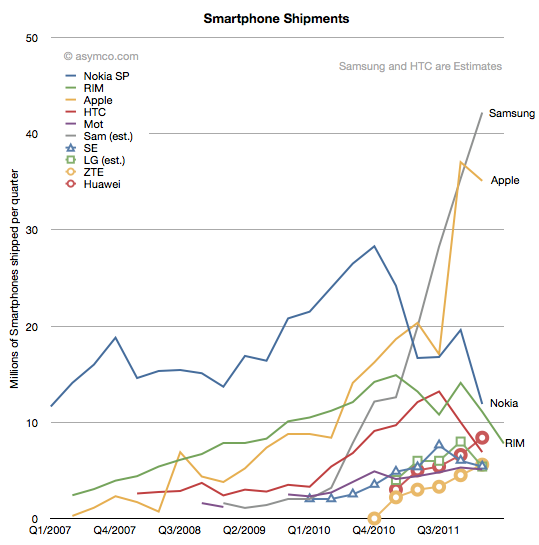
  10. The value of the OS X monopoly

    Research · 40 comments

    In January I noted that there were more iPads sold by Apple than PCs from HP, the largest PC vendor in the fourth quarter. Including all tablets, this is the distribution of market shares by units shipped.

    Note the different color palettes for Windows and non-Windows.

    By the metric of tablets+PC's Apple appears to be the leading vendor. However, if we consider only the Mac, Apple is still well behind. The historic unit volumes of the two is shown below:

    Although Apple has nearly doubled its shipment volumes since 2008, it's still only one third that of HP. In addition to comparing volumes, we can also measure profitability. In this case HP's PSG (Personal Systems Group) reports operating profits and we can estimate the same from Apple based on a gross margin estimate and an operating expense estimate (as percent of sales).

    The comparison looks like this:

    The operating profit for Apple is 2.7 times higher from a third the units. This gap is a result of a vast difference in profitability. HP's operating margin for PCs is 5% while Apple's is 21%.

    A few days ago I highlighted that Apple's iPhone yields disproportionate profits because of the way it performs the jobs its hired to do by consumers and operators.

    With the Mac the story is that Apple's OS X is primarily responsible for delivering quadruple hardware margins vis-a-vis the most successful PC vendor.

    Both iPhones and Macs are sold as hardware products and the entire econometric analysis of Apple depends on hardware cost structures. This is because hardware lends itself to easy measurement. However, a casual observer would be stumped by a comparison with competitors which cannot come near the profitability Apple enjoys. How can the same bundle of components (admittedly mostly off-the-shelf) be sold at triple the margins?

    It comes down to software. Apple has a monopoly on iOS and OS X and charges for it through its hardware. That's a very valuable monopoly. It's worth at least $1 billion per quarter.

  11. The parable of RIM

    Research · 155 comments

    Here are the highlights from RIM's latest quarter:

    • 14.1 million BlackBerry smartphones shipped, 13 million sold through
    • 150k PlayBook shipped with sell-through slightly higher. 800k PlayBooks shipped so far.
    • BlackBerry subscriber base up to 75 million
    • High growth cited for U.K., France, South Africa, Mexico and Argentina, Indonesia, Saudi Arabia and South Africa. RIM is the #1 smartphone vendor in the Latin America and Caribbean region. Sales outside the US, UK and Canada were 61% of revenues. US is now 20% of sales, UK 11%.
    • Hardware growth outside the US was 56%
    • There are 630 carriers
    • 50k apps in App World with 5 million downloads per day
    • Forecasting 11 to 12 million smartphones next quarter

    Given the channel fill with a new product, the device business was marginal at best. The company obtained -1% growth y/y in units but 31% sequential growth from a transitional quarter. The average selling price (inclusive of service revenues) is $354 and about $280 excluding service revenues. I estimate that operating margins have dropped to about 11%. Not a good story, but one we have been warned to expect.

    But a crucial new twist to the story is that RIM announced that they don't expect new BlackBerry 10 devices until late next year. That came as a surprise and the stock sold off significantly, valuing the company at well below book value.

    Stepping back, the biggest surprise is that the company seems to have had no plan for sustaining itself.

    Let me explain.

    If you go back to 2005 or so the world of smartphones was a mix of modular OSs and integrated platforms, much as it is today.  Not unlike Android today, Windows Mobile was successful in licensing to dozens of vendors who in turn released hundreds of products. Symbian also was licensed but most volumes came from Nokia and they held the lion's share. Then there was the BlackBerry integrated solution which worked smoothly and had devoted fans who upgraded every chance they had and operators who were joyous at the new ARPU. There was also PalmOS as offered by PalmSource trying to be a "third horse" and unseat stodgy old Microsoft.

    It was into that fray that both Apple and Google jumped. Google acquired Android in 2005 and Apple was busy polishing a version of OS X that would became iOS. In three and two years respectively these platforms would be in the market.

    Regardless of the actions of rivals, all competitors must have faced the same questions in 2005: As technology was changing rapidly and as they all had access to component roadmaps, what is the best technology approach to this market? Should they embrace certain innovations to sustain their business trajectory? RIM had a tightly integrated software, hardware and service offering. What could make it better? Nokia was also basing its products on a more loosely integrated offering (nominally it was modular, but only just). It saw the writing on the wall and began developing a Linux variant (Maemo) as a potential candidate to replace Symbian. Microsoft was basing its solution of a modular approach. Windows CE was ok as a kernel but they had layers on top which were optimized around stylus-based user experiences (analogous to mouse actions). Could it take on a rich computing experience?

    There were many experience candidates. Stylus, keypad, keyboard all had adherents. There was a lot of hesitation. After the iPhone launched with capacitive (finger) touch, resetting user expectations, it still took a year for many of the vendors to re-consider their technology plans. The weakest changed first.

    Microsoft felt the pain quickest. They also had the least to lose since revenues from Windows Mobile were paltry. By 2008 internally they turned 90 degrees. They embarked on re-building their user experience and orphaning the Windows Mobile ecosystem and many of the vendor relationships they had built. Palm dropped PalmOS and built WebOS internally quite quickly. They licensed Windows Mobile as a stop-gap. Around the same time Nokia doubled down on Maemo and joined with Intel to form MeeGo. They did not orphan Symbian though and kept trying to adapt it to the new experiences and input methods.

    But RIM did nothing. Almost nothing. They were the healthiest competitor. They felt no pain from iPhone's entry. The platform they had built was still growing and they were tweaking it constantly. There were always improvements to point to but fundamentally the code was limited. It was very difficult to adapt it to touch input and the first attempts at a touch UI were embarrassing. But there were no signs of a new platform that reflected the Unix-like competition.

    As I pointed out in an earlier post, Unix-like operating systems were having their revenge. To a computer scientist the future of mobile computing would mirror that of personal computing in terms of architecture. The foundations of the early smartphones were built on constraints that were disappearing while being unable to accommodate new input methods. In other words, the early efforts were optimized around those constraints and sub-optimal for rich user experiences. They had to be. There were limited processors, memories and screens and battery life.

    It turned out that all the early mobile operating systems were unsuitable for the advances in technology that came after 2007. Companies which were able to adapt or embrace Unix-like operating systems in a mobile context gained the ability to grow with the new input methods. The sooner they "pulled the trigger" on the shift, the better off they were. This is in fact what enabled entrants to gain footholds. Entrants entered with Unix-like OSs straight away while incumbents had to justify changing and the more successful they were the harder it was to justify changing.

    RIM had trouble justifying this change. It waited until 2010 to finally acquire the QNX asset that would offer them a stronger software foundation.  It still had to adapt this acquisition and it looks like it won't be done until at least 2012, seven years after they should have started. And this should be seen as a sustaining technological change. A new OS is not a disruptive technology to what is already a mobile computer.

    However, delays like these can be fatal. We see the impact on Microsoft who was earliest to push the reset button in 2008. It still took two years to rebuild Windows Mobile into Windows Phone and is now still struggling to regain lost share (less than 2% today). We see the impact on Nokia which was unable to affect a transition to MeeGo due to a litany of issues and had to throw in the towel on self-determination. We see the impact on Palm which lost its independence as WebOS was a bit too little too late.

    These companies had the right technical strategies but suffered from execution and business architecture issues. RIM is years late in embracing what appears to be a sustaining improvement.

    But whenever you see what appears to be a coordinated effort by companies to fail simultaneously you have to ask if the change they struggle with is really sustaining or disruptive. The pattern makes me suspicious that what RIM, Microsoft, Palm and Nokia faced was more than a failure to embrace a sustaining improvement. I suspect that the failure is evidence of tectonic shifting of business models.