Asymco

Asymmetric Intelligence

HP

  1. Visualizing the Steve Jobs era

    Research · 44 comments

    On October 4th, Tim Cook will take the stage at Apple’s fall event. With Steve Jobs’ transition to head the Board of Directors of Apple and after serving as CEO for fourteen years, it is time to take a look at his reign.

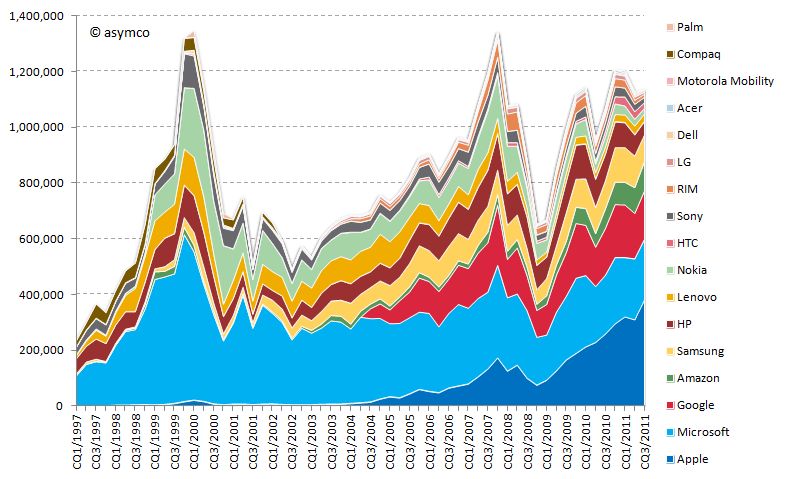
    Looking at his performance vs. peer companies from a capital market performance, I have composed the following two charts:

    Market capitalization of selected peer companies by calendar quarter in USD million sorted by most recent market capitalization (1997-2011)

    Market capitalization of selected peer companies in USD million sorted by recent market capitalization (1997-2010)

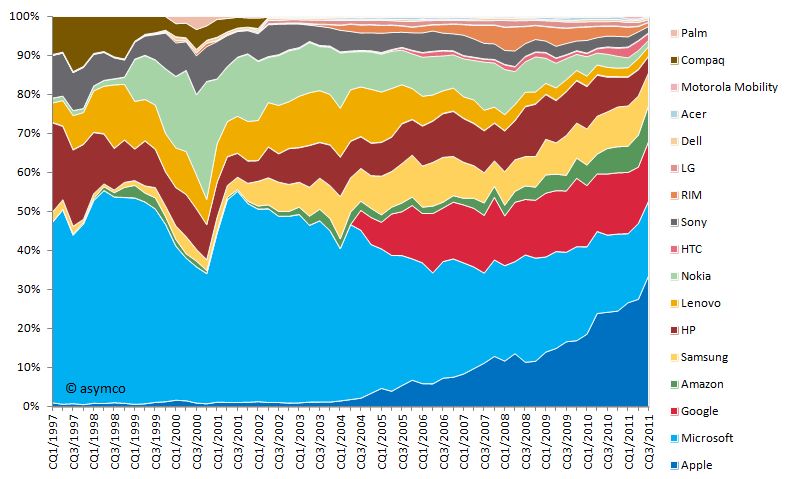
    Market capitalization as share of combined market capitalization by calendar quarter sorted by most recent market capitalization (1997-2011)

    Market capitalization as share of combined market capitalization sorted by recent market capitalization (1997-2010)

    You will note that I included more companies than in previous analysis. The new additions are:

    • Compaq (acquired by HP in 2002)
    • Palm (acquired by HP in 2010)
    • Amazon (a popular request by readers)

    I divided this era into three distinct periods:

    Restructuring of Apple 1997-2000

    In the beginning of 1997, Apple’s market capitalization was lower than almost all of its peers. In absolute terms the market capitalization moved only slightly upwards towards 1999 and the dent in 2000 is significantly lower compared to the market capitalization increase of other companies, first and foremost Microsoft's. Especially in the early part of this period restructuring and streamlining efforts took precedence. The introduction of iMac in 1998 and the iBook in 1999 set the tone in terms of design, quality and "thinking different" for many years to come.

    iTunes era 2001-2006

    With a stable core business and healthy profitability, Apple introduced the first iPod in October 2001 complementing the earlier introduced iTunes music player. Two years later, Apple introduced the iTunes Store offering downloadable music for the Mac and Windows operating systems. The venturing into the music and portable music player business and the halo effect for the Mac business is reflected in the market capitalization increasing significantly during the following years surpassing HP and Nokia.

    Mobile iOS devices 2007-2011

    Market capitalization further increased with the entry into the smart-phone market in 2007. Note that market capitalization of all selected companies combined at that time was as high as in the dot.com era of 2000. But this time Apple accounted for more than 10% of it. From 2008 to 2009 market capitalization of all companies declined severely due to the financial crisis. Rapid recovery followed during 2009 and early 2010. Apple introduced the iPad in March 2010 further fueling its rise to the top, surpassing Microsoft’s capitalization and topping Exxon Mobil as the world's most valuable listed company.

    During the time of Steve Jobs as CEO, Apple's market capitalization increased on average by 42% every year--an unprecedented track record. According to his own admission, Steve Jobs became CEO when Apple was 90 days away from bankruptcy. He resigned 14 years later after leading Apple to becoming the most valuable listed company in the world. From a value creation point of view, it's hard to think of a better performance from anyone, ever.

  2. Growth and punishment: The vector space model

    Research · 23 comments

    After processing more than 1500 data points on the performance of thirteen technology companies, patterns are beginning to emerge. The steps so far:

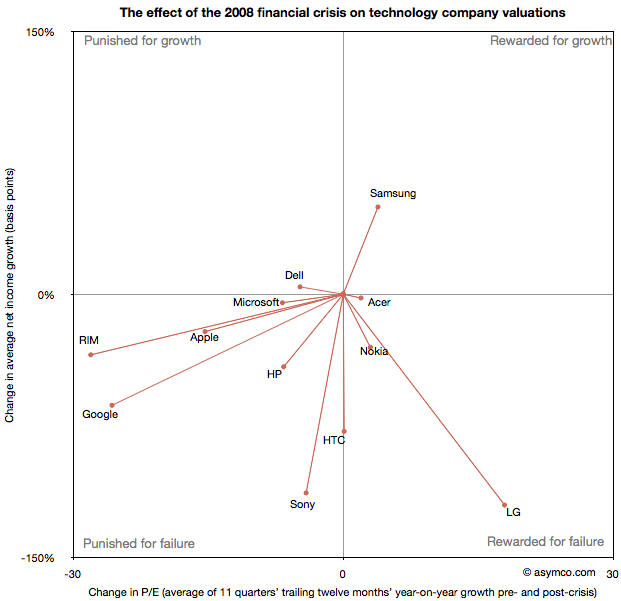
    The final step is to plot the changes in the relationship between pre- and post-crisis for the set of companies normalized to the same starting point and then classifying them: 

    The chart shows how the "average P/Es" changed after 9/30/2008 vs. how the companies performed during those periods. An evocative categorization is suggested for the four quadrants.

    One way to read the data would be as a degree of effect of the crisis. For example, in the case of HP, its P/E dropped by about 6.5 while its average growth decreased by 41 basis points giving an average of 0.16 drop in P/E for every basis point reduction in growth. That would be a fairly modest impact. In the case of HTC, the impact would be even less. The effect on P/E was zero even though growth dropped by about 78 basis points. At the same time the impact on Microsoft was severe with the P/E dropping as much as for HP even though its growth only moderated by 5 basis points.

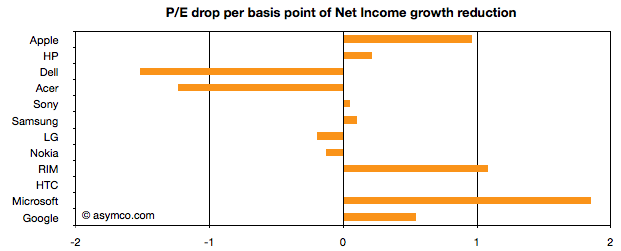
    Therefore the "slope" (or angle in vector parlance) of each of the lines in the chart above may be interpreted as the severity of discount in value that the crisis invoked. Those values are shown the following chart:

    A strong bar on the right half of the chart implies severe impact, a bar around the middle implies minimal impact and a bar in the left represents an inverse relationship where the market priced in opposition to performance[1]. What should be considered along with this chart is the quality of earnings and consistency of performance (which are shown in the posts linked above.)

    Discussion

    As noted in a previous article, there are really only six companies which had strong separation between pre- and post-crisis valuations: Apple, HP, RIM, HTC, Microsoft and Google. They are also the companies which had strong P/E drops (except for HTC). As a group they are also the companies with the best growth stories historically. This is perhaps the reason for the drop. Basically, because these were strong companies they "had the most to lose". The market "punished" them more severely than the weaker companies because the weak had already been discounted.

    The other observation is that Apple and RIM are not treated particularly differently. The drops in P/E are at about 1 for every basis point drop in growth. This means that the the degree of value lost is about the same as a function of growth loss. Microsoft seems to have been the most affected. We can argue that it is perhaps weaker than the others strategically so this is reflected here, but I doubt it's weaker than RIM. Microsoft is also in contrast with Google which seems to have been given a lot of benefit of the doubt.

    Nonetheless, this framework offers some hints on how technology companies have been treated after the crisis. There is no rightness or wrongness about this treatment but it may indicate potential for significant reaction in the opposite direction if and when macroeconomic conditions improve. These vectors are, in a way, proxies for volatility or "beta" in terms of correlation to the overall market. The greater the beta, the more amplification to market movement; the greater the slope value

    As always, Apple is the canary in the coal mine as far as sentiment is concerned. What should be watched is the pricing reaction as Apple moves from a net reduction in growth to a net increase in growth. How will P/E react? The argument on this site so far has been that growth is exceptionally strong for Apple and it's not being reflected in the price. However, in this analysis we've stretched the time frame and did a longer retrospective. On this new time scale growth is not yet at the levels Apple enjoyed in the heady days of 2005/6. Perhaps this growth will return and when it does we'll get to see which way Apple's vector moves.

    ----

    Notes:

    1. An inverse relationship with value can happen for various logical reasons, for example that a company has volatile performance which is depending on anomalous events.
  3. HP's decade-long departure

    Research · 221 comments

    HP's sudden departure from a business model that has sustained the company since inception is symptomatic of the passing of an era. Yesterday HP announced that it would exit the PC and tablet computer business, focusing on higher-margin "strategic priorities of cloud, solutions and software with an emphasis on enterprise, commercial and government markets." In other words, HP is fleeing upmarket, away from a core that it will abandon to device makers.

    HP management conceded that the disruptive impact of the iPad forced their hand but that hand was already quite weak from a decade of over-serving the market. The last decade offered plenty of opportunities for incumbent PC companies to adjust to the realities of mobility. However only one computer maker made the transition.

    Why is that?

    Consider how HP and Apple faced the changes in the PC market almost exactly a decade ago.

    • On September 3, 2001, HP announced that they would acquire Compaq.
    • On October 23, 2001, Apple announced the iPod.

    The rest, as they say, is history.

    But what would any reasonable person have done? The PC industry was no longer young but still thriving, why not consolidate? Consolidation is a natural and well-reasoned practice for maturing industries. You get rid of over-capacity, you consolidate overhead, "leverage synergies" and boost margins.

    And it's not like they were ignoring innovation. Compaq had a growing line of PDAs, so there were plenty of diversification opportunities. Microsoft was offering Pocket PC and the Phone edition was on the roadmap. HP was clearly watching mobility carefully.

    Contrast that with Apple's predicament. Which aspiring manager would want to deal with the disaster that was Apple at the time? Apple was struggling with a declining Mac business and had just re-booted it with OS X but it seemed a quixotic effort. Moving to music players seemed desperate (and late). Margins were low, commodity vendors were lining up, record labels offered resistance, they did not have any IP or any DRM and nothing but Mac users as target audience.

    As it turns out, the path of sustaining and the path of disruption diverged that moment in time a decade ago. Companies like HTC, Apple and RIM were embryonic in their device businesses vs. Goliaths like Microsoft, HP and Dell. But they grew, at first slowly, but at all times profitably.

    By the time their success was worth noticing, in 2004, HP and Dell decided to dabble in devices. But all their efforts were half-hearted. They did not crave profits but growth and share. HP's PDAs and phones never received management attention. How do I know? Because they relied on off-the-shelf components for everything including software. It indicated that the value to be offered was in "leveraging" (there's that word again) their brand and distribution. The value of HP was not to build something great--something that required blood, sweat and tears.

    The result was a set of mediocre experiences while the (now incumbent) Apple was iterating rapidly into new directions. By the time the future was self-evident, it was too late to build foundations. HP did the right thing to acquire Palm, but they did it far too late. In 2010 the game was over.

    How cruel.

    But that's the nature of unforeseeable growth: you cannot foresee what will happen and plans never work out. Data and planning don't help. The lesson is that you need to plan for that which cannot be planned. When you are at your peak you must assume failure is imminent and when you are at the trough you must assume success is inevitable.

    All failures of strategy are rooted in the assumption that outcomes are predictable.

    This is why I expect Apple is now working on shaping the post-iPhone world.

    --

    Update: This article has also been published in the Harvard Business Review blog: HP's Decade-Long Departure - Horace Dediu - Harvard Business Review

  4. Disruptive failure: How Acer Took Aim at Dell and HP and missed

    Research · 72 comments

    Two years ago:

    With new netbooks, laptops, desktops, and, yes, a smartphone, Acer CEO Gianfranco Lanci explains why he expects to soon overtake No. 2 PC maker Dell

    via Acer Boss Lanci Takes Aim at Dell and HP - BusinessWeek.

    Today Acer CEO and President Gianfranco Lanci resigned with immediate effect. Acer is in trouble. You can read more on Acer's current problems in the wake of the downward revision of its sales targets for two quarters here: Acer Should Overhaul Its Operation: Stan Shih | CENS.com - The Taiwan Economic News

    In a nutshell, whereas Acer under Lanci took aim at Dell and HP, it seems that Apple took aim at Acer. And whereas Lanci missed, Apple's aim was true.

    What is interesting here is that Acer had a very disruptive approach. They used the low end "netbook" concept to take share from incumbents motivated to move up-market.

    But what went wrong? Part of the answer is that "low end" does not just mean "cheap". Low end disruption is about also offering simplicity and performance along a new dimension or trajectory of improvement.

    Mobile computing could not be implemented as a low-end strategy because the modules available to portable computing could not be used to make it expand into new contexts of consumption. Windows and keyboards and all the input methods associated with portables could not be adapted to mobility. You could not use a netbook in places or at times when you did not use any other laptop.

    In addition the business model was not a good match. Low margins could not support development or new integration that could improve that which was not good enough. Acer did not have the means to tackle the problems of not-good-enough mobile computing. They did not build software and low margins meant that they could not even try to build software.

    Competitors also were motivated to respond. HP and Dell built their own netbooks which, arguably, were just as good (or, perhaps more accurately, just as bad) as Acer's. But more problematic was the fact that regular notebook prices dropped to netbook levels and the category came to mean "cheap" not "convenient".

    Finally, Acer's strategy did not have the time horizon necessary for true disruption. It takes many years to polish a product and nurture it up the trajectory. Acer was too impatient for growth and not patient at all for profit.

    Contrast this with Apple's tablet strategy:

    • It dealt with complexity of computing by removing it. This was not easy as simplification required a new platform altogether--something that portable computers could not benefit from.
    • It priced low but held on to margins because removal of complexity also reduced cost
    • The margins allow it to rapidly iterate on integrated development and improve the product
    • Competitors initially were not motivated to respond. They did not have the tools at hand to respond: no integrated operating system for PC vendors, no distribution for phone vendors.
    • Apple is also patient enough to wait for several product cycles. Even though demand is astronomical, the iPad still has a long way to go to become a new computing standard. Time is on Apple's side.

    Apple is effectively disrupting the PC with asymmetry. It contrasts with Acer's reliance on a sustaining, symmetric approach. The market was showing clear signs of over-service, declining margins, in-absorbable features and performance and complexity.

    Calling the winner in 2009 may have been tough given no iPad was visible, but knowing Apple's resources, processes and motivations should have guided observers to the right answer.

  5. What's a Post-PC device?

    Research · 86 comments

    Microsoft's Steve Ballmer argues that the tablet computers (aka slates, media tablets or iPads) are PCs. Steve Jobs argues that they are post-PC devices. There are analogies to trucks, cars and various metaphors for what these new devices symbolize. Some argue that because the iPad needs a PC, it's not a post-PC device.

    But how to define a new generation of computing? Since the PC is not the beginning of computing, it may make sense to look to the eras of computing that preceded it.

    The first post-mainframe computers worked alongside mainframes and were typically used by engineering departments (vs. the finance and accounting departmental role occupied by mainframes.) They did not require a dedicated (often external) mainframe service team and could be administered by in-department system administrators. Input was not through dedicated data entry personnel and output was not a ream of folded paper. Users could use a CRT terminal to interact with the computer directly. Digital Equipment Corporation, Control Data, HP, Honeywell, Prime, et. al. grew up in the shadow of IBM but thrived. Their products were cheaper and simpler to operate. Initially, the products were not more powerful.

    The first post-minicomputer microcomputers (also known as PCs) were used alongside mainframes and mini-computers. They were typically used for 2-dimensional spreadsheets analysis by individuals in many departments and were easier to justify cost-wise than the time-sharing cost structure of the incumbent computers. Many microcomputers were able to access mini-computers and mainframes through terminal emulation software (and sometimes special hardware boards) so they were still able to work with existing business processes. They did not require dedicated personnel for administration but had a shared support department. Input and data storage were on the "desktop" as was printing. Compaq, Dell, HP, Apple and IBM embraced this new form factor. Their products were cheaper and simpler to operate than the previous generation of computers. Initially, the products were not more powerful.

    The first post-microcomputer tablets are used alongside microcomputers for tasks such as presentations and entertainment. They have software available that allows access to desktop computers and services dependent on PC-architectured servers. They depend on PCs for data backup and software updates. They do not require IT support. They do not require a keyboard or a desk. Apple and many mobile phone vendors are embracing the new technology. They are cheaper and simpler to operate. The new products are not more powerful.

    To define a new generation of computing by its isolation and exclusion of the previous generation is not sustained by the history of computing.

    I would suggest that the definition of a new generation of computing is that the new products rely on new input / output methods and allow a new population of non-expert users to use the product more cheaply and simply.

    I might add that the consequences of each generational shift are:

    1. Consumption increases
    2. Skill required decreases
    3. Support required decreases
    4. There are new applications and use cases
    5. The economics are not favorable for incumbents
    6. The economics are favorable for new entrants
    7. The older generation slowly fades through diminished growth but never disappears
  6. Flummoxed, again

    Research · 184 comments

    The last time I took a snapshot of the iPad death watch it was March 9th, 2010. Almost a year ago. The now-classic quotes are reproduced here.  Last May I wrote:

    Apple keeps a tight lid on new products so that competitors don’t get a head-start on copying, but in the case of the iPad, advance knowledge would not have had any impact. Competitors look at the iPad and see nothing.  They’ll only react once the market explodes and they start to feel belated pain.

    I thought that would be that. As the success of the product would become self-evident, predictions of imminent demise would trail off. The pain of share loss would prompt a wave of challenger copycats. Imitation would be the the best form of flattery.

    But no.

    Critics were not silenced. One year, 15 million units, and $9.2 billion later I went back to the source of the quotes and found the following (published quotes dated after March 9th 2010). (Cited from aaplinvestors.net with some editing for brevity and relevance):

    “Problematically, the Android competition is just as expensive as the iPad lineup, so Apple obviously feels free to continue gouging consumers on iPad pricing.” Paul Thurrott, Windows IT Pro, 3 March 2011

    “Apple’s iPad 2 might be ‘magical’ but it still should’ve been better ... It needs more G’s. It’s still just a toy” Zach Epstein, Boy Genius 2 March 2011

    “11 reasons NOT to buy an iPad 2 ... Reason 5: Competition David Gewirtz, ZDNet, 23 February 2011

    “Given what I’ve seen of Honeycomb and Motorola’s excellent tablet, Cupertino will have some serious catching up to do with their iPad 2.” J.P. Mangalindan, Fortune, 4 February 2011

    “We very carefully chose our tablet processor, the Nvidia Tegra 2, and to really compete it will take [Apple] some time. You know, [Nvidia] is well known for graphics.” Jonney Shih, Asustek Computer, 3 February 2011

    “If you were to ask me in two years time, will Apple have less than 50 percent of the global tablet market, I think that’s a certainty. Neil Mawston, Strategy Analytics, 31 January 2011

    “We have an extreme focus on the innovation of LePad and LePhone because these products will dominate the future market. Though Apple is winning a significant share in the Chinese market, it has not gained a clearly leading position yet. Our advantage is we know this market better.” Liu Chuanzhi, Lenovo, 27 January 2011

    “The iPad may still be the lone leader, but with 100+ competitors on the way, it won’t likely keep its majority market share unless the pending next generation iPad really addresses all the complaints about the current version, like a missing camera and a lack of a USB port, and the company has to add those features without a major price increase - a tall order, to be sure.” James Brumley, Investopedia, 13 January 2011

    “Hands-on PlayBook demonstrations at CES showed its differentiation in multitasking and performance, which may be difficult for Apple/Android to rival.” Mike Abramsky, Royal Bank of Canada Analyst, 11 January 2011

    “Apple Inc.’s popular iPad is getting its strongest competition thus far as consumer-electronics manufacturers unveil tablet computers with bigger screens, front-facing cameras for video chatting and more.” Rachel Metz, AP Technology Writer, 3 January 2011

    Apple may be simply trying to get in ahead of Research in Motion’s aggressively priced PlayBook or combat the early success of Samsung’s Galaxy Tab.” Rick Aristotle Munarriz, The Street, 29 December 2010

    4. Competitors are coming. Brett Arends, Wall Street Journal, 22 December 2010

    Reason 6: WiFi is still unreliable David Gewirtz, ZDNet, 16 December 2010

    “I can’t imagine anyone under the age of 30 wanting an iPad. A PS3, Wii, GameBoy, or even a useful laptop maybe, but an iPad? Furthermore, I do not recall ever seeing anyone under 30 actually using an iPad.” John C. Dvorak, PC Mag, 13 December 2010

    “We hope our tablet PCs can reach a global market share of 10-20% initially, and become the market leader in two to three years.” Gianfranco Lanci, CEO and President, Acer, 26 November 2010

    “It’s a nice-to-have product, for those of us who don’t have a budget, but is it a must-have product? I don’t think so.” Ashok Kumar, Analyst, Rodman & Renshaw LLC, 12 November 2010

    “Steve Jobs never says anything without thinking through it carefully. But I think in this case he may be a little afraid of this category. And he’s finding whatever he can to attack because he sees [seven-inch tablets] as a challenge to the dominance of the iPad.” Adam Hanin, VP Marketing, Viewsonic, 1 November 2010

    “There could literally be millions of first-generation iPads gathering dust in people’s home offices already. This product is the tech industry’s biggest MacGuffin yet.” Paul Thurrott, Windows IT Pro, 23 October 2010

    “I cannot see a need for the thing.”John Dvorak, MarketWatch, 22 October 2010

    ”For those of us who live outside of Apple’s distortion field, we know that 7″ tablets will actually be a big portion of the market and we know that Adobe Flash support actually matters to customers who want a real web experience.” Jim Balsillie, Research In Motion, 20 October 2010

    “iPhone and iPad have been amazing products that have opened new markets. But I do not think they will own either market in a few years. Android will.” Fred Wilson, AVC.com, 18 October 2010

    “The constant search for an ‘iPad killer’ and the sheer multitude of tablet computers launching in the next 18 months should make Apple aware that its competition is fierce and will only become tougher.” Barbara E. Hernandez, PCWorld, 5 October 2010

    “HP’s New Tablet Could Be an iPad Spoiler HP’s decision to bundle a tablet computer with its new $399 printer could make trouble for competitors.” Cliff Edwards and Aaron Ricadela, Bloomberg Businessweek, 23 September 2010

    “Our tablet will be better than the iPad.” Chang Ma, VP Marketing, LG, 20 August 2010

    “Not only is Apple typically lost in the enterprise, but it focuses very little of its time there. And with a new, potentially more compelling tablet coming — the Cisco Cius — the iPad’s success in the corporate world could be short-lived. Here’s why:... 10 The power of Windows” Don Reisinger, Channel Insider, 5 August 2010

    “I don’t think there is one size that fits all…I’ve been to too many meetings with journalists who spent the first 10 minutes of the meeting setting up iPad to look like a laptop.” Steve Ballmer, Microsoft, 29 July 2010

    “ [...] It still isn’t the device that I’d take to a meeting because it has no input.” Bill Gates, Microsoft, 2 June 2010

    “Which means I end up on the iPad — and tablets more generally — where I started. Tablets will not create a new category, but will supplant (or merge with) one or more of the current substitutes: smartphones or netbooks.Here I am less optimistic about the iPhone and webOS than I am about Android. ” Joel West, professor of Innovation & Entrepreneurship, College of Business at San José State University, 30 May 2010

    “The iPad is useless. Beautiful, but useless. The iPad is too heavy. It’s awkward to hold and view in public. It’s fragile. It requires expensive accessories to protect it and extract more functionality. ”Josh Belzman, MSNBC.com, 20 May 2010

    “Mum, the iPad is not ‘amazing.’ It’s just marketed very well, both by Apple and its culpable partners in mainstream media. ” Paul Thurrott (in response to comment by Mum), Paul Thurrott’s Super Site for Windows, 26 April 2010

    “In short, I don’t get the ‘magical and revolutionary’ vibe that Apple chief executive Steve Jobs touted at the iPad’s January unveiling.” Rob Pegoraro, Washington Post, 9 April 2010

    “The first troubling sign is the fact that you can still get an iPad today. They didn’t sell out. The pure slate form factor has failed all these years because, other than for vertical applications, people want and/or need a keyboard for regular use. The fact of the matter is that a touch screen or bluetooth keyboard just doesn’t compensate.” Jonathan Yarmis, Ovum, part of Datamonitor Group, 6 April 2010

    “I don’t get it. It costs $500 for the basic model, when you could get a laptop with a lot more functionality for about the same price. The iPad hype machine has been in full effect this week, and I still think it’s just that—hype. ” Alex Cook, Frontier Outlook, 3 April 2010

    “As far as what this means to Apple, one thing to keep in mind: Even if the iPad sells more than the iPhone did in its first year, it’s still only around 5% of the company’s revenue. So it’s a very small slice. From there, it probably doesn’t grow as large as the smartphone market. So, if you’re buying under rumors, keep perspective in mind. The iPad’s a great product, but it’s probably not a game-changer.” Eric Bleeker, Analyst, Fool.com, 31 March 2010

    “The iPad will remain an expensive, niche device compared to all-purpose netbooks.I think that one of the iPad’s most important uses will be for reading ebooks and publications. Even so, though, when it comes to the marketplace, netbooks will sales still far outstrip those of the iPad.” Preston Gralla, PC World, 30 March 2010

    “Don’t Believe the iPad Hype. Apple has sold out pre-orders of the forthcoming device, but it could all be a marketing tactic. By not manufacturing enough iPads for the initial launch date, is this a case of Apple shooting itself in the foot?” Mike Schuster, Minyanville.com, 29 March 2010

    “‘iPad Killer’ May be Palm’s Last Hope”Tom Bradley, PC World, 20 March 2010

    “Even if your company has relented and now supports the iPhone, as growing numbers of businesses do (70% of the Fortune 100 are at least testing it, says Apple) you’ll want to say “No” to the iPad and other tablets. Here’s why: 8. Speaking of money, there is no money in the company budget to pay for iPads. 9. Not supporting iPad will be the enterprise norm. Robert McGarvey, CIO Update, 16 March 2010

    “This morning, the fool’s parade gets started. Apple is taking online “pre-orders” for its iPad tablet, which is supposed to begin shipping on April 3. Buying a new kind of product sight unseen is foolish. Especially given how mysterious Apple has been on what the iPad can do and what restrictions on capabilities and media access it will place on users and content providers.” Galen Gruman, InfoWorld, 12 March 2010

    “The recent launch of Apple, the iPad tablet, has won the award for the second edition of Fiasco Awards delivered this Thursday in Barcelona. From the more than 7,000 people who voted via the website www.fiascoawards.com, 4,325 have considered it the fiasco of the year. Fiasco Awards, 2010, 11 March 2010

    “I think I’ve mentioned this once or twice before, but it bears repeating until it sinks in: the Apple iPad is not unique, nor necessarily the best of breed in the media tablet sector it is spearheading. And it ain’t gonna help Apple shareholders any.’” Anders Bylund (TMF Zahrim), 11 March 2010

    From this critical review, it looks like 2011 will indeed be the year of the iPad 2.
  7. Android vs. Windows Phone: Which vendors benefit?

    Research · 32 comments

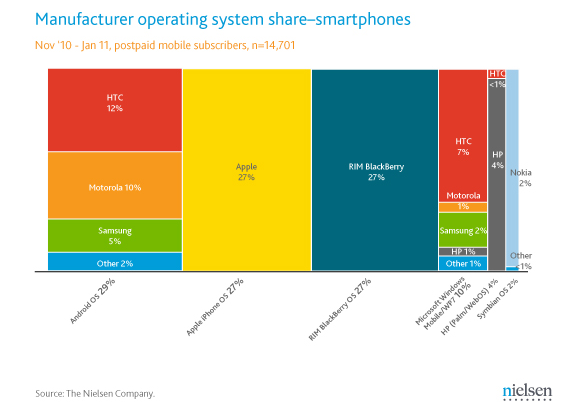
    Who is Winning the U.S. Smartphone Battle? | Nielsen Wire.

    This is a great chart from Nielsen showing the split in manufacturer share by OS in US installed base. What I consider significant is how the modular software platforms Windows Mobile and Android worked out for the licensees.

    Whereas in the case of Windows Mobile HTC took a significant, nearly dominant share, the Android ecosystem was more balanced between HTC and Motorola. However, HP and Motorola left the Microsoft camps, Motorola going exclusively for Android and HP buying Palm. That leaves Microsoft with HTC, Samsung and Other (mainly LG I presume).

    The question of how Windows Phone will shape up vs. Windows Mobile and Android remains. Motorola has signaled they are not interested in WP7 for the time being and so it's likely that they will stick with Android. Samsung is always hedging its bets so it will probably balance its portfolio. One could conceive of Nokia stepping into the US with significant WP volumes, but there are many hurdles on the way.

    One can see the challenge individual modular vendors have to edge the overall volumes of the integrated vendors. As Nielsen points out:

    But an analysis by manufacturer shows RIM and Apple to be the winners compared to other device makers since they are the only ones creating and selling smartphones with their respective operating systems

    Not only are the volumes higher, but so are the margins and hence profit share.

  8. Changing places: Microsoft trades HP for Nokia

    Research · 56 comments

    The juxtaposition of HP's strategy of increased independence and Nokia's new strategy of increased dependence can't be more striking.

    HP is probably Microsoft's biggest customer. As the largest licensee of Windows it probably generated more revenue for Microsoft than any other company. The fact that HP invested in a new operating system for its mobile efforts shows a level of discomfort with the lack of strategic leverage.

    Nokia, on the other hand, has been resolutely independent in its software strategy. For over a decade it held out against licensing any OS, especially one from Microsoft. The pantomime theatrics that took place over that decade will make a great case study some day.

    But now we have a complete reversal of roles: The abandonment of platform independence by a mobile giant at precisely the same time as the acquisition of platform resolve by an IT giant.

    It seems almost poetic. And that should be a clue. Whenever you see poetry, you need not look far for some truth.

    These chess moves are taking place in the context of a greater game: the collision and disruption of IT and Telecom. It's not surprising that massive market forces are causing incumbents to react. HP, Microsoft and Nokia are in the throes of fundamental disruption. Even if these moves may not be all in the same direction, they each react in ways that make sense to them.

    It's also very likely that all the moves are for naught. Incumbents rarely win with reactions. Let's not forget that the entrants came with different business models. Apple and Google are not making money in the ways of Nokia and HP (who are channel dependent) or Microsoft (who is license dependent). The reaction must itself be asymmetric. So far it's not clear where the asymmetry lies.

    Read more:

    HP/Palm’s Rubinstein believes in integration

    WebOS: HP, and HP Only. QNX: RIM and RIM Only

    HP’s PC group spends 0.7% of sales on R&D

    The reason Robbie Bach was fired

  9. Of Platforms, Operating Systems and Ecosystems

    Research · 21 comments

    In the earnings Q&A Stephen Elop used the word 'Platform' once, 'Operating System' three times and 'Ecosystem' 15 times.

    Though they seem interchangeable, the three phrases have significant differences in meaning. Briefly put, a Platform is a business model concept,  an OS is a technology concept and an Ecosystem is a marketing concept.

    Platform

    A platform, as the New York Times recently pointed out, can take many forms. The Barbie doll is a platform as is the US Interstate Highway system. These are products or infrastructure that allow other products to be 'built on top' and can thus charge rents from them. When building platforms, a company needs to think of how to make their work foundational so it can support other structures. Other examples of platforms are browsers, the Apple 30 pin dock connector, Game Consoles and Facebook.

    In terms of innovation theory, a platform is a signal to industry that the company is willing to allow its innovations to be extended and thus share in the creativity of adopters. There is however a down side: platform adopters may also create so much value that users will shift loyalties to the layers above the platform thus restricting the freedom of the platform owner to modify or modernize the underlying platform.

    This loss of control over the roadmap often forces platform owners to institute draconian limits to the extensibility of the platform (e.g. the iPhone developer restrictions.) In other cases, platform owners have acquired and integrated various core apps or services so that the platform and core apps can be upgraded in sync. This was the impetus to the development of Microsoft Office. Office was motivated by a need to prevent Lotus from slowing the upgrade path for Windows not, as it's assumed, to create a new revenue source. However, again, the effect is the destruction of the ability to innovate on that particular area (no new Word Processor or Spreadsheet programs for 20 years).

    It takes a great deal of work to platformize a product. I would guess 10x more than a similar product which does not allow collaborative innovation. Platforms are difficult to build, require delicate balancing acts to maintain but can be enormously valuable due to network effects.

    Operating System

    In contrast an Operating System has a very clear technical definition. It has been extended to include many applications and services, but it's basically the control system of a computer. An OS may or may not be a platform. For example embedded operating systems typically do not have APIs to support applications. Some basic mobile operating systems support applications through a sandbox like JaveME (in this case the platform is Java) and are therefore also not platforms.

    A company licensing an OS may not accept the platform with the license or may not consider it valuable. It's even possible to license an OS and consider the platform value to be a liability to your own strategy (arguably HP fits in this scenario as regards to Windows. HP had its own operating systems and tried to build alternative platforms in spite of Windows).

    An example of an OS with minimal platform value may be WebOS which has a very limited API for native applications.

    Ecosystem

    The word ecosystem as it applies to technology was coined by Palm to describe the app vendors that built apps and the accessories for its Palm Pilot. This is not a common word as it's largely equivalent to Platform. The subtle difference is that it's used in a marketing context to signal platform value. Having a large ecosystem implies the acceptance of a platform by a large base of developers.

    For example a platform may not have a viable ecosystem if there are few developers and/or little economic value 'on top' of the platform. Symbian is often cited as being a decent OS, but a poor platform with a mediocre ecosystem.

    So these three phrases are overlapping but have a different tone. Although perhaps unintentional, Elop's emphasis on Ecosystem vs. Platform or OS, might signal that what's missing from Nokia's strategy is the motivation or encouragement of developers to participate. My prediction of WP7 licensing may not fit well with this deficiency but perhaps Microsoft's ecosystem building potential is still greater than Nokia's.

    I should also point out that Nokia's platform strategy has also included an intermediate layer called Qt that enables cross-platform ecosystems, thus making the OS irrelevant. Technically this may have merit, but it's a long haul to getting an ecosystem for it.

  10. HP/Palm's Rubinstein believes in integration

    Research · 34 comments

    In other words, to differentiate and succeed in the mobile device space, you need to own a veritically integrated stack strategy — software, hardware and services — like the one Palm is now building out with the help of HP’s not inconsiderable resources

    via Palm Chief: By Birthright, Palm Should Have Owned the Smartphone Market | John Paczkowski | Digital Daily | AllThingsD.

    I would not write Palm/HP off in this market.