Asymco

Asymmetric Intelligence

HP

  1. WebOS: HP, and HP Only. QNX: RIM and RIM Only

    Research · 14 comments

    WebOS: HP, and HP Only.

    With the launch of RIM's tablet computer based on QNX and HP's confirmation that WebOS will not be licensed, we have

    • Apple the largest tablet and music player company,
    • HP the largest PC company,
    • RIM the largest smartphone company in the US, and
    • Nokia largest smartphone company in the world

    avoiding Android.

    These are the companies which today are profitable and enjoy large market shares. Why did they choose integrated (aka "closed") software with their hardware vs. the modular (aka "open") approach offered by Google and Microsoft?

    See also: asymco | Android’s Pursuit of the Biggest Losers

  2. Hewlett-Packard is bundling a tablet with a $399 printer

    Research · 17 comments

    The bottom line: HP's decision to bundle a tablet computer with its new $399 printer could make trouble for competitors.

    HP's New Tablet Could Be an iPad Spoiler - BusinessWeek

    HP took the control panel display from a printer and made it detachable. The idea, according to the manager in charge, is that this will encourage printing. Printing is a good business for HP because they manage to charge $7500 per gallon of ink.

    I suppose there can be some sense to this idea but I don't use inkjet printers so I can't judge how popular this can be. But the headline suggestion that the new display panel cum web pad is "an iPad Spoiler" calls into question the author's motivations. Maybe he did it for a bet.

    But the real gem is a quote from Richard Shim an IDC PC analyst who says "Everyone is trying to figure out the opportunity for these types of devices, how to position media tablets in a way that they don't cannibalize other businesses."

    That's an interesting comment coming from a PC analyst. It says that the vendors in the industry are already feeling that the iPad is substituting regular PCs (and hence the need for a response that is sustaining not disruptive).

    This acknowledgment means it's only a matter of time before the idea of iPad as PC morphs from crazy talk to conventional wisdom.

  3. IBM CEO: the PC era ended three years ago

    Research · 23 comments

    But one area where IBM won't compete with HP is personal computers. In 2005, IBM sold its PC business to China's Lenovo Group for $1.75 billion. The PC era, Mr. Palmisano said Tuesday, ended three or four years ago.

    "We wanted to get out before it was obvious to everyone," said Mr. Palmisano. "I couldn't give it away today," said Mr. Palmisano of the PC business. HP is the world's biggest PC maker.

    via IBM's Chief Thumps H-P - WSJ.com.

    Is this obvious to everyone yet?

  4. Gartner Predicts Mobile OS Market Share

    Research · 15 comments

    Lots of people apparently think it’s a big deal that Gartner is predicting Android will surpass iOS for second place. But why is that necessarily a good thing, given that they’re predicting Symbian will remain in first place? Who thinks Symbian is actually doing well? Nokia’s board sure doesn’t.

    via Daring Fireball Linked List: Gartner Predicts Mobile OS Market Share.

    I also noted with amusement that by 2014 "other" is slated to sell 85 million units or nearly 10% share, up from 6.1% in 2009. These "others" will be selling more than twice what Apple is expected to sell this year. Is "other" WebOS, Bada, MeeGo, LiMO? If so they're in for a healthy future.

    But dwelling on details like these is missing the point. To see how improbable this prediction is, let's go back to 2006 and ask what Gartner was forecasting would happen now.

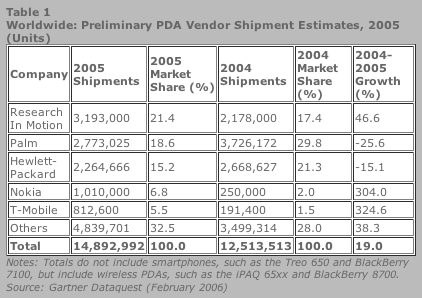
    First thing to note is that in 2006 Gartner was busy tracking PDA sales. You might wonder why this is relevant. The reason is because a significant proportion of RIM's Blackberries counted as wireless PDAs and were therefore considered to compete with Palm's Treos, HP's iPaq and Dell's famous Axim. Nokia was in the running with its Communicators. Here is how Gartner characterized the equivalent market in early 2006:

    So I'll just come out and say it: In 2006 Gartner did not have a clue what a smartphone was. By their admission:

    Gartner defines a PDA as a data-centric handheld computer weighing less than one pound that is primarily designed for use with both hands. These devices use an open market operating system supported by third-party applications that can be added into the device by end users. They offer instant on/off capability and synchronization of files with a PC. A PDA may offer WAN support for voice, but these are data-first, voice-second devices.

    In other words, in 2006 Gartner was splitting phones with operating systems into two separate markets: data-oriented wireless PDAs and voice-oriented smartphones. The split was mostly based on the judgement of the analyst on whether a device was "voice" or "data" oriented. I suppose they used the primary input method as a proxy: numeric keypads meant the device was one-handed and therefore voice-oriented. If the device had a full keyboard and/or a stylus-actuated touch screen then it was a two-handed data-oriented device. But even this proxy was not quite enough, sometimes devices were classified whimsically.

    To make it more complicated, they bundled non-cellular but Wi-Fi enabled PDAs with wireless PDAs. This made some sense from a corporate IT point of view (their primary customer base) as these data-oriented devices would be used either on a LAN or a WAN (Wide Area Networks: what Gartner anachronistically called cellular networks.)

    The presence or absence of a cellular radio did not enter into their view of these devices. So if you asked Gartner in 2006 to forecast smartphones (as we know them now) in 2010, I suppose you'd get what they forecast for "data-centric" devices.

    So assuming that today's smartphones are mostly "data-centric" we would have to look back on their view of that market and not the voice market which was seen as an entirely different thing. Their answer should have had something to do with the market leaders and participants in 2006. As the table above shows Gartner showed that RIM, Palm and HP led in 2005 with Nokia and T-Mobile[1] pulling up the rear.

    However, from a platform point of view, at the beginning of 2006

    Microsoft Windows CE was the No. 1 PDA operating system (OS) in 2005 as 7.05 million PDAs were loaded with the OS, up 33 percent from 2004 shipments of 5.28 million units. Palm OS PDA shipments declined 34 percent to 2.96 million units in 2005.

    In late 2006, Gartner made further predictions for the year:

    In 2006, Gartner expects the PDA market to increase by 6.3 percent to 16 million units. The market will continue to be driven by broader availability of cellular-enabled PDAs from wireless carriers. Gartner estimates that 53 percent of all PDAs shipped in the first half of 2006 featured integrated cellular capability, up from 46 percent during the same period in 2005. “The share of PDAs purchased by enterprises will continue to increase; it accounted for 49 percent of all PDA shipments in the second quarter of 2006 and Gartner expects that the enterprise market will account for 52 percent of all PDA shipments in 2006,” said Todd Kort.

    At this time I have not yet dug up a Gartner "Wireless PDA OS" four year forecast from the year 2006 but I suspect it would not show devices running Google's Android operating system or any running something called iOS.

    I also seem to remember that they were suggesting that Windows would be the leading mobile platform. Although it was trailing in 2006, Gartner was quite bullish on the disruptive challenger from Redmond.

    [1] T-mobile is in the list because it was common practice in 2006 for operators to market Pocket PC Phone Edition devices made by HTC under their own name. Orange, Vodafone and Verizon also had own-brand HTC Windows touch-based devices. Now what does that strategy remind me of?

  5. The reason Robbie Bach was fired

    Research · 37 comments

    Vague justifications about under-performance of Windows Mobile or cancelled Courier miss the whole point.  The chronic problems with Microsoft’s consumer businesses cited as causes for dismissal have roots in core processes and priorities which management changes will not address.  The failure of Zune was evident long ago. Windows Mobile has not been competitive with RIM for years, and failed to take significant share from Symbian, never mind iPhone. Tablets were the responsibility of the Windows team.  Kin is a rogue project based on a bone-headed acquisition. From a P/L point of view, Entertainment was mostly Xbox, which although deep in the hole over its lifetime, was starting to break even.

    No, the reason I believe Bach lost his head is that HP bought Palm.

    Bach lost a key account; in fact, he could be responsible for having lost the biggest account that Microsoft ever had.  Ballmer is a sales guy and he knows the importance of these relationships.  A customer like HP must be managed carefully and their strategy must be steered to fit with yours.  If HP felt they needed to go somewhere else for their mobile OS, it's a slap in the face, but if they buy the asset and IP and internalize a competing platform, then that is a dagger to the heart for Ballmer.

    Consider Google's seduction of Dell. Microsoft can tolerate Dell's affairs (Dell even fooled around with Linux back in the day.) But in contrast, HP is effectively filing for divorce.

    The blow could not have been more obvious and more cruel.

  6. Will Apple rule the iPad market? (part II)

    Research · 12 comments

    Continuing from Will Apple rule the iPad market? | Asymco.

    The first claim is that

    it is unclear if [Apple] will end up dominating the market the way it has come to rule the digital music player market with the iPod.

    After hearing a thousand voices cry out that the iPad is nothing more than a bigger iPod touch (which, plainly, it is) it's amusing to read that its similarity with a sibling ends when it comes to market performance.

    Let me make one claim up-front: the iPad is more of an iPod than the iPod.

    The original iPod was successful because it had a significant integrated value chain bolted on. Apple disrupted music with a value chain, not a product. It changed the way music is bought, consumed and even how it is produced. It changed the economics from retail down to songwriting.

    This is why it came to dominate its market. Every competitor that took a run at it did so with a partial solution to the value chain. Often it was nothing more than a music player, and in some cases (e.g. Zune) it was bundled with some other pieces of technology, but poorly executed and too late.

    The iPad comes with an even bigger value chain bolted on: the App Store. Apple is flogging not just an "app player" but also a new way to develop and distribute software. If you cut "music" and paste "apps" you see the immediate parallel between iPod and iPad. The app ecosystem will quickly grow to be larger than the music ecosystem with the mobile software business already eclipsing the music business.

    A competitor launching a tablet device will have to somehow overcome the momentum of billions of downloads fed by hundreds of thousands of apps built by tens of thousands of developers for hundreds of millions of users.

    The iPod juggernaut pales in comparison to the iPad supernova. The iPod had no apps or dedicated developers. Its ecosystem consisted of a handful of music companies. The only thing that made it "sticky" was the tie-in with one type of content.

    The iPad on the other hand has a thousand other jobs to do for its users. It has a rich tapestry of functionality and a multi-dimensional (literally) user experience.  It's a platform. It's even powerful enough to impose new standards on the web itself and to suggest that search is a bygone activity.

    So to suggest that Asus or Dell will somehow build "iPad killers" sounds asinine. These competitors don't even grasp what the product is and what it's for.  Sony said they don't see a market for it. Microsoft, trapped in the innovator's dilemma and overshooting the market by miles, said they don't understand what the point is because users want full PCs.  Google asked what's the value of a big iPod. I could go on, but there was not a single company in the industry who recognized what they were looking at in January. Apple keeps a tight lid on new products so that competitors don't get a head-start on copying, but in the case of the iPad, advance knowledge would not have had any impact. Competitors look at the iPad and see nothing.  They'll only react once the market explodes and they start to feel belated pain.

    If, and it's a big if, they do recognize what an iPad is, their response cycle is going to be measured in years. On hardware, they were blown away with a product that had twice the power, half the bulk, twice the battery life with half the price of what they had on the shelf. They may catch up on hardware in a year or two and launch some sort of iPad-like assembly of components, but that is like making the first iPod killer in 2002.

    Then there is software. Their software supplier (Microsoft of Google) will have to build a platform that works. That will take years. Years during which the iPad will penetrate every geography, demographic and vertical market.

    Google might move more rapidly than Microsoft, but they will produce an open source poster child of a platform. Fragmented and rough around the edges to the point of looking like a hobby project. Their flea market store will also have the smell of fresh glue about it. Microsoft is so far behind the curve that I don't even think they will try to move the tiller.  Their view of the market was betrayed by the recently knifed Courier demoware. To suggest a challenge to the PC/Windows model inside Microsoft is a career-limiting move so don't expect their brightest to be lining up to propose new platforms to management.

    What about HP? Assuming they overcome the pitfall of NIH that kills 80% of integration efforts, they will still need to perform an enormous amount of heavy lifting to get WebOS to be a competitive experience on a tablet. Most opinions were that Palm came pretty close with a smartphone, but that was nowhere near enough to stay alive, never mind challenge iPhone.

    Then there is the ecosystem. Building it is just not something I can even begin to roadmap. What about developer tools, SDKs, frameworks and evangelism? With a Palm division, HP is the best positioned of the PC vendors but it has a chance at being a player as much as Creative did vs. the iPod, or needless to say, Palm vs. the iPhone.

    So the iPad challengers face five daunting obstacles:

    1. Recognition of a threat from a seemingly benign product
    2. Execution on hardware against the best integrator on the planet
    3. Execution on software against a new UI metaphor fortress surrounded by a patent moat
    4. Integration of hardware and software to a sublime whole
    5. Re-building a value chain for which they have no handle vs. a broad and deep existing universe of app/content creation distribution and consumption enjoying logarithmic network effect value.

    That does not even touch the logistics, sourcing, margin and pricing challenges of world-wide distribution of the whole value chain. Nor does it cover the lock-in of advertisers to new tools for creatives or the billions of daily views from a platform that is blindingly dazzling.

    To put it in the language of disruption, by the time the competitors launch symmetric attacks on the iPad, Apple will be the incumbent. And we all know that symmetric attacks never work against entrenched incumbents who have all the levers of power at hand to deploy in a withering counter-attack.

  7. HP on Windows Mobile/Phone

    Research · 1 comment

    Will webOS replace Windows on all of your smartphones?

    Microsoft will continue and will always be a huge strategic partner for Hewlett-Packard. Our focus is to create choice for customers around those products and services that will allow them to connect to the information they need as quickly and as safely as they can.

    via HP Gets Its Hands on Palm - BusinessWeek.

    Sounds like a definite non-answer.  My bet is that they have not decided but that when they will decide it will be to show Microsoft the door.

  8. HP WebOS tablets, netbooks

    Research

    "During a conference call about HP's acquisition of Palm Wednesday, Todd Bradley, executive VP of HP's Personal Systems Group, said that there are "a lot of opportunities" with the purchase. Namely, he said, HP could use the WebOS mobile operating system as a touchscreen interface for new hardware such as a tablet or netbook.

    Palm CEO Jon Rubinstein and Brian Humphries, HP's senior VP of Strategy and Corporate Development revealed that HP plans to "double down on WebOS," which is considered the "prized asset" of the acquisition. The two reportedly mentioned the scalability of WebOS, implying that HP plans to bring the platform to multiple hardware form factors. HP even said it has already tested WebOS for its scalability."

    http://www.appleinsider.com/articles/10/04/28/hps_purchase_of_palm_could_lead_to_webos_tablets_netbooks.html

    Oh, and someone from HP also said they will still do business with Microsoft.

    Let's see...HP is adding its own mobile OS, HTC was hunting for its own mobile OS but is living on skinning, Palm made its own mobile OS and managed to escape oblivion, Samsung launched its own mobile OS, Apple has its own mobile OS, RIM has its own mobile OS and bought the kernel of another, Microsoft has its own mobile OS--really more than one, Nokia has its own mobile OS(s), and Google has its own mobile OS (plus Chrome). Chances are that Amazon is building its own OS as well.

    Only Microsoft and Google are still betting that licensing is going to be the way forward but each is hedging its bets: Microsoft with Kin and Google with Nexus One.

    Can anyone seriously suggest that the mobile computing industry is rapidly moving toward horizontal modularity or even consolidating like the Operators are hoping?

    Before you answer, consider also other horizontal players that are no longer with us: PalmSource, Symbian (and, give it a year, Windows Mobile).

  9. HP continues to say that it is serious about smartphones

    Research

    The consequences of licensing a mobile OS:

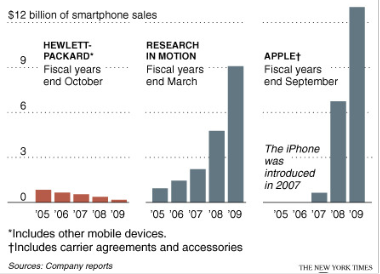
    Sales of H.P.’s hand-held products, including its iPaq smartphone, dropped to $25 million in the quarter, down from $57 million in the same period last year. Apple, by contrast, had sales of $5.6 billion for iPhones and related products during its most recent quarter.

    To put it in more perspective, $25 million at an ASP of $350 a phone means HP sold about 70k phones last quarter, or what Apple sold every 17 hours.

    link: Hewlett-Packard, a Technology Powerhouse, Stumbles in Smartphones - NYTimes.com