Asymco

Asymmetric Intelligence

IBM

  1. The conditions for survival and prosperity

    Research · 41 comments

    Yesterday's post described the history of personal computing platforms over the past 37 years. It showed a distinct shifting of "eras" between traditional personal computing and the emergent mobile computing represented by device-based platforms.

    Underlying these lives (and deaths) of platforms were the growth (and decline) of fortunes of companies and people. I hoped that by observing these patterns insight could be gained into the conditions for success or failure.

    The following graph shows the companies which were predominant (in the top five ranking by shipments[1]) during each year of the industry's history and the volumes they were able to obtain during that period. I also added Nokia and RIM as examples of the challengers coming from mobile devices.
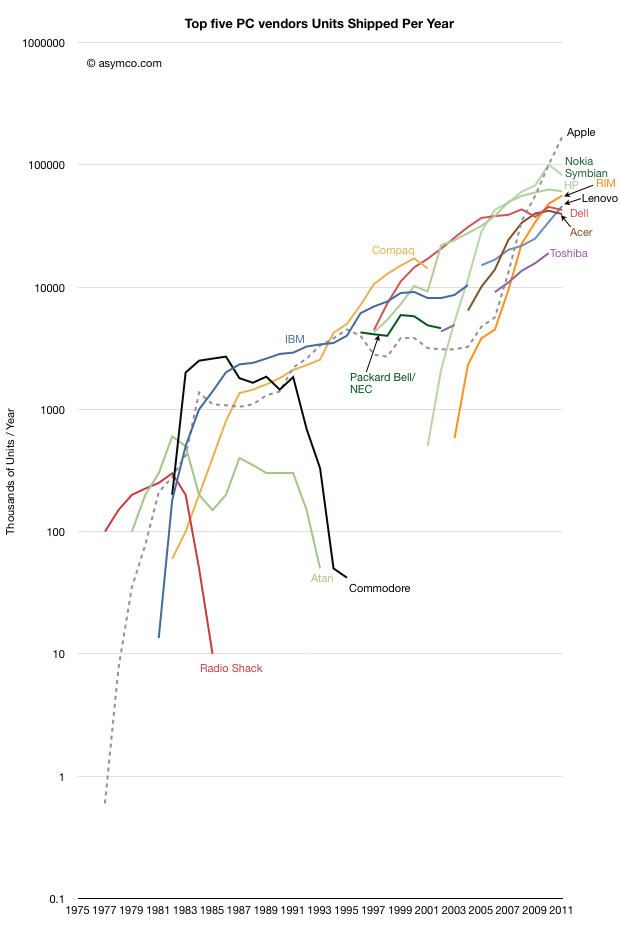
    It's a difficult graph to interpret. The pattern I observed was that most companies were not able to sustain presence in the top five ranking for long. Indeed, regardless of having one's own platform or being a licensee, companies seemed to fade reliably. Some were acquired, some sold their operations but there is a distinct impermanence to their prosperity.

    To sharpen this perspective of longevity I indexed each company to the point when they entered the "prosperity zone" and measured their staying power within it. The following graph shows these indexed lives.
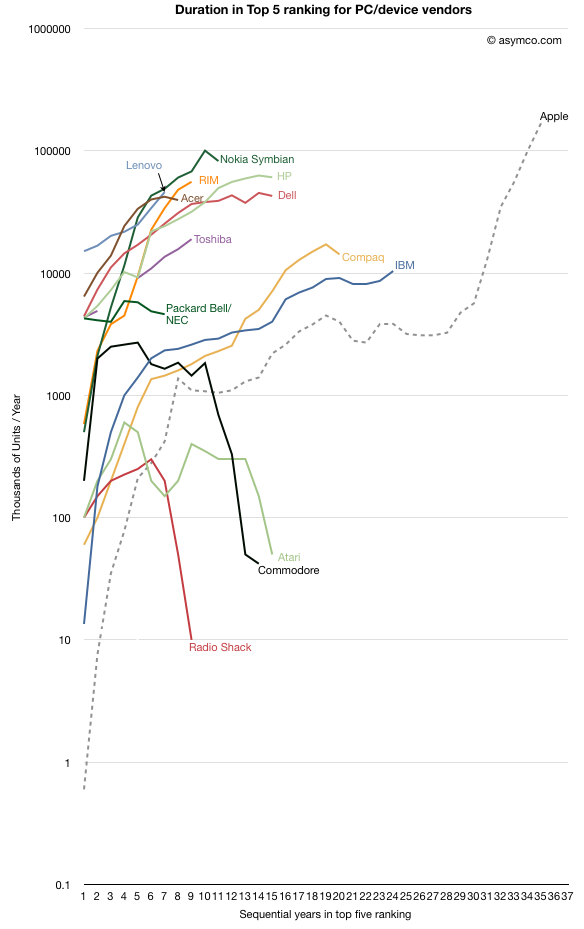
     

    Apart from Apple, IBM remained in the business the longest (24 years). Compaq was second with 20 years before being bought by HP. HP and Dell are still operating after 15 years, having tied Atari and Commodore. After these ancients, the upstarts Nokia and RIM are struggling to remain relevant after 10 to 12 years.

    Then there are the transients like Packard-Bell/NEC, Toshiba, Radio Shack and Fujitsu which lasted less than 10 years. The newest PC companies are all from China or Taiwan: Acer, Asus and Lenovo. Their longevity cannot be called yet though Acer seems to be in decline. Lenovo, which took over IBM's brands continues to grow. However, as yesterday's post showed, without diversification into devices, pure PC makers are likely to fade.

    But besides this interesting history lesson, there is a deeper, unsettling observation. The scale of these periods of prosperity is far shorter than the average person's career. Indeed, the entire time span of the study is 35 years, about the time an average person will be employed. All the companies failed to maintain prosperity over this time frame.

    These are a small sample, flawed by showing only hardware units, but I consider it a proxy for the overall technology market. Software-only or services companies have had no better records.

    The implications for company managers and workers is profound. Chances are that the business you work for will not prosper for more than a decade and will reward you for an even shorter period. Similarly, as witnessed by the P/E ratios, investors have  given up on this industry as one with any quality of earnings.

    There is no "rule" that this has to be so. The high mortality rate and short longevity of technology companies is a consequence of a failure to manage innovation and disruption. Apple may be an exception--one I think worth studying. Though not always prosperous, it has managed to survive, being the only company from the early era of personal computing to still be operating in the industry. Indeed, it's now the most prosperous. Maybe it's a fluke, but I rather think it's due to an ability to re-define itself as the market shifts. Its essential quality being an ability to disrupt itself.

    And if we think about it this way, ultimately, longevity is more important than prosperity. Without patience there is nothing but chance determining prosperity. The fate of more than company finances rests in the balance.

    Notes:

    1. Apple did not maintain a position in the top 5 throughout this period but is shown as a benchmark as it remained in the same business throughout this period.
  2. Clayton Christensen and Siri

    Research · 165 comments

    At the Open Source Business Conference in March 2004 Clayton Christensen gave a presentation. It's available as an audio file for download here: Clayton Christensen | Capturing the Upside. I strongly recommend listening to the whole thing because it's the quintessential Disruption lecture.

    It has relevance in many areas of analysis, but when I was trying to think of a way to characterize the potential for Siri I recalled one particular passage that I saw as almost clairvoyant. Seven and a half years ago, Clay said:

    ... the next time you go to a computer superstore, go to the voice recognition software shelf and pick up a box there that’s called the IBM ViaVoice.  Now don’t buy it, but just look at it!  They have a picture of the customer on the box, and it’s an administrative assistant who is sitting in front of her computer wearing a headset speaking rather than word processing.

    You think about the value proposition that IBM has to be making to this woman.  She types 90 words a minute.  She is 99% accurate.  If she needs to capitalize something, she just instinctively presses shift and cruises through.  And IBM has to say, “No, don’t do that anymore.  I want you to put this headset on and teach yourself to speak in a slow and distinct and consistent manner in complete sentences.  If you must capitalize, you must pause, speak the command “capitalize,” pause, speak the word you want to capitalize, pause, speak the command “uncapitalize,” pause, please be patient, we are 70% accurate, this will get better we promise.”

    This is not an attractive proposition to this customer.  And IBM has -- I’ve not worked with them at all, but as I understand it -- they’ve spent maybe $700 million trying to make voice recognition technology good enough that it can be used in that market.  This is a very difficult technical hurdle to surmount. Meanwhile, while they are investing that aggressively, Lego comes up with these robots that recognize “stop,” “go,” “left,” “right,” and the kids are thrilled with the four word vocabulary, and then "press -- or -- say -- one" kinds of applications take root, and now directory assistants ask you to say the city and state and so on, and much simpler, and an interesting market is emerging.

    I bet maybe the next place it takes route is in chatrooms because the kids don’t spellcheck or capitalize anyway, and they would rather speak than type.  And maybe then the next application would be, when you see these stubby fingered executives with their BlackBerrys trying to peck out emails, and their fingers are four times the diameter of the keys, they’re only 70% accurate.  If somebody gave them a voice recognition algorithm that really didn't have to be very good so that they could speak their wireless email rather than peck it out, I bet they’d be thrilled with the crummy product.  And ultimately, as it takes route in these new applications, it may get good enough that we can do word processing with it, but it’ll be a long time.

    The thing that strikes me about Siri is how "crummy" it is. It's trying to be an intelligent assistant but it's not nearly good enough. Many have called it "toy like". It was so uninteresting that there was minimal coverage of it after the keynote launch. One can almost forgive the cynics. It was "yet another feature".

    However, it does seem to be good in a very limited set of tasks. It is something you can hire for some minor jobs that you'd rather not do. Basic calendar booking, context aware search and a few delightful surprises. But it's not trying to be much more. It's not trying to be a typist. It's not trying to be a companion. It's not trying to be smarter than you and make you redundant. It's only trying to help lubricate your life. This is what makes it so exciting.

    Like the example of the toy robot that delights the child, Siri delights with simple competence. It's not profound but as Clay points out in his talk, it's a necessary first step. What must follow are many more steps. Siri must get better. And because it will have at least 200 million users, I'm betting it will. So over time it will take on more tasks and will eventually help us in ways that we cannot yet conceive possible today. This is just like the introduction of the capacitive touch screen. Popularizing the touch screen has led to experiences with phones and tablets which we did not think possible four years ago.

    But it takes time. Like any truly useful breakthrough, it takes a long time to mature. And also like any disruption, the potential of Siri is rooted in four principles:

    1. Humble early goals which it accomplishes well
    2. A large population of enthusiastic adopters who give it sustenance
    3. Plenty of headroom in improvement giving it areas to grow into with positive feedback
    4. A patient sponsor who makes a stable living

    There's no magic to it. In fact it's banal. These are only the principles that every parent uses to raise a child.


  3. What's a Post-PC device?

    Research · 86 comments

    Microsoft's Steve Ballmer argues that the tablet computers (aka slates, media tablets or iPads) are PCs. Steve Jobs argues that they are post-PC devices. There are analogies to trucks, cars and various metaphors for what these new devices symbolize. Some argue that because the iPad needs a PC, it's not a post-PC device.

    But how to define a new generation of computing? Since the PC is not the beginning of computing, it may make sense to look to the eras of computing that preceded it.

    The first post-mainframe computers worked alongside mainframes and were typically used by engineering departments (vs. the finance and accounting departmental role occupied by mainframes.) They did not require a dedicated (often external) mainframe service team and could be administered by in-department system administrators. Input was not through dedicated data entry personnel and output was not a ream of folded paper. Users could use a CRT terminal to interact with the computer directly. Digital Equipment Corporation, Control Data, HP, Honeywell, Prime, et. al. grew up in the shadow of IBM but thrived. Their products were cheaper and simpler to operate. Initially, the products were not more powerful.

    The first post-minicomputer microcomputers (also known as PCs) were used alongside mainframes and mini-computers. They were typically used for 2-dimensional spreadsheets analysis by individuals in many departments and were easier to justify cost-wise than the time-sharing cost structure of the incumbent computers. Many microcomputers were able to access mini-computers and mainframes through terminal emulation software (and sometimes special hardware boards) so they were still able to work with existing business processes. They did not require dedicated personnel for administration but had a shared support department. Input and data storage were on the "desktop" as was printing. Compaq, Dell, HP, Apple and IBM embraced this new form factor. Their products were cheaper and simpler to operate than the previous generation of computers. Initially, the products were not more powerful.

    The first post-microcomputer tablets are used alongside microcomputers for tasks such as presentations and entertainment. They have software available that allows access to desktop computers and services dependent on PC-architectured servers. They depend on PCs for data backup and software updates. They do not require IT support. They do not require a keyboard or a desk. Apple and many mobile phone vendors are embracing the new technology. They are cheaper and simpler to operate. The new products are not more powerful.

    To define a new generation of computing by its isolation and exclusion of the previous generation is not sustained by the history of computing.

    I would suggest that the definition of a new generation of computing is that the new products rely on new input / output methods and allow a new population of non-expert users to use the product more cheaply and simply.

    I might add that the consequences of each generational shift are:

    1. Consumption increases
    2. Skill required decreases
    3. Support required decreases
    4. There are new applications and use cases
    5. The economics are not favorable for incumbents
    6. The economics are favorable for new entrants
    7. The older generation slowly fades through diminished growth but never disappears
  4. IBM Survey: The cell phone is no longer a gadget – it’s what IT is going to become

    Research · 3 comments

    “In all areas of software development, mobile computing is seen as the number-one hottest IT opportunity next year,” said Jim Corgel, an IBM general manager of independent software vendors and developer relations who was involved in the survey. “Not only will mobile spike to the forefront, but by 2015, respondents said it will dominate everything. The cell phone is no longer a gadget – it’s what IT is going to become.”

    via IBM Survey Says Mobile Apps Will Dominate Enterprise - Venture Capital Dispatch - WSJ.

    Developers are usually not very good at predicting specific business winners or losers (to prove this consider why developers don't spend their energy and earn their living picking tech stocks instead of writing code.)

    However, developers are very good at spotting long term technology trends. It was developers who championed the early internet and it was developers who saw potential in social networking. To see a survey of developers confirm that mobile devices will dominate IT, in contradiction to most incumbent strategies, is encouraging.

  5. IBM CEO: the PC era ended three years ago

    Research · 23 comments

    But one area where IBM won't compete with HP is personal computers. In 2005, IBM sold its PC business to China's Lenovo Group for $1.75 billion. The PC era, Mr. Palmisano said Tuesday, ended three or four years ago.

    "We wanted to get out before it was obvious to everyone," said Mr. Palmisano. "I couldn't give it away today," said Mr. Palmisano of the PC business. HP is the world's biggest PC maker.

    via IBM's Chief Thumps H-P - WSJ.com.

    Is this obvious to everyone yet?

  6. Dell's running

    Research · 6 comments

    Once the pride and joy of the world's largest computer systems builder, consumer products now make up just 18% of Dell's total sales. That's probably a good thing in the long run, because this segment is notoriously margin-poor when compared to the less price-sensitive corporate computing market. I can't blame IBM for giving up on consumers years ago, and I think Dell should follow suit.

    via Make a Hard Left, Dell! (AAPL, CTXS, DELL, HPQ, IBM, MSFT, VMW).

    That's right. Flee upmarket Dell. Run, run.

    Quoting from the gospel:

    Step 2: Entrants grow and improve; incumbents choose flight. As disruptive attackers follow their own sustaining trajectories, they make inroads into the low end of the market or begin pulling less demanding customers into a new context of use. What happens when the disruptive entrant begins to make inroads? [...]

    Incumbents naturally choose flight. What looks highly attractive to the entrant continues to look relatively unattractive to the incumbent. The asymmetric motivation leads to incumbents naturally fleeing the low end. They cede that market to the entrant. [...]

    Remember, incumbents focus on delivering up-market sustaining innovations that allow them to earn premium prices by reaching undershot customers. They view flight as a positive development.

  7. Market Caps

    Research

    For reference, some selected current market caps:

    • Microsoft (MSFT) - $236.76B
    • Apple (AAPL) - $183.40B
    • Google (GOOG) - $173.97B
    • IBM (IBM) - $159.93B
    • Cisco (CSCO) - $138.60B
    • Hewlett-Packard (HPQ) - $114.26B
    • Intel (INTC) - $109.85B
    • Disney (DIS) - $54.31B
    • Nokia (NOK) - $48.24B
    • Research In Motion (RIMM) - $37.43B
    • Amazon (AMZN) - $40.34B
    • Dell (DELL) - $29.63B
    • Sony (SNE) - $29.10B
    • Yahoo! (YHOO) - $24.78B
    • Motorola (MOT) - $18.82B
    • Adobe (ADBE) - $18.23B
    • Palm (PALM) - $2.51B
    • RealNetworks (RNWK) - $564.74M

    The top 10 world-wide:

    1. Exxon Mobil Corporation 352.31B
    2. PetroChina Company Limited (ADR) 240.47B
    3. Microsoft Corporation 237.58B
    4. Petroleo Brasileiro SA (ADR) 220.19B
    5. BHP Billiton Limited (ADR) 204.30B
    6. HSBC Holdings plc (ADR) 199.98B
    7. China Mobile Ltd. (ADR) 199.09B
    8. Royal Dutch Shell plc (ADR) 195.76B
    9. Wal-Mart Stores, Inc. 195.27B
    10. Apple Inc. 183.57B

    Steve Ballmer is not worried, Apple is just a rounding error.