Asymco

Asymmetric Intelligence

internet

  1. Jim Zellmer interviews me about my life

    Research · 45 comments

    This is a transcript of a voice interview conducted April 19th 2012.

    The interview is available as an audio file here.

    --

    Jim Zellmer: I thought we'd start by describing your education from the beginning, Horace.

    Horace Dediu: OK, that's good, yeah. I like to say I'm the product of the public school systems. I went to public schools in three different countries, and probably maybe a dozen different schools altogether because we moved a lot, moved over 30 times.

    My family emigrated, and we were what you might call political refugees for a while. We were stateless. We didn't have passports. We were officially not citizens of any country. So, for a period of about four or five years, that was the case. I started having regular schooling in Romania, and then moved to Italy and was enrolled in a school, actually, in the city of Verona, which is where "Romeo and Juliet" was originally set.

    I was saying...my background. I spent a year in school in Italy, and I went to school in the north of Italy, in Torino. The thing was that I didn't know Italian, so I actually had to learn. But that's a lot easier for children. I was about nine, I think. And so, I learned Italian, was able to have a good school year. But then we moved.

    In the summer, we moved again, and we emigrated to the United States. It took about a year to get the paperwork for that--because that was our ultimate goal was to be in the US. I was enrolled in the public schools. First, in Cleveland, where we found someone to help us. I actually went to, I guess, elementary school in the city of Cleveland, where we lived.

    And then, later on, for middle school... What happened in Cleveland around that time was that busing started, desegregation. It would have meant, for me, more than one-hour journey across the whole city, from the west end to the east end of Cleveland, and my parents would have none of that. So, we moved to a suburb, immediately adjacent, which is called Lakewood. I went to middle school and high school in Lakewood, Ohio, for three years in high school.

    And then, we actually moved yet again, to Boston. My father got a job in the booming tech sector at the time, which was in the early '80s. I ended up in a suburb of Boston called Medford. We didn't know much. Again, we were flying pretty blind here. We weren't familiar with neighborhoods or what were good schools or anything like that--"good schools." Mostly it was a question of, "Can we find affordable housing?"

    Medford turned out to be a pretty lucky choice. In one hand, at the time, it was a blue-collar town. It was one of the near suburbs. So the closer to the city, it tends to be the older the immigrant generations are. It was settled mostly by Italian Americans. And so, a lot of the children I met in school were of some ethnic background.

    Again, in the Midwest, that was a bit more rare. So East Coast, for me, was a little bit more vibrant in the sense that there were more interesting ethnic backgrounds and people from different histories and so on.

    I enjoyed it, but I only had one year at Medford High School. It was actually more enjoyable, that year, I would say, than my years in Ohio. I have friends that I retained from that one year, and I don't have friends I stay in touch with from Ohio.

    But it has changed. The city since has become much more, I would say, a lot of those families moved yet again, probably to a further suburb, and has changed character. I think it's more Hispanic now, the city overall. Nothing wrong with that, it just probably would feel different to anyone there now.

    I was, again, in Medford. My choice, my next question, was where to go to college. I had been doing OK in school. And that was an interesting puzzle to solve as a kid, because you don't quite know how to fit in, the usual problems. Fortunately, having moved around so much, I had a pretty thick skin, and having had an accent or a strange background just made you a little bit tougher. And so, I was pretty immune to some of the high-school politics.

    I focused on studies, and my parents are both educators. My father has a PhD in mathematics, and my mother had a Master's in mathematics and she taught. Actually, her job was as a teacher. They both got certified as teachers in the United States. My father had taught, also, university in Romania, but he ended up teaching high school and other two-year colleges in the US. It's very hard to go into academia from another country.

    In any case, the fact that I had such devoted, academically inclined parents helped in focusing me on academics. That also, I think, was my nature. As far as college, my concern, we always had financial concerns, right?

    Jim Zellmer: Right.

    Horace: So, for me, I wasn't interested in the social aspect of college. For us, really, the decision was, "Can we keep expenses down?" I was accepted at Tufts University and also at Brandeis, which were local. That was important to me, that it would be near to my home and I could actually commute to these places.

    Tufts was slightly better. It was a little bit closer. It was actually in Medford. So, I almost went to the college that was nearest to me. It had a very good program, also, in both engineering and computer science.

    The odd thing is now, in college for me, was that - it's almost accidental - but, they had an option for you to take two degrees. The dual degree program was meant for people to study liberal arts and engineering. The idea would be you'd be a well-rounded individual.

    The weird thing is that when I went there, which is 1985 to 1989, the School of Liberal Arts included the mathematics department and included the computer science department, which is a spinoff of the math department. So, computer science was a Liberal Arts degree; whereas, engineering was like electrical, mechanical, and so on, the traditional subjects.

    I enrolled in the dual degree program with the intention of obtaining a computer science degree from the Liberal Arts School and a computer engineering degree from the School of Engineering. That meant that I would essentially take about 30 percent more courses. I think it was 50 credits versus the standard 30, or so. So, I was going for incrementally more material, but I would end up with two bachelor's degrees.

    That's what I did. I actually also did it in an accelerated fashion. I ended up doing that in three and a half years, rather than what they expected it to take, five years.

    Jim Zellmer: Wow.

    Horace: That involved a lot of summer school. I was actually going through taking some of the requirement courses in the summer. So, I was basically a student 365 days a year and I managed to get the two degrees.

    In the third year, there was one of these internship opportunities for research in a lab, GTE Laboratories.

    Jim Zellmer: I'm sure.

    Horace: GTE Labs was, again, local, which was important to me. They actually put us up in the dorms. So, the only time I spent living in a dorm was during the summer of my internship because it was paid for by the employer.

    That was a great time. I loved it. I absolutely adored it. Those years right at... In my third year, which actually was my, I guess, my second year as I was a junior a bit early, I was going through this internship and I was studying, I was going working in the research lab. Then I ended up doing my senior year, my last year, I kept going back there. Somehow they kept me around as a part time employee because the project I had been on turned out to be useful.

    It was in the library. I was actually working on indexing, which turned into search, which turned into Google later on, but we didn't know what it was then. We called it information retrieval. The algorithms, so we now do search intuitively when it actually became a commercial product, but it was something we did as research back then.

    It was great because I was getting the experience I wanted desperately, loved it, and then I was still in school and I managed to get my degree. I was even earning money while I was doing this. It worked out very well, but it was a very tough period.

    I graduated with not the highest scores, but I think I was magna cum laude, or something like that, which is not summa cum laude, but it's pretty good. It's like 3.8 GPA, or something like that. That's it. I don't know if that's what you wanted to hear. Then, of course, I did grad school.

    Two years, while I was still employed. I took a full time job at the labs, then essentially I did two years. In '92, I got my Master's in computer engineering. Then I spent about a year or two figuring out what to do next. I went to New York to have a bit of experience. Oh yeah, I remember. I applied to Harvard because I wanted to go to business school. The reason I wanted to go to business school was I didn't understand business.

    Jim Zellmer: [laughs] How did that play out? MBA's are often criticized.

    Horace: Yeah, I'll tell you how it played out. Well, first thing is this. I'm sitting with my friends. We're all engineers, hackers, if you will. We're like, "We don't understand. We don't understand how we get funded."

    Here we are sitting in these nice offices, but how does this company, who's basically a boring utility, how are they going to fund us to do cool stuff? We just compared notes and nobody knew. I realized none of us knew how business worked.

    I said, "Well, I better learn about this." To me, I had been so focused in engineering that all this business stuff, the only thing I knew was because I would read the "Wall Street Journal." I didn't have either friends, acquaintances, families. All my friends were nerds. All my family were educators. I knew nobody, literally not one person, who could tell me how the stock market worked.

    I would pick up the Wall Street Journal, read it cover to cover, and I wouldn't understand what the heck they were talking about. It sounded very abstract to me. It sounded like I need to learn something that there was something missing in my education.

    I felt that the only way to get that training was to go to business school. And so, I applied. I was rejected, and the assumption was, in my mind, that I was too technical, too focused in a very, very narrow niche. Back then, there were headhunters that were trying to headhunt people. So, one headhunter got a hold of me and they said they had an opportunity in New York. I said, "Oh, New York. I know they do business in New York. So I better learn more from going to New York."

    And so, I took a job with Chase Manhattan, at the time. It's called something else now, but it was Chase Manhattan. The job was also in IT, but at least it was IT, more pragmatic--corporate technology they call it. But I was there trying to understand more about business. I would still read the "Wall Street Journal" every day, still wouldn't understand it.

    I reapplied to business school. I told them what I did. I said, "Look, I took this job because I wanted to learn business." I think I somehow convinced them the second time because I was so mad to do these things.

    Jim Zellmer: Persistent.

    Horace: Persistent. Somehow, I got accepted. I'll never know how they made that mistake.

    Jim Zellmer: [laughs] Yes, of course.

    Horace: But, anyway, once I went there, I was like, "OK, teach me." Now, the problem was that you start to learn with the case method, and you realize pretty quickly that there is no real curriculum. This is actually a lot of examples you're being given. It's not even empirical. It's like, "Let's throw a lot of examples and see if something makes sense in a pattern somewhere."

    Jim Zellmer: This was Harvard?

    Horace: Yeah. So, Harvard Business School. It was the only school I applied to, because I felt I didn't know how to qualify quality in terms of business. It was just a brand name. If you know nothing about phones, you just buy the iPhone because you know it's the best, right? So that was me, very naive. And throughout the school, it wasn't as rigorous.

    In many ways, it was easy, because in engineering, engineering is very hard. You have to take test and you have to get answers right. And then in business school, it seemed like you just had to talk and you had to be articulate and you had to somehow be sufficiently smart-sounding to succeed.

    Jim Zellmer: The theater, aesthetics.

    Horace: Yeah. They drilled that into you. They said, "This is what we're teaching you is how to basically be a leader," and that leadership meant being proactive, not being passive. It meant getting in, if you will, on the discussion. I got that. I got it. It made sense to me because, yeah, in the meeting, if you sit there and say nothing, probably no one pays attention to you. You won't go anywhere in life.

    So that was one of lessons. The other ones were about vocabulary. What we're not learning here, however, is that there's axioms. There's no specific rules of business. In fact, if you were to put rules down, there'd be many which would contradict each other. One of the classics is that money now is better than money later. But you need spend money now in order to have money later.

    Jim Zellmer: [laughs]

    Horace: So these two things are contradictory. There were no rules in business that made any sense as if you were proving a theorem or something like that. I decided all right, let's just go with the flow. I met nice people. I learned more from a lot of people.

    The best thing that happened to me is that I had Clay Christensen as a professor. He was the nicest guy. The way he taught, it just resonated with me. He hadn't yet published "The Innovator's Dilemma." He was only teaching us operations, which is a first year course.

    It's the only technical course in the sense that you do some process diagrams and you do some analysis. Finance is another analytical course, but the math is pretty straightforward. It's not very conceptual, in a way. Accounting is not either. It's interpretation.

    But the professor, Christensen, he had a way of speaking to me that made sense as an engineer. It wasn't just me, there were a lot of people in the class who just felt that this guy was getting to the heart of a lot of the questions that we had. I took him as much as I could. I also had the option to take him in the second year. But, unfortunately, there was change in the dean and I think he had to change courses that he was teaching in the second year.

    In any case, we had a good two years there. My question was, what do I do after I graduate? This was 1996. The Internet, at the time, was just emerging. Netscape existed as of 1994 or 1995. There were no Internet business models per se. Certainly, there was a technology industry. But it was pretty much boring and either IBM or commodity PCs and you had a bunch of software companies like Microsoft and Adobe.

    It was already getting a little bit tired as an industry. As an MBA, it wasn't really that exciting. Everybody was doing either consulting or investment banking. Those were the typical ways of getting out of school. I had, of course, done something different. I did a startup. And nobody...

    In fact when I told people I wanted to do a startup everybody said "You came to the wrong school. No one goes to Harvard to learn how to do a startup. There are specific schools that  train you for entrepreneurship." Like for example, Simmons or something. I forgot the names now. Maybe that's a women's college. I don't remember the names.

    But the point is guys were saying "No, when you come out of here, you are either going to become a CEO of a Fortune 500 company or you're going to be a consultant for life or you're going to be in finance, managing other people's money or in private equity." I was like "Oh man. All right, well, whatever."

    Jim Zellmer: [laughs]

    Horace: I went and did this startup. I did a startup with no VC money. It was done with a partner in California who had raised money from the government using SBIR grants.

    We're talking the Department of Defense, and we were doing algorithms research. I went back to my university and recruited an engineer who I worked with in a basement office right off of Massachusetts Avenue. That was in '96. We built a system. We ended up licensing it to Adobe. It was a plugin to Acrobat. We didn't benefit much from it financially. Other people made a lot of money but not us.

    But we did learn a lot. So I'm thinking: In business school, I didn't really learn how business works, but I have this degree which gives me credibility. Now, I'm going to do my own business...

    Jim Zellmer: It's a ticket horse, yes.

    Horace: Yeah, but I did my own business. I threw away the ticket.  It didn't help me at all. What I was realizing, for example ... I didn't know how to do sales. I thought when you're doing your own business, you actually need to know how to do sales, and they don't teach you that at business school. I actually went and took a sales course, like they do in a daylong seminar.

    I'm saying there are so many pieces that are missing. I didn't know how VCs, how to handle VCs and how to do pitches and do all these things. And none of that was taught, so I thought, OK, what I'm going to do? I'm going to do on-the-job training. I'm going to figure this out. And [learn from] networking with people in technology.

    Eventually, I decided from the learning we had in the first startup to do another one, to do e-books! That was 1999. I'm trying to do an e-book startup in 1999. [So] I get on a standards body. I'm doing something with folks and I'm actually in a standards group that includes people from Microsoft, from Adobe, from a bunch of other startups, and from Nokia.

    Actually that's where I met someone from Nokia, who...

    At the time--it was 1999--I realized at that moment, with or without Nokia, I said, all computers are going to be handheld devices. This is so obvious. I can't express how obvious it is. I was interested, because Nokia had pretty much at the time the best mobile devices.

    Jim Zellmer: Yeah, they were the player, no doubt.

    Horace: I was asking myself, look, everybody in the U.S. doesn't get mobile. It's obvious that either it's Japan or Europe. And so, the question in my mind was, do I stay with the technology industry and try to figure out how this mobile computing will play out, or do I go to somebody who really knows mobile and expect that they will actually figure out how to become a computing company?

    I chose the latter, partly because they also offered me a job and the dot-com bubble burst, and I wasn't ever going to get funding for my e-book business, which was called Handheld Media by the way. It was a great idea, great business idea, that we would actually help publishers convert books. Because at the time, the publishing workflow didn't include exporting tools. You either went to print or PDF, and we had this tool that would reformat a PDF book into a publishable format, like what e-pub is now.

    Jim Zellmer: E-pub, right.

    Horace: At the time, it was called OEBF, Open E-Book Format. It was using HTML, a variant. I actually had a workflow I could execute on my own and I could basically produce e-books. I did a couple of dozen, mostly as trials. I remember them even now, actually going through and manually extracting hundreds of pages, fairly quickly though.

    But, anyway, that all came crashing down because although e-books were still interesting, there was no more funding in the docket. I had the opportunity to work with Nokia because they were actually very interested in launching something, not necessarily in e-books, but in media distribution. They wanted to sell music. They wanted to sell video. They wanted all those things in 2000. I came to them. Now, I'm playing my ticket, my bus ticket.

    [The job] was something about how to do business strategy. They hired me. I had this technical background as well. One year I spent based in Boston. But then I was fairly quickly moved to Finland because that's really where you need to be to have any career opportunities. I was young. I was not married. Finland has its charms.

    [I met] another American ex-pat who had moved there before I did and he extolled its virtues. I was pretty sold on that. Even though you pay more taxes, you get less wages, everything I did was economically the wrong thing to do.

    Jim Zellmer: [laughs] That's a learning, though, too. You've learned a lot. Looking back on all that, Horace, what might have been better or more effective? When you think about your kids today...?

    Horace: I don't know. I'm probably having too long of a chat on this, I mean fooling around this. But yeah, I'm very conscious of education, as I said. I realized pretty much after a year after leaving ... When I started Asymco, it's very weird. Again, you never know when you start down a journey where you're going to end up.

    It was purely going to be app development because apps were just starting out. Apps were really almost invisible or there was no development going on in Europe. So my idea was why don't I bring iPhone apps into the land of Nokia, because here it's a green field site.

    Jim Zellmer: Yes.

    Horace: But it was a tough sell. I got one customer, but it was very, very tough. I wanted to bring apps to small and medium companies. I was going to essentially do apps as marketing material, like apps that are essentially a branding thing.

    I was naïve also about the Finnish business culture because I think Finnish businesses are extremely conservative and that wasn't playing out. But the fortunate thing was that I began to blog because I had blogged while I was inside Nokia. I told that story about how I started doing it because I realized I wanted a bigger audience.

    Then when I left, people kept saying "Why don't you do that while you're on the outside, just for fun?" I took that year to figure things out. I  went back to writing my blog. Then, literally, everything was happening in 20 minutes. It was like a fire hose. I had to learn everything. I kept asking: OK, how do I do this?

    So, I am learning every single thing, because I had done it inside Nokia where it was movable type. It was a completely different system. I didn't have to set up anything. It was very simple. It was done for me.

    But on the outside, I am having to do it all myself. I started using actually iWeb, which at that time had a blogging tool. So, I opened an account on MobileMe. I was just putting everything through the desktop tools. They were right under my nose. Then I realized the limitations of that, and I moved to the next thing. I was like, "Oh! Seems like WordPress is something people use. Let's go to that." So, I went to WordPress.

    Then I realized, "Oh! Hang on! If they are hosting me, they are going to put ads in my stuff, and I don't know what they put there. So, I better host myself...how do you do that? " I need to find a hosting provider. How do you do that?"

    So, every technology, every bit of knowledge I had to have, I obtained strictly on my own. I say that every single character written in Asymco and every single mouse click that made it possible was performed by me.

    I had no technical support at all. It helps maybe to have a computer science background, but years had passed. So, I was able to... Here the key to the whole thing is that, every step, I am learning, and it keeps me motivated. I am like, "Oh! I understand how this works."

    I had some friends, who were more technical, and I would ask them, and they would say, "Oh! You are wasting your time. You can't get any traffic. This won't work." I would ask: "Tell me about Twitter", and they would say, "Oh! You're better off on Facebook." I was like, "Oh! Man!" Every single thing that I was given as advice turned out to be...

    Jim Zellmer: Wrong?

    Horace: Yes, doing the opposite would actually be the right thing. And so, I started learn about stats, the numbers game of blogging. So, how does that work? What does it mean to have good traffic?

    I didn't expect to get advertising revenue, but I was thinking: what does it mean to be successful? So, I would go to John Gruber's site. John puts up his own rates, and I am like, "Oh wow! Look at the numbers." He actually tells you how much he charges per week, and then he says he is fully booked. So, you know what his income is. And so, from that, I was like wow! That's my goal I said to myself.

    If I can get the traffic that Gruber gets, then I can charge these rates. I was trying to figure out how much traffic he was getting. He was getting like four million page views a month. I said, "I don't know if that's a lot or not." It certainly is a lot to get money, but you know, how do I get from zero to four million? So, what happened is that also when I was starting out, I reached out to John by email, directly by email.

    Some time before I mailed him and said, "I used to work at Nokia and there's a couple of things you're writing about that I wanted to amplify or I wanted to give you some background." He has great stuff, and he actually used my material in one or two blog posts. I wasn't blogging at that moment.

    But once I started blogging I mentioned to him, I said "Remember me? I sent you that info, and now I have my own blog." He didn't say anything. But then I wrote, I think the first piece that I wrote that was provocative. It was why someone at Microsoft had been fired or something like that. He linked to me. Then I saw. Then my eyes were open, because then my traffic... from zero to 12,000 a day.

    Jim Zellmer: Yeah.

    Horace: 12,000 views, for me, was like infinity. My server crashed and all that. I went back [to him] and I said "Thanks for the traffic. Now what do I do because I need money to be able to get this traffic managed." He said "No, you don't need money." You need to turn on caching." I was like "Oh."

    Jim Zellmer: [laughs]

    Horace: That solved the problem. But then I was asking him "So where do I go from here? Should I think about putting ads on my site? Is that the right thing," because I was so naïve. And he said "No, no, no."

    He gave me one piece of advice. This is the only piece of advice I ever got from and from anybody that was useful. He said "Don't put ads. Just do what you do. Your value is in the future. Just keep doing what you're doing." That's all he said, one line.

    I said "OK. If he says that, I believe it. That makes sense. Let's do it." I kept getting better at what I was doing, basically writing as well as I could, getting the feedback from comments and learning every step of the way.

    This is still going on. One year on, I learned what Twitter really meant. I didn't know Twitter. The first thing I learned at Asymconf was what a hash tag is good for. [I mean] I knew what they were. But I did not use them. I never used a hash tag before Asymconf because I don't use Twitter that way. I don't use it to look up stuff. I mostly use it as a way to get my word out and get feedback, just like a mini micro blog.

    But then I didn't understand the potential of a hash tag. It dawned on me when people were writing about Asymco and using a hash tag and if I searched on that I could find out everything that everybody said about it, a great idea.

    But that I learned again just a few days ago. So many things I learned, thousands and thousands of details. So many things that the tables are now turned. Now people expect me to teach them about blogging.

    Jim Zellmer: Yeah. [laughs]

    Horace: For example, how to get traffic. A lot of people are sending me emails with paragraphs and paragraphs of effusive, "Oh you are so great. Thank you so much. Can you help me with this?" I'm like "Well, you don't need to say any of those thank you things, just tell me what you need."

    A 15 year old sent me a request for an online interview. He made it easy. Five questions. So sure, I'll answer five questions. I treat everybody equally. Whether it's the Wall Street Journal or a 15 year old. I give them equal attention. I learn as much from both. The kids will teach you more, actually.

    Jim Zellmer: Given all of that, if you were entering college today, what would you study?

    Horace: I would still study engineering, absolutely. I am at heart an engineer. My son, I hope he does the same things I do. When I was a kid  I loved building things.

    I loved building Lego, although I didn't have money for a lot of them. I loved building model kits, the little plastic model kits, planes, and so on. That's not fashionable anymore, and mostly, it's old men who do it nowadays.

    Jim Zellmer: [laughs]

    Horace: [But] I'm trying to teach my kid. I actually bought a whole bunch of kits and began to model again so he could see me do it so he would get a passion for it.

    I think building things with your hands, learning how things work, being passionate about numbers and about technology and things that are tangible is the only way to really create if your mind works that way. I'm not saying it's for everyone. To me, that's the heart and soul of progress.

    By the way, I didn't mention this, but my parents also infused in me a love for the arts, and not "modern music". Being Romanians and of a certain age, they weren't ever part of the Rock and Roll, if you will, generation, although they knew of the Beatles.

    So, they listened to classical music. Throughout my life I was exposed. I was taken to the theatre, opera, ballet. I used to sit in these performances since I was five years old. I maybe didn't get it. I wasn't talented. I tried to play the violin. I wasn't good at it, but I understood, after repetition, I understood the value of that.

    When I went to that liberal arts college and got my degree, even though it was in computer science, I had a lot of requirements. I had to take English poetry. I had to take Japanese art. I had to take a lot of courses that were basic requirements. At the time, they were a burden, but in retrospect, they actually taught me a great deal. I'm very proud of having that background.

    I'm not saying to not have an arts education, but absolutely, if you have the skills and can execute or can perform as an engineering student, do that and do the other things. Do the other things which develop the other half of your brain.

    Jim Zellmer: Where did you learn to write, Horace? You write very well. Especially given that English is not your first language, you're able to be succinct and you have a wide ranging command of the language. So, where did you learn that?

    Horace: Reading, partly. OK, so I have to give a lot of credit, and I did once on Twitter, give a credit to my English high school teacher. I said if you like the writing I have on Asymco, you should thank her.

    Actually I wrote to her. She had seen my work in "The Boston Globe." It had been syndicated from that or something.

    Jim Zellmer: [laughs] Wow.

    Horace: She wrote me an email saying me an email saying, "I'm so proud to see your work and I sent it to your calculus teacher, as well."

    They were both retired. The calculus teacher had seen my work in the financial section, actually. He sent her a note saying, "Check out the. . ." They read the paper. These are from that generation, right?

    Jim Zellmer: Yes.

    Horace: I've never seen my work in print. I've seen it online, but there it was. I thanked her. What I said is this: What she taught me was to write plainly and write clearly. This was Medford High School, a working class neighborhood, nothing special about it.

    The teachers I had in English in Ohio didn't instill in me the same passion. The same books were read. Right? The same classics.

    Jim Zellmer: Classics, yeah.

    Horace: Twain and Conrad and all those classics, but the teacher in Medford, when I would write an essay, and also, I think, there was positive feedback because I was perhaps a little bit better than average in her class. Better than I was in Ohio. There I was about average, maybe.

    I had good grades, but I didn't feel like I was great at it. I was nervous because a lot of the tests were vocabulary, or a lot of the tests were not essays.

    This teacher instilled in me the passion for writing good essays. She kept telling me how great my essays were.  I was writing somehow, and I loved reading the books. That's the other thing, the other kids would cheat. They would read the Cliff Notes.

    Jim Zellmer: Yes.

    Horace: They would copy from each other or do all these things. I was like, "No, no. I want to go home and I really want to read this book. These are really nice books." So, a lot of reading, a lot of passion for reading and I think practicing with essays. Practicing, also, in the writing of work online.

    Now, again, when I look back at my early stuff, I cringe. It took me a while to find my voice. I didn't know what a voice was. I figured that out quickly. Then I had this challenge of working in the rigor of data. I realized the way to make my stuff stand out is to avoid opinion, to avoid hyperbole, to avoid all these things which bloggers seem to do.

    So, anyway, it took some time. I think there's both a lot of ability, like, Einstein said, "It's 20 percent ability, 80 percent perseverance or perspiration." It's just practice. The other thing is it's like an athlete, right? An athlete gets good because they practice every day.

    When I set out I said, "This is so much fun. I want to keep to it. I want to write a story every day. I want to write a blog post every day. I pretty much stuck to that. I was even writing on weekends, but I stopped because time, family. But, I write every day. I think of it as mental athleticism. You've got to go running every day if you want to be an athlete. You've got to write every day if you want to be a writer.

    I heard, later on, that Jerry Seinfeld said he wrote every day. That was his key to success. He always tried to write jokes every day. That, to me, is what I learned. You bite your tongue sometimes, you learn how to deal with comments. Through comments, you see exactly how people make mistakes. They make mistakes by getting ahead of their thoughts, or they are too impulsive.

    You get this great sense of what makes it good and I thought myself being able to write things. I write email in a good way, crisp in the email. You get a sense for it. For example, if somebody sends me ad copy, like a sponsor, and they send me a copy, I sometimes cringe when I look at it.

    Jim Zellmer: I noticed that!

    Horace: I can't help myself, I edit their copy, and even though they probably don't want me to, there is no time to go back and do feedback. But it's something you learn as a skill.

    Some other people have asked me, "How can I teach my son to write well?" To me, it's not about being able to do more, it's actually being able to cut stuff out, and just go straight to thought. Maybe it takes practice.

    Jim Zellmer: Now that you are a parent in Finland, your children are in Finland, so what choices do you have for your kids'?

    Horace: We are very conscious of that. So, I like [Finland]. Well, I came for one reason, because, it was a wonderful place to play. But I stayed because it's a wonderful place for families.

    What Finland's known for, among other things, is that it has the best scoring students on tests ...So, their educational system is considered absolutely in the top, literally top of the world.

    There's a lot of mystery about why that is, and you can't really put your finger on it. A lot of educators from Finland have been on world tours trying to explain what they do, and everybody comes away scratching their heads.

    I think this actually goes back to Christiansen theory, because when you study it people want to see a formula or an algorithm, but in fact, what is happening is, is something about whether the system is integrated or modular.

    Whether the system is centralized or decentralized. So, it's not a question of process. It's like when he approaches health care, he comes  at it from these two different angles. He says, "It's not about being public or private. It's being modular or integrated."

    The assumption in other countries is always that everything is modular, and it cannot be anything else. So, in a sense, you need to question down at the deeper roots of causality.

    So, my son, just to give you some perspective. He is now in pre-school.

    He is six now or he is in grade zero, as they call it here, and he is going to a French school, meaning that they speak French in class.

    Jim Zellmer: An immersion school. Yes.

    Horace: There are several language schools like this. We're going to the French one partly because his mother went to a French school, his uncle went to a French school and they have loyalty to it, but also because I'd personally like for him to learn a romance language because I knew one. I still know Romanian. I had learned Italian, and I took French in school myself.

    The thing is that it doesn't cost any more to go to that school than any other school. All education is free. Not everybody can get into any school, but it isn't about money. The other thing is that it's a small nation.

    There's only about five million people, so all the decision-making can be centralized. There is no local school boards. There's no organization down to the smaller units that you might imagine. It's very simple and it's top down.

    If you were to try to do a top down approach for a country as big as the United States it wouldn't work. You can't really transplant this system. People are very wary of centralization and control and the decision-making at the top that is incompetent. I completely understand that.

    However, this being a small nation, it works and it's central. There's a question of optimum size. I mean, in some sense five million might be the right, maybe 8, even 10 million maybe works. I don't know  beyond that.

    There's also the question of how different the people are in terms of homogeneity. Although Finns are fairly homogeneous, there are minority groups as well and there's been plenty of immigrants. I'm not an expert on any of this, but I'm just pointing out some minor details.

    I really like the school system. We actually had a parent teacher meeting this morning. They're very relaxed. Children seem to be much more relaxed. This is one thing that came across from the educators meeting and discussing around the world.

    There's no pressure. Even though they're performing exceptionally well, there doesn't seem to be that pressure on testing, on measurement, on all these things that supposedly correlate with performance. In many ways, it's asymmetric, or doesn't make sense to people who are steeped in education theory.

    I don't know if that's advisable, though. The problem, again, is that it may only work in this context. It may only work in the Nordic country, but we're very happy with the way it works. It's the same thing, by the way, with healthcare. Healthcare here is also centralized. It is a public resource.

    Jim Zellmer: Yeah. What's your sense of the teachers you've encountered? One of the things "The Economist" reported a couple years ago was that Finland requires master's degrees from teachers. Contrasting that with what you experienced in America and Verona and Romania, do you have a sense of differences in the teacher capabilities, or no?

    Horace: Because here mostly all degrees are considered Master's, it's essentially, I think, five years of school, of education. There's so many differences I can't even begin.

    My wife, for example, she has a master's degree. A bachelor's degree would be more equivalent to like a two year college in perception.

    Jim Zellmer: OK.

    Horace: So, if you have a technical degree...a lot of people drop out. They get out because it is somewhat  long and tedious and it is also not conducted in the American's style of valuing... It's so hard to explain. I actually would like him to go to university in the U.S., but I'd like him to go to every other school in Europe, or in Finland, more specifically.

    I think the U.S. higher education system is better. It's better because it actually doesn't teach you according to a cookbook. It's actually much more open. In a way, that's the opposite in the lower grades.

    Jim Zellmer: Yes.

    Horace: The lower grades are open and the students are given a lot more freedom, and the teachers are given a lot more freedom. So, it's the opposite.

    You'll see this, also, in Japan. Japan's educational system is a bit of a joke because they drill so hard in order to get good scores and get into a good university, but once they get into the university, they do nothing.

    The entry is your ticket. After that there's hardly any effort. I've heard from others that the way university programs here are, many students will stay in for 6, even 10 years. It takes a long time because they'll drop in and out. They'll take a couple of courses. They'll do something else.

    It isn't rigorous in the sense of, "Hey, the clock is running. This burns a lot of money. You've got to get a job to pay off loans." Because you've got that pressure on you in American universities, I think people actually are faster. It's more efficient. It tends to also draw more talent into it. The professors are more ambitious.

    So, there's something I like about the U.S. higher education system, although if you listen to Clay, he'll say that it's also being disrupted, and he's probably right, especially the bigger names are going to be pressured from online education.

    Jim Zellmer: Given your steep experience in technology and engineering, what is the role or is there a role for technology in education? Certainly in America and other countries we have all these people who say "Gee, our kids don't have iPads, they're just falling behind," among other things. So what is your perspective on that, Horace?

    Horace: Well, technology is useless without the software. Hardware is useless without software. Computers are useless without a job to be done.

    Jim Zellmer: Yes.

    Horace:  I believe technology will help, but we have to make sure that we solve the job problem with technology, rather than saying that technology itself is this answer. I think the iPad has potential because it enables the content to come through again. What you might learn by using it is focused on the content itself.

    In other words, a computer was always hard to use. Most of the time you spent using it was actually learning how to use it. So you have to fight through it to get to the actual content and material was supposed to teach you something. Even the way that it used to be, that there was a computer room or a computer lab and you would go and sit in front of these computers and there were all these things considered.

    In other words, it got in the way. I think that what the content needs to do is be more pervasive. You need to give the platform to someone who can build something on top of it, someone who can actually create new content, new material, new ways of teaching.

    The real innovations that I've seen have been the Khan Academy or even Ted Talks or something along the lines of video content that is packaged in small pieces that people can take and learn at the rate that they're comfortable with. That makes a lot of sense to me. I don't know how that can be worked to the K-12 system because that is so regimented. But I think kids having iPads seems to be potentially a breakthrough opportunity there for how to really teach.

    It's all going to come down to the materials. Is this a platform that teachers can build stuff on? The only thing I have to criticize the system for is that it's still not possible for laymen to create material for it. We need more and better tools that sit on top of the tools we have. So abstract from the hardware so you can create great e-books, you can create... experiments and so on.

    Jim Zellmer: Right. Well, that's great. I appreciate your time today, Horace. Perhaps we can continue this again one day on education, which certainly continues to change. Again, good luck with the French school, with your son.
  2. Assessing the Smart TV Opportunity

    Research · 83 comments

    There has been increasing chatter about a new TV being developed by Apple.

    My opinion on the subject was summarized in the post called Tele Vision. I contend that a TV cannot be smart until the content it delivers becomes smart. The logical conclusion is that the value chain needs re-integration so that the component which is not good enough (the content) can be improved along the dimensions that users value. And it cannot be improved unless the direction it needs to go into is aligned with the direction of the disruptive innovator. I won't repeat the theory here, but it suffices to say that whatever will change television will do so by re-defining the core product not just the tools we use to consume it.

    But today I wanted to address another question: how do we value the opportunity? In a back-of-the-envelope manner, can we tell if this business is big enough to try to fix.

    The answer depends a lot on the business model of the disruptive entrant. The entry could depend on software or advertising or hardware or distribution, and each would have a different valuation.

    But for the sake of calibration, I want to start with a proxy. The basic question of how many "terminals" exist to the value networks. How many units of TVs are sold and how many could a new entrant convert to a new paradigm?

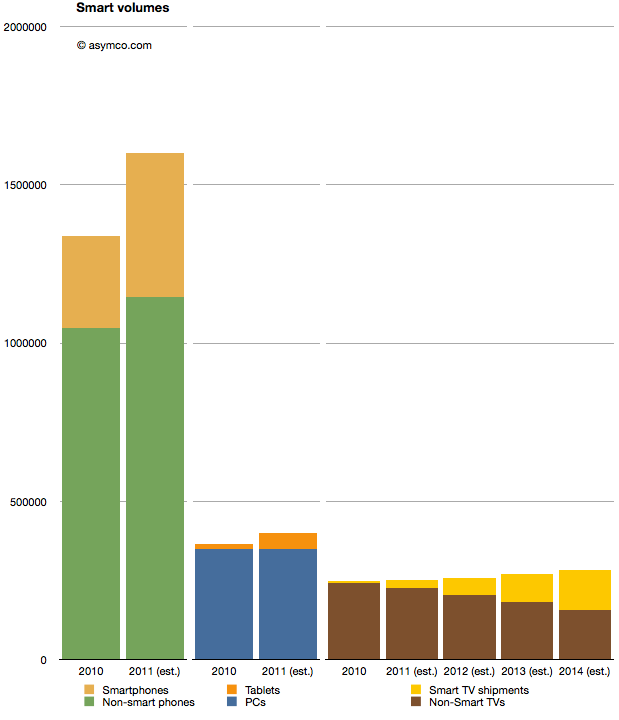
    I prepared the following chart showing the world-wide TV market with a highlighted subset of so-called "smart TVs" (source TRi). The market is shown from 2010 actuals through 2014 estimates. To make it more interesting I also added similar data for two other markets. Mobile phones and PCs with their own sub-categories of smartphones and tablets as equivalent "high growth" opportunities.

    When considering the opportunity, the Smart TV volumes are small relative to either tablets or smartphones. 2011 shipments are expected to be around 25 million Smart TVs, vs. 454 million smartphones and 51 million tablets. Looking forward, it seems that even by 2014,  smart TVs will be smaller volumes relative to either (projected) smartphones or tablets.

    A reason for this is that the TV market is not that big. It barely reaches 280 million units in 2014. Having reached saturation, the rate of growth is never assumed to be greater than 5%. The growth in the Smart TV business is assumed to be much higher however, being at least 100% in 2012, though off a low base.

    But the concept of what "smart" means in this forecast is troubling. Christina Bonnington at Wired highlights many of the failings of Smart TV.

    “In most cases consumers are buying a television with Internet connectivity as insurance. In other words, they are buying them just in case they need it in the future,” says Van Baker, a vice-president at the research firm Gartner. “Less than half of Internet connected televisions actually get connected to the Internet so clearly consumers don’t yet see this capability as a must have feature.”

    There is vast under-consumption even if the devices are being purchased. This looks eerily familiar to the smartphone market before they became usable by the vast majority through the transformative touch input method.

    So this market seems to be ripe for some serious re-definition. It may not be large today because there is nothing worth buying. Absent any innovation the forecasts can only foresee more of the same. If there is a breakthrough which "cracks" this puzzle then we might indeed witness unforeseen opportunity.

  3. The case against the Kindle as a low end tablet disruption

    Research · 232 comments

    In an Harvard Business Review post Rob Wheeler makes the case for the Kindle Fire as a disruptive innovation. I believe that it is but crucially I disagree that the Kindle Fire is a low end disruption.

    My assessment of the Kindle Fire is based on the two attributes which Amazon highlights as the key selling points which offer a basis of differentiation and potential for asymmetric competition: a low price and a new browsing model. I believe that these two attributes result in two opportunities: one for low end disruption and another of new market disruption. I reject the first and tentatively support the second.[1]

    The price

    It's immediately obvious that the price point of the Kindle Fire is well below alternatives. That forms the basis of disruptive potential, but before we jump to analyzing the disruption hypothesis we should determine whether and to what extent Amazon profits from the device directly. Profitability gives us a clue to where Amazon will apply resources and thus establish its trajectory of improvement.

    We know the margin on the Fire is low because we can calculate the bill of materials for 7" tablets. Gene Munster of Piper Jaffray estimates that Amazon "loses" $50 for each unit sold. We also know that the design Amazon used is essentially very similar to the RIM PlayBook and was sourced from the same ODM. RIM priced the product at $499 but has struggled to find buyers and is reluctantly dropping the price. We also can estimate that Apple with a product having more than twice the screen size is keeping modest (~30%) gross margins for at a price point approximately double that of the Fire. It does seem that Amazon does not have much or any margin to dip into.[2]

    So the Fire can be classified as a low price product. Does that make it a low end disruption?

    Disruption requires asymmetry but it also requires the ability to go up a trajectory of improvement along the basis of performance that a majority of users demand. The first condition is met, but what of the second? In a combined system where one asset is used to leverage another--the subsidized being sacrificed to benefit the profitable--success is conditional on one element being "good enough" while the other "needing improvement". Investment follows accordingly.

    But investment decisions have consequences. The subsidized device is starved of investment while the profitable service is nurtured. We see evidence of short cuts in investment in the off-the-shelf nature of Kindle products: from a second-hand (unsanctioned) OS to a second-hand (ex-RIM) hardware. Meanwhile, Amazon spends heavily on capex for the infrastructure that delivers the profitable content.

    If the hardware is indeed commoditized and cannot be usefully improved, then this model works. If, on the other hand, the hardware and systems software can benefit from dramatic improvements in technology then the model fails. The very asymmetry of a service vs. a product turns into the latter having all the advantages and the former failing to gain traction.

    I'll give three examples of this how service model creates limitations which lead to a failure to disrupt a product model.

    The Game Consoles

    The first is the game console business. In consoles, the vendors maintain long hardware product life-cycles to recover their hardware investment and subsidy by maximizing the number of games attached to each console. If you plot product cycles you realize that the bigger the subsidy, the longer the hardware lifecycle. The result is a very wide turning circle which prevents innovation in new dimensions.

    Consider that the Playstation or the Xbox could have been a low end computing disruption. The original Xbox was in fact a PC. It was supposed to bring PC dynamism to the console business and create a cottage industry of new developers building games on commoditized hardware. However by the second generation the Xbox was a locked down, custom architecture, pure gaming machine. Gone was Intel, gone was the PC architecture and gone was any dream of cheap development.

    This is entirely due to the economics of subsidized hardware. It compelled Microsoft, the world's greatest software company, built on the open and cheap PC architecture to make closed, expensive hardware. Sony followed in kind as did Nintendo. Each generation of consoles was a sustaining improvement on gaming and had no ambition beyond gaming[3]. The subsidy and the dependence on an integrated content value network led to a distinct lack of disruption and an insular industry which continues to seek out increasingly immersive experiences for increasingly demanding customers while itself being disrupted by casual, mobile gaming.

    The Set-top boxes

    The second example is the TV set-top box business. There again, the vendors maintain long hardware cycles in order to recover subsides. There too, the main value driver is the content and its distribution which stipulates the architecture, and through subsidy, defines its evolution. This offers the vendor no motivation to improve the user experience[4], secondary uses or the absorption of new streams of content (like those the internet can offer.)

    Again, the set-top box could have been a budding disruptive opportunity for Microsoft. They invested billions in the 1990s to acquire placement of software on set-top boxes in an attempt to penetrate the living room. And again Microsoft was not alone. Since then Tivo, Google and Apple and many others tried to attach cheap hardware to video streams. They all failed to get on a disruptive trajectory. And again, the blame can be placed on the stifling effect of subsidies and dependencies on services or content which dictate where the value and hence the investments should go.

    The Blackberry

    The third example is the RIM Blackberry. Although RIM made most of its money on hardware and was by no means subsidizing it, the differentiation of their product was undoubtedly its service value. Both as a corporate device with BES and as a consumer device with BBS, customers "hired" the product as a service. By being committed to this model RIM management became blind to the hardware and client OS software innovations coming down the pike.

    Through their own admission, they could not accept a touch screen because it would make the messaging experience too slow and it is messaging that sells Blackberries. They could not accept apps (and hence platform orchestration) as a differentiation because their customers did not hire Blackberries for "lifestyle apps". Merely being differentiated as a service leads to blindness and enough hesitation that you run off the disruptive rails.

    People ascribe myopia or incredible absence of mind to RIM's management but the opposite is true. They were deeply committed and observant of the things which made the Blackberry successful. It just happened to be something that stopped being relevant.

    The iPhone

    I'll add one more "bonus" example on this. The iPhone is also a subsidized product and it seems very successful. How come it won? The answer is in details. As I mentioned, the other products ended up in poor life cycles or incorrect motivations. The iPhone differs in that the lifecycle of the product is much shorter (2 years ownership with 1 year for product updates). The shorter lifecycle works for the iPhone because it has a very high service revenue base to dip into to offset the subsidy. Something none of the content models above could count on.

    Consider that each game console subsidy needs to paid off by a handful of game titles whose royalties to the console maker are modest. Or that the TV box needs to ride on top a service that also has thin margins from a stable or slightly shrinking user base. In contrast, the iPhone enables vast new consumption worth thousands of dollars to the operator. This is the famous ARPU uplift that smart phones enable. Users are doubling their telecom spending when they move to smartphones.

    The margins for Kindle content are thin. Very thin. Apple runs its content business at break even though it transacts billions of items per month. The amount of content that needs to pass through the Kindle ecosystem (with lower prices than Apple charges) will need to be astronomical to make it profitable on the shortened cycle time the iPhone enjoys. Thus the Kindle is likely to languish in a leisurely update cycle with users encouraged to hang on to their devices for years. This is the case at least with the original e-Ink Kindles. How eagerly awaited are new generations? How many users stampede to update the hardware or even upgrade the software? How many users have owned every version of the Kindle?

    Service Scale

    Finally one last point about services. As Amazon asserts, they see Kindle as a service, which, I concede, is asymmetric to a product business. The problem is that services don't scale as well as products. Consider that none of the content streams that Amazon will depend on are available outside the US. The Kindle has not been a strong seller internationally. This is because book rights are limited to national boundaries as are movie rights and song rights. Apple has only this week finally completed the rollout of iTunes music to all of Europe! A process that took almost a decade. And they are still unable to sell music in most of Asia and forget about movies or TV shows.[5]

    The reality is that there are no global service brands. Not in telecommunications (operators are, at best, regional), not in Media (TV, radio, publishing are a local businesses), not in Banking (not even in commercial banking) and not in Retail (even Wal-Mart was humbled trying to export its disruption). The internet has not broken down any of these boundaries and even Amazon has modest reach outside the US for any of their franchises. Services are local but products can be global.[6]

    To wrap up, this discussion on the asymmetry of device-based services to product models leads me to conclude that the Fire will not have the opportunity to disrupt the iPad or tablets in general. Amazon sees the hardware and software of a device as a commodity and the content and its distribution as valuable. This assumes that the device is "good enough" and will not require deep re-architecting or that new input methods can be easily absorbed. In short, they see the tablet as at the end of its evolutionary path. Apple sees the exact opposite. The iPad is 18 months old, and as they say in the ads, they see it as only the beginning.

    ---

    Notes:

    1. Due to length of discussion, in this post I will make the case against the low end disruptive potential and use a second post to make the case for it being a new market disruption.
    2. Presumably, Amazon will also distribute only through Amazon.com and thus not incur channel mark-ups. This means that comparisons with other tablets should be at a price nearer to 70% of retail.
    3. Gaming networks and video streaming are extensions but neither leveraged open architectures.
    4. See also discussion from June 2010 on the challenges to Apple TV that Steve Jobs enumerated.
    5. Apps are another story. Because it controls the medium, Apple can and does sell apps in every country where the iPhone or iPad or iPod touch is available.
    6. Note also that because of distribution through Amazon.com, the Kindle cannot reach as many buyers as a tablet selling through the tens of thousands of points of purchase that operators and retail shops offer.


  4. Tele Vision

    Research · 115 comments

    Every few months rumors emerge of another technology company attempting to create a new product centered around the TV. Apple's name comes up, of course, but so does Google. And Microsoft has been experimenting with no lesser degrees of vigor than the others. They all seem to be trying to make TV smarter, somehow.

    But I would argue that these efforts are misguided. Television is more than the TV set or a set-top box, or any box. It's more than channels or broadcasters or producers or aggregators or distributors. It's all of these things; plus more. It's a value network of great breadth and complexity. It's a highly modularized industry with well-defined business model boundaries and inter-dependencies. I would argue that its very breadth is what has kept it rigid and immune from disruptive change.

    If you look at each technological experiment to move to a new business model, they can all be reduced to the offer of an additional or substitutive module. There is no assumption made that the content being served will change. To put it in the context of mobile computing, it's like trying to introduce a smartphone in a world without data networks--where the only service to be served is person-to-person calling. Unlike the Smartphone which could only have emerged to leverage the Internet, TV has no "smart content" to leverage. The "smartness" has to be not in the box but in the programming.

    Of course, I don't mean there's a lack of good programming. What I mean is that there is no innovation in what a program is--the job it's hired to do. The way it and its distribution fits into a person's life. TV programs have not changed for half a century. They feature the same genres, the same duration, the same business model, the same series, format and scheduling and the same value chains as when "I Love Lucy" premiered in 1951. They assume people watch TV during the same time each day (while doing nothing else.) They also assume people are equally influenced by brand advertising and that audiences are largely homogeneous.

    Contrast that with other media. The song, the book, the game, the newspaper even the movie have gone through consumption changes which have been supported by disruptive innovations. The portable music player, the ebook reader, the console and the mobile phone and the internet in general have all allowed consumption to conform to new usage patterns. The jobs that music is hired to do has changed dramatically. These re-definitions of what media is used for caused dramatic changes in both the production and distribution and hence the way value is captured in media.

    TV, it seems, stands alone and immune.

    So it's not hard to understand why technology solutions have largely failed. Every attempt to make a change in a part of the value network has affected another part, which has led to resistance and reversal. Even Hulu, an innovative distribution method for content, owned by a group of incumbents, has had to scale back ambitions as the incumbents throttled it. Apple TV faces a stone wall of restrictions on distribution due to the inter-locking contracts content is bound by. Google TV has been largely shut out for the same reasons.

    And I won't delve deeply into the fact that TV is intensely parochial. There are few if any global brands, programs or regulations. Every country, region, city and town feels a need to localize its content and offer obstacles to external sourcing. Governments engaged with the industry so long ago that they've become co-dependent.

    Only one experiment is entirely independent of the current network: YouTube. YouTube does not rely on current programming. It has allowed a new set of producers and new form factors to emerge. It's still very rough and incomplete as a solution but it may get better. The growth is phenomenal and the business model is sustainable[2].

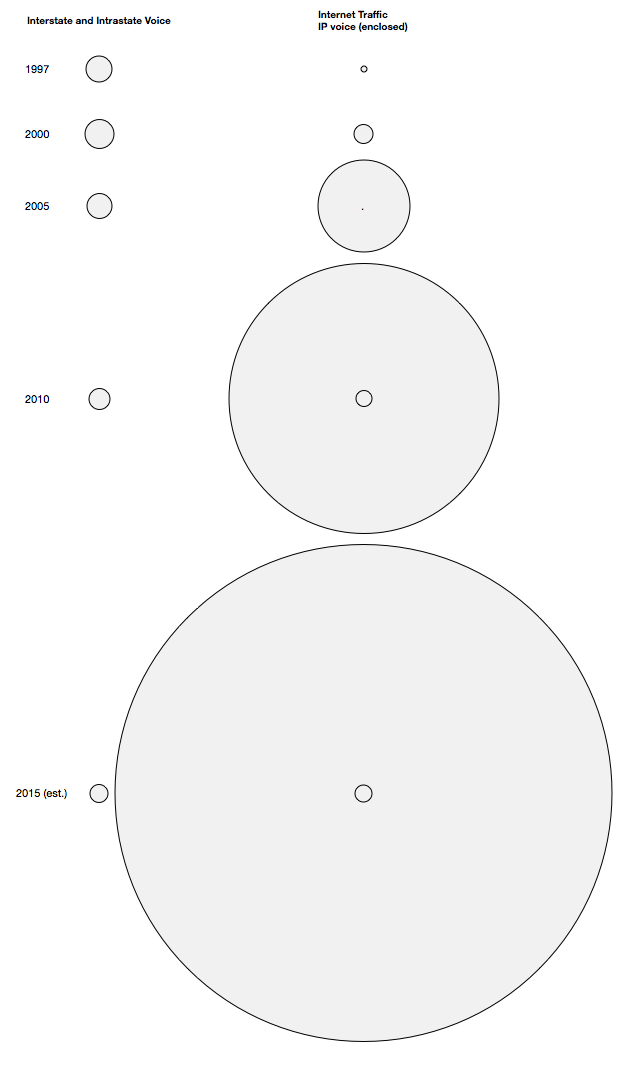
    It's hard to provide an illustration of how important this separate network effect becomes, and how long the time frame can be. The only proxy I can draw on is the story of how Voice over IP has grown in comparison to voice traffic over the switched network. The following chart shows how three types of traffic have grown in the US between 1997 and 2015 (est.): Interstate and Intrastate Voice (left column) vs. Internet traffic (right column) with IP voice inset inside Internet Traffic (areas represent relative traffic measured in Terabytes/month)[1].

    The estimate for 2015 shows that Voice over IP will reach 23,000 terabytes/mo. while PSTN voice will consume only 26,000 TB/mo. A negligible difference and one which will likely be in favor of IP over a global scale. The tail indeed does wag the dog.

    The only numerate conclusion that can be drawn is that the growth of internet consumption is so vast that it swamps other forms of media, even if within the internet, media itself is a minor component.

    So as far as having a vision of tele-vision, the answer is not to graft technology onto an archaic value network, but to build a new value network around new technology.

    ---

    Notes:

    1. Source: Lampert, O'Connor & Johnston, P.C. June 16, 2011 Ex Parte via ... The Tail Wagging the Dog--A comparison of PSTN and IP traffic from 1997 to 2015.
    2. I note with some dismay that Google feels it needs to dabble in the current value networks. Nurturing YouTube is a far better use of its resources.
  5. In memoriam: Microsoft's previous strategic mobile partners

    Research · 223 comments

    Microsoft's new "strategic partnership" with Nokia is not its first. For a decade the software company has courted and consummated relationships with a variety of companies in mobile and telecom. Here are the ones I can remember:

    • LG. In February 2009 Microsoft Corp. signed a multiyear agreement for Windows Mobile to be included on devices from LG Electronics Inc. LG would use Windows Mobile as its "primary platform" for smartphones and produce about 50 models running the software.

    What happened? LG made a few Windows Mobile devices but with WinMo uncompetitive, they abandoned the platform and moved to Android losing years of market presence and all their profits.

    • Motorola. In September 2003, Motorola  and Microsoft announced an alliance. "Starting with the introduction of the new Motorola MPx200 mobile phone with Microsoft Windows Mobile software, the companies will collaborate on a series of Smartphone and Pocket PC wireless devices designed to create a virtual "remote control" for the Web-centric, work-centric, always-on-the-go mobile professional." In addition, the alliance includes cooperation on joint marketing and wireless developer programs.

    What happened? Motorola launched a series of Windows Mobile phones culminating in the Motorola Q "Blackberry killer". As Motorola hit the rocks in profitability new management reached for the Android liferaft. The company now relies exclusively on the Droid franchise.

    • Palm. In September 2005 Palm and Microsoft announced a strategic alliance to "accelerate the Smartphone market segment with a new device for mobile professionals and businesses. Palm has licensed the Microsoft Windows Mobile operating system for an expanded line of Treo Smartphones, the first of which will be available on Verizon Wireless’ national wireless broadband network."

    What happened? Palm shipped a few Windows Mobile, famously dismissing Apple's potential entry as something "PC guys" could never achieve. A new CEO, a private placement and an acquisition later the company is a division of HP making its own operating system.

    • Nortel. When Steve Ballmer was famously laughing at the iPhone and saying that he likes the Windows Mobile strategy "a lot" he was sitting next to the then-CEO of Nortel (Mike Zafirovski formerly of Motorola) with whom the company had just closed a strategic deal.  "an alliance between Microsoft and Nortel announced in July 2006 ...  includes three new joint solutions to dramatically improve business communications by breaking down the barriers between voice, e-mail, instant messaging, multimedia conferencing and other forms of communication".

    What happened? Nortel declared bankruptcy two years later.

    • Verizon. In January 2009 "Verizon Wireless has selected Microsoft Corp. to provide portal, local and Internet search as well as mobile advertising services to customers on its devices. The five-year agreement will go into effect in the first half of 2009 when Microsoft Live Search is targeted to be available on new Verizon Wireless feature phones and smartphones." The deal would ensure Bing distribution to all of Verizon's smartphone customers.

    What happened? Bing did ship on some devices but in October 2009 Droid came to Verizon.

    • Ericsson. In September 2000, "Ericsson and Microsoft Corp. today launched Ericsson Microsoft Mobile Venture AB. This previously announced joint company will drive the mobile Internet by developing and marketing mobile e-mail solutions for operators. The first solutions are expected to be on the market by the end of the year. The company is part of a broader strategic alliance between Ericsson and Microsoft"

    What happened? Ericsson divested itself of the mobile division forming a joint venture which would go on and make more strategic alliances with Microsoft over Windows Mobile culminating in a loss of profits and eventual flight to Android.

    • Sendo. In February 2001, Microsoft announced a partnership, in which Microsoft bought $12m of Sendo shares and a seat on the board. Sendo was to be Microsoft's "go to market partner" for the Stinger smartphone platform that would become Smartphone 2002.

    What happened? Sendo after litigating IP issues with Microsoft went bankrupt in 2005.

    And finally,

    • Nokia. No, not this OS deal, but in August 2009 "The worldwide leader in software and the world’s largest smartphone manufacturer have entered into an alliance that is set to deliver a groundbreaking, enterprise-grade solution for mobile productivity. Today, Microsoft Business Division President Stephen Elop and Nokia’s Executive Vice President for Devices Kai Öistämö announced the agreement, outlining a shared vision for the future of mobile productivity. This is the first time that either company has embarked on an alliance of this scope and nature."

    The plan was to bring "Microsoft Office Mobile and Microsoft business communications, collaboration and device management software to Nokia’s Symbian devices."

    What happened? One and a half years later the same Stephen Elop announced that Symbian will be deprecated.

  6. The asymmetric competition between Google and Apple app stores

    Research · 56 comments

    In the latest version of Android, Google shifted from bitmaps to vector rendering for maps.  The shift is probably more a function of available processing power on the device than a strategic shift to position value on the device rather than in the cloud. Vector maps, which are much more efficient in terms of bandwidth and local storage, have been the choice for in-car navigators but Google has always been using bitmap tiles which are fetched from a server and delivered only if the device is using a data connection. The downside for vectors is that they require a bit more local processing power.

    I doubt that Google's move to vectors is part of a shift to more app-centered/edge-of-network strategy.

    How is this relevant?

    Google has been riding a wave of re-centralization of value toward the center of the network as broadband made the cloud feasible. Keep in mind that Microsoft rode a wave of de-centralization as value moved to the PC and away from the mainframe. As intelligence was pushed to the edge, Microsoft accrued value from enabling the edge as a locus of productivity. This is no small thing.

    Then came apps.

    The supernova that is the App Store illuminated the possibility that apps are perhaps a "pushback" on the center. Like all good disruptions this was unforeseen: Apple built the store and the apps sold; by the billions. Apple joined the world in a scramble to react. Something profound was happening, but the very brightness of this explosive growth blinds us to what is actually going on.

    My hypothesis is that there is a tug-of-war going on between the mobile cloud and the device-at-the-edge. Both will become better and neither is good enough. Technology roadmaps point to both higher availability of local storage/processing power as well as faster, cheaper and more ubiquitous mobile broadband. So technology insight by itself is not enough to give us a clue to the outcome.

    What I would focus on is what is more natural for the user.  Note that Twitter and Facebook both have better interfaces with their apps than they do with their browser interfaces. That and innovations in game interaction points out that apps are as much a disruption of UI metaphors as they are of the locus of power in the network. It would not surprise me if people end up spending a larger part of their lives tethered to device-enabled social media, "firing" the PC from the job of social interaction.

    If we believe the app will grow as the preferred interface for the web (and I'm leaning in that direction) then the implications are potentially harmful to Google. Google does not "do" interfaces. Their strategic assumption has been that interfaces are commodities. The browser is the universal interface. Perhaps HTML5 will offer sustenance to the concept, but it's not a panacea. Web apps have a long way to go to become competitive with hand-crafted app UIs. (While web apps have been possible for iPhone since its inception, developers vote en-masse for apps and almost zero popular web apps exist. Ditto for Flash-to-app interface ports.)

    This brings us to focus on the asymmetry of business models.

    the App Internet

    What we end up with is the "app internet": a potential disruption of the browser-as-interface and the re-integration of the user experience around the device. Because the iTunes store allows money to be attached to new interface innovations, developers follow and compete on better interfaces rather than on access to the back end.  The asymmetry ensues from the fact that by attaching profit to the point where the user touches the screen, Apple took the basis of competition for developers away from the cloud.

    In other words, the point where the electrical charge of the human skin is detected is suddenly the exact location of value capture from mobile computing.

    Of course, Google is responding, but since they did not focus on seamless and curated experiences, developers are not seeing returns for investment in interfaces at the touch point. As a consequence, Google apps developers seek ad revenues. In turn, this is a road that leads to less innovation in interfaces and more innovation in network-dependent services.

    I sense a distinct asymmetry in app trajectories between the platforms due to core business model choices. Asymmetric competition causes the great fortunes to be made and great fortunes to be lost.

  7. The integrated iPad news daily: Read all about it!

    Research · 28 comments

    When I wrote my opinion on the future of publishing (Citizen Publisher), I focused my lens on books and magazines. Published works that have relatively low time-sensitivity and hence relatively long shelf life are quite different from newspapers which package material with very brief temporal relevance.

    The print-based news industry has suffered much more than print-based books and magazines. The primary cause is that "print" plays a far larger role in newsprint-based newspapers than in books.

    To give you an idea of how important the printing plant is, consider that a huge proportion of a newspaper's assets are tied up in its printing plant. That plant is so large and so demanding that it ends up causing the whole business to revolve around it: Print runs are done at night to make sure the product is delivered in the morning. That puts a hard deadline on the writers to submit stories before the product is "frozen" into a final edition. Writers and editors and advertisers need to march in lock-step to the cycle time of a big manufacturing operation.

    There are 19 presses and 17 printing plants that print the two million copies of the U.S. edition of The Wall Street Journal. To make changes to the plant require large amounts of capital investment and that capital's depreciation is an integral part of the financial balance of the company. So much so that one wit remarked that a newspaper is nothing more than an instrument that permits the depreciation of a printing plant.

    Costs of manufacturing have been slightly offset by better technology and distributed printing but newsprint itself has soared in price so the dependence on physical product has made the economics worse over time.

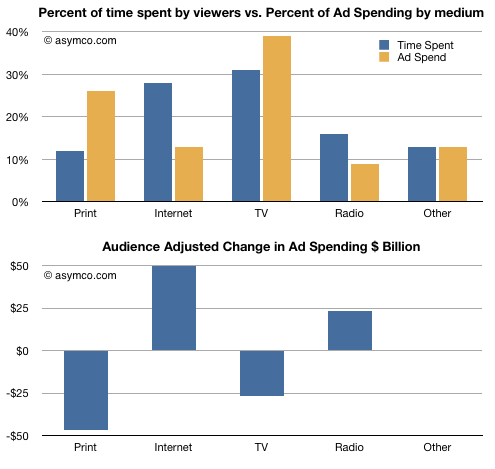
    That's the cost side. But if you keep following the money from the revenue side, you realize that the situation is critical. In the US, a large part of the local paper's revenue base was wiped out by Craig's list. Classifieds are a fading memory. With respect to regular ads, the story is almost as bad. 26% of ad spend in 2009 was allocated to print, while only 12% of time spent consuming media was spent on it. In contrast, Internet use is at 28% of time where only 13% of ad dollars are allocated.

    Source: Morgan Stanley Internet Trends Presentation.pdf

    It's inevitable that advertisers will shift their budgets to follow where the attention is going. Potentially that's a $50 billion shift into Internet advertising. The number nearly matches the $47 billion loss from print.

    This future is not far off. In fact, it's already happening. in recent years the number of newspapers slated for closure, bankruptcy or severe cutbacks has risen—especially in the United States, where the industry has shed a fifth of its journalists since 2001.

    Once the printing plant is taken out of the equation, the raison d'être of the package itself ends. For this reason, the newspaper product cannot survive on-line. Reading news is still very popular, but newspapers aren't.

    So will the iPad save this medium?

    As in Citizen Publisher, I argue that for that to happen, the medium needs its Orson Welles. Furthermore, to have him emerge, the business must be architected as an integrated approach to solve a new job to be done.

    The latest story from The Guardian suggests that Rupert Murdoch is working on just such an approach. In another interview Murdoch explained the project in more detail:

    What is the biggest thing on your mind now?

    ...There are so many disruptive technologies coming all the time! [This in almost a whoop of excitement.] Pretty. Damn. Interesting! Just trying to stay ahead of the technology. I'm starting a paper in six weeks. A brand new paper. It will be a bit like the New York Post . But it will be national. Have that sort of humour and attitude like the Post . It will only be seen on tablets. It will only employ journalists - and maybe eight to 10 technicians.

    What sort of circulation will you need?

    At the price we are talking about, that's $1 a week - not a day, a week - we need 800,000. By the end of next year there will be 30 to 40 million iPads. I believe every single person will eventually have one, even children.

    Via: afr.com

    What's more, it's suggested that an unreformed disruptor is mysteriously involved.  One can only speculate, but the hints of autonomy, dedicated (and incentivized) creative professionals involved in a new (not re-purposed) publication with a low-cost structure bodes well.

    The medium may get its Orson Welles after all.

  8. NYT blames yet another culprit: Nokia’s Culture of Complacency

    Research · 11 comments

    “I am sure there are things we could have done better and innovations we missed,” Ms. Suominen added. “But that happens to all companies. We have been very successful with some other innovations.”

    She cited Nokia’s large patent portfolio and its 770 Internet Tablet, a compact, flat-screen device without a phone, released in 2005. It worked with a pen stylus and was made for Internet browsing but is no longer sold.

    via Nokia’s New Chief Faces a Culture of Complacency - NYTimes.com.

    If I may suggest a better list of innovations for Nokia to stand behind:

    1. The first GSM call in 1991 was made on a Nokia phone and a Nokia network
    2. The first mass-market smartphone, the Communicator in 1998
    3. First compact smartphone, the 7650 in 2002.

    While these innovations and "firsts" happened many years ago, Nokia's ability to innovate is just as important at the low end. Nokia was the first company to address the lowest tiers of the market with over a billion customers served. This was no small feat and many observers faulted the strategy when it began in the middle of the decade.

    I would not discount the difficulty and determination required in reaching those customers. Engineering a profitable low end product is as hard if not harder than engineering a high end superphone. More importantly, you have to find a way to distribute to these hard-to-reach customers and find ways to make the product useful, usable and affordable. Were it not for these efforts, the company would be facing collapse today, similar to the fate of Motorola or Ericsson: squeezed in the mid-range.

    Blaming "culture" is nothing more than suggesting bad management. The culture of Nokia did not change between the few years when it was successful and the years when it was not.

    The challenge Nokia faces is not complacency. It's that the business model for selling voice-oriented phones is diametrically opposed to the business model for selling data-oriented phones. In one case you cooperate with and sustain operators, in the other you compete with and disrupt them.  It looks damn near impossible to do both with the same organization. Everything must be done differently. The real problem is that Nokia has not realized this and therefore can't build its own replacement.

  9. On a mobile device Search hasn't happened

    Research · 7 comments

    This is one of the most thought provoking things I've ever heard.  Some of the implications are unfathomable.  Before we dive into the implications of iAd, here is the exact quote from the Apple Special Event, April 2010 (iPhone 4.0 launch) around 45 minutes in.

    When you look at a mobile phone, it's not like the desktop.

    On the desktop, Search is where it's at.  That's where the money is.

    But on a mobile device Search hasn't happened. Search is not where it's at. People aren't searching on a mobile device like they are on a desktop.

    What's happening is that they're spending all their time in apps.

    When people are looking for a place they want to go out to dinner they're not searching. They're going into Yelp. They're using apps to get the data on the internet rather than a generalized search.

    And this is where the opportunity to deliver advertising is.

    Not as part of search but as part of apps.

    Jobs is making a set of huge claims:

    1. There is no search on devices.
    2. There is no money in search on devices.
    3. Apps create an inventory of billions of ad impressions every day
    4. Apps are better at delivering the data from the internet than a browser
    5. Apps are therefore the new browsers and eyeball aggregators

    This is heavy stuff.  I believe what gives Apple the confidence to make these claims is the vast amount of data on user behavior that the app store collects. It's possible they're wrong, but it's more likely they're right.

    If they're right, what are the implications?  First, obviously, iAd adds up to a lot of cash « Asymco.  Second, this has dire consequences for Google.  Jobs could not be more blunt: search is not where the money is at.

    I can chip in some personal experiences that confirm this preference for apps over browser interfaces, but I leave it as an exercise to the reader.

  10. Music. Sweet music

    Podcast · 37 comments

    iPad Death Watch : AAPLinvestors

    You can't go wrong betting against this bunch.

    (link above reproduced below due to bandwidth issues with their servers.)

    “Any tablet computer, including Apple’s eagerly anticipated iPad, will face serious problems in generating big sales. Tablets look cool, but the reality is they don’t do anything new.” Michael Comeau, Minyanville, 5 March 2010

    Dvorak:”I’m telling you, look at this product coming out of India called the Adam.” Curry: “A-D-A-M?” Dvorak: “Yeah.” Curry: “And it’s a what it’s a pad?” Dvorak: “It’s an iPad Killer. And I hate to use that term since the iPad is probably dead anyway.” No Agenda Podcast, Adam Curry & John C. Dvorak, 25 February 2010

    “Fewer capabilities (than a netbook) but a similar size? Not a good start.”Lee Gomes, Forbes Asia Magazine, 5 March 2010

    “We of course build plastic mock-ups that we show (to customers)…we had a slate form factor. The feedback was that for (our) customers it will not work because of the need to have (a physical) keyboard. These were 14-year-old kids, who, I thought, would be most willing to try a virtual keyboard but they said no, we want the physical keyboard.” Mika Majapuro, Worldwide Sr. Product Marketing Manager, Lenovo, 22 February 2010

    “The Apple iPad is not going to be the company’s next runaway best seller.” John Dvorak, MarketWatch, 12 February 2010

    “It’s a nice reader, but there’s nothing on the iPad I look at and say, ‘Oh, I wish Microsoft had done it.’” Bill Gates, Microsoft, 10 February 2010

    “The rally has been especially kind to seemingly racy stocks such as Apple and Google. Both have pole-vaulted to market-surpassing gains over the past 12 months, despite the fact that the former’s hamster-wheel of innovation (to borrow an apt phrase from my Fool colleague Joe Magyer) may have hit a snag with the iPad. ” Shannon Zimmerman, The Motley Fool, 10 February 2010

    “It’s not a tablet, it’s an extension of the iPod Touch. It has some new kinks, but generally speaking it’s using the iPhone OS. It’s more like a smart phone than a personal computer. It’s the Newton reborn. What’s missing most is the communications aspect.” Andreas Haas (former Apple executive), CEO, Axiotron (Modbook), 7 February 2010

    Before Jan 20th, 49 percent of people said they didn’t think they needed an Apple Tablet. That number jumped to 61 percent after the announcement. Fifty-nine percent of buyers wouldn’t pay extra for 3G coverage. Whether this device becomes a big hit is anyone’s guess but based on this study it sure looks doubtful.” Retrevo, 5 February 2010

    “Yet it’s hard to see how the iPad, in the form unveiled last month, will come close to transforming daily life as much as the iPod or iPhone. The challenge with the iPad will be less about improving an established market than building a new one.” Arik Hesseldahl, BusinessWeek, 5 February 2010

    “I added it up and … like 800 people are going to buy the iPad. . . . It’s not that the iPad is a failure. It’s just a product ahead of its time. No one should actually buy this iPad — between its inevitable first-generation bugs, fulfillment problems, and buyer’s remorse over added features and price drops, it’s heartbreak waiting to happen.” Molly Wood, CNet, 31 January 2010

    “It was a bigger iPod Touch. I question whether those features would be enough to get people to buy new machines.” Satoru Iwata, President, Nintendo, 29 January 2010

    “The company once notorious for its ability to upend convention and revolutionize markets may no longer have what it takes, worry some technology journalists. Call it the iPad or the iPlod, but the message seems clear: Apple may have lost its mojo.” Jeremy A. Kaplan, FOXNews.com, 28 January 2010

    “What’s the single most worrisome thing about the iPad? It’s Apple’s monopoly on distribution of applications. ” Harry McCracken, Tecnologizer.com, 29 January 2010

    “The tablet market has only succeeded as a niche market over the years and it was hoped Apple would dream up some new paradigm to change all that. From what I’ve seen and heard, this won’t be it.” John Dvorak, MarketWatch, 29 January 2010

    “It is a humorous world in how Microsoft is much more open than Apple,” Frank Shaw, Microsoft, Corporate VP, Corporate Communications, 29 January 2010

    “When Steve Jobs first demonstrated the Apple Mac, he used the words “insanely great” to demonstrate the full graphical display of the computer. It’s a tag that has stuck around to this day among Apple fans. But, today’s comments from Jobs that the iPad is a “magical, revolutionary” device ring hollow.”Dan Wayne, apc mag, 28 January 2010

    “All the people (including me) who felt underwhelmed by the iPad initially might have missed its true potential. Put another way: the iPad is all about software. Forget the sleek form factor – that’s just a prerequisite. Ironically, it’s the software and services that Microsoft never ‘got’, that Apple totally does get.” Dan Wayne, apc mag, 12 February 2010

    “Nothing from the iPad specs that I’ve seen really shows any great cause for celebration. Unless Apple has also developed some new type of power source, such as nuclear cells or magical hamsters on tiny spinning wheels for the iPad, don’t expect the claims about battery life to hold true. ” John Breeden II, Government Computer News, 28 January 2010

    “Ultimately, the iPad is a large iPod touch: a great device to draw your inspiration from, but perhaps not the seismic shift in technology that we were expecting.” Claudine Beaumont, The Telegraph, 28 January 2010

    “Behold: The Apple iFlop Neither “truly magical” nor “revolutionary,” the cluelessly named Apple iPad tablet device has dropped like a shiny wedge into the gadget game, dividing tech watchers in to opposing views — the critical and the adoring.” Scott Moritz, TheStreet.com, 28 January 2010

    “9 Worst Things About The Apple Tablet: 1. No Flash 2. Its screen 3. Its price 4. Closed App Store 5. Its name 6. No multitasking 7. No camera 8. No USB 9. AT&T deal Bianca Bosker, Huffington Post, 29 January 2010

    “What do the new Apple iPad and Google’s Nexus One have in common? Both were DOA: Disappointing On Arrival. Why is the iPad a disappointment? Because it doesn’t allow us to do anything we couldn’t do before. Sure, it is a neat form factor, but it comes with significant trade-offs, too. No 16:9 widescreen, for example.” David Coursey, PC World, 28 January 2010

    “E-readers will outsell iPads because of the simple economics of the consumer device market. It’s triple the weight and 30% thicker than an e-reader. You need two hands to hold it. It’s got a backlit screen, and it’s too expensive to give one to everyone in your house.” Russ Wilcox, CEO E-Ink (makers of Amazon’s Kindle), 28 January 2010

    “It seems like a high priced, unnecessary trinket to me.” Paul Thurrott, SuperSite for Windows, 27 January 2010

    “Apple iPad - failure, joke or fiasco? Pick one” Linen DeFiller, MillionFace.com, 27 January 2010

    “The press weren’t cheering and whooping. I didn’t see anybody pee their pants … Not one! The only people I saw cheering were the people who work at Apple down in the front two rows … Al Gore was going crazy. I wanted to see more. It’s a big iPod. What is there to do there? Play a video game on a bigger screen? I thought it [iPad] was ‘paving the cow path’ (enshrining a makeshift solution).” Dan Lyons aka Fake Steve Jobs, 27 January 2010

    “Let’s face it, the Internet was designed for the PC. The Internet is not designed for the iPhone. That’s why they’ve got 75,000 applications — they’re all trying to make the Internet look decent on the iPhone.” Steve Ballmer, Microsoft, 21 October 2009