Asymco

Asymmetric Intelligence

iPad

  1. An interview about Microsoft's Surface

    Research · 15 comments

    This interview was conducted with Bruno Ferrari Editor of Exame magazine in Brazil.

    First, do you have forecasts for tablet market share including Microsoft for next years? (Apple, Android, Amazon etc)?

    I have some guesses but I don't think it's something that is defensible. Too many things can change. Fundamentally I believe Microsoft sees the tablet as a PC and intends to migrate a substantial portion of would-be PC customers to tablet forms. If they are successful then they preserve the existing PC user base and allow it to grow a bit.

    In contrast Apple sees the iPad as a new type of device that is used for things not directly related to PC style computing. In that sense the iPad competes with PC non-consumption. It means people may own both a PC and an iPad and some will own only an iPad. The iPad will expand the market while taking share from the PC. Windows tablets will try to hold the Windows share steady.

     How do you analyze Microsoft’s strategy with Microsoft Surface? Don’t you think they’re admitting themselves that Apple was right since the beginning?

    We don't know the strategy yet. Without pricing and an idea of how the other OEMs will respond, I have more questions than answers. The fact that they are doing their own PC hardware does indicate that they see the industry architecture changing and that a large number of vendors offering hardware "choice" is not really the basis of competition in PCs. In other words, buyers are not willing to pay a premium for Windows because the hardware it's available on is offered in a wide range of options.

    Do you think MS growth at tablet market will surpass the lost at PC (desktop and notebook) market in the next years?

    This is a crucial question. It's possible that Windows 8 on tablets will create new markets, like the iPad has done and it could take the leading role in expanding computing in a post-PC era. However, to do this, Windows 8 and its successors need to be optimized to solve the new jobs people may have for mobile devices. They have to do this even though they need to sustain the old use cases and business models. To succeed Microsoft needs to "fork" the business model and create new ways of profiting from hardware and software. The rumors that Windows 8 RT devices will be sold at a loss is perhaps a hint that this is the plan.

    Did you see the rumor of a 199 dollars Surface? If it’s true, do you think is a good strategy?

    It all depends on what will be the alternate source of revenue. I assume there will be some sort of subscription service, taking a page from the telecom industry. Perhaps a mixture of Windows Live services (media, documents in the cloud and software updates). We have to see whether subscription computing makes sense for consumers.

    How do you see the problem that MS is creating with its OEM by turning itself on a tablet maker?

    There is a problem, of course. However here again the question is whether they are moving to an "ecosystem subscription" model and whether they want to offer revenue share to OEMs. If they offer something then Microsoft plays the role of the operator and device makers are paid some up-front subsidy in exchange for keeping their systems locked into the network.

     One more questions: did you already estimate the shipments of Samsung Galaxy Tab since its launch?

    Sorry, I don't have the Galaxy Tab estimate. However, here is what I found:

    A week after its release, Samsung announced that they had sold 600,000 units. On the 4 December, it was reported that the 1 million mark was reached, two months after launch. However, an executive at Lenovo claimed that Samsung had only sold 20,000 out of the 1 million Galaxy Tabs that were shipped. In January 2011 Samsung announced they had shipped 2 million units to stores. In August 2012, actual sales figures were released in the patent infringement court case against Apple showing that a total of 725,000 Galaxy Tabs were sold through Q2 of 2012.

    Source: Wikipedia.

    Note that the figure of 725k is US only.
  2. How many Kindle Fires were sold?

    Research · 71 comments

    Last September I argued against the potential of the Kindle Fire acting as a low end disruption in the tablet market.

    Now that the first version of the product has reached is end of life, it's time to review the discussion.

    The first problem is finding out how well the product did. Amazon just released a statement that the Fire accounted for 22% of tablet sales in the US in the nine months it was available. The challenge becomes knowing how many total tablets were sold in the US during this time frame.

    Fortunately we know the vast bulk of that total based on the Samsung v. Apple trial. Both Apple and Samsung submitted as evidence sales of the iPad and the Tab product lines in the US. The iPad added up to 16.14 million units (Q4'11 through Q2'12) and the Tab was 540k units. That makes the iPad and the Tab add up to about 16.7 million units. Assuming an additional 1 million units for the other (non-Kindle) total yields an estimate of 22.7 million tablet devices sold in the nine months ending June.

    Applying the 22% claim to that total gives a Kindle sales total of 4.987 million. That's awfully close to a round number of 5 million.

    Since Amazon admitted that they ended production prior to launching a replacement (and presumably did so quite early in order to drain inventory,) then we can safely assume that the original production order was 5 million units.

    Five million Kindle Fire units becomes the first reliable estimate of Kindle sales (based on Apple, Samsung and Amazon supplied information rather than guesses from analysts.)

    So the question now is whether this is consistent with the hypothesis that the Fire is disrupting the tablet business.

    Bearing in mind that this 5 million total was reached with prominent placement on Amazon.com and a loss-leading pricing, I would conclude that this is not an auspicious start for a disruptive product.

    As I argued nearly a year ago, the business model for the Kindle is limited to the footprint of the Amazon franchise, which is small internationally. Amazon itself implicitly admitted that the product was a US-only phenomenon. Further worry comes from the way the company approached production. It was not planning it as a maximization of reach into the market. What they did was order a batch production and then wait for it to be sold through.

    Perhaps Amazon is being patient for growth, but I don't see a hunger for profit in this strategy. We know that Kindle probably lost money at the price charged. Perhaps it's on the order of $40 per unit. Five million units would imply a charge against the business of $200 million. Did Amazon earn a profit on content sales of $40 on each of those five million units? The margins on content sold through Amazon are so low that I have a hard time imagining that Fire users are that ravenous in their consumption.

  3. The Interlopers

    Research · 48 comments

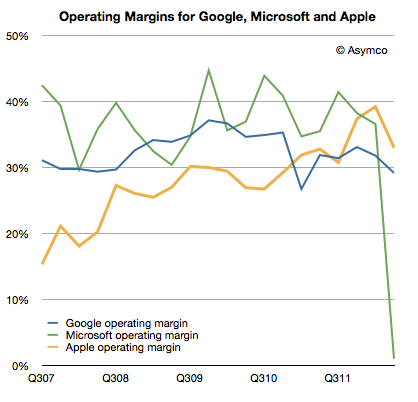
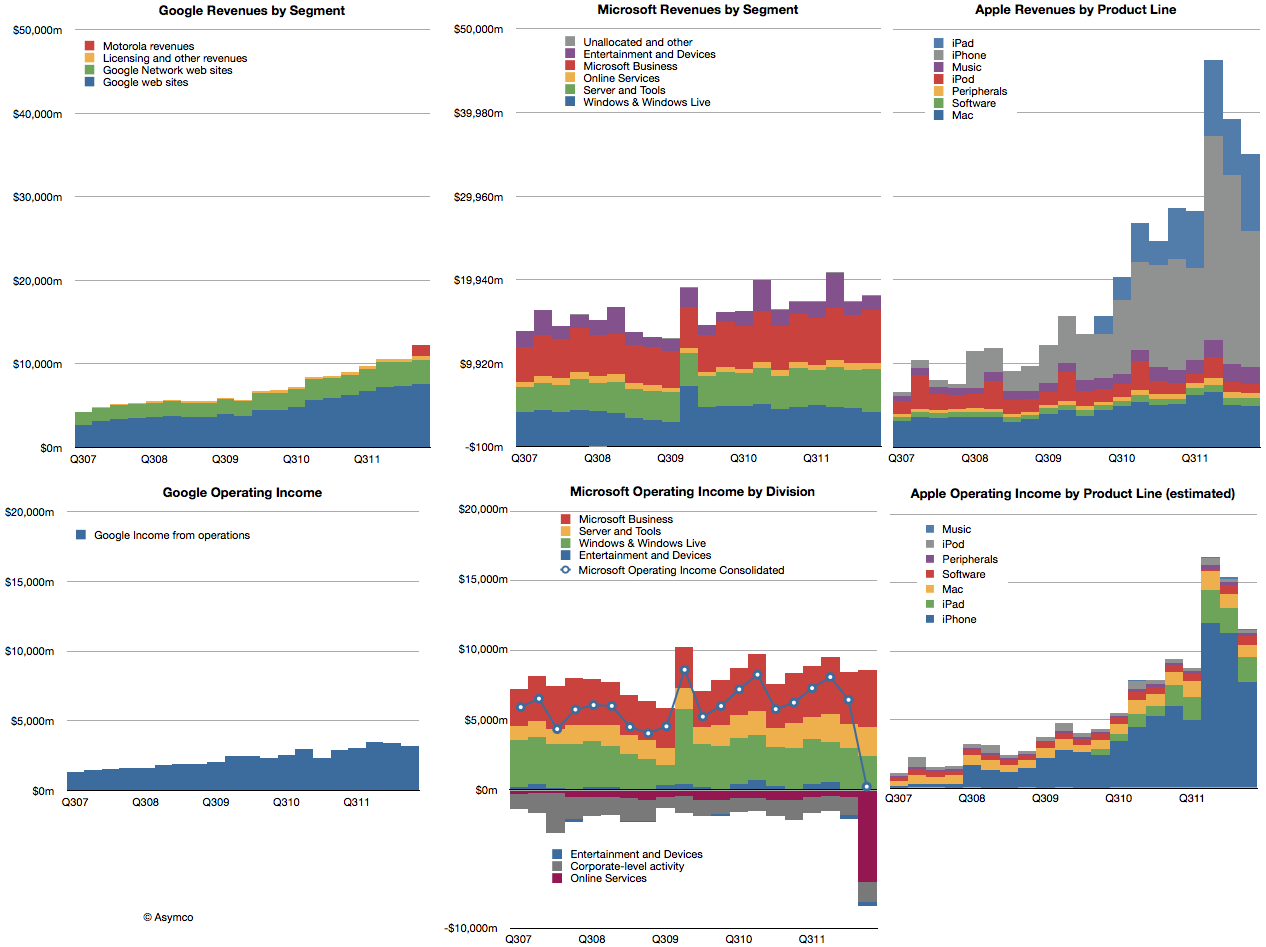
    Google, Microsoft and Apple all had reasonably good second quarters. Microsoft's revenues grew by 4%, Google's by about 22% and Apple by 23%. Apple's growth was disappointing but the other companies weren't. The revenues for the three companies are shown in the following charts:


    I also showed the performance of each company's operating income in the bottom three charts.

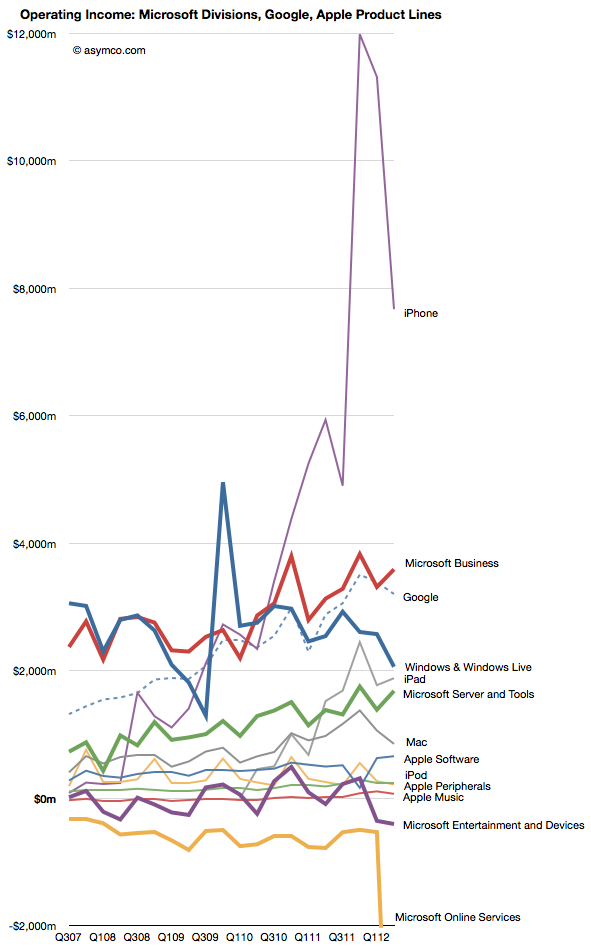
    Microsoft did declare a one-time write-off of $6.2 billion which it spent on aQuantive a few years ago. That was booked as contributing to a loss of $6.67 billion for its Online Services division. Without that one-time charge consolidate operating income would have grown at about 3.6%. Google's operating income grew at a rate of 11% and Apple grew (again, disappointingly) at 23.4%.

    Apple's operating margin fell to 33.1% while Google's fell to 29.2%. Microsoft's margin evaporated due to the one-time charge. If we back that charge out, the margin would have slightly topped 35%.

    Comparing the contribution (in operating income) for each division or product line (where possible) gives the following view:

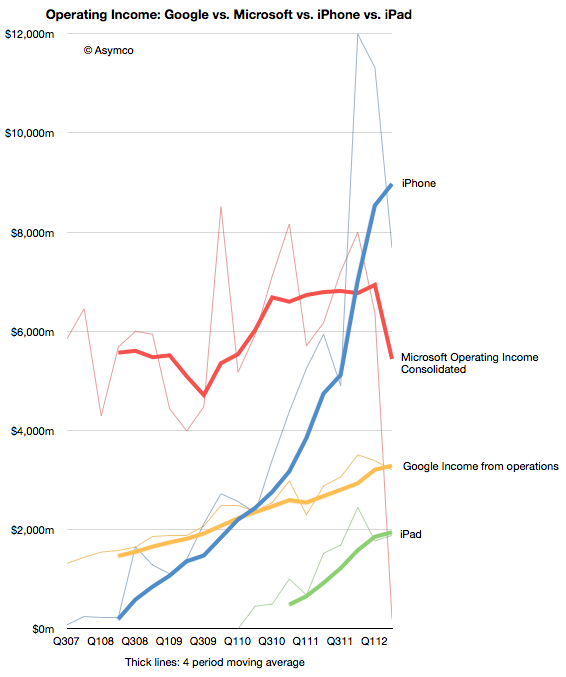
    I tried to remove some noise by isolating the iPhone and iPad and consolidating Microsoft overall and Google.

    By also smoothing out seasonality with a four-period moving average we can observe the pattern of growth for the iPhone and iPad relative to the other companies' overall performance.

    The crucial question remains if and when the iPad will be a bigger business than Google and/or Microsoft. The iPhone climbed over both some time ago.

  4. International Tablet of Mystery

    Research · 31 comments

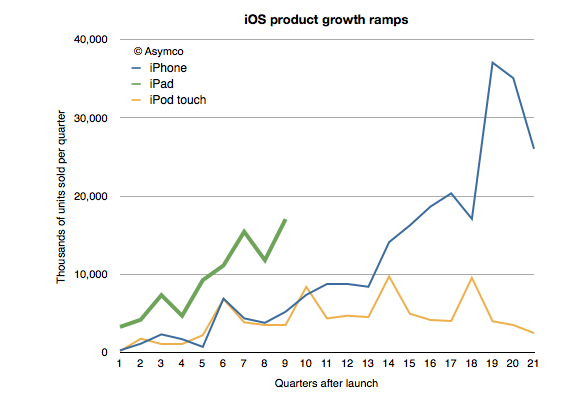
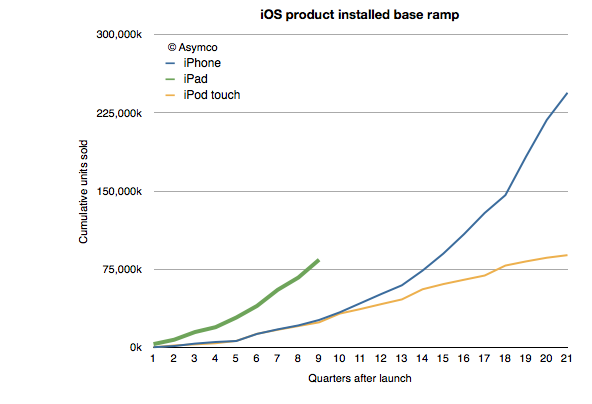
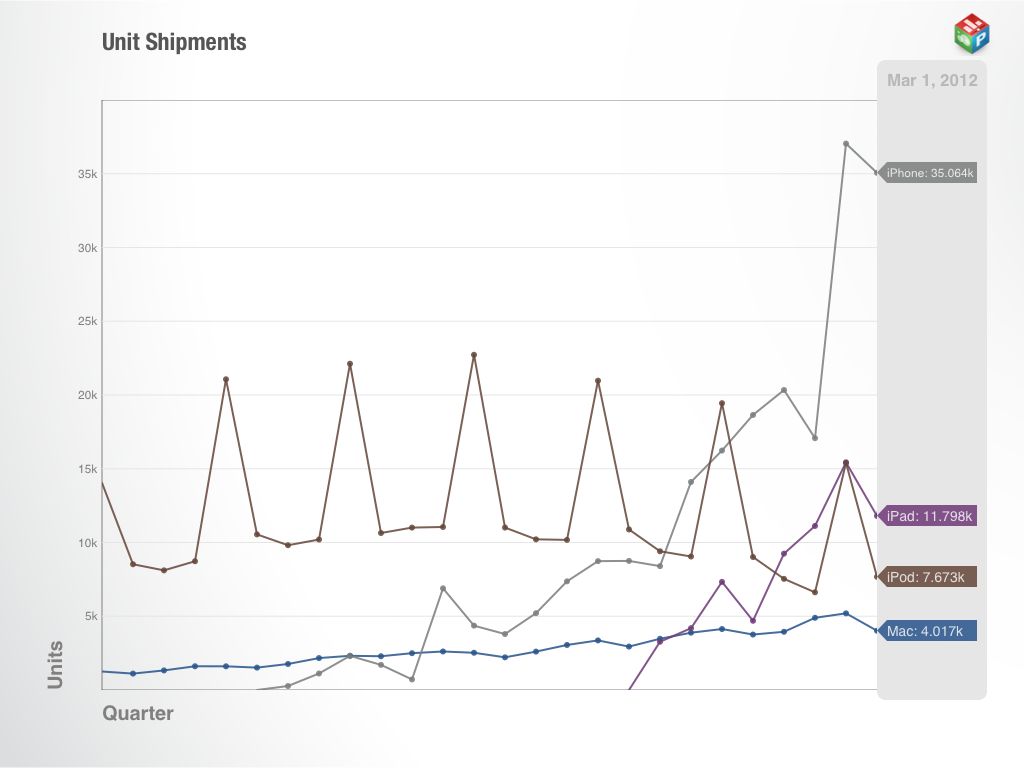
    One of the remarkable patterns associated with the iPad has been its growth rate. Looking at the ramp of the product relative to the iPhone and iPod touch reflects this sense of raised expectations:


    At the same point in time, and adjusting for seasonality the iPad is outselling the iPhone by a factor of 3 and the iPod touch by a factor of about 5. This is also reflected in the installed base of devices, where the 84 million iPads sold through its first nine quarters is more than three times the iPhone base at a similar point in time.

    Of course, the world of 2012 is different than the one from 2009 when 25 million iPhone sold. iPhones are available in far more points of sale and to many more buyers world-wide. But the interesting contrast is between the iPad and the iPod touch.

    I've always maintained that the dynamic difference between the iPad and the iPhone is that it's unrestrained (and unsupported) by the operator channel and all that it implies. The iPad is a pure computing product whose means of communication is unregulated. That means transparency in pricing and transparency in distribution.

    But so is the iPod touch.

    The iPod touch is a "nano iPad" (or as detractors put it, the converse of that.) So shouldn't the iPod touch behave as the iPad?

    We don't know exactly how the iPod touch behaves. We don't have specific figures on its sales. What you see in the charts above are my estimates for the iPod touch based on company statements that "about/above 50%" of iPods are touch versions. That and the cumulative sales totals that are occasionally reported.

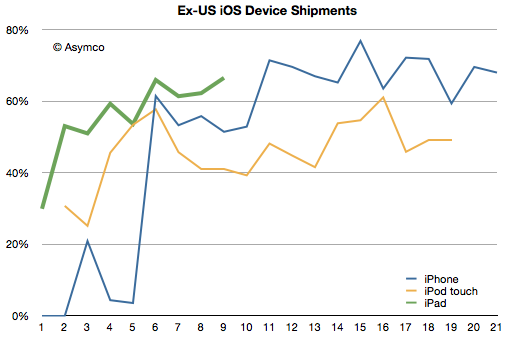
    However, we have received an unexpected morsel of data from the Samsung v. Apple trial that may help characterize the two products: US sales data. Having the US data and knowing/estimating the global data gives us an estimate of the international (ex-US) sales for all three products.

    I indexed the three products to measuring quarters since launch. The pattern here is that the iPad diverges from the iPod touch in its international appeal. Since the iPad expanded internationally even faster than the iPhone, the issue is not only one of rapidity in appeal but also a qualitative difference.  The iPod touch seems to have stabilized at 50% non-US sales while the iPhone is between 60% and 80% outside the US.

    The iPad reached 60% non-US sales in its first year. Its last quarter was 70% outside the US.

    So what's going on?

    The characteristic value of the iPad is in its appeal to "computing non-consumers". Computing has come to mean media consumption, education, communication and entertainment. These jobs to be done are casually done with much more ease on an iPad. The iPod touch can do these jobs as well, but not as comfortably. The iPod touch is "absorbable" by younger consumers and typically they have their hiring done by their parents. Those parents are less likely to indulge where incomes are lower.

    But the universal appeal of the iPad is evident in its global visibility. Like the tasks it performs, the iPad itself is becoming less of a mystery.

  5. Scoring my performance on the third fiscal quarter forecast

    Research · 21 comments

    Did I get anything right in last forecast?

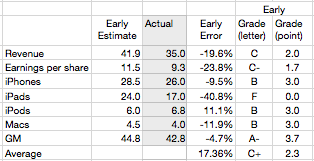
    The table below shows the scores for my various estimates[1]

    Last quarter I managed a B+ overall but this quarter was a C+. The iPad estimate was a complete failure mitigated slightly by a, directionally at least, correct call on the iPhone. The failure on iPad dragged down revenue and EPS while the accuracy on iPhone improved the gross margin. iPod and Mac estimates were consistent with recent performance.

    The error on iPad is a harsh lesson which shows how the category is still unpredictable. With only four quarters where we could measure y/y growth, and with those quarters showing 183%, 166%, 111% and 151% growth, I assumed that the 150% growth was sustainable.

    That turned out not to be the case. The iPad slowed to 84% unit growth and 51% revenue growth. It's perhaps unrealistic to expect 150% growth for more than one year. This is the main learning for the quarter and I will adjust my expectations accordingly. Overall, the product has sold 84 million units since launching in early 2010. I now expect it will sell approximately 80 million this year and 150 million units in 2013.

    ---

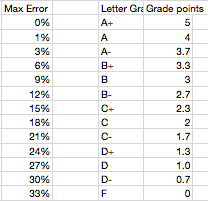
    Note: Grading algorithm is based on this table:

  6. Padcast: Reviewing Apple's Third Fiscal Quarter 2012

    Research · 59 comments

    Here is the second Perspective "padcast" where I discuss:

    1. Top and bottom line growth
    2. iPhone, iPad, iPod and Mac revenue growth
    3. iPad vs. Mac
    4. iOS product mix
    5. Other product line growth
    6. Gross Margins by product
    7. Pricing and revenue per unit by product
    8. Cash and cash growth
    9. Guidance and whether results were a surprise to management

    The discussion is an audio presentation with animated, interactive motion charts which can be manipulated by the user.

    It's available as an in-app purchase for $0.99 on the iTunes app store via the Perspective iPad app.

  7. A preview of Apple's performance in Q2

    Research · 60 comments

    In anticipation of the earnings release tomorrow, I prepared a iPad-enabled audio-visual chart-based discussion of my expectation for product-level performance.

    I discuss six topics in a historic context and the reasoning behind my expectations for the just-ended June quarter:

    1. Units by product line
    2. Unit growth
    3. Gross Margin percent (profitability) by product
    4. Pricing power in terms of revenue per unit sold
    5. Contribution to revenues for each product
    6. Contribution to margin for each product (i.e. profitability)

    The discussion is packaged as a "padcast" which means you need to have an iPad and the Perspective App available on the iTunes App store in order to view the content.

    It's available for $0.99 here.


  8. The poetry of Steve Ballmer

    Research · 121 comments

    Steve Ballmer July 9th, 2012 on competing with Apple:

    We are trying to make absolutely clear:
    We are not going to leave any space uncovered to Apple
    We are not.
    No space uncovered that is Apple’s
    We have our advantages in productivity
    We have our advantages in terms of enterprise management, manageability
    We have our advantages in terms of when you plug into server infrastructure in the enterprise.
    But we are not going to let any piece of this [go uncontested to Apple]
    Not the consumer cloud
    Not hardware software innovation
    We are not leaving any of that to Apple by itself
    Not going to happen
    Not on our watch.

    Steve Ballmer, July 2010 on competing with Apple's iPhone and iPad:

    Today, kind of I'd say one of the top issues on my mind, let alone on your minds, one of the top issues on my mind, is, hey, there is a category that we've had Windows on for actually a long time. We've had Windows 7 on, tablets and slate machines now for a number of years, and Apple has done an interesting job of putting together a synthesis and putting a product out, and in which they've -- they sold certainly more than I'd like them to sell, let me just be clear about that.

    We think about that. We think about that in competitive sense. And for us, then, the job is to say: Okay, we have a lot of IP, we have a lot of good software in this area, we've done a lot of work on ink and touch and everything else -- we have got to make things happen. Just like we had to make things happen on netbooks, we've got to make things happen with Windows 7 on slates. And we are in the process of doing that as we speak. We're working with our hardware partners, we're tuning Windows 7 to new slate hardware designs that they're bringing them to market. And, yeah, you're going to get a lot of cacophony. There will be people who do things with other operating systems. But we've got the application base, we've got the user familiarity. We've got everything on our side if we do things really right.

    So, we think about these devices and I don't think there really is one size that fits all. I don't think everybody wants a slate. I've been to too many meetings with journalists who'd spend the first 10 minutes of the meeting setting up their iPad to look like a laptop...

    Laptops actually are well designed for a lot of things. I notice they are all light. In fact, if you look around this room, they all weigh zero pounds, because they're just sitting on the table, you are not holding them and you don't set them up when you want to type, and they prop up -- they have good attributes. But some people are going to want that form factor. Some people are going to want probably a screen that they take with them and maybe they throw it back into the keyboard. Some people are going to want a device that is screen and keyboard that spins around for inking purposes. Some people are going to want things very light or very cheap or very expensive or very powerful. All of those things are going to be important, and we've got a push right now -- right now -- with our hardware partners.

    ... We're coming full guns. The operating system is called Windows. No -- there's -- let me be unambiguous. A new Windows Phone for screen sizes that, let me just say, are, you know, sort of bigger than three or four inches -- the answer is Windows Phone. We are in the game. We're all in the game today with Intel architecture machines. We've got improvements coming from Intel. We're driving forward. We're unambiguous about that. Now, where we'll go and what's going to matter -- I said also in my remarks that in no way will we allow hardware to be the impediment. We will embrace what we need to embrace over time in terms of hardware evolution.

    But you say to me are we going to see slate? Yes. What processor are they going to have? They are going to have an Intel architecture processor at least in any foreseeable future. Are they going to run Windows? Yeah. Will it be tuned? Yes! And we are going to sell like crazy. We are going to market like crazy. We have devices that will run more applications, that have as much content, that have anything you want on the planet.

    And we have an ecosystem of developers that know how to write applications for that thing. Believe me, as I think everybody knows, you can buy two PCs for the price of one iPad -- two netbooks today for the price of one iPad. So, people are sitting there over-celebrating BOM costs and blah, blah, blah. We and Intel can get our job done and know how to make money. There's good money for everybody in the ecosystem to go make.

    I talked about power. We've got work we have to do with hardware partners, with Intel. There's certainly some work to be done there. And over time where we go is where we go. But at least in the timeframe that which anybody does these models, for example, let's go. Let's go and we'll be in market as soon as we can with new devices, whether that's, you know, really, really soon or just really pretty soon. I'm going to wait until I have the device that I want to hand you and tell you to go use, or a collection of devices. I think that would be the appropriate time to say it is time. But it ain't a long time from now. Pardon my English...

    On the netbook, nor the slate, if it's two weeks one way or the other, or it's a month, I mean, let's not speculate, let's merely say when you get your Windows 7 machine, it will print. Let's just start with that. I mean some people actually like to print every now and then. Ours will print. I'm not trying to say that other guys aren't doing good work. I'm not saying that. We've got to ‑‑ come on, every day. Every day you come to work you have to prove yourself, prove yourself, prove yourself. We'll prove ourselves. ...

    I relish the competition. I relish holding up those couple of machines today that I wanted to hand you. It's not today. I'll relish doing it tomorrow. Bring on ‑‑ particularly if with the application base, with the tools that we have, with the user understanding and momentum and everything going on, we can't compete with ‑‑ particularly whatever the weird collection of Android machines is going to look like, shame on us.

    Apple is Apple. They're always a little tougher to compete with. They're a really good competitor, and tend to be a really high-priced competitor. People worried a little bit about our bottom costs. They've got a lot of margin in those devices, which creates a lot of room in which to operate. Okay. We've competed with Apple before. I talked about that.

    We've been competing with Macs, and I notice in this audience you get one profile for the 93 percent of people almost who agree with us every day about laptops. We're going to have things that should be interesting to them. That doesn't mean it's not going to be exciting. That doesn't mean you're not going to have to pay attention to shareholders. It certainly means we've got to pay attention. But, at the end of the day kind of what makes life kind of interesting, kind of fun, and you're going to see very interesting things.

    Steve Ballmer, January 2007 on competing with Apple's iPhone and iPod:

    Right now, well let’s take phones first Right now we’re selling millions and millions and millions of phones a year. Apple is selling zero phones a year. In six months they’ll have the most expensive phone by far ever in the marketplace and let’s see. You know what’s so special...? Let’s see how the competition goes.

    In the case of music and entertainment players Apple absolutely has the preeminent position We said we want to be in this market. There’s a lot of reasons why. There’s synergy with other things that we’re doing. We’ve got some neat innovations. In particular, what we’re doing with community, with wireless networking. And we came into a market in which they’re very strong and we took, you know, about, by most estimates, I would say we took about twenty, twenty-five percent of the high-end of the market. We weren’t down at some of the lower price points but for devices 249 dollars and over we took, you know, let’s say about twenty percent of the market. So I feel like we’re in the game. We’re driving our innovation hard. Ok, we’re not the incumbent. He’s the incumbent in this game but, uh, at the end of the day he’s gonna have to keep up with an agenda that we’re gonna drive as well.

  9. Who will be Microsoft's Tim Cook?

    Research · 88 comments

    As previously noted, Apple has overtaken Microsoft (and Google) in operating margin percentage. This is an astonishing statistic as Apple is still largely perceived to be a "hardware company" while Microsoft is a "software company" and Google is a "services company."

    To suggest that "hardware" could be more operationally profitable than either software or services is akin to heresy in technology analysis. This reversal is newsworthy indeed. However, even the most casual observer would note that Apple does not derive its market power from hardware alone. It is, in fact, an integrated hardware, software and services company (with a few more roles besides.)

    So the emergent successful business architecture in this technologically transitional period is of integration and completeness of solutions.

    This shift explains at least at a conceptual level Microsoft's tectonic Surface shift.

    But what about another point of view? What does integration mean for Microsoft's income, cost and profit structure? Is integration self-disruptive to Microsoft?

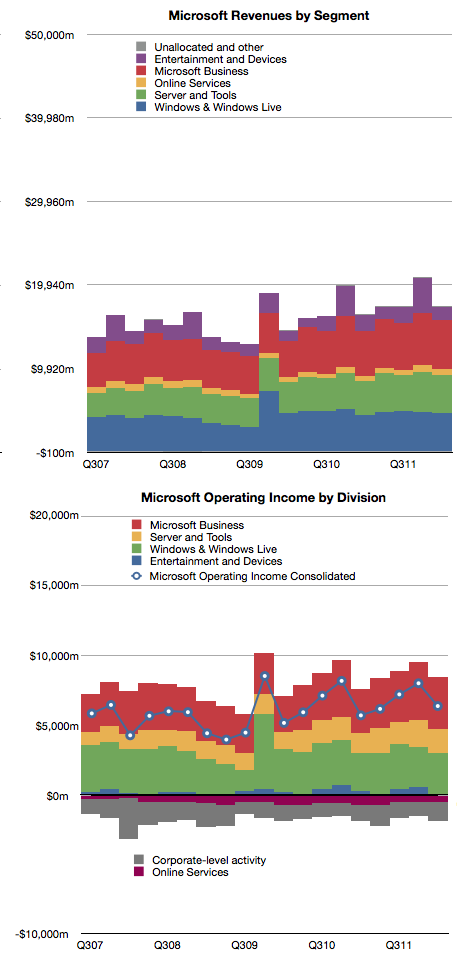
    Here's a reminder of Microsoft's revenues and operating income by division:

    The challenge of devices for Microsoft is that the licensing of software for devices is very difficult to sell.

    In 2011 Microsoft received about $18.7 billion in Windows revenues and $23 billion in Office revenues. The chart shows that this is a fairly steady growth business. According to Gartner, in 2011 there were about 336 million Windows PCs sold and that this too is a fairly stable and mature business.

    If we simply divide revenues by PCs sold we get about $55 Windows revenues per PC and $68 of Office revenues per PC sold [1]. The total income for Microsoft per PC sold is therefore about $123. If we divide operating income by PCs as well we get $35 per Windows license and $43 per Office license. That's a total of $78 of operating profit per PC.

    Now let's think about a post-PC future exemplified by the iPad. Apple sells the iPad with a nearly 33% margin but at a higher average price than Microsoft's software bundle. Apple gives away the software (and apps are very cheap) but it still gains $195 in operating profit per iPad sold.

    Fine, you say, but Microsoft make up for it in volume. Well, that's a problem. The tablet volumes are expanding very quickly and are on track to overtake traditional PCs while traditional PCs are likely to be disrupted and decline.

    So Microsoft faces a dilemma. Their business model of expensive software on cheap hardware is not sustainable. The future is nearly free software integrated into moderately priced hardware.

    For Microsoft to maintain their profitability, they have to find a way of obtaining $80 of profit per device. Under the current structure, device makers will not pay $55 per Windows license per device and users will not spend $68 per Office bundle per tablet. Price competition with Android tablets which have no software licensing costs and with iPad which has very cheap software means that a $300 tablet with a $68 software bill will not be competitive or profitable.

    However, if Microsoft can sell a $400 (on average) device bundled with its software, and is able to get 20% margins then Microsoft is back to its $80 profit per device sold. This, I believe, is a large part of the practical motivation behind the Surface product.

    The challenge for Microsoft therefore becomes to build hundreds of millions of these devices. Every year. Sounds like they need a Tim Cook to run it.

    ---

    Notes:

    1. Microsoft accounts for revenues using deferrals due to Software Assurance pre-payment models for many corporate customers so this figure is not a precise value for each license sold.


  10. A more precise measure of Apple's device installed base (and device longevity)

    Research · 43 comments

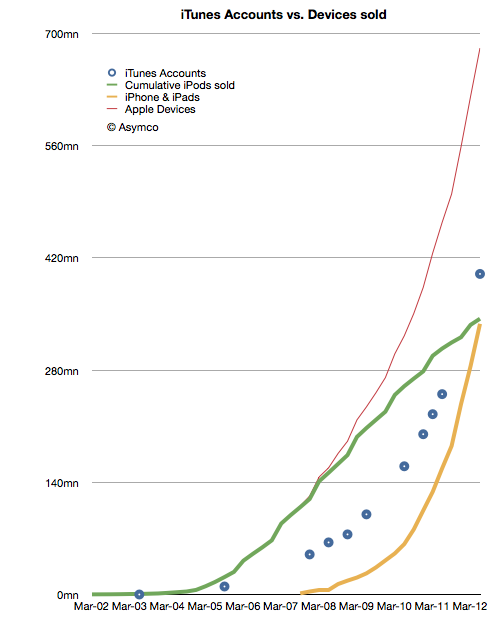
    Apple announced that the total number of iTunes account (with credit cards attached) has reached 400 million. This was touted as being the largest collection of credit card accounts for any retailer and I have no reason to doubt it. However, looking beyond the bragging rights, there are more interesting patterns to observe about this asset.

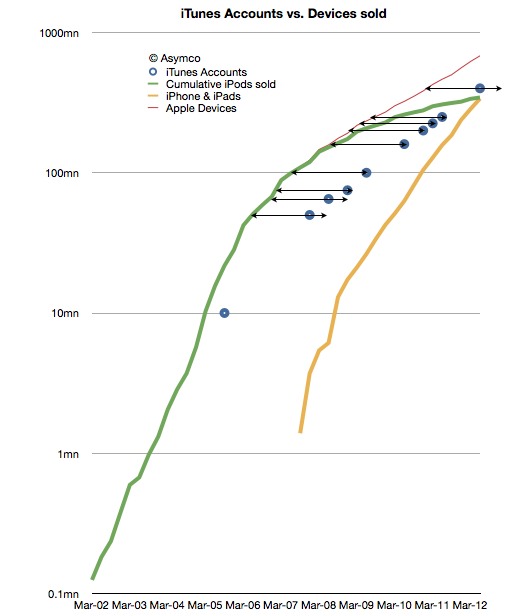
    What I plotted was the cumulative number of iPods sold (green), the cumulative number of iPhones and iPads (yellow), the combined devices total (red) and the reported number of iTunes accounts (blue).

    The first observation is that the combined total iPhones + iPads have overtaken cumulative total iPods. The iPhone started in Mid '07, more than five years after the first iPod shipped. The acceleration in that product line is still evident while the iPod decelerates gracefully.

    The second observation is that the total device count has reached 680 million in the last decade. It's a big number but it is still a number that is dwarfed by the overall device market. Apple is still around 10% of the devices market today. It should give an idea of how many devices could still be sold in the next decade.

    The third observation is the ratio between the iTunes accounts and the total devices sold. Since iPods, iPhone and iPads have been dependent on iTunes, the number of iTunes accounts gives a rough indication of active users. Combining active users with total devices sold should give a rough estimate of the number of retired devices. In other words, if we assume that account holders typically use one device then by taking the difference between devices sold to date and accounts at that point in time we should know how many devices have been retired.

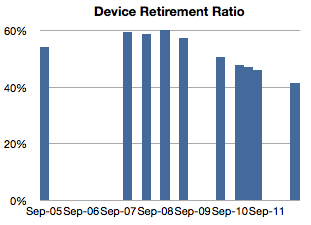
    Dividing that number of retired devices by devices in use should give us the retirement rate and that is shown in the following chart:

    Note that as the iPod was slowing and the iPhone was still a small part of the total, the retirement ratio was increasing. As the iPhone accelerated, the ratio began decreasing and is still decreasing.

    Projecting the retirement rate should give us a way of more precisely estimating  the addressable market for developers, accessories makers, and other ecosystem participants.  Currently that means that about 60% of all Apple's devices sold are still in use. We can tune that figure upward in the next few quarters and make better estimates as Apple releases their shipment data.

    The iTunes account data is not just a way to calibrate addressable markets but also a valuable method for measuring device longevity. The distance between the red line and the blue happens to be nearly a constant 8 quarters as shown in the following chart (note change to log scale for the vertical axis).

  11. Estimates for Apple's third fiscal 2012 quarter

    Research · 77 comments

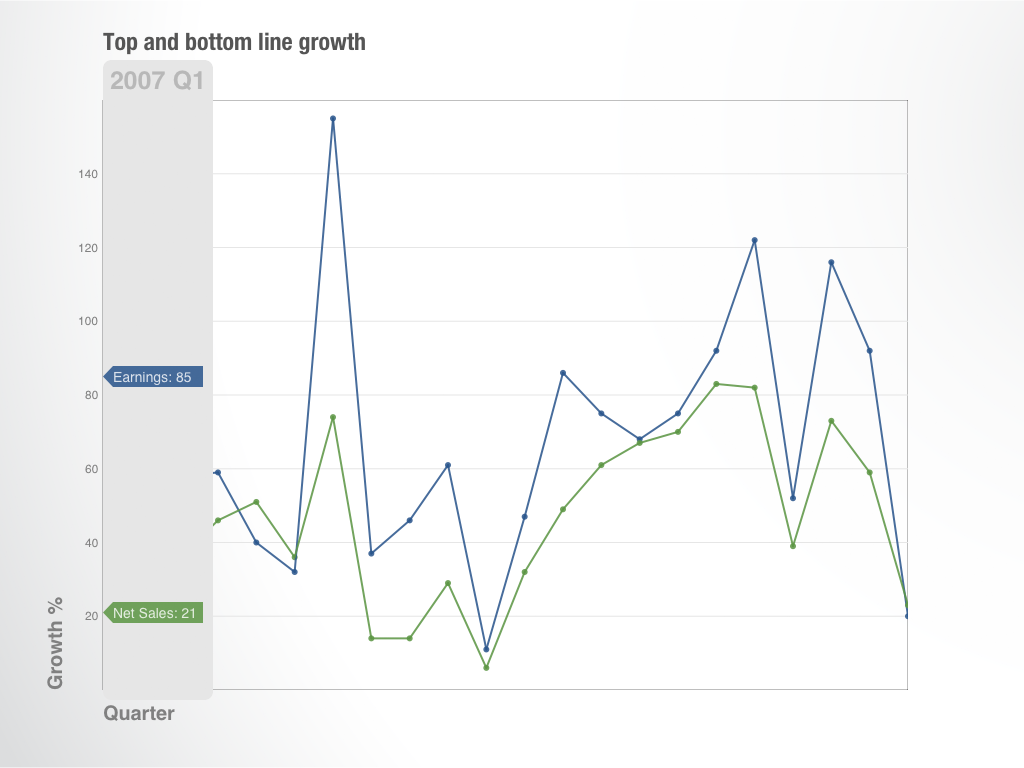
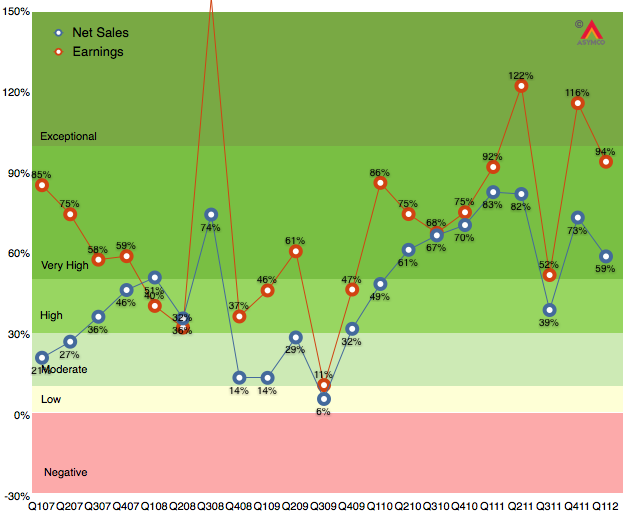
    As the chart below shows, the last quarter (first calendar 2012, second fiscal 2012) was robust with 94% earnings growth and 59% net sales growth. Subject to the usual superlatives, the performance was, again, unexpected by many.

    Much of that surprise was due to the underestimation of iPhone sales in China during what is a holiday quarter in that nation. Growth this quarter will be more difficult to estimate. The iPhone is still the most important component but the iPad is becoming increasingly decisive in overall performance. In fact, I'm projecting that the iPad will have the equivalent of 73% of the iPhone revenues this quarter.

    In this quarter the iPhone is reaching a late stage in its launch cycle but it continues to reach more points of purchase through distribution agreements and it also has a "portfolio" in terms of multiple price points and models available.

    The iPad was supply constrained last quarter and may be in balance this quarter. Management has very clearly and repeatedly signaled that the iPad will have a very strong quarter.

    So with these clues, here are my estimates for the quarter (with y/y growth in parentheses):

    • iPhone units: 28.5 million (40%)
    • Macs: 4.5 million (15%)
    • iPads: 24 million (160%)
    • iPods: 6 million (-20%)
    • Music (incl. app) rev. growth: 35%
    • Peripherals rev. growth: 20%
    • Software rev. growth: 15%
    • Total revenues: $41.9 billion (46%)
    • GM: 44.8%
    • EPS: $11.54 (48%)

    This earnings value would imply a trailing twelve months’ EPS of about $44.8. At the current price of $571/share the P/E would be 12.7[1]. Cash and equivalents will probably increase to $118 billion.

    ---

    1. Apple's P/E also dropped to 12.7 around Christmas 2008. I did a search for some headlines to recall that time and came across one that seems appropriate: "Unrest Caused By Bad Economy May Require [domestic] Military Action, Says US Report".