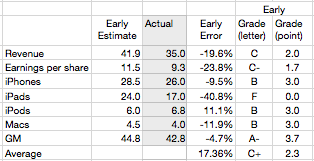
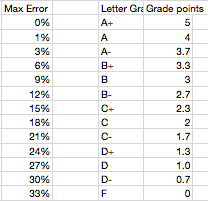
The table below shows the scores for my various estimates[1]
Last quarter I managed a B+ overall but this quarter was a C+. The iPad estimate was a complete failure mitigated slightly by a, directionally at least, correct call on the iPhone. The failure on iPad dragged down revenue and EPS while the accuracy on iPhone improved the gross margin. iPod and Mac estimates were consistent with recent performance.
The error on iPad is a harsh lesson which shows how the category is still unpredictable. With only four quarters where we could measure y/y growth, and with those quarters showing 183%, 166%, 111% and 151% growth, I assumed that the 150% growth was sustainable.
That turned out not to be the case. The iPad slowed to 84% unit growth and 51% revenue growth. It's perhaps unrealistic to expect 150% growth for more than one year. This is the main learning for the quarter and I will adjust my expectations accordingly. Overall, the product has sold 84 million units since launching in early 2010. I now expect it will sell approximately 80 million this year and 150 million units in 2013.
In my last podcast (Impatient for Growth) I mentioned my frustration at Apple's slow entry into emerging markets outside of China. I cited Tim Cook's comments that he did not see an opportunity there in the short term. He mentioned the multi-level distribution challenge which I took to mean the difficulty in setting up Apple stores (in itself due to restrictions on foreign owned retail chains) and the absence of device/service bundling.
This requires more analysis and the best place to start is to look at the data available.
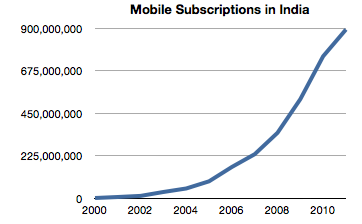
The market potential is enormous. Globally, there are 6 billion mobile cellular subscriptions (end of 2011, ITU) and 86% penetration, but only 1 billion have mobile broadband subscriptions (which make ownership of a smartphone worthwhile). In India there are 893 million subs (vs 986 million in China).
In 2011 142 million mobile cellular subscriptions were added in India, more than in the Arab States, CIS and Europe put together.
So the potential and growth are spectacular. But that is just 2G. Mobile broadband (i.e. 3G) is rare. Globally, developing countries have only 8% mobile broadband penetration vs. 51% in the developed world. Mobile broadband is a proxy for mass adoption of the iPhone (though perhaps not for Android inasmuch as it's employed as a feature phone).
The situation for 3G in India is even worse than the overall developing world. 3G licenses were only first awarded at the end of 2010 and the process was fraught with allegations of corruption. In the year and a half since, there came to be an estimated 10 million HSPA connections in the country.
The potential therefore is huge but the timing is difficult. Analysts are projecting 100 million mobile broadband connections by 2014 and over 350 million by 2016. Apple can affect this rate of growth as it's not only enabled by the network roll-out but can affect the take-up rate by consumers.
It's a chicken-and-egg problem. No network means no devices but no devices may mean the network cannot be paid for. In the initial phases, the economics of mobile broadband are still dominated by the incentives for operators to pay for the infrastructure rather than for consumers to pay for the service. The iPhone will have a role to play and the question is whether 2014 or 2016 are the dates when Apple will be able to claim that they've cracked the India code.
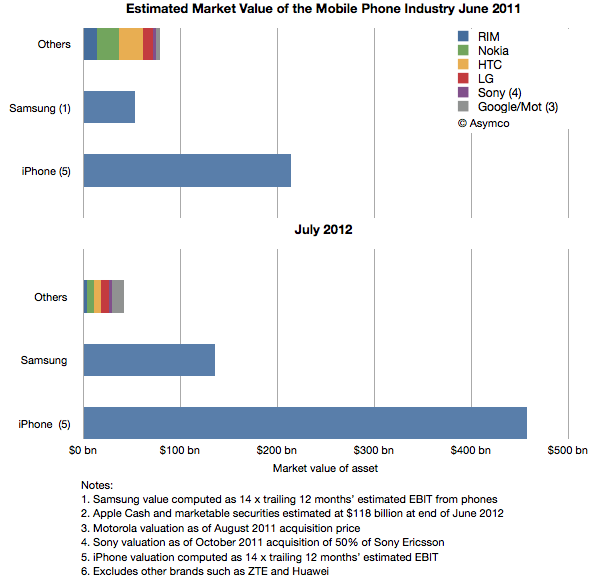
A year ago I noted that Apple could buy most of the mobile phone industry with cash on hand (excluding Samsung's operations).
Since then Apple's cash has grown significantly and the value of all phone vendors except Samsung has gone down significantly. The following chart shows the year ago and present day estimated market value of the industry participants.
Phone brands other than Samsung and iPhone have seen a reduction in market value of a combined 47%. That's actually being quite generous since I'm valuing Motorola and Sony's businesses at their acquisition prices. The operations of both those companies have continued to stagnate.
Based on the same multiple of estimated earnings Samsung grew its value by 157% and iPhone by 114% (note this excludes iPad).
In absolute terms the iPhone franchise created $244 billion in value while Samsung created $83 billion. The others destroyed $37 billion.
The good news is that the industry has had net value creation--always a healthy sign that innovation is being valued and absorbed.
The bad news is that there is vast income inequality. The rich are getting richer and the poor are getting destitute. This is an unhealthy sign. The concentration of power and wealth may indicate a peaking of experimentation and discovery of new opportunities.
Also noteworthy is that almost all the value from the Android ecosystem is concentrated in Samsung. I did not include Google in this analysis since its mobile is so small as to be not visible in its accounting. A separate analysis of Android economics shows that Google's benefit from the platform is modest. In contrast, Samsung, and Samsung alone, is benefitting greatly. It could even be said that today Samsung is the only Android profit engine.
Steve Ballmer July 9th, 2012 on competing with Apple:
We are trying to make absolutely clear: We are not going to leave any space uncovered to Apple We are not. No space uncovered that is Apple’s We have our advantages in productivity We have our advantages in terms of enterprise management, manageability We have our advantages in terms of when you plug into server infrastructure in the enterprise. But we are not going to let any piece of this [go uncontested to Apple] Not the consumer cloud Not hardware software innovation We are not leaving any of that to Apple by itself Not going to happen Not on our watch.
Steve Ballmer, July 2010 on competing with Apple's iPhone and iPad:
Today, kind of I'd say one of the top issues on my mind, let alone on your minds, one of the top issues on my mind, is, hey, there is a category that we've had Windows on for actually a long time. We've had Windows 7 on, tablets and slate machines now for a number of years, and Apple has done an interesting job of putting together a synthesis and putting a product out, and in which they've -- they sold certainly more than I'd like them to sell, let me just be clear about that.
We think about that. We think about that in competitive sense. And for us, then, the job is to say: Okay, we have a lot of IP, we have a lot of good software in this area, we've done a lot of work on ink and touch and everything else -- we have got to make things happen. Just like we had to make things happen on netbooks, we've got to make things happen with Windows 7 on slates. And we are in the process of doing that as we speak. We're working with our hardware partners, we're tuning Windows 7 to new slate hardware designs that they're bringing them to market. And, yeah, you're going to get a lot of cacophony. There will be people who do things with other operating systems. But we've got the application base, we've got the user familiarity. We've got everything on our side if we do things really right.
So, we think about these devices and I don't think there really is one size that fits all. I don't think everybody wants a slate. I've been to too many meetings with journalists who'd spend the first 10 minutes of the meeting setting up their iPad to look like a laptop...
Laptops actually are well designed for a lot of things. I notice they are all light. In fact, if you look around this room, they all weigh zero pounds, because they're just sitting on the table, you are not holding them and you don't set them up when you want to type, and they prop up -- they have good attributes. But some people are going to want that form factor. Some people are going to want probably a screen that they take with them and maybe they throw it back into the keyboard. Some people are going to want a device that is screen and keyboard that spins around for inking purposes. Some people are going to want things very light or very cheap or very expensive or very powerful. All of those things are going to be important, and we've got a push right now -- right now -- with our hardware partners.
... We're coming full guns. The operating system is called Windows. No -- there's -- let me be unambiguous. A new Windows Phone for screen sizes that, let me just say, are, you know, sort of bigger than three or four inches -- the answer is Windows Phone. We are in the game. We're all in the game today with Intel architecture machines. We've got improvements coming from Intel. We're driving forward. We're unambiguous about that. Now, where we'll go and what's going to matter -- I said also in my remarks that in no way will we allow hardware to be the impediment. We will embrace what we need to embrace over time in terms of hardware evolution.
But you say to me are we going to see slate? Yes. What processor are they going to have? They are going to have an Intel architecture processor at least in any foreseeable future. Are they going to run Windows? Yeah. Will it be tuned? Yes! And we are going to sell like crazy. We are going to market like crazy. We have devices that will run more applications, that have as much content, that have anything you want on the planet.
And we have an ecosystem of developers that know how to write applications for that thing. Believe me, as I think everybody knows, you can buy two PCs for the price of one iPad -- two netbooks today for the price of one iPad. So, people are sitting there over-celebrating BOM costs and blah, blah, blah. We and Intel can get our job done and know how to make money. There's good money for everybody in the ecosystem to go make.
I talked about power. We've got work we have to do with hardware partners, with Intel. There's certainly some work to be done there. And over time where we go is where we go. But at least in the timeframe that which anybody does these models, for example, let's go. Let's go and we'll be in market as soon as we can with new devices, whether that's, you know, really, really soon or just really pretty soon. I'm going to wait until I have the device that I want to hand you and tell you to go use, or a collection of devices. I think that would be the appropriate time to say it is time. But it ain't a long time from now. Pardon my English...
On the netbook, nor the slate, if it's two weeks one way or the other, or it's a month, I mean, let's not speculate, let's merely say when you get your Windows 7 machine, it will print. Let's just start with that. I mean some people actually like to print every now and then. Ours will print. I'm not trying to say that other guys aren't doing good work. I'm not saying that. We've got to ‑‑ come on, every day. Every day you come to work you have to prove yourself, prove yourself, prove yourself. We'll prove ourselves. ...
I relish the competition. I relish holding up those couple of machines today that I wanted to hand you. It's not today. I'll relish doing it tomorrow. Bring on ‑‑ particularly if with the application base, with the tools that we have, with the user understanding and momentum and everything going on, we can't compete with ‑‑ particularly whatever the weird collection of Android machines is going to look like, shame on us.
Apple is Apple. They're always a little tougher to compete with. They're a really good competitor, and tend to be a really high-priced competitor. People worried a little bit about our bottom costs. They've got a lot of margin in those devices, which creates a lot of room in which to operate. Okay. We've competed with Apple before. I talked about that.
We've been competing with Macs, and I notice in this audience you get one profile for the 93 percent of people almost who agree with us every day about laptops. We're going to have things that should be interesting to them. That doesn't mean it's not going to be exciting. That doesn't mean you're not going to have to pay attention to shareholders. It certainly means we've got to pay attention. But, at the end of the day kind of what makes life kind of interesting, kind of fun, and you're going to see very interesting things.
Steve Ballmer, January 2007 on competing with Apple's iPhone and iPod:
Right now, well let’s take phones first Right now we’re selling millions and millions and millions of phones a year. Apple is selling zero phones a year. In six months they’ll have the most expensive phone by far ever in the marketplace and let’s see. You know what’s so special...? Let’s see how the competition goes.
In the case of music and entertainment players Apple absolutely has the preeminent position We said we want to be in this market. There’s a lot of reasons why. There’s synergy with other things that we’re doing. We’ve got some neat innovations. In particular, what we’re doing with community, with wireless networking. And we came into a market in which they’re very strong and we took, you know, about, by most estimates, I would say we took about twenty, twenty-five percent of the high-end of the market. We weren’t down at some of the lower price points but for devices 249 dollars and over we took, you know, let’s say about twenty percent of the market. So I feel like we’re in the game. We’re driving our innovation hard. Ok, we’re not the incumbent. He’s the incumbent in this game but, uh, at the end of the day he’s gonna have to keep up with an agenda that we’re gonna drive as well.
We asked him eight questions about the five-year impact of Apple's iPhone, and he replied from his iPad.
Q: Five years ago, people actually began to get their hands on the Apple iPhone. There were other smartphones; no prior phone products from Apple; there was no App Store, no apps "ecosystem." So what accounted for its initial success with consumers?
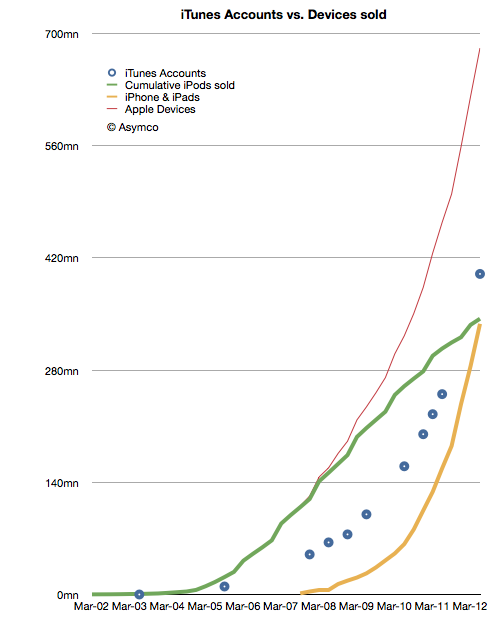
Apple announced that the total number of iTunes account (with credit cards attached) has reached 400 million. This was touted as being the largest collection of credit card accounts for any retailer and I have no reason to doubt it. However, looking beyond the bragging rights, there are more interesting patterns to observe about this asset.
What I plotted was the cumulative number of iPods sold (green), the cumulative number of iPhones and iPads (yellow), the combined devices total (red) and the reported number of iTunes accounts (blue).
The first observation is that the combined total iPhones + iPads have overtaken cumulative total iPods. The iPhone started in Mid '07, more than five years after the first iPod shipped. The acceleration in that product line is still evident while the iPod decelerates gracefully.
The second observation is that the total device count has reached 680 million in the last decade. It's a big number but it is still a number that is dwarfed by the overall device market. Apple is still around 10% of the devices market today. It should give an idea of how many devices could still be sold in the next decade.
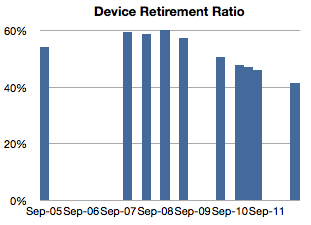
The third observation is the ratio between the iTunes accounts and the total devices sold. Since iPods, iPhone and iPads have been dependent on iTunes, the number of iTunes accounts gives a rough indication of active users. Combining active users with total devices sold should give a rough estimate of the number of retired devices. In other words, if we assume that account holders typically use one device then by taking the difference between devices sold to date and accounts at that point in time we should know how many devices have been retired.
Dividing that number of retired devices by devices in use should give us the retirement rate and that is shown in the following chart:
Note that as the iPod was slowing and the iPhone was still a small part of the total, the retirement ratio was increasing. As the iPhone accelerated, the ratio began decreasing and is still decreasing.
Projecting the retirement rate should give us a way of more precisely estimating the addressable market for developers, accessories makers, and other ecosystem participants. Currently that means that about 60% of all Apple's devices sold are still in use. We can tune that figure upward in the next few quarters and make better estimates as Apple releases their shipment data.
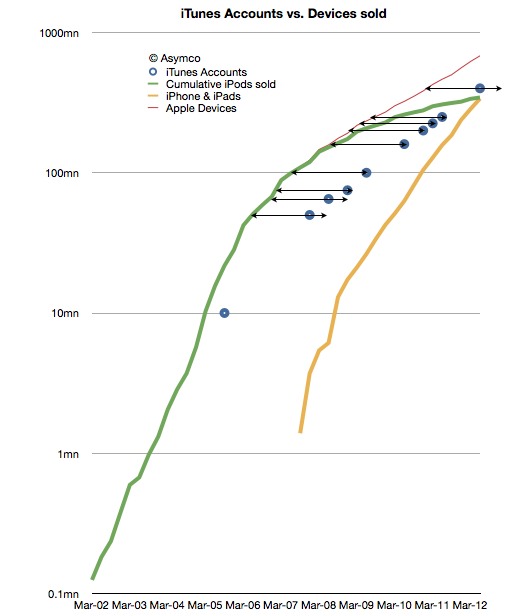
The iTunes account data is not just a way to calibrate addressable markets but also a valuable method for measuring device longevity. The distance between the red line and the blue happens to be nearly a constant 8 quarters as shown in the following chart (note change to log scale for the vertical axis).
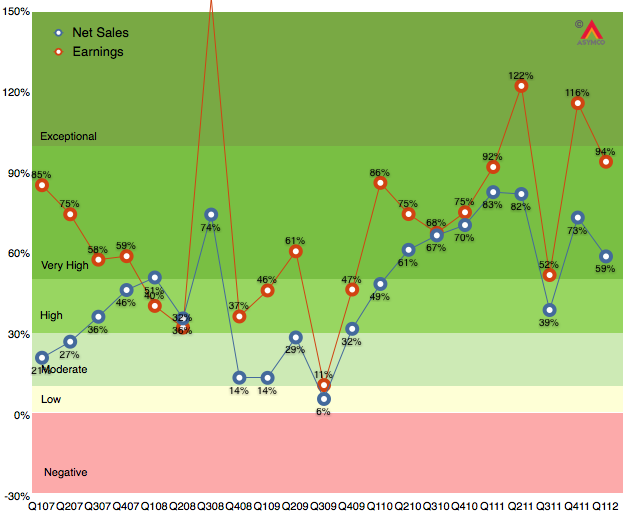
As the chart below shows, the last quarter (first calendar 2012, second fiscal 2012) was robust with 94% earnings growth and 59% net sales growth. Subject to the usual superlatives, the performance was, again, unexpected by many.
Much of that surprise was due to the underestimation of iPhone sales in China during what is a holiday quarter in that nation. Growth this quarter will be more difficult to estimate. The iPhone is still the most important component but the iPad is becoming increasingly decisive in overall performance. In fact, I'm projecting that the iPad will have the equivalent of 73% of the iPhone revenues this quarter.
In this quarter the iPhone is reaching a late stage in its launch cycle but it continues to reach more points of purchase through distribution agreements and it also has a "portfolio" in terms of multiple price points and models available.
The iPad was supply constrained last quarter and may be in balance this quarter. Management has very clearly and repeatedly signaled that the iPad will have a very strong quarter.
So with these clues, here are my estimates for the quarter (with y/y growth in parentheses):
iPhone units: 28.5 million (40%)
Macs: 4.5 million (15%)
iPads: 24 million (160%)
iPods: 6 million (-20%)
Music (incl. app) rev. growth: 35%
Peripherals rev. growth: 20%
Software rev. growth: 15%
Total revenues: $41.9 billion (46%)
GM: 44.8%
EPS: $11.54 (48%)
This earnings value would imply a trailing twelve months’ EPS of about $44.8. At the current price of $571/share the P/E would be 12.7[1]. Cash and equivalents will probably increase to $118 billion.
---
Apple's P/E also dropped to 12.7 around Christmas 2008. I did a search for some headlines to recall that time and came across one that seems appropriate: "Unrest Caused By Bad Economy May Require [domestic] Military Action, Says US Report".
I note the "our" in "our year". This implies fiscal year (that and the fact that he spoke in the past tense before six months had passed in the calendar year.)
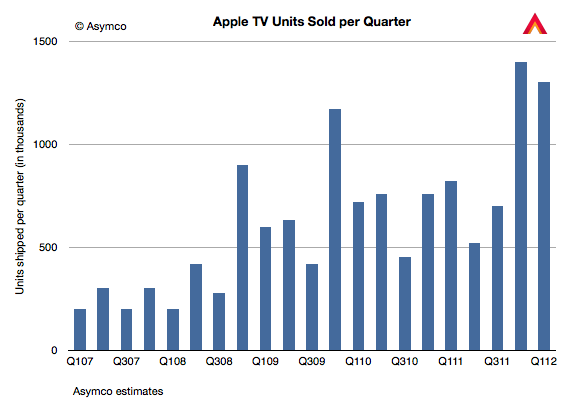
Given the public information we have so far, it's now possible to estimate with some confidence the sales history of Apple TV. The following chart is my estimate. It includes all the known data so far with some interpolations to fill in the gaps.
Assuming average revenues per device of $100, we can get an estimate of about $344 million in Apple TV hardware revenues for calendar 2011. This is not a large amount relative to Apple's other lines of business. It is, for example, only 14% of the overall Peripherals revenues and only 5% of the iPod.
However hardware revenues are not the whole story. The business model for the device is in many ways the polar opposite of the business model of the iPhone. Whereas the iPhone employs "break-even" iTunes App Store (and the Music and Video and Book stores) in order to sustain its high hardware margins, the Apple TV business has low hardware margins that sustain content.
The complete picture therefore has to include an assessment of the content attach rates and the agency fees that Apple gets for that content.
Let's assume that each Apple TV is used to generate $10/month in content sales. This is not a lot. It's equivalent to 5 TV shows or one movie purchased or two movie rentals per month. The model I have shows that the installed base of Apple TVs was about 10 million by the end of 2011. That means that the run rate is $1.2 billion in content sales for the Apple TVs in use.
Now Apple does not book all that. They book only about 30% as revenues as their agency fee. That means that Apple TV could be generating revenues at a run rate of $360 million (to Apple.)
If we add that to the $344 million in hardware revenues we get about $704 million for 2011. This is still not a huge business. It is about equal to the revenue from iPad Smart Covers[1]
Looking forward, if Apple TV units sell at double the rate of last year and we increase the footprint accordingly, we could see a revenue rate of $1.2 billion for 2012.
Now this is not a high margin business. The margin on the content may be less than 50%--depending on transaction costs and hosting/traffic fees. The margin on the hardware is also likely to be below 40%. So the business is not wildly profitable. But it probably is profitable. Which means it makes sense to keep it running while waiting for other pieces to fall into place.
As Tim Cook repeated, they are very interested in this space. However, any discussion of the future must include an analysis of the business model and the sustainability in terms of profit that keeps long term development focused on getting the product to be good enough for the right jobs to be done.
What we should think about however is this "polar opposite" business model. Apple is running this as a "hobby" or as an internal experiment. Sales are (relatively) tiny but it generates some profit. Volumes are small but they are growing. It's taking a heck of a long time. It's asymmetric to the prevailing model the company relies upon. It's beneath contempt from all observers. Sounds familiar?
---
Notes:
In 2011 there were about 40.5 million iPads sold. If we assume half of those purchases also resulted in a Smart Cover purchase and if the average revenue per Smart Cover was $35 then total Smart Cover revenues were $709 million.
Markets are difficult to measure. Mainly because the information is not easy to obtain and that which is obtained is not made public. Collecting, analyzing and filling in the gaps is big business with many firms involved in selling it.
However, with all the analysts and companies selling and promoting their "numbers" it's important to understand the difference between the methods used. There are for instance at least the following measurements:
Units sold to end users. For example NPD or GfK data of retail transactions. Also Gartner's estimates for phone units sold.
Units sold to the channel. For example units recognized on income statements usually reported by companies. Also IDC's estimates for phone units sold.
Units in use. For example comScore and Nielsen survey data.
Units "activated". The measurement Google uses to describe Android performance.
Intent to buy. For example ChangeWave surveys of early adopters.
Utilization rate. For example browser statistics.
Each measurement tells a different story about the market but the best story is told when all data is analyzed in a combined integrated market review.
Before diving into that it's important to understand the difference between the first and second measurements or the difference between shipped and sold.
What does "Sold" mean?
Let’s say that you sell a phone to another party. What constitutes a sale? The sales agreement? That you shipped it? That he wanted it? That you were paid for it?
What if he changes his mind and returns it? Is it still a sale? What if a manager's bonus depends on these sales? What if the company’s share price depends on these sales? Is there a way to rig the accounting?
As it turns out, yes there are; many ways. Unethical and fraudulent practices happen surprisingly often. A classic instance would be: A customer is shipped ten phones, though he only wants one, and he gets paid to ship the other nine back, after the close of the year.
The sales manager records ten times the sales he actually made, making ten times the commission and the company’s stock price rises. To compound the offense, the manager could also tip his friends to short the stock at the end of the year, leaving investors “holding the bag” when the inevitable correction follows.
There have been so many cases of this kind of accounting fraud that the FASB (GAAP), SEC, and IFRS have placed a very stringent definition on “revenue recognition”. This means that although you can sell all you want, the company can only recognize the proceeds and profit in the financial statements according to strict rules.
In the case of hardware (Sales of Goods), the customer must receive it (“delivery has occurred”), and like it enough to not return it (“amount to be refunded”), and be able to pay for it (“collection is probable”). If some are projected to be returned or unpaid, that percent is subtracted from total revenue. In the case of software (Sales of Services), it is generally accounted for over a time period. And because it is customary to send the customer upgrades, the revenue must be spread out over the time the service is provided. (“upgrade rights … 24 to 48 months.”)
It gets complicated when a piece of hardware has upgradeable software. The rules used to stipulate that the hardware, in its entirety, must be accounted for as a service and have subscription accounting. This is how Apple had to report sales during the first few years of the iPhone. It still defers some revenues for its hardware, mainly on account of iCloud, but the vast bulk of hardware revenue (96%) is now accounted upfront, recognized upon the product's acceptance by customers. 4% is for software upgrades and is accounted for over a specific lifetime of the product (24 months in the case of the iPhone).
What does "Shipped" mean?
The discussion so far implies that if a product that is accounted for as "Sold" on an income statement does not mean that it's in the hands of an end user. These "revenue recognized" products are sold to a distributor, typically for a phone that's an operator.
These sales satisfy the requirements for financial reporting as revenues booked. But they are not in the hands of users. Nor are they "activated" and they don't generate page views that are measured by web analytics companies. Most analysts and companies now use the phrase "Shipped" to describe these revenue-recognized units though it's also common to hear "sold".
When a product sells to end users it's sometimes called "sell-through". It's counterpart is "sell-in" which is sales to the channel distributors.
A big gap between sell-in and sell-through might imply large amounts of in-channel inventory. This is product that is sitting either in stores or in warehouses or on trucks in transit. If sales are steady, the inventory is measured in time as in "weeks of inventory". This means that the excess is expected to be sold within a fixed time frame if shipments were to end. The smaller this amount, the better or "tighter" the operations are. Inventory, as Tim Cooks says, is fundamentally evil. It eats capital and erodes profitability.
Sometimes miscalculation of sell-through could result in vast amounts of inventory that has to be returned by distributors. That inventory is either written off or sold at fire sale prices resulting in a "write-down". This happened recently with both the HP TouchPad and with the RIM PlayBook. This special charge against income is a one-time (usually) incident but it can also affect a firm's reputation with channel partners for a long time. This type of failure is very costly.
Therefore what matters most is to keep the difference between Sell-in and Sell-through as small as possible. However, it can't be too small. Sometimes if Sell-through is too fast, you get stock-outs which means that there is more demand than supply and sales opportunities are missed. This has happened many times with iPhones and iPads. This is also an unwanted situation (unless there was too much inventory in the channel during the previous period and thus it was being drained in the current period.)
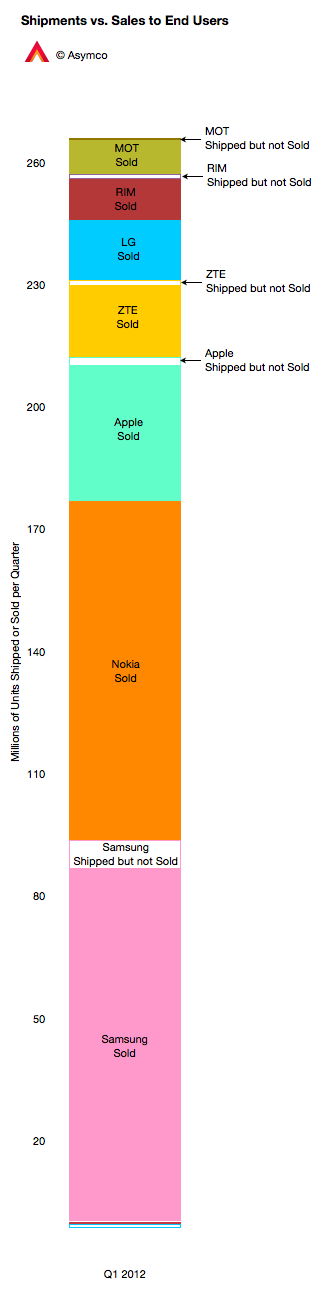
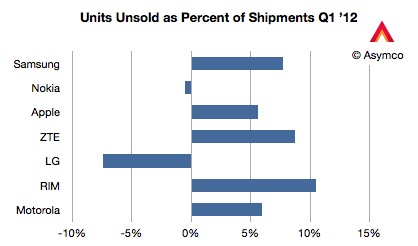
The chart to the left shows how the phone market looked for various vendors last quarter. I compiled the data based on Gartner's "sales to end users" and IDC's "shipments" data. Two vendors had higher sell-through than sell-in (Nokia and LG) probably because they were draining excess inventory. The others had channel inventory of between 5% and 10% of units shipped.
This ratio is shown below in a chart comparing the largest phone vendors.
Management is often rated for performance on this metric, as they should be, since it's a measure of operational skill. However, there are many factors that affect overall performance.
New product launches, windows of opportunity related to seasonal buying patterns, anticipating macroeconomic slowdowns, even natural disasters and legal challenges can affect this metric.
Understanding the overall market requires an appreciation of this distinction but also an understanding of all the other metrics listed above and what stories they tell.
---
Notes: My thanks to Michael Dediu for input on this discussion.
During my talk at the first Apple Investor Conference in January I said that I would pay very close attention to the Machinery, equipment and internal use software line item from its PP&E during the next quarterly report (it appears on Page 13 in the latest report).
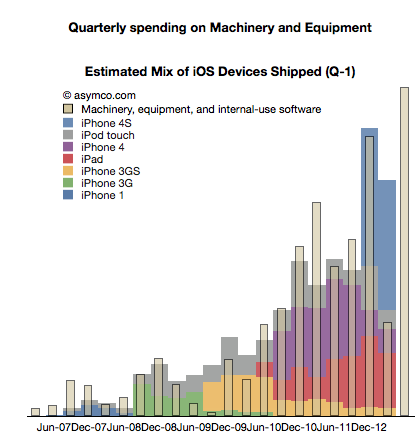
The reason I consider this important is because capital spending has provided reliable foreshadowing of iOS device production. This is itself because Apple invests in the equipment used in the manufacturing processes for its devices. The more spending on equipment, the more production capacity is brought to bear and the more units are produced. Since iOS devices tend to be supply constrained, the more units are produced then the more are sold.
The first quarter of the fiscal year saw a very small increase in CapEx which caused me to "backload" spending later in the year. By watching this spending, we can assess approximately when and for which products is investment allocated. If the spending happens early then we can anticipate an early update to the iPhone. If it happens late then we can anticipate a late release. So has the ramp-up begun as of the second quarter (first calendar quarter)?
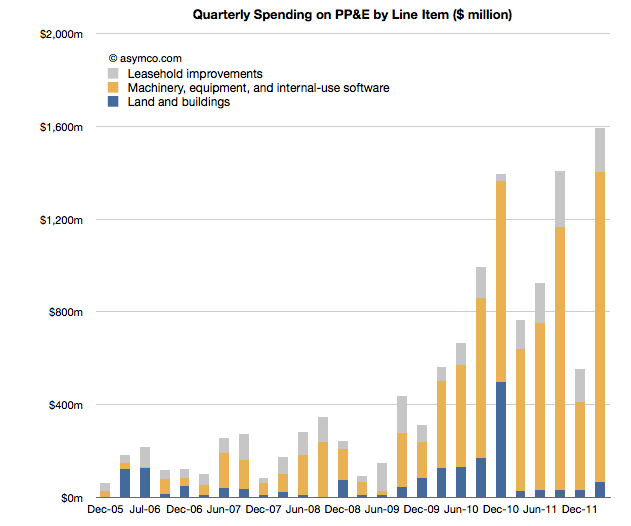
The following chart begins to give us the answer. It tells the story of spending by tracking the change in asset values:
Stripping out the Machinery and Equipment portion (in yellow above) and overlaying the following quarter's iOS shipments yield the following composite graph:
It would appear that there is significant acceleration into the second quarter. Is it something significant?
The increase in M&E is the highest for any quarter to date. Some of that is undoubtedly in service of the new iPad but some must also be the initial ramp-up for the new iPhone.
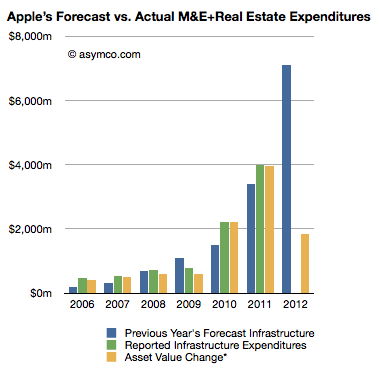
To gauge it further however, we need to look at overall expectations. The company also signals future production plans though its yearly report. As I concluded from October's 10K, fiscal 2012 production should double from the year before (as it did from the year before that and the year before that, etc.)
At $1.3 billion, the spending is substantial and a new record, but it does not make a big dent in the overall budget for the fiscal year. Half-way through the year, the total spending on M&E and Real Estate is still only 26% of the budgeted $7.1 billion. You can see the gap in the following chart. The yellow line needs to match or exceed the blue line after the next two quarters.
In order to reach its own expectations, the spending therefore needs to double from the current rate to at least $2.5 billion/quarter over the next two quarters.
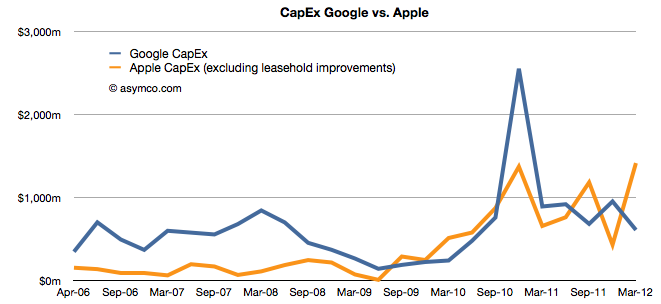
Such numbers are hard to grasp. They are unprecedented not only for Apple but for almost any comparable company. Just as a reference point, they will have to exceed the historic average CapEx rate for Google by more than 100%.
Regular readers will note that there is nothing new in this analysis. This is only an update in a continuing story. The pieces are in place for continuing the existing rate of growth.
My thanks to Bruno Ferrari of Exame magazine Brazil for asking the following questions. My answers were written two weeks ago on April 2nd.
Based on financial data of the first fiscal quarter, it is possible to confirm that 2012 will be the best year in Apple's history?
Actually, it's possible to confirm without looking at first quarter data. Every business line Apple has except the iPod is growing and is likely to keep growing during this year. That means that sales will increase over 2011, which was Apple's biggest year. You can see historic sales growth data here:
What are your predictions for the second fiscal quarter?
The iPhone number seems to be higher than consensus. It's aggressive but I'm basing my opinion on the launch of the iPhone 4S in China and the Chinese New Year and new carrier agreement there. Also the iPad will do quite well.
Do you think Apple will hold the iPhone 5 launch to September in order to open 2013 with an extraordinary result?
The next iPhone will launch between June and September. It might be earlier due to the 4S being the "wide end of the egg". Think of the iPhone as an egg rolling down the hill. There is a sharp end and a wide end and the speed of rolling depends on which end is down.
Besides the iPhone 5, which products that Apple could announce in 2012 you think may help them to maintain this extraordinary growth?
I think the iPhone is becoming more predictable. What I'm more curious about is what they will do with the iPod. Apple takes its brands seriously. I am watching the iMac, MacBook and iPod for clues of a re-fresh or replacement as they have aged.
Do you think we will see the “iTv”? Do you think it could be “the next iPad” of technology market?
Apple TV is in waiting mode. It's like an airplane circling, waiting to land. Something will happen but not sure when. Fundamentally, the opportunities are still there but the entertainment industry is very complex. The more complicated it is the more necessary for an entrant is to create a parallel version of it. That takes time.
The building blocks are all there however. See additional thoughts here.
If we analyze the growth of Apple in recent years, it is supported by the launch of new products, especially the iPhone and the iPad. Do you think Apple can lower your rate of growth in coming years since we don’t see in its roadmap new innovative products like a new smartphone or a new iPad?
New products created new growth but iterations of those products also created and will continue to create growth. Of all of Apple's products only one product is not growing today, the iPod. And that is after 10 years in the market and with a "dominant" market share. In addition, Apple has a lot of room to expand internationally and into enterprise and professional sectors.
I do agree that 100% growth is hard to maintain without new products. I believe there might be a few products still waiting for launch. TV is one area (along with game-based entertainment). New user interfaces might be enabling new categories of products. Intelligent assistance and companionship are open problems that software can solve but which have not been productized.
When do you think we’ll stop to see Job’s legacy in Apple new products. And what then?
Jobs' legacy is not in specific products but in how products are built. He also taught the importance of putting products first and markets second (this is, at its base, an artistic principle, not a commercial one). I think that legacy can last forever, if managed properly.
How do you analyze the dividends pay and the buyback made this month?
I wrote some thoughts about it here. I believe the impact will be mostly psychological for investors.
And finally, I was reading at Asymco some analysis of Apple’s share price. Do you think $600 is enough? Do you think in a 1 trillion dollars company in 2014 as some analysts are saying?
The share price depends on the psychology of people. I like to say that Apple is the same exact company today as the one that was priced at $78/share three years ago. When I look out the window of my office I see the same view year-to-year. When I look on my computer screen at Apple's financials I also see the same view year-to-year. I don't know how people can see Apple differently one year to the next. To me it's like looking out the window and seeing mountains instead of the sea.
But this is how markets behave. I can't say what the price will be. It may be $1000 or it may be zero. But the company will not change in either case. It won't change because it does not need to change.