Asymco

Asymmetric Intelligence

laptop

  1. Apple’s Custom Silicon Opens up Potential for a Cellular MacBook

    Nota Bene · 1 comment

    iPhone Air share of mix samples 2x iPhone Plus

    Explore how Apple’s C1X modem performs in the real world, with Ookla Speedtest data from Q4 2025 showing the iPhone Air matching Qualcomm’s X80 download speeds while setting new latency benchmarks.

    iPhone Air marginalizes competing slim form-factors. The iPhone Air has largely eclipsed the Samsung Galaxy S25 Edge globally, out-sampling it 3-to-1 in the U.S. based on Speedtest data, while the Edge remains statistically negligible in terms of adoption across European markets. South Korea remains the primary competitive exception, driven by strong home-market bias.

    In 2024, the iPhone 16 Plus was the clear laggard of the range, capturing a mere 2.9% of the launch mix. By sunsetting the iPhone Plus and replacing it with the design-centric iPhone Air, Apple more than doubled the share of this roster slot to 6.8%. This suggests that “Slim” as a category successfully resonates with a segment of the market that “Large” simply did not.

    Apple’s newest hardware cycle centered on a key question: could Apple’s first high-performance modem, the C1X, improve upon the original C1? Furthermore, could it match the industry-standard Qualcomm X80, without the thermal headroom of a “Pro” chassis. Despite its slim form-factor, the iPhone Air does include a vapor chamber to aid cooling, while its titanium frame also aids heat dispersion. Qualcomm remains a formidable incumbent with its X85 modem, which alongside MediaTek’s M90, will feature in newer Android flagship devices this year. Based on comparisons with the X80, our data suggests that Apple’s silicon has reached a critical maturity point, shifting the conversation from a performance gap to a strategic “equalizer” in real-world performance.

    Source: Ookla®

    NB: Lots of very interesting data in the source. Definitely worth looking at carefully. The conclusion is quite a bombshell…

  2. Running a data-center AI model on a MacBook

    Nota Bene

    Supercomputer

    Data-center AI model on MacBook: Why it matters for Apple

    The implications for Apple’s competitive position in AI are significant. The dominant narrative that Apple is behind — that Siri is a joke compared to ChatGPT, that Apple Intelligence is underwhelming, that the company missed the generative AI wave — could be misleading. Woods’s experiment suggests Apple may have quietly built the right hardware all along.

    Apple silicon’s unified memory architecture lets CPU and GPU share the same high-bandwidth memory pool. And that looks like precisely the design needed for the flash-streaming technique Apple’s own researchers described. No other mainstream laptop platform has this. So MacBook Pro isn’t just a laptop that can run AI on the side. It may be the most capable personal AI computer on the market.

    While competitors race to build billion-dollar data centers, the most powerful AI model you can run might soon be the one already sitting in your bag. Apple’s chip lead, combined with techniques like these, could make local AI on Mac — private, fast and free from cloud subscriptions — a genuine reality far sooner than anyone expected.

    As Willison noted, the quality tradeoffs are still being evaluated. But we can’t overstate the breakthrough in simply getting it running. The AI race might not be won in a data center after all.

    (via Cult of Mac - Your source for the latest Apple news, rumors, analysis, reviews, how-tos and deals.)

    Source: and it changes everything via Cult of Mac

    NB: In a recent interview I said that the original iPhone was very weak...

  3. Is Apple Pivoting?

    Research · 3 comments

    No.

    After the flurry of new product launches this week, I've read a few comments suggesting that this is a new strategy for Apple, or a pivot of sorts. The premise is that the 17e and the MacBook Neo are new low-end products that are intending to compete in markets that have been either uninteresting or unattractive to Apple in the past. Thus the company is now turning to either addressing affordability, memory costs or competitive pressures.

    The flaw with this argument is that there is an assumption that Apple segments its markets by price. The bigger assumption is that *all* markets are segmented by price. This is naive in the narrow and broad sense. If you ask me, any marketer that segments by price is not very good at their job.

    Remember, when you segment, you are making an explicit causal statement describing a purchase decision. In other words you are specifying the reason people buy a product. Price segmentation suggests that the reason for any purchase is that it reflects what the buyer can afford. Rich people buy expensive versions of a product and poor people buy cheap versions of the same product. The problem is that I've known many poor people who buy expensive things (actually most luxury brands sell to the less affluent) and many rich people buy cheap things (shunning conspicuity). The correlation is poor and the causation is actually nonexistent. Most importantly, you are missing the ability to create any new products because "new" simply implies higher or lower price.

    In the case of technology products, performance is also a factor. Here again, there might or might not be correlation between performance and price and customer income/net worth. Many people of means buy low performance products and many who are constrained financially will pay for performance. For instance, a non-wealthy aspiring YouTube influencer may very well purchase a high performance computer for video editing. And a millionaire pensioner could well opt for a MacBook Neo to communicate with grandchildren.

    So what is causation for technology, or, for that matter, any product or service? The answer that comes closest is the "job-to-be-done". What outcome is desired and circumstances are present when a purchase decision is made? What are the forces pulling and pushing the decider? It might be tempting to generalize and say that the young are poor but it would be wrong to generalize that they don't demand performance.

    So what does this mean for Apple's portfolio?

  4. Asymco Bulletin 003 - Mar 8, 2026

    Bulletin

    Asymco Bulletin is a digest of all the work we have published for the week ending Mar 8, 2026.

    Editor's Note

    It's been about a month since we launched Asymco One, and we are elated with the response from the community. Most recently, we held our first Office Hour, where we discussed the impact of Apple's latest products and answered questions in front of a live, Asymco One subscribers. We'd like to thank you for your support.

    We continue to make improvements in how we create and deliver our content. Please bear with us while we renovate our infrastructure. Should you have any issues or have questions, please reach us at contact@asymco.com.

    Finally, if you are on the fence about committing to Asymco One for a whole year, we've introduced the Asymco One monthly subscription. Try it today!


    Research

    Apple Services in Europe: Scale and Growth

    Since October 2023, Apple has been transparently reporting App Store user metrics across 27 EU nations, updating these figures biannually. This initiative spans a population over 450 million, offering a granular yet rounded down to the nearest million, potentially skewing figures slightly downward. To mitigate this undercounting bias, adjustments are factored into trend analyses.

    Through three sampling intervals from 2023 through July 2024, a market landscape emerges. The aggregated data hints at subtle shifts and growth patterns. →

    Stairway Update

    The iPhone 17e emerges as an incremental refinement—"the new low end, same as the old low end, but better." Apple has streamlined its lineup by axing the mid-memory "e" model, leaving us with two price points. This simplification might appear reductive, yet it strategically consolidates offerings while enhancing value. Notably, the base model's memory has doubled, a move that defies the prevailing DRAM scarcity narrative, suggesting Apple's adept supply chain management and perhaps a bit of market leverage.

    By trimming excess and boosting core features, the 17e exemplifies a nuanced approach to product evolution. →


    Nota Bene

    Apple introduces iPhone 17e → Apple's iPhone 17e offers double storage at the same $599 price, boosting profit margins. →

    Apple introduces the new iPad Air, powered by M4 → Apple's new iPad Air with M4 chip and increased memory boosts performance, enhancing versatility. →

    Apple announces new MacBook Air with M5 and MacBook Pro with M5 Pro and M5 Max → Apple's latest MacBook lineup offers the affordable, efficient M5-powered Air, the mid-range balanced performer, and the high-end, powerhouse M5 Pro and Max models for demanding professionals. →

    Apple unveils new Studio Display and all-new Studio Display XDR → Apple's Studio Display XDR boasts a 27-inch 5K Retina screen with mini-LED, 2000 nits brightness, and 120Hz refresh, ideal for professionals. →

    Say hello to MacBook Neo → Apple launched the MacBook Neo, a budget-friendly laptop with premium features, priced at $599, amid concerns over shrinking margins in the Windows laptop market. →

    Apple’s strategy is actually genius if you think about it → "Apple's strategic pivot to on-device AI could dismantle the AI boom by making models redundant and controlling the distribution gateway." →


    Office Hours

    Apple Q&A: Horace Dediu & Ben Bajarin discuss implications of Apple’s March 4, 2026 rollout →

    We convened our first Office Hours on March 4 to review Apple's latest releases, where we answered questions from a live audience of subscribers, and dissected Apple's latest and strategies. Topics covered:

    • MacBook Neo's Market
    • iPhone Pricing tiers
    • Apple's Margin Strategy
    • Siri and Apple's AI Strategy
    • Spatial Computing: Ergonomics, AI
    • Apple's AI and Spatial Computing
    • Cellular Modems and Laptops
    • Premium vs. "cheap"
    • Changes to Smartphone Market Dynamics
    • Product Cannibalization

    Full recording and transcript is available to Asymco One subscribers.


    Asymco One gives you full access to our research, analysis, and commentary. Subscribe with code BULLETIN for a discount.

    Feedback: Have questions or comments? Reach out to us at contact@asymco.com. We’d love to hear from you.

  5. Say hello to MacBook Neo

    Nota Bene · 2 comments

    hello

    Apple today unveiled MacBook Neo, an all-new laptop that delivers the magic of the Mac at a breakthrough price. Apple’s all-new MacBook features a durable aluminum design, a stunning 13-inch Liquid Retina display, the power of Apple silicon, and all-day battery life — all for the breakthrough starting price of just $599.

    "While many Chromebooks start lower than the Neo's $599 starting price point, there have been reports that disappearing margins could drive the cheap Windows laptop market into extinction by 2028." -Tom's Hardware

    Source: Apple Newsroom

    NB: The choice of a neo generation. MacBook Neo is a watershed event. First Mac with a…

    Join us at Asymco Office Hours, for a Live Q&A about Apple with Horace Dediu & Ben Bajarin.

    Today, Wed March 4, 3pm ET / 12p PT.

  6. Apple announces new MacBook Air with M5 and MacBook Pro with M5 Pro and M5 Max

    Nota Bene · 1 comment

    The high end, the low end and the middle end.

    The world’s most popular laptop gets even better with the incredible performance of M5, double the starting storage, and improved wireless connectivity, packed into a thin, light, and durable aluminum design

    The world’s best pro laptop raises the bar again with blazing-fast CPU and GPU performance, plus up to 2x faster SSD speeds and 1TB of starting storage.

    Apple announced M5 Pro and M5 Max, the world’s most advanced chips for pro laptops, powering the new MacBook Pro. Built using the new Apple-designed Fusion Architecture, M5 Pro and M5 Max feature an advanced CPU, a next‑generation GPU with Neural Accelerators, and higher unified memory bandwidth for a massive increase in AI compute.

    Source: Apple Newsroom MacBook Air

    NB: This week saw a blast of new products spanning fro…

  7. mini

    Research

    We want things to get better. The desire of improvement and an increase in performance is seemingly innate. The old adage goes that using the word "new" is the most effective way to increase sales. "New & Improved" if you want to be redundant.

    For many in technology, New & Improved means faster with more of every measurable parameter. More memory, more pixels, more storage, more bandwidth, more resolution. In devices, the tendency has been to communicate "new & improved" through an increase in screen size. We are subject to this to such an extent that phones are becoming unusable with one hand, stretching screens to the edge of the device and then wrapping those screens around the edges and then even folding the screens so that we have to unfold or unroll to use the product. Maybe an origami phone is in the works.

    But there is a parallel movement where "New & Improved" means smaller. This is the trend to miniaturization. Smaller is better because it's more portable, more conformable. Things sold by the ounce are better than things sold by the pound. The best computer, the best anything, is the one you have with you and having it with you is more likely if you can take it with you. So that which you can take with you is the best. QED.

    Apple has had a great history of miniaturization. The original Macintosh was tiny compared with personal computers of its day. It had a handle so you could take it with you. Apple pioneered laptops with breakthroughs in utility and form which made them truly portable. The iMac followed with a degree of integration and portability which made it iconic. Of course the iPod and iPhone were marvels when they first appeared.

    Over the years these products expanded into ranges with "good, better, best" type segmentation. The bigger being the best in performance and the smaller typically being the most convenient. However it seemed that the positioning was toward "bigger is better" for a lot of these products. The iPhones Plus, the iPads Pro, etc. As even the largest were getting thinner, the "mini" versions appeared to be neglected. You could get "good enough" portability from the larger products so why bother with the minis.

    It came to a head when the iPhone SE was discontinued last fall. Its demise felt like the end of an era. I always considered the SE as the "Steve Edition". It was the last design Steve Jobs was involved in and it pained me to see it go. With it seemed to go the positioning around "mini".

    But also last fall we saw a re-boot of another almost-forgotten mini: the Mac mini. For me the Mac mini was quintessentially Jobsian. I remember that he loved tiny products. His launch of the iPod nano was spectacular; reaching into his jeans' watch pocket to pull it out on stage. Holding the Mac mini up as if a tiny tray. Even the iPod shuffle was a quirky and lovable idea ((probably the first Apple wearable as you could actually pin it to your clothes)). And let's not forget the Mac Cube which made the iMac look huge.

    When the Mac mini was released last fall in Brooklyn with a huge spec bump and a thunderous reveal I thought something was up. When the MacBook Air was also out at the same event I felt that the company was signaling something. Perhaps a re-dedication to the low end.

    Also in parallel there is the wearables product line. The AirPods and the Apple Watch are jewelry. The essential qualities of products you wear are that they be small and beautiful. The smaller the better. Above all, both the Watch and AirPods are marvels of miniaturization. They pack so much in so little volume and that volume is shaped in such an aesthetically elegant way that they become daily essentials. I use my Apple wearables more than any other Apple product. Watch glances and time with AirPods exceeds the iPhone unlocks and iPhone use time. The fact that we don't even realize that the smallest Apple products are also the ones we use most is a testament to their conformability to us.

    So the Mac mini that is suddenly the Mac Maxi in performance, the MacBook which is an extraordinarily small laptop, the wearables success, all pointed in a direction that the iPhone did not: that "mini" was back.

    And now we see the iPad mini being re-launched with a huge spec bump. We should take the hint. The iPad mini is just charming. I have been trying it out for a few days and it has worked its way into my routine. I have an iPad Pro that I use on a desk to design presentations (and to deliver them). I use it with a keyboard for dealing with email on my lap or on a plane and take it instead of a laptop when going to meetings.

    But the iPad mini worked its way to my nightstand. It the one I reach for when on a couch. It is like an iPhone but when you're at home it's better than the iPhone because you can linger on that new true tone screen. It works well one handed. It now has Pencil support so it can be used for sketching and doodling.

    I am an analyst not a product reviewer but I sense how it fills a gap between iPhones and larger devices--in a home setting. Of course it can be used in an office. It is much easer to take with you if you carry a laptop in a bag.

    Fundamentally explaining mini is pointless. mini is something that is felt more than it is perceived. You can see the attraction of a tiny product only when you come face-to-face with it. In a picture it's hard to get it--there is no frame of reference. What draws me to a MacBook or to a mini or a Watch is when it's touched and held and carried or worn. The experience of the product is not how it works but how it works with you. You have to be part of it. It's not asking "Does it look good?". It's asking "Does it look good on me?" mini means more personal.

    That is the nature of mini and that is why I love the new minis: the iPad mini, the Mac mini, the MacBook (mini) and that is what I dare to hope that there is an iPhone mini coming.

  8. The Genealogy of the MacBook Pro

    Research · 18 comments

    I was an early user of the first MacBook Air. When that product was launched I saw in it something different: a dedication to a new measure of performance: thinness and conformability. The key image used to launch the Air was the laptop sliding neatly into an inter-office envelope. The implication was that the laptop does not need to have its own special "laptop bag". It could fit into any bag. Users would be able to slip it into all manner of new contexts. It sought to compete with computing non-consumption.

    The Air was launched by Steve Jobs in 2008 and was almost universally panned. It was considered underpowered and the dedication to thinness was seen as irrelevant to what consumers wanted. The stock price fell.

    The product went on to become Apple's most popular laptop. It still is. It grew the base of Mac users to over 100 million today.

    For the same reason, I was an early adopter of the newest MacBook Retina. The even thinner new MacBook was spectacularly thin. It was smaller than an iPad. It had no ports except one USB-C and a headphone jack. It required dongles for physical connections. It had a new keyboard that barely registered movement and it had a new trackpad that did not move at all but played mind tricks to make you think it did.

    As I used it over the last year, I became used to it. It was not my only laptop. I had an older 15 inch Pro, but over time I came to use the MacBook Retina exclusively. I thought I could not do "real work" with it but I managed. I got used to the keyboard. I got used to the trackpad. I got used to the need for a dongle to connect a display. But these challenges were more than offset by delightful improvements. I was delighted by the small power brick and the ability to use any USB power to charge it. I was delighted at the all-day battery life which meant I would charge it the way I charged my Phone: at night.  I was delighted that I could use it in places where I could not use a laptop: on any airplane tray, stowing it in the seat back pocket. And I no longer cared what bag I had for my computer. It did not make me productive by completing tasks more quickly. It made me more productive by letting me be do things when and where I otherwise couldn't. I love my MacBook.

    Now Apple launched a new Pro Mac laptop.The new Pro laptop has the same (slightly improved) keyboard as my MacBook. It has the same (larger) trackpad as my MacBook. It has the same (but more of) USB-C port.  It has something new called a Touch Bar which puts function keys into a touch screen but mainly it feels like a grown-up version of my MacBook Retina. It's faster too.

    Overall, the new MacBook Pro feels to me like an evolution of the MacBook of 2015. I remember at the time thinking that this baby MacBook is probably the wave of the future: the new keyboard, new trackpad, new thinness, new USB-C, deprecation of other ports. These required enormous engineering efforts and it would be silly to leave them on only one model. In any case, from where I was standing all these were "better". Not along the previous definition of goodness but along a new definition: making the computer more conformable and easier to put into use in more places. The very ideas that drove the development of the Air of 2008. Indeed the very idea that drove the development of laptops since the 1990s.

    What's fascinating to me from a product management point of view is that the groundbreaking new features which re-define the product's direction are not designed to trickle-down from the top-of-the-line to the bottom, but rather that they trickle-up. The low-end product gets the updates first and the the Pro products adopt them later.

    And we can even trace this genealogy of features through to an even "lower-end" product: the iPhone. The iPhone "ethos" of usability and conformability has permeated through to the Macs, starting from the lowly and advancing to the top of the range. The question of where Apple's design direction comes from can be answered: the bottom.

    All this is consistent with a strategy of "low-end evolution". A way to defend the low-end rather than abandon it in pursuit of what the most demanding customers are asking for. Rather, Apple seeks to incubate a new performance measure. Re-defining goodness.

    So is this new MacBook Pro a worthy successor to the MacBook Retina? My attention is riveted by the Touch Bar. It seems a completely new way of interacting but requires discovery and practice. What Apple has to achieve is allow the product to work well without it but also to allow users to evolve their experience with it. Over time we got used to trackpads instead of mice (many resisted the change). We got used to a different, small travel keyboard. We got used to new ports (HDMI vs. VGA) and we got used to wireless everything (it may seem easier, but remember having to always enter credentials vs. plugging in a cable).

    The touch bar is a new UI metaphor. It will take time but it is looking at me right now, winking.

  9. Forecasting Windows market share

    Research · 80 comments

    Last week Frank X. Shaw, VP of corporate communications at Microsoft stated:

     ... most of the people around me were using their iPads exactly as they would a laptop – physical keyboard attached, typing away, connected to a network of some kind, creating a document or tweet or blog or article. In that context, it’s hard to distinguish between a tablet and a notebook or laptop. The form factors are different, but let’s be clear, each is a PC.

    Actually this "admission" that iPads are PCs is not something new. Steve Ballmer made the same assertion in 2010 pre-iPad (though calling them slates). Arguably, the notion that tablets are PCs has been dogma at Microsoft for over a decade and Windows running on all form factors has been a strategic guiding principle.

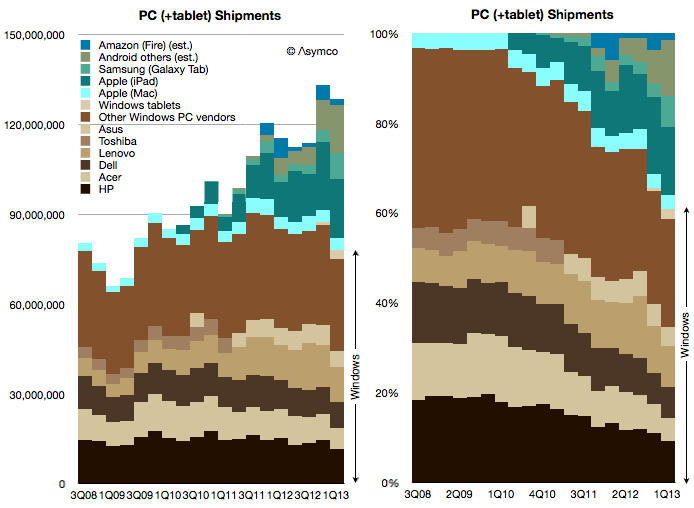
    Which is why I've always added the tablet data to the PC data to create a picture of the "personal computing" market. And this is what that picture looks like today:

    Screen Shot 2013-06-03 at 6-3-5.31.21 PM

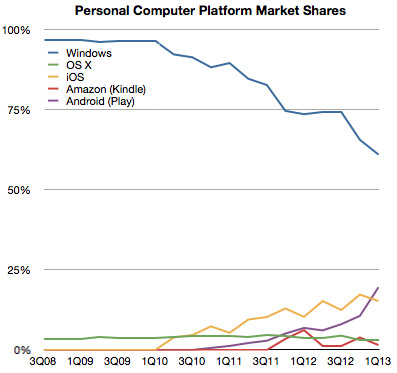
    Note how the share of various platforms has evolved over this brief time span:

    Screen Shot 2013-06-03 at 6-3-5.32.43 PM

    Seen this way, Windows has now reached 60% market share and it's likely to dip below 50% during this year. What happens beyond then is harder to imagine. If Windows tablets start growing as fast as the tablet market overall then Windows could stabilize in share. But if Android and iOS tablets follow their phone brethren in growth then it will be far harder for Microsoft to maintain share. But is that cause for concern?

    Not necessarily.

    The total computing market[1] is likely to expand to over 4 billion users with 1.5 devices per user in the next five years. That expansion implies that 20% share equals more than one billion devices, making such an ecosystem "good enough" for the average developer. It certainly has been good enough for Windows developers to date and they have kept hiring it throughout the new mobile app revolution.

    So even if Windows dips to only 20% of the world's computing market it will still be perfectly "viable" for some time to come.

    --

    1. I define the computing market as the total number of devices which have (a) a CPU (b) a broadband connection (c) a native application execution environment which is open to third party apps. This definition implies the presence of an "ecosystem" which is bound specifically to a platform.
  10. Bits v. Bytes: Follow the money

    Research · 68 comments

    Google announced its first computing product: the Pixel. It's not the first Chromebook but it is the first device which is uniquely branded as a Google product (Motorola notwithstanding.)

    It's a curious choice given that companies which have "crossed-over" from being service or software oriented to hardware have started with more "mobile" devices. Amazon launched the Kindle as a low-end product and gradually moved it up-market. Microsoft launched with the Surface tablet and then followed with the Pro version as a hybrid laptop/tablet.

    It's also curious since Google has spent years contributing to the development of mobile phones and tablets under the Nexus sub-brand. This was an approach consistent with earlier Chromebooks as well.

    But the Pixel is a high-end product. It's priced at the top of the range of what a laptop computer might cost (given the dimensions).  Perhaps it's part of a pattern where Google will hone its hardware skills toward releasing a phone or tablet it can call its own. Starting with a more traditional computer is "easier" than trying to deliver on the more demanding smaller form factors.

    And yet, the more obvious question is why would Google want to be in the hardware business? Isn't being a web-focused company implicitly suggesting that hardware is a commodity to be farmed off to perpetually impoverished and violently abused OEMs?

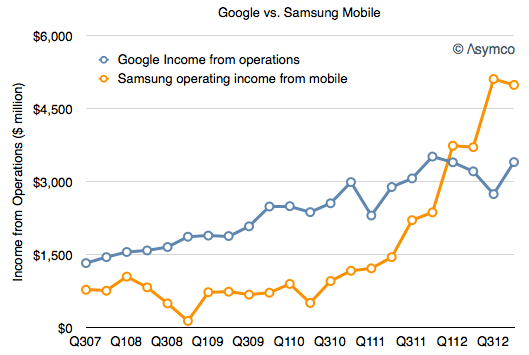
    The truth is quite different from this. Samsung currently makes far more operating profit from Android phones than Google does from all its operations. 

    Screen Shot 2013-02-22 at 2-22-3.47.58 PM

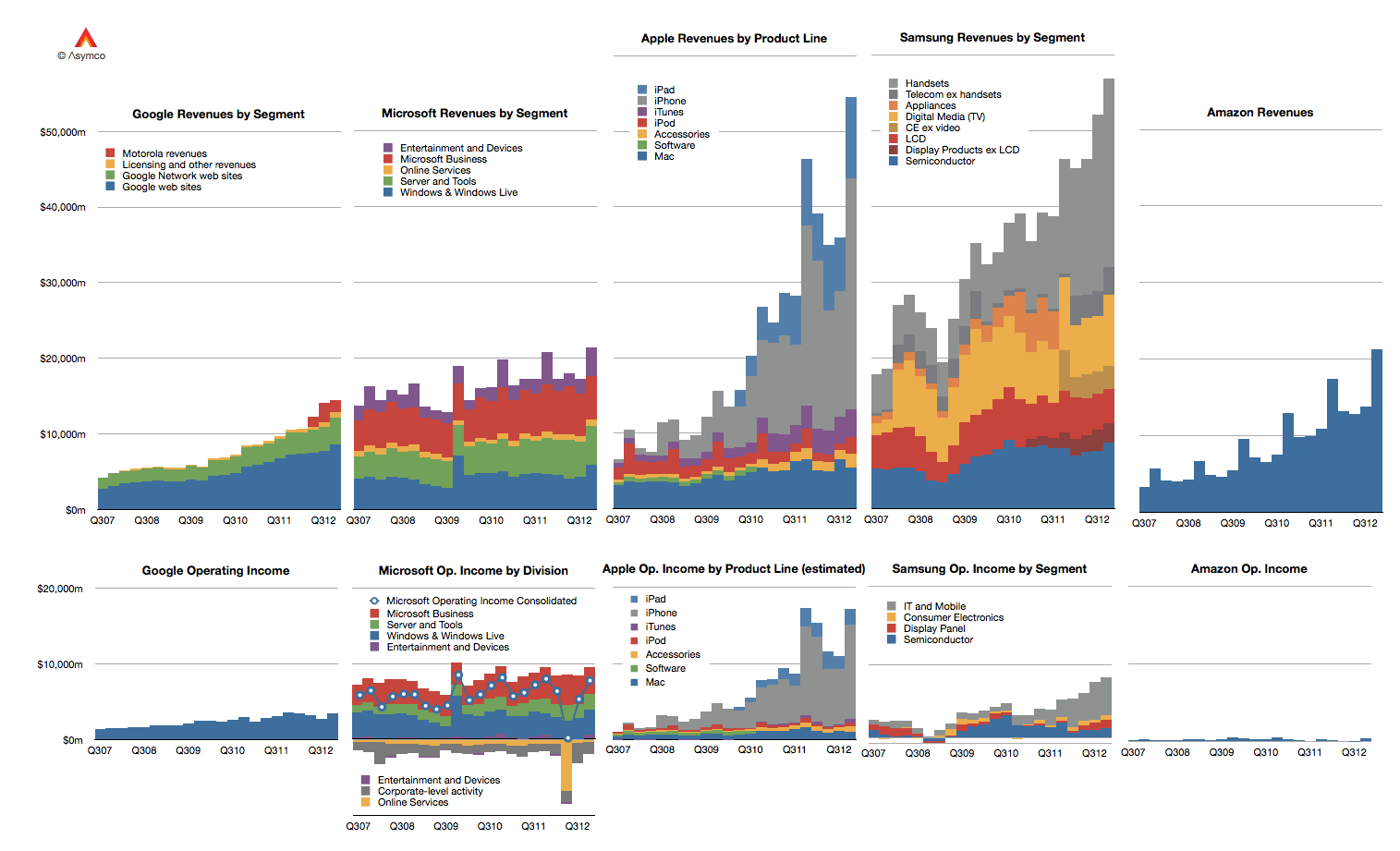
    When looking at the patterns of sales and profit capture for hardware vendors since 2007 the contrast is stark:

    Screen Shot 2013-02-22 at 2-22-3.32.46 PM

    Apple and Samsung tower over the fortunes for software only Microsoft or service-oriented Google and Amazon. Although all companies are growing, the value, as defined by the buyer, resides in the whole product. Putting aside all the theory, the numbers are staggering. Google, Microsoft and Amazon are skimming profits but they are not particularly efficient at profit generation vis-a-vis the integrated Apple (and increasingly integrated Samsung.)

    The question is which of the companies illustrated above will prosper from the value chain evolution under way?

  11. The real threat that Samsung poses to Apple

    Podcast · 430 comments

    [The following is a post written by James Allworth.

    James is the co-author of How Will You Measure Your Life?. He has worked as a Fellow at the Forum for Growth and Innovation at Harvard Business School, at Apple, and Booz & Company. It follows and builds on a discussion we had on the 56th Critical Path podcast.

    You can connect directly with James on Twitter at @jamesallworth -ed]

    A lot of ink has been spilled in the wake of the recent Apple Samsung patent disputes, and the legal wars see no sign of abating any time soon. The rise of Samsung's phone business has been meteoric, and Apple is right to be concerned. But the real threat that Samsung poses to Apple has very little to do with the copying (or not) of Apple's designs. The lawsuits have simply been a convenient (if expensive and risky) way to attempt to quash a threat that is of Apple's own making. While there's no doubt that Google has played a key role in Samsung's success by handing out a free mobile operating system to pretty much anyone who wants to build one — it is actually Apple, more than any other company, that is responsible for Samsung's present success.

    How? By outsourcing as much work to Samsung as they have. And it's impossible not to wonder whether Tim Cook's announcement yesterday on bringing back Apple's manufacturing to the USA is the beginnings of an attempt to rectify the problem.

    But first, I want to establish why copying is actually less of a threat to Apple than you might think. Daring Fireball's John Gruber wrote last year on what he termed "The New Apple Advantage". Like most people who appreciate Apple and its products, the starting point for Gruber's appreciation of Apple is its design — he says as much in the article. But the realization that Gruber has in the article on Apple's true competitive advantage is what's really interesting:

    So let’s be lazy for a second here, and attribute all of Apple’s success over the past 15 years to two men: Steve Jobs and Tim Cook. We’ll give Jobs the credit for the adjectives beautiful, elegant, innovative, and fun. We’ll give Cook the credit for the adjectives affordable, reliable, available, and profitable. Jobs designs them, Cook makes them and sells them.

    It’s the Jobs side of the equation that Apple’s rivals — phone, tablet, laptop, whatever — are able to copy. Thus the patents and the lawsuits. Design is copyable. But the Cook side of things — Apple’s economy of scale advantage — cannot be copied by any company with a complex product lineup. How could Dell, for example, possibly copy Apple’s operations when they currently classify “Design & Performance” and “Thin & Powerful” as separate laptop categories?

    This realization sort of snuck up on me. I’ve always been interested in Apple’s products because of their superior design; the business side of the company was never of as much interest. But at this point, it seems clear to me that however superior Apple’s design is, it’s their business and operations strength — the Cook side of the equation — that is furthest ahead of their competition, and the more sustainable advantage. It cannot be copied without going through the same sort of decade-long process that Apple went through.
    (emphasis mine)

    The argument is beautifully made. The design part of Apple's equation is to their ability to redefine new industries as they did with the iPhone. Whether they go after the TV market next, or something else, it's this integrated design component that will be crucial to their initial success. But compared to the business side of Apple, design actually generates much less sustained strategic advantage in any one product category, once performance in that category becomes "good enough". The tech industry has always revolved around copying. Once folks work out how it's done, everyone piles on. And at that point, it becomes much less about design than it does about how you operate your business.

    It is the last part of the Gruber quote that really drives things home. "It cannot be copied without going through the same sort of decade-long process that Apple went through". He's right — it's very hard for a competitor to outright replicate what Apple has achieved without going through all the same steps. But it got me thinking of a concept — and a related story — that I learned from someone I was fortunate enough to have as a teacher: Clayton Christensen. Perhaps a competitor didn't have to copy Apple.

    What happens if Apple had already taught them?

    Christensen first wrote about the dangers of outsourcing in The Innovator's Solution, explaining how seeking to maximize efficiency by employing third party vendors to do the "low value-add" work for you can be a lethal strategy. In the Solution, Christensen and Michael Raynor gave the example of two fictional corporations—"Component Corporation" and "Texas Computer Corporation". I had the good fortune to work with Clay on his most recent book, How Will You Measure Your Life?, and we recount a similar story; only without any of the players being disguised. The story is that of Asus and Dell, and how by outsourcing its work—starting with just basic circuit boards—Dell equipped a competitor:

    Asus came to Dell and said, “We’ve done a good job fabricating these motherboards for you. Why don’t you let us assemble the whole computer for you, too? Assembling those products is not what’s made you successful. We can take all the remaining manufacturing assets off your balance sheet, and we can do it all for 20 percent less.”

    The Dell analysts realized that this, too, was a win- win...

    That process continued as Dell outsourced the management of its supply chain, and then the design of its computers themselves. Dell essentially outsourced everything inside its personal-computer business—everything except its brand— to Asus. Dell’s Return on Net Assets became very high, as it had very few assets left in the consumer part of its business.

    Then, in 2005, Asus announced the creation of its own brand of computers. In this Greek-tragedy tale, Asus had taken everything it had learned from Dell and applied it for itself. It started at the simplest of activities in the value chain, then, decision by decision, every time that Dell outsourced the next lowest-value-adding of the remaining activities in its business, Asus added a higher value-adding activity to its business.

    There are two sides to this story: the part that relates to Dell, and the part that relates to Asus. Dell, in its quest to maximize its financial efficiency, continued to outsource way beyond manufacturing components and assembly. They outsourced a long way up the value chain. But there's also the side of the story that relates to Asus — a small components manufacturer that was, in effect, nursed to success by Dell. The extent of the schooling delivered by Dell to Asus was pretty profound, given how far up the value chain Dell outsourced its operations.

    But here's a question: at what point did Dell seal its fate? When was it that Dell had outsourced enough that Asus, with a desire to simply get out of the low-value work, could have made it all the way to the point that it did? I'm beginning to wonder whether just component development and assembly was enough. In the case of Samsung, it seems that everything else they needed to learn, they did by entering the emerging market, which Apple has largely left alone.

    Now, it's obvious that there are some very clear differences between the decisions that Apple have made in terms of outsourcing, and the decisions Dell have made. Dell outsourced its business all the way up to the design of its products. In many respects, Apple is doing the opposite — going so far as to even bring chip design in house. Horace has done some fantastic work detailing the extensive amount of investment Apple has made in its supply chain and it's clear that they've spent a lot of money investing in equipment used in production.

    But there's also no denying that Apple has begun to rely extensively on a network of suppliers across Asia.

    It's when you start putting the two arguments together that you realize that Apple may have a more serious problem on its hands. I want to again recount the final two lines of Gruber's argument:

    It’s their business and operations strength — the Cook side of the equation — that is furthest ahead of their competition, and the more sustainable advantage. It cannot be copied without going through the same sort of decade-long process that Apple went through.

    He's right — generating that scale requires a long gestation period — one that Apple went through. And it can't be copied without significant time and effort on the part of a competitor. But there's one big implicit assumption here — that suppliers won't turn around and start developing their own offering. Because when Apple went through this transformative process, where the design whittled down the broad range of offerings to just a few, and they generated the scale on the business side that accompanied that — they weren't actually the only one to go through that process. Apple's partners — their suppliers — went through it with them. And they've got very big, and very good at what they do. Samsung, obviously, is among those partners.

    Now, the response I often hear to this line of reasoning is: Apple hasn't outsourced anywhere near as much as Dell has. How are the situations analogous? But I think it's actually the wrong question. Instead, the question is: has Apple already outsourced too much?

    For all intents and purposes, we're at a level of maturity in the smartphone market where I believe design — particularly on the hardware side — has largely become commoditised. Performance is now "good enough". Whereas it was not so long ago that consumers sat on the edge of their seats to find out what the new iPhone had to offer ("please, fix the battery life", or "please, make it faster") the recent release of the iPhone 5 seemed not to generate the same intense reaction. Now, I'm not saying it won't sell well — in fact, it will probably become the best selling phone of all time — but people aren't making these decisions based on huge design differences between the devices. The basis of competition has shifted. HTC recently learned this the hard way when it introduced the One X — a phone that, to the critics, at least, was considered the best Android phone available — "a masterpiece",  "one of the best mobile devices I've ever used". Yet it has been absolutely crushed in the marketplace by Samsung.  How? Well, Samsung used its business scale to, as Horace put it on Twitter, "invite operators to a better party with an eye-watering marketing budget". This has nothing to do with Samsung making a better phone (they probably didn't), or Samsung copying Apple (indeed, HTC may have just done a better job of copying Apple). Instead, it has everything to do with the fact that Samsung has had its business sucked along in Apple's slipstream.

    There's another way of seeing just how deep the problem lies. Jobs promised "thermonuclear war" on the copied devices, and so far, the biggest target of Apple's many legal warheads has undoubtedly been Samsung. Getting a $1 billion judgement certainly proves Apple was serious about it. But doesn't it seem strange to you that the target of such a devastating strategy on the legal side, just so happens to be… one of the most important suppliers for Apple's new phone?

    The problem that Apple is facing right now has nothing to do with their designs being copied. There is a long history of copying in the tech industry; patents being deployed in lawsuits by giants often signify desperation more than anything else. Rather, the problem that Apple faces is that it now is going up against at least one competitor that has been a beneficiary of the scale that Apple has achieved on the business side. Samsung has clearly demonstrated that, like Asus, it was not satisfied being a low-margin ODM — of doing all the menial work while somebody else made the big bucks. Suing Samsung over Android patents isn't going to change that — if Google's operating system gets too expensive to use, there'll be a switch made to Microsoft. Or to another operating system altogether. It doesn't really matter, because design in the smartphone space has been commoditized. It's good enough. Manufacturers are now creating performance that most consumers aren't able to absorb. Instead, as we've moved into a world where performance is now "good enough", the world has flipped into one where it's the business side — operational scale — that matters most.

    Apple have taken steps to minimize the ability of competitors to duplicate their business advantage. There's a great post here on Quora describing how Apple has used its supply chain as a competitive advantage and how competitors end up subsidizing Apple's use of the technology. But the approach of "locking in" key new technology so nobody else can get them works best in a world where consumers need more performance from their devices — a world is rapidly slipping away.

    So, what's Apple got to do? In so much as it is able to trust its suppliers of key components not to become competitors, it can continue to use them. But where it can't, or where those suppliers have already become competitors, it has only one sensible choice — replace them. It has two choices here: the first (and obvious one) is with another supplier. But that risks the same thing happening all over again — Apple nursing another supplier into a competitor. The second choice: for components and services that are critical to maintaining competitive advantage in the markets which Apple plays, Apple needs to build the components themselves.

    Most companies wouldn't be in a position do that. But Apple is almost already there. I also hear that there might be a country out there with relatively high unemployment rate, looking for some jobs to be brought back home. Funnily enough, it seems that's just what Tim Cook is doing right now. This approach might just be a good way of on-shoring some of those untaxed offshore profits (I imagine the tax benefits for building a few factories in the US would be quite high), all the while taking away business from competitors — both current and future.

    But there's one question that still remains. In the instance of the threat that Samsung poses to Apple: is it already too late?

    –

    Looking for more information on the renaissance of production and its effect on the technology industries? Then come to Asymconf and take part in the debate.