Asymco

Asymmetric Intelligence

Lenovo

  1. The biggest surprise of the MacBook Neo

    Research · 2 comments

    Remembering the PC market

    Almost 10 years ago I said "Managing the Mac product line must be one of the most challenging problems at Apple. That may not be obvious given the product’s success." I pointed out that although the company grew the Mac into a redeemed and prosperous platform, "The big change in computing has not been a growing Mac vs. declining PC. It has been a huge surge in mobile device use vs. a decline in PC use overall."

    It's time to revisit this observation.

    First, a status update:

    • The Mac is in its 32 42nd year of market presence. A longevity that is (still) unmatched by any other PC maker.
    • Apple reached a top five four position in the ranking of PC vendors. This was achieved far along in the evolution of the market.
    • With about $23 $33 billion in revenues per year, Apple places among the top four three PC vendors in terms of revenue.
    • With an estimated $5.5 $13.8 billion in operating margin Apple is the most profitable PC vendor, capturing over 60% of the available PC hardware profits.
    • The product has retained an average selling price of over $1200 ($1400 last year) for at least a decade. At the same time the average pricing of Personal Computers has more than halved.
    • Volumes increased by about 20% over a decade.

    The overall picture of the market is shown the following graphs. First, the overall quarterly shipments.
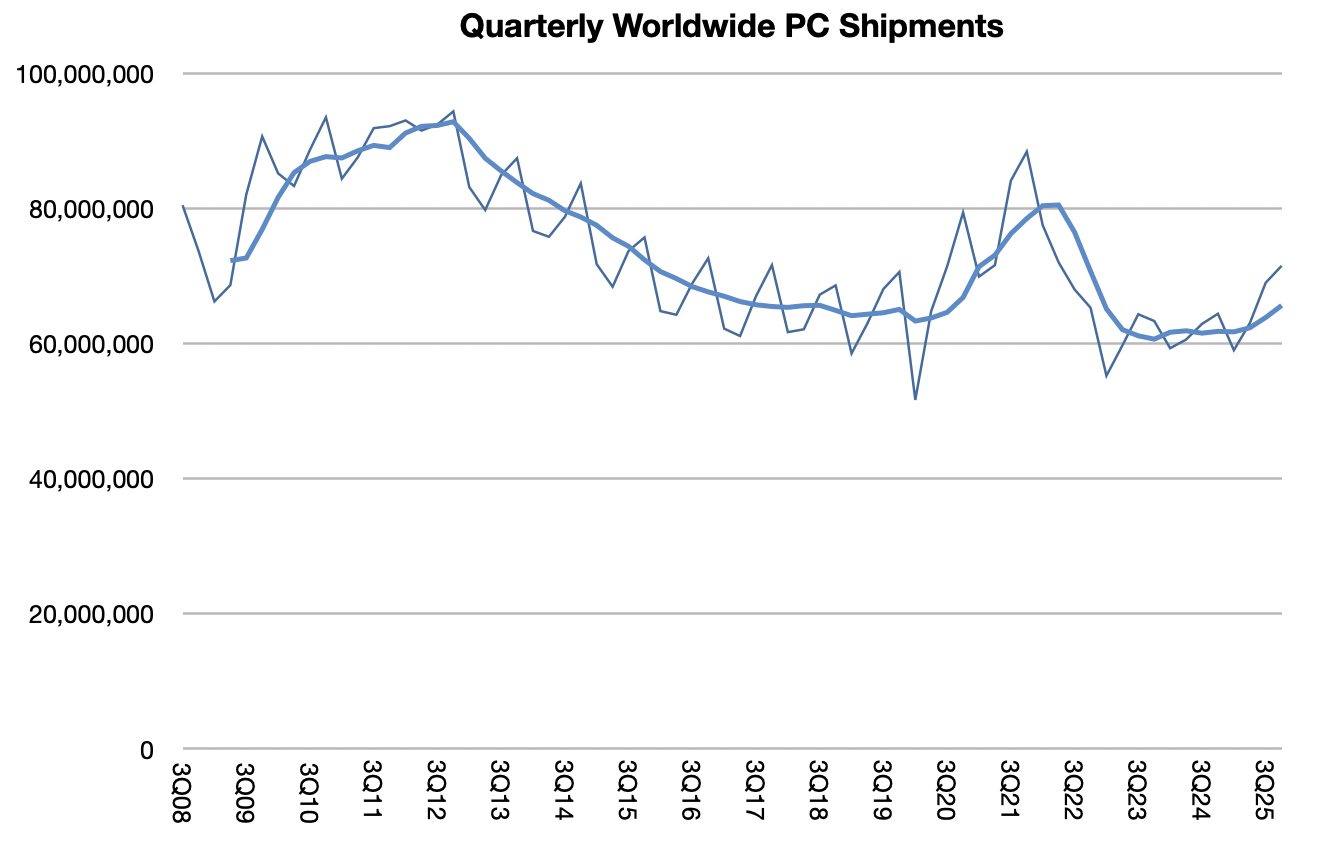
    Note the Covid-era surge during 2020 and 2021 but overall decline from peak in 2012. Yearly shipments were 262 million in 2025 vs. 371 million in 2012. The install base of users is largely unchanged. Microsoft has cited "over 1 billion" to 1.4 billion monthly active devices, with figures varying between official statements. My estimate has been 1.2 billion PC users with an additional 250 million Mac users, more about this later.

    The shipments data provided by Gartner over the last 17 years is shown below:
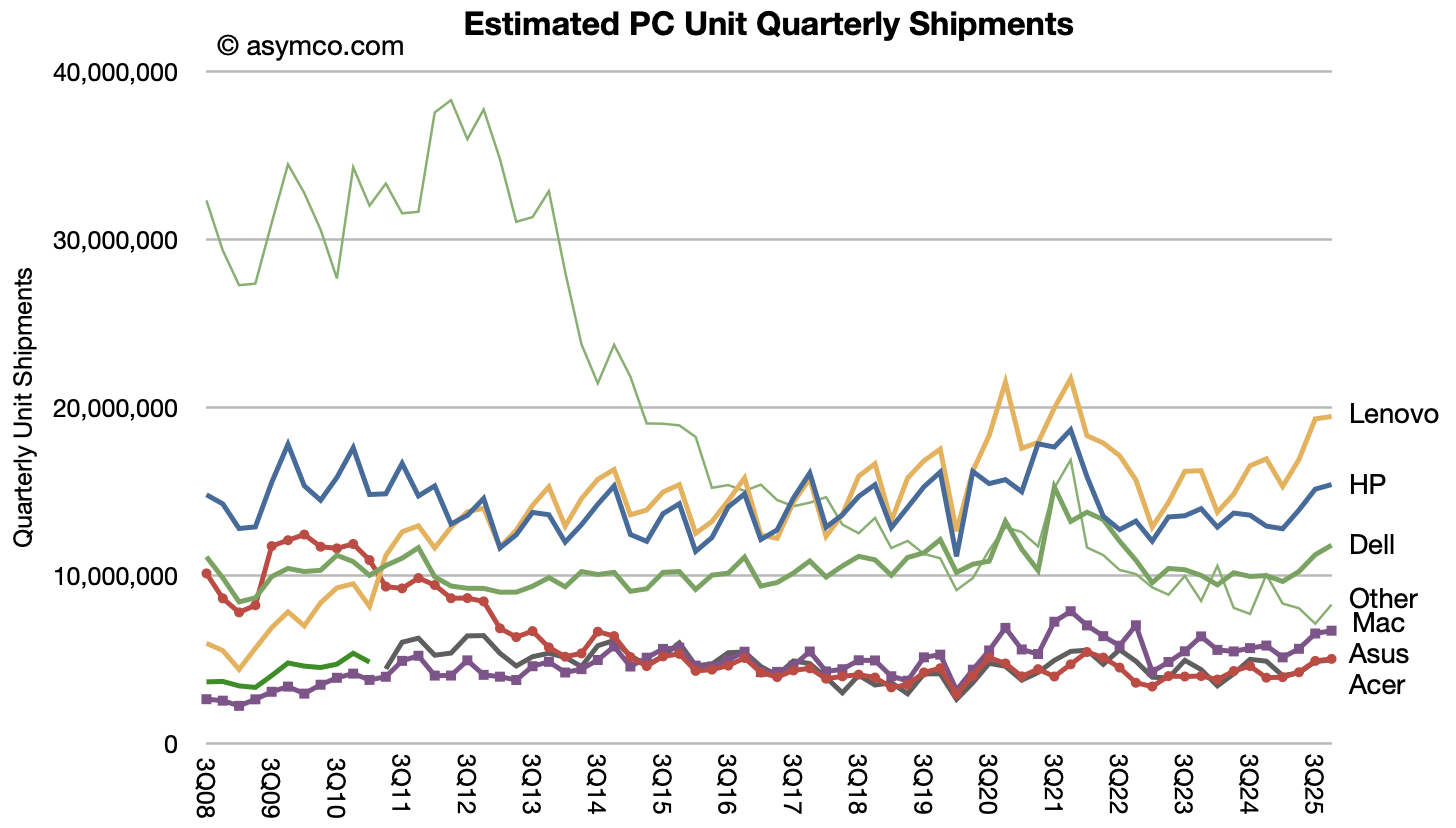
    Notable are the declines in "other" vendors and the gains from Lenovo and Apple. Broadly speaking, "other" are assumed to be mostly consumer markets and that has either declined or been captured by Mac with consolidation around Lenovo. Lenovo, HP, Dell are likely to maintain enterprise accounts serving large customers and that has been a steady but low margin business for decades.

    Mac has grown to fourth place but still a way to go to third place Dell. Apple may overtake "other" combined in a year or two.
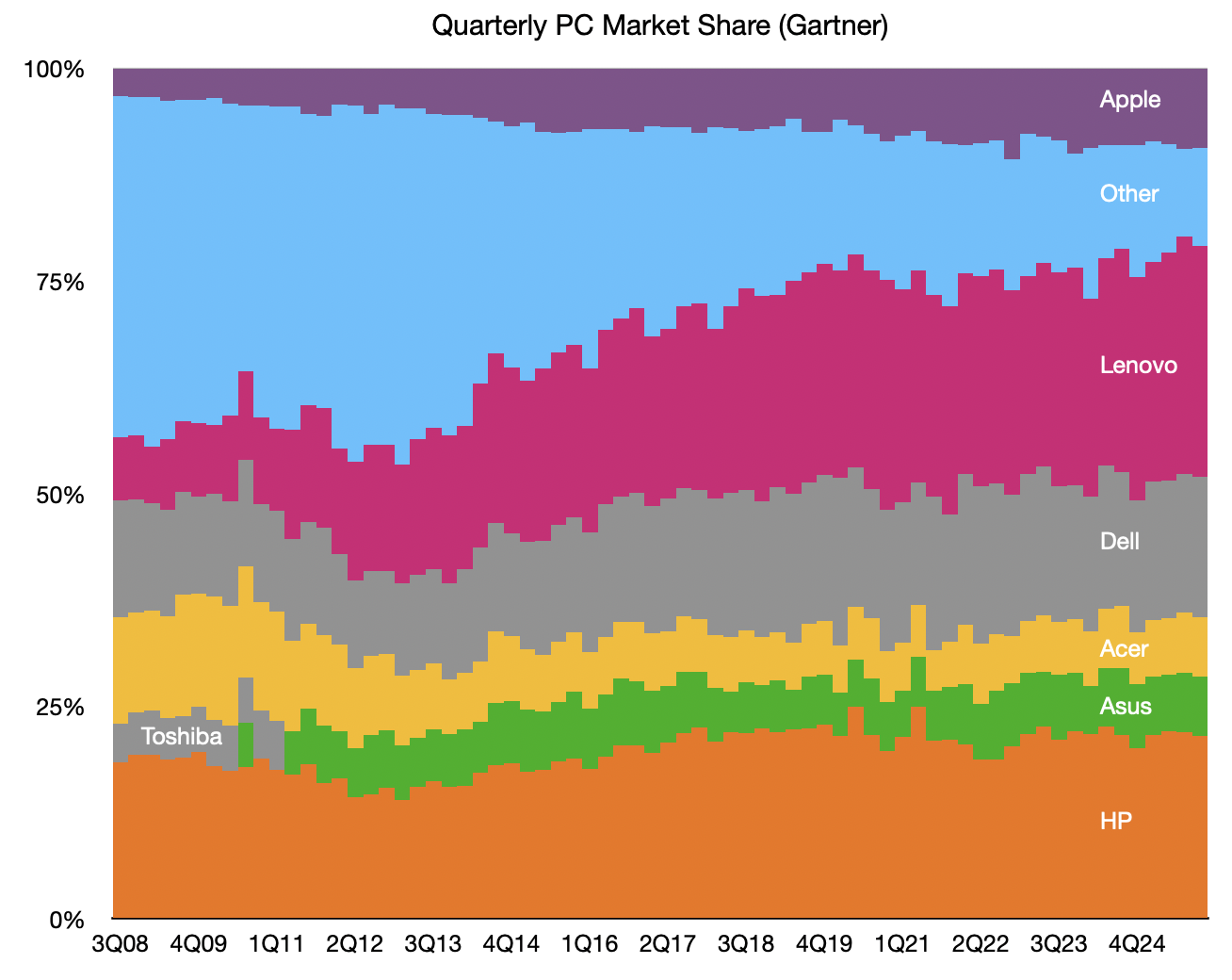
    Quarterly PC Market Shares by Vendor

    The market share data shows how "other" has been squeezed between Lenovo and Apple while the other players have largely held steady. Acer and Asus somehow managed to survive.

    So what does this mean for the future? What is Apple's strategy with the MacBook Neo. Or for that matter, for Studio and iMac and Mac Mini and MacBook Air and MacBook Pro?

    The Neo was such a surprise for many given its incredible price/performance ratio and the overall quality and affordability (and distribution potential). I've read many reviews suggesting it will "disrupt" the market and that Windows PCs are just no longer competitive.

    Will the MacBook Neo move the needle? Will it take share from the Windows world (or for that matter from the Chromebook and even iPad?)

    One more thing: Apple's sales of about 24 million Macs for a base of 260 million users implies a life span for Macs of nearly 11 years. However, all the other PCs sold add up to 238 million for a user base of 1.2 billion. That means the life span for the non-Mac PC is only 5 years.

    This is, of course, reflected in the price difference but with the MacBook Neo, the potential for a 10 year old life for a $500 laptop puts the Neo price at $50/yr or 14c/day. Based on data for 2025, the average selling price of a new Windows PC is estimated to be $600 to $900 for consumer models. At $700 for a life span of 5 years makes the PC cost $140/yr or 38c/day.

    This means that the average PC is more than twice the cost of the MacBook Neo. Now that is a surprise.
  2. Faster Followed

    Research · 76 comments

    Samsung's smartphone ascent was breathtaking. From having essentially zero market share in the category in late 2010 to becoming the largest vendor took less than two years. In doing so it grew to become the largest phone vendor, smart or not--a goal which eluded them during the previous decade of effort. Samsung went on to capture not only the lion's share of unit volumes, they also took almost all the profits in the Android mobile phone market.

    And in a market filled with competitors. Literally hundreds of vendors and thousands of products were available at every conceivable price point. Samsung did away with HTC, LG, and Motorola. HTC, the first Android vendor (and first to market with Windows Mobile), Motorola, Google's launch partner in the US and "Droid" brand partner (and future owner).  Google's own Nexus products. Samsung Galaxy ruled them all.

    Galaxy swamped the Chinese market and the Indian market, the largest in the world. They were so powerful that they were singled out both by Microsoft and Apple for IP royalties.

    All within two years or the average life-span of one smartphone.

    But something went wrong in 2014. Growth in shipments suddenly stopped. This was not a problem with the overall market, which kept growing. The slowdown did not affect other vendors, especially the up-and-coming Lenovo and Xiaomi and the second and third tier vendors whose names are  known only in the local markets they serve.

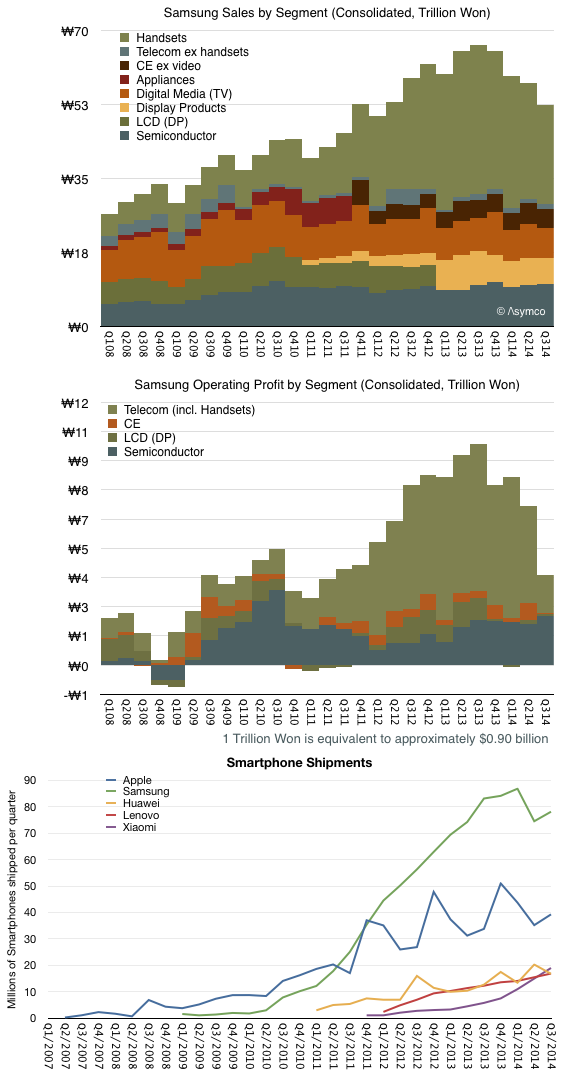
    The result of this slowdown is shown in the following graphs:

    <>

    Screen Shot 2014-10-30 at 10-30-4.11.19 PM

    Note how the wobble in units shipped was foretold by slowing revenues and an even more profound effect in profits. Peak revenues and profit occurred in Q3 2013 while volumes continued to grow until Q1 2014. Even in the last quarter, shipments are at near year-ago levels. Profits however have dropped to 2011 levels.

    At the same time, Apple shipments continue to grow as do those of Lenovo, Huawei and Xiaomi. Xiaomi in fact is growing in a trajectory eerily parallel to that of Samsung from 2010. It just hit the same level of volume that Samsung had in Q2 2011. And Samsung had been making phones for decades while Xiaomi is barely two years old.

    Having seen a boom/bust rise/fall pattern with other vendors (e.g. Nokia and Blackberry) it should behoove us to ask what are the causes of success and failure in this business. Samsung management suggests that they perceive speed of action, product mix/portfolio choices and hardware experimentation are the keys to their success.

    However, competitors which are rising rapidly (at the expense of Samsung) are not acting in the same way. Xiaomi is patterned as a Chinese Apple, offering design, brand, attention to detail and software as differentiation. Lenovo is building on its computing roots and expanding with acquisition. Huawei and ZTE leverage networking business and operator relationships.

    The crisper answer to causality may be that the market is bifurcating into an "upper" market where new jobs-to-be-done are being explored with integrated offerings (Apple and Xiaomi) and a "lower" market which is in the throes of low-end disruption. Both are competing with non-consumption though the upper market is service non-consumption and the lower market is feature non-consumption.

    Samsung is stuck right in the middle ((Just like Nokia was.)) It defines itself on the basis of what exists. It competes only within a defined market and positions itself agains existing products. They claim to be "better" than the competition and make the point loudly with their advertising. However, being better is never a solid foundation. At some point you'll be either good enough or someone more agile will be faster than you.

    At some point the fast follower exposes themselves to being faster followed. Better to find new lands to conquer.

  3. IBM and Apple: Catharsis

    Research · 62 comments

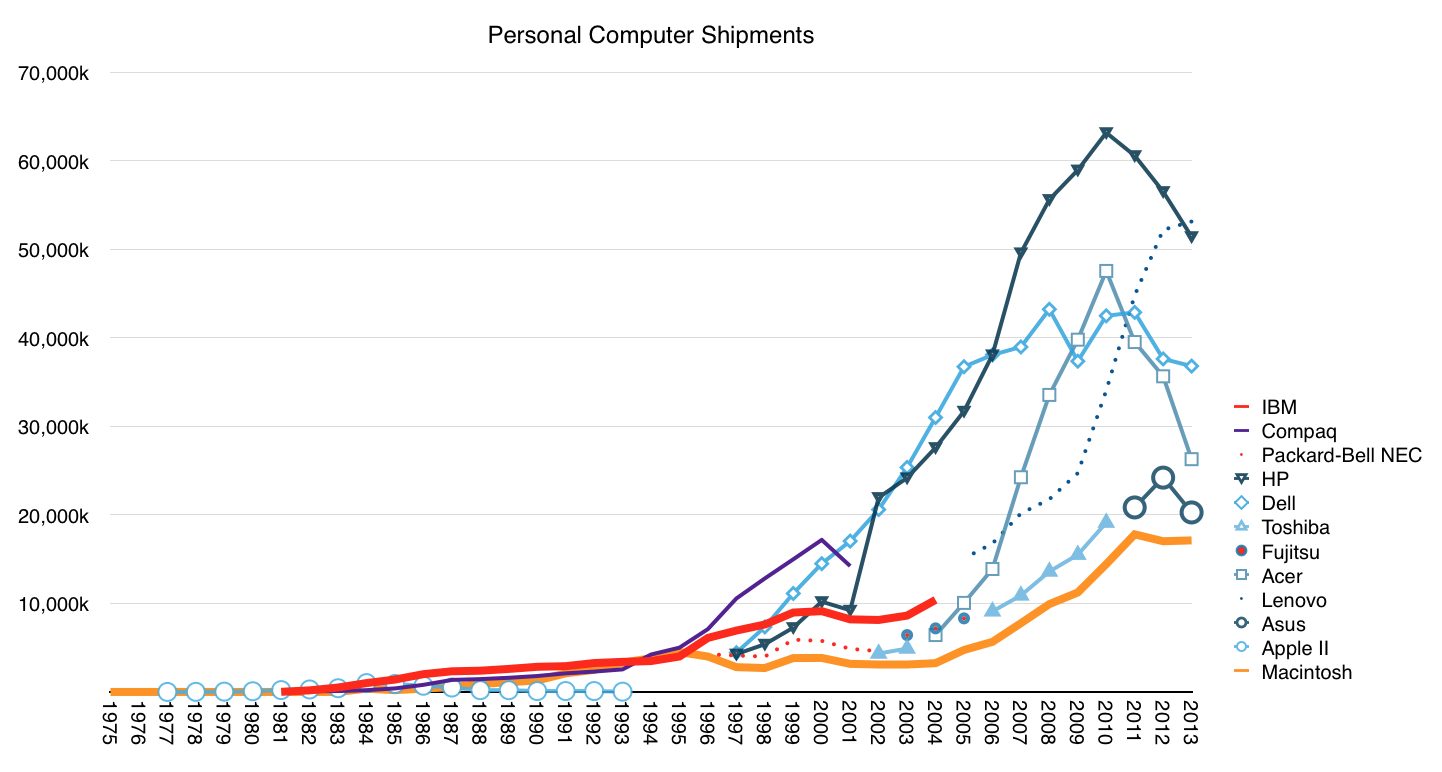
    IBM did not invent personal computing but their "PC" became synonymous with the category. Having entered the market in 1981, the IBM PC quickly became the top selling brand. From 1984 to 1993 IBM sold more PCs than any other vendor, conceding the spot to Compaq which remained on top only until 2000. No PC vendor remained at the top of the sales leagues longer than IBM. HP had the second longest run but that run was broken last year as Lenovo (who acquired IBM's PC business) surged.

    Screen Shot 2014-07-16 at 4.19.11 AM

    As the graph above shows, the period of time when IBM was dominant was characterized by far lower volumes. In 2004, the year IBM exited, they sold about 10 million units. ((as the graph shows, if we consider Lenovo as taking over from there, they did a very good job extending the legacy.)) It was a decent performance but one that did not keep up with the Dell and HP/Compaq race to the bottom in pricing and subsequent rise in volumes.

    However, throughout its position of strength, IBM was a reluctant PC maker. IBM never controlled the PC platform the way they had controlled their mainframe and mini-computer businesses. Their falling out with Microsoft over OS/2 and their attempts at differentiating with the PS/2 architecture show how uncomfortable the situation was. Their exit in 2004 must have come as a relief and, in retrospect, they should be congratulated for having exited the market well before it began deteriorating. First came pricing and margin collapse and later total volumes began to decline. Most of the remaining vendors are today in various states of distress. Lenovo is growing but incumbents like Dell, HP and entrants have come and gone (Fujitsu, Sony, NEC, Toshiba). Potential disruptors  like Asus and Acer have found no long-term success with PCs.

    This is because without control over the platform, PC hardware is nothing more than a commodity, with negligible margins, intense competition and an inability to control one's destiny.

    One company making computers did manage to control its destiny. By continuous refinement, the Macintosh survived and even thrived as the market pivoted toward mobility (and hence requiring integration that values design).  Indeed, Apple now ships over 17 million Macs a year. More than either IBM or Compaq did at their peaks. It's not in the top five globally but has a very profitable niche. ((It's very likely that it captures more operating profit than the top five vendors combined.))

    As a matter of fact, through 2013 Apple shipped a total of 156.5 million Macs,  50% more than all IBM PCs ever shipped. Apple also shipped more than twice as many iPads and five times more iPhones. And it's not just popular with consumers. With iOS Apple manages to reach 98% of Fortune 500 companies and 92% of Global 500.

    At the same time, even though IBM exited the hardware business, it remained a powerful force in computing. IBM pivoted to primarily being a service company with a vast client base and increasing global reach. It essentially moved up the value chain to become an integrated services provider to business customers. IBM's reach in breadth and depth of services is extraordinary.

    This dramatic turnaround–Apple moving to a device leadership position and IBM moving to a service leadership position–created the conditions for today's announcement of a strategic partnership--an event which is astounding to those who witnessed the 1980s and 1990s. Were it not for the tenacious independence of Apple and the business model agility of IBM, neither company would be around today to leverage one another.

    There is drama in this industry and this latest chapter has a plot twist which any poet would envy.

  4. The conditions for survival and prosperity

    Research · 41 comments

    Yesterday's post described the history of personal computing platforms over the past 37 years. It showed a distinct shifting of "eras" between traditional personal computing and the emergent mobile computing represented by device-based platforms.

    Underlying these lives (and deaths) of platforms were the growth (and decline) of fortunes of companies and people. I hoped that by observing these patterns insight could be gained into the conditions for success or failure.

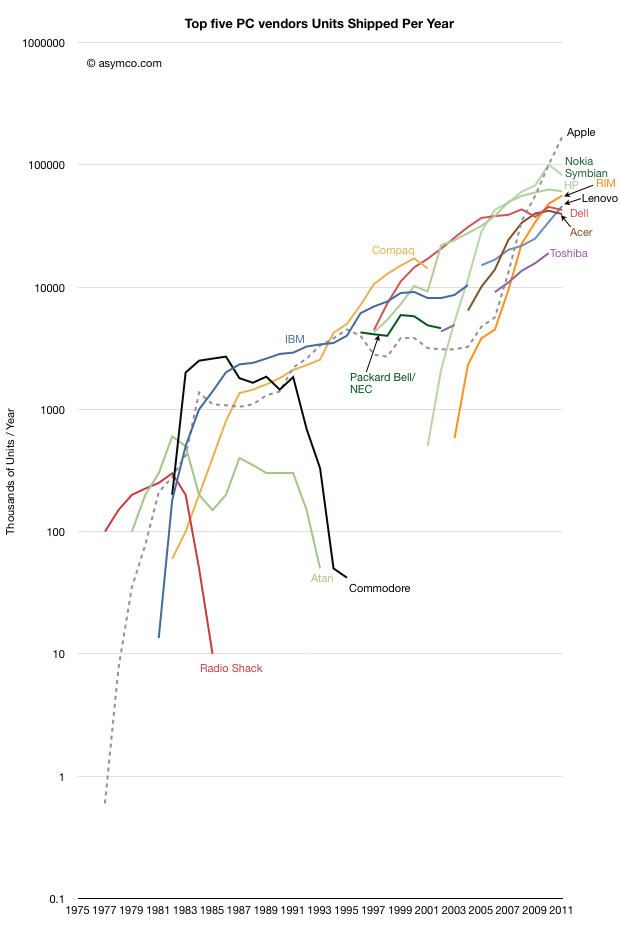
    The following graph shows the companies which were predominant (in the top five ranking by shipments[1]) during each year of the industry's history and the volumes they were able to obtain during that period. I also added Nokia and RIM as examples of the challengers coming from mobile devices.

    It's a difficult graph to interpret. The pattern I observed was that most companies were not able to sustain presence in the top five ranking for long. Indeed, regardless of having one's own platform or being a licensee, companies seemed to fade reliably. Some were acquired, some sold their operations but there is a distinct impermanence to their prosperity.

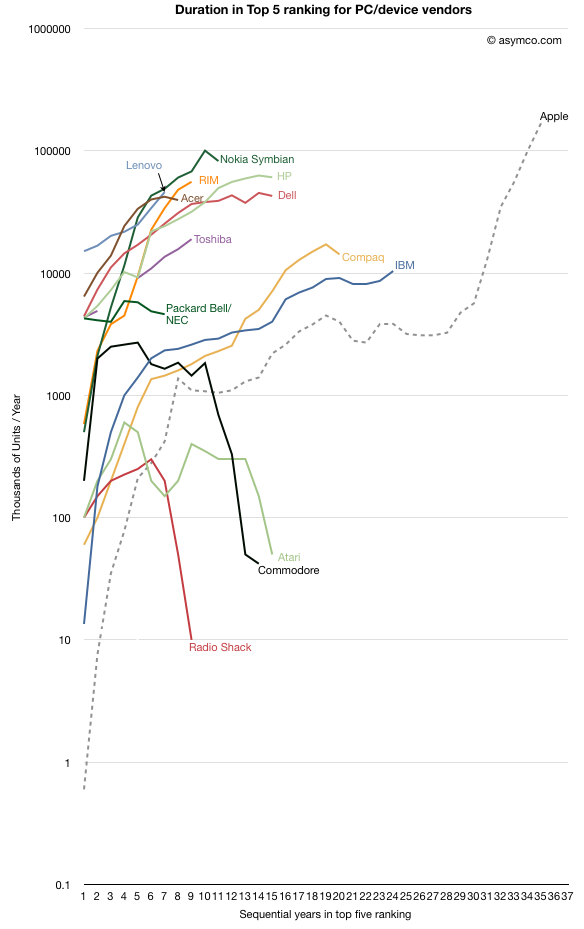
    To sharpen this perspective of longevity I indexed each company to the point when they entered the "prosperity zone" and measured their staying power within it. The following graph shows these indexed lives.


    Apart from Apple, IBM remained in the business the longest (24 years). Compaq was second with 20 years before being bought by HP. HP and Dell are still operating after 15 years, having tied Atari and Commodore. After these ancients, the upstarts Nokia and RIM are struggling to remain relevant after 10 to 12 years.

    Then there are the transients like Packard-Bell/NEC, Toshiba, Radio Shack and Fujitsu which lasted less than 10 years. The newest PC companies are all from China or Taiwan: Acer, Asus and Lenovo. Their longevity cannot be called yet though Acer seems to be in decline. Lenovo, which took over IBM's brands continues to grow. However, as yesterday's post showed, without diversification into devices, pure PC makers are likely to fade.

    But besides this interesting history lesson, there is a deeper, unsettling observation. The scale of these periods of prosperity is far shorter than the average person's career. Indeed, the entire time span of the study is 35 years, about the time an average person will be employed. All the companies failed to maintain prosperity over this time frame.

    These are a small sample, flawed by showing only hardware units, but I consider it a proxy for the overall technology market. Software-only or services companies have had no better records.

    The implications for company managers and workers is profound. Chances are that the business you work for will not prosper for more than a decade and will reward you for an even shorter period. Similarly, as witnessed by the P/E ratios, investors have  given up on this industry as one with any quality of earnings.

    There is no "rule" that this has to be so. The high mortality rate and short longevity of technology companies is a consequence of a failure to manage innovation and disruption. Apple may be an exception--one I think worth studying. Though not always prosperous, it has managed to survive, being the only company from the early era of personal computing to still be operating in the industry. Indeed, it's now the most prosperous. Maybe it's a fluke, but I rather think it's due to an ability to re-define itself as the market shifts. Its essential quality being an ability to disrupt itself.

    And if we think about it this way, ultimately, longevity is more important than prosperity. Without patience there is nothing but chance determining prosperity. The fate of more than company finances rests in the balance.

    Notes:

    1. Apple did not maintain a position in the top 5 throughout this period but is shown as a benchmark as it remained in the same business throughout this period.