Asymco

Asymmetric Intelligence

Mac mini

  1. Mac mini and Mac Studio orders booming

    Nota Bene · 2 comments

    AI boosting Mac sales.

    Mac mini and Mac Studio orders are facing unusually long shipping delays, stretching up to 4-5 months. This could hint at an upcoming M5 refresh or supply constraints.

    After a few months of delay, Apple refreshed the MacBook Pro and MacBook Air lineup with its new M5 family of chips in late February. The new M5 Pro and M5 Max chips bring a significant uplift in CPU, GPU and AI performance. The Mac Studio and Mac mini are also due for an M5 refresh, but it’s unclear when it will land.

    The extended shipping delays of these Macs could be an early sign of that transition. Apple may be winding down inventory of current models ahead of the refresh. Or it could be struggling to keep up with demand. Despite their age, the Mac Studio and Mac mini are great for AI tasks.

    In the US, the Apple Store currently shows a one-month delivery time for an M4 Pro Mac mini with 24GB of system memory. The shipping time jumps to a whopping 10-12 weeks if you bump the memory to 48GB.

    Source: Cult of Mac

    NB: The bias of the shortage toward the high end impli…

  2. Lobster Boil

    Nota Bene · 6 comments

    Om my God

    Makes you wonder: what is really going on here? Hope and madness. Whatever the reasons, I am fascinated with the very idea of OpenClaw, how it might be foretelling a future we are not seeing yet.


    OpenClaw is a free, open-source AI agent built by Austrian developer Peter Steinberger. It started as a weekend project in November 2025, originally called Clawdbot, went through a rename to Moltbot after a trademark complaint from Anthropic, and landed as OpenClaw at the end of January 2026.

    You connect it to whatever AI model you prefer. It runs on your own machine. You talk to it through the messaging apps you already use, including Slack, WhatsApp, Telegram, iMessage, and Discord. And then it does things. Typical chatbots answer questions. It acts. It clears your inbox, makes reservations, tracks your calendar, executes tasks on your behalf while you are doing something else.

    By March 2026, it had crossed 247,000 stars on GitHub. Steinberger has since been hired by OpenAI to work on personal agents, and the project has moved to a foundation. The lobster, as they say, has molted. Ironic, the movement’s Jesus has ceded control to his apostles.

    The Mac Mini has become the unofficial hardware of the OpenClaw moment. People are buying the Apple desktop with a single purpose: a dedicated machine to run their agent, separate from their main computer, connected to a free or cheap open-source model. The SF Standard called the Mac Mini bro the new matcha latte guy. Oy vey!

    Source: On my Om

    NB: Definitely worth reading this post. Om is always good for a zeitgeist check. He and I …

  3. Asymco Bulletin 002 / March 1, 2026

    Bulletin

    Asymco Bulletin is a digest of all the work we have published for the week ending March 1, 2026.

    Office Hours

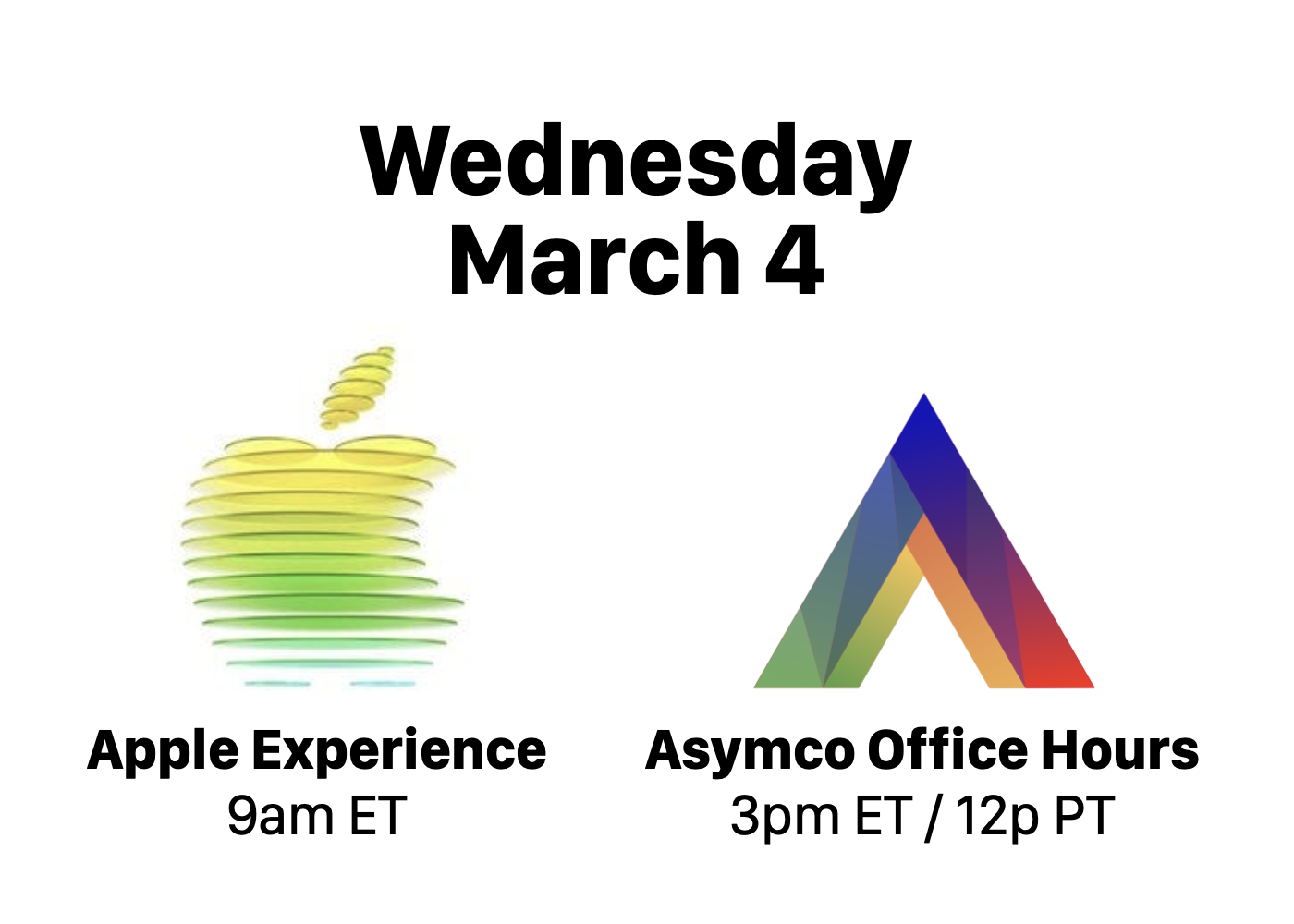
    Our first Office Hours interactive seminar and Ask Me Anything questions/answer session will be on March 4th, after, presumably all the new announcements Apple will be making during the week. I will be broadcasting to you en vivo y en directo from Paris.

    Apple March 4 Special Event – Q&A

    Apple March 4 Special Event – Q&A → Join us for an exclusive Asymco One live Q&A on March 4 at 3pm ET to dissect Apple's latest business moves. →

    Research

    How many Apple users are in China?

    Greater China (GC) is a specific reporting segment for Apple, encompassing Mainland China, Taiwan, Hong Kong, and Macao, with a combined population nearing 1.5 billion. This region is not just a significant contributor to Apple's revenue—accounting for 18% of net sales in Q4 2025—but also a dynamic landscape of technological adoption and consumer behavior. The smartphone user base in GC has surged from 690 million in 2016 to nearly a billion in 2025, with projections reaching 1.08 billion by 2029.

    The iOS ecosystem within GC exhibits varied dynamics across its constituent regions. While Macao maintains a steady iOS share of around 60%, Mainland China and Taiwan show different trajectories. Analyzing these trends through mobile OS share data reveals iOS's ascent, suggesting robust potential for further penetration and user engagement. As Apple navigates this complex market, understanding GC's historical growth patterns and future prospects is crucial for capitalizing on emerging opportunities and sustaining its competitive edge. →


    Nota Bene

    Apple #1 phone vendor in Europe → Apple leads Q4 2025 with a 7% YoY shipment rise driven by iPhone 17, while Samsung follows with 4% growth; Xiaomi faces a 6% decline amid shifting regional dynamics. →

    Are Solid State Batteries Finally Here? → Donut Lab has partnered with VTT for independent battery tests, with full reports and videos to follow. →

    iPhone becomes India’s top single export item → In 2025, Apple's iPhone exports from India, driven by Tata and Foxconn plants and a robust supply chain, reached $23 billion, making smartphones the top export category. →

    Apple’s App Store growth is reaccelerating → Apple's Services, beyond just the App Store, are poised for robust growth, driven by global market expansion and strong hardware demand. →

    Here’s why demand for Macs has spiked → Mac lead times have surged to multi-year highs due to increased demand, notably impacting models like Mac Studio, MacBook Pro M4, and Mac Mini. →

    A resource for AVP news → "AVP VIP offers a weekly, ad-free digest of tech news and insights, accessible to Asymco One members." →

    Apple to Start Assembling Mac mini in the United States This Year → Apple revamps the Mac mini with M4 chips and boosts U.S. chip sourcing, starting at $599 without display, amid rising demand. →

    Apple Pay Aiming Launch in India This Year → Apple Pay aims to launch in India by late 2026, pending regulatory approvals and fee negotiations with card issuers. →

    iPhone and iPad approved to handle classified NATO information → Apple's iPhone and iPad achieve unprecedented NATO compliance, marking a pivotal shift in secure mobile technology acceptance. →

    Eddy Cue says Brazil is Apple TV’s second-largest market, talks Netflix-Warner merger → In an interview, Apple's Eddy Cue highlighted Brazil as the second-largest and fastest-growing market for Apple TV subscribers, while noting potential impacts from proposed streaming regulations and a possible Netflix-Warner deal. Specific user and device numbers were not disclosed. →

    DRAM Shortage Will Cause ‘Seismic Shift’ in Smartphone Market, But Apple Will Be Less Affected → A looming DRAM shortage due to AI demand will slash smartphone sales by 13% in 2026, forcing a market shift towards pricier devices, with relief not expected until mid-2027. →


    Asymco One gives you full access to our research, analysis, and commentary. Subscribe with code BULLETIN for a discount.

    Feedback: Have questions or comments? Reach out to us at contact@asymco.com. We’d love to hear from you.

  4. Apple to Start Assembling Mac mini in the United States This Year

    Nota Bene · 3 comments

    Just in time for Personal AI

    The Mac mini remains a smaller part of Apple’s Mac lineup, accounting for about 5 percent of global Mac sales last year, according to Consumer Intelligence Research Partners. In 2024, Apple gave the desktop its first major redesign since 2010 and introduced M4 and M4 Pro chips. In the U.S., the Mac mini starts at $599, though buyers must provide their own display and accessories.

    At the same time, Apple is increasing domestic chip sourcing. The company plans to purchase more than 100 million chips this year from TSMC’s Arizona facility, reinforcing its long-term strategy to expand U.S. manufacturing while managing tariff pressures on imported products.

    Source: The Mac Observer

    NB: As demand for Mac mini spikes, assembly ...

  5. Here's why demand for Macs has spiked

    Nota Bene · 3 comments

    Personal AI

    "OpenClaw [is] driving Mac lead times to multi-year highs." — Analyst Erik Woodring

    As of Thursday, February 19th, lead times across most Mac products have quickly inflected to multi-year highs, around 2-4 weeks in the US (Exhibit 58), with lead times for Mac Studio the longest (27 days) followed by MacBook Pro M4 (23 days) and Mac Mini (19 days).

    Source: Morgan Stanley via Apple 3.0

    NB: It's not just the Mac Mini that is seeing a spike in sales...

  6. mini

    Research

    We want things to get better. The desire of improvement and an increase in performance is seemingly innate. The old adage goes that using the word "new" is the most effective way to increase sales. "New & Improved" if you want to be redundant.

    For many in technology, New & Improved means faster with more of every measurable parameter. More memory, more pixels, more storage, more bandwidth, more resolution. In devices, the tendency has been to communicate "new & improved" through an increase in screen size. We are subject to this to such an extent that phones are becoming unusable with one hand, stretching screens to the edge of the device and then wrapping those screens around the edges and then even folding the screens so that we have to unfold or unroll to use the product. Maybe an origami phone is in the works.

    But there is a parallel movement where "New & Improved" means smaller. This is the trend to miniaturization. Smaller is better because it's more portable, more conformable. Things sold by the ounce are better than things sold by the pound. The best computer, the best anything, is the one you have with you and having it with you is more likely if you can take it with you. So that which you can take with you is the best. QED.

    Apple has had a great history of miniaturization. The original Macintosh was tiny compared with personal computers of its day. It had a handle so you could take it with you. Apple pioneered laptops with breakthroughs in utility and form which made them truly portable. The iMac followed with a degree of integration and portability which made it iconic. Of course the iPod and iPhone were marvels when they first appeared.

    Over the years these products expanded into ranges with "good, better, best" type segmentation. The bigger being the best in performance and the smaller typically being the most convenient. However it seemed that the positioning was toward "bigger is better" for a lot of these products. The iPhones Plus, the iPads Pro, etc. As even the largest were getting thinner, the "mini" versions appeared to be neglected. You could get "good enough" portability from the larger products so why bother with the minis.

    It came to a head when the iPhone SE was discontinued last fall. Its demise felt like the end of an era. I always considered the SE as the "Steve Edition". It was the last design Steve Jobs was involved in and it pained me to see it go. With it seemed to go the positioning around "mini".

    But also last fall we saw a re-boot of another almost-forgotten mini: the Mac mini. For me the Mac mini was quintessentially Jobsian. I remember that he loved tiny products. His launch of the iPod nano was spectacular; reaching into his jeans' watch pocket to pull it out on stage. Holding the Mac mini up as if a tiny tray. Even the iPod shuffle was a quirky and lovable idea ((probably the first Apple wearable as you could actually pin it to your clothes)). And let's not forget the Mac Cube which made the iMac look huge.

    When the Mac mini was released last fall in Brooklyn with a huge spec bump and a thunderous reveal I thought something was up. When the MacBook Air was also out at the same event I felt that the company was signaling something. Perhaps a re-dedication to the low end.

    Also in parallel there is the wearables product line. The AirPods and the Apple Watch are jewelry. The essential qualities of products you wear are that they be small and beautiful. The smaller the better. Above all, both the Watch and AirPods are marvels of miniaturization. They pack so much in so little volume and that volume is shaped in such an aesthetically elegant way that they become daily essentials. I use my Apple wearables more than any other Apple product. Watch glances and time with AirPods exceeds the iPhone unlocks and iPhone use time. The fact that we don't even realize that the smallest Apple products are also the ones we use most is a testament to their conformability to us.

    So the Mac mini that is suddenly the Mac Maxi in performance, the MacBook which is an extraordinarily small laptop, the wearables success, all pointed in a direction that the iPhone did not: that "mini" was back.

    And now we see the iPad mini being re-launched with a huge spec bump. We should take the hint. The iPad mini is just charming. I have been trying it out for a few days and it has worked its way into my routine. I have an iPad Pro that I use on a desk to design presentations (and to deliver them). I use it with a keyboard for dealing with email on my lap or on a plane and take it instead of a laptop when going to meetings.

    But the iPad mini worked its way to my nightstand. It the one I reach for when on a couch. It is like an iPhone but when you're at home it's better than the iPhone because you can linger on that new true tone screen. It works well one handed. It now has Pencil support so it can be used for sketching and doodling.

    I am an analyst not a product reviewer but I sense how it fills a gap between iPhones and larger devices--in a home setting. Of course it can be used in an office. It is much easer to take with you if you carry a laptop in a bag.

    Fundamentally explaining mini is pointless. mini is something that is felt more than it is perceived. You can see the attraction of a tiny product only when you come face-to-face with it. In a picture it's hard to get it--there is no frame of reference. What draws me to a MacBook or to a mini or a Watch is when it's touched and held and carried or worn. The experience of the product is not how it works but how it works with you. You have to be part of it. It's not asking "Does it look good?". It's asking "Does it look good on me?" mini means more personal.

    That is the nature of mini and that is why I love the new minis: the iPad mini, the Mac mini, the MacBook (mini) and that is what I dare to hope that there is an iPhone mini coming.