Asymco

Asymmetric Intelligence

MacBook Air

  1. Asymco Bulletin 009 - Apr 19, 2026
    Bulletin

    Asymco Bulletin is a digest of all the work we have published for the week ending Apr 19, 2026.

    Research

    Estimates for Apple’s March Quarter 2026
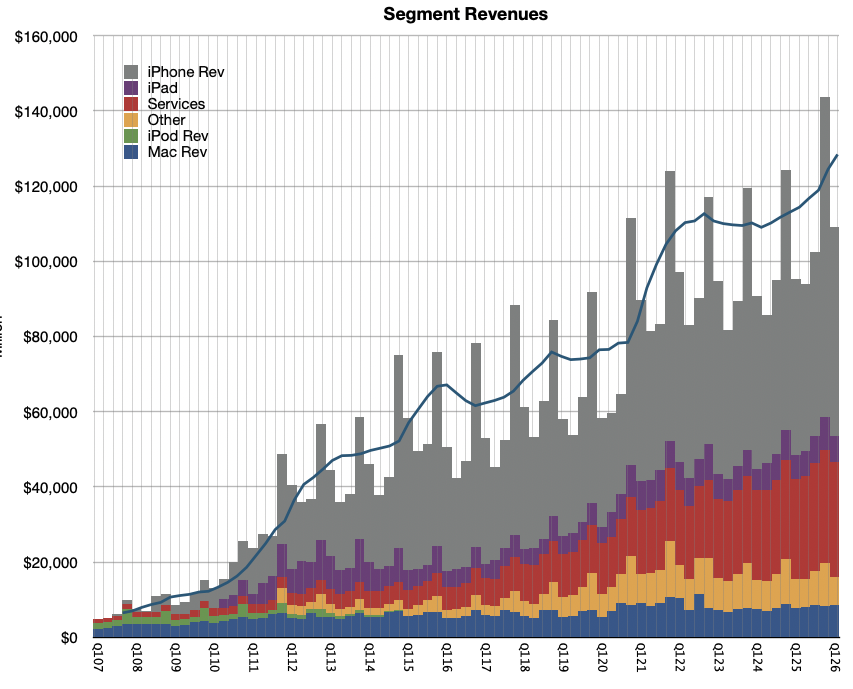
    Estimates for Apple’s March Quarter 2026

    Revenues and growth rates for iPhone, Mac, iPad, Services, Wearables, plus Net Sales, Gross Margin, Operating Expense, Other Income and Expense, Tax Rate, Net Income, Share Count and EPS with a comparison to CFO guidance.

    Ref. conference call's guidance, Kevan Parekh, Apple CFO: As we move ahead into March, I would like to review our outlook, […]. We expect our March total company revenue to grow by 13% to 16% year over year, which comprehends our best estimates of constrained iPhone supply during the quarter. We expect services revenue to grow at a year-over-year rate similar to what we reported in December. We expect →

    The Inevitability of Combining the Digital and Physical Worlds
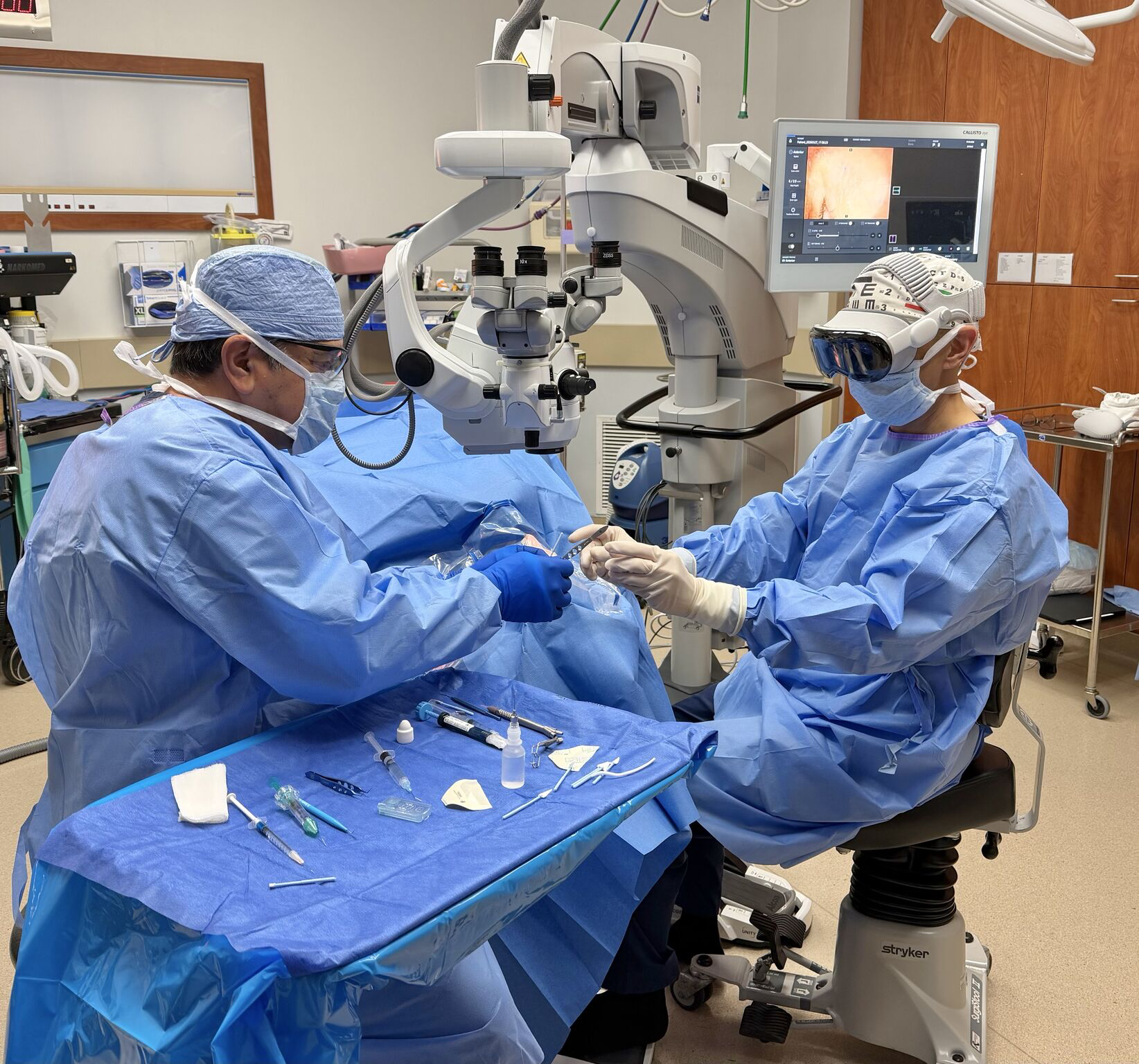
    The Inevitability of Combining the Digital and Physical Worlds

    In a recent interview Apple management was asked about AI, which is perceived as an area where Apple has been struggling. Greg Joswiak replied: We’ve been doing things with intelligence for many years, right? And gen AI allows us an opportunity to do that even more. So I’m excited about that, but boy, this is not a sprint. This is a marathon.

    In contrast to AI, Spatial Computing is being largely ignored. It is however making significant leaps in utilization, especially in verticals. →


    Nota Bene
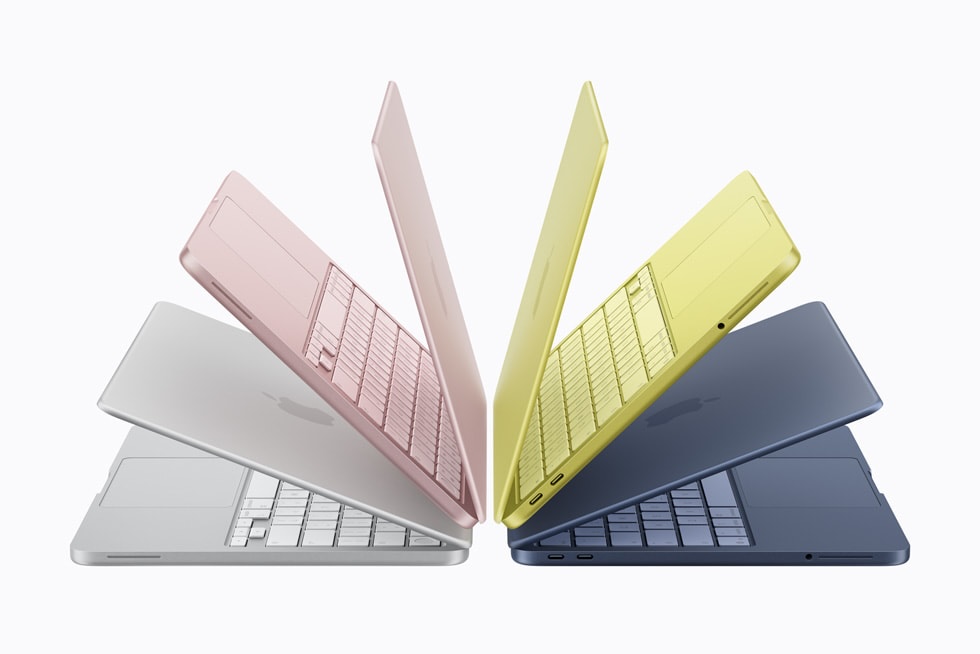
    Monday Notes: Neo still sinking in

    Monday Notes: Neo still sinking in →

    Apple's potential to double its Mac user base through strategic budget expansion and memory supply tactics presents a promising growth trajectory.

    260 million Mac users? Huge room for growth.

    Two analysts, two stories. The Neo will move the needle and the supply crunch will hamper competition…

    Nevertheless, a doubling of the Mac user base is certainly a worthy and achievable goal over the next decade. →

    Apple Studio Display XDR Now Cleared for Diagnostic Radiology

    Apple Studio Display XDR Now Cleared for Diagnostic Radiology →

    At just $3,000, the Studio Display XDR democratizes medical imaging, undercutting specialized monitors by up to 90% and revolutionizing healthcare accessibility.

    The ‌Studio Display‌ XDR is priced at $2,899 with a VESA mount, and it is more affordable than many specialized medical imaging monitors.

    It allows a new set of people to do what previously required only specialists to do and allows specialists to do more than they used to do. →

    Antelope standing beside a wooden desk with a vintage Macintosh computer

    All of a sudden, everyone is doomed except Apple →

    Despite optimistic predictions for Mac growth, persistent skepticism argues Apple faces inevitable doom due to supply issues and product flaws.

    As honored as I am to be the recipient of an antlers tip, I must respectfully disagree…

    The only thing you could be sure of is that Apple is doomed. →

    Computer History Museum interviews Bertrand Serlet

    Computer History Museum interviews Bertrand Serlet →

    Bertrand Serlet, a pivotal yet understated architect behind Apple's OS X, exemplifies the profound impact of tech's quiet innovators.

    Pay attention to the quiet ones

    This is one in a series on Apple’s quieter heroes.…

    That this interview only has 6000 views after three years shows how much untold history exists. →

    Bank of America raises Apple price target to $325 from $320 →

    BofA slightly ups Apple's price target to $325, forecasting $113B revenue and $2.00 EPS for Q2, driven by strong iPhone sales and Services growth, slightly above my estimates of $110B and $2.00.

    Q2 forecast update

    My own estimates for Q2 revenues and EPS are $110B…

    More to follow as we get closer to the earnings release date but this is a good preview. →

    Omdia releases first estimate for Q1 PC unit shipments →

    Apple's Mac shipments grew 5.4% to capture 11% market share in Q1 2026, driven by MacBook Air and Neo sales, with revenue estimates slightly differing from unit projections.

    Apple growing at double market rate.

    Omidia estimates that Apple reached a market shar…

    …e of 11% with shipments growing 5.4% due to solid MacBook Air sales performance and the initial sell-in of the MacBook Neo.. This means 5.4% growth for Apple y/y. As I noted in my Office Hour yesterday, I adjusted my Mac growth from 0% to 6% based on the new products launched. This is an estimate of revenues not units but it might be pretty close. Omidia estimates 7,112 million units whereas I’m a little above 6 million. We seem to disagree on ASP. →

    Apple and Amazon Partner on Satellite Deal

    Apple and Amazon Partner on Satellite Deal →

    Amazon's acquisition of Globalstar boosts its satellite internet ambitions and strengthens ties with Apple, while highlighting the limited reach of space-based networks compared to terrestrial ones.

    I assume Apple has wanted to steer clear of Starlink but it’s not clear that was a primary consideration in choosing Globalstar.

    Starlink, considered the dominant player, serves about 11 million users. I would note that 11 million is 0.1% of the number of cellular subscriptions worldwide. →

    iPhone vs Android Switching Rates →

    iPhone users boast nearly quadruple the loyalty of Android counterparts, with actual annual switching rates favoring Apple slightly, despite inflated survey intentions.

    I did a deep dive into the data and came up with graph above. The original report shows intention numbers which seem quite high. For instance, the net switching rate between iOS and Android is 10% in favor of Apple. This would imply that the entire user base would flip in 10 years. It would also imply…

    I think actual net churn is 1.7% of the base each year. That’s still 100 million a year. For now it seems Apple is happy to maintain that rate. →


    Office Hours

    Asymco One Office Hours Live Q&A with Horace Dediu & Gene Munster: April 8, 2026

    Asymco One Office Hours Live Q&A with Horace Dediu & Gene Munster: April 8, 2026 →

    Asymco Office Hours, April 8, 2026

    Hosts: Horace Dediu and Gene Munster

    This episode of Asymco Office Hours covers a wide range of topics related to Apple, including geopolitical risks, financial performance, AI developments, and business strategy. The discussion is led by Horace Dediu and Gene Munster, with insights from industry experts.


    Podcast

    Asymetric Podcast: Waterloo

    Asymetric Podcast: Waterloo →

    In this Asymmetric Podcast episode, Horace muses on buying flowers, highlights Apple's distinguishing product, and teases his new research. →


    Asymco One gives you full access to our research, analysis, and commentary. Subscribe with code BULLETIN for a discount.

    Feedback: Have questions or comments? Reach out to us at contact@asymco.com. We’d love to hear from you.
  2. Apple's Business Strategy

    Nota Bene · 1 comment

    Remember the orifices?

    Apple’s top-line is benefiting from an expanding enterprise footprint. In the first quarter of fiscal 2026, the company saw strong adoption with Snowflake deploying more than 9,000 Mac devices while AstraZeneca rolled out more than 5,000 M5-powered iPad Pros to its pharmaceutical sales team. Mexico’s largest domestic retailer – Coppel – added MacBook Air to its growing fleet of more than 10,000 iPad devices.

    In the trailing 12 months, Apple’s devices have been adopted by the likes of BMW Group (tens of thousands of iPhones), Capital One added MacBook Airs, while the Czech Republic’s largest bank, Ceska sporitelna, is using more than 5,000 iPhones in addition to its existing thousands of iPads and Macs. Other notable users include PayPal, Roche, and Thailand’s Siam Commercial Bank. Apart from iPhones, iPads and MacBooks, Apple Vision Pro is gaining adoption. Apple’s visionOS 26 introduced new enterprise APIs that empower companies to build their own spatial experiences. This is expected to further drive the adoption of Apple devices.

    The company is now bringing Apple Business that combines built-in mobile device management, business email and calendar services with custom domain support. Apple Business can help enterprises grow their reach and connect with local customers across Apple Maps, Mail, Wallet, Siri, and more. Apple is set to introduce a new option coming this summer that will enable businesses in the United States and Canada to place local ads in Maps during key search and discovery moments. Beginning April 14, Apple Business will be available as a free service in the United States and more than 200+ countries and regions to new and existing users of Apple Business Connect, Apple Business Essentials and Apple Business Manager.

    Source: Yahoo Finance

    NB: Is it going to move the needle? I don't think that's the right question...

  3. Remembering January 14, 2008: The day the market lost faith in Apple

    Research · 106 comments

    In a recent but recurring lament I asked why Apple shareholders are not being rewarded for the company's growth. I pointed out that there is no fundamental reason why the company should receive such a low P/E multiple (about 18 ex-cash trailing and 10x forward while maintaining 70% earnings growth for over a year).

    There were many objections in the comments. Most of them dealt with recent reasons why doubts might have arisen among investors: Android hegemony or some perceived lack of competitiveness leading to margin compression or some macro hangover from the recession.

    In this article I argue that none of these objections hold water. My argument hinges on the fact that there is a precise date when Apple ceased being seen as an exceptionally valuable company and that date precedes any of the causes being suggested.

    The day of disillusionment was almost exactly three years ago: January 14th, 2008.

    How to pin down the date of disillusionment

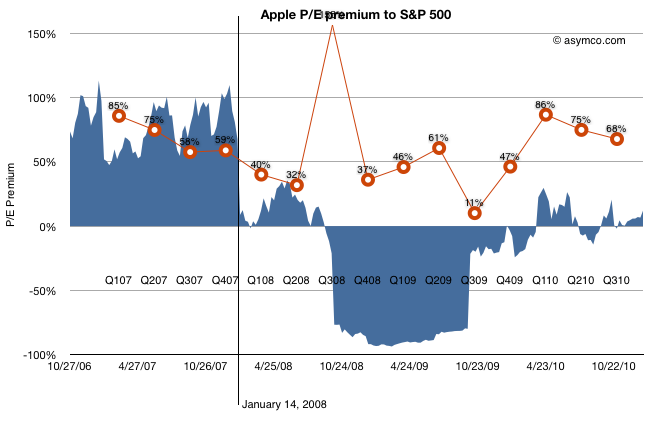
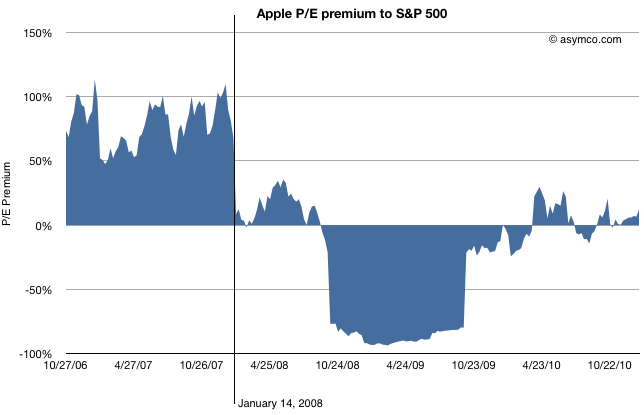
    Consider the following chart.

    The blue area represents either a premium (above 0) or a deficit (below 0) of Apple's P/E (ex-cash) relative to the S&P 500 P/E. This is a re-imaging of a chart, first introduced in June 2010 when I first pointed out that Apple was being discounted relative to the S&P 500.

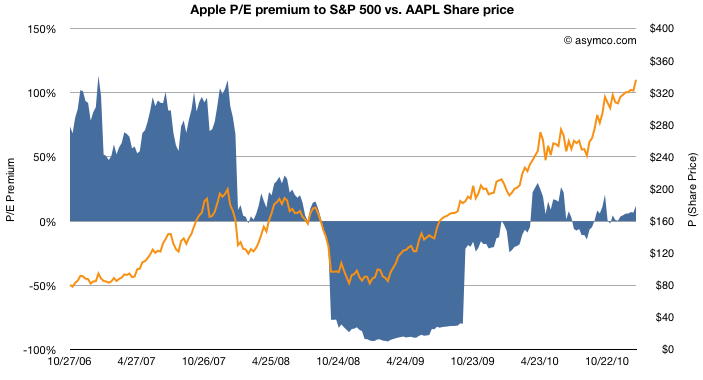
    By measuring P/E I am focusing not on the stock price, which has grown nicely, but the ratio of the price relative to earnings, which hasn't (see the next chart below). P/E is a fundamental measure of potential (its reciprocal is the stock's earnings yield.) It is usually highly correlated to the company's growth. If that P/E is uncorrelated to past growth, there is some significant discounting of future growth. It's the most significant (and simplest) measure of "faith" in a company.

    By measuring the company's P/E relative to an index of other large companies (S&P 500 P/E) we can assess whether the company's potential is being valued as extraordinary or whether it's being valued as ordinary. In other words we are measuring whether a company is "special".

    The chart shows that until January 14th, 2008 the company was valued at a significant earnings premium--a P/E consistently 50% higher than the norm.[1]

    Following the collapse (about 40% drop in share price but 100% drop in P/E premium), there was a small recovery followed by a huge trough in valuation. During the recession quarters Q308 to Q309 S&P earnings fell to zero or below. As a result of S&P earnings collapse the S&P P/E shot up astronomically (as E approaches zero, P/E approaches infinity). Apple's earnings dropped as well but remained positive throughout that period bottoming at 37% growth(!) in Q408. As a consequence Apple's P/E fell as low as 11 while the market's went well above 100 (122.41 peak). The P/E deficit for Apple went 80%: Apple was valued as basically worthless (3x cash).

    After the earnings recession, the S&P P/E recovered close to historic levels but Apple's P/E did not. It's in-line with the S&P but does not obtain the 50% premium preceding the recession.

    So we can establish that the day that Apple's potential was discounted was nearly six months before the onset of recession.

    What other discounting factors can we discard?

    How about earnings growth itself? Did the collapse foretell an earnings collapse?

    The chart above shows the P/E premium vs. earnings growth (in red). Although earnings growth began to slow soon after the 14th (earnings for CQ407 were not yet announced at that point), growth recovered six months later after the launch of the iPhone 3G[2]. Growth continued throughout 2009 and 2010 reaching new heights last year of 86%.

    Still, the company received no premium to the S&P 500 P/E. Companies in the index averaged, at best, a quarter of Apple's growth in earnings.

    What about Android? The first Android device did not ship until October 2008 (HTC Dream or T-Mobile G1). There were no appreciable Android volumes until 2009, one year after the drop in relative value and no talk of a threat until 18 months later.

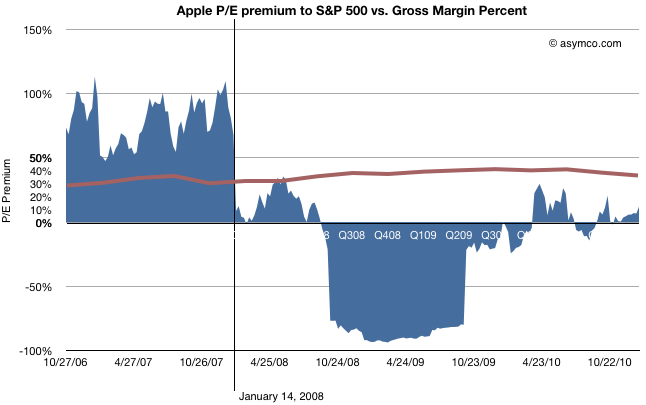
    The last objection to be put aside is that of margin compression.

    This last chart shows how margins (in brown) behaved during the same time period. They went up. The only slight decline took place during the last few quarters, after the launch of the iPad, long after the collapse.

    Regardless of the adjustments with product launches, Apple's GM is the envy of the world and is not at all correlated with the loss of faith in the company.

    So What happened on January 14, 2008?

    Having led you this far in the story, I'm afraid I'm going to let you down at the end: The cause for the loss of faith is a mystery to me.

    There is only one noteworthy event that took place on that date: Macworld 2008 (January 14-18). During the keynote, Steve Jobs introduced the Macbook Air (and Time Capsule and Leopard and pre-announced the iPhone SDK which, six months later led to the app supernova). I remember that day and I remember that the stock began selling off exactly at the point when the Air was mentioned. It has never been the same since.

    Obviously, correlation is not causation. The Macbook Air need not be the cause for the loss of faith in Apple as an investment. Or can it? I'm hoping someone can explain this because to me it makes no sense. The product was not a home run but it did not do badly either and its current incarnation seems to be a hit. Whatever sins the original Air may have had have surely been expurgated by now.

    Regardless the cause, the bottom line is that, in the eyes of investors, Apple stopped being "special" that day. Its valuation dropped to in-line the S&P and, given its growth, well below what a large growth company should be worth. The company's shares went into the bargain bin and are still there today.

    ---

    [1] I should point out that the P/E ratio is based on post 2009 re-stated earnings. The restatement changed the P/E as the "E" changed. This was based on the abolition of subscription accounting for the iPhone. Although it may seem unfair to hold the market to this standard, restatement did not actually change cash flows which were transparent and visible to all, even to amateurs such as myself and the other unaffiliated analysts that published throughout this period. Earnings may be an opinion but cash flow is a fact. Valuation on the basis of cash flow should have yielded the same results as shown above.

    [2] That quarter showed a y/y growth of 150% while the stock was in freefall. In fact, it was during that earnings day that Steve Jobs came on the conference call and pointed out the astronomic iPhone cash flow to an audience of analysts more concerned about their own jobs.