Asymco

Asymmetric Intelligence

MeeGo

  1. The parable of RIM

    Research · 155 comments

    Here are the highlights from RIM's latest quarter:

    • 14.1 million BlackBerry smartphones shipped, 13 million sold through
    • 150k PlayBook shipped with sell-through slightly higher. 800k PlayBooks shipped so far.
    • BlackBerry subscriber base up to 75 million
    • High growth cited for U.K., France, South Africa, Mexico and Argentina, Indonesia, Saudi Arabia and South Africa. RIM is the #1 smartphone vendor in the Latin America and Caribbean region. Sales outside the US, UK and Canada were 61% of revenues. US is now 20% of sales, UK 11%.
    • Hardware growth outside the US was 56%
    • There are 630 carriers
    • 50k apps in App World with 5 million downloads per day
    • Forecasting 11 to 12 million smartphones next quarter

    Given the channel fill with a new product, the device business was marginal at best. The company obtained -1% growth y/y in units but 31% sequential growth from a transitional quarter. The average selling price (inclusive of service revenues) is $354 and about $280 excluding service revenues. I estimate that operating margins have dropped to about 11%. Not a good story, but one we have been warned to expect.

    But a crucial new twist to the story is that RIM announced that they don't expect new BlackBerry 10 devices until late next year. That came as a surprise and the stock sold off significantly, valuing the company at well below book value.

    Stepping back, the biggest surprise is that the company seems to have had no plan for sustaining itself.

    Let me explain.

    If you go back to 2005 or so the world of smartphones was a mix of modular OSs and integrated platforms, much as it is today.  Not unlike Android today, Windows Mobile was successful in licensing to dozens of vendors who in turn released hundreds of products. Symbian also was licensed but most volumes came from Nokia and they held the lion's share. Then there was the BlackBerry integrated solution which worked smoothly and had devoted fans who upgraded every chance they had and operators who were joyous at the new ARPU. There was also PalmOS as offered by PalmSource trying to be a "third horse" and unseat stodgy old Microsoft.

    It was into that fray that both Apple and Google jumped. Google acquired Android in 2005 and Apple was busy polishing a version of OS X that would became iOS. In three and two years respectively these platforms would be in the market.

    Regardless of the actions of rivals, all competitors must have faced the same questions in 2005: As technology was changing rapidly and as they all had access to component roadmaps, what is the best technology approach to this market? Should they embrace certain innovations to sustain their business trajectory? RIM had a tightly integrated software, hardware and service offering. What could make it better? Nokia was also basing its products on a more loosely integrated offering (nominally it was modular, but only just). It saw the writing on the wall and began developing a Linux variant (Maemo) as a potential candidate to replace Symbian. Microsoft was basing its solution of a modular approach. Windows CE was ok as a kernel but they had layers on top which were optimized around stylus-based user experiences (analogous to mouse actions). Could it take on a rich computing experience?

    There were many experience candidates. Stylus, keypad, keyboard all had adherents. There was a lot of hesitation. After the iPhone launched with capacitive (finger) touch, resetting user expectations, it still took a year for many of the vendors to re-consider their technology plans. The weakest changed first.

    Microsoft felt the pain quickest. They also had the least to lose since revenues from Windows Mobile were paltry. By 2008 internally they turned 90 degrees. They embarked on re-building their user experience and orphaning the Windows Mobile ecosystem and many of the vendor relationships they had built. Palm dropped PalmOS and built WebOS internally quite quickly. They licensed Windows Mobile as a stop-gap. Around the same time Nokia doubled down on Maemo and joined with Intel to form MeeGo. They did not orphan Symbian though and kept trying to adapt it to the new experiences and input methods.

    But RIM did nothing. Almost nothing. They were the healthiest competitor. They felt no pain from iPhone's entry. The platform they had built was still growing and they were tweaking it constantly. There were always improvements to point to but fundamentally the code was limited. It was very difficult to adapt it to touch input and the first attempts at a touch UI were embarrassing. But there were no signs of a new platform that reflected the Unix-like competition.

    As I pointed out in an earlier post, Unix-like operating systems were having their revenge. To a computer scientist the future of mobile computing would mirror that of personal computing in terms of architecture. The foundations of the early smartphones were built on constraints that were disappearing while being unable to accommodate new input methods. In other words, the early efforts were optimized around those constraints and sub-optimal for rich user experiences. They had to be. There were limited processors, memories and screens and battery life.

    It turned out that all the early mobile operating systems were unsuitable for the advances in technology that came after 2007. Companies which were able to adapt or embrace Unix-like operating systems in a mobile context gained the ability to grow with the new input methods. The sooner they "pulled the trigger" on the shift, the better off they were. This is in fact what enabled entrants to gain footholds. Entrants entered with Unix-like OSs straight away while incumbents had to justify changing and the more successful they were the harder it was to justify changing.

    RIM had trouble justifying this change. It waited until 2010 to finally acquire the QNX asset that would offer them a stronger software foundation.  It still had to adapt this acquisition and it looks like it won't be done until at least 2012, seven years after they should have started. And this should be seen as a sustaining technological change. A new OS is not a disruptive technology to what is already a mobile computer.

    However, delays like these can be fatal. We see the impact on Microsoft who was earliest to push the reset button in 2008. It still took two years to rebuild Windows Mobile into Windows Phone and is now still struggling to regain lost share (less than 2% today). We see the impact on Nokia which was unable to affect a transition to MeeGo due to a litany of issues and had to throw in the towel on self-determination. We see the impact on Palm which lost its independence as WebOS was a bit too little too late.

    These companies had the right technical strategies but suffered from execution and business architecture issues. RIM is years late in embracing what appears to be a sustaining improvement.

    But whenever you see what appears to be a coordinated effort by companies to fail simultaneously you have to ask if the change they struggle with is really sustaining or disruptive. The pattern makes me suspicious that what RIM, Microsoft, Palm and Nokia faced was more than a failure to embrace a sustaining improvement. I suspect that the failure is evidence of tectonic shifting of business models.
  2. The lives and deaths of mobile platforms

    Research · 68 comments

    When Stephen Elop said that Nokia and Microsoft sought to create a "three horse race" he implied that there were only two viable mobile ecosystems today. With that statement he sought to deprecate or declare "end of life" two platforms: Symbian and MeeGo, implying that Nokia's efforts at being the third way failed.

    However, he also implicitly declared irrelevant a larger set of market participants. In fact, the market is awash with platforms. Far more than the three or five that Stephen considered.

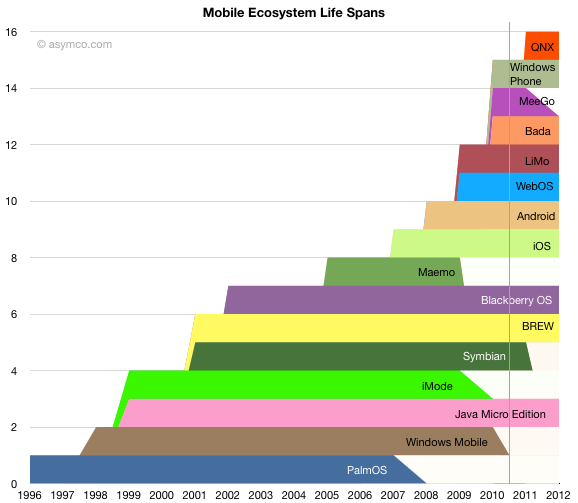
    To illustrate I built the following chart showing the history of all major mobile platforms. The are ranked by launch date (earliest at the bottom). A vertical line marks the present. End dates are approximate and based on declarations of end of life rather than end of usage.

    There have been 16 total mobile platforms[1], 10 of which are still (or soon will be) on the market. Of the six that were terminated, three had replacements built by the same orchestrating company (Windows Mobile begat Windows Phone; Maemo begat MeeGo, and PalmOS eventually led to WebOS.) Only three reached end of life with no known descendant (iMode, MeeGo[2] and Symbian).

    Operating systems that were launched in the 1990s or early 2000s have mostly been withdrawn/replaced with the exception of Java and BREW.  "Modern" operating systems all emerged after 2007 (following iOS). A total of eight such new OSs were introduced in four years[3].

    What I find noteworthy is that there is an implied peculiar fatalism about the market when only two platforms are considered viable, neither of which are more than 3 years old. While visiting the Mobile World Congress, I sensed this jumping to conclusions about platforms was eerily similar to that of a few years ago when new entrants like Apple and Google were declared dead on arrival.

    I can only conclude that there is a great deal of groupthink going on in the industry. A perfect setting for a disruptive entrant to change everything, all over again.

    ---

    Notes:

    1. I excluded some platforms like Motorola's Linux, SavaJe and perhaps some others (Openmoko, Qtopia) which did not gain significant traction. I also excluded any embedded OSs which did not have native APIs.
    2. The end of MeeGo is speculative. Intel is still defending it and may continue developing it.
    3. Android variants like Tapas could be considered new platforms, but I maintain them as part of one OS for the time being.
  3. A review of Asymco Predictions on Nokia’s new platform strategy

    Research · 25 comments

    Predictions on Nokia’s new platform strategy: new OS for the US | asymco.

    Here are my predictions from January 27 for the February 11 Nokia strategy announcement followed by the actual quotes from Nokia's press release:

    • Prediction: There will be a multiple OS strategy.

    Actual: The following sub-units [make up] Smart Devices: Symbian Smartphones, MeeGo Computers, Strategic Business Operations. To support the planned new partnership with Microsoft, Smart Devices will be responsible for creating a winning Windows Phone portfolio.

    • Prediction: The US market will be the first to see a new non-Nokia OS. I would guess Windows Phone with AT&T.

    Actual: "Plans for a broad strategic partnership with Microsoft to build a new global mobile ecosystem; Windows Phone would serve as Nokia's primary smartphone platform"

    • Low end devices will remain with Symbian due to price considerations for the chipsets, components.

    Actual: "Symbian becomes a franchise platform, leveraging previous investments to harvest additional value. This strategy recognizes the opportunity to retain and transition the installed base of 200 million Symbian owners. Nokia expects to sell approximately 150 million more Symbian devices in the years to come."

    • Prediction: MeeGo will be phased out in phone products but development will continue for tablets

    Actual: Under the new strategy, MeeGo becomes an open-source, mobile operating system project. MeeGo will place increased emphasis on longer-term market exploration of next-generation devices, platforms and user experiences

    More details to follow, but so far it looks like there are no surprises.

  4. Nokia employs as many people to develop its smartphone software as Apple does to develop all its products

    Research · 106 comments

    In a recent post I pointed out that Apple's R&D was about 2.2% of sales in the last quarter. Bernstein took a look at the R&D for Nokia and presented a chart showing the difference between the mobile industry players in terms of total expenditure on R&D.

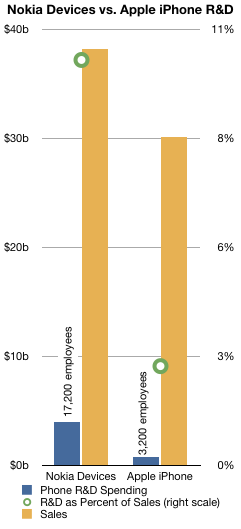
    I took inspiration from that to plot the Devices R&D for both Nokia and Apple over the entire 2010 period. I also compared that with sales and computed the ratio between R&D and sales.

    The result is shown in the chart on the left.

    Bottom line: Nokia spent 10.2% of phone sales in 2010 on phone R&D while Apple spent 2.5%.

    Bernstein goes on to argue that at least for Devices,

    Nokia spent $3.9bn in R&D in 2010, almost 3x the average of its peers, 31% of the industry's R&D total spending, for an output that we can qualify as visibly disappointing.

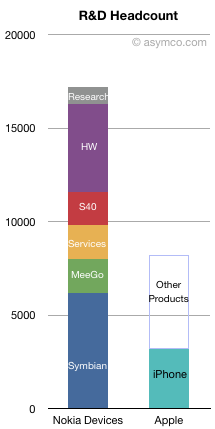
    To relate the $3.9 billion for Devices into head count, they estimate that Symbian projects employ 6,200 people; MeeGo and Qt 1,800; Services 1,800; and S40 1,800. Hardware headcount is assumed to be 4,700 and 900 more for fundamental research.

    So Nokia's total software headcount adds up to 11,600 people. Nokia smartphone headcount adds up to about 8,000.

    Applying a similar formula ($240k/employee[1]) to Apple's estimated iPhone R&D (from Bernstein's chart) yields a headcount of about 3,200 and a total Apple company R&D headcount of 8,200.

    So Nokia employs about the same number of engineers[2] for its smartphone software platforms as Apple does for all its product lines[3].

    In fact, Symbian alone may cost twice as much to develop than the iPhone (including the hardware).

    ---

    Notes:

    1. The cost per employee is obviously different between the companies as they operate in different countries. However there are enough sources of error in these estimates that they probably overwhelm the cost of living/tax differentials.
    2. I know that engineers are not all that R&D headcount covers, but let's assume that the mix of overhead is similar for the two companies.
    3. The total for Symbian + MeeGo is 8000 and the total for Apple overall is 8,200, however one can comfortably allocate 200 out of 900 researchers out of Nokia research to their mobile software effort.
  5. Nokia says the fightback starts now. Oh Really?

    Research · 1 comment

    2010.Realization that iPhone is a threat from new dimensions (user experience). Planning begins on reshaping the software base as a market-driven (not technology-driven) asset (5 year cycle). Apple begins to be evaluated as a competitor in devices and services, although still not compliant with current market definitions.

    via asymco | Assessing Nokia’s Competitive Response.

    I wrote these words a year ago based on observations made three years ago.  My expectation was and still is that Nokia does not quite understand what they are competing for and what the competition actually consists of.

    On Friday Anssi Vanjoki wrote that "The fightback starts now." He seems to contradict my timeline which has the "fightback" starting in 2014.

    How do we settle this?  Let's turn to the claims:

    In the article he says they sell 2 in 5 smartphones on the planet, yet, he turns around and says that Nokia is now the challenger in that space.  He says Symbian is the way forward on smartphones, yet he says MeeGo is the way forward on 'connected devices'. He writes that he is obsessed with getting Nokia to being number one in high-end devices (presumably by volume or sales or profit) but a recent survey by third-party tool developer Appcelerator shows 90 percent of developers surveyed said they were interested in the iPhone while 81 percent expressed interest in Android; for Symbian and MeeGo, the related figures were only 15 percent and 11 percent, respectively.

    I'm not ready to revise my timeline. The fightback begins in 2014.

  6. Platform Bonanza! Three new Platforms in one Day

    Research

    Delivering precisely what the world needs today:

    • Samsung launched Bada
    • Microsoft launched Windows Phone “7 Series”
    • Nokia and Intel jointly announced MeeGo.

    Three new ambitious platforms starting with zero installed bases and no applications are going up against the following:

    • Symbian with more than 200 million users and 20k apps
    • WebOS with less than 3 million users and about 1k apps
    • Windows Mobile with 30 million users and about 2k apps
    • iPhone OS, about 75 million users and 150k apps
    • Android with 3 to 5 million users and approx. 20k apps
    • Blackberry OS with more than 50 million users and a few thousand apps.

    It should be noted that Microsoft’s new Windows Phone “7 Series” will compete with Microsoft’s Windows Mobile 6.5 which will continue as a product line.

    MeeGo will also compete with Nokia’s existing Symbian OS for developers, replacing Maemo.

    Most of these new platforms will not have products shipping for at least 6 months during which time another 50 million (at least) new users will join existing ecosystems.

    There are now nine smartphone platforms, but who’s counting? I’ve been hearing predictions of consolidation for years and although platforms have come and gone (PalmOS, SavaJe), the total number continues to increase.

    If nothing else, this seems to indicate that the industry is not in any state of maturity or point of “over-service” where commoditization takes place.