Asymco

Asymmetric Intelligence

Meta

  1. The problem with the P/E ratio

    Research · 1 comment

    Why the most common measure for valuation is inadequate in an age of AI

    Software and services companies like Google, Microsoft, Amazon, Meta are spending on Capital Expenditures at the rate of heavy industry manufacturing. This defies their description as "asset light" business models which depend on services, distribution or platform economics.

    The problem isn't just semantic. It is that for their entire existence, these companies were valued for their profitability and measured in terms of a P/E ratio and earnings growth. The situation has changed dramatically. Their revenues are up, the earnings are up and growth is up and share prices are way up. But not their P/E ratios. Why is this?

    Consider the graph below showing the (forward) P/E ratios of the Dot Com market leaders vs. the market leaders today.
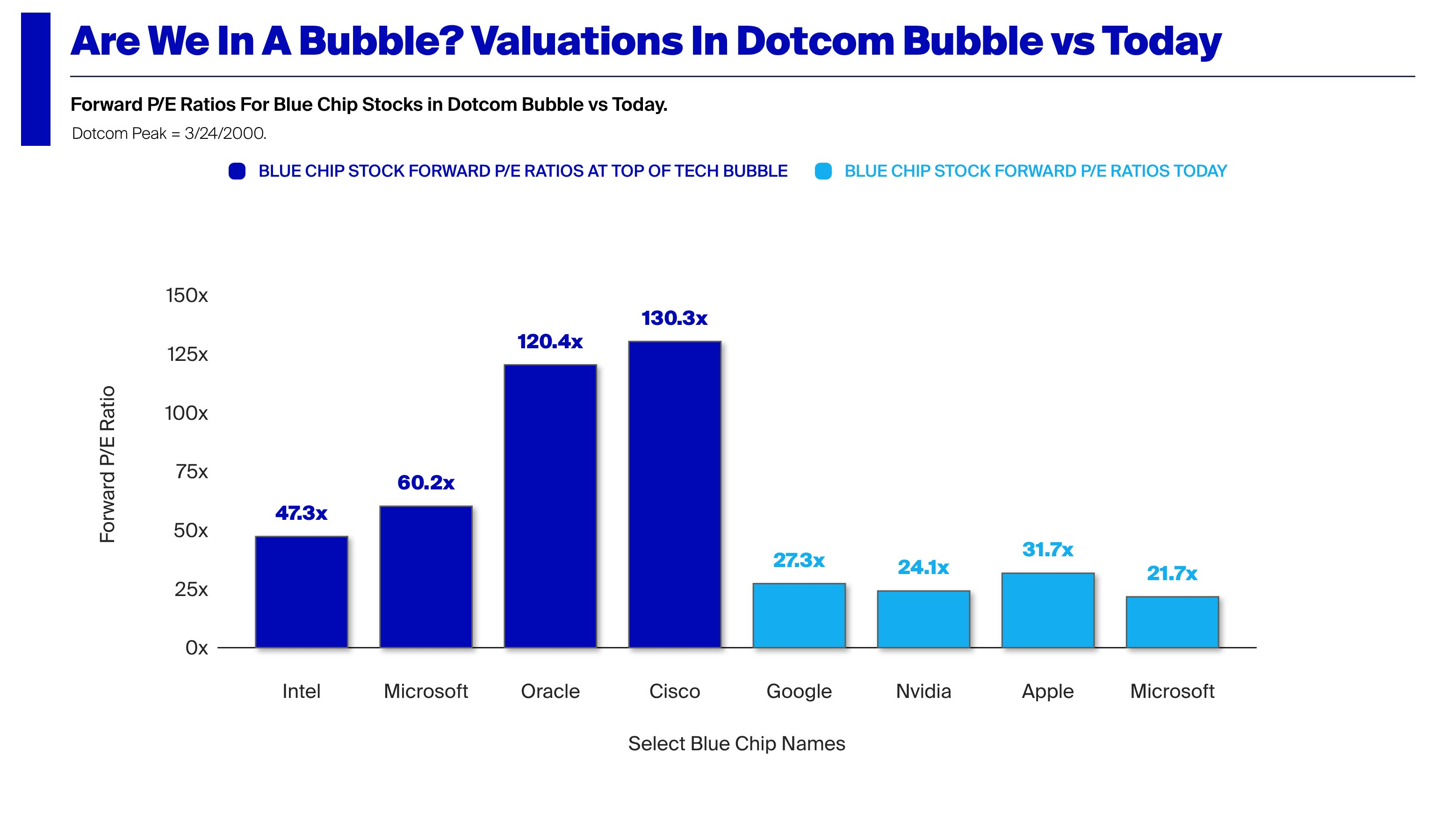
    This even as share prices and value concentration have risen even faster than in the Dot Com era. Seen from the P/E basis, it does not look like we are in a bubble. Earning growth is way up so the share prices are not outrageous on that basis. That is contrary to 1999 when P/E ratios in the hundreds were considered normal. Expectations of an internet fueled boom were speculative. Expectation of an AI earnings boom seem well founded.

    But these companies could still be over-valued. The P/E ratio is not the full picture. It is in fact a simplifying shortcut which ignores significant pockets and omissions of value.

    For this analysis I'll use a sample including some of the largest market caps in the world with two exceptions. The exceptions are Lilly (LLY), Berkshire Hathaway (BRK-B) which are on the list but not in the top 10 (though in top 15) and Saudi Aramco and Broadcom which are in the top 10 but not on the list[1].

    CompanyMarket Cap
    NVDA$5,709,746,405,376
    AAPL$4,379,916,369,920
    GOOG$4,811,891,146,752
    MSFT$3,041,424,048,128
    AMZN$2,874,514,866,176
    TSM$2,166,463,135,744
    TSLA$1,664,912,326,656
    META$1,569,837,154,304
    BRK-B$1,044,046,610,432
    LLY$897,716,060,160

    The following diagram shows the P/E ratios of the sample relative to the top 100 US market caps[2]. Note that, with one exception, the companies are not in the dark red zone with above P/E of 60. The exception is, of course, Tesla, which, at P/E of 400+ is 14x the average multiple.
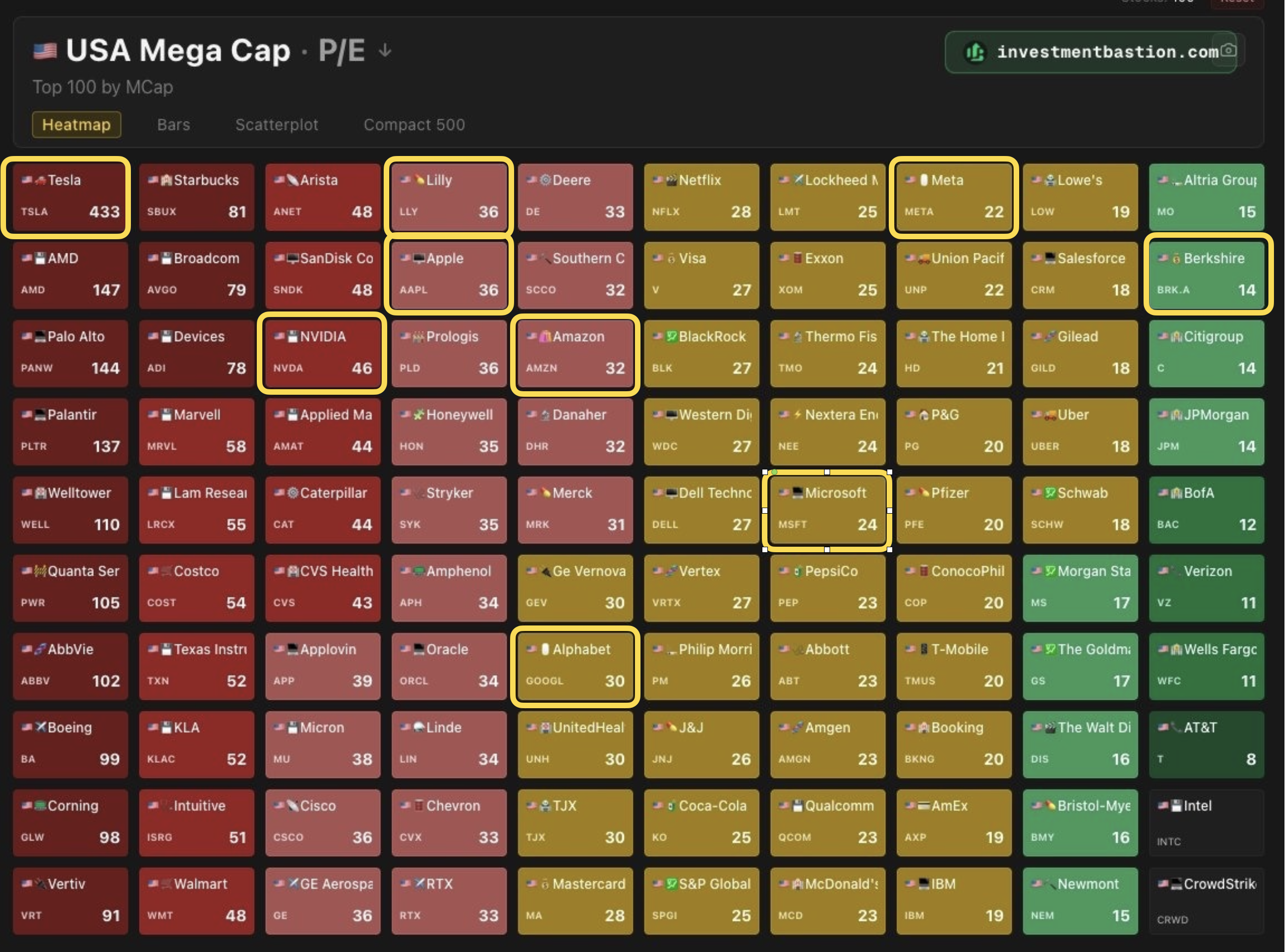
    Moreover, compared with the S&P 500, these P/E ratios are in-line with the median. The following graph shows the sample set with P/E ratio vs. Market Cap.
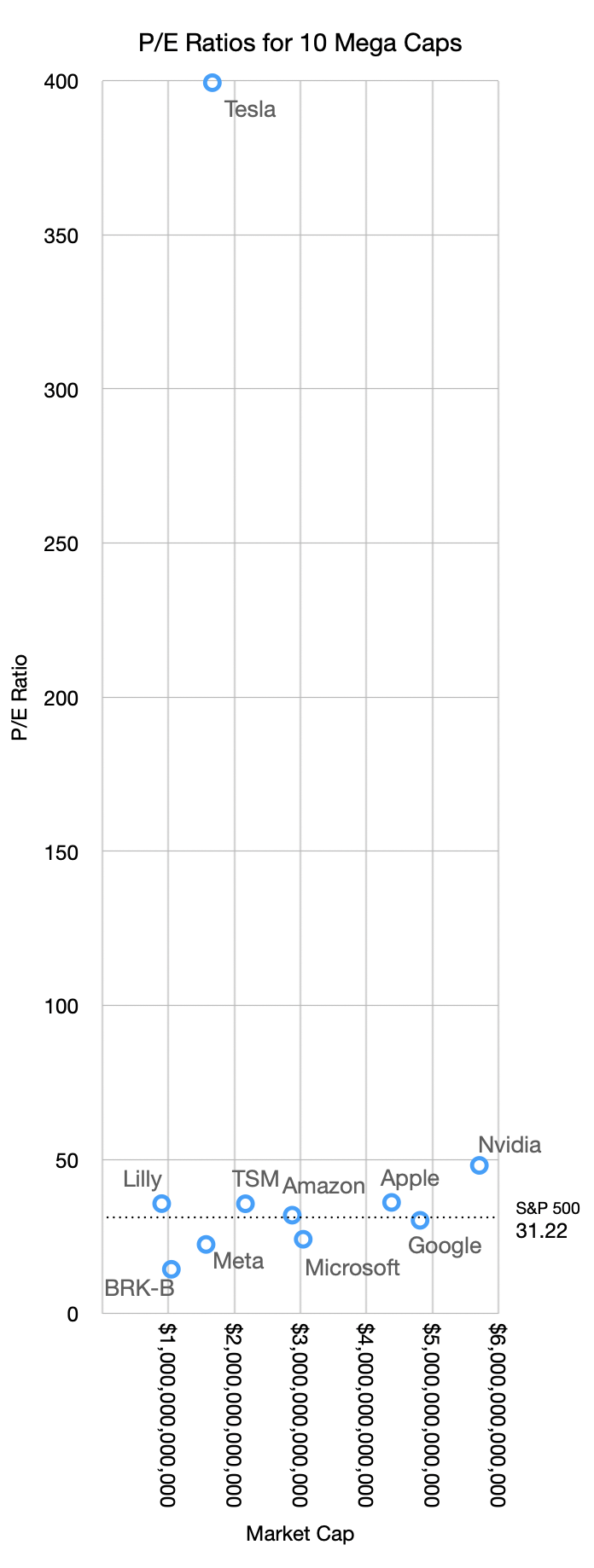
    Excluding the one anomaly the relationship seen is that higher market caps roughly correspond to higher P/Es. Nvidia has a market cap over $5.7 trillion with a P/E of 48 while Meta has a market cap of $1.5 trillion and a P/E of 22.5.

    Higher P/Es should also correspond to higher growth rates. The graph below shows the relationship between P/E and growth, both in the most recent quarter (MRQ) and trailing twelve months (TTM).
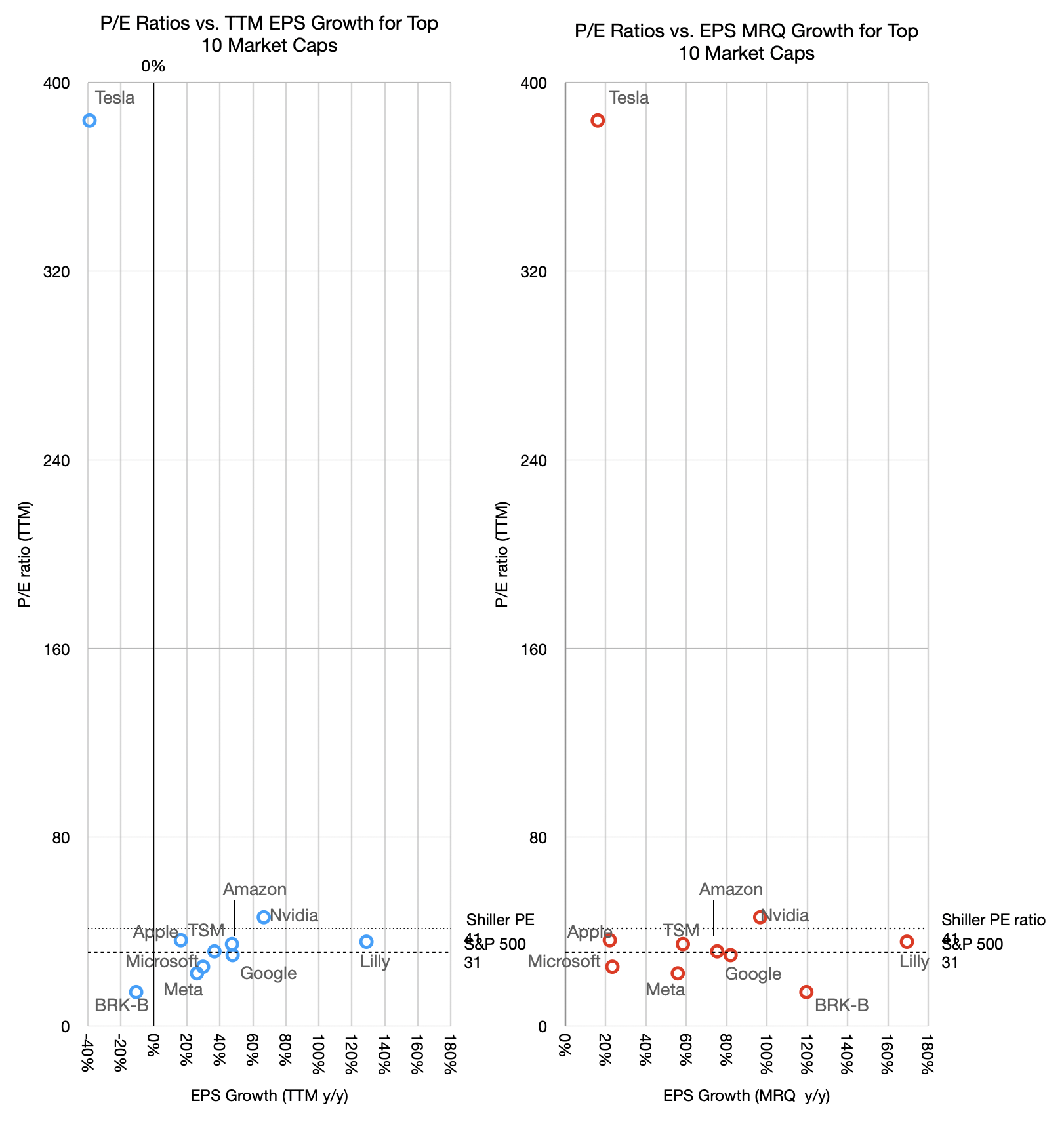
    There is a loose relationship between P/E and TTM growth but not with last quarter's growth. The one anomaly is even more prominent as it shows negative growth with exceptional valuation. Fundamentally however the relationship between P/E and growth is weak. Companies having widely divergent growth show similar P/E ratios. Alphabet for example has seen its P/E ratio in the 20s with growth in the 80s TTM and 50s MRQ.

    This might sound familiar. From 2008 to 2020 Apple was trading at a P/E ratio in the teens and low 20s while growing as fast as 80%. The logic was captured by my analogy of the goose that lays the golden eggs. Apple was able to create extraordinary products but the market considered such hits fleeting. It valued consistency over heroism. Getting on base vs. home runs. And so the P/E began to rise only once Services became more prominent. Regardless of how foreseeable this pattern was, it took a decade and is still ongoing for the pricing to catch up.

    But the situation with AI companies (that is, all the big tech companies but Apple) is that their earnings today are somewhat an illusion.

    An old maxim that says "earnings are an opinion while cash flow is a fact.[3]"

    This is because Net income can be manipulated by accounting abstractions, whereas cash flow is based on bank transactions.

    To wit: Net income (earnings) is calculated using accrual accounting, which relies heavily on judgment calls rather than bank balances. Companies recognize revenues the moment a contract is signed, even if the cash won't be collected for months. Or they can dial in a delay as they desire.

    Because of varying accounting policies, two identical companies with the exact same physical business can report vastly different earnings figures.

    Cash flow is objective and simply tracks the actual movement of money in and out of the business. Real dollars either enter the bank account or they don't. A company can look highly profitable on an income statement but still go bankrupt if its cash is trapped in unpaid invoices or unsold inventory.

    Finally, cash flow can be strongly negative while earnings are strongly positive. This is because investment in capital equipment does not appear in the income statement.

    Therefore true economic value is determined by the cash a company can actually distribute or reinvest rather than how it declares profitability based on accounting abstractions.

    AI companies are not necessarily hiding behind suspect earnings but their extraordinary capital expenditures are draining their cash and thus what investors have access to.

    Earnings seem to be soaring so the ratio P/E suggests a modest valuation. This is based on opinion or at least incompleteness.

    We should look at a better indicator. It's the EV/FCF ratio. We will look at this next.

    1. The top 10 ranking can change rapidly and it makes analysis difficult over longer time periods. The inclusion of LLY and BRK-B allow for visibility outside of the tech sector and they were in the list mid 2025. Saudi Aramco is in a completely different environment influenced by non-economic factors.
    2. TSMC is absent from the table as it is US only companies. It is notable perhaps that of the top 15, three are not US companies (TSMC, Samsung and Saudi Aramco). Furthermore the top Chinese company, Tencent is 25th, valued at $532 billion and the top European company is ASML at 21st and $610 billion.
    3. Attributed to economist Alfred Rappaport.
  2. Google’s free cash flow will hit zero next year

    Nota Bene · 8 comments

    The commodities strike back

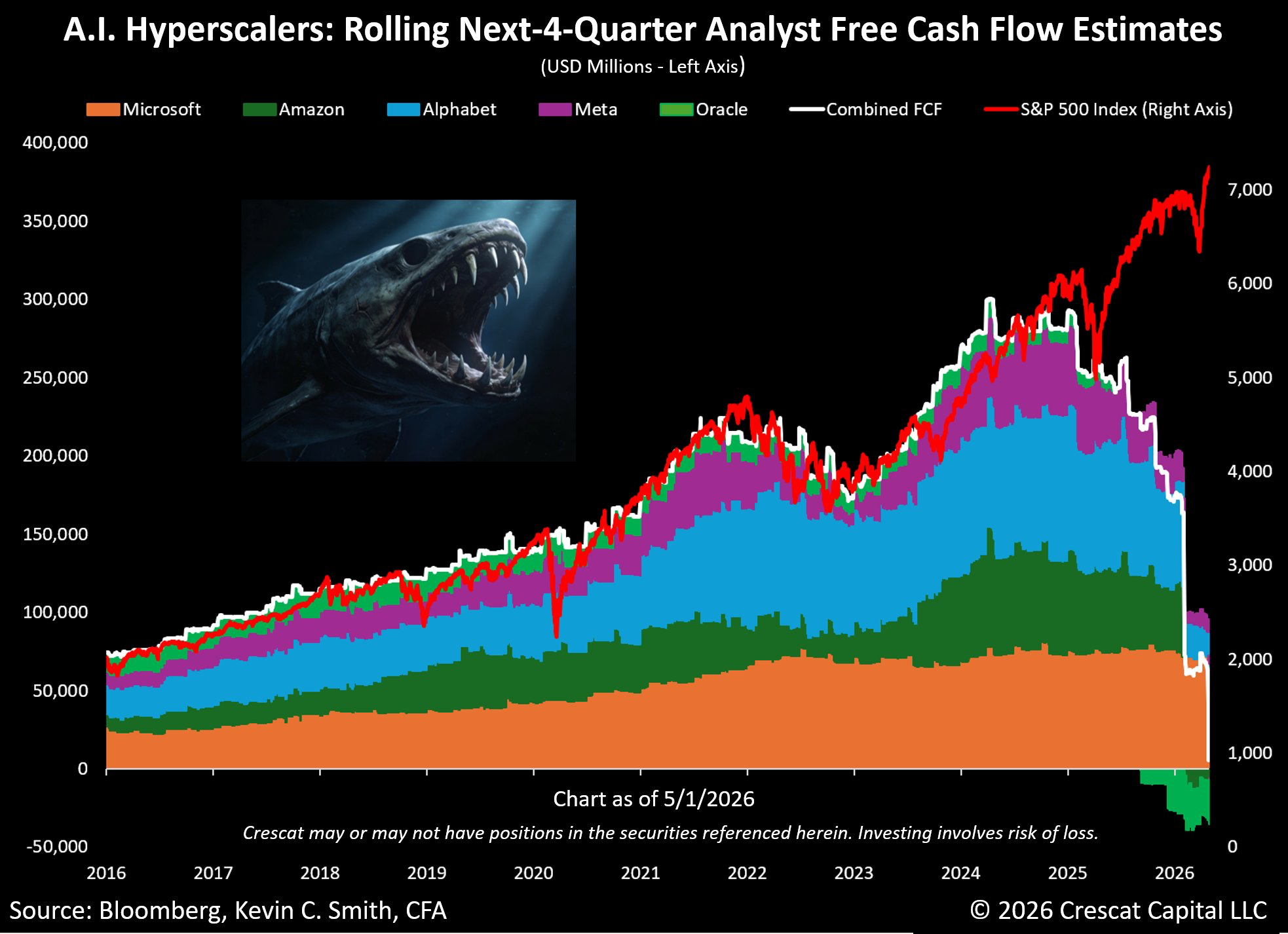
    Alphabet generated $73.266 billion in free cash flow in FY2025, which sounds enormous until you look at what's coming. CEO Sundar Pichai has guided for 2026 capital expenditures in the range of $175 to $185 billion. For context, Alphabet's FY2025 operating cash flow was $164.713 billion. If capex hits the midpoint of that guidance range, it consumes essentially all operating cash the business generates.

    The trajectory has been accelerating hard. In 2023, Alphabet spent $32.3 billion on capex. In 2024, that rose to $52.5 billion. In 2025, it hit $91.4 billion, a 74% year-over-year increase. The proposed jump to $175-185 billion in 2026 would be another near-doubling. Q4 2025 alone saw capex grow 95% year-over-year to $27.9 billion.

    This dynamic is playing out across the peer group. Amazon already lived this story in 2025: FY2025 free cash flow collapsed 65.95% year-over-year to $11.194 billion as capex hit $131.8 billion. CEO Andy Jassy has guided for approximately $200 billion in capital expenditures across Amazon in 2026.

    Meta and Microsoft are spending aggressively too. Meta's FY2025 free cash flow declined 19.39% year-over-year to $43.6 billion against 2026 capex guidance of $115 to $135 billion. Microsoft's Q2 FY2026 capex alone was $29.9 billion, up 89% year-over-year.

    Patel's broader point is that tech insiders understand the technology better than financial markets, and that returns on AI infrastructure will ultimately justify the spend. The businesses backing these bets are not struggling — Alphabet posted Google Cloud revenue of $17.7 billion in Q4 2025, up 48% year-over-year, with a 31.6% operating margin at the Alphabet level. Full detail is in Alphabet's SEC filing.

    Whether it's applied enough is exactly what Patel is questioning. If you believe AI infrastructure is a winner-take-most game and Alphabet and Amazon are positioned to win it, the FCF compression looks like the price of admission. If you think the returns won't materialize at the scale management expects, zero free cash flow at a $1.7 trillion market cap is a very different conversation.

    Source: Yahoo Finance

    NB: Even before these future investments are considered, for the trailing twelve months Alphabet's EV/FCF has his 73 vs. a P/E ratio of 29. If FCF goes to zero…

  3. Google to sell TPU chips as Gemini shows returns

    Nota Bene · 2 comments

    Why give all your cash to Nvidia? Why not make your own chips? Then why not sell them?

    Google said that it plans to sell its custom Tensor Processing Units (TPUs) to select customers who will install the chips in their own data centers.

    The move is a change from Google’s prior strategy, which saw it rent out TPU capacity to customers from its own data centers — and is yet another strike at AI chip king Nvidia.

    The announcement, during the company’s Q1 earnings call, comes a week after Alphabet announced two new TPUs: its TPU 8t for AI training and TPU 8i for inferencing.

    Alphabet didn’t disclose potential customers, but it signed a multiple-gigawatt agreement for next-generation TPUs with Anthropic earlier this month, with chips expected to begin coming online in 2027.

    And according to The Information, Alphabet has also entered into a multibillion-dollar chip deal with Meta (META).

    Source: Yahoo Finance

    NB: Alphabet Q1 sales grew 22% to $110 billion, with Cloud up 63% to $20 billion. Operating margins grew by 220 basis points, with services and cloud operating margins both increasing y/y.

    The search business continues to benefit from AI. AI overviews and AI mode are sustaining as search sales grew 19%.

  4. Apple at 50 - Ben Thompson interviews Horace Dediu

    Podcast · 4 comments

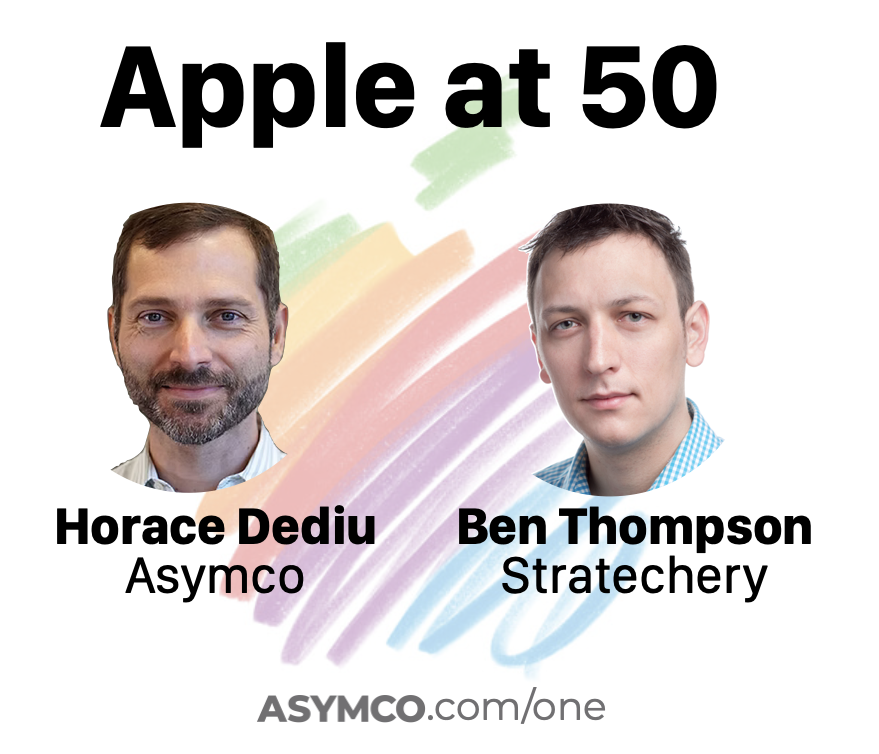
    Ben Thompson of the Stratechery interviews Horace on the Stratechery Plus Podcast to discuss Horace's journey to become an influential tech analyst: early career in research, business school under Clayton Christensen, and his time at Nokia during the rise of the iPhone. 

    The conversation further explores Disruption Theory in the context of both smartphones and AI, why Christensen misjudged Apple, and whether AI could challenge today’s tech giants. It also marks the launch of Dediu’s new paid service Asymco One and reflects his continued conviction in Apple Inc. at its 50-year milestone.

  5. People don’t like wearing things on their faces and don’t trust those who do

    Research · 1 comment

    Says Neal Stephenson who first coined the term “metaverse”

    This revelation came soon after Meta canceled the Metaverse.

    My thought was immediately, will Meta rename itself back to Facebook? We'll get to that soon, but first let's look into Neal Stephenson's mea culpa:

    When I was working at Magic Leap, and people asked me why I thought that [Metaverse] was a good idea, I would ask the rhetorical question: “do you really think that twenty years from now everyone is still going to be going around all day staring at little rectangles in their hands?” At the time it seemed obvious to me that the answer was no.

    Reader, I have changed my mind. Twenty years from now, everyone is still going to be staring at handheld rectangles. Or at least that is the case if the only alternative is wearing things on their faces. Maybe this should have been obvious to me given the amount of time, effort, and money people put into making their faces look as good as possible.

    A possible workaround is to keep refining and miniaturizing the devices to the point where they just look like eyeglasses. This, however, turns out to have the unintended side effect of making these things seem sinister. It happened with Google Glass, which instantaneously spawned the term “glasshole,” and it has happened again with Meta’s product that looks like normal, albeit heavy-framed glasses.

    When someone around you is staring at a rectangle in their hand, it might be incredibly annoying, but at least you can tell they’re doing it. When someone’s wearing a head-mounted display, on the other hand, you don’t know whether they are looking at you or not.

    Likewise, when someone holds up their phone and aims it at you, it’s obvious that you are on camera. That’s not true in the case of glasses or goggles. So it’s creepy.

    Timing is everything and 20 years is always kicked around as some "infinite time horizon". It's notoriously difficult to predict when a transition happens and too many times we give up because we were certain how long it would take. That's rather the story of my life.

    To remedy this, first, I never thought Magic Leap was interesting. Nor did I bother even skimming stories about Google Glass. I went nowhere near anything made by Facebook/Meta. Did not even try to use any one product, did not read specs, reviews or any other commentary.

    I knew the products would not be very good being not much more than demos or experiments. To understand the market, you first need to make a marketable product and these were not good enough.

    The goodness here was defined in the absence of creepiness. I've always argued that wearables are easily categorized: just look for places on the body where jewelry is placed and you'll know where wearables will be worn.

    Jewelry has been developer for thousands, perhaps hundreds of thousands of years and it is inextricably connected to our psyche. Glasses do pass for jewelry but only if they conform to high standards of style. Functional objects rarely are granted status as ornament. Finding that balance is the key. It happened with watches and maybe ladies' hats.

    Stephenson is right in saying that face ornaments are difficult "given the amount of time, effort, and money people put into making their faces look as good as possible."

    That does not disqualify face wearables entirely. It simply needs design thinking and that's what was always what I expected from Apple. The Apple Vision Pro was not meant to be used socially. It does not even work outdoors.

    It's a productivity product and one aimed at professionals. Apple will release a face wearable only when it conforms to its principles of user-centric design.

    That was not the case for Meta because it is not a company concerned with customer satisfaction. Its business model is to sell users to advertisers and was motivated to enter device development only so as to disintermediate the smartphone. Doing so would remove any impediments to harvesting users data. The priority of user affinity and affection was nice to have but it requires a maniacal attention to even have a chance of success at being loved.

    Rebranding around a hypothesis like the metaverse was impulsive but Facebook was a dying brand anyway and having diversified well beyond it, deprecating it was no great loss. Slapping on the Meta moniker was a bark up the wrong tree but not much was lost. I doubt there will be another change unless Zuckerberg falls in love with another way to get rid of its distributors.

    NB: Apple never chose to use Metaverse branding. What it developed was spatial computing. It approached the problem not as a content but as a platform and user interface. Will we move to spatial computing en masse to the detriment of "rectangles in our pockets". I don't think that the right question. In reflecting on the past of computing, a new platform did not just replace the previous but created new markets altogether.

    Each new interface was an order of magnitude more popular than its predecessor. Keyboard, mouse, touch, each added a few zeroes to the number of users. We are now at nearly 1:1 machine to human. I don't think that this is the limit.

    We are entering the n:1 machines to human and wearables are the only way we get there. And as I said, where there is jewelry there will be a machine. Spatial interfaces are more natural as far as our perceived reality is concerned. The rest is engineering.

  6. Amazon developing a new phone more than a decade after its first

    Nota Bene · 2 comments

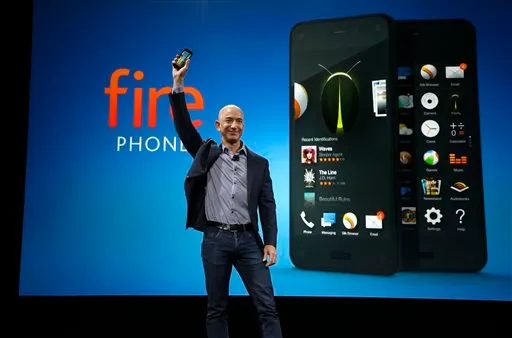
    Who remembers the Fire?

    The latest effort, known internally as “Transformer,” is being developed within its devices and services unit, according to four people familiar with the matter. The phone is ‌seen as a potential mobile personalization device that can sync with home voice assistant Alexa and serve as a conduit to Amazon customers throughout the day, the people said.

    The initiative is the newest chapter in a years-long effort to bring ‌to market Bezos’ long-held vision of a ubiquitous voice-driven computing assistant akin to the voice-controlled computer in science fiction series “Star Trek.”

    Bezos had envisioned a smartphone that had shopping at its core and could take on Apple by offering shipping convenience and discounts through the Prime membership. Along the way, Amazon could gain a wealth of ​new data about users only available through mobile phones combined with purchase history and content preferences.

    As envisioned, the new phone’s personalization features would make buying from Amazon.com, watching Prime Video, listening to Prime Music or ordering food from partners like Grubhub easier than ever, the people said. They asked for anonymity because they were not authorized to discuss internal matters.

    A key focus of the Transformer project has been integrating artificial intelligence ‌capabilities into the device, the people said. That could eliminate the need for traditional app stores, ⁠which require downloading and registering for applications before they can be used.

    The project is being led by a year-old group within Amazon’s devices unit called ZeroOne, whose mandate ​is to create “breakthrough” gadgets, the people said. ZeroOne is led by J Allard, a former Microsoft executive involved in such devices ​as the Zune music player and Xbox gaming console.

    The head of Amazon’s devices and services unit, Panos Panay, has been working to reverse years of unprofitability in the division. That includes a forthcoming tablet that ‌will—for the first time—run Android instead of Fire OS and could sell for around $400, which Reuters was ​first to report.

    One inspiration for the new phone has been the Light Phone, two of the people said, a $700 minimalist smartphone with a camera, map, calendar and not much else, such as an app store or web browser.

    A dumbphone or feature phone could also ​help Amazon market it as a potential second handset to accompany iPhones and Samsung Galaxies already ‌in customers’ pockets, the people said. Such handsets, like the Light Phone and flip phones, accounted for 15% of global handset sales in 2025, according to Counterpoint Research.

    Source: Yahoo Finance

    NB: The problem with any new phone, whether it's from Amazon or Google or Meta or OpenAI or Trump…

  7. Movies and the Internet

    Research

    Almost a year ago, on March 1st, 2021, I tweeted a snapshot of the "FAANG" P/E ratios. They were:

    • Netflix: 88.63
    • Amazon: 73.94
    • Microsoft: 34.65
    • Google: 34.75
    • Apple: 32.89
    • Facebook: 25.53

    Today same companies have the following ratios:

    • Netflix: 19.34
    • Amazon: 46.08
    • Microsoft: 30.17
    • Google: 22.35
    • Apple: 27.79
    • Facebook: 13.67

    What a difference 13 months makes. Microsoft and Apple saw modest falls 13% to 16%. Amazon, Google and Facebook saw large falls in their ratios: 38%, 36% and 48%. Facebook (now renamed pitifully as "Meta") in particular saw its valuation collapse by half! This is largely because in February the company forecasted lower than expected revenue growth in the next quarter, blaming privacy changes in iOS, macroeconomic challenges, and the market finally realizing that it's an evil and despicable company.

    Microsoft and Apple grew their businesses nicely and have been resilient post-Covid. They are now revenue-reliable "blue chip" tech companies with large user bases that encompass high value, loyal customers. Google and Amazon are a bit more precarious given exposure to macro conditions and unclear new market opportunities but Amazon is still sporting a very healthy 46 ratio which is largely due to its investment-heavy approach to cash flow.

    But the star of the show, the real blockbuster, is Netflix. It fell from P/E of 88 to P/E of 19. Even six months ago the P/E was close to 70. What happened?

    Remember that P/E is an indication of growth potential. A P/E of 19 implies that the equity should be priced at 19 times last year's earnings, which are roughly indicative of profit in a year and thus P/E is a time horizon: how many years would I wait before I got my investment capital back (and thus break-even).

    Well, one could say that a P/E of 13 or 19 (FB or NFLX) is pretty reasonable. It's reasonable to pay that many years' profit for a company. The large ratios only make sense if a company is growing rapidly. 20% to 30% growth can justify P/E of above 20. But what would justify a P/E of 88?

    The market has always given Netflix high valuation because it was growing and when the growth stopped the P/E fell to a more reasonable level. Unfortunately that means the share price had to fall over 70% from its peak. More than 40% in two days. Tragic.

    The stock peaked at $700 in October and is $221 now. Why were investors betting on high growth, just a few months ago?

    I think it was because investors like movies. And the Internet. Investors like movies and the Internet.

    Netflix was never a great business. The logic evolved from sending movies as DVDs by email, ordered through an online catalog, to having the same selection available for download (streaming). Everything was subscription-based so bundling gave movies a "binging" consumption option.

    But this depended on the having access to good titles. The access was easy at first since Netflix was a new channel and it was a bonus for the movie publisher. Pure margin. But over time the movie publishers saw the new channel eating into existing distribution and they thought they could deliver it themselves, increasing margins. The catalogs were suddenly cut off.

    Netflix responded bravely: they would make their own movies. Out came the checkbooks and the distributor became the producer.

    Amazing.

    But is that really a good business? You have to make movies which are very expensive. Some will be hits, some won't. You thus have to make a lot of them. And then you have diverse demand. People want to have all kinds of genres. So you have to make them all. And what's more you can't really market them as events because they are so numerous. It sounds really hit-and-miss with a huge risk.

    At this point you have to raise pricing. And then came the competition who, like Disney, said "we have better, more targeted family content". Or Apple TV+ which simply said "we have better quality." Many other streamers offered alternatives like Amazon Prime with a smorgasbord approach. Sure, households could subscribe to all these services, but the bill would start to be painful. Not much savings over the cable bundle. Netflix increasing price sends many for the exits.

    The company then drops a bomb: they feel they can't grow subscribers because they are "near saturation" and the families which are not yet paying are probably using "shared" passwords. It can only grow if it converts the non-payers.

    That all happened rather quickly. The market loves movies and the internet and who doesn't. It's just that movies and the internet don't make a great business.

    Movies look to be more of a feature of an internet service bundle. That's Apple's approach. They don't see video as a business but as hygiene: must-have something to put in a bundle.

    So Netflix, who first unbundled the neighborhood video store, then bundled production and distribution was itself not much more than a substitutable piece of a bigger bundle.

    For this reason I always wondered why there was an "N" in FAANG. Netflix always seemed more a transient idea: yes people like movies, as they like music and books and magazines. And producing and distributing media has undergone dramatic change with computing and internet. But a business that only produces and distributes a single media type may be an ok business but should it be put on the same level as platform companies with billions of users?

    Netflix has 200 million subs but that is not a big number. Apple distributes 785 million subscriptions to over 1 billion customers. Google has at least 2 billion users, Microsoft about 1.5 billion and Meta is over 3 billion. Netflix says it can't get many more and indeed they forecast losing 2 million next quarter.

    It's a bit sad, but reminiscent of the games industry: it has its limits and the limits mean that it can't be seen as a ubiquitous and hence maximally valuable asset.