Asymco

Asymmetric Intelligence

Netflix

  1. Asymco Bulletin 002 / March 1, 2026

    Bulletin

    Asymco Bulletin is a digest of all the work we have published for the week ending March 1, 2026.

    Office Hours

    Our first Office Hours interactive seminar and Ask Me Anything questions/answer session will be on March 4th, after, presumably all the new announcements Apple will be making during the week. I will be broadcasting to you en vivo y en directo from Paris.
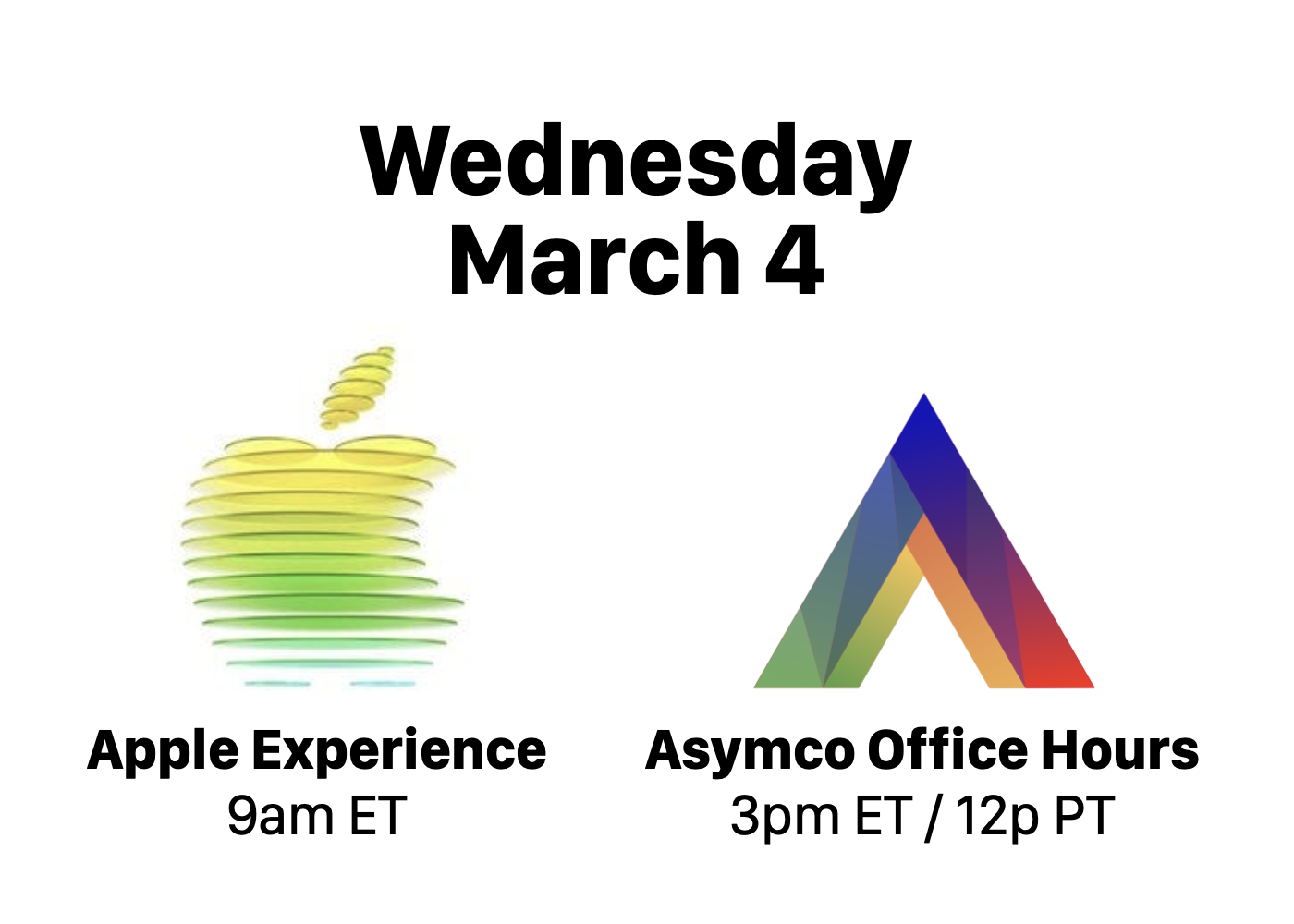
    Apple March 4 Special Event – Q&A

    Apple March 4 Special Event – Q&A → Join us for an exclusive Asymco One live Q&A on March 4 at 3pm ET to dissect Apple's latest business moves. →

    Research

    How many Apple users are in China?

    Greater China (GC) is a specific reporting segment for Apple, encompassing Mainland China, Taiwan, Hong Kong, and Macao, with a combined population nearing 1.5 billion. This region is not just a significant contributor to Apple's revenue—accounting for 18% of net sales in Q4 2025—but also a dynamic landscape of technological adoption and consumer behavior. The smartphone user base in GC has surged from 690 million in 2016 to nearly a billion in 2025, with projections reaching 1.08 billion by 2029.

    The iOS ecosystem within GC exhibits varied dynamics across its constituent regions. While Macao maintains a steady iOS share of around 60%, Mainland China and Taiwan show different trajectories. Analyzing these trends through mobile OS share data reveals iOS's ascent, suggesting robust potential for further penetration and user engagement. As Apple navigates this complex market, understanding GC's historical growth patterns and future prospects is crucial for capitalizing on emerging opportunities and sustaining its competitive edge. →


    Nota Bene

    Apple #1 phone vendor in Europe → Apple leads Q4 2025 with a 7% YoY shipment rise driven by iPhone 17, while Samsung follows with 4% growth; Xiaomi faces a 6% decline amid shifting regional dynamics. →

    Are Solid State Batteries Finally Here? → Donut Lab has partnered with VTT for independent battery tests, with full reports and videos to follow. →

    iPhone becomes India’s top single export item → In 2025, Apple's iPhone exports from India, driven by Tata and Foxconn plants and a robust supply chain, reached $23 billion, making smartphones the top export category. →

    Apple’s App Store growth is reaccelerating → Apple's Services, beyond just the App Store, are poised for robust growth, driven by global market expansion and strong hardware demand. →

    Here’s why demand for Macs has spiked → Mac lead times have surged to multi-year highs due to increased demand, notably impacting models like Mac Studio, MacBook Pro M4, and Mac Mini. →

    A resource for AVP news → "AVP VIP offers a weekly, ad-free digest of tech news and insights, accessible to Asymco One members." →

    Apple to Start Assembling Mac mini in the United States This Year → Apple revamps the Mac mini with M4 chips and boosts U.S. chip sourcing, starting at $599 without display, amid rising demand. →

    Apple Pay Aiming Launch in India This Year → Apple Pay aims to launch in India by late 2026, pending regulatory approvals and fee negotiations with card issuers. →

    iPhone and iPad approved to handle classified NATO information → Apple's iPhone and iPad achieve unprecedented NATO compliance, marking a pivotal shift in secure mobile technology acceptance. →

    Eddy Cue says Brazil is Apple TV’s second-largest market, talks Netflix-Warner merger → In an interview, Apple's Eddy Cue highlighted Brazil as the second-largest and fastest-growing market for Apple TV subscribers, while noting potential impacts from proposed streaming regulations and a possible Netflix-Warner deal. Specific user and device numbers were not disclosed. →

    DRAM Shortage Will Cause ‘Seismic Shift’ in Smartphone Market, But Apple Will Be Less Affected → A looming DRAM shortage due to AI demand will slash smartphone sales by 13% in 2026, forcing a market shift towards pricier devices, with relief not expected until mid-2027. →


    Asymco One gives you full access to our research, analysis, and commentary. Subscribe with code BULLETIN for a discount.

    Feedback: Have questions or comments? Reach out to us at contact@asymco.com. We’d love to hear from you.
  2. Eddy Cue says Brazil is Apple TV’s second-largest market, talks Netflix-Warner merger

    Nota Bene · 1 comment

    How big is Brazil for Apple, exactly?

    In an interview with Brazilian newspaper Folha de S. Paulo, Cue emphasized Brazil’s growing role in Apple TV’s global business, reaffirmed the company’s commitment to theatrical releases, and commented on Netflix’s attempt to acquire Warner Bros.

    Cue says Brazil is Apple TV’s second-largest and fastest-growing market in terms of subscribers. He adds that Apple is closely watching proposed streaming regulations in the country that could require national content quotas:

    During the conversation, Cue also said Apple remains committed to doing theatrical releases through partnerships with traditional distributors. And although he recognized that “the bar for leaving home and going to the movie theater” is getting increasingly higher, he said:

    Finally, Cue commented on how a potential Netflix–Warner deal could affect Apple, which has partnered with Warner on films including F1: The Movie.

    Source: 9to5Mac

    NB: To appreciate the Brazilian market for Apple we need to know the number of users, iPhones and devices in use. That information will be published...

  3. Apple is Doomed, Revisited

    Research

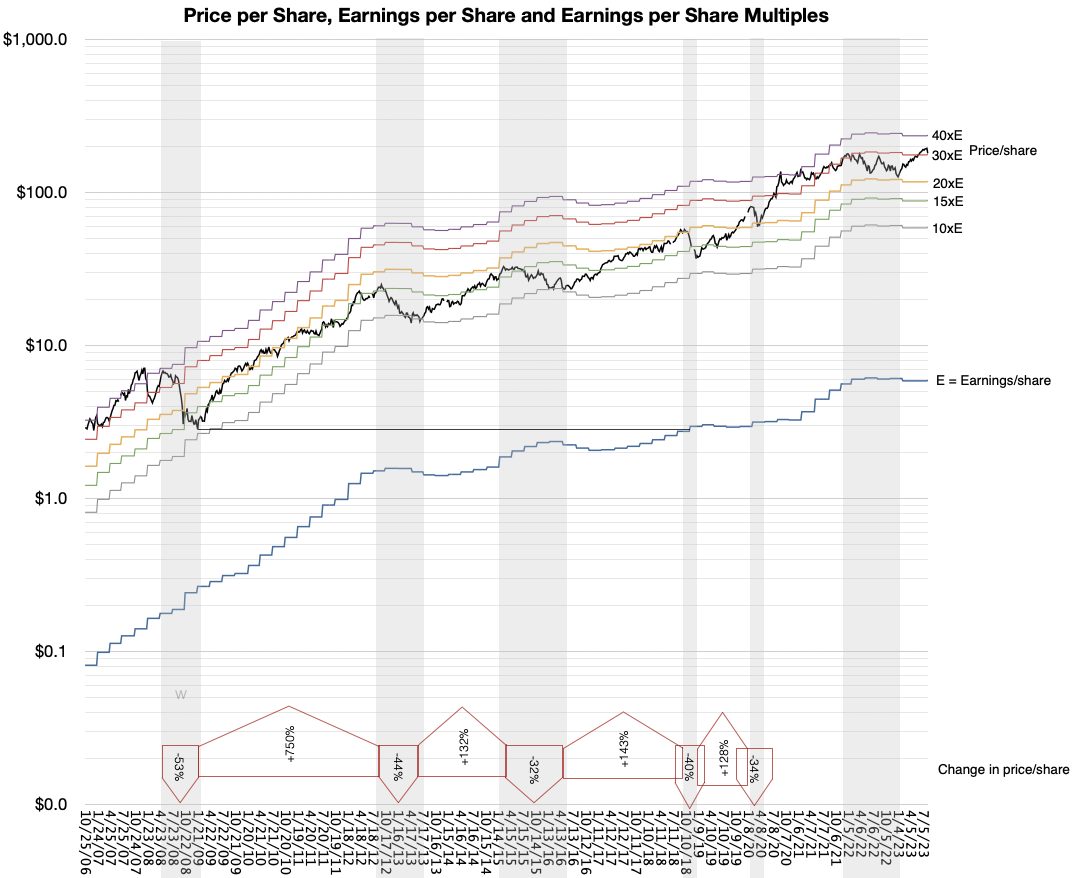
    Before the iPhone launched in late 2007, Apple was trading consistently at a P/E ratio above 30. Here is a table for the P/E ratio on each Friday's closing price from May to August, 2007. The iPhone launched on June 29, 2007.

    Apple's P/E ratio around the iPhone launch
    DateP/E Ratio
    5/23/0731.5
    5/30/0731.6
    6/6/0734.1
    6/13/0733.7
    6/20/0734.6
    6/27/0733.6 (2 days before iPhone launch)
    7/11/0737.2
    7/18/0734.6
    7/25/0734.3
    8/1/0733.3
    8/8/0734.2
    8/15/0730.2

    Apple was not super powerful but it was not doomed either. It was a time when the iPod was dominant and the Mac was still alive. iTunes re-wrote the rules of the music industry and debate was raging whether Apple should be considered a media company. Platforms were not its strength but Steve Jobs showed he was still able to distort reality.

    These good times did not last. The first year of the iPhone was a period of minimal contribution from the new category with Apple still largely valued on the basis of the iPod. The predictions of failure for the new communications product, especially given its high price, were legendary. It wasn't until 2008 that the iPhone began accelerating and making a meaningful contribution to the bottom line.

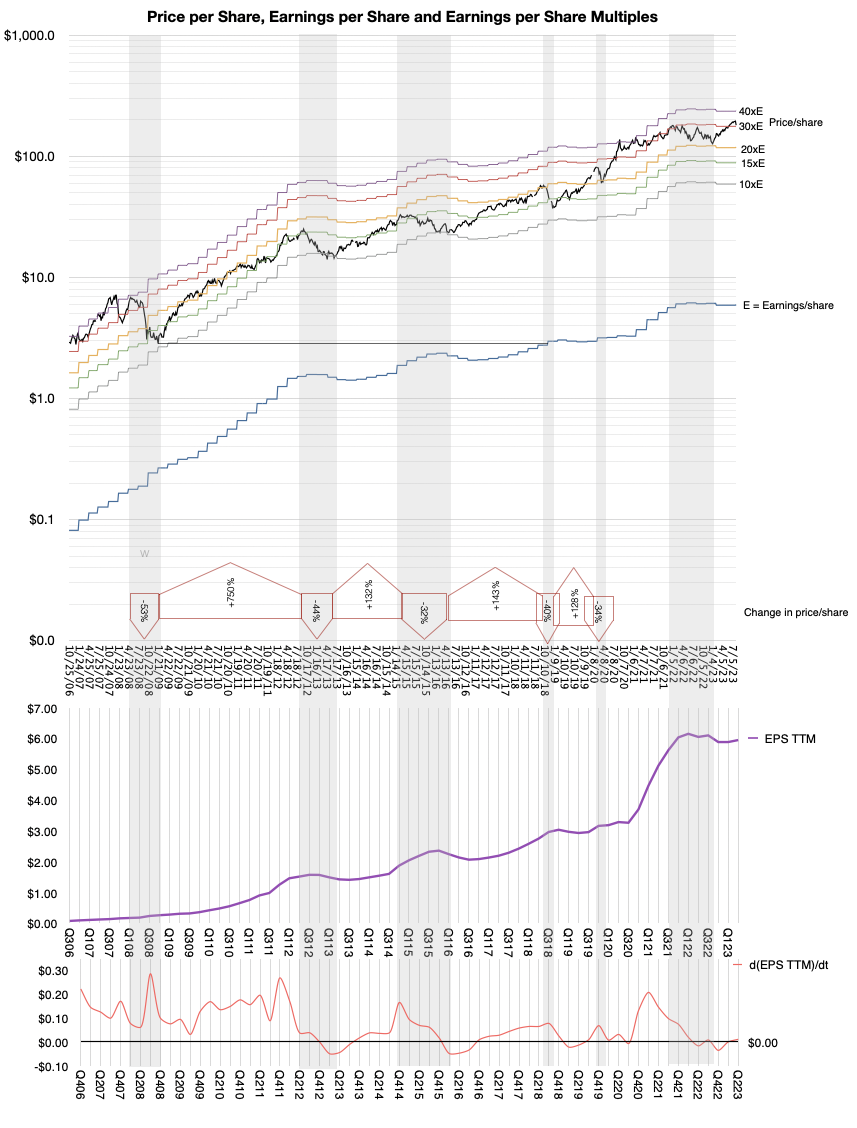
    It was then, in late 2008, that Apple's valuation broke. The P/E ratio fell from above 30 to nearly 10. The following graph shows the catastrophic 53% share price collapse coupled to the triple digit surge in earnings which led to the P/E ratio tanking.

    [The graph shows earnings per share for the trailing 12 months (blue line) and 10x, 15x, 20x, 30x and 40x that value (colored lines). The share price is the black line. The share prices are sampled every Friday. The graph is notably logarithmic. The grey shaded areas are periods of significant contraction. The percent drops/increases during these periods of contraction/expansion are shown in the annotation arrows near the bottom.]

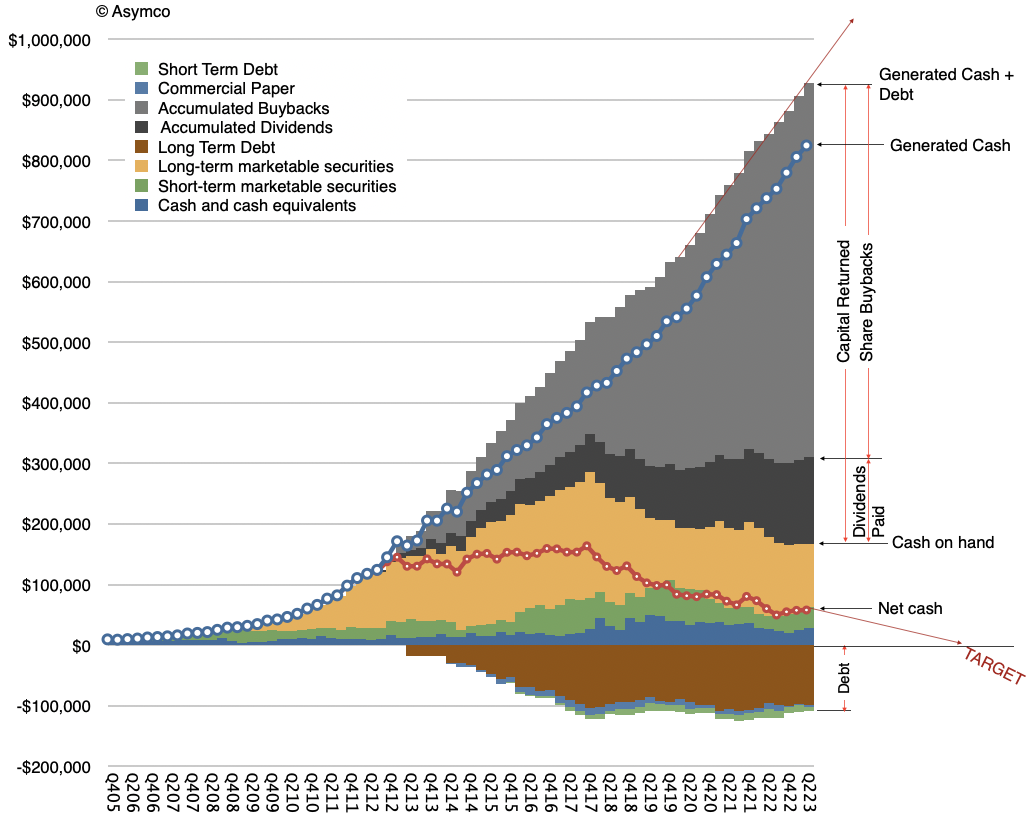
    The valuation remained broken for 12 years, between late 2008 and late 2020. This period being, arguably, the most remarkable wealth creation event in history of business. For evidence see the following graph showing the amount of retained earnings returned to shareholders building inexorably toward one trillion dollars. This is not share price appreciation but cash returns. [If you have evidence of a larger wealth-creation event do let me know.]

    The creation of $800 billion of shareholder wealth at fire-sale share pricing.

    As I explained throughout this period, motivation to dispose of shares which create immense wealth is explained by the fable The Goose That Laid the Golden Eggs but the question some are asking now is whether more wealth can still be created, and if so, can we expect Apple's valuation to collapse accordingly?

    I should note that during the long, dark years of wealth creation, other technology companies such as FaceBook, Amazon and Netflix, Google (so-called FAANG) and Microsoft enjoyed far higher multiples than Apple, sometimes 3x higher. This was not seen as abnormal by analysts because those companies were always assumed to have higher growth potential, with a diverse portfolio of opportunities while Apple's growth was perpetually in its past, based on one product.

    Paradoxically perhaps, since the Covid-19 pandemic Apple shares have enjoyed P/E ratio roughly equivalent to the other tech companies. For instance, peaking at 42 in January 2021, the P/E ratio has averaged about 27.5 since then. Simultaneously, diversified companies such as FaceBook (now Meta) and Netflix collapsed due to serious business model flaws (based on single sources of income) and Google (now Alphabet) and Amazon have slowed growth and are facing anti-trust scrutiny. Having lost any presence in mobile computing Microsoft has become entrenched in enterprise, finding new businesses in cloud and (possibly) generative AI. As a result of these reversals, the contrast between Apple and the mega-cap cohort has become fuzzy.

    So back to the question: does it make sense to price Apple in the 30x P/E or should it go back in the gutter at 10 to 20?

    I would argue that the big change in perception hasn't been the surge in earnings during Covid (see graph below). The big change is the realization that Apple is no longer about to go out of business.

    How could Apple not be going out of business?

    Remember that a P/E ratio in the teens is a clear signal from the market that the company is a questionable "going concern". This is parlance indicating doubt that the company will continue in its present form..

    What has changed since 2020 is that even though there were a multitude of crises—from war to pestilence—the eggs kept coming. Perhaps, perhaps, Apple was not doomed after all. In that time it managed to create 1 billion customers. Perhaps having 1 billion customers was a positive outcome. Perhaps counting iPhones during a single quarter was not the only way to value the company. Perhaps having 1 billion satisfied customers made it viable. Perhaps having 1 billion satisfied and loyal customers returning every year was interesting. Perhaps having 1 billion satisfied wealthy customers meant the end is not around the corner. Perhaps having 2 billion active devices in use was sustainable. Perhaps providing services to 1 billion customers using 2 billion devices delivered through 1 billion subscriptions made some sense. Perhaps having all this data in a linear graph made it predictable?

    Perhaps. Though Apple provided updates on these figures regularly, the questions everyone asked were still on unit shipments (which Apple stopped providing.) While Services grew at double digits and 70% margins the questions from analysts on conference calls persist on the iPhone and currency or production "headwinds". Perceptions take time to change. They are still changing.

    Maybe at this point it's time to agree that Apple's end will not come through being easily replaced by the competition (first Windows then Android, etc.) but by having access to its markets restricted. Being the only American company to have cracked the China puzzle, it's surely vulnerable there. And please don't mention India.

    Apple is no longer doomed because it's too weak. It's doomed because it's too strong.

    It seems that it's not too hard to believe the end is still near.

  4. Movies and the Internet

    Research

    Almost a year ago, on March 1st, 2021, I tweeted a snapshot of the "FAANG" P/E ratios. They were:

    • Netflix: 88.63
    • Amazon: 73.94
    • Microsoft: 34.65
    • Google: 34.75
    • Apple: 32.89
    • Facebook: 25.53

    Today same companies have the following ratios:

    • Netflix: 19.34
    • Amazon: 46.08
    • Microsoft: 30.17
    • Google: 22.35
    • Apple: 27.79
    • Facebook: 13.67

    What a difference 13 months makes. Microsoft and Apple saw modest falls 13% to 16%. Amazon, Google and Facebook saw large falls in their ratios: 38%, 36% and 48%. Facebook (now renamed pitifully as "Meta") in particular saw its valuation collapse by half! This is largely because in February the company forecasted lower than expected revenue growth in the next quarter, blaming privacy changes in iOS, macroeconomic challenges, and the market finally realizing that it's an evil and despicable company.

    Microsoft and Apple grew their businesses nicely and have been resilient post-Covid. They are now revenue-reliable "blue chip" tech companies with large user bases that encompass high value, loyal customers. Google and Amazon are a bit more precarious given exposure to macro conditions and unclear new market opportunities but Amazon is still sporting a very healthy 46 ratio which is largely due to its investment-heavy approach to cash flow.

    But the star of the show, the real blockbuster, is Netflix. It fell from P/E of 88 to P/E of 19. Even six months ago the P/E was close to 70. What happened?

    Remember that P/E is an indication of growth potential. A P/E of 19 implies that the equity should be priced at 19 times last year's earnings, which are roughly indicative of profit in a year and thus P/E is a time horizon: how many years would I wait before I got my investment capital back (and thus break-even).

    Well, one could say that a P/E of 13 or 19 (FB or NFLX) is pretty reasonable. It's reasonable to pay that many years' profit for a company. The large ratios only make sense if a company is growing rapidly. 20% to 30% growth can justify P/E of above 20. But what would justify a P/E of 88?

    The market has always given Netflix high valuation because it was growing and when the growth stopped the P/E fell to a more reasonable level. Unfortunately that means the share price had to fall over 70% from its peak. More than 40% in two days. Tragic.

    The stock peaked at $700 in October and is $221 now. Why were investors betting on high growth, just a few months ago?

    I think it was because investors like movies. And the Internet. Investors like movies and the Internet.

    Netflix was never a great business. The logic evolved from sending movies as DVDs by email, ordered through an online catalog, to having the same selection available for download (streaming). Everything was subscription-based so bundling gave movies a "binging" consumption option.

    But this depended on the having access to good titles. The access was easy at first since Netflix was a new channel and it was a bonus for the movie publisher. Pure margin. But over time the movie publishers saw the new channel eating into existing distribution and they thought they could deliver it themselves, increasing margins. The catalogs were suddenly cut off.

    Netflix responded bravely: they would make their own movies. Out came the checkbooks and the distributor became the producer.

    Amazing.

    But is that really a good business? You have to make movies which are very expensive. Some will be hits, some won't. You thus have to make a lot of them. And then you have diverse demand. People want to have all kinds of genres. So you have to make them all. And what's more you can't really market them as events because they are so numerous. It sounds really hit-and-miss with a huge risk.

    At this point you have to raise pricing. And then came the competition who, like Disney, said "we have better, more targeted family content". Or Apple TV+ which simply said "we have better quality." Many other streamers offered alternatives like Amazon Prime with a smorgasbord approach. Sure, households could subscribe to all these services, but the bill would start to be painful. Not much savings over the cable bundle. Netflix increasing price sends many for the exits.

    The company then drops a bomb: they feel they can't grow subscribers because they are "near saturation" and the families which are not yet paying are probably using "shared" passwords. It can only grow if it converts the non-payers.

    That all happened rather quickly. The market loves movies and the internet and who doesn't. It's just that movies and the internet don't make a great business.

    Movies look to be more of a feature of an internet service bundle. That's Apple's approach. They don't see video as a business but as hygiene: must-have something to put in a bundle.

    So Netflix, who first unbundled the neighborhood video store, then bundled production and distribution was itself not much more than a substitutable piece of a bigger bundle.

    For this reason I always wondered why there was an "N" in FAANG. Netflix always seemed more a transient idea: yes people like movies, as they like music and books and magazines. And producing and distributing media has undergone dramatic change with computing and internet. But a business that only produces and distributes a single media type may be an ok business but should it be put on the same level as platform companies with billions of users?

    Netflix has 200 million subs but that is not a big number. Apple distributes 785 million subscriptions to over 1 billion customers. Google has at least 2 billion users, Microsoft about 1.5 billion and Meta is over 3 billion. Netflix says it can't get many more and indeed they forecast losing 2 million next quarter.

    It's a bit sad, but reminiscent of the games industry: it has its limits and the limits mean that it can't be seen as a ubiquitous and hence maximally valuable asset.

  5. Why does Apple TV deserve to exist?

    Research · 93 comments

    Since writing Peak Cable six months ago, surveys, research and analysis have contributed to the themes of unbundling the TV package. The data under scrutiny is, as usual, the data that can be gathered. Unfortunately the data that can't be gathered is where the insight into what is happening may lie. For instance, what matters for an entertainer is not how much you're watched but how much you're loved. Measuring love is done poorly with data on payment for subscriptions.

    A better proxy might be time. Liam Boluk makes the point in his post that "focusing on cord cutting or even cord shaving largely misses the point." Don't follow the dollars, he says, follow the time or engagement. "Relevance" is what matters.

    His data shows how linear TV has fallen by roughly 30% among the young (12-34) in the last five years. The trouble for the TV bundle (and advertisers) is that this is the most culturally influential group. They are also the group which will grow into the highest income group over the next decade. And this group does not love TV.

    We have to remember that it was the youth who drove early radio, TV and consumer electronics markets. Those young are now the old which still cling to the old media, served by companies that grew old with them. They are the "high-end" customers with which Nielsen itself has grown. They have the most money to spend and they are the targets for the ads ((no longer the Pepsi generation, they are the Depend and Viagra and pharmaceuticals generation))

    Paying $150/month to watch incontinence and erectile dysfunction ads—at a time not of your choosing—is preposterous for the young. They may like the programs but not the way they are packaged, delivered or interrupted. They are not smarter than their parents. They, like their parents, took to new technology more quickly. What makes the technology new is also what lets its makers separate the content from its delivery. These new technologies allow "modularizing" or unbundling that which was was integrated/bundled and thus allow their developers to focus on the customer's real jobs-to-be-done.

    Unsurprisingly, incumbents have responded by throttling access to original programming–an asset over which they still exert influence as distributors. Netflix and Amazon are taking the path of responding with their own blockbuster productions. Although Silicon Valley has more capital to deploy than Hollywood  this battle of attrition is by no means one that incumbents will win, and generally, it's not going to be pretty.

    Tweaking the nose of the incumbent might not be the way to establish asymmetry. The better tactic may be to help the system survive but offer a "short-term alternative". This is how iTunes took on and won Music. When Napster and file sharing created a clear and present danger to the industry, Apple's approach of a controlled alternative allowed the industry to finally move to a digital download model.

    An observer in 2004 would have said that Apple was bowing to the industry and providing it sustenance against "disruptive" free music. However, as behavior shifted to an overwhelming preference of iTunes downloads over physical media, the music labels found themselves in an untenable negotiating position. They had to concede on DRM, pricing and bundling itself. The music disruption occurred with a tacit acceptance and collaboration by the incumbents.

    Is history repeating? Looking at the situation around TV today, the strategies of the challengers can be summarized in a similar way:

    1. The content low-end: Now, YouTube, Twitch. Then, Napster, Gnutella
    2. The distribution low-end: Now, Netflix, Amazon. Then, incumbent music download sites.
    3. The nominally sustaining: Now Apple TV. Then, iTunes

    Apple cannot play an "ignore me" strategy because as much as investors think the company is irrelevant, everything it does is closely watched by anybody who might be even remotely touched by it. Especially in entertainment.

    In addition, due to brand considerations, the company cannot ship low-quality or no-quality product, including material that sits on its platform.

    They have to do something different. Something more complicated and something that takes much longer.

    What Apple best contributes asymmetrically is a new experience. The experience allows new behavior, new usage models and hence new loyalties to emerge. The loyalties create affinity which shifts the "love interest" for the user. The new Apple TV attempts to provide such a contribution. Not only in terms of the experience but also for becoming, finally, a platform for developers, who will try to make the product itself better in collaboration with Apple. Thus the "new experience" flips when bits which are streamed cohabit a device with bits which expect a consumer response.

    This "appification" becomes an interesting experiment in behavior alteration. Will "couch time" change from pure passivity to partial interaction?

    To the orthodox adherents to the religion of linearity of immersive programming this sounds impossible. But why else should a product deserve to exist? A great product is one which changes the user and for Apple TV to become great it needs to engage us to do something different than we do today. It needs to make us feel we are better for using it.

    Is this new Apple TV up to it? We'll have to wait and see. But then again, if not this one, then another one will. TV will not remain unchanged forever.

  6. The billion dollar hobby

    Research · 67 comments

    During the latest shareholder meeting Tim Cook revealed that Apple TV sales were above $1 billion in the last fiscal year (ending September 2013). The company later clarified that this figure includes device and content sales.

    This poses a problem. In previous statements the company cited device (unit) shipments rather than value. The statements made to date suggested that cumulative volume of 3rd (current) generation Apple TV totaled 6 million units as of January 1, 2013.

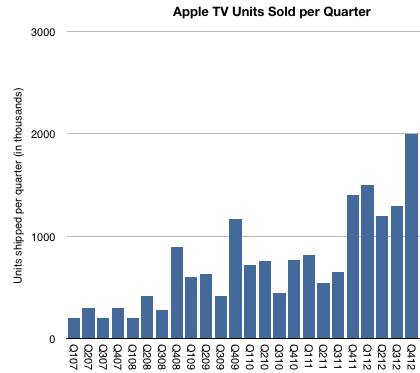
    The following graph includes an estimate of quarterly Apple TV sales based on comments made to date.

    Screen Shot 2014-03-02 at 3-2-8.07.43 PM

    As there were no additional comments during 2013, the "Billion Dollar" quote is all we have to go with for the year.  The problem with trying to separate content from hardware is complicated by several factors:

    • How are we to attach content revenues to Apple TV? For example, what if I purchase a series of shows on iTunes or an iPhone and decide to watch them on my Apple TV. Do these purchases count as being "attached" to Apple TV? Do we attach the full transaction value or do we attach the portion that Apple keeps (as in agency accounting)?
    • How does Apple account for channel placement on Apple TV? Do the channels prominently displayed on its user interface pay for this access (even though the user needs a cable subscription?) Is this the primary source of content revenue that is attributed to Apple TV?
    • What about Netflix, YouTube, etc? What is the content licensing deal with these channels? Does the Netflix channel actually cause an Apple TV purchase or does the Apple TV purchase cause a Netflix subscription?
    • Without content, one might think that the $1 billion revenue would yield total device shipments approximately 10 million units in fiscal 2013 (assuming $99 unit pricing). This is not quite right however as Apple's revenue per unit is unlikely to be $99 unless all units are sold through its own retail stores (including online). Sales through other retailers probably allow for some retailer margin so Apple's average selling price will be below $99.
    • Another question is the fiscal year accounting. We have visibility into the fourth quarter of 2012 (about 2 million units est.) so we only need to fill in the first three calendar quarters of 2013 to understand the Billion Dollar volume.
    • Finally, I already estimate separately the overall video market (in my iTunes Business Report) which, based on historic data and other inferences suggests a total video content gross (contributing to iTunes revenues) of $1.8 billion for the fiscal quarter. If a significant portion (50%) of this were allocated to Apple TV it would imply that the hardware business contracted sharply in 2013. Put another way, if I add what we know about C2012 units (6 million and an ASP of $89) to what I estimate video content revenues to have been in 2012 ($1.6 billion) I get a $2.1 billion business. This would be a "two billion dollar" business in 2012.

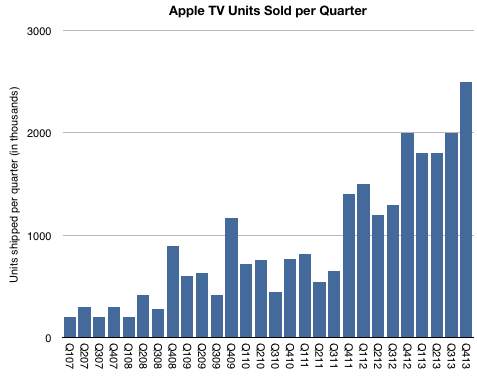
    All this makes the Billion Dollar Hobby a puzzle. The way I can make it square with existing assumptions is by saying that "Apple TV content revenues" are mostly, if not entirely, distribution revenues from channel placement rather than iTunes purchases. ((This revenue will end up in licensing/other revenues in iTunes/Software/Services segment and separate from Apple TV (which is a part of Accessories).))  As a result, my best guess now is that there were about 7.6 million Apple TVs sold in fiscal 2013, with a bit over 8 million for calendar 2013.

    If I'm right, the complete history of the shipments would be similar to this graph:

    Screen Shot 2014-03-02 at 3-2-9.08.24 PM

    By Apple standards this is indeed a modest story. The total units sold would add up to more than 25 million units with healthy growth. But it would not be in the same magnitude as other iOS devices which have so far sold 800 million units.

    More important than this picture however, or the Billion Dollar Business threshold, would be a better understanding of how Apple sees Apple TV as a business. We already knew that it was a low value hardware business. I even suggested that it's "Apple's equivalent of the Kindle": Hardware sold at low margins as a gateway for a high volume content business (iTunes). The problem with that model is that selling other people's content is never a good margin business. If it were to be sustained, Kindle may ultimately have to become an Amazon Prime salesman.

    So that leaves the Apple TV as a product without a satisfactory business model. Unsatisfactory, at least, to Apple's standards; hence the hobby label. But what if the model is turning out to be a platform for discovery of content and therefore the equivalent of (dare I say it?) a portal! ((Exclamation point.)) The TV UI certainly limits search or traditional browsing interaction but it enables eye candy for a few choice placed offers. It is a low interaction model. Think of how the prevailing UI for TV for decades has been that of pressing one button repeatedly, also known as channel surfing.

    If so , the business of Apple TV may be the auctioning of the real estate on the landing page. In some ways this is how iTunes is already behaving by "featuring" exclusive music content.

    There are all sorts of implications, which I will leave as an exercise to the reader.

  7. 5by5 | The Critical Path #72: Bingewatch

    Podcast · 10 comments

    We take on the future of TV again, given the developments and experiments hitting the news. Hanging in the air like a big matzah ball is the question of a catalyst to bring long form video to the age of software. Not just digital production and distribution but an integration of software into the product itself. We get there via a quick recap of Asymconf California.

    via 5by5 | The Critical Path #72: Bingewatch.

    Show Notes & Links

  8. The App Revolution (in Filmmaking)

    Research · 21 comments

    The following article is published in Filmmaker Magazine. Fall 2012, Vol. 21 #1.

    There is a saying I once heard: "Once you change the method of distribution, the product has to change."

    This itself is a take on the idea that distribution defines the product. You see this around you every day in the products you buy. Cars are influenced by the dealership networks that sell them. Phones by the mobile network operators and the choice of computer you use at work by whatever the IT department or value added reseller prefers to work with. Mass market restaurants offer what can be sold by wholesalers--typically frozen, long shelf-life staples. Almost every product category is shaped more by what can be distributed than what can be produced. That's simply because in mature economies distribution is harder than production. In consumer products it requires access to wholesalers who then require access to shops who themselves have access to prime real estate which attracts foot traffic. Production only requires capital. Distribution requires relationships, often exclusive ones.

    This pattern is even more pronounced when looking at media products. Production is arguably easier since it's constrained by talent, which is fungible. But distribution is even harder as it is addressing bigger audiences in shorter time frames. You see this lopsided balance of power in the abundance of books being written relative to those being published. There are thousands of films produced and hundreds get distributed.

    But the saying suggests that if distribution were to change then the product itself would change. Indeed, if you can sell ebooks direct, then they tend to evolve into new genres (e.g. Fifty Shades of Grey). If you can sell cheap adult video online it tends to evolve into new genres as well (I'll leave examples to the imagination.) YouTube videos quickly cluster around "Fail" or "Win" compilations which evolved from America's Funniest Home Videos. They get millions of views. Even before the Internet, the availability of cable created the genre of music video, which created the first music broadcast alternative to radio. And of course, cinema itself redefined theater once it could get shown to millions rather than thousands. The new methods of distribution of media affected what gets produced rather than the other way around. Consider the converse: innovative filmmakers who try new storytelling methods are stymied by a lack of acceptance by existing distributors and find their material languishing in festivals or perpetual cult status.

    So we can re-state the saying to a new "Law of new media": Once you change the method of distribution, the medium itself has to change.

    I gave examples of how Internet distribution changed some media formats. However, the Internet itself has not had any effect on long-form cinema so far. In fact, you would be able to tell if Internet distribution did work by watching if the product would change. So far, it seems, at least to me, that the commercially successful product has not changed. One reason has been that film is still a very difficult product to distribute digitally as most of the world does not have the capacity to buy, consume and enjoy films digitally. Another is that the current distributors have had an allergic reaction to the option. As existing products have been crammed into the new distribution chain (e.g. Netflix) the established distributors are experiencing channel conflict and are raising the costs of digital distribution rights. Netflix has seen its costs triple as it ate into Cable market share. Fundamentally, the incumbent distributors are reluctant to open a channel of distribution which conflicts with or reduces margins of the existing channels.

    This brings up another corollary: fundamentally, you can’t move an existing media to a new network. You have to think of it as a deeply rooted-in system, and it's just not going to like moving to another environment. You have to uproot this huge tree, and it just won’t come out and if it did it will not take root in a new place.

    The only way to create this new value network around new distribution is to plant a new tree.

    This is the problem for the technology industry today. The only way technology companies can solve the “content is king” dilemma (which, by the way, is an euphemism for "Hollywood is king and Silicon Valley isn't"), is by allowing new content to flourish on top of new platforms. It’s not about moving the old content to the new platform. It’s about allowing new content to be created exclusively on the new platforms. This new content will therefore, by our law, be a new medium.

    For me, apps are that new medium. Apps offered a new way to package entertainment for “niche time”. The early fart apps evolved into a whole new genre of games which are now challenging the established game studios. The result is that a generation of developers has moved from building PC or web software to apps with cloud back-ends. The first to switch to this new medium were those with the least to lose and with the most modest of goals. Apps have now a more valuable industry than digital music with over 55 billion installs between the iPhone and Android ecosystems. Consumers are increasingly spending their spare time in front of apps. In the US “app consumption” increased from 43 min/day in 2010 to 94 min/day at the end of 2011. This number already exceeds the time spent in web consumption. I find it difficult to doubt that app time will exceed TV time, especially as TV time is increasingly a dual screen experience.

    (Feels like it needs one sentence explaining why. Is it because of their accessibility to small developers, or their ability to reach mobile handsets natively, or because of consumer trend?) If it’s absolutely impossible to move long-form video or long-form cinema to this new medium in such a way that everyone in the world can consume it on every device, then the app ecosystems will take up that challenge and say, “There’s a job to be done, and that’s to enertain people for an hour-and-a-half with characters, plots and wonderful stories, and we will make that happen, and we’ll call this thing an app.”

    And that app will solve that job for that person. It's what's happening to the game console business. The new game apps are distributed differently, priced differently and produced differently. As a result they are used differently and make a different set of developers thrive.

    The new app media will mean that we’ll just have to live in app universes, and go eat popcorn somewhere else. Microsoft and Google and Apple and Amazon and anybody else whose belly is at the bar has been scratching their heads wondering "How do we move that content over to us?" They've been barking up the wrong tree. The fundamental question isn't how to cram old media into a new shiny screen. It is how do you let developers and artists and creative people create stuff that is new and compatible with this new way of living.

    Think also about the history of media -- movies haven't been around forever; music hasn't existed as a recorded medium forever. Not even books. What did people do before these forms of expression? We think of the use cases of going to the movies, or the use cases of sitting in front of a TV on Sunday night, or playing a console game. These things didn’t get done at some point in time. Nor will they be done at some future point in time.

    In a few years we’ll move on and we won’t do those things. Each person will probably have his own screen in front of them--many already do--and whatever we do together we’ll do through a shared screen. We won’t have communal experiences that we associate with the old media. Certainly not in a theater. Maybe not even in a living room. And that is how we will move into a new value network.

    It is inevitable. As a technology provider, you shouldn’t try to squeeze a 19th-century model into a 21st-century model. Just let it go. Create a platform and give people the freedom to create on it. As a media creator, you should try to learn what the new model demands. New forms of interaction, new story telling opportunities, new ways to communicate with audiences. Create experiments and learn. It's the only way.

  9. Take the money and run

    Research · 26 comments

    In August 2007, during the HD format wars between HD-DVD and Blu-ray format, Toshiba offered Paramount and Dreamworks $150 million to produce HD versions of their movies exclusively as HD-DVD.[1]

    This type of deal is equivalent to an "advance" offered to a book author. The DVD manufacturer pays studios up-front cash for the right to make its DVDs. From an accounting point of view this is treated as an advance that the manufacturer recovers by selling the DVDs back to the studio's video division in the same way a publisher earns back the advance it gives an author.

    In this case, the payment was so large and the sales of HD-DVDs so small that Toshiba was unlikely to earn back the entire advance. The way the deal made any sense for Toshiba was that it was exclusive: the studios could not continue to release their movies in Blu-ray. The deal was done explicitly to hobble a competitor and create "critical mass" of content for its own format.

    But then in March 2008, Toshiba threw in the towel and abandoned the HD-DVD format. The way the deal worked, the studios got to keep almost all of the $150 million. They then re-released all their movies in the Blu-ray format. The only "cost" to the $150 million windfall was that there was a nine month delay in the eventual release to Blu-ray--a small price to pay for an emergent format without a large install base.[2]

    Platform owners go to great lengths to ensure "content" for their platform. They will, essentially, finance an ecosystem when there are barriers to entry or when competing ecosystems are far more lucrative.

    This scenario for movies is being played again with Netflix, Hulu and other distributors who need to fill their pipelines. Netflix's content acquisition costs are exploding and putting the whole company's future in doubt.

    But this scenario is also being played out with app developers. Most recently, news broke that developers are receiving payments from Microsoft for Windows Phone ports of popular apps. In mobile platforms, apps are the new content and developers are the new studios.  It's also a practice that is not without precedent[3].

    This is as it should be. The value of the platform lies mainly in what is built on top of it just like a foundation is not much use without a house on it. However, the practice of "priming the pump" with cash payments for porting is not ideal. Like spiffs, those who receive payments may become used to it and withhold development if there is no payment. Also, those who did not get payment offers may feel shunned and retaliate in kind. Those who receive payment may become cynical about it and may not put in the extra effort (or, more probably, outsource) to make the work spectacular.

    Or, like Paramount, they may just take the money and run if/when the platform fails.

    ---

    Notes:

    1. Source: The Hollywood Economist 2.0: The Hidden Financial Reality Behind the Movies by Edward Jay Epstein.
    2. Paramount made $250 million more from three "replication output" deals: $50 million from Toshiba for agreeing to release Titanic on DVD in time for Christmas sales, $150 million from Panasonic for agreeing to allow them to take over video replication from Thompson, and $50 million from the law firm Ziffrin, Brittenham and Circuit City stores for agreeing to support the DIVX format. Paramount got to keep the money even though DIVX never launched.
    3. Although it's never been reported that Apple pays developers for building iOS apps, some developers do benefit from promotional placement and visibility during launch events and from early access to devices or SDKs under development.
  10. Is Android fragmented by design?

    Research · 99 comments

    When I wrote about the absence of copyright enforcement on the Android marketplace, I was trying to point out that Google did not have the interests of copyright owners at heart. This attitutde is also apparent in many ways from the absence of desktop sync for Android (and hence the absence of discovery or acquisition of commercial media) to the absence of protection for the app developer.

    Moreover, recently Google TV was blocked from all major US TV content and Google faced litigation from copyright holders in print publications and before that for YouTube infringements and before that from newspaper publishers for Google News' unlicensed reuse of their content.

    Therefore it should not come as a surprise the following revelation that Android lacks any common DRM framework.

    The hurdle has been the lack of a generic and complete platform security and content protection mechanism available for Android. The same security issues that have led to piracy concerns on the Android platform have made it difficult for us to secure a common Digital Rights Management (DRM) system on these devices.

    Setting aside the debate around the value of content protection and DRM, they are requirements we must fulfill in order to obtain content from major studios for our subscribers to enjoy. Although we don’t have a common platform security mechanism and DRM, we are able to work with individual handset manufacturers to add content protection to their devices.

    Unfortunately, this is a much slower approach and leads to a fragmented experience on Android, in which some handsets will have access to Netflix and others won’t.

    via Netflix blog.

    But the absence is not just oversight. DRM is, by its nature, proprietary and, by necessity, "closed". DRM ultimately includes "secrets" which would always be revealed in open source. If Android is to be open source, then it cannot include a DRM framework.

    This leaves the problem of content protection up to the device vendors who must license schemes from various third parties.

    The upshot is more fragmentation.

    As John Gruber points out,

    More and more, I’m convinced that Android isn’t a single platform. It’s a meta-platform upon which handset makers build their own platforms.

    In other words, Android fragmentation seems to be not only impossible to rein in, but it may actually be by design. Google is doing nothing to stop the centrifugal force that is building up in its ecosystem. They have neither the means nor the incentives to control the spiraling.