Asymco

Asymmetric Intelligence

Nokia

  1. iPhone share of phone market in Q1: 5% volumes, 20% revenues, 55% profit

    Research · 40 comments

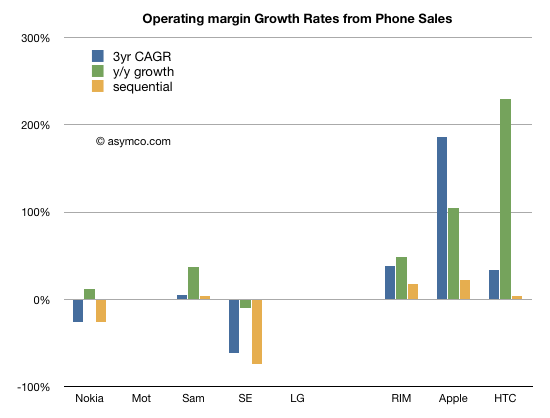
    Operating profits for the eight vendors I track increased at a compounded 25% over three years. As with revenues, the growth is concentrated. The following chart shows operating profit growth across three time frames: three year compounded, year/year and sequential. Loss-making vendors are excluded from this chart.

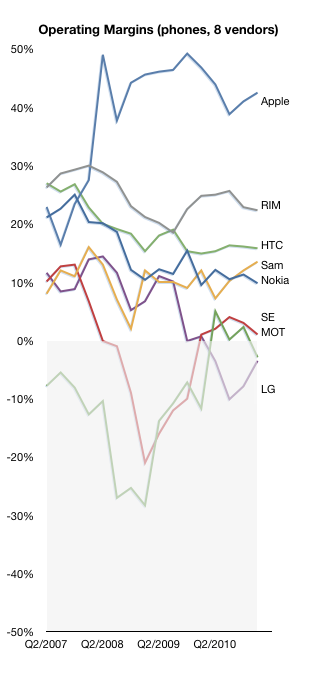
    Looking at individual performance, the following chart shows how each vendor performed over time:

    The mobile industry has historically been unforgiving. Companies that fall into unprofitability tend to stay there or exit/merge. This has claimed many: Ericsson, Siemens, Alcatel, BenQ, Palm, Sony, Toshiba, Handspring, NEC, Hitachi, Casio.

    LG, MMI and Sony Ericsson are all in the same precarious situation. We'll have to watch carefully whether a recovery is possible for any of them and whether Nokia will reach the same rocky position.

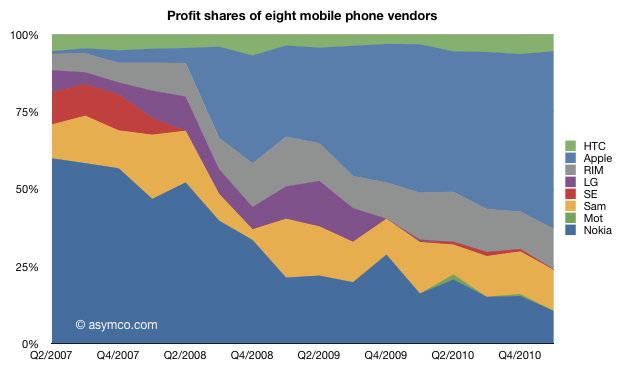
    Looking at operating profit shares, the picture is plain to see. While RIM, Samsung and HTC have maintained profit share, between 2007 and now, profit share has mostly shifted from Nokia to Apple.

    But this does not tell the whole story. Here are the absolute amounts of operating profit from mobile phones. Exactly three years ago Nokia was earning 47% profit share or $2.35 billion. This past quarter Apple's 57% was equivalent to $5.23 billion, more than twice as much.

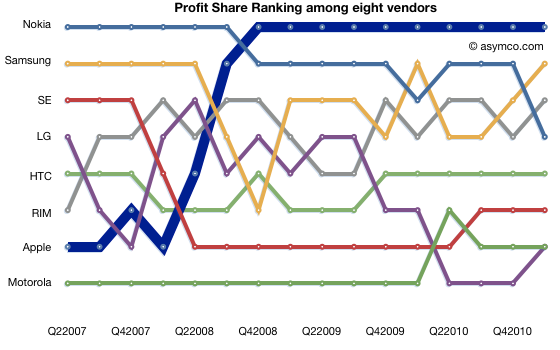
    Finally, the league table shows how Nokia has now dropped from second to fourth in the last quarter. Not only Samsung, but RIM has overtaken Nokia as well.

    It's become routine to see Apple at the top of the list of profit earners from mobile phones.

  2. The end of phone vendor tiers

    Research · 25 comments

    It's time to review the mobile phone market at the end of the first quarter of 2011. Before I begin, I'd like to remind that this analysis will span multiple posts and that many details will be published separately due to time and space constraints. Data about platforms, sales, profitability and pricing will be posted separately.

    All data sets and chart data will be available for interaction and download through Asymco Interactive when complete. You can purchase a license to Asymco Interactive anytime and you will have access to any new data sets for next 90 days so don't hesitate to pre-order the report.

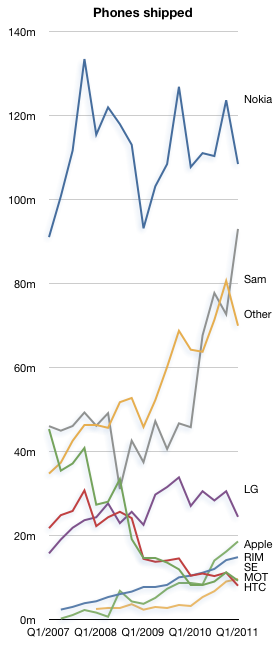
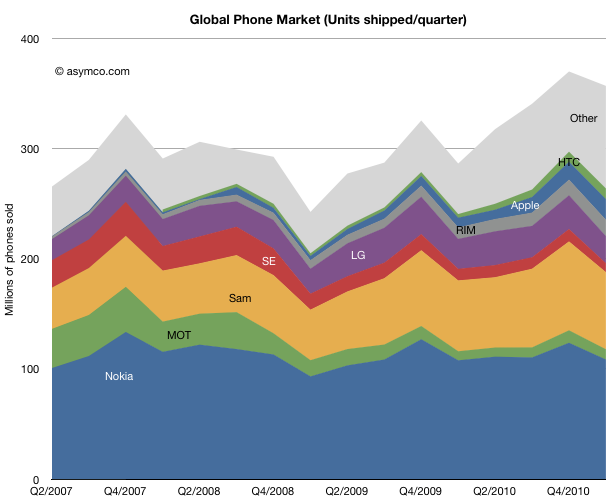
    The overall phone market grew at a compound rate of 9% over three years. The pattern of entrants focused on smartphones and mobile computing growing faster than the incumbents continues. The compound three year unit growth for the tracked vendors in descending order is:

    1. Apple 122%
    2. HTC 55%
    3. RIM 50%
    4. Samsung 15%
    5. Other 14%
    6. LG 0%
    7. Nokia -2%
    8. Sony Ericsson -29%
    9. Motorola -30%

    To give an idea of the split between smart and non smart, Nokia's smart business grew at 18% compounded while its non-smart units contracted at -6% rate.

    In terms of y/y growth the market grew at 26% and the vendor ranking is:

    1. HTC 194%
    2. Apple 113%
    3. Other 103%
    4. ZTE 75%
    5. RIM 42%
    6. Motorola 13%
    7. Samsung 9%
    8. Nokia 1% (smart: 13%, non-smart -2.3%)
    9. LG -10%
    10. Sony Ericsson -23%

    Sequentially, the growth rankings are:

    1. Other 28%
    2. Apple 15%
    3. HTC 7%
    4. RIM 5%
    5. ZTE -10%
    6. Nokia -12%
    7. Samsung -13%
    8. Motorola -18%
    9. LG -20%
    10. Sony Ericsson -28%

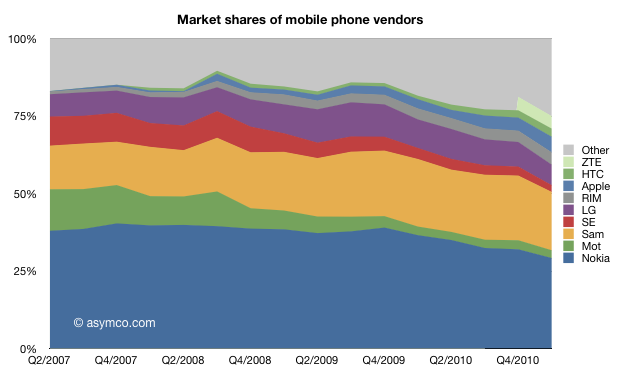
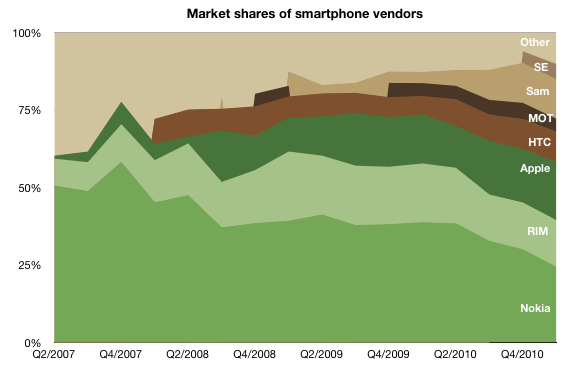
    In terms of market share, the field is becoming more crowded.

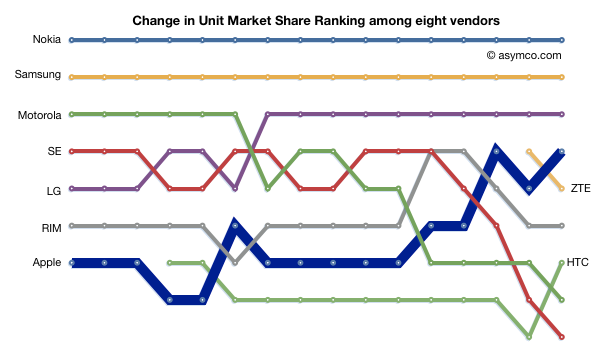
    The ranking of units shows a continuing relegation of Sony Ericsson and the increase of HTC to 7th spot. Apple reclaimed its fourth spot from ZTE.

    As the number of vendors increases and the share of incumbents decreases it becomes harder to identify who is a "top tier" vendor or, in fact, what the tiers are.

    It's pretty clear that on a unit basis there are nine vendors selling significant volumes. The other important observation is that vendors like ZTE are graduating from "other" while "other" is still growing, now at 25% of the market.

  3. A rising tide does not lift leaking ships

    Research · 28 comments

    I've often said that the smartphone rising tide has lifted many boats. If you were selling smartphones during the last three years, your business was growing, no matter what phones you made.

    In fact, measuring success and failure was a matter of deciding what growth rate was "not good enough". Growing at 30% was nearly enough to shame some vendors into re-evaluating their strategies.

    But that sort of tidal growth can't last. At some point  ships with holes begin to sink no matter what the tide brings.

    When we look at the data from the last quarter, we should be asking again whether some ships have developed some leaks.

    The challenge is in eliminating seasonal effects. Q1 is usually a sequential drop for many markets. There is an unsettling drop in Nokia and Motorola and a weakening in Samsung and HTC. On a year/year basis the growth rates appear more robust for HTC and Samsung (194% and 530% respectively), but one should note the low bases they started from. Apple maintained triple digit growth (113%) while RIM sustained a respectable 42%. Motorola grew at 78% but looks weak sequentially. Sony Ericsson began to offer smartphone units and they are showing a run rate similar to Motorola but can't gauge their growth rate yet.

    Apple and RIM seem largely unaffected by seasonality but Apple is growing twice as fast.

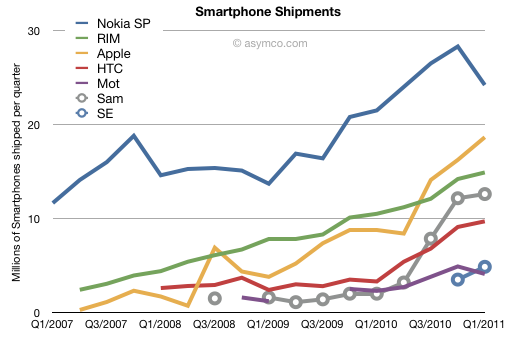
    But the biggest surprise is the drop in Nokia's volumes. There was a similar drop in Q1 2008 but the phone market was plunging into recession then and the company's smartphones moved in sync to the overall market (one with limited competition). This quarter's drop happened when the overall market is growing. The alarming thing is that Nokia's smartphone performance in Europe seems to be a big part of the problem.

    Data from IDC shows that Nokia's volumes plunged by 15% y/y in Europe while the smartphone market there grew by 76%. Apple ended up with the largest share in a region that had been Nokia's with 70%+ share. That share is now under 20%. Nokia's overall growth was a mere 13% y/y while the market grew 73%. The result is the following picture of Smartphone shares:

    But perhaps the drop should not be a big surprise. Was it due to the public execution of Symbian? Did Europeans stay away from Nokia in droves due to an aging portfolio or because they felt betrayed. Perhaps we'll never know but there is another indicator to mull over. Nokia's brand fell to 81st spot in a recent survey. It used to rank in the top 10.

  4. HTC and self-determination

    Research · 74 comments

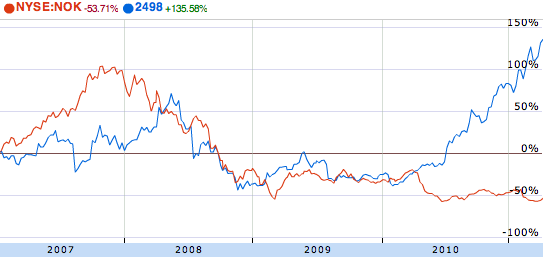
    HTC's market cap has just overtaken Nokia's. While market capitalization is a fickle thing, shifting with sentiment, this is still a remarkable feat. Nokia's market capitalization has almost halved in the space of a year while HTC has more than tripled from $10 billion to over $33 billion.

    If you roll back to 2007 and the start of the modern era of smartphones, you can see how the two companies stocks traded places:

    (source: Google finance)

    The recession was hard on everybody but HTC soared during 2010 while Nokia never recovered. Markets reward unforeseen growth and typically that means above-market growth.

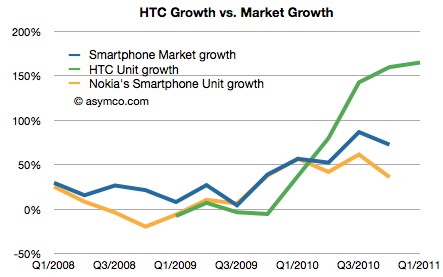
    That's reflected in the following chart (admittedly units and not profits, but pricing and margins for both have remained relatively steady.)

    As Nokia's growth lagged the market the stock was punished. As HTC's growth exceeded the market's growth, the stock was rewarded.

    But there are a few more observations to make:

    • HTC's smartphone business was under-performing the market for most of 2009. In fact, it was even in negative growth for three quarters.
    • The surge in growth coincided with HTC adding Android to its portfolio and given no other changes, seems to be causal.
    • Although not within the time range of the charts above, HTC had another period of rapid growth in the mid 2000s.

    A year ago HTC was making excuses and apologizing. Today they are more valuable than the largest phone vendors. All thanks to Android.

    But why no thanks to Microsoft?

    HTC was the primary Windows Mobile vendor a few years ago. They claimed at one point to have shipped over 80% of all Windows Mobile devices. They were also the leader in the Pocket PC franchise as they were the ODM behind the iPaq brand from HP/Compaq. HTC would not exist today were it not for Microsoft.

    The relationship is such that HTC is paying Microsoft for protection from (potential) Android IP infringements. HTC has also licensed Windows Phone though the relationship between Nokia and Microsoft must give them pause.

    But that's the whole problem. Those who live by the sword shall die by it. HTC was a Microsoft dependent and now they're a Google dependent. As the basis of innovation shifted, HTC was agile enough to make the transition. Perhaps they can execute a portfolio switch yet again as their upstream suppliers change whims or business models.

    But then again, as we saw with Windows Phone, perhaps not.

    If HTC wants to control its destiny it needs to control its suppliers. Now that its power and brand have grown, it needs software because in their market software is self-determination.

  5. The controversy of playing it safe: What's IDC's Smartphone Market Message?

    Research · 53 comments

    IDC released a new forecast for the worldwide smartphone market which included a long range forecast--all the way to 2015.

    Most people fixated on the share data in 2015. Not hard to do since whoever wrote the press release highlighted this flashy headline. Putting aside the three significant digits of accuracy on every data point and the hard to swallow declaration that a painfully underperforming (in more ways than one) Windows Phone will overtake iOS and BlackBerry to become the second largest platform by units/year in 2015, there is much more to the report.

    Using only the public data from the press release we can put together a pretty good picture of the transition being forecast and determine some of the (unstated) assumptions being made. It's these assumptions about the underlying market dynamics which illuminate far more than the falsely precise share data.

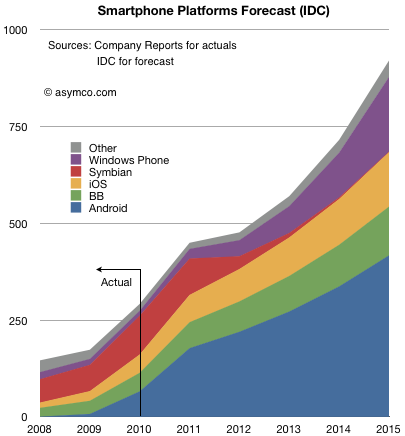
    The following chart shows both historic platform performance (which is detailed in the Asymco Interactive data sets on a quarterly basis) and the forecast based on the given compound growth rate published.[1]

    I see three main assumptions being made:

    1. Nokia (or more precisely Symbian) share will be swapped for Windows Phone. The transition period 2011 to 2015 shows approximately 150 million Symbian devices will be sold which is the stated goal for Nokia. IDC is making an assumption that the hardware vendors will roughly maintain their respective shares irrespective of platform dynamics and that Nokia will switch its share of users from one platform to another in a predictable way.
    2. iOS and BlackBerry will maintain share. Presumably this is also driven by hardware channel dynamics and relationships with carriers.
    3. Android will grow share slightly but the vast bulk of growth will come from market growth.
    4. Market growth is strong but undramatic.

    Overall this is not a controversial set of assumptions.

    Except perhaps that it assumes that the basis of competition in the market is unchanging. Of course it's well understood that the basis has shifted during the tumultuous 2007 to 2010 and forecasts made before the iPhone was launched sound absurd today.

    But IDC says that the unpleasantness won't happen again. From listening to the conversations going on today on this blog and elsewhere, their assumption that things will not change (again) is fairly deeply ingrained, indeed conventional wisdom. In that sense IDC is not taking any liberties with the future. The projections of current realities onto the future leads to this type of forecast and status quo defenders should be satisfied, if not rejoice.[2]

    However, there are a few more consequences of even this uncontroversial forecast which should make keen observers sit up and notice.

    If we look at more than the before and after snapshots and comfortable pie-splitting sound-bites there are some profound seismic things being implied.

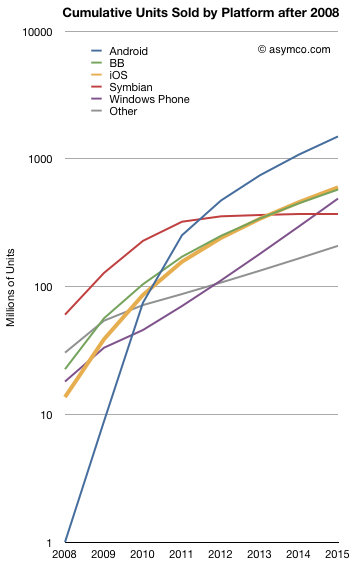
    For example the entire market will be nearly 1 billion smartphones a year (in four years!). Even more startling, considering the "race to a billion" discussion we've been having, some of the platforms seem to be reaching that threshold rather quickly. The following chart shows the cumulative unit sales for the candidate platforms on a log scale:


    Android is considered likely to break one billion units in five years post-launch. Windows Phone will sell nearly half a billion units and Blackberry will be well over that number.

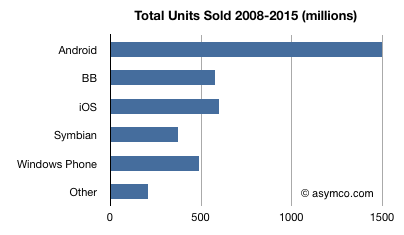
    I tallied the cumulative platform unit totals below:

    No less than four platforms will have sold half-billion units by 2015. The suggestion that Android will "win" by having the most units sold seems as hollow as the suggestion that Symbian "won" by having the most users in 2008. Not so much because it will go on to lose them, but because there were plenty of viable alternatives for users to buy and developers to build for. Half a billion users cannot be easily ignored.

    So even "safe" assumptions can lead to astonishing results in this market. Namely, IDC is saying that the smartphone market will not have any platform losers.

    There is one more thing the report implies. If you look at the ranking of leading platforms (by units/year) in 2008,  2015 and, with a little extrapolation, 2016/2017 you get:

    Rank in 2008Rank in 2015Rank in 2016/2017
    SymbianAndroidAndroid
    OtheriOSWindows Mobile
    RIMRIMiOS
    Windows MobileWindows MobileRIM
    iOSSymbianOther
    AndroidOtherSymbian


    In other words, there is a complete reversal being projected. An almost perfect flip: those on top end up at the bottom and those on the bottom end up on top. That's about as controversial as it gets. Pretty impressive for a set of safe assumptions.

    --

    Notes:

    1. You should ignore the shape of the curve between 2011 and 2015 as it assumes the CAGR is applied to every year. Although the press release shows a CAGR, the actual report may include various fluctuation in yearly growth. The starting point of 2011 and the end result in 2015 however should be the same.
    2. If, on the other hand, you believe that exponential growth, rapid gains in communications speed, new breakthroughs in interaction with devices, and entrants winning with new business models are causes for a disruption, then perhaps extrapolation may not be the way to forecast this market.
  6. The Allegory of Treo

    Research · 35 comments

    The following is a work of fiction.

    The combination seemed unthinkable just a few years ago. Nokia envisioned itself as a substantial rival to Redmond, threatening to head off its computing dominance as the power of desktop computing shifted to pocket-size devices. But a series of miscues substantially weakened the company, leaving it little choice but to team up with the world's largest software maker.

    Although Nokia has pledged to continue using the Symbian OS in both handhelds and phones, the company has now significantly tied its fortunes to the rival it once denounced.

    In doing so, Nokia is making a tough bet. The company is gambling that Microsoft's operating system has advanced far enough to power a decent cell phone, while still having enough rough edges that Nokia can carve out a niche by going beyond the standard Windows Phone software. In doing so, Nokia hopes it can avoid the fate of being just another clone cranking out hardware on Microsoft's behalf.

    Microsoft, meanwhile, has scored a significant win in its decade-long quest to crack the mobile market. In wooing Nokia, Microsoft has brought a one-time rival into its fold and ideally gained a new creative force as it tries to move its PC empire into the burgeoning market for cell phones.

    "Nokia always did great work, and so we lusted after some of those things that they do well," Ballmer told reporters at Monday's launch.

    The partnership is not totally out of the blue, of course. The two companies offered a glimpse at the detente last year, announcing a pact that allowed Symbian OS-based smartphones to connect directly with Microsoft's Exchange servers for corporate e-mail and calendar information.

    In its secret meetings, Nokia execs managed to convince their Microsoft counterparts to build several software hooks they needed into the latest version of Windows Phone. The changes allowed Nokia to add some handy features into the Windows version of the N series phones. One new trick allows Nokia owners to ignore an incoming cell call, instead sending a brief text message to the caller. A second feature allows Nokia owners to navigate multiple voice-mail accounts using VCR-like buttons, rather than having to know that "5" is the key for fast forward or remember that "7" saves voice mail at work, but deletes it at home.

    A key question, though, is whether Microsoft will give Nokia enough room to innovate in the future, now that it has successfully wooed the device maker. By going with Microsoft, Nokia is letting go of one of the key differentiators between its products and those from better-known competitors.

    Elop said he understands the risk and only undertook it with assurances that Nokia would be able to build enough software on top of the OS to make his products stand out.

    "It was the only way we felt it could work for us," he said at the Monday press conference.

    Executives from both companies suggest that the Nokia-Microsoft relationship, forged at those meetings in Cannes and New Orleans, will continue to be close. But it remains to be seen whether Nokia will retain its individuality now that it has the Microsoft imprimatur.

    Wirt acknowledges that there are no formal procedures in place that ensure that Nokia will get the things it asks for the next time, or the time after that. "It's functioned more as a relationship-type thing."

    Elop said Nokia could try to patent particularly strong advances, but in general he said the company believes the best way to stay ahead is to keep cranking out new products.

    "We have ideas about many things that we didn't get to do in this version," he assured reporters.

    But for all its ideas, Nokia is still a relatively small company. And given that it has pledged continued support for the Symbian OS, it must now divide its limited engineering resources between two incompatible efforts.

    Elop acknowledged that the challenges of developing for two entirely different operating systems are enough to keep his firm hopping. He emphatically shook his head back and forth when asked if Android and MeeGo-based Nokia phones might be next.

    "We don't need another operating system," he said, adding later, "It's too much effort."

    This fictional article was created by taking an actual article from 2005 about Palm and Microsoft (Palm's tale of Treo intrigue - CNET News) and changing the words "Palm" for" Nokia", and "Colligan" for "Elop", "Ballmer" for "Gates", "Treo" for N series (or Nokia) and "Symbian" for "PalmOS". A few paragraphs about the mechanics of the deal process were deleted.

    Credit: This tweet from Charles Arthur.

  7. Nokia: We depend on uninformed customers, deception preserves brand value and uncompetitive software will keep us competitive

    Research · 99 comments

    In a previous post I asked whether Nokia's strategy is dependent on a "built-in assumption that end users are inherently stupid."

    Nokia confirmed that this is indeed the case.

    “Millions of consumers are oblivious to the announcements that we have made,” she said. Those consumers value Nokia’s brand, she said, and will continue to buy devices provided the company keeps making competitive products.

    via Nokia's Jo Harlow on the Move To Windows Phone, the Future of Symbian and More | Ina Fried | Mobilized | AllThingsD

    There are three statements being made:

    1. Nokia is counting on uninformed customers, not just end users but the shops and operators which will keep stocking the end-of-life product lines. There needs to be a conspiracy of stupidity for this plan to work.
    2. Nokia's brand will survive even after customers are deceived into buying lame duck products. The idea that buyers value a brand that is offering products that the company does not believe have a future is cynical.
    3. The absurd implication that Nokia's products will be "competitive" even though management asserted clearly and emphatically that the software they run--the very basis of competition for any smartphone--isn't. If a smartphone is expected to be competitive even though its software isn't then it's not competing on the basis of software. If it isn't then how smart is this smartphone?

    One gets the sense that Nokia is undergoing significant ethical decay.

    [UPDATE]

    To paraphrase the ethical dilemma:

    "We want a three horse race. We're not there yet. In the meantime we have a sturdy donkey that can still walk. We expect 150 million people to bet on it."

    [UPDATE 2]

    I take issue with the ethics of jumping off a burning platform while selling tickets to tourists to come visit.

  8. The platform as a promise

    Research · 39 comments

    In a recent answer on quora, I wrote that I did not believe developers are tempted primarily by economic incentives when choosing which platforms to work on. I suggested that they hire platforms because of their star-making potential and that star-making value is not a something that money can buy. Using Hollywood as an example I suggested that subsidies decrease the perceived value of a talent-oriented platform.

    The notion that a platform signals meaning to developers led me to think about how mobile platforms signal meaning to consumers. I have a hypothesis that platforms can and should be treated as brands. This point of view allows platform orchestrators to develop a comprehensive market-driven strategy for platforms that transcends technical debate.

    First a word about what a brand is.

    Brands are vaguely defined. They are identities, names, symbols or attitudes or all of the above. Marketers struggle to define brand value because they are trying to encapsulate what they sell into a single symbolism. The problem is that there are vast varieties of things being sold. Every product or service has different meaning to buyers and it cannot be captured the same way. Because I cannot rely on a single definition I have to create a specific definition of brand to the context of mobile platforms.

    I choose to define brand in this context of platforms as the "promise of the platform". A platform is a promise that the products will function in ways beyond what's "written on the box"; that the product is extensible and has value provided by an ecosystem bigger than the original vendor.

    For example, although the iPhone is based on iOS platform, iOS is not the brand. "iPhone" encompasses the platform brand and it's a promise to users that they can expect apps and content and an extended flow of innovation to continue well beyond the initial purchase of the device. This brand value is attached to iPod touch and iPad even though it's not communicated as a unified platform. In other words, consumers don't look for "iOS inside" but the implicit value of "there's an app for that" covers all the products.

    When looking at platforms as promises or brands, we can observe how some are more powerful than others.

    Symbian or Series 60 was never marketed as a brand and Nokia users are generally unaware of what OS or platform their phone runs. Does Symbian make a promise of an "extended flow of innovation to the device" after the time of purchase? It's hard to make that promise when you can't communicate clearly anything but device specs.[1]

    Conversely, Android has become a strong brand. The Android label (and mascot) is frequently used by device vendors to signal platform brand value.

    How did Google achieve in a year this value with Android while Nokia continued to squander any brand goodwill around Symbian for a decade? The answer lies in marketing decisions. Nokia wanted to focus on the hardware as value (and the Nokia brand as the way that value is encapsulated). Google and Android OEMs wanted to lift their own device brands into becoming smartphone brands and attached the value of Android branding to them.

    Which brings me to the question of how to design platforms as powerful brands. Creating awareness of extensible value is the way to signal to developers and all members of an ecosystem that a platform is valuable. Apple did this very well with their iPhone ads which focused on the app value of the product. They showed the product in use and did not rely on metaphors. Developers saw other specific apps being advertised by Apple and it engendered huge star value in the platform. Every developer wanted a shot at being featured in an iPhone ad. The iPhone could and did make stars.

    But you can't make the great promise of the platform without the ensuring consistency, reliability and longevity. Fragmentation, malware, copyright infringement and arbitrary termination amount to the confiscation of platform value by the orchestrator. Poor custodianship results in the destruction of both ecosystem and end user value.

    --

    Notes:

    1. The lack of platform promise for Symbian may also explain why Nokia believes they can sell 150 million Symbian devices which have a deprecated platform. Those devices could be sold as feature phones, not platform products. The challenge for them will be to get a smartphone price for a feature phone product.
  9. Nokia's Burning Ships strategy

    Research · 84 comments

    In the recent series of exposés on Nokia's new strategy I sought to paint a background for what caused such a dramatic decision:

    This gives a backdrop to the decision, but it does not explain the most crucial part of the decision: why did Stephen Elop decide to maintain an exclusive platform for Nokia rather than a multi-platform approach as chosen by successful competitors such as HTC, Samsung and Sony Ericsson.

    Going from backing one "burning" platform exclusively to backing another "ice cold" alternative without bothering with a hedging alternative is very risky. This may be the biggest puzzle and mystery for outside observers.

    Here I put forward a few reasons why exclusivity attracted Nokia:

    1. The lessons of product focus (see why focusing on a few products is hard).
    2. The costs associated with Symbian and Meego were unreasonably high. (see Nokia employs as many people to develop its smartphone software as Apple does to develop all its products).
    3. The psychology of change management.

    This last one may be the most crucial of all.

    What has to be appreciated is how bloated Nokia has become. It has 140 thousand employees. It's been organized and re-organized countless times and is completely intractable even to insiders. Cutting headcount can only accomplish so much. It deals with costs, but not with motivation. What management needs to do is also incentivize the survivors.

    This is where exclusivity comes in as a motivational tool.

    To explain we need to dip into a new metaphor. Conquistador Hernan Cortés landed in Mexico with the intention to conquer it. Legend has it that as soon as he landed, he burned his ships to prevent his men from retreating and motivating them that conquest their only option.[1]

    Leaders motivating their followers by removing the means to surrender or retreat is not uncommon. It's harsh and brutal. It's not a natural thing do do: destroying perfectly useful options is value destructive and generates outrage, even mutiny.

    In Nokia's case, institutional inertia with a vestigial Symbian effort would compel the organization to maintain the current platform while treating the new alternative as a pathogen.

    Counter-distruption theory states that the response to a disruption requires a focused approach through an autonomous challenger protected from corporate antibodies by the CEO herself. In this case, the autonomous organization is outside the company (Microsoft). Protecting the new effort was not possible with a Chinese wall. The only alternative was to simply get rid of the old and start with a clean slate.

    While there are times it makes sense to burn ships to eliminate any ideas of retreat, there are other times when doing so is reckless. You can do the calculation on the basis of cost of being wrong and levels of uncertainty [2], but even when armed with all the data linked above, this decision can hardly become something that can be quantified.

    It's a gut-level decision.

    I would say that Nokia's new CEO did not just jump off a "burning platform" but that once he jumped he made sure it kept burning so that nobody thought of going back on board.

    ---

    Notes:

    1. There is a Microsoft precedent to this story. See Amazon.com: Burning the Ships: Transforming Your Company's Culture Through Intellectual Property Strategy (9780470432150): Marshall Phelps, David Kline: Books Burning the Ships recounts the decision that forced Microsoft to face its own 'succeed or die' moment. It's a lesson in strategy and survival that speaks about the courage required to embrace radical business transformation.
    2. See also: Burning Ships
  10. Platform sunk (cost): What is the value of a quarter billion Symbian users?

    Research · 38 comments

    In the quarterly smartphone summary published here, I noted the significant acceleration of Android sales at the expense of "other" and Windows Mobile/Phone. Some share was also lost to Symbian. This might be seen as justification for the "platform jump" that Nokia undertook.

    In a second discussion, I published the history and life cycles of the smartphone platforms, identifying 10 platforms (out of 16) still in the market. This challenged the view that it was a two horse race today and that it will become no more than a three horse race in the future.

    Questions came up about the "quality" of these platforms. Clearly some are barely viable while some are thriving. To explain the value of a platform, one metric we can use is the cumulative sales which allows us to derive the installed base.

    The following charts do just that.

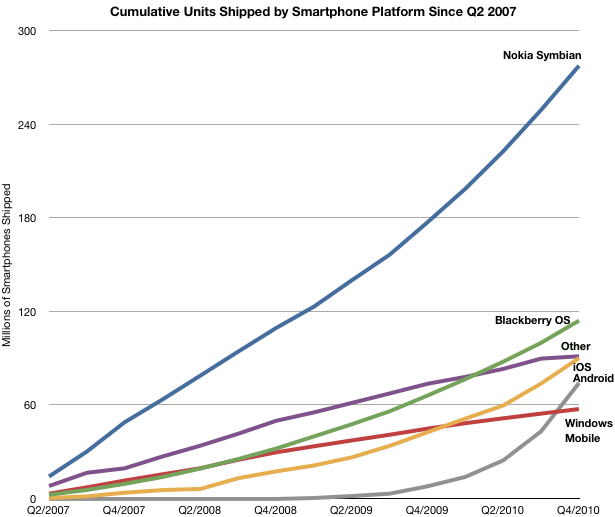
    This first chart shows the cumulative total of units sold since Q2 2007. This is the sum of all smartphones sold in the last 3.5 years. There are some interesting patterns here, but right now we want to focus on the installed base.

    3.5 years of cumulative sales is an upper bound on the installed base. We can get a better estimate the phones in use by subtracting from the base phones older than 2.5 years. This is shown in the second chart below:

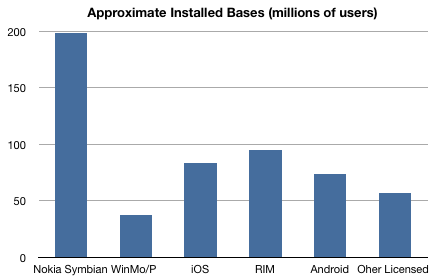
    As of the last quarter, Nokia's Symbian is likely to have 200 million in use. Apple may have about 85 million iPhones in use (this excludes iPod touch and iPads) and Android about 75 million. RIM is around 95 million and Windows Mobile less than 40 million.

    What's interesting is that of these installed bases, the largest is the one that's just been abandoned, and the smallest was chosen as its replacement. Even that's not quite fair since Windows Mobile is not a valid replacement. It's Windows Phone that was chosen and that probably has an installed base of about 1 million [Unlike the measurement of units shipped, Microsoft reported two million licenses were sold to OEMs who had to build those into phones which would be shipped to carriers and distributors. One million may be a generous estimate.]

    The bottom line is that there are about 5 Windows Phone users for every 1000 Symbian users. In other words, Nokia jumped from the "burning" 200 million user Symbian platform to the "ice cold" 1 million user Windows Phone platform.

    The disposal of such a large installed base must count among the largest divestitures in technology history and, when coupled with the adoption of the least-tested alternative as a replacement, elevates platform risk-taking to a new level. It may seem bold, but there is a fine line between courage and recklessness.

    I'll do my own "dive" into the possible justification for this in a future posting.

  11. The lives and deaths of mobile platforms

    Research · 68 comments

    When Stephen Elop said that Nokia and Microsoft sought to create a "three horse race" he implied that there were only two viable mobile ecosystems today. With that statement he sought to deprecate or declare "end of life" two platforms: Symbian and MeeGo, implying that Nokia's efforts at being the third way failed.

    However, he also implicitly declared irrelevant a larger set of market participants. In fact, the market is awash with platforms. Far more than the three or five that Stephen considered.

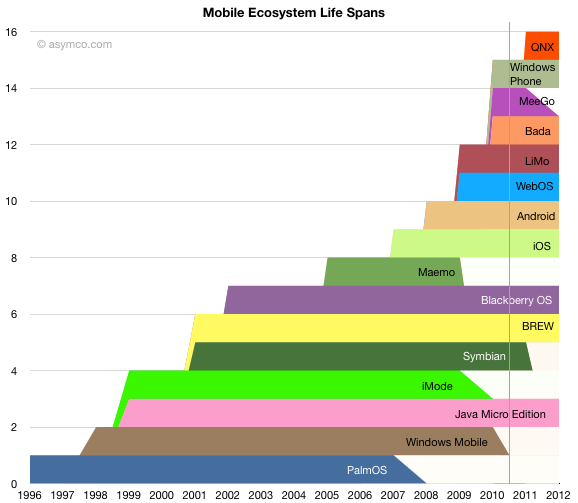
    To illustrate I built the following chart showing the history of all major mobile platforms. The are ranked by launch date (earliest at the bottom). A vertical line marks the present. End dates are approximate and based on declarations of end of life rather than end of usage.

    There have been 16 total mobile platforms[1], 10 of which are still (or soon will be) on the market. Of the six that were terminated, three had replacements built by the same orchestrating company (Windows Mobile begat Windows Phone; Maemo begat MeeGo, and PalmOS eventually led to WebOS.) Only three reached end of life with no known descendant (iMode, MeeGo[2] and Symbian).

    Operating systems that were launched in the 1990s or early 2000s have mostly been withdrawn/replaced with the exception of Java and BREW.  "Modern" operating systems all emerged after 2007 (following iOS). A total of eight such new OSs were introduced in four years[3].

    What I find noteworthy is that there is an implied peculiar fatalism about the market when only two platforms are considered viable, neither of which are more than 3 years old. While visiting the Mobile World Congress, I sensed this jumping to conclusions about platforms was eerily similar to that of a few years ago when new entrants like Apple and Google were declared dead on arrival.

    I can only conclude that there is a great deal of groupthink going on in the industry. A perfect setting for a disruptive entrant to change everything, all over again.

    ---

    Notes:

    1. I excluded some platforms like Motorola's Linux, SavaJe and perhaps some others (Openmoko, Qtopia) which did not gain significant traction. I also excluded any embedded OSs which did not have native APIs.
    2. The end of MeeGo is speculative. Intel is still defending it and may continue developing it.
    3. Android variants like Tapas could be considered new platforms, but I maintain them as part of one OS for the time being.