If it wasn't for the MacBook Neo the fall would have been much worse.
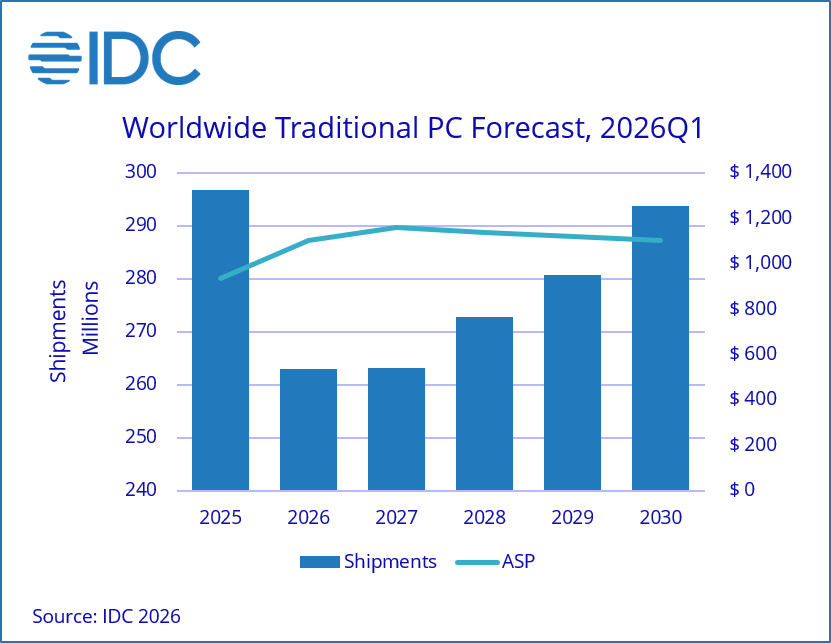
IDC now forecasts global PC shipments will decline 11.3% for the full year, with conditions worsening progressively through Q4, when shipments are expected to fall 20% year-over-year.
Pull-forward demand masked the problem, temporarily
The first quarter of 2026 offered a deceptively encouraging signal, with shipments growing 3% versus the same period last year. But that strength was largely borrowed from the future. Buyers, both consumer and commercial, accelerated purchases ahead of anticipated price hikes and product availability constraints.
Pull-forward demand masked the problem, temporarily
“The anticipation of rising prices and of limited availability of some system configurations due to memory and other component shortages has led some end-users to make purchases earlier than anticipated,” said Jean Philippe Bouchard, Vice President of Devices and Consumers at IDC. “We’re not seeing any relief to the memory shortage situation before the end of 2027, which means prices will continue to rise and PC manufacturers will struggle to maintain full product portfolios for the foreseeable future.”
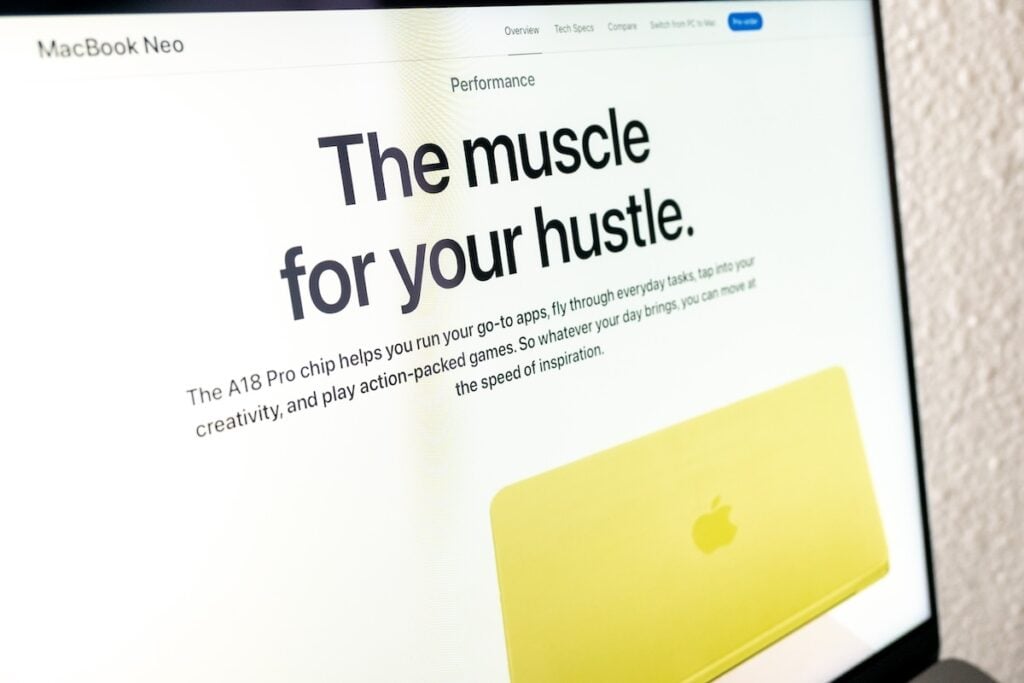
One notable wildcard is Apple’s MacBook Neo, which has driven stronger-than-expected notebook demand and prompted IDC to revise its notebook forecast upward.
NB: The problem is a memory shortage: PC manufacturers are struggling to maintain product portfolios.
“The introduction of the MacBook Neo is putting real pressure on the entire PC ecosystem,” said Jitesh Ubrani, research manager for IDC’s Consumer Devices Trackers. “We expect vendors to respond with a combination of new silicon, a more efficient OS from Microsoft, and aggressive promotional pricing.”
“The competitive pressure from the Neo is providing a partial offset to broader price increases, keeping some low-cost notebook options alive. But the overall trajectory for average selling prices (ASPs) is firmly upward. IDC forecasts ASP growth of 17% in 2026, and even as memory capacity expands over the next two years, pricing is unlikely to return to 2025 levels,” Ubrani added.
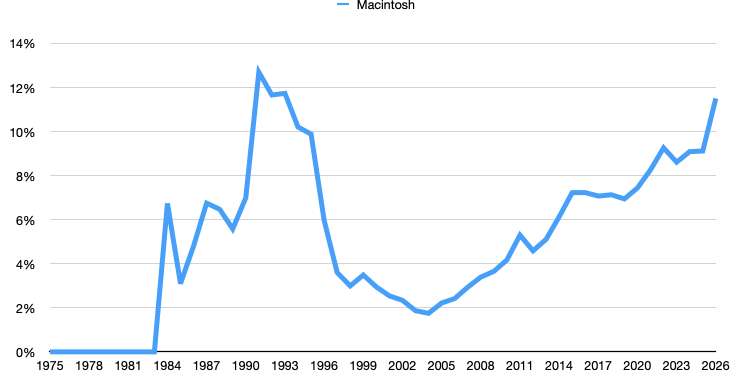
As the graph shows, IDC forecasts no recovery in volumes until after 2030. This is a multi-year opportunity for Apple and may reset market share dynamics permanently.
According to the latest research from Omdia, total shipments of desktops, notebooks, and workstations in 1Q26 increased by 3.2% year-over-year to 64.8 million units. Notebooks (including mobile workstations) saw a modest year-over-year increase of 2.6% in Q1 to 50.8 million units. Meanwhile, desktops (including desktop workstations) performed slightly better, up 5.4% to 14.0 million units. Growth was supported by vendors and channel partners pulling orders forward ahead o
Global notebook shipments are showing clear signs of further weakening, according to TrendForce’s latest findings on the notebook industry. Subsequently, TrendForce has revised its 2026 full-year shipment forecast downward from -9.2% to -14.8% YoY amid expectations of deteriorating end-market demand and rising supply chain costs, reflecting a deeper industry correction.
TrendForce estimates that Apple’s notebook shipments will grow 7.7% YoY in 2026, outperforming the broader market trend. This is based on Apple’s ability to expand into lower price segments, adopt a proactive pricing strategy, and maintain stronger chain control than its peers.
Francisco Jeronimo, Vice President of Client Devices at IDC, told Benzinga, "The MacBook Neo will have a significant impact on the low-end PC segment, particularly in education, which accounts for 6.7% of global PC shipments, or 13.4 million units in 2025."
He said that the market is currently dominated by Windows notebooks, with an average selling price of $682 and Chromebooks, which average at $362.
"Apple's ASP in Education was $1,425 in 2025 and accounted for only 5% of the segment," he said.
He echoed the statements by the above analysts while adding that MacBook Neo will allow Apple to acquire users early in their digital lives.
"Omdia’s February 2026 forecast shows Windows OEMs facing component cost increases of $90 to $165 per unit, pushing average notebook selling prices from approximately $850 toward $915," the research firm stated.
It went on to say that to maintain margins after these cost increases, many Windows laptops would need to be priced above $1,000 to "stay profitable."
On the other hand, Apple benefits from higher margins, making it easier for the iPhone-maker to sell the product at low-cost while still maintaining profitability.
In the education segment, the $499 price for students removes the cost barrier. However, the firm noted that the price isn't the only hurdle.
"Displacing Chrome in K-12 would require Apple to match Google’s admin tooling and institutional relationships, not just its price point," Canalys stated.
David Naranjo, associate director at Counterpoint, told Benzinga that Apple's real opportunity lies in higher education.
It is because the launch comes when Google continues to dominate the K-12 sector through Chromebooks, Google Workspace and school-managed devices.
"The MacBook Neo is unlikely to displace Chromebooks at scale in the K-12 market in the near term. Schools remain highly price-sensitive and deeply integrated into the Google ecosystem," Naranjo stated.
The iPad is still only slightly more than a year and a half old. Forecasting unit volumes has proven very difficult. But more than that it's proven very difficult to appreciate the impact on the market it's disrupting, PCs.
For some people this is obvious, but what if you don't live and breathe disruptive theory? What if you don't watch every data source like a hawk for hints of change? What if you are not even a technologist. How would you form an opinion on the effect of the iPad on PCs?
There are many industries and sectors about which I know nothing. If you asked me to analyze a market like industrial lubricants, I'd probably start by reading the consensus opinion put forward by the leading market analyst, an expert in that particular sector. That would form the baseline.
In the PC sector, that opinion is formed by Gartner (and IDC and Forrester perhaps). Gartner will get a lot of citations and its stats and opinion forms the baseline view. It may not be right, but we can expect it to be the "consensus". This is because Gartner surveys a lot of data and interacts with a lot of insiders in the industry. They collect and weigh these inputs and put out what is likely to balance them all.
If Gartner says that the iPad is a "media tablet" that is not a PC they may be wrong. But they are also repeating what the PC industry is saying. So I value Gartner as a reflection of the consensus. If there is a significant gap between Gartner and what I conclude to be reality then there is an interesting opportunity as well as evidence of incumbent ignorance.
Let's then look back on how Gartner has been reporting the iPad's rise and the PC's decline.[1]
Q2 2010
"The consumer PC market registered double-digit shipment growth, but consumer mobile shipment growth slowed. This was due in part to slower growth of mini-notebooks," Ms. Kitagawa said. "Surging popularity of Apple's iPad temporarily cannibalized mini-notebooks, as well as consumer notebook sales to some degree. It is not certain at this stage if the cannibalization will continue with the current price point of media tablets."
Q3 2010
"Media tablet hype around devices such as the iPad has also affected consumer notebook growth by delaying some PC purchases, especially in the U.S. consumer market. Media tablets don't replace primary PCs, but they affect PC purchases in many ways," Ms. Kitagawa said. "At this stage, hype around media tablets has led consumers and the channels to take a 'wait and see' approach to buying a new device."
Q4 2010
“U.S. holiday sales were not fantastic for most PC vendors, but the professional market did show healthy growth during the quarter,” Ms. Kitagawa said. “Media tablets undoubtedly intensified the competition in the consumer market. These devices do not replace primary PCs, but they are viewed as good enough devices for these who want to have a second and third connected device for content consumption usage. Mini-notebook shipments were hit the most by the success of media tablets.”
Q1 2011
"Weak demand for consumer PCs was the biggest inhibitor of growth," said Mikako Kitagawa, principal analyst at Gartner. "Low prices for consumer PCs, which had long stimulated growth, no longer attracted buyers. Instead, consumers turned their attention to media tablets and other consumer electronics. With the launch of the iPad 2 in February, more consumers either switched to buying an alternative device, or simply held back from buying PCs. We're investigating whether this trend is likely to have a long-term effect on the PC market."
Q2 2011
Overall shipments of media tablets took place late this quarter and volumes remained low, minimizing any impact of the media tablets for PC substitutions in the second quarter of 2011
Q3 2011
"The main contributor to the weak consumer PC market in the U.S. was intensified competition for consumers' money," Kitagawa said "Media tablets and smartphones took center stage in the U.S. retail sector, and the expectation is for continuing demand for these devices throughout the holiday season."
I've added emphasis for the key words describing the impact of the iPad (referred to as "media tablets").
Note how the message changed over time. At first the effect was thought to be temporary (presumably due to "hype"). Three months later the "hype" was leading to "hesitation" in the channel. Three more months and there was "a hit" on Mini-notebooks but only for those needing a second or third device for "consumption". In the fourth report it seems that "consumers" (vs. business users) are really interested in this. The fifth report suggests that the effect is "minimal". The latest report suggests that this is a "localized effect".
An external observer (or paying customer) reading this must conclude that five quarters in, these media tablets are having some effect but most probably a transient one. By keeping tablets separate from PC's Gartner is implicitly stating that the two products do not compete. If they have an effect it's on the discretionary spending by consumers. Similar to the effect game consoles or consumer electronics may be having on PCs.
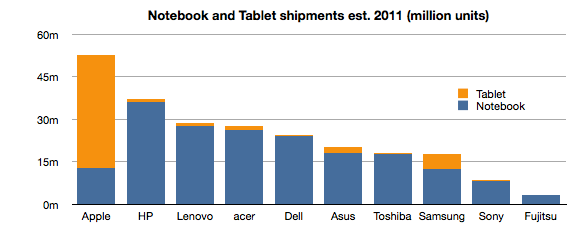
However, if tablets were added to notebook totals the chart for 2011 would look like this:[2]
Notes:
The quotes are from periodic reports (every quarter) from the same analyst at the same firm using a consistent set of measurements about the market. In order to ensure the same context, I've selected the comments from press releases published using the same template.
Source: Digitimes Research, compiled by Digitimes, October 2011
According to Gartner, mini notebooks constituted less than 18.0% of the total mobile PC market in the second quarter of 2010, down from 20.0% of the total market at 2009-end. Gartner expects mini notebooks market share to drop to approximately 10.0% by 2014.
However, worldwide PC shipments are projected to total 367.8 million units for the full year 2010,
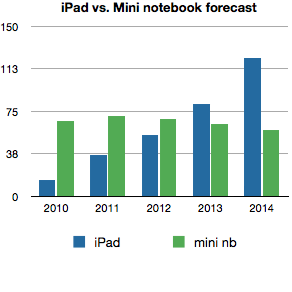
Speculation about the iPad production ramp indicates that the iPad will ship about 14 million units this year and 36 million next year. Projecting a forward growth rate of 50% and adding the Gartner forecast above gives us the graph on the left.
The iPad (plus competitors) will likely overtake the sales of mini notebooks as soon as 2012. The collapse in netbook sales is likely to be much more rapid than Gartner suggests.
RIM's co-chief Mike Lazaridis downplayed many of Apple's efforts today in a keynote at the TD Newcrest technology conference in Toronto. The executive was concerned that there wasn't necessarily a market for tablets like the iPad and that any devices would have to be put in the context of computers and smartphones. Many companies ask new hires to choose either a new smartphone or a new notebook, and if the tablet is simply a substitute for a notebook it may not have an easy answer, Lazaridis said.
He added that smartphones are getting more powerful and more computer like, and by extension would reduce the need for a tablet.
The company leader also dismissed the importance of touchscreen phones. While it's important to give customers what they want, touch-only phones like the iPhone aren't that popular, Lazaridis argued. He claimed that most of the people buying touchscreen phones are going back to phones with hardware QWERTY keyboards, like those that made RIM "famous."
He pointed out that it was the experience and not the features that determined a phone's success, and that the most popular BlackBerry was actually the starter Curve 8520. It not only lacks touch but 3G and a high-resolution screen.
The results all but confirmed a sudden slowdown in netbook sales in the early part of the year and suggested the business may actually be on the decline. Intel didn't directly explain the shift, but an ongoing recovery from the recession and a more mature market are likely to give more buying power and greater interest in faster notebooks, especially following the addition of mobile Core i3, i5 and i7 chips.
The trend away from netbooks is likely to continue as Intel raised its profit margin estimates for the whole year from a range of 58 to 64 percent earlier to between 62 and 66 cents.
14 October 2008, Doug Aamoth at CrunchGear: “Five Reasons Why an Apple Netbook Is a No-Brainer”:
When asked today about the possibility of an Apple netbook, Steve Jobs said something to the effect of, “The market is just getting started — we’ll see how it goes.”
Huh? Here’s how the netbook market’s going, Steve: pretty much every major computer company has a netbook but you. Apple’s a prime candidate for a netbook, too.
20 January 2009, Brian Caulfield at Forbes: “Apple’s Real Problem: Netbooks:"
The real problem is how Apple’s portfolio of expensive gear — particularly notebooks — will fare as the recession starts to bite.
21 January 2009, Brian X. Chen at Wired Gadget Lab: “Apple Still Oblivious to Netbook Opportunity”.
18 March 2009, Shane O’Neill at PC World: “Recession Breathes Life Into Windows PCs as Apple Gasps for Air”:
At this point, I’m going to stop asking when Apple will acknowledge these dark days we live in because I think the answer is never. Maybe Apple should just be a bull market company. When times are lean, it should pack up like a traveling carnival or disappear like a baseball team in winter and not come back until everybody’s rich and happy again.
24 March 2009, Scott Moritz at TheStreet.com: “Apple’s Netbook Foray Will Flop”
Nonetheless, design hubris and slumping sales will cause Apple to tap a hot segment of computer market.
19 August 2009, Charles Moore at The Apple Blog: “Lack of Netbook, Price Hurting Apple in This Year’s Back-to-School Market”.