Asymco

Asymmetric Intelligence

operating system

  1. And then there was one. Sony Ericsson to stop making Symbian phones

    Research · 17 comments

    Sony Ericsson is to stop making smartphones featuring Nokia’s Symbian operating system.

    The move means that the troubled Finnish mobile maker is likely to be the only significant user of Symbian.

    Analysts said Sony Ericsson’s decision confirmed the “failure” of Symbian as an open source platform, given that it was supposed to be used by several large mobile makers.

    via FT.com / Technology - Sony Ericsson to stop using Symbian system.

    While Android and Windows Phone continue with a licensing model, the list of abandoned licensed mobile operating systems grows:

    • First there was the original PalmOS/Garnet OS (from Access), licensed in its day by several vendors including Samsung.
    • Then came SavaJe that was dead on arrival.
    • Then there was Windows Mobile with over a thousand devices and hundreds of licensees. Now a fading memory.
    • There's LiMo, licensed by operators but not not seen in the wild.
    • And now the mighty Symbian is standing with no takers (except its own parent).

    Note that MeeGo, WebOS, BlackBerry OS and Bada are not licensed.

    In 2010, as Windows Phone is not yet shipping, it's clear that for any vendor without their own operating system, Android has been the only choice.

    The question I have is: how long before every top tier vendor has their own OS?

  2. Unix's Revenge

    Research · 98 comments

    With QNX now firmly roadmapped at RIM and Android spreading among vendors like a virus, I wanted to point out that these operating systems share one ancestor: Unix.

    A technical triumph

    Technically Linux, which underlies Android, among others, is walled off from Unix from an IP point of view, but the philosophical and architectural lineage goes back to 1969's Unix. It was an amazingly well thought-out operating system which has stood the test of time mostly due to its modular architecture. It was not always clear that Unix would make it this far, and in many ways it was written off.

    There is some poetic justice in its comeback. Unix could have become a default for desktop computers. When Windows emerged from the shadow of DOS, Microsoft had the option to base NT on a flavor of Unix. But Bill Gates, no doubt motivated by license fee considerations, hired a group of developers from Digital Equipment Corporation and many elements of the NT design reflect earlier DEC experience with VMS and RSX-11. Microsoft went with that new architecture rather than Unix and that code lives on even in the current Windows 7.

    So Unix missed a chance to become the core of the desktop experience throughout the 1990's. It was relegated to the perilous high end: Sun workstations, servers and supercomputers. It seemed to be at a dead end. Fortunately, in stepped open source. Linux picked up the pieces and forged ahead to become a serious server operating system but never got beyond a toehold in the desktop.

    The death of Unix(tm) was also forestalled because of the efforts of others. Sun, IBM and even a startup called NeXT kept development alive. When NeXT was acquired by Apple, OS X was born and in 2000 Unix was once again on the desktop.

    Meanwhile, the Linux kernel also became device friendly and it was embedded into an increasing number of vertical applications while powering most of the new web servers that fed the dot com era.

    Now we've entered a new decade of devices where Unix(-like) operating systems will, on a CPU basis, probably out-install Windows. Not only is iOS based on Unix, but Android and MeeGo and even Bada are based on Linux as are QNX and WebOS. Google, Apple, HP, RIM, Samsung and Nokia are all now betting heavily on Unix or Unix-like implementations. The success is so overwhelming that there are really only two hold-outs: Microsoft and the rapidly depreciating Symbian.

    Value Chain Evolution

    There is more to this than a sentimental technology riches to rags to riches story. The history of kernel adoption is evidence of the evolution of value chains and the tension between modular and integrated business architectures. It also supports a hypothesis of why Microsoft could not respond to a tectonic shift of power.

    As a kernel, Unix was modular which allowed it to scale both down to devices and up to mainframes. It could conform to the applications above it (like being a server or being an embedded controller) and did so far more readily than Windows. In fact, Windows could not conform to applications outside its core PC and server domain.

    For Unix, the point of modularity was reached early in the 1990's and, through the Linux implementation, it allowed the lowest layers of the software to become commoditized (and free). This commodity status was actually what Microsoft tried to avoid by integrating Windows with the layers above it. This was a conscious and deliberate decision which also led to trouble with anti-trust regulators. The decision seemed to have paid off. Microsoft won.

    However, the very strategy which Microsoft used to maintain a monopoly caused its rigidity of response to a new, post-PC market. Unix fit right in with the new shift in the basis of competition: toward more personal, portable and conformable computing. Windows did not. Microsoft had to build a completely new OS to deal with devices (Windows CE has little if any shared code with Windows NT et. al.). The dual OS strategy continues to hobble Microsoft as each is stretched into new dimensions: the desktop Windows being dragged into the high end and into tablets while the device Windows is re-written to accommodate new input methods.

    The modular Unix just keeps conforming to new applications. It helps that it's open source but the open sourcing is a result of the modularity not the cause for it. So far, it looks like there is no stopping the revenge of Unix. It's been a long journey for Unix and I, for one, am cheering the comeback.

  3. European Operators contemplate own OS. Why not just fork Android?

    Research · 31 comments

    France Telecom-Orange CEO Stephane Richard has invited the heads of Vodafone, Telefonica and Deutsche Telekom (T-Mobile) to Paris on 8 October to discuss the development of a common operating system for mobile devices. He told Le Figaro that mobile operating systems were the Trojan horse used by Google and Apple to establish relationships with mobile customers. The four operators have nearly 1 billion customers combined and the capacity to influce industry. The initiative could take several forms including a joint venture or a common apps development unit. He added that the operators aim to retake the reigns of innovation, rather than be followers.

    In the interview Richard also stated that carriers have decided not to advertise the iPhone any more.

    Phone carriers want to team up against Apple and Google. - HardMac Forum

    This attempt at operator cooperation in software has been tried before, but it predictably failed (does anyone remember Savaje?) Symbian itself was an attempt at mobile phone vendor cooperation on systems software. There are various consortiums for "open mobile OS" based on Linux (e.g. LiMO which started as a Japanese effort). Even the Open Software Alliance is a rubber stamp body rather than an attempt at development.

    Although one can safely dismiss the potential of this effort on the basis of a lack of competence, the arrogance reminds one of the rigidity in response to the disruption under way. The fact that high-speed data networks allow operator disintermediation cannot be changed by "innovation" on systems software.

    But the odd thing is why even bother. The solution to taking control over the user experience and services platform is straight-forward: each operator could fork a version of Android as their own and hire a team to integrate white label services. It's much more straight-forward than coordinating a joint effort. China Mobile have already done their own non-Google Android.

  4. Gartner: Windows Mobile attracts far more developers than any rival mobile operating system

    Research · 65 comments

    Gartner in 2006 predicting mobile OS future.

    "Interest in Windows Mobile 5.0 has grown steadily, and it now attracts far more developers than any rival mobile operating system. This should improve the likelihood of IT directors being able to buy line-of-business mobile applications for the Microsoft platform. More than 10,000 developers are currently working on applications for Windows Mobile 5.0. Part of the reason for this developer momentum is Microsoft's programming model. Nick Jones, vice-president at analyst firm Gartner, said, "Every device using Windows Mobile 5.0 has the same interfaces, but that is absolutely not the case with other operating systems, such as Symbian."

    __________________

    via Gartner Says WM Can Empower Your Developers.

    A piece by Gartner that has a typical Gartner conclusion: WM 5 is going to grow the WM Developer community because of device-by-device similarities, and more freedom than RIM or Nokia devices can give.

    Love the "every device using Windows Mobile 5.0 has the same interfaces" dig at Symbian. That was four years ago. This week Gartner predicts the fragmented but magically open Android will dominate four years from now.

  5. Gartner Predicts Mobile OS Market Share

    Research · 15 comments

    Lots of people apparently think it’s a big deal that Gartner is predicting Android will surpass iOS for second place. But why is that necessarily a good thing, given that they’re predicting Symbian will remain in first place? Who thinks Symbian is actually doing well? Nokia’s board sure doesn’t.

    via Daring Fireball Linked List: Gartner Predicts Mobile OS Market Share.

    I also noted with amusement that by 2014 "other" is slated to sell 85 million units or nearly 10% share, up from 6.1% in 2009. These "others" will be selling more than twice what Apple is expected to sell this year. Is "other" WebOS, Bada, MeeGo, LiMO? If so they're in for a healthy future.

    But dwelling on details like these is missing the point. To see how improbable this prediction is, let's go back to 2006 and ask what Gartner was forecasting would happen now.

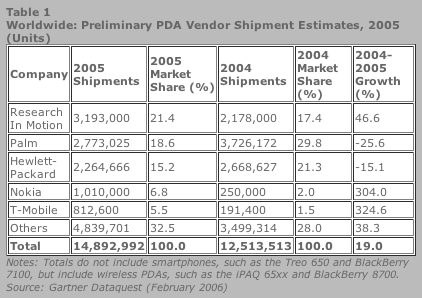
    First thing to note is that in 2006 Gartner was busy tracking PDA sales. You might wonder why this is relevant. The reason is because a significant proportion of RIM's Blackberries counted as wireless PDAs and were therefore considered to compete with Palm's Treos, HP's iPaq and Dell's famous Axim. Nokia was in the running with its Communicators. Here is how Gartner characterized the equivalent market in early 2006:

    So I'll just come out and say it: In 2006 Gartner did not have a clue what a smartphone was. By their admission:

    Gartner defines a PDA as a data-centric handheld computer weighing less than one pound that is primarily designed for use with both hands. These devices use an open market operating system supported by third-party applications that can be added into the device by end users. They offer instant on/off capability and synchronization of files with a PC. A PDA may offer WAN support for voice, but these are data-first, voice-second devices.

    In other words, in 2006 Gartner was splitting phones with operating systems into two separate markets: data-oriented wireless PDAs and voice-oriented smartphones. The split was mostly based on the judgement of the analyst on whether a device was "voice" or "data" oriented. I suppose they used the primary input method as a proxy: numeric keypads meant the device was one-handed and therefore voice-oriented. If the device had a full keyboard and/or a stylus-actuated touch screen then it was a two-handed data-oriented device. But even this proxy was not quite enough, sometimes devices were classified whimsically.

    To make it more complicated, they bundled non-cellular but Wi-Fi enabled PDAs with wireless PDAs. This made some sense from a corporate IT point of view (their primary customer base) as these data-oriented devices would be used either on a LAN or a WAN (Wide Area Networks: what Gartner anachronistically called cellular networks.)

    The presence or absence of a cellular radio did not enter into their view of these devices. So if you asked Gartner in 2006 to forecast smartphones (as we know them now) in 2010, I suppose you'd get what they forecast for "data-centric" devices.

    So assuming that today's smartphones are mostly "data-centric" we would have to look back on their view of that market and not the voice market which was seen as an entirely different thing. Their answer should have had something to do with the market leaders and participants in 2006. As the table above shows Gartner showed that RIM, Palm and HP led in 2005 with Nokia and T-Mobile[1] pulling up the rear.

    However, from a platform point of view, at the beginning of 2006

    Microsoft Windows CE was the No. 1 PDA operating system (OS) in 2005 as 7.05 million PDAs were loaded with the OS, up 33 percent from 2004 shipments of 5.28 million units. Palm OS PDA shipments declined 34 percent to 2.96 million units in 2005.

    In late 2006, Gartner made further predictions for the year:

    In 2006, Gartner expects the PDA market to increase by 6.3 percent to 16 million units. The market will continue to be driven by broader availability of cellular-enabled PDAs from wireless carriers. Gartner estimates that 53 percent of all PDAs shipped in the first half of 2006 featured integrated cellular capability, up from 46 percent during the same period in 2005. “The share of PDAs purchased by enterprises will continue to increase; it accounted for 49 percent of all PDA shipments in the second quarter of 2006 and Gartner expects that the enterprise market will account for 52 percent of all PDA shipments in 2006,” said Todd Kort.

    At this time I have not yet dug up a Gartner "Wireless PDA OS" four year forecast from the year 2006 but I suspect it would not show devices running Google's Android operating system or any running something called iOS.

    I also seem to remember that they were suggesting that Windows would be the leading mobile platform. Although it was trailing in 2006, Gartner was quite bullish on the disruptive challenger from Redmond.

    [1] T-mobile is in the list because it was common practice in 2006 for operators to market Pocket PC Phone Edition devices made by HTC under their own name. Orange, Vodafone and Verizon also had own-brand HTC Windows touch-based devices. Now what does that strategy remind me of?

  6. Stop the Presses! RIM Buys own OS Kernel

    Research

    RIM Buys QNX to Tie Phones to Cars | News & Opinion | PCMag.com.

    Seriously, a real operating system. This is their first.

    As a (Unix-like real-time) microkernel-based OS, QNX is based on the idea of running most of the OS in the form of a number of small tasks, known as servers. This differs from the more traditional monolithic kernel, in which the operating system is a single very large program composed of a huge number of "parts" with special abilities. In the case of QNX, the use of a microkernel allows users (developers) to turn off any functionality they do not require without having to change the OS itself; instead, those servers are simply not run.

    ...which is more than can be said for the BlackBerry "OS".

    Source: Wikipedia