Asymco

Asymmetric Intelligence

profit

  1. Sony Ericsson units down 20 percent

    Research

    Sony Ericsson shipped 11 million phones at an average selling price of EUR160 in the second quarter, compared with 13.8 million units at an average price of EUR122 a year earlier. Sales rose to EUR1.76 billion from EUR1.68 billion, against expectations of EUR1.79 billion.

    The company's estimated share of the global handset market remained flat from the previous quarter at around 4%.

    The company reported net profit of EUR12 million for the three months to June 30, compared with a EUR213 million net loss the year before, missing analysts' expectations for a EUR50 million profit but sustaining the turnaround that started in the first quarter.

    via Sony Ericsson Swings To 2Q Profit.

    Sony Ericsson still sells more phones than Apple.

    See also:

    asymco | Sony Ericsson ships 14.6 million phones.

    asymco | Sony Ericsson and RIM reach market share parity.

  2. The value of software in mobile phones

    Research · 4 comments

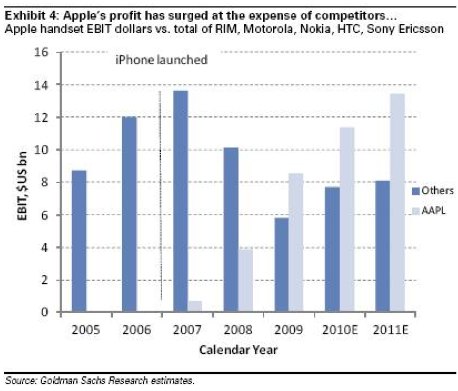
    Apple will generate 2X as much handset profit as the rest of the industry combined this year DESPITE SELLING ONLY 3% OF THE HANDSETS BY UNIT VOLUME

    via You Can't Appreciate How Completely Apple Has Humiliated The Cellphone Industry Until You See These Charts.

    That interpretation of the data is exaggerated and/or incorrect.  An analysis of profitability was done with respect to Nokia here and industry-wide here.

    Goldman Sachs analysis (graph below) shows competitors' profits and losses combined.  Sony Ericsson and Motorola generated negative profits during 2008 and 2009 and may do so through 2010.  Apple's profits are likely to be larger than the industry *net* profits but not twice as much by 2011 (the graph does not even show that; 13.5 is not twice 8). Furthermore, the competitors do not include Samsung and LG!

    Exaggeration or not, the fact remains that Apple entered the market in 2007 and in only three years became the most profitable phone vendor. It's indicative of the value of an integrated user experience innovation in the market, which itself is indicative of the value of software in a hardware-oriented incumbency.

  3. Nokia vs. Apple phones business comparison shows comfortable lead for Apple

    Research

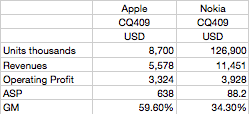
    Nokia reported 21.5 million converged devices sold in Q1.  The units, share, ASP, Revenues and Operating Profits are compared in the following table.

    It's once again evident that Apple captured more profits from the iPhone than Nokia did from all its devices and services operations.

    With respect to converged devices, Apple also generated more sales and had nearly triple the ASP.  Unit shares remained almost the same sequentially. Nokia did suffer more from ASP erosion sequentially as the converged ASP dropped by 24% vs. a 2.5% drop for Apple.

    What is interesting from a growth perspective is that Apple's #1 position in the share of profits from mobile phones was acquired with such a low market share.  Analyst Brian Marshall said the most interesting part of Apple's story is the international growth of the iPhone. He believes that Apple has only acquired about 1.5 percent of its international carrier partners' total postpaid subscription base of 525 million. For comparison, its penetration in the U.S. peaked in Sept. 2009 on AT&T with 5 percent.

    Sources:

    Nokia - Investors- News Release

    Apple - Investor Relations

  4. Nokia back on top

    Research

    Nokia regained top spot in operating profit. I'll leave net profit assumptions aside this time, but Apple is sure to have beat by having far lower R&D as percent of sales.

    Nokia Smartphones had a good quarter due to new launches. I show also share and ASP comparisons for smartphones in both companies.

  5. Nokia shutters U.S. flagship stores

    Research · 1 comment

    In other news:

    • Nokia shutters flagship Regent Street store in face of Apple retail’s domination - December 08, 2009
    • Nokia sees flat market share as Apple gains - December 02, 2009
    • Nokia Chief Strategist: Apple will remain a niche player in smartphones, just like in computers - November 30, 2009
    • Nokia to cut another 330 R&D jobs - November 20, 2009
    • To understand market share vs. profits, look no further than Nokia vs. Apple - November 11, 2009
    • How Apple passed Nokia to become the world’s most profitable handset vendor - November 11, 2009
    • Strategy Analytics: Apple passes Nokia to become world’s most profitable handset vendor - November 10, 2009
    • Nokia sues Apple claiming iPhone infringement of Nokia GSM, UMTS and WLAN patents - October 22, 2009
    • Nokia posts loss of 559 million euros on weaker smartphone sales - October 15, 2009
    • Nokia’s earnings plummet 66 percent - July 17, 2009
    • Jim Cramer: The problem with Dell and Nokia is that no one wants their products; Buy Apple - July 17, 2009
    • Nokia’s failures vs. Apple’s vibrant iPhone platform puts market share at risk - June 24, 2009
    • Nokia Ovi Store launch a complete disaster - May 26, 2009
    • Nokia ships 19% fewer phones in Q1, bleeds more share - April 16, 2009
    • Nokia axes 1700 jobs worldwide - March 17, 2009
    • Nokia halts sale of iPhone killer; 5800 handset plagued with major problems - March 02, 2009
    • Nokia hops on bandwagon, unveils knockoffs of Apple’s iTunes Store, App Store - February 16, 2009
    • Nokia profit collapses 69% in fourth quarter 2008 - January 22, 2009
    • Nokia’s profits plummet 30 percent - October 16, 2008
    • Nokia’s fatally flawed ‘Comes With Music’ service no Apple ‘iTunes Store killer’ - October 03, 2008
    • Nokia fumbles iPhone lookalike-not-workalike launch in U.S. and Europe - October 02, 2008
    • Nokia sputters that iPhone ‘not worthy of discussion’ - August 13, 2008
    • Apple takes top spot from Nokia on AMR Research’s 2008 Supply Chain Top 25 list - May 30, 2008
    • Nokia shares slammed in wake of miss; Nokia CEO calls Apple iPhone ‘niche product’ - April 17, 2008
    • The knockoff parade continues: Nokia exec shows Apple iPhone lookalike ‘Tube’; dismisses Apple - April 08, 2008
    • Nokia previews blatant Apple iPhone knock-off (with video) - August 29, 2007
    • Nokia CEO challenges Apple over iPhone - February 13, 2007

    http://www.macdailynews.com/index.php/weblog/comments/nokia_shutters_us_flagship_stores_as_floundering_cellphone_maker_fails/

  6. Nokia Quarterly Results

    Research

    Nokia's latest quarterly results and forecast caused a 15% drop in the share price on a day when the S&P rose by about 1%. The drop was the largest single day change in the company's valuation since 2004. The cause for the drop was not macroeconomics or performance in the previous quarter, but the guidance provided.

    The shock was in an unchanged low margin and a flat market share. Both of these measures of performance were expected to improve as the overall market improved. What Nokia is saying, in effect, is that it will perform no better than the market average. Naturally, its value should therefore be no higher than the market average.

    The trouble is that the "market" for mobile phones is abysmally free of value and hence of profits. Taking the sum of profits for all the major incumbents (Nokia, Samsung, LG, Sony Ericsson and Motorola) we find that net profits for the entire industry are, at best, flimsy, at worst, negligible. But this begs another question: why is value missing in mobile devices--a market that seems to be growing faster than almost any other technology market?

    First a few facts:

    • Focusing only on Devices & Services, Nokia did make a net profit of EUR763 million on sales of 103.2 million phones. That's EUR 7.39 average operating profit per phone. In Q1 Nokia Devices made about EUR 6 per phone, so a slight improvement, but down from about EUR 20 a year ago.
    • Sony Ericsson entered its fourth quarter of losses.
    • Motorola entered its 9th consecutive quarter of losses.
    • Samsung and LG are at about break-even.

    So if one were to look at the incumbents, the ~1 billion phones they sell a year seem to be generating barely EUR2 per phone, most of it in the hands of Nokia.

    The exceptions are, of course, the entrants RIM and Apple with EUR 60 and EUR 120 profits respectively per phone, orders of magnitude above average.

    Nokia seems to be the best of a bad lot. Can Nokia expect to join the entrant cohort or sink with the incumbents? Answering this question forces us to go through a deep examination of what correlates with value in the new device market.