Asymco

Asymmetric Intelligence

Qualcomm

  1. WWDC Special: Asymco Office Hours - June 2026 - Live Q&A with Horace Dediu: Recording & Transcript

    Office Hours

    Recording and transcript of the June 9, 2026 Asymco One Office Hours, recorded the day after Apple's WWDC 2026 keynote. Horace Dediu shares his impressions of the event and takes questions from Asymco One subscribers.

    Recording

    Subscribe to Asymco One to listen to the recording and read the transcript.

    Transcript

    Sign up and latest updates at asymco.com/live.

  2. Will Apple avoid giving their cash flow to Nvidia?

    Research · 3 comments

    Asked by Jay Goldberg

    Q: Do you think Apple will start investing heavily in AI data centers?

    There's rumors and actually statements from Apple saying that they're working on a server chip. Google has a server chip. Amazon's got a server chip. These are effectively aimed at Nvidia. And if you can make something, you tend to do it. Now, of course, there's some protection — Nvidia's got other special sauce, but their margin is everybody's opportunity. They have a huge margin. And everybody's writing huge checks. As I say, hyperscalers are just handing over their entire cash flows to Nvidia. And that means their shareholders' entire wealth is being handed off to Nvidia shareholders. So there's a transfer of wealth happening right now. Presumably, because we're going to get some benefit later, but if that's happening and people are irritated by it, they're going to find a way to do what Nvidia does.

    And Apple, of course, can and will do that. Now, whether that'll get deployed at the edge or in Apple's own cloud — because they probably also don't want to write checks to Nvidia, and they'll say, well, we can do it, and we won't necessarily sell them, like Google wants to. They'll probably just use them themselves. And that's something certainly they're capable of.

    The question I was always asking is how many are we talking about? Because if it's in the tens of millions, or even single-digit millions — for Apple, single digits. Is it worth it to develop your own designs? There's a limit to how many you can deploy. And probably you're going to have to replace them every so often, so there's a question about how much it costs to keep on the treadmill.

    But it is an interesting question, and I think everybody's capable of doing what Nvidia's doing. But it's about execution, timing, delays. Look at what happened with the Qualcomm chip — how long it took Apple to finally deploy the communications chip relative to the amount of grief it had to deal with. First, of course, it moved out of Intel. It moved out of Qualcomm now, and now the question is, is it going to move out of the server supplier chain? And that's a complex decision. But again, Apple's not doing it because they want to be in that business. It's more that they want to avoid dependency.

    This was one of the questions asked by the participants in Asymco's May 2026 Office Hours live Q&A sessions, open to Asymco One subscribers.

    See also: May 2026 Office Hours

  3. Apple’s Custom Silicon Opens up Potential for a Cellular MacBook

    Nota Bene · 1 comment

    iPhone Air share of mix samples 2x iPhone Plus

    Explore how Apple’s C1X modem performs in the real world, with Ookla Speedtest data from Q4 2025 showing the iPhone Air matching Qualcomm’s X80 download speeds while setting new latency benchmarks.

    iPhone Air marginalizes competing slim form-factors. The iPhone Air has largely eclipsed the Samsung Galaxy S25 Edge globally, out-sampling it 3-to-1 in the U.S. based on Speedtest data, while the Edge remains statistically negligible in terms of adoption across European markets. South Korea remains the primary competitive exception, driven by strong home-market bias.

    In 2024, the iPhone 16 Plus was the clear laggard of the range, capturing a mere 2.9% of the launch mix. By sunsetting the iPhone Plus and replacing it with the design-centric iPhone Air, Apple more than doubled the share of this roster slot to 6.8%. This suggests that “Slim” as a category successfully resonates with a segment of the market that “Large” simply did not.

    Apple’s newest hardware cycle centered on a key question: could Apple’s first high-performance modem, the C1X, improve upon the original C1? Furthermore, could it match the industry-standard Qualcomm X80, without the thermal headroom of a “Pro” chassis. Despite its slim form-factor, the iPhone Air does include a vapor chamber to aid cooling, while its titanium frame also aids heat dispersion. Qualcomm remains a formidable incumbent with its X85 modem, which alongside MediaTek’s M90, will feature in newer Android flagship devices this year. Based on comparisons with the X80, our data suggests that Apple’s silicon has reached a critical maturity point, shifting the conversation from a performance gap to a strategic “equalizer” in real-world performance.

    Source: Ookla®

    NB: Lots of very interesting data in the source. Definitely worth looking at carefully. The conclusion is quite a bombshell…

  4. Asymco Bulletin 004 - Mar 15, 2026

    Bulletin

    Asymco Bulletin is a digest of all the work we have published for the week ending Mar 15, 2026.

    Research

    The most brilliant move in corporate history?

    In a bold departure from its Big Tech peers, Apple sidestepped the $650 billion AI infrastructure spending frenzy. While Amazon, Google, Microsoft, and Meta funneled cash into data centers, bleeding cash flow and adding debt, Apple maintained a consistent $14 billion capital budget. This strategic choice reflects Apple’s belief that AI models are rapidly commoditizing, as evidenced by DeepSeek’s $6 million model rivaling $100 million counterparts. Instead of building proprietary models, Apple licensed Google’s Gemini, reserving the option to switch vendors as superior models emerge.

    Apple’s genius lies in leveraging its ecosystem—2 billion devices transforming into a distributed AI powerhouse. Apple silicon on device enables local AI processing, bypassing the need for colossal server farms. This approach not only conserves capital but also amplifies customer loyalty, as Apple uniquely protects privacy. Ultimately, Apple bets on owning the customer experience, positioning itself to thrive regardless of infrastructure ownership. →

    Is Apple Pivoting?

    Apple's recent product launches, including the 17e and MacBook Neo, have sparked speculation about a strategic shift towards low-end markets. However, this view overlooks Apple's fundamental approach to market segmentation, which eschews simplistic price categorizations. Instead, Apple focuses on the "job-to-be-done," understanding that consumer purchases are driven by desired outcomes rather than affordability alone. This perspective reveals that performance and quality are crucial, transcending income levels. For instance, affluent individuals may opt for simpler devices, while budget-conscious consumers might invest in high-performance tools to meet specific needs, like content creation.

    Historically, Apple has aimed to deliver superior experiences to a broad audience, refusing to compromise on quality with budget-friendly products like Chromebooks. While cost can limit access, as seen with the Vision Pro, Apple prioritizes profitability as a validation of its value proposition. The MacBook Neo exemplifies this ethos, leveraging efficient mobile chipsets to redefine laptop capabilities at a competitive price point. This innovation blurs the lines between mobile and traditional computing, underscoring Apple's commitment to crafting products tailored to diverse tasks. Ultimately, Apple's strategic depth, powered by Silicon advancements, positions it to serve an expansive global market by addressing a wide array of functional needs. →


    Nota Bene

    Rosenblatt Lifts Price Target on Apple by $1, Maintains Netural Rating → On March 5, Rosenblatt's Barton Crockett slightly raised Apple's price target to $268 while maintaining a Neutral stance, optimistic about Apple's budget product launches and steady high-end performance, despite trading at a modest premium compared to peers, as analysts foresee robust revenue growth for FY2026. →

    How many employees does Apple have? What do they do? → Apple, despite its marketing reputation, is fundamentally an engineering powerhouse with nearly half its workforce dedicated to engineering roles, driving its substantial revenue growth and global employment expansion. →

    First footage of X-Plane 12 on Vision Pro → X-Plane 12 on Apple Vision Pro leverages ARKit to seamlessly integrate physical controls into a mixed reality flight simulation streamed from a Mac, showcasing advanced professional-grade AR capabilities. →

    iPhone production in India increases by 53% in 2025 → Apple's strategic shift to ramp up iPhone production in India by 53% last year, aiming not just to sidestep tariffs but to cultivate a vast new customer base, underscores a long-term vision mirroring its successful penetration of the Chinese market. →

    Qualcomm faces loss of Apple business, rated ‘Underperform’ by Bank of America → Qualcomm's dominant era in smartphone chips wanes as Apple and others pivot to internal solutions amid costly licensing disputes. →

    MacBook Neo May Boost Revenue By 0.5% While Expanding Into Student Market – Gene Munster → The MacBook Neo, targeting both education and broader markets, could modestly boost Apple's revenue by $2 billion annually without impacting margins, potentially revitalizing the Mac segment akin to Covid-era growth. →

    Apple’s AI Hardware Blitz Could Send The Stock 33% Higher, Says Wedbush’s Dan Ives → Apple's hardware blitz prioritizes product refreshment over AI emphasis, potentially setting the stage for future growth, though its $350 stock target faces external market challenges. →

    China’s Android shipments plunge as inventory builds in contrast to iPhones: Jefferies → "China's Android market faces a perfect storm of rising inventories, soaring memory costs, and renewed iPhone strength, hinting at a potential tipping point." →


    To gain full access to these articles, subscribe to Asymco One.

    Use code BULLETIN for a discount.

    Feedback: Have questions or comments? Reach out to us at contact@asymco.com. We’d love to hear from you.
  5. Qualcomm faces loss of Apple business, rated 'Underperform' by Bank of America

    Nota Bene · 3 comments

    Writing of the wall faded after years in the sun

    The analysts see Qualcomm as a leader in smartphone processors, but noted the handset chip market has matured and faces potential headwinds, including higher memory prices and a decline in business from Apple. They added that the company faces the well-known imminent ~$7 billion to $8 billion loss of Apple business.

    Apple has historically been one of Qualcomm’s largest modem customers, but the bank expects the relationship to wind down as the iPhone maker shifts to its own internally developed chips. “QCOM's modems will be completely phased out of iPhones by Fall 2027 as top customer Apple shifts to internal modems,” they wrote.

    The report also highlighted a broader trend of smartphone manufacturers investing in their own semiconductor capabilities. Samsung has reduced Qualcomm’s share of processors used in its Galaxy lineup, while Chinese smartphone maker Xiaomi has committed about $7 billion toward internal silicon research and development.

    Source: Yahoo Finance

    NB: It's not just Apple that is bailing…

  6. Apple's growth vs. top ten largest tech companies

    Research · 10 comments

    In the last article I described growth vs. P/E and price change for the largest "ultra-large cap" companies, of which Apple features prominent.

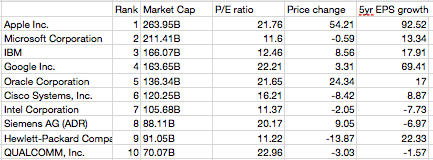
    In this article I take the same analysis to the top ten largest technology companies (by market cap, see table at bottom).

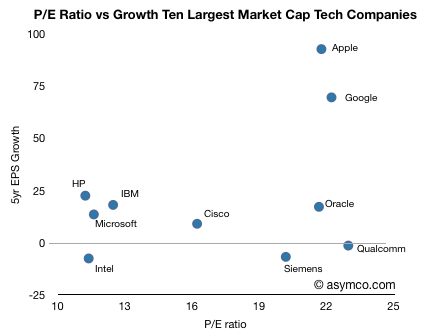
    In this comparison, Apple no longer has the largest P/E ratio. Qualcomm, Google and Oracle are all at similar levels of valuation relative to earnings, however Apple's growth outstrips them, only with Google in the same quadrant.

    Note the "Wintel" cohort consisting of Intel, Microsoft, HP clustered around the Low growth, low valuation quadrant in the lower left (coincidentally co-located with IBM). Oracle, Qualcomm and Siemens show high valuation with low long-term EPS growth. Cisco is somewhat on the fence.

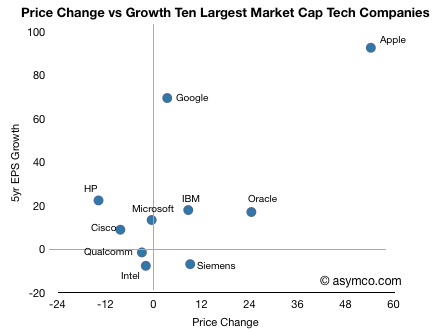
    When comparing how the market has rewarded growth through share price appreciation, the correlation to growth is much better. Google seems under-rewarded.

    Data follows: