Asymco

Asymmetric Intelligence

transcript

  1. Asymco Office Hours Duo: The First Ternus Keynote – Sunnyvale Session Recording & Transcript, September 11, 2026

    Office Hours · 1 comment

    Recording and transcript of the September 11, 2026 of the Office Hours Duo, recorded in Sunnyvale two days after Apple's September event, the first keynote under John Ternus.

    Horace shares his impressions from the event and the briefings that followed and takes questions from Asymco One subscribers.

    See inside:

    • Duo: a pricing decision made seven years ago
    • Theatrical, not cinematic: on the attraction of moving objects
    • Duo cents an unlock
    • The 1.2 billion-dollar puzzle of the iPhone ASP
    • Why launch iPhone 18 in spring?
    • The anti-social: Siri, designed not to be a companion
    • Apple's unpretentious moonshot
    • Memory: one-hundred year flood led to famine. What's next?

    Subscribe to Asymco One to see the full recording and transcripts.

    If you missed the first part of Office Hours Duo, you can still join us this coming Friday in person or remotely.


    Video Recording

    Subscribe to Asymco One to watch the recording and read the transcript.

    https://asymco.com/wp-content/uploads/2026/09/Asymco-Office-Hours-2026-09-11.mp4

    Transcript


    Horace Dediu: Thanks for joining us. We're having our first in-person Office Hours. We've had Office Hours before, but nothing quite like this, and we're having another one next Friday on the East Coast. Today we're in Sunnyvale, near Cupertino, where I was part of the Apple events. They even had us do a walk-run kind of physical thing with Apple Watches. That's where I got this hat: a little souvenir with the rings, and it says Apple Watch on the back. I took part in a run around the Apple Park building, the spaceship. Some people walked, some people ran, and I chose to run. It was ninety degrees Fahrenheit and it was quite a struggle, but I managed to complete all three laps, about three-plus miles, with a bit of jet lag in the process.

    I've been to a lot of these events, and one thing that struck me was how many more people seemed to be there. The audience is typically media. They're there because they're going to promote the product. The purpose of the event is to make sure the word gets out, and none of those people are paid by Apple to be there. This is what's called earned media. Maybe there's some compensation for travel for some, but generally people volunteer, or are asking to be there. I've never seen so many people at this event. It was completely packed. They bussed in a lot of people from all over the world. I somehow ended up with the Europe crowd, so we had a Europe bus, a Japan bus, a China bus, and they clustered us by colored lanyards into different parts of the Steve Jobs Theater.

    Watching all of that operationally was fascinating: the degree of scale and professionalism in event production and event marketing. I've seen dozens of these, but this seemed to be the biggest in terms of production quality. Afterwards we got several briefings. There were people allocated to manage us as groups. I got to see the Mac mini and the Studio being used as localized AI servers, and we met with the product management teams for Apple Intelligence, the iPhone and the Apple Watch, one-on-ones with the product owners, product marketing people, and got to ask questions.

    I got to see John Gruber, the usual suspects, Ben Bajarin. I happened to also see Phil Schiller, who was in the audience, and Avie Tevanian, an eminent ex-Apple engineer famous for his contributions to NeXTSTEP. I didn't meet John Ternus. I escaped from the huge crowd because it was so hectic and so busy, like a circus.

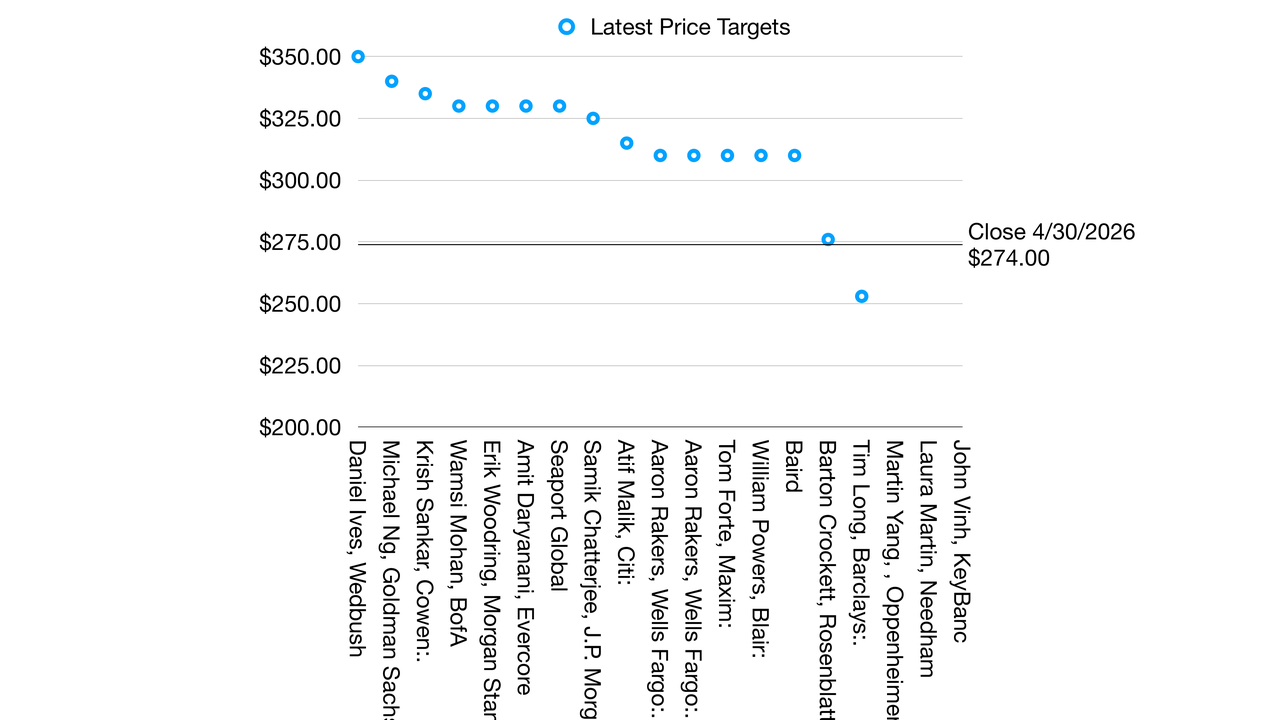
    Given this behind-the-scenes look, my impression of the products is this. Firstly, and I wrote it up today, the pricing was a shock. I think the pricing was very low, and the shock to me was that they are holding the line. Bank of America issued a note suggesting they're going to take a hit on margins, and as a result lowered their target price a few dollars. It's symbolic. I think Apple is very careful about what they're doing here. Pricing at Apple is an art. I've said this many times. It's one of the most carefully thought-out decisions they make, and it is not tied to competitive issues. To some degree, with memory, it's tied to supply questions and to being cost conscious, but it is much more about signaling to customers what the value of the product is. Is it a thousand dollars of value, or multiples of that thousand? That price becomes something that competitors need to deal with. Apple doesn't deal with competitors. Competitors deal with Apple.

    There have been leaks, credible ones in my opinion, that the Duo began seven years ago. This is not unusual. The iPhone took seven years. The Vision Pro took seven years. The Apple car, before it was canceled, took seven years. These things take a long time. And I think the decision to start seven years ago was predicated on the premise that this would be a $2,000 product. That price was set that long ago, irrespective of what happened since. So pricing is one of those things that suggests a very strategic intent. Now, they've tweaked the prices of some of the older products, and the piece I wrote today measures exactly what the percentage changes are depending on the amount of memory involved. That's a reaction to commodity pricing. But overall it's very disciplined pricing, and I think they're going to manage the volumes in a way that is optimal.

    I'm not the only one to say this: I think the Duo will be supply constrained for at least four to six months, which in my mind means about a month's waiting for some configurations. The 18 Pro and Pro Max will probably be less constrained. But demand for the Duo is going to be off the scale. Already people who were skeptics, myself included, are thinking about how to justify buying one. The only one I spoke to who was still on the fence was Ben Bajarin. He really likes the single monoblock configuration. I think he'll cave. He'll realize he needs something like this, if not as a daily device, then for some tasks.

    The products are phenomenal. The Watch: I'm going to write another piece on the new health initiatives. I don't know what to call them; the focus, the dedication. This is a recurring theme, but health is now up yet another notch. It's becoming a coach, an advisor, a longevity guide. That's all very exciting. We're about fifteen minutes in, so let's make sure we give people time for questions. First, anyone with us here. Fred, do you have anything?

    Fred Stein: It's a theme that I think is underreported about the iPhone Duo: pleasure, and prestige, the pride of ownership. It's always been there with Apple products. But being the first to get a foldable, right after everyone's been talking about it for so long, and Apple having its demographic, this might be a big driver, rather than everyone thinking about the practical aspects of it.

    Horace Dediu: Absolutely. The skeptics are the ones who haven't been able to be there, and seeing is believing. Let me use some framing. I called it having a sense of theater about it. It took what was a two-dimensional experience into three dimensions. As the demos show, it's always in motion. It's not just opening it as a book, though even the book nature of it matters. It can be held at a slightly open angle to resemble a book. It will be an alarm clock, a television, a keyboard and screen, and with the Apple Pencil it will be a notebook. The configurations they've demonstrated suggest that it has a sense of theater, a presence, a satisfaction you get from using it in a tactile way. It is not a simple sheet of glass. That has its own attraction; we've always been sold on the thing as a piece of glass. But now it's suddenly an origami, a moving object.

    I'll give my own story. When I was at Nokia we believed in the so-called monoblock, a single phone that didn't have any moving parts, for many practical reasons. It was more durable. It had a longer battery, because you could put a big battery in it. It was cheaper to manufacture. There were all kinds of benefits to having no moving parts. And yet, at the same time, in the US and in Japan the flip phone was catching on big. Everyone in Finland was scratching their heads and asking why anybody would do this, as a user or as a builder of phones. We were resistant and reluctant to convert to the flip format, though eventually I think they did launch a flip phone. One of the things people argued with us about was that there's a sense of action when you open and answer, and a sense of closure when you end the call by closing the phone. In Japan, even more so, they had antennas that pulled out, so you opened it and had all these activities you would do to initiate a call. It's not just for the person doing it, but for the person watching. There are all kinds of secondary and tertiary effects to this form and the way it feels.

    On top of that, I think there's an element of attraction that, without saying it's only women, I think women are going to feel more: that this is more stylish. My wife, for example, has a case that opens this way, because she likes to put cards in it, and she likes the physical cover because the phone sits in a purse. There are all these reasons why you want a folding form factor. It's something perhaps a bit more feminine, and that alone might attract people. We don't think logically about this. We think this is a waste of energy, a waste of time, but it's extremely important to understand. I'm unable to articulate it fully because I haven't seen the research or the data. Perhaps no one has; perhaps it's all secret. But I think Apple has seen what people do with things that move.

    Remember, even Jony Ive said people like to fidget. If you have a pen, you're always clicking it. If you have a pen with more than one function, where you can select different colors of ink, you're always messing with it. There's this notion that physically moving objects have a natural attraction. If I ever have a pen, I take it apart to see what's in it. The psychology of behaviors related to physical objects we hold that have moving parts: I think there's something there. The folding competitors may have known this already, but Apple just didn't think the technology or the quality was there until now. They've made that clear. Apple doesn't do it just because you can. It only does it when it can meet their criteria to be sufficiently good.

    So the product is going to be a big hit, even though it's a niche, and many people, maybe most, would argue they don't need it. It'll be a bigger hit than we anticipate. Initially the market reaction was very muted. The stock closed flat, down half a percent or something. But since then it's risen quite a bit, and on the second and third day we've seen the realization, also by the media who were out there, that this has resonance with audiences. There's a lot of buzz around it. It's on another level. It's not about specs. It never is, with Apple, but in this case in particular I think there's a mystery to it, a mystery as to why it's going to be successful, and a charm. I always said Apple really sells hormones. Here we have people who are going to have the flushed cheeks and the dilated pupils, an emotional, hormonal response. And another thing: if you see another person with it, it's going to be contagious. People will get it from others. And if you go to the store, this is why stores exist. The Apple Store exists precisely for this product. Steve even said the Apple Store exists for the Watch, because once you see it and touch it, you'll be persuaded. In this case, once people see it in the stores, it'll be a huge driver.

    Farshad Nayeri: You mentioned it was theatrical, and I didn't realize at first that you meant it in contrast to cinematic, which is the two-dimensional experience of the iPhone. Theater is three-dimensional, and it is a moving object. Of all the things Apple has made, most are not like this, with screens that move.

    Horace Dediu: They have dynamism within the screen, and the Vision Pro is three-dimensional virtually. What you see on screen comes alive; it's illuminated, and there's beauty in it. But when you go to the theater, the idea is that you have much more intimacy. I wouldn't say this is the first and only one. The Watch has a similar feel because of the band and multiple controls. Watches have always had that kind of mechanical nature. But this is on another level. The object itself transforms.

    Farshad Nayeri: Our experience with the iPhone has been that you touch something and it reacts to you. The screen reacts to your touch. This has it when you open it. That physiological loop between you doing something and it responding: the things that do this are animate objects, live objects. It makes it more alive than a screen. And it's hard to convey any of this.

    Horace Dediu: We're having a struggle here trying to put it in words. Once you see the thirty-second video, then you see it in real life in front of you, then you see other people using it. All of this is the usual effect. Honestly, to see it is to love it.

    Fred Stein: I was riffing off one of your prior articles: reasons to buy it, reasons to have someone else give it to you. Especially in emerging markets. I'm hoping you can go a little further into emerging markets.

    Horace Dediu: As a gift, from men to women perhaps. As I said, it has a nature about it that's attractive. It's an attractive gift, perhaps more feminine than masculine. I'll be honest: I'm thinking of giving it to my wife. I hope she's not watching. I know she likes this form factor. That's how I think about it. I perhaps wouldn't even have one for myself, although maybe I will eventually.

    I'll tell you a big secret. My favorite iPhone is actually the Air. I don't have one now; I'm waiting for the next version. The Air, as John Gruber says, is the nicest iPhone. It has a niceness about it. It is maybe the most beautiful iPhone ever. Here's how I think of it: I'm not sure I can pull it off. I wish I could own one, but to do so would require some compromises. It's like saying I wish I could pull off this outfit, or these shoes. If it's a lady: I wish I could do high heels, because they're wonderful, but they're bad for my back, so maybe I shouldn't wear them. The Air is a similar type of thing. Having it, socially speaking, signals that you are sacrificing for the sake of art, for the sake of beauty. I carry a phone that is less than perfect, but it's beautiful; it's sublime. I'm told many top Apple execs carry that phone, because there's an understanding that it is high art. To me, that's the more desirable one. But the Duo is yet another level.

    Farshad Nayeri: In jobs-to-be-done theory there are three types of hotspots. What you have been describing is the emotional: you open it, you close it, the feeling of that. And the social: other people see it and ask, can I play with it? But there is another one called functional or practical. I think anyone who actually uses an iPad on a regular basis and has an iPhone is going to want one of these, because it's one device. It replaces the iPad mini, and it gives the pocket exception to the iPad. You always want to find what kind of pocket fits an iPad mini, and now you can put it in any pocket.

    Horace Dediu: A lot of people are going to discuss the utility. The whole point I'm making now is to work at another level, away from utility, which gets less coverage because it is so much harder to talk about.

    Farshad Nayeri: Dave Sundahl and I were studying this. If you get all three hotspots locked in, it's very hard, once you have that, to displace that product. It's very stable.

    Horace Dediu: I've been reading many, many comments since the event, and a lot of people are discussing exactly this: pencil use, could I replace my iPad, what size is it, all the possible measurements. I'm trying to highlight the fact that it's sublime beyond these things. The decisions to buy it are much more emotional than rational, because frankly that's how it came across to me. It's a product of dazzling dimensions of attraction, not just utility. It is above that. People argue, and I bring up metaphors and examples: high heels, fashion, jewelry. Why do people buy jewelry at all? It's extremely non-functional, but it signals between people. Especially as a gift, it signals love, it signals desire, and people like to receive those symbols. I don't have to beat this horse. My observation is: why do we not think this should apply to devices that happen to do other things as well, especially highly utilitarian things?

    Let me step back a moment to talk about price again, because I also published this idea that the pricing of the product is about a dollar ninety a day at the starting point of the Duo. Let's round up to two, once you factor in taxes and whatnot. So you end up at two dollars a day, and that's about twice the historical average for the iPhone, or even the average Apple product. The median Apple product is a dollar a day. You can go and check this out: go to store.apple.com, price the product, and see what the lease price is. It'll be approximately $58 per month. Divide that by 365 over twelve and that gets you the daily price. I've done this for all the iPhone configurations, and for other products when they announced Apple Upgrade. Whenever someone says this is going to cost me my mortgage payment, some ridiculous number, that they can't afford it: you have the option to pay on a monthly basis, and it comes to two dollars a day.

    And here's the killer: it's in use four hours a day. Maybe, because of the fold, it's going to be in use more, because people will find jobs to do with it. Entertainment is a huge time sink. People will sit and watch more video, not just short form but long form. Short is easy, that's swiping. Long form: open it up, start watching a movie. Much more comfortable on this device. Then you start to add up the hours and the number of interactions. The average number of unlocks of an iPhone was 80 many years ago. It's possible we're now at a hundred unlocks a day. So two dollars divided by a hundred unlocks is two cents every time you use the phone. If it gets more use, it becomes even cheaper.

    I think people intuitively know this is the most useful product they own. It's the one they can't leave the house without. It's the one they panic over if they can't find it, and they have to have a way of finding it. I use my Watch to find my phone every other day, because it might be in the couch or in the other room. It's so important that you can't be without it for more than a few minutes. It's the thing you check that you have with you whenever you leave the house, and you think about safety all the time: if I don't have my phone, I'm unsafe. What if something goes wrong? If it's that important, two dollars a day. And by the way, the median across all the variants is a dollar forty right now. You can buy a used one for much less: a used iPhone for $400 or $350, no problem, an iPhone 15 or thereabouts. Even if it only lasts two years, that's less than 50 cents a day. The value is unbelievable. I'm preaching to the choir, but I wanted to throw in the $1.90.

    Farshad Nayeri: A little while ago I did a calculation of how much things cost versus how much you use them per day. The cheapest, the one with the most spend and the most utilization, turns out to be your bed. Of course those aren't awake hours, but they're hours. The smartphone was number two.

    Horace Dediu: But the bed goes with the house. That's the difference. The phone is always with you, even when you're not at home. I did this for cars, and cars are the worst. If it's a luxury car that depreciates quickly, it could be over fifty dollars a day. The cost per mile is fifty to sixty cents nowadays, maybe even seventy-five with inflation.

    Farshad Nayeri: I was looking at it per person. Two people share a bed, and a home is shared across two-three-four people.

    Horace Dediu: I don't question the bed. The bed is up there because you're in it for so long, and you should invest in a good mattress, no question. I'm pointing out that the bigger objects in your life, washing machines or refrigerators, are super important and very low per unit. What I'm trying to convey is that there are things in life that are underpriced, in a way, because we use them much more than we think. And other times we're spending way too much. I think cars are much too expensive for what they deliver. You spend one hour a day in a car and yet you spend tens of thousands for one. It's unbelievable. Anyway, moving on.

    Farshad Nayeri: We have some questions. Bob V. asked about AI interactions, now that the new iOS has AI built in. When hallucinations or wrong answers came from ChatGPT, or the original integration we had, Apple could say this is ChatGPT's problem. But now it's integrated into the OS. How does that work, and does that make any difference?

    Horace Dediu: In other words, is there a risk for Apple? I suppose. But then again, people have gotten used to AIs being wrong. There have been improvements in performance and quality, but there's an acceptance that the nature of AI is that it's not deterministic, and usually you get a disclaimer saying answers may be wrong. I don't think there's that much brand risk, as long as the experience is as expected. Of course, Siri also had its problems, but it wasn't usually being wrong. It was not understanding, or not getting the question right.

    Where it gets dangerous is if you're using these technologies to make decisions that are life-threatening, or if it gives you bad advice, as we see with chat AIs, where people become psychotic as a result of using them. I got a briefing on this from the product manager of Apple Intelligence, and she said: we're building Siri not to be a companion. It was a very big deal. It's an advisor, but not a companion. Siri is there as a concierge, a professional persona. It is not an amiable person, because they want to maintain an emotional distance. That was by design. It's interesting they made that decision, because it would have been very attractive to create a companion Siri. Years ago, when Siri first came out, Big Bang Theory put Siri as a character in one of the shows: the nerdy characters became emotionally involved with Siri, and it was a cause for comedy. That was more than ten years ago, and I think since then Apple has become very aware of the pitfalls. They're probably conscious of the hallucinations and being careful with that. But the main focus is not on error prevention. It's on preventing violations of privacy or security. It's far more scandalous if they're accused of some sort of leak of information. They'd get sued right away.

    Farshad Nayeri: Or capturing information: not leaking it, but internally using something.

    Horace Dediu: There was a recent lawsuit where they were claiming there was a privacy fault, and they would get sued because of their claim. This gets very tricky: regulatory concern, legal liabilities, class actions of all kinds. It's part of the cost of doing business, managing all that risk.

    Farshad Nayeri: I've been using the Siri AI in the beta, and I think there are ways Apple could reduce this. They have situations where they know about, say, my contacts. If I'm asking a question about a contact and it hallucinates, they can check whether it's one of my contacts. There are ways to limit the search space, because they have access to a lot more data than your average cloud model.

    Next question. You did the Stairway to Heaven. The top price now is $3,200, is that right? We've got the really high price, but probably not high volume. Does that affect your thinking about the average selling price?

    Horace Dediu: The way I wrote it up today: if you look at the price increases as a percentage from the previous generation, or even the current generation at a higher price, like the 17 non-Pro, there's a range of percentage increases. They're not the same. Obviously, if you're going from 256 gigabytes to 512, that's double, 1024 is quadruple, and then eight times. So you should see bigger jumps, and indeed, if you divide by the capacity, there's some consistency, between 20 and 30 cents per gigabyte of additional cost. This is in my blog post. But what I observed is that some configurations are getting a kind of bonus, in the sense that their increases are lower, as low as 8%. That configuration is the 512 gigabyte. The reason I think that got a break is probably because it's the most common one. That's the logical conclusion. So there's a higher increase at 256, it dips at 512, and then it comes back and is highest at 2048.

    My expectation is that the sweet spot is the 512, and therefore if I were to weight the pricing, I would concentrate on that price point as the most likely one. The mode, that's the word I'm looking for: the most common configuration. Now, it's multiplying way too many assumptions to come up with an exact ASP, but I did pencil something in. I said the average price increase is probably around 12%, which is way lower than most people thought. My estimate was 10 to 15, and we came in close to the 10. That's a surprise.

    What this does to the ASP depends on what the previous ASP was, and that is never given by Apple. There are a lot of estimates out there. People are saying it's already at 1,200, or already at 1,100. I've been much more conservative. I thought it was about 900, and therefore now we're at a thousand, perhaps. If you'll indulge me, the reason I believe it's lower than what the mainstream is saying is that I can't reconcile the fact that there are 1.2 billion iPhones in use and only 200 million are sold a year. If only 200 million are sold a year, and some are to new customers, how do you account for, let's say, 150 million phones replacing the worn out, broken and obsolete portion of the 1.2 billion? It suggests the lifespan of the product is eight to ten years.

    Farshad Nayeri: That doesn't make sense either.

    Horace Dediu: And no one is talking about this.

    Fred Stein: I totally agree.

    Horace Dediu: The ASP immediately affects this, because we don't know it, but if you assume a huge ASP, you're shrinking the volume, which means you're not servicing the installed base.

    Farshad Nayeri: Is that including the used ones?

    Horace Dediu: It's only new, of course. That's all that matters for Apple's revenue. There are several reasons the ASP is lower, by the way. When Apple publishes a price, there are retail margins. If they sell direct they get the full price, but they're going through carriers, and you see the discounts popping up. Some of that is eaten by the distributor, but Apple's not getting full MSRP on every deal. There's margin evaporation there. And they can account for the revenue differently. There's always this accounting issue where they say: because of software updates, we're deferring some of that revenue. They started doing this years ago, and we forgot about it, but for compliance with GAAP accounting they cannot book the hardware revenue if software is yet to be delivered. If there are future versions of the product, they haven't delivered the product in its complete form, so they defer it.

    Farshad Nayeri: So they're trickling the booked revenue.

    Horace Dediu: Over time that evens out, because now you're booking some tiny amount of a sale from two or three years ago while deferring this year's. It was more important when things were going up quickly. There's a lot in accounting that distorts the picture. I still remember that episode, because all the analysts didn't know what to do with the new data. So now you see the struggle: what is the correct ASP? I'm a little more conservative. I think they're selling a lot more phones. Why are analysts fixated? Because if you read my Stairway to Heaven, you fixate on the top. Oh, the phones are so expensive. But do you know how few two-terabyte units are sold? Those are for people capturing video for hours and hours. You need to be a YouTuber to need a two-terabyte phone. Or they're so wealthy that they don't even question it.

    Fred Stein: Give me the best, and here's my card.

    Horace Dediu: There are people who are completely insensitive to price and will just say, I want the best. But that's a vanishingly small number. What people tend to forget is that there's a lot of this middle to low end. I was a bit surprised, as I was doing my inventory for the Stairway data, that the 16 is still available for sale. The 16 is even lower than the 17e right now, which is considered the low end. There are a lot of good-enough phones down there. I had to do this inventory because I had to see how much the prices increased on the 17, the 17e, the Air and the 16. All of these are now a little higher, depending on the memory configuration.

    So what is the ASP? That is the question. Excluding the Duo, I think it's gone up to probably 1,100 right now. With the Duo, I think we're at 1,200. It all depends on how many Duos they sell. Another small footnote: the start of sales will be in October, so it's not going to make this quarter at all.

    Farshad Nayeri: What's the lowest-priced iPhone?

    Horace Dediu: It's in the 800s. But it used to be 400. That's now taken by the used market, the second-hand market. And by the way, when you think more about Apple Upgrade, you realize that those leased products that return to Apple are going to be under their control and visibility, and they'll know much more about that market. That information is super important. Once a phone goes into the secondary market, they don't know much about it. They don't know what pricing people are getting. They have to sample it. If you want to Google it, you can find refurbished phones on Amazon, on eBay, on dedicated sites. There are also physical retail locations. I was in Paris a few weeks ago and walked by a shop where you could see the used phones for sale.

    Fred Stein: A follow-up to that: will Apple follow what carmakers have been doing, where they take those phones from the upgrade program, put them in a nice package and sell them?

    Horace Dediu: They do. On the Apple Store there are refurbs, but that's a scale game. What you're referring to is lease returns. Currently, when people go to the Apple Store and return one a month later that they didn't use that much, because of the refund policy, Apple takes those almost completely new and resells them at a slight discount. But now we're talking about one- to two-year-old phones. I don't think there's a three-year-old option, but they have the two-year-old phone that they will probably take in huge numbers, refurbish in a very high-volume facility, and pump back out at minimal profit. I don't think it's about profit. I think it's about knowledge of the market and understanding how to deal with it.

    The auto market is the key question, because in the auto market there are four used cars sold for every new car. The used market is now becoming the primary market, because cars are so expensive. Only twelve percent of Americans today can afford a new car. It used to be like sixty or seventy percent who were in the market for a new car. Prices have exploded, and so one in six Americans are buying new cars, and now they determine why the cars we find available are all enormous SUVs: that 12% is the wealthiest 12%, and they're buying those cars and saying no to economy cars.

    This is a very important observation, because a lot of classical disruption theory depends on the low end and the mass market being interested in good enough. The problem is that the industry has completely dehydrated itself of visibility into that market. The challenge for Apple is not to fall into the trap of making things for the rich few, and yet not compromise on quality. If there's one thing I would advise Apple on, it's not to fall into the innovator's dilemma. It's a trap to think that more profitability is always the right answer. Apple being a premium brand, people already assume it's an exclusive, frivolous type of product, but they're not thinking fully about what's going on there.

    Farshad Nayeri: Speaking of that: a couple of Office Hours ago, when John Ternus's position was announced and the Neo was announced around the same time, you said you would like to see more disruptive products like the Neo. Now we see the Duo, which seems like the other side.

    Horace Dediu: But there's a dual launch cycle. This is unprecedented. We're going to have a second iPhone launch event. It started with the iPhone 5c, the plastic iPhone, which I think was a spring launch, and then they had the SE, and they've been dribbling out E's over time. Now the core product, the iPhone 18, is not launching in the fall. It's launching in the spring. You could read that as saying they're downplaying the core, the mid, the low, and hyping only the premium, the Pro. But I think of it as moving the core to having its own event. You'll have the Pro and the core at two separate events.

    Why not the holidays? Apple is very seasonal. It's got this huge leap because gift-giving is so important. It's consumer behavior; it's psychological. But the reason you do a spring launch is that there's gift-giving in other countries that doesn't follow the Christian calendar. You're still pushing gifting and seasonality, but spreading it across two different gift seasons. They might even do another one. I don't know if India is out of cycle with China; they might do an Indian orientation as well. Also, competitors took advantage of the fact that Apple was so focused on the fall by launching exactly out of phase, six months later. All the Samsung launches were happening in the spring. So Apple is going to suck some oxygen out of that by moving its own schedule there. It's cultural, regional, and it's also the idea that the markets that buy in the fall are grabbing the latest and greatest. The most popular phones and the highest ASP were during the December quarter. So we'll see that play out. If anything, they're giving more credence and more power to the spring schedule. They might put the Mac, the iPad, education, out into the spring as well. There are a couple of surprising things, like launching the new Mac mini a couple of weeks before this event, probably because they can't do more than four things in one. So there are two launch events in the fall.

    Farshad Nayeri: Maybe there's going to be an October surprise.

    Horace Dediu: I can tell you that what I saw in terms of logistics, a real gold iPhone is a tough thing to do.

    Farshad Nayeri: As you were talking about the Duo, I remembered that iOS is completely reshaped to support it. As a developer, I'm thinking about their platform strategy, where they went to SwiftUI and everybody said the apps on the Mac look ugly, not native, ported from the iPad. Given that the fold form factor has been around for such a long time, I'm wondering how long Apple has been thinking about supporting that kind of UI, with moving all the controls to the right.

    Horace Dediu: They've been thinking about it for seven years. They don't think about the fold in terms of bending screens. Screens that bend are nice, and their laboratories would have been thinking about it a long time ago. The whole picture was: what about the software? How would it feel? What might you do differently? Durability, the engineering side of things. Everything gets looked at.

    Farshad Nayeri: Bob has another question. Klarna runs the iPhone leasing program for Apple. Is Apple selling these leased iPhones to Klarna? Does that allow Apple to book the revenue immediately while Klarna takes it over time?

    Horace Dediu: It's a good question, but I think the Klarna business is more underwriting. It's a risk management business. They deal with the issues related to people not paying, dealing with bad loans. It was something I thought about when I first heard about it, whether they book it differently, but I don't think it's core to the concept. One valid question would be: why didn't they do it themselves? They surely have the banking chops to pull it off.

    Farshad Nayeri: They did the card with Goldman Sachs.

    Horace Dediu: Goldman, again, is where you see the separation between what Apple does and what their partner does. They like to outsource credit risk, and in this case they like to outsource the risk involved with bad loans. If Apple became a financial organization, that's a line they draw: this is a risk we don't want to take. It's like the hybrid nature of the way they handle manufacturing. The line is drawn not on owning the factory, or the equipment in the factory, or even the processes. They actually engineer those themselves and get deeply involved in engineering the factory. Where they draw the line is labor, because they don't want to be involved with labor disputes, recruiting, all the aspects of managing a workforce that is not their workforce. Their workforce is very carefully chosen to be R&D, SG&A, core employees, and then retail. They didn't want to get into managing manufacturing employees. It's a whole different game. So they're very carefully choosing where they want to draw the line of demarcation. They have done banking, in a sense. They have Apple Cash accounts and so on.

    Farshad Nayeri: They don't do full banking. I wonder who has custody of that cash with Apple Cash.

    Horace Dediu: Insured, as far as I know, but through a partner, because you have to comply with all kinds of things.

    Farshad Nayeri: We can't end this call without talking about AI a little. There's been this discussion online that this is all well and good, but AI is going to get rid of all screens and we'll just talk to the thing. So what's the big deal with Apple's results?

    Horace Dediu: We've had a lot of betas since WWDC that people have been testing with. There are a few hints now. First, the OS upgrade ships Monday. As we speak it's Friday, so it's around the corner. That'll be big. I think people overall have been giving good reviews. It is much better than many people expected.

    But the big news of the event, to me, was the Watch, and health in general, and how it's going to end up leveraging AI. That is one of those things that keeps compounding. The story of health and Apple continues to be a drumroll that gets bigger and louder, and it's still getting ignored. It's getting ignored the way services were ignored ten years ago, when for years Wall Street didn't think it was worth paying attention to. It was a hobby. Even the most famous followers of Apple would have said Apple's no good at the services business, that it was Google's game to be a good services company, that Apple was too slow, that they were bad at building data centers. No one's saying that now.

    Tim has a lot of quotes, but the one I like most is where he said that in the future Apple may be known most for its contribution to health. That's a bold claim. Again, it flew over people's heads. But think about it: would I rather have a device that keeps me healthy? Not just fixes me, but keeps me healthy. That's health maintenance. As a coach, it does all the things that lead to a good lifestyle, and maybe not just health but happiness; it keeps me mentally healthy. What would be the value of that machine versus one that was an AI? We focus entirely on AI being some kind of magic, whereas health is another kind of magic that doesn't seem to be considered very valuable. If I were to do the math, the health industry, including wellness, exercise, apparel, the diet industry, is far bigger than knowledge-based assistance.

    I'm not discounting AI at all. But people's values are more likely to say: we want to preserve and be healthy. There are big problems with that, obviously, in motivation and so on. But if Apple can crack that nut. We like GLP-1s because we like pills. Simple answers, simple solutions, quick, but expensive. Doctors like them because they're easy to prescribe. You don't have to rely on the habits or the mind of the patient. You don't have to change people's behaviors. But what if you could change people's behaviors? What if you had a machine that was effective in this way of guidance, without the side effects? The problem with pills is that they have side effects. They are also expensive, and they end up creating artificial monopolies. The case in point would be exercise. If exercise were a pill, it would be a miracle pill.

    Farshad Nayeri: Every doctor would prescribe it. They just don't think people will do it.

    Horace Dediu: The point is that what you should be thinking is: how do I make exercise into a pill? Making it into something so reliably delivered and so easily administered: whoever does this will reap enormous rewards. That's where I think Apple is thinking they'll be in twenty years. I'm not saying five years from now. We're just seeing continuous progress, always flying under the radar, everyone glazing over. Oh, more sensors under the Watch, what's the big deal, another way to look at your health data. But that Watch is collecting so much data. I'm shocked, when I scroll through my Health app, at how many different things it's able to infer. And now people are looking closely and seeing that it's tracking your heart rate at five-second increments. Five-second increments means as close to real time as possible. What about blood pressure? What about glucose? Your hearing, your eyesight? We're seeing all of this. And then ultimately the biggest things of all: exercise and diet. Apple will eventually, I think, conquer these domains, and then it'll be a thing you have that's as important as an AI assistant. How about my health coach?

    Farshad Nayeri: When they showed the VO2 max video, they were saying, put your iPhone over there, and they were trying to read your whole body, how you move. Because an iPhone is multimodal: the screen is for me to see what I should be doing, the camera is to see what I am doing, and then the Watch. Going back to AI: where are AI's eyes? Where is it going to interact with me? Is it going to tell me how to move my arms? People underestimate how hard it is to get accuracy and precision in an interaction with words alone.

    Horace Dediu: And they just did an acquisition. I put out a Nota Bene about this. They acquired a company that is using electromagnetic fields to infer, not necessarily intent, although that was my initial read, but having looked into it further, I think it's going to be more biosensing: possibly using electromagnetics to determine blood sugar or other metrics of your health. Lots going on there. It's not going to be neural implants, but they're going to get all this data. This is a moonshot. This is the human moonshot. It's solving something bigger than AI, in my opinion.

    Farshad Nayeri: One last question, from Roger S. Given the minimal price increase on the 18 Pros, and the minimal price increases on the older models, do you believe Apple will be using Chinese memory in the phones sold in China?

    Horace Dediu: This is a very specific question, Roger, and such a political problem. I don't know. As I always say, I'm not a political analyst. I don't even know if anybody could be one. But I think the puzzle will be solved somehow. The memory thing is a multi-year problem. It is a hundred-year flood. Apple is going to have to work it out, but I don't have any doubt that they will. For two or three years they're going to face issues with supply and margin. Those are the two main issues. But coming out of this, either there's a reconfiguration of the whole industry, because we got here through concentration into two or three suppliers, so either the supplier base explodes with new entrants, or the incumbents choose to do it themselves. That is unclear. Do you want to get into this game or not? But capital needs to flow into this, and capital flows into a vacuum like this. Why? Because if you have companies with sixty percent gross margins, among the most valuable companies on the planet, making one commodity, obviously it's going to attract anybody. There's a lead time involved. But I don't have any doubt: every shortage is followed by a glut. I don't believe we're going to rewrite the economics of supply and demand on the basis of one component.

    Farshad Nayeri: On that note, it was submitted to me that it is possible you could wear a chain.

    Horace Dediu: You think I'm pulling it off?


    The second session of the Office Hours Duo takes place in Boston on Friday, September 18. Get tickets. visit asymco.com/live for the latest.

    Subscribe to Asymco One for full access to this and other content.
  2. Apple 2026 FQ3 Review: The Presentation — Asymco Office Hours, 31 July 2026

    Office Hours

    Apple's best quarter in years, albeit with a warning label.

    July 31, 2026 Asymco One Office Hours, recorded day after Apple's Fiscal Q3 2026 earnings call, Tim Cook's last as CEO. Horace Dediu presents his analysis of the quarter and takes questions from Asymco One subscribers. Hosted by Horace Dediu and Farshad Nayeri.

    Presentation Summary

    Revenue +16%. EPS +29%. Mac +29%, double what most expected; guidance cut growth to 10%.

    See inside:

    • The 11-cent line item nobody modeled.
    • Cook's concession
    • 1.5 billion paid subscriptions, following ACTIVE model.
    • R&D nearing 10% of sales, and where it's going.
    • Three visits to 40x earnings. Three pullbacks.
    • Apple Upgrade: every lease, priced to the penny.

    Video Recording

    Transcript, with Embedded Slide


    CQ2 FQ3 (June) 2026 Quarterly Review

    Horace Dediu: This is the office hours that happens to be right after earnings for Apple, which came out at the end of trading yesterday. We had the conference call, and we've had a little less than a full day to digest. It's quite an interesting quarter. Let's dig in.

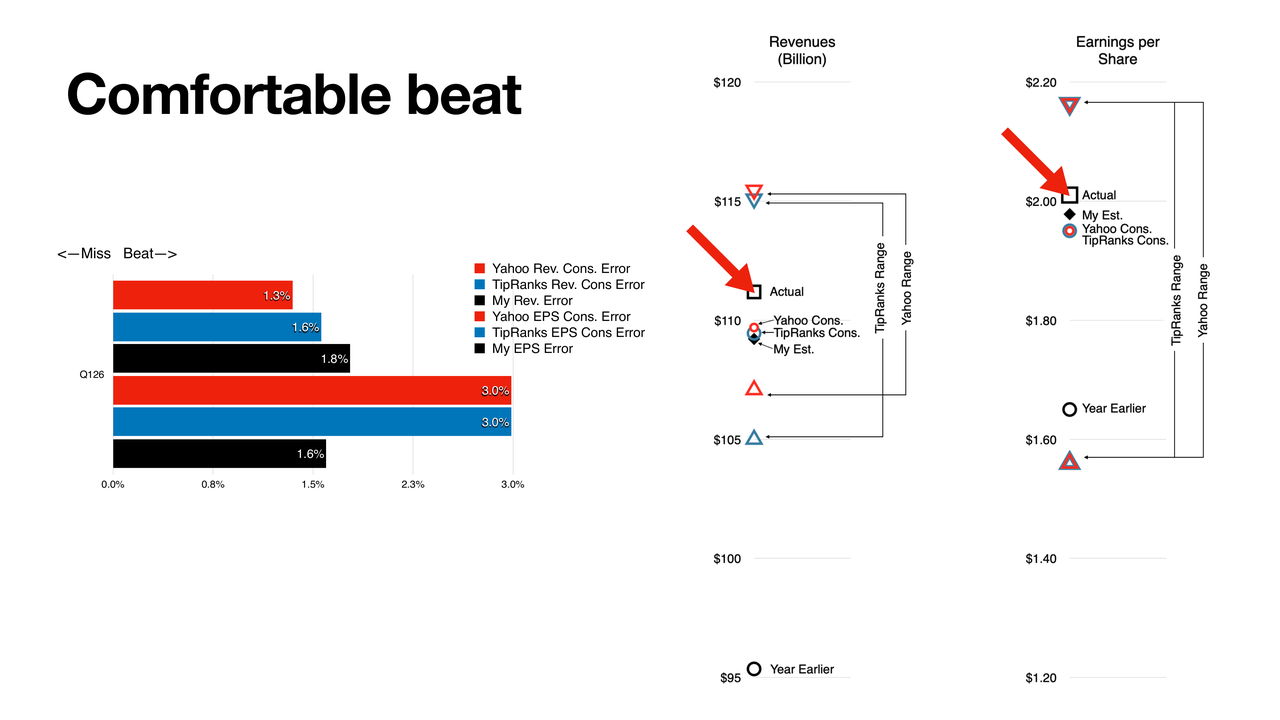
    This is a new type of graph. I'm testing it — it's a little complicated, I admit, but I'm trying to put a lot of information in here. For the quarter, we have revenue on one graph and earnings on the other. But I also have the previous quarter, and the next quarter. In the middle, on the vertical, are all the estimates, including the actual results and the previous year, so that it gives us a growth picture.

    Performance and Guidance

    That middle line represents all the estimates: Yahoo, TipRanks, Philip Elmer-DeWitt's Apple 3.0 — both the professionals and the independents — and my number as well. The growth in the previous quarter was 16.6%, and we had 16.4% in the just-ended quarter. This is very consistent with guidance, so there wasn't a lot of surprise. In fact, you can see how many of the estimates were clustered around the very point where we ended up.

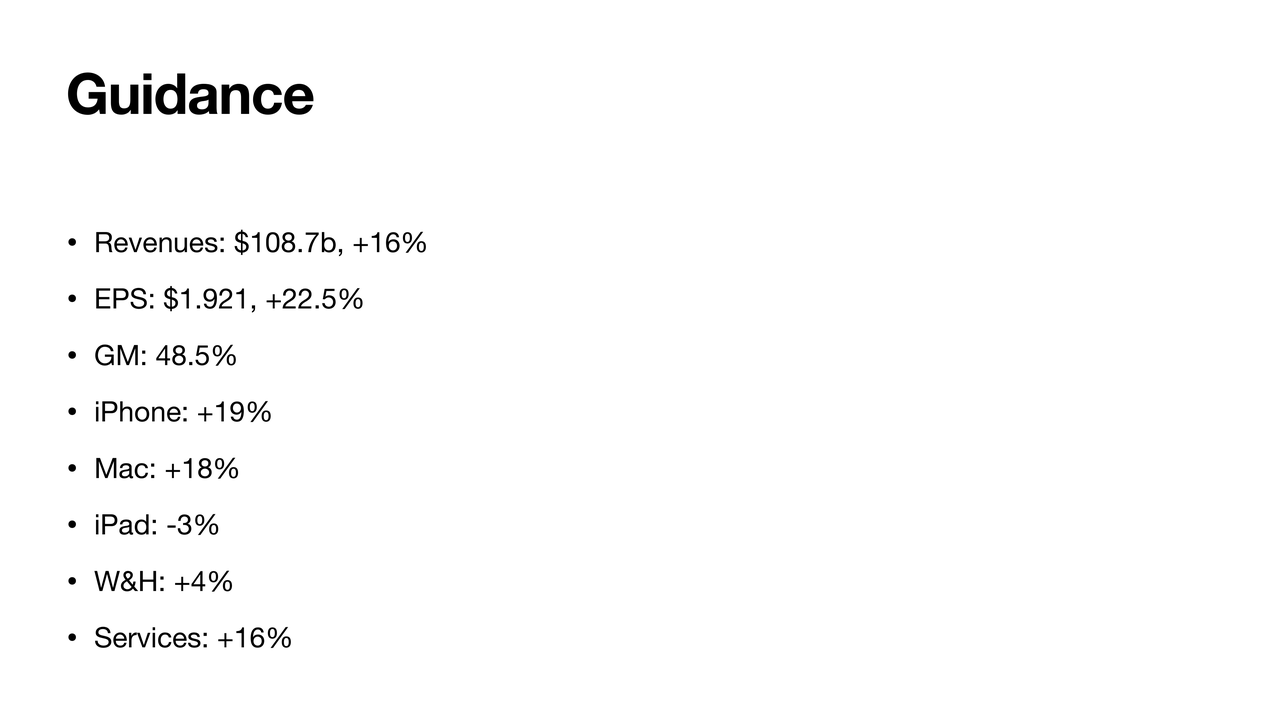
    That's revenues. In terms of earnings, Apple really outdid itself. We ended up with 29% growth, versus 21.8% in the previous quarter. The reason a lot of this was outstanding is that about 11 cents of those earnings was tariff refunds. That was a surprise to everyone — no one factored it in, although there were hints of it from the previous quarter and the outperformance in that quarter as well. If those were removed, we would be much closer to the middle — about $1.91. My estimate was $1.93, consensus was about $1.90 ($1.88 even for some). So, in line or a slight beat on earnings, but a huge windfall from tariff recovery.

    Now, the guidance is where the surprises came, and we'll get into why. The guidance indicates about 11% — they gave a range, and I'm putting in an 11% estimate on revenue growth and a 10% estimate on EPS growth. As you can see, this is a significant reduction: from about 30% to 10% on EPS, and 16% to 10-11% on revenue. A lot of that is because they're actually way too successful as a company. The demand is off the charts. In fact, the demand into the first and second quarter of this year was far higher than they estimated. Tim is on the record now saying: we made a mistake. We made a mistake in planning this year. We had certain expectations of growth, and they seem to have been double that. As a result, we didn't allocate enough resources on the supply side to meet this demand, especially on the semiconductor manufacturing side.

    There are also some headwinds with foreign exchange, and I suspect those have a lot to do with Japan — we've seen the yen. So there's a lot of jitters in the market, a lot of surprised people saying: why is growth decelerating? Apple threw us a curveball with demand — actually, they were surprised as well. But overall, the growth is substantial. Even at 10%, it's healthy, and I think a lot of that demand is going to be delayed into next year, and we're going to end up with a surge, if not a super cycle, as it used to be called, because of this pent-up demand.

    The Numbers

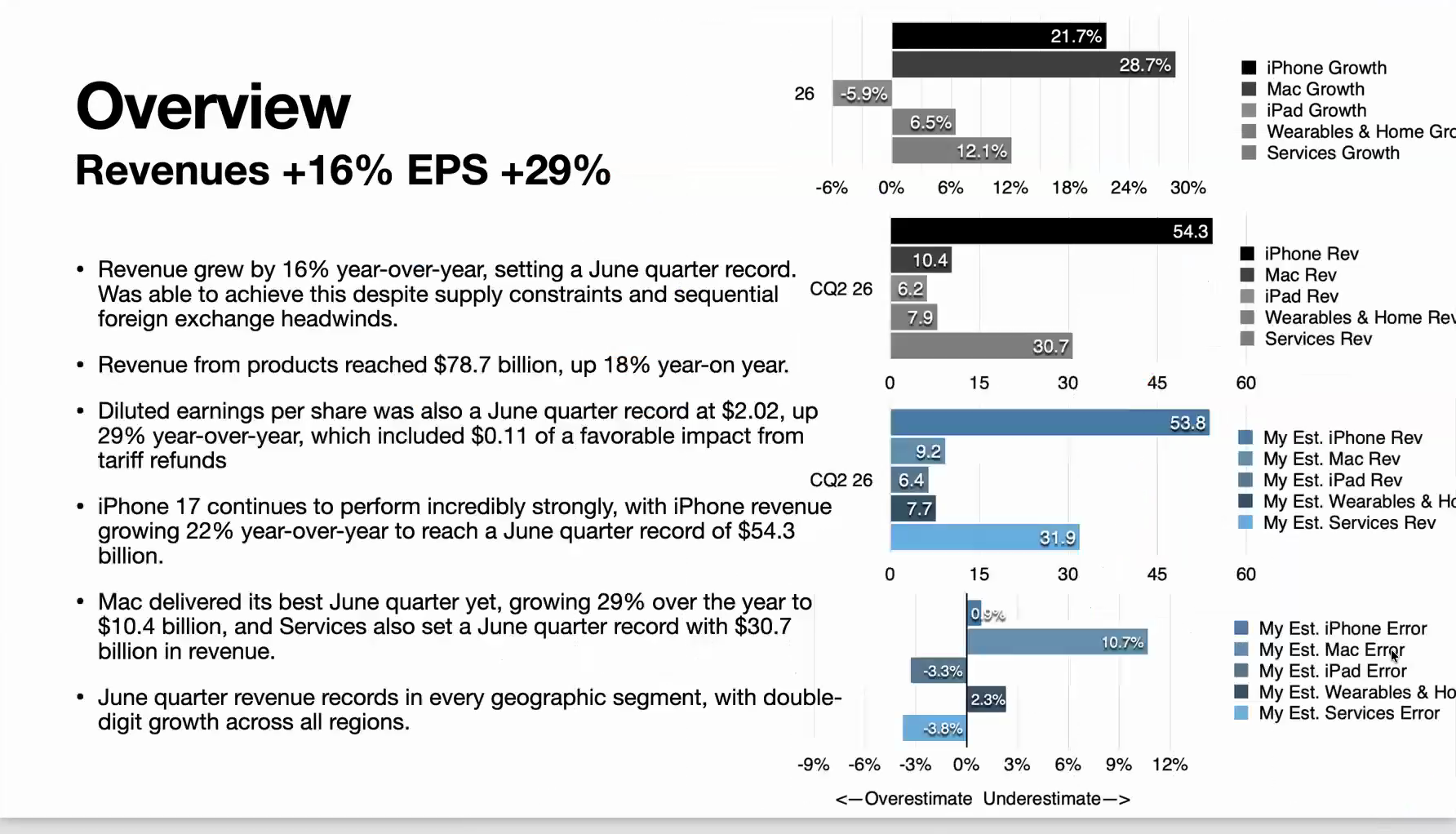
    Overview: Revenues +16%, EPS +29%

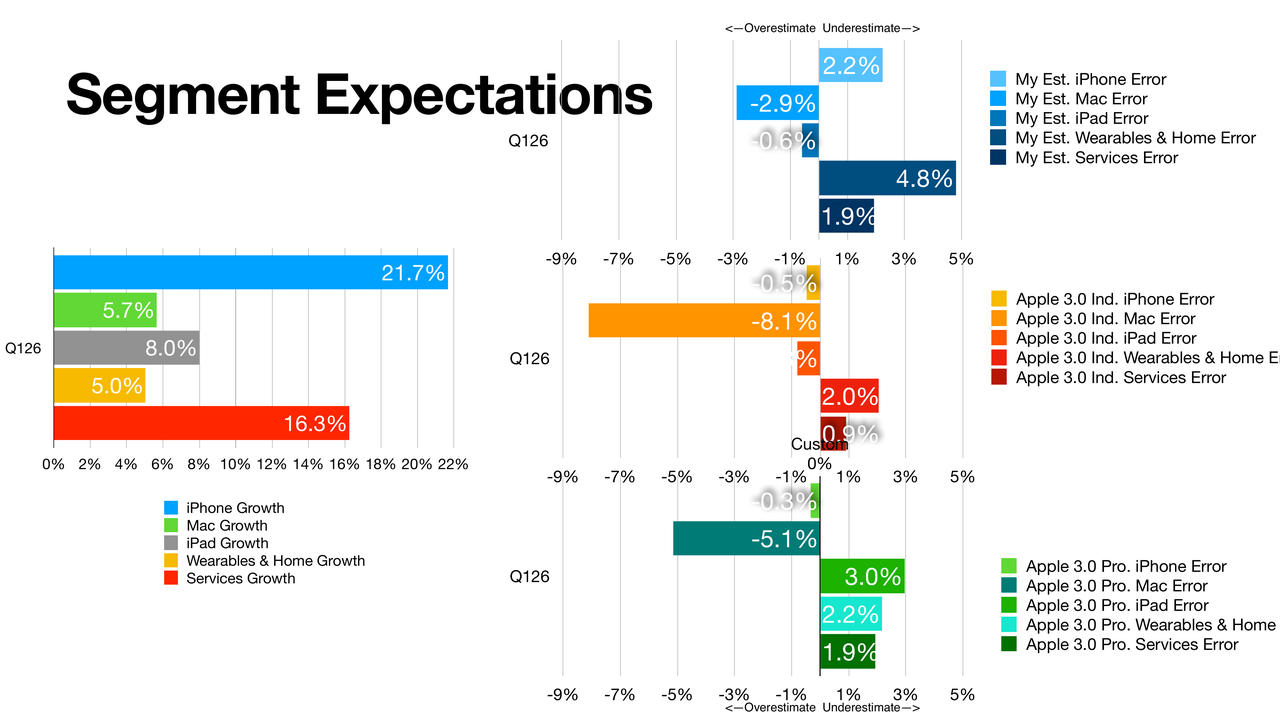
    Revenue's up 16%, EPS 29%, as I said. Products up 18%, Services up 12% — a little heavier on products, and Services was a bit of a surprise; a lot of that was, again, foreign exchange. We had the 11-cent favorable impact from tariff refunds. The iPhone itself: $54.3 billion, very strong growth at 22%. A June quarter record — we're talking almost holiday-level sales right now. The Mac: 29%. Outstanding, extraordinary. We expected an outstanding quarter, but we got much more than that — probably double what most people thought. I really thought 15% would have been a very strong quarter.

    When you look at my own estimates, my biggest error was on the Mac: I was off by a cool 10 points there. I had overestimated Services a little bit, again due to that foreign exchange issue. iPad, a small miss, but it was a tough comp — they warned us about the comp. It ended up the only category that's down, about 6% (5.9%). But Apple constantly repeats: revenue records in every geographic segment, double-digit growth across all regions, and so on. We don't have the absolute numbers, but a lot of records are being broken.

    iPhone

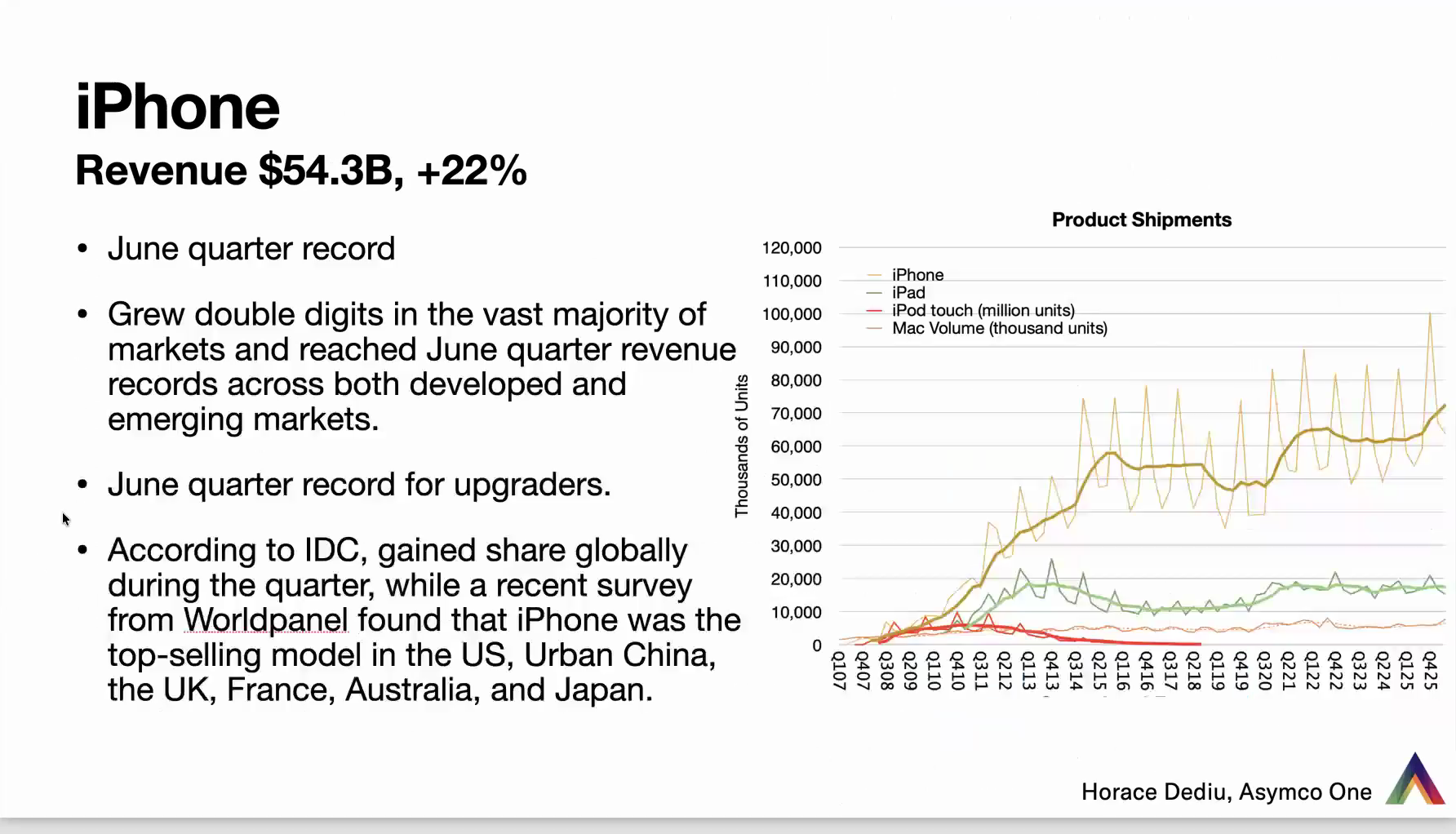
    iPhone: Revenue $54.3B, +22%

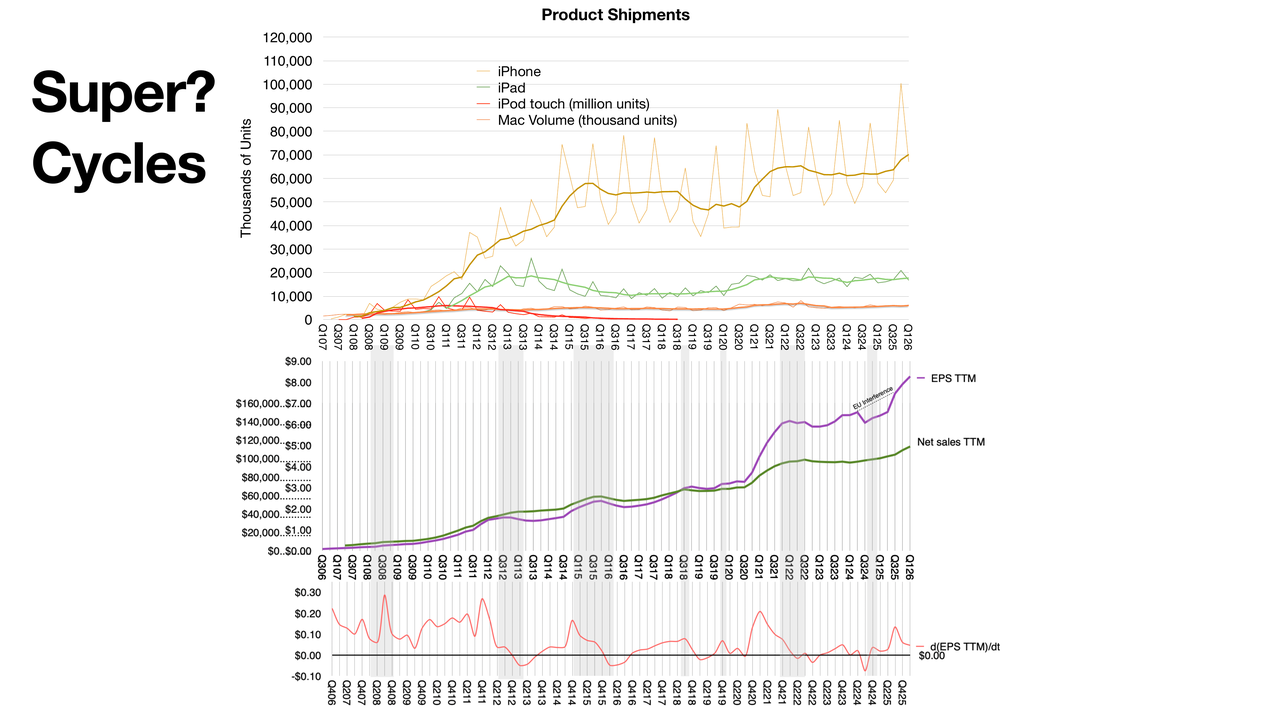
    The top line is the smoothed version — a four-quarter average — of iPhone product shipments. This isn't what they report; they give us only revenue numbers, so I'm estimating this. When I talk about a surge, or a super cycle: we had this bump around 2015, then it looked like everybody said growth is over. Then another surge in 2022 — that's COVID — and then again a plateau. And now we're seeing another surge.

    Is this due to the periodic nature of the iPhone — the fact that people tend to hold on to the product for a while and then come back to upgrade? Is there pull-forward demand because people anticipate price increases? Is there AI demand? (That wouldn't happen in advance.) To me, this is a cyclical thing that's very much built into the history of the product. So I don't read much more into that, but I do see a surge coming. What I'm surprised by is that Apple themselves were surprised by the surge — they hadn't planned for it, as Tim's comments said.

    Mac

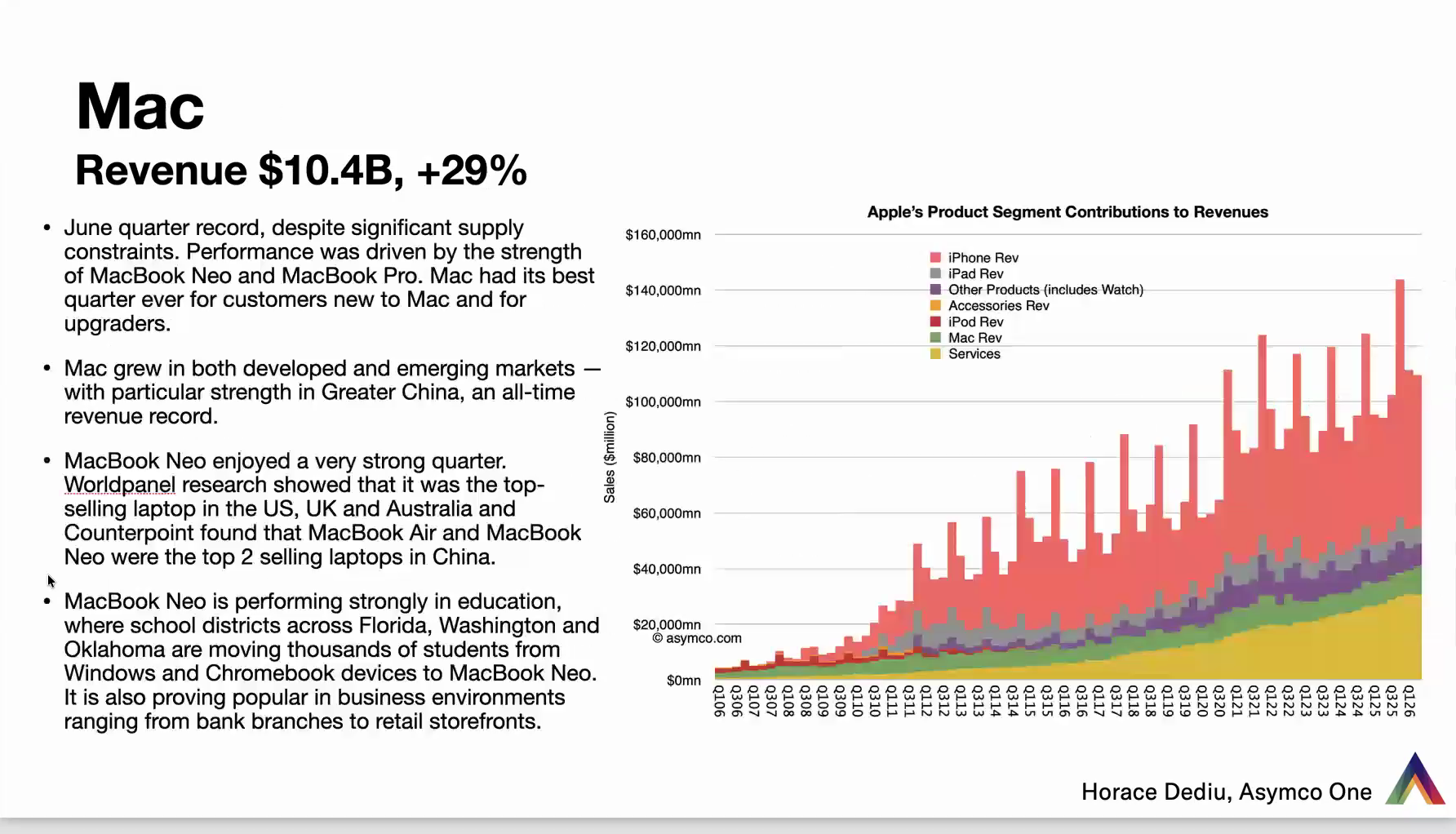
    Mac: Revenue $10.4B, +29%

    The Mac is hardly a ripple on this scale, but the Mac is also seeing an obvious secular surge right now. According to IDC — and not just IDC, many others are reporting the same thing — there are share gains around the world on all these products.

    Back to the Mac: $10.4 billion, 29% growth. They repeat that the MacBook Neo was a big driver. A lot of skeptics would have said it's too cheap to make a dent, it's low margin, it's not available in large enough numbers. But clearly management has highlighted it as the driver, plus the MacBook Pro, and it's driving enormous growth: over $10 billion in a quarter that is not the holiday quarter. They also gave anecdotal evidence about the MacBook Neo being used in retail and in education, replacing Chromebooks and Windows. Nothing new there, but they are confirming a lot of the assumptions people had.

    iPad & Wearables

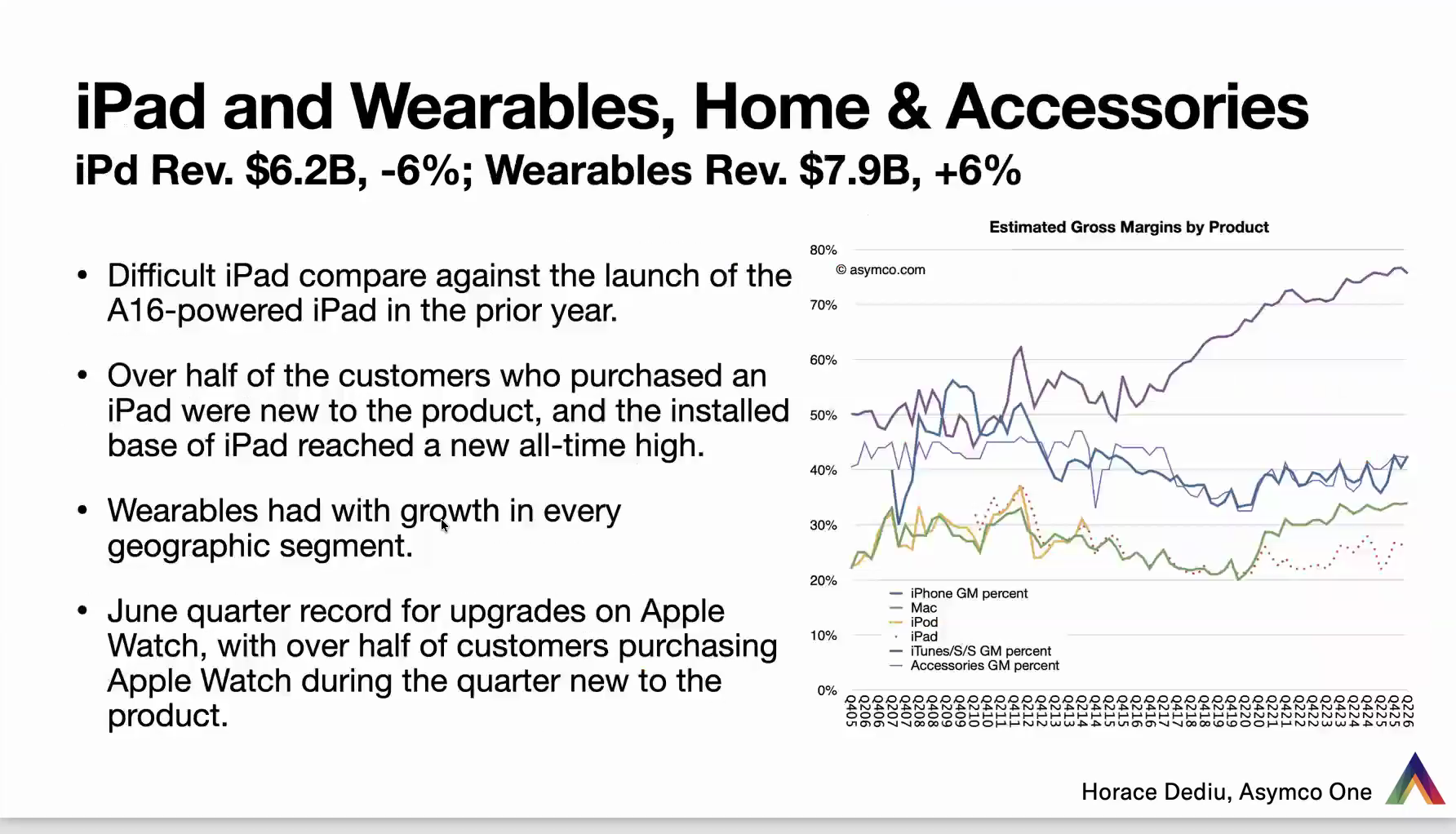
    iPad and Wearables, Home & Accessories; estimated gross margins by product

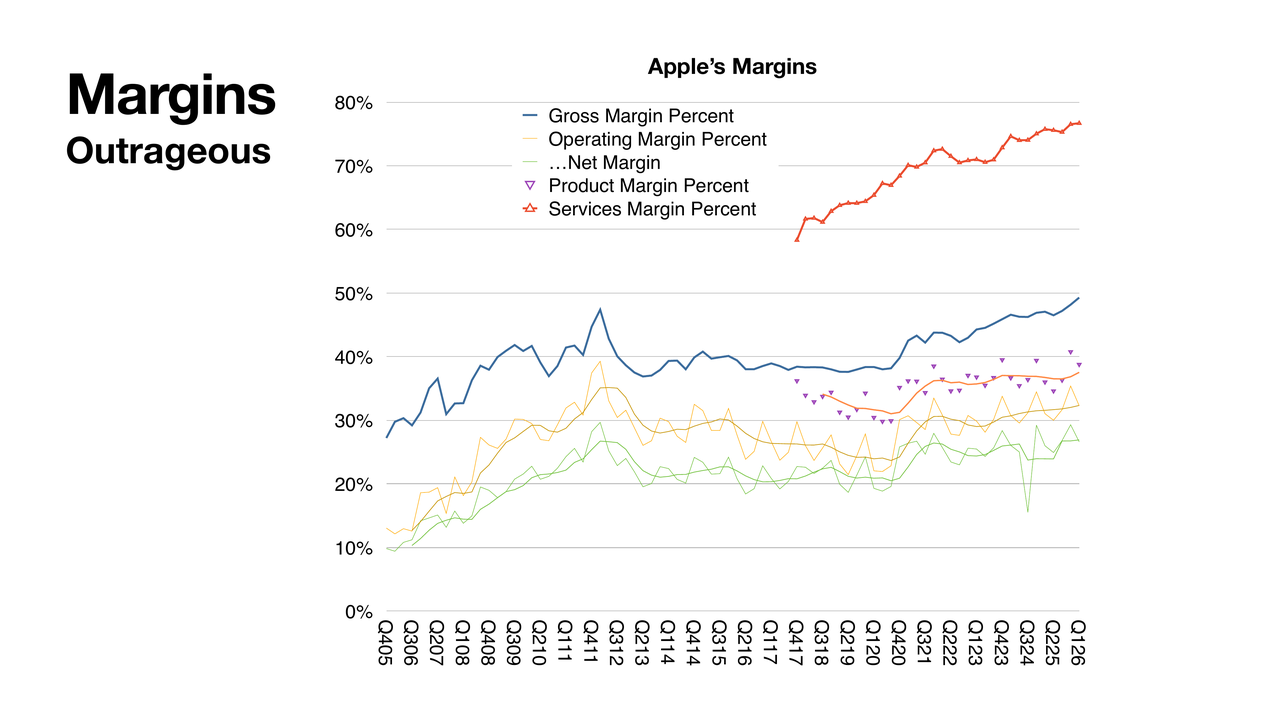
    iPad revenue was down, as I mentioned: $6.2 billion, about −6%, on a tough compare. Wearables, Home & Accessories revenue was $7.9 billion, up 6% — a decent amount, actually; it hasn't been growing a lot lately. I also have gross margin estimates on an individual product level. From my deductions (Services margins are not a deduction — everything else is), the margins on the iPhone are holding around 40% and actually growing slightly on average. The Watch, apparently, is doing really well, growing with new customers as well.

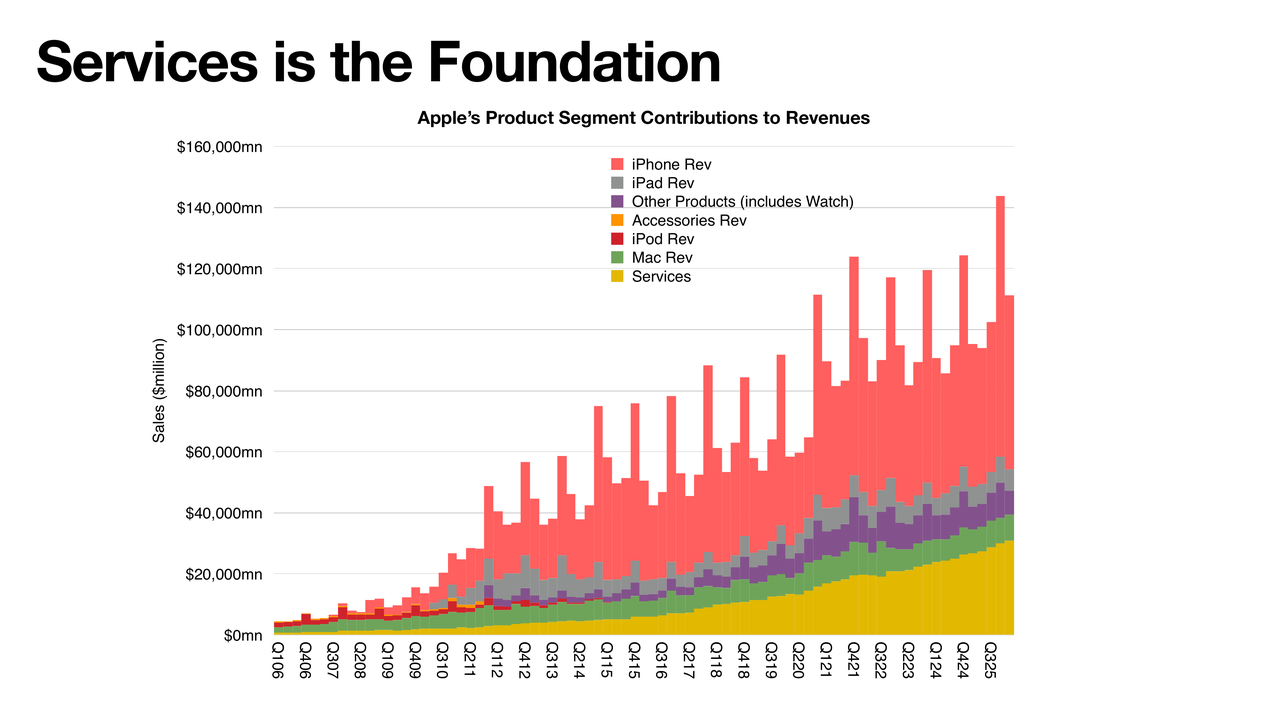
    Services

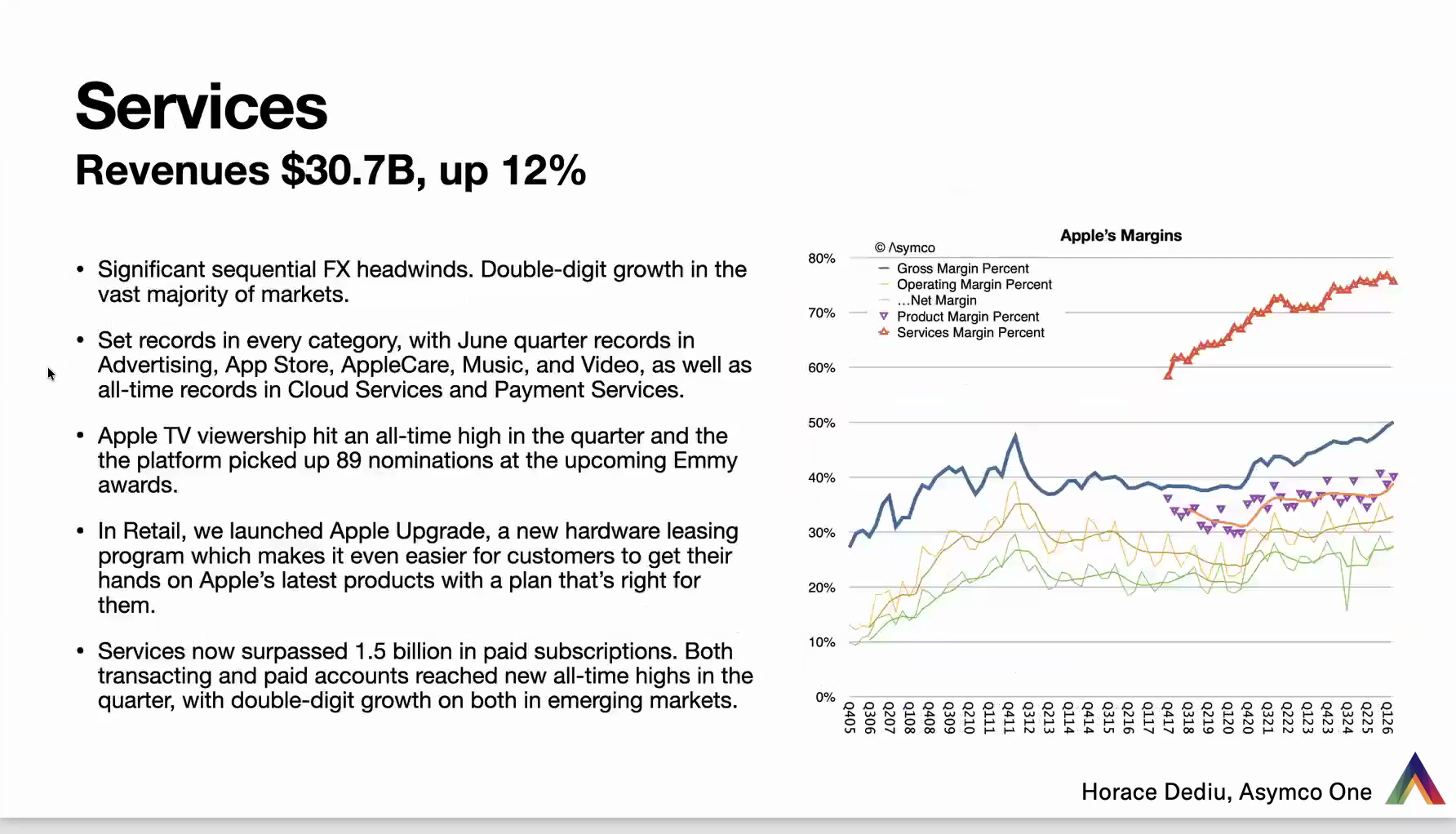
    Services: Revenues $30.7B, up 12%

    Services was $30.7 billion, up 12%. There were a lot of estimates above 15%. I think they guided pretty close to this, but they missed due to sequential foreign exchange headwinds. This seems like something you could hedge against, but apparently there was a missed anticipation there.

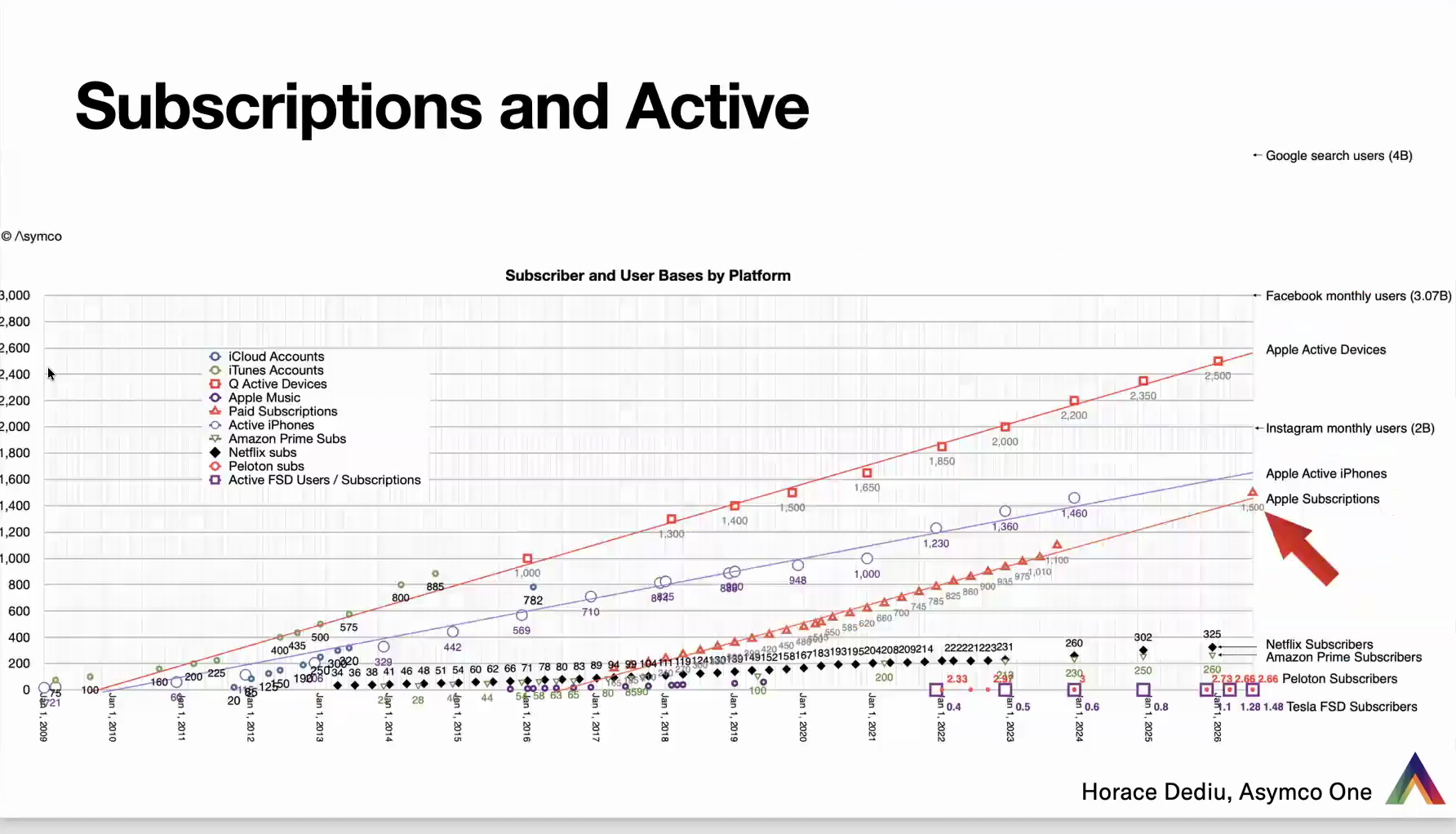
    But the bombshell was that they reached 1.5 billion paid subscriptions. This was not a figure we've received an update on since they hit 1 billion, which was a couple of years ago. Everything since has been an estimate on the trajectory we had. 1.5 billion paid subscriptions — this includes Apple's own services, but also third-party services that Apple manages through the App Store. It's significant. It is possibly coming close to the number of users out there, which is probably 1.4 to 1.5 billion. And it's to be contrasted with the trajectory of growth in active devices, which since January has been at 2.5 billion.

    Subscriptions and Active

    This is a famous graph in the sense that it's been maintained for many years — a decade even. It's every data point Apple ever shared about the number of users it has: everything from iCloud accounts to iTunes accounts, active devices, even Apple Music (some of these are no longer reported). I've also mixed in third parties: Amazon, Netflix, even Peloton, and — based on a suggestion I received — Tesla's FSD subscribers. I've also added, as data points, Google search users (about 4 billion) and Facebook monthly users across all properties (about 3 billion). Below the active devices trajectory crossing 2.5 billion, we have Instagram monthly users at 2 billion, then an estimate of the iPhone base, and below that, with the arrow, Apple subscriptions, just printed at 1.5 billion.

    How does that fit the pattern? There's the line — and that line is pretty much dead on what we've had since the beginning of that data set. Compare that to Netflix and Amazon and we're talking about order-of-magnitude differences: latest data, Netflix subscriptions were 325 million and Amazon Prime 260 million. Peloton has not moved much at 2.6 million. And there's a lot of pride among Tesla fans that FSD has reached 1.48 million. That's one 1,000th of Apple subscriptions. I'm not saying it's a bad thing, but it's in a different category altogether. The big question, again: can we use this to project? Is this linearity going to continue? As far as I can tell, since starting this more than 10 years ago, it has been holding.

    Supply Constraints

    Constraints Limiting Growth

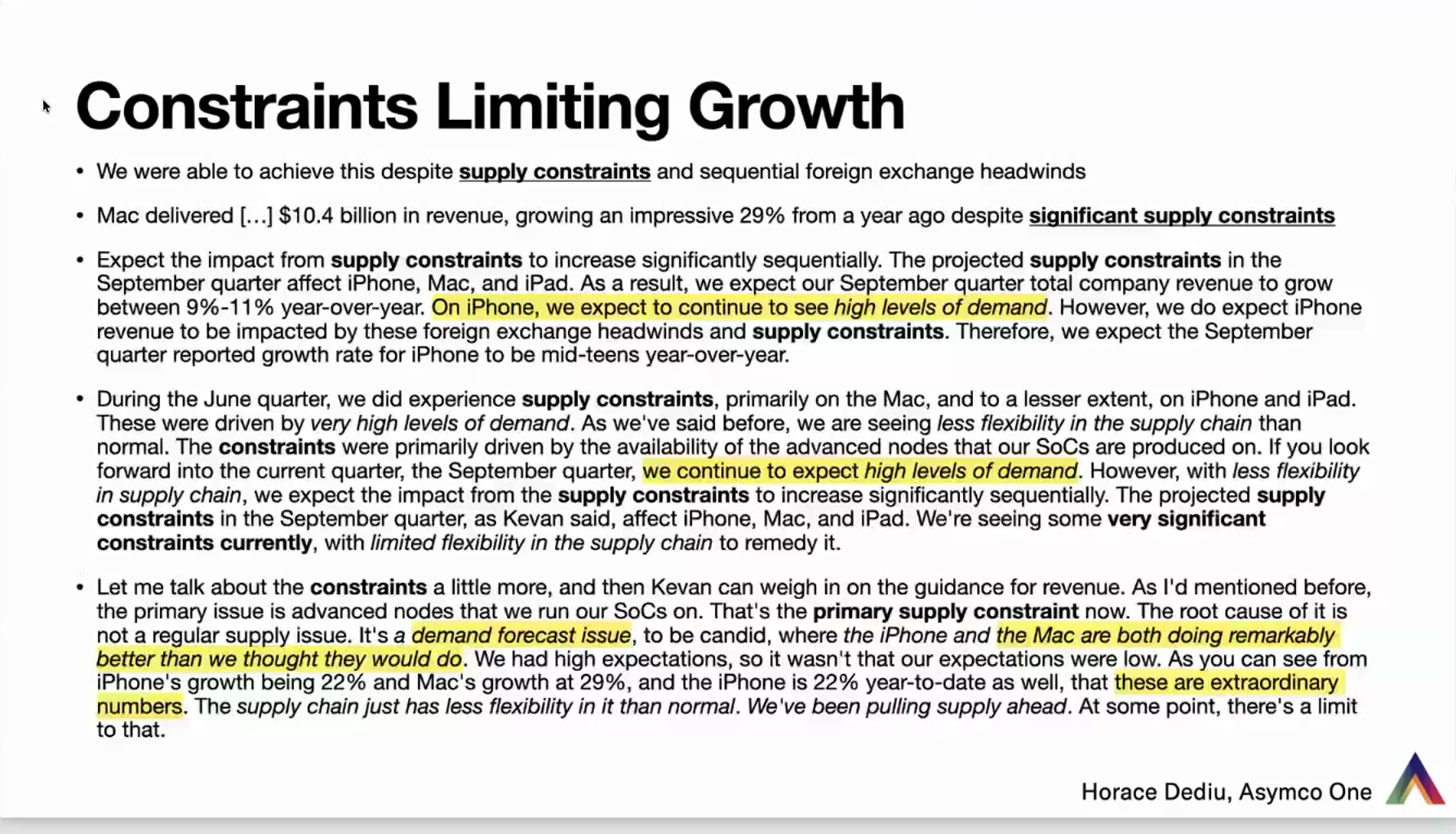
    This is a very wordy slide because I picked up a lot of text from the conference call — direct quotes from Tim Cook and Kevan, the CFO. I've used bold to identify supply-constraint citations and highlights for the points about demand. Let me summarize: supply constraints are the primary reason they are unable to project growth similar to what they've had before. The reason for supply constraints is that there's excess demand.

    As Tim Cook said in response to a question: we had high expectations. It wasn't that our expectations were low. But as you can see from iPhone growth of 22% and Mac growth of 29%, these were extraordinary numbers. The supply chain just couldn't cope. They've been pulling as much supply forward as they could, but at some point there's a limit. By the way, one of the places this shows up is in inventories, which have increased significantly — Apple has pulled a lot of inventory and pushed manufacturing as much as they could to take advantage of the imbalances that are present.

    I encourage you to read through, or even search, the transcript for instances of "supply constraints" — this is not even the full set here. And on and on about high levels of demand: "We continue to see extremely high levels of demand. The Mac and iPhone are both doing remarkably better than we thought." The demand is there, and typically with Apple products, if the demand isn't fulfilled, it's delayed. We've had this situation before, especially at the beginning of the iPhone: it was very much constrained on production and supply, and the demand was persistent. It kept going.

    Foreign exchange sequential headwind

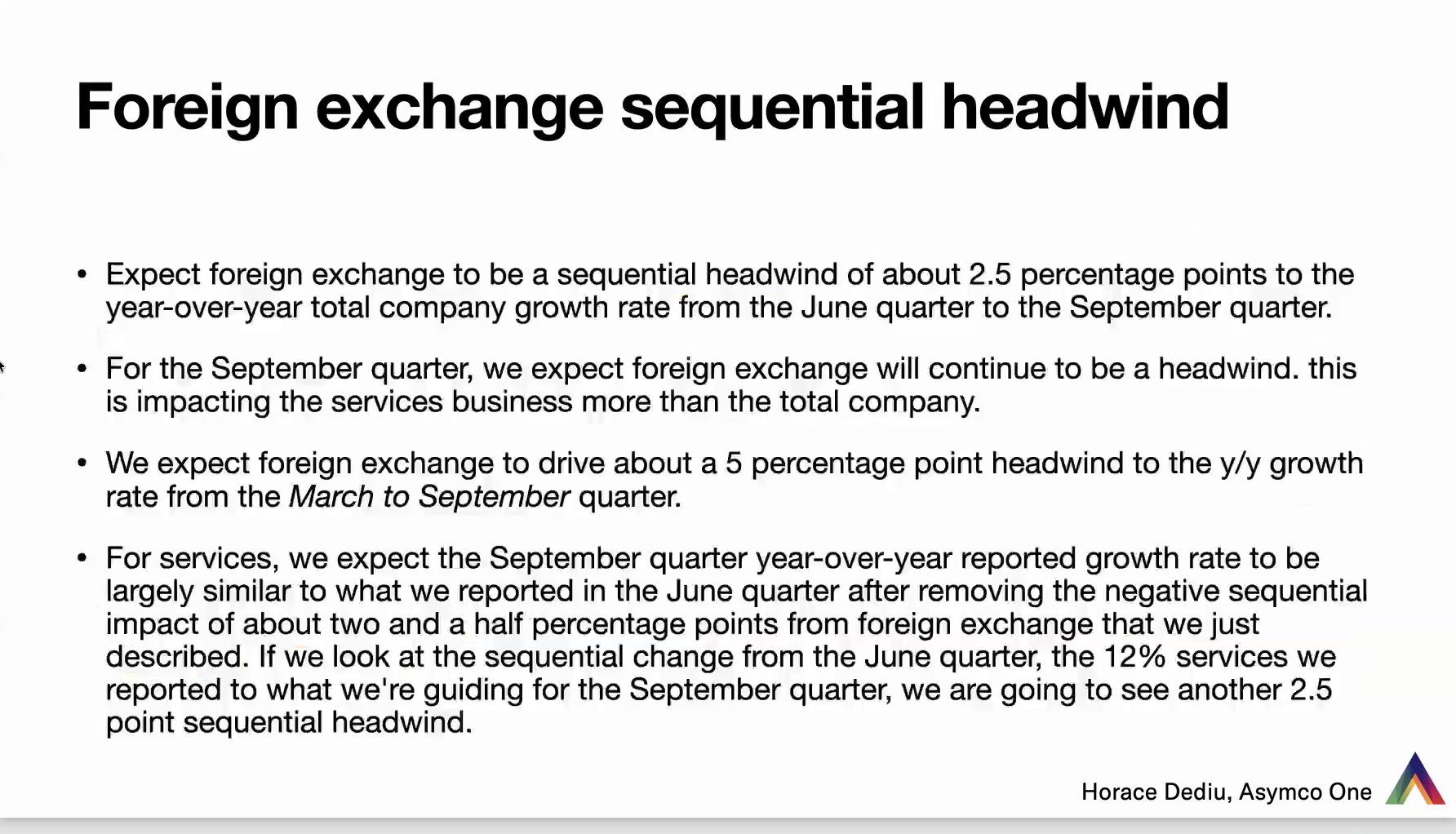
    The other, more subtle thing is foreign exchange headwinds — a terrible, jargony phrase. It simply means that if people are paying in a foreign country for product or services, they're paying in local currency. If that currency dropped significantly against the dollar, Apple's getting paid less in dollars, and they report in dollars. From a European perspective, the euro hasn't weakened very much, but in Asia there's been a lot of turmoil — we've heard quite a bit about the yen. I haven't dug into all the currencies Apple is exposed to, but if they're feeling this much pain — two and a half points of so-called headwinds, especially against Services — this is something they felt they needed to highlight. And they have, rather cryptically, put forward that this will impact next quarter as well, to the extent of another 2.5%.

    So those are the two primary excuses: first, we can't meet demand, especially on the SoC — the system on a chip, their main processor, which cuts across multiple products — and on Services, because of the foreign exchange headwind.

    Capital Returns: Stronger Than Ever

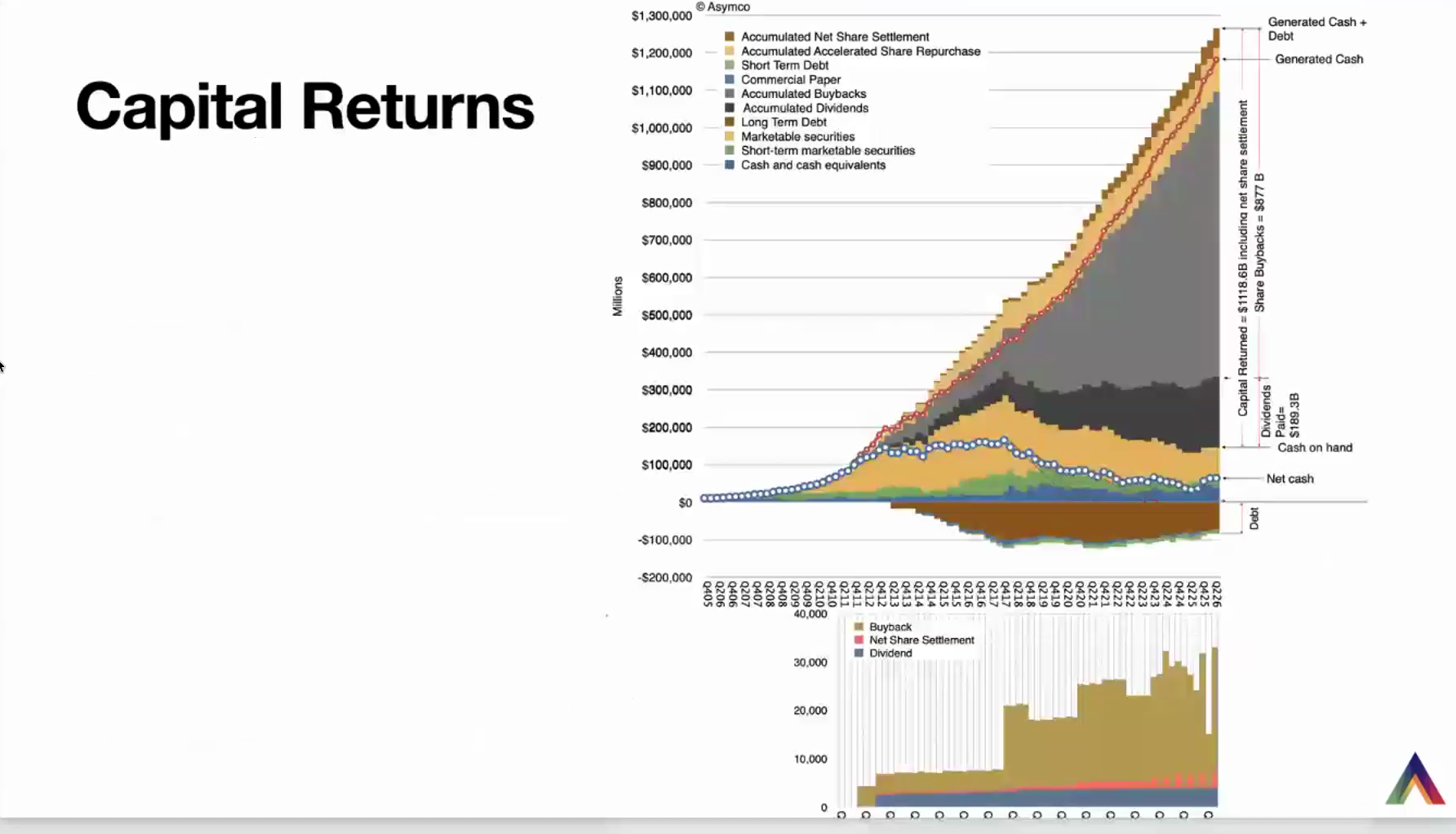
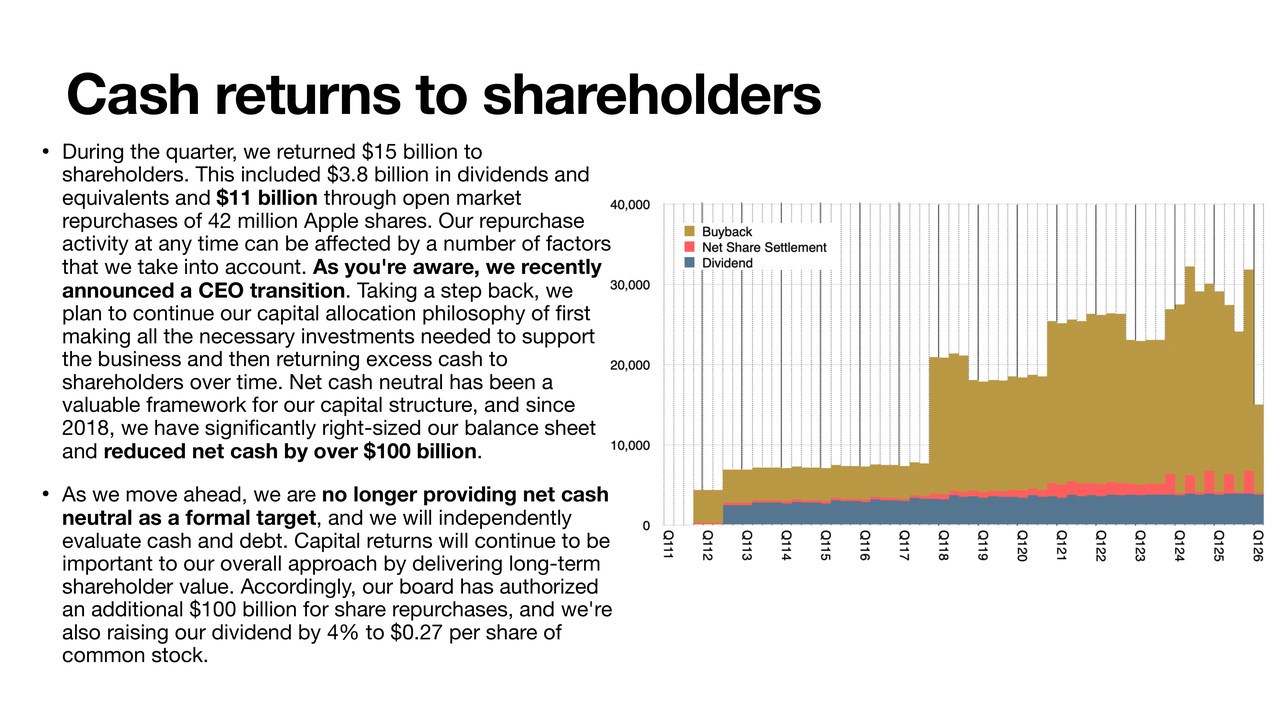
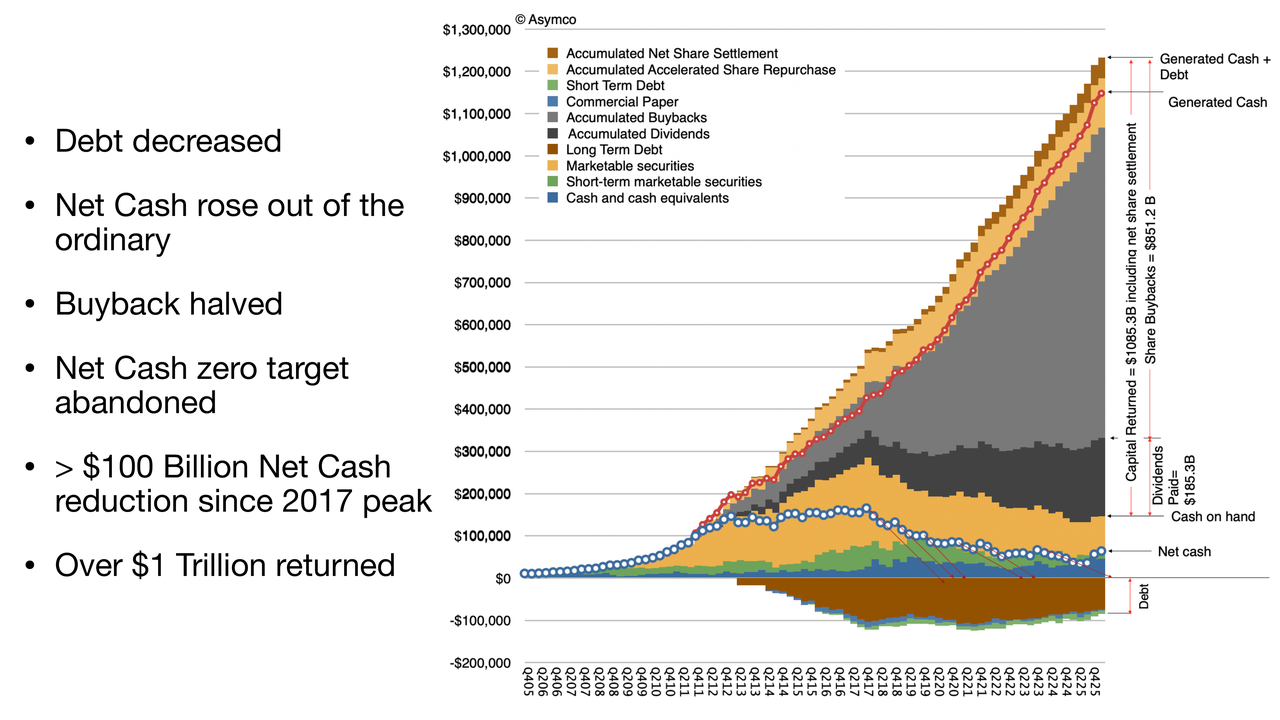
    This incredible money mountain graph shows generated cash and capital returned (the gray sections): Apple has generated cash flow of $1.2 trillion for its shareholders and has returned $1.12 trillion of it. It holds a decreasing amount of debt — very low interest rate debt, and it seems they're not raising more as rates have changed; they seem to be paying it down. Net cash is holding flat. They said last quarter that they will no longer be targeting net cash zero. We only have two quarters of that to see what happens, but there's the trend.

    Below that, a new graph: the split, for every quarter, of how capital is returned — buybacks in an olive color, net share settlement (a little obscure — it seems to have been constant, now a little more lumpy), and dividends, which have been growing as consistently as ever. As you can see, there was a period last quarter where there was a disturbance in the force, so to speak — the buybacks seemed very weak. But we're back to full blast, and I think the highest ever in that regard.

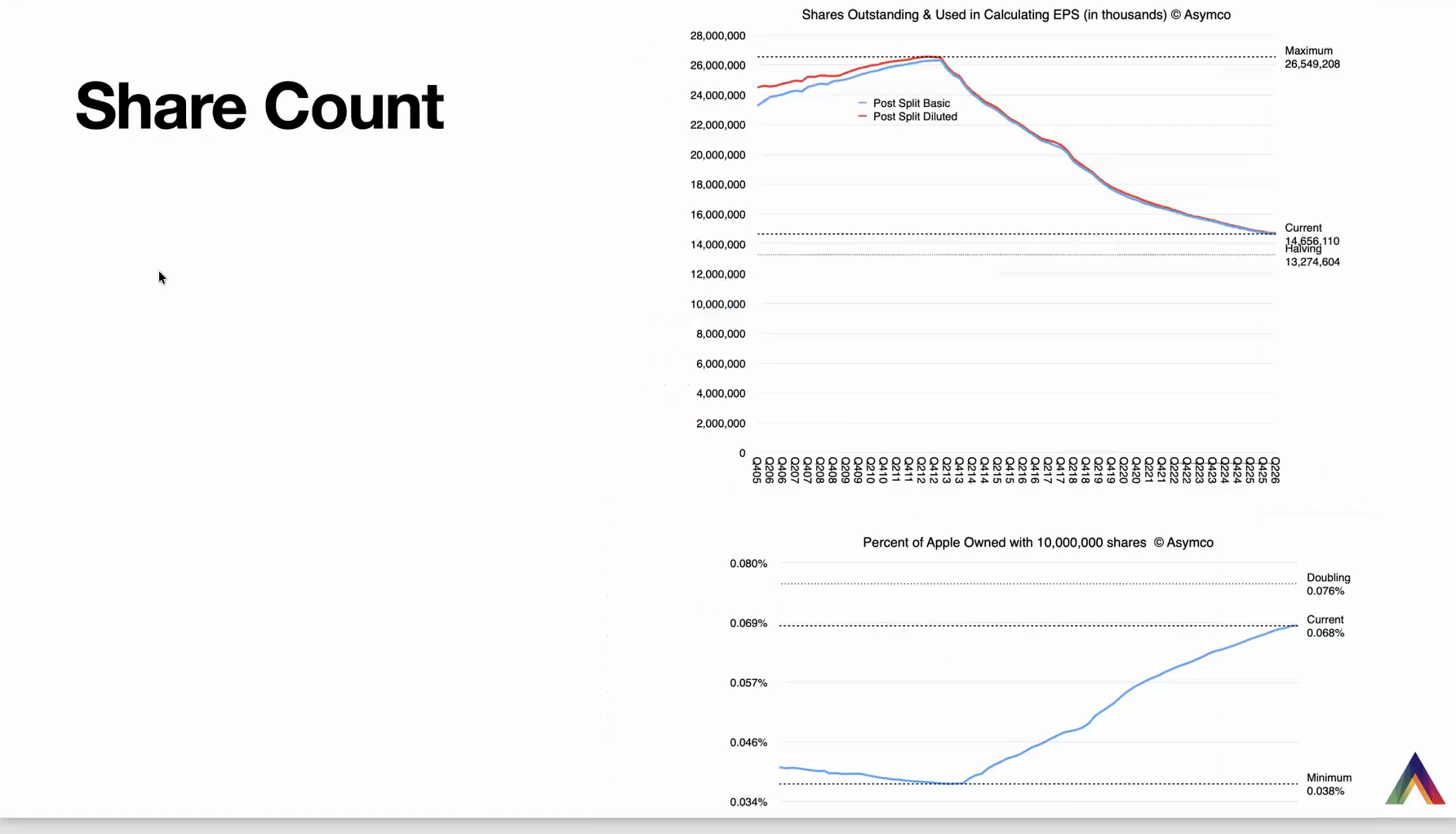
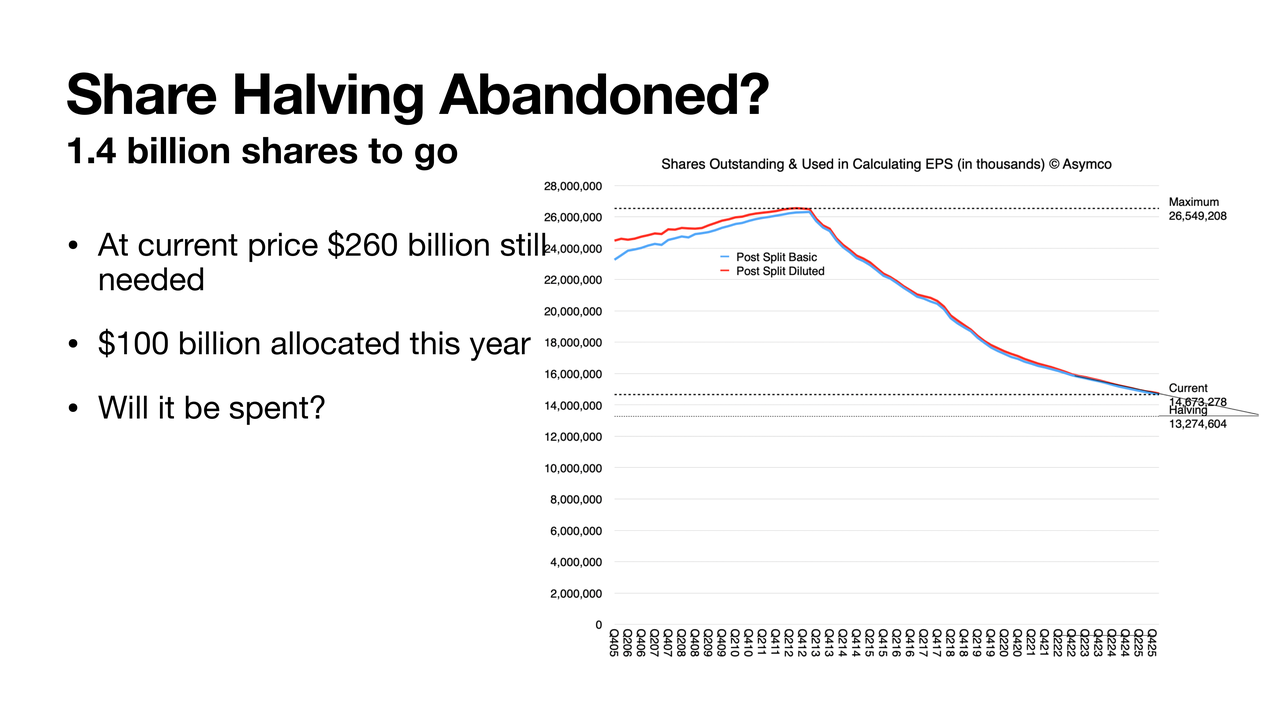
    As a result, the number of shares outstanding is decreasing — less rapidly than it used to, which is mathematically understandable: as the shares increase in price, you cannot afford to buy as many as you used to. In the good times, when the market was oblivious, shares were cheap, and the steepness of the curve was far higher. But we're still heading towards what I call the halving point — targeting 13.27 billion shares, half the number since the beginning of this capital return program. And the graph below that shows your percentage as a shareholder — indexed to, say, 10 million shares — your concentration of wealth going up.

    The Growth Scorecard

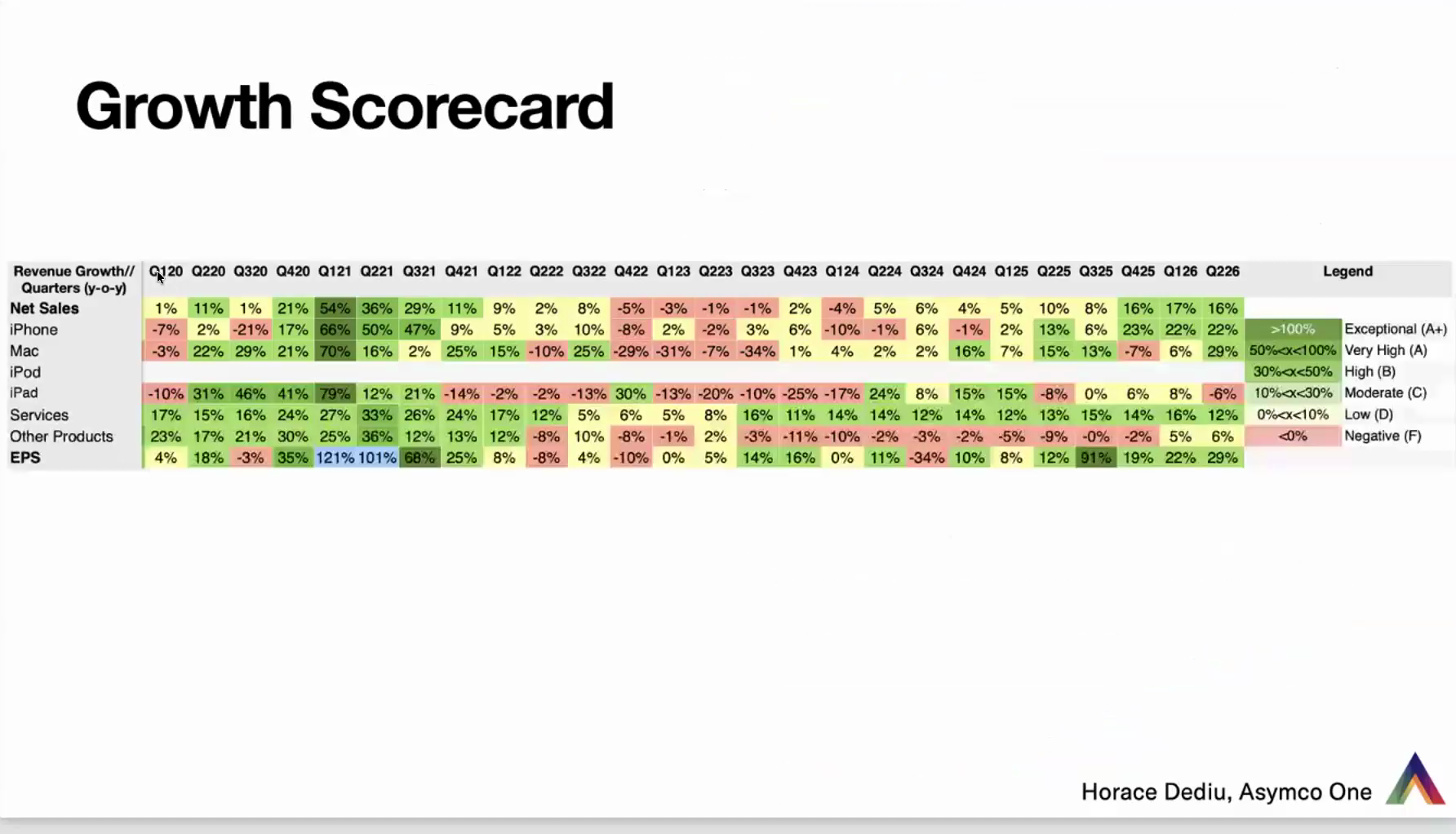
    This is a table that is very long — this view goes back to 2020. Every quarter has green, yellow, and red indicators, from net sales at the top to EPS at the bottom and every category in between. We're looking to see green across the board. Dark green is super-fast growth — we saw those back in Q1 2021, in the middle of COVID, that whole area of green. The bottom line was even above green — above 100% turns blue in my algorithm. When you look at the latest, we actually had a better-looking quarter, I think, than the one before. The Mac turned from moderate to very high growth. Going forward, I think these are going to be closer to 10% than 20%, but I think it's green into the next quarter as well.

    OpEx: The Cost of AI

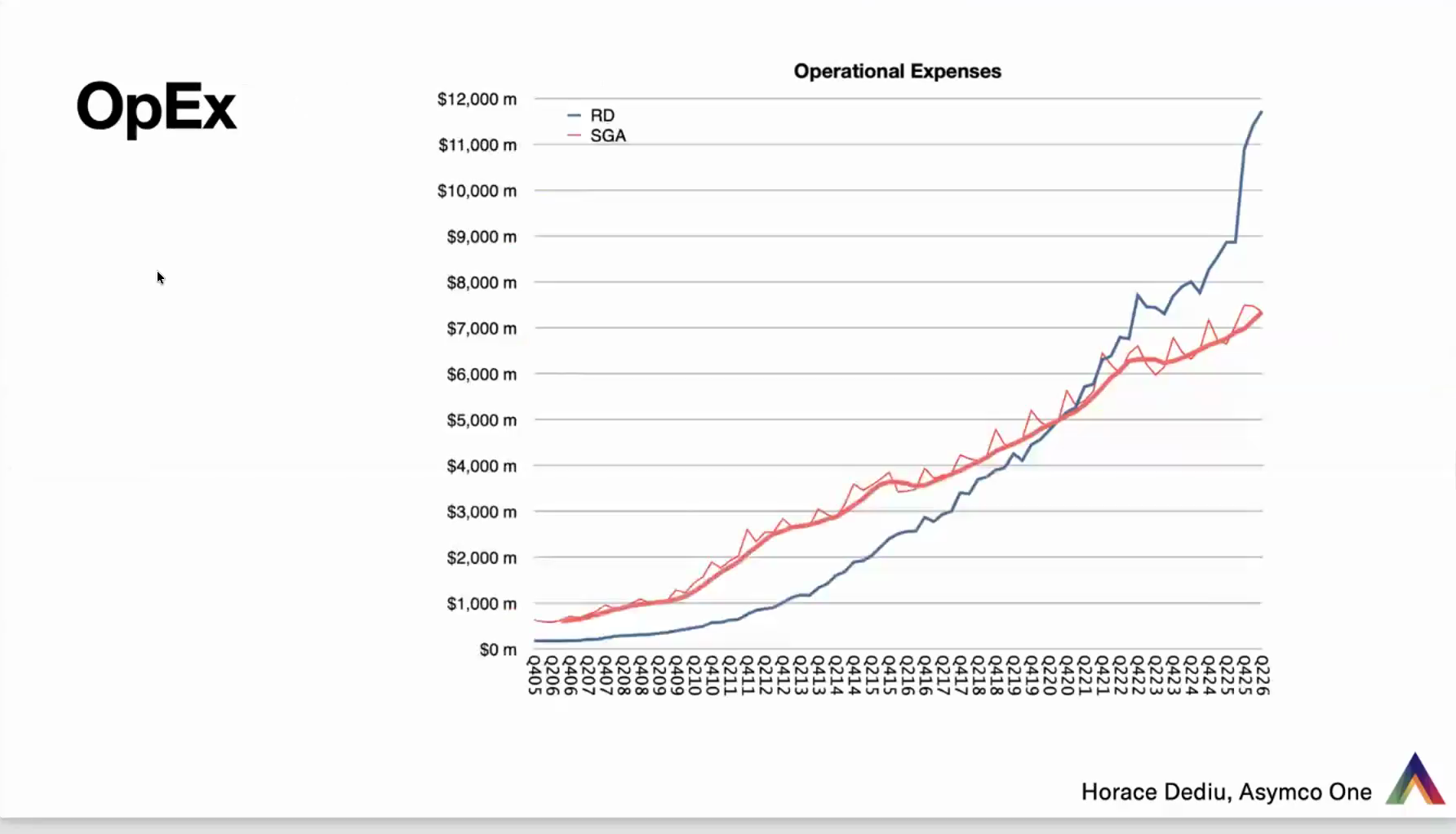
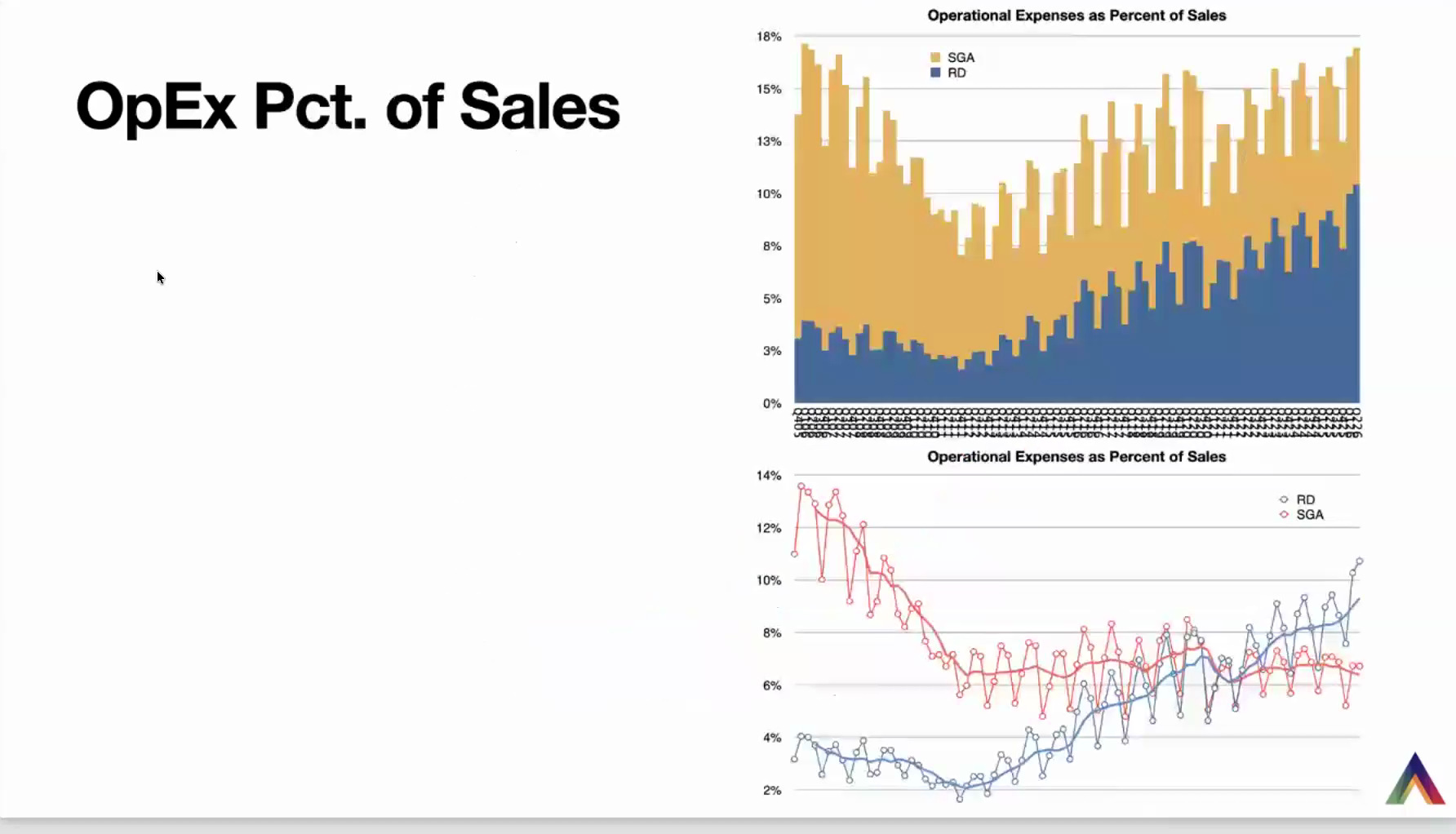
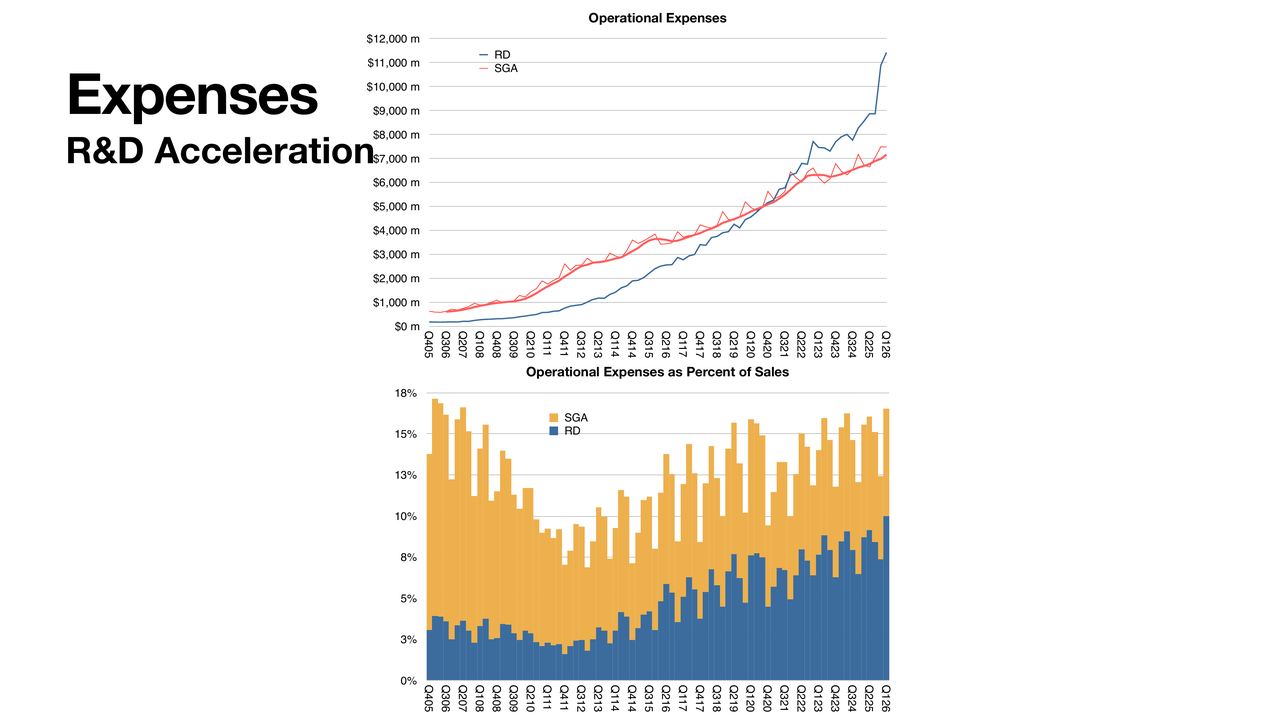
    On the cost side: SG&A relative to R&D — together they make up OpEx. R&D has overtaken. Back in the days of Steve Jobs, R&D was far lower than SG&A. That flipped around 2020, and now what we're seeing is incredible growth. I think that's their allocation to AI. It's not just research — I think a lot of the costs baked into AI development are going into R&D for Apple. Since it's core to their business, they can book it as research and development — similar to Amazon putting almost all of their engineering into OpEx, because for them, all of that is not core to retail.

    We are seeing the surge, but perhaps a slight tapering off on the rise. As a percent of sales, the two together are reaching higher and higher, closer to the all-time peak of 18% — again, back in the days of Steve Jobs. It's not outrageous, but it is something to keep an eye on. R&D alone reaching about 10% of sales I consider a little bit excessive, but it is the nature of the business today, especially with respect to the need to do more pure research on the hardware side, and on the software side with AI.

    Valuation

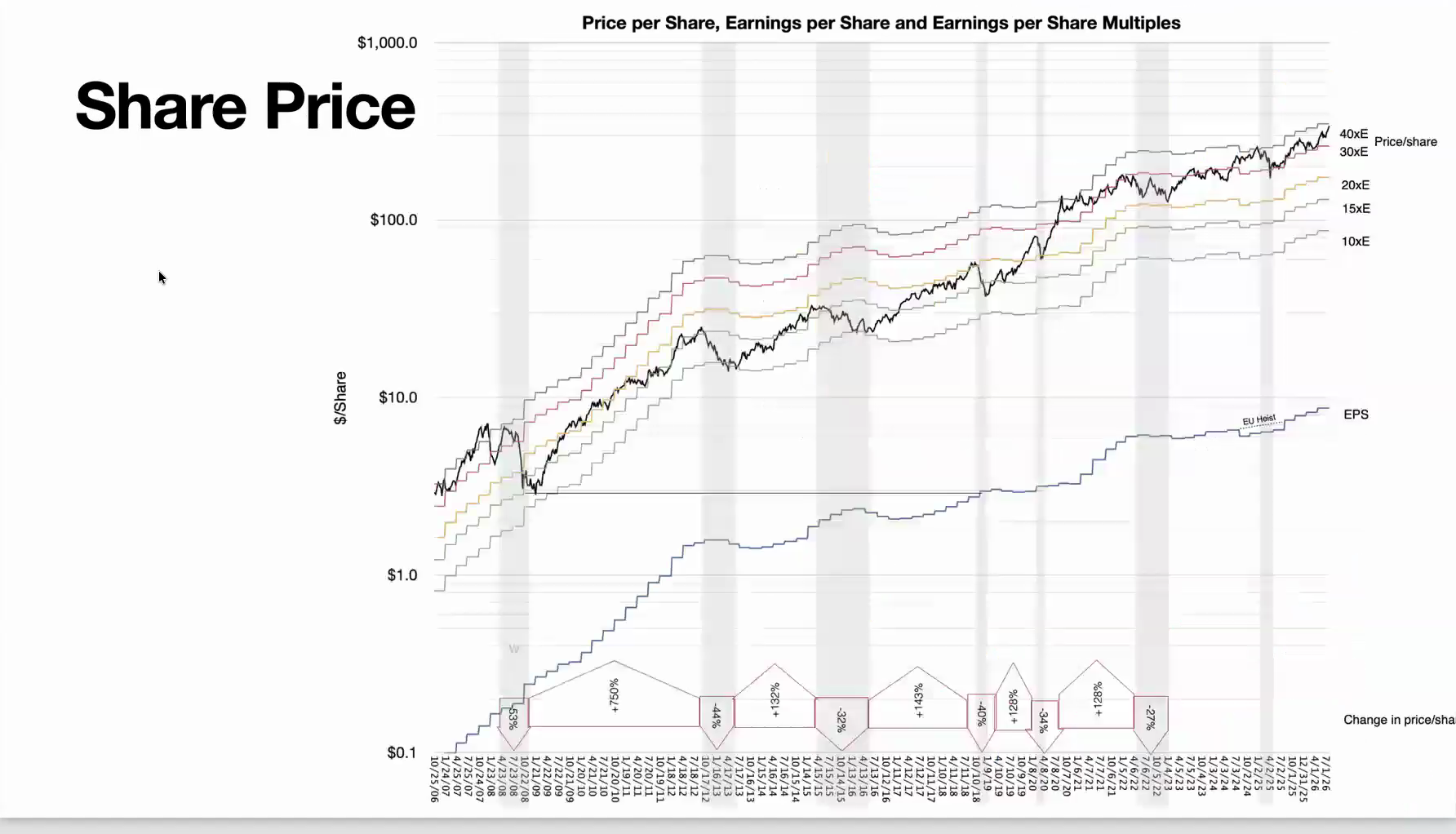
    Share Price: price per share, earnings per share and share multiples

    This is one of those graphs that's hard to process, but very rewarding. What we see here is EPS (trailing twelve months, now about $8.70) as the blue line, and multiples of that EPS as parallel curves above it — note that it's a log scale. The black graph is Apple's price per share. Apple touched 40 times earnings. As we speak — I checked a couple of hours ago — it seems to have come down to 34, because the share price fell, but also because earnings went up a bit.

    Historically, it seems to bounce off these upper bounds. Around 2010, it was bounded by a P/E of only about 20 — hitting that and bouncing down. We've seen that migrate up to about 40 now, and we've had three episodes hitting P/E 40, with some pullback each time. I'm not here to predict what's going to happen, but it does seem it's a bit bound by a multiple. That's not to say it can't change — we can see euphoria, we can see faster growth rates justifying it. But we also have situations where companies growing very rapidly with very low P/Es slip dramatically in one day.

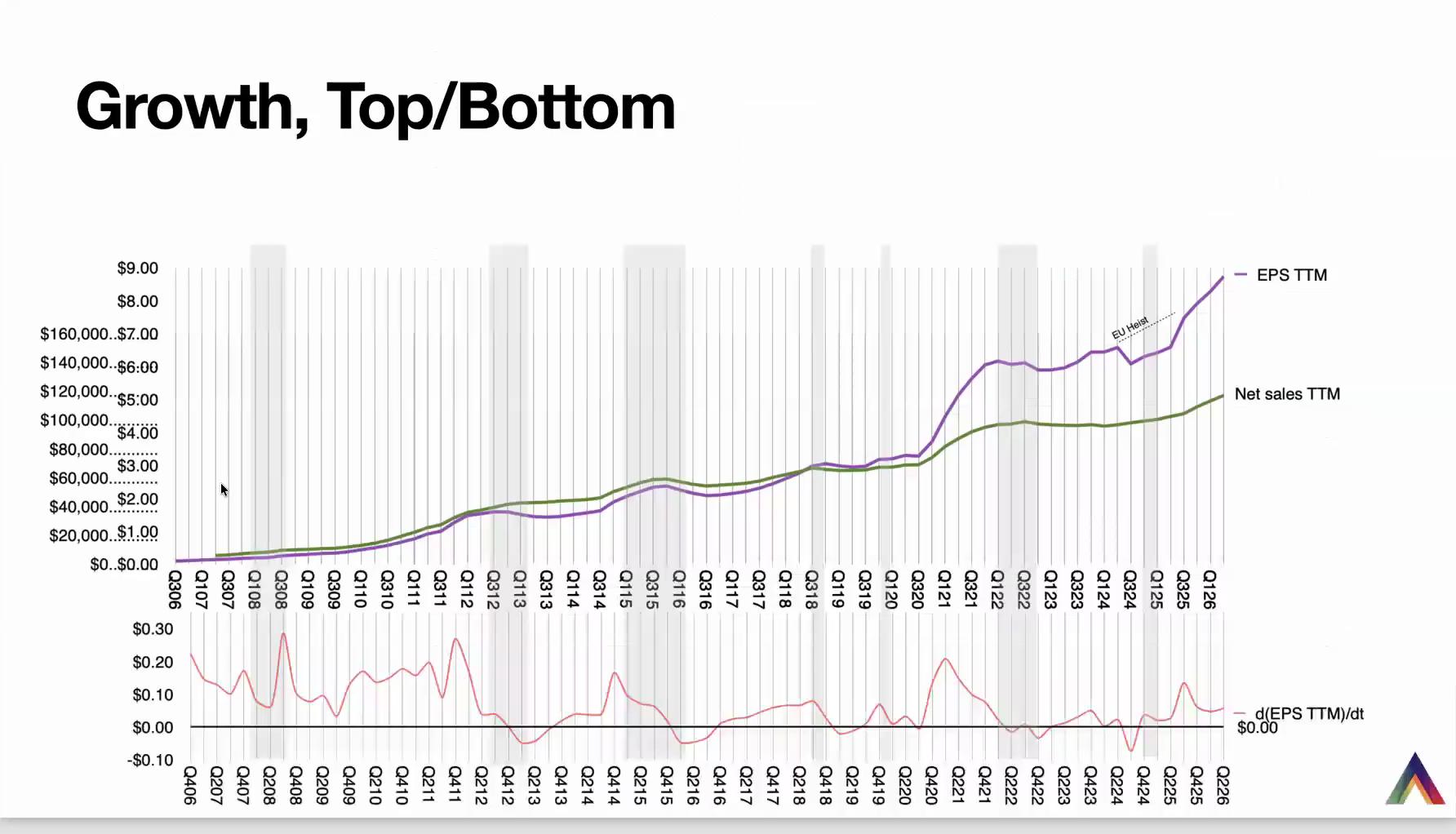
    Growth, Top/Bottom

    Same view with the drawdown bands carried over: plotting EPS and net sales on a TTM basis, we see the correlation, and the oscillation — product cycles in there. We have a drop due to what I call the EU heist; had that not been there, we would have seen a different picture. Nonetheless, TTM EPS is growing very, very robustly. And its change — the delta in TTM EPS — is the red line below it. You can make your own conclusions about whether it indicates or precedes the share-price sell-offs, but it is at least one indicator of how the company's doing.

    Apple Upgrade: A Preview

    I want to spend a few minutes on Apple Upgrade. I think this is going to deserve its own hour's worth of conversation. I had done this work prior to earnings and haven't published it yet, so I'll give you a preview and run through it fairly quickly. I think this is one of the most extraordinary and exciting developments with Apple.

    They say that necessity is the mother of invention. But return on invested capital is the mother of innovation, is what I like to say. And in this case, what we're witnessing is innovation. This is nothing more, apparently, than packaging of an existing product with new ways of buying it, new ways of financing it. But boy, is this thing a great idea. It makes it so much simpler for people to make decisions on Apple products. Unless competitors are able to replicate this perfectly — and there are a lot of questions about that — I think Apple is going to make a tremendous impact with this. Of course, it needs to go global, it needs to scale, it needs to be well communicated. And it must not fail due to other factors — for example, rates of delinquency. I'm not an expert on this.

    One of the things I've wondered for many decades was: why doesn't Apple do this? And I kept coming to the conclusion that it's very hard to do. This is hardware as a service. I don't want to buy a phone; I want to use a phone. As the old saying goes, people have a job to be done: I don't need a drill, I need a hole in the wall. What Apple was offering with the iPhone was: pay $1,000 upfront and you can get all these jobs done. But most people don't care about the product so much; they just want to get things done. And here is a way to package that proposition and say: for $33 a month, you can get it done.

    The subscription makes perfect sense. A lot of people read too much into it as some sort of magical thing, or evil thing. It's just convenience. Tremendous convenience. The old way of calculating the cost per day was: you pay $1,000, and then maybe after two or three years you tire of the product, or you want to upgrade, and then you find a way to sell it — maybe Apple trades it in, maybe a third party, maybe you give it to a relation or a friend. All of these were possibilities, but you had to do a lot of calculation in your mind. Well, this is very plain and simple now.

    Apple Upgrade: iPhone

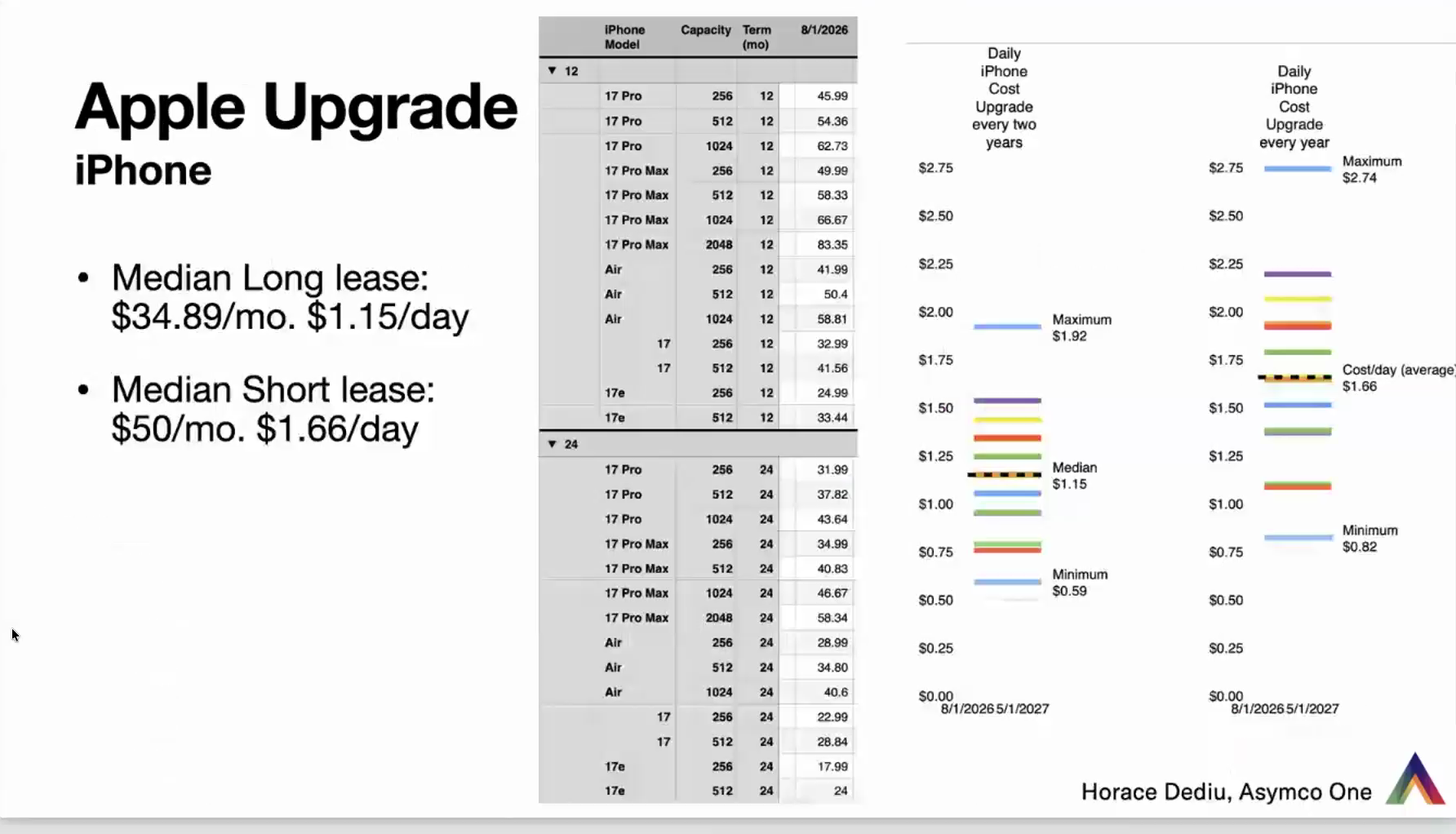
    What I did is I went through the website and got every single configuration that has a price on it, and put it in a spreadsheet. This is just the iPhone, split into the 12-month lease and the 24-month — I call these the short and the long term. For each product, I took down the price, forwarded to August 1st. The thing to do is to track this and see whether it changes. We know that with the iPhone as it is, once they set that price in September, it doesn't change for the full year — they've never moved it. But here we're seeing the potential for Apple to tweak this on an ongoing basis.

    Also notice that each price is down to the penny. This isn't $9.99, some feel-good price known to resonate. There are some in here that are essentially $18.01 per month — one cent. We see 67 cents, 35 cents, 56 cents, all over the place. These are very carefully chosen. These aren't chosen by a marketeer who says this is a feel-good price. These are chosen either because of the cost, or because of the knowledge of what the product can do.

    To summarize: the median long lease for the iPhone is $34.89 per month, or $1.15 a day. The median short lease — only a year — is $50 a month, $1.66 a day. A very simple proposition: 34 or 50. On top of that comes the carrier plan, which is probably another similar amount. It makes a lot of sense to me, and I would love to do this, because if I commit to two years, then I know I'm going to get a new one after it's over. Nothing new, nothing special — it's just packaging and convenience.

    Apple Upgrade: Watch

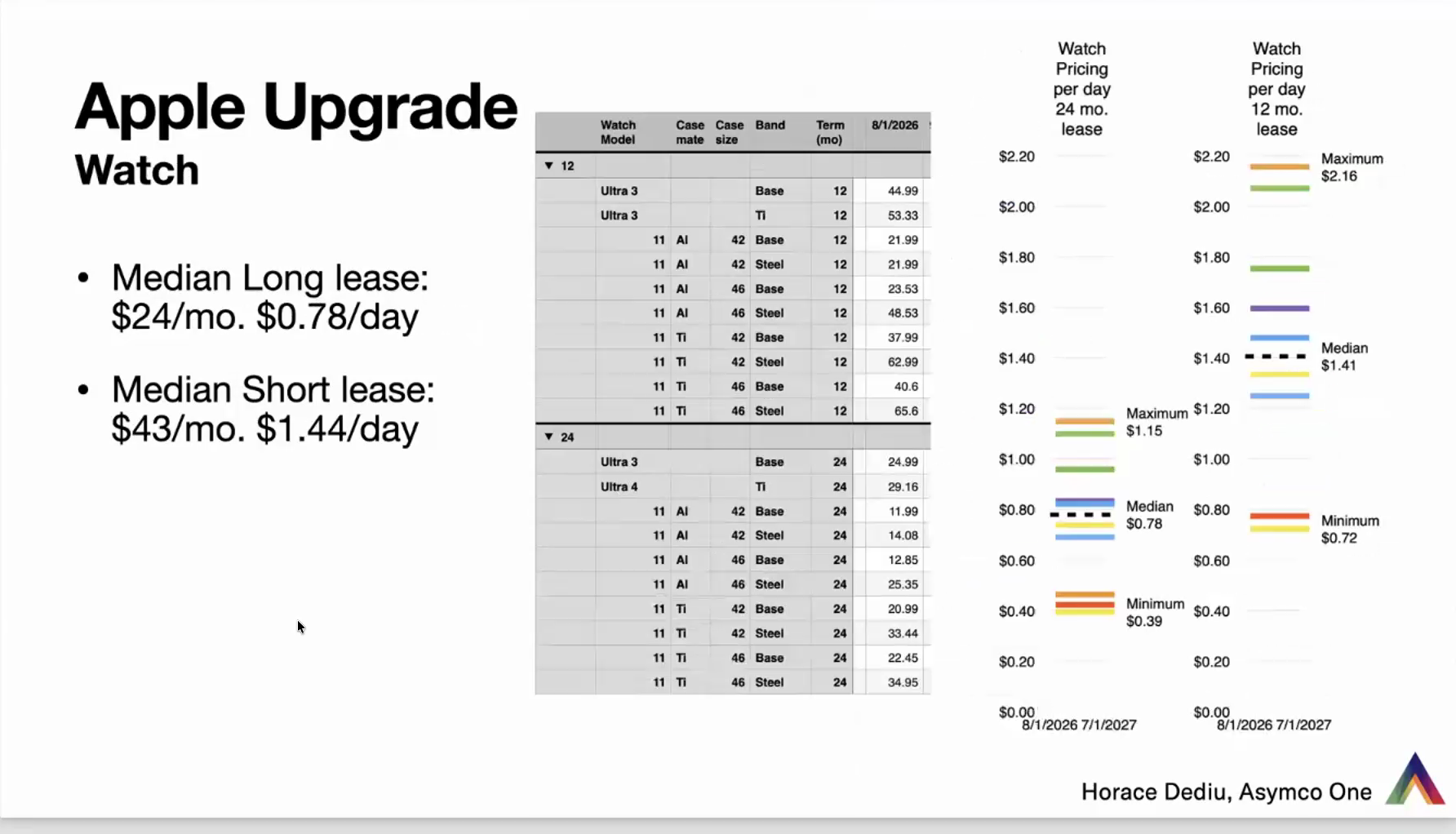
    Jumping through the others quickly: the Watch is $24 a month, or 78 cents a day, on the long lease ($43 a month, $1.44 a day, on the short).

    The iPad, it turns out, has a lot more configurations than the iPhone — it's the most complex, having to do with different displays, not just memory. The median for the iPad is $32 a month on the long lease, or $1.05 a day, and $36 a month, $1.18 a day, on the short. (By median I mean the price band halfway between the top and the bottom — half the prices above, half below. It's not the average; it shows where the midpoint is.) It comes out to about a dollar a day. The lease terms are slightly different for the iPad: 24 months is the short and 36 is the long, and the same with the Mac.

    Mac prices surprised me — this is the first time I've done this exercise — but it's $44 a month median on a long lease ($1.45 a day) and $61 a month on the short. You could present this and say: if you want to get into a Mac, you can go as low as 82 cents a day. Or if you want to max out your system — some options cannot be put on a lease; they're purchase-only — a more or less fully loaded Mac Studio goes up to $5 a day.

    I find these numbers extremely exciting, and most people, when they see them, cannot believe it. When I presented some of this on X, on Threads, and on Mastodon, people said: how do I sign up? How is it possible I can get a Mac for this little money? This is how people are going to react. Nobody believes it — they think it's a $5,000 product at the top end of the Mac scale.

    I think this is very compelling. I think it's innovative because it makes it easy and convenient. Many critics said: if you do a lot of mental arithmetic, you'll probably realize you'd maybe save $15 going a different way; if you just want convenience, this is convenient. To which I'd respond: who's ever known anybody who cares about convenience? Obviously this is going to fail. Convenience is so important. People pay huge amounts of money for it — probably 20% of the economy is trying to deliver convenience to people. It's what credit cards do, it's what Apple Pay does. And it just is phenomenally resonant with consumers. It's not hiding anything. It's all transparent. You don't pay that much more — it's actually 0% financing in effect. You don't own the product, but who cares?

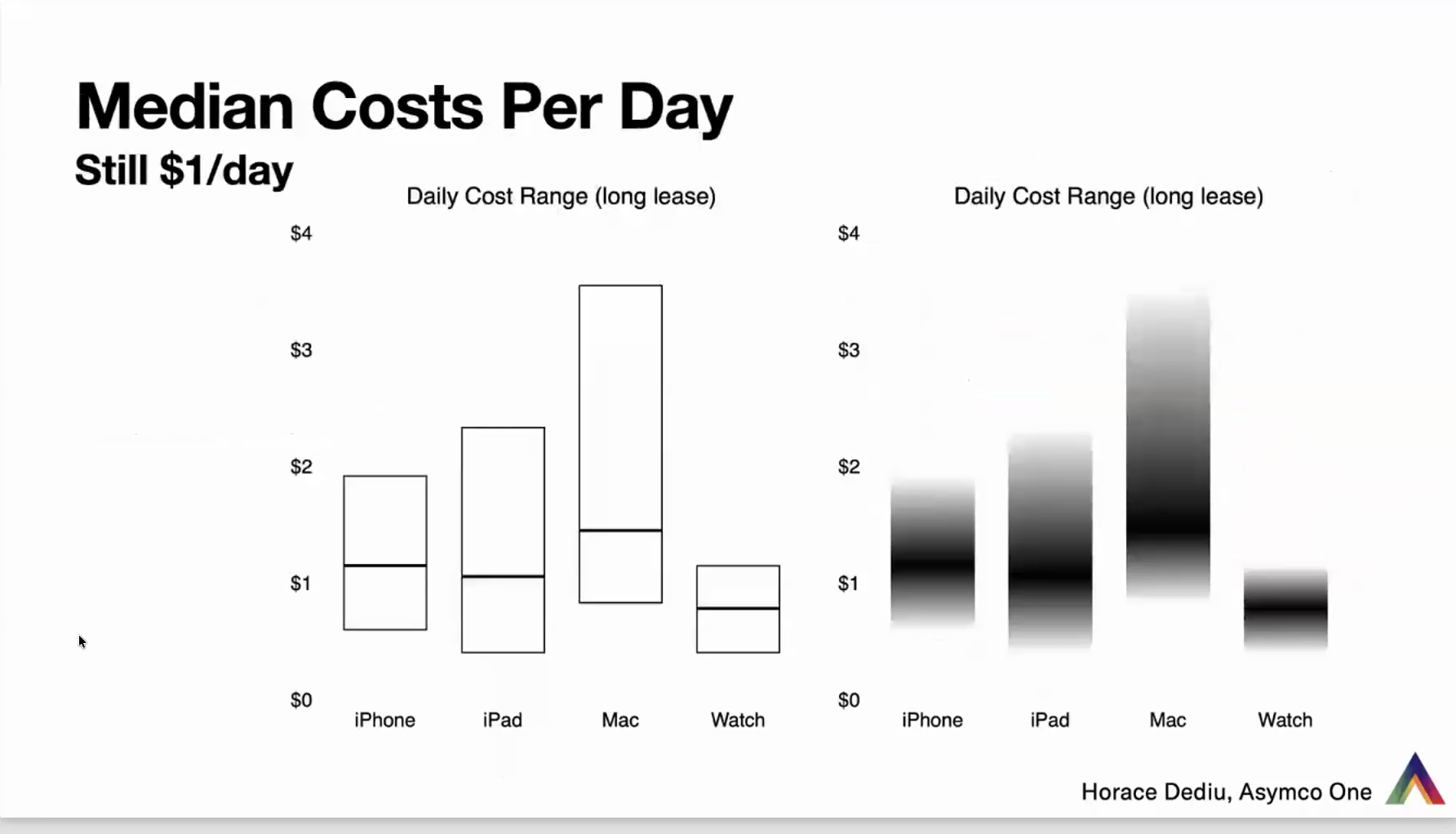
    Median Costs Per Day: Still $1/day

    One summary slide on this. Across all these products — iPhone, iPad, Mac, and Watch — the median daily cost sits right around the $1 line. A little higher here ($1.10), $1.05 there, 78 cents for the Watch. Remarkably consistent. When I wrote this story about a dollar a day, maybe 15 years ago — prompted by Jean-Louis Gassée, by the way, who asked me one day over dinner: why don't you take the value of a Mac and divide it over its lifespan? — I did it for the iPhone, and lo and behold, it was a dollar a day. That would have been 2010, '11, '12. And it's still a dollar a day.

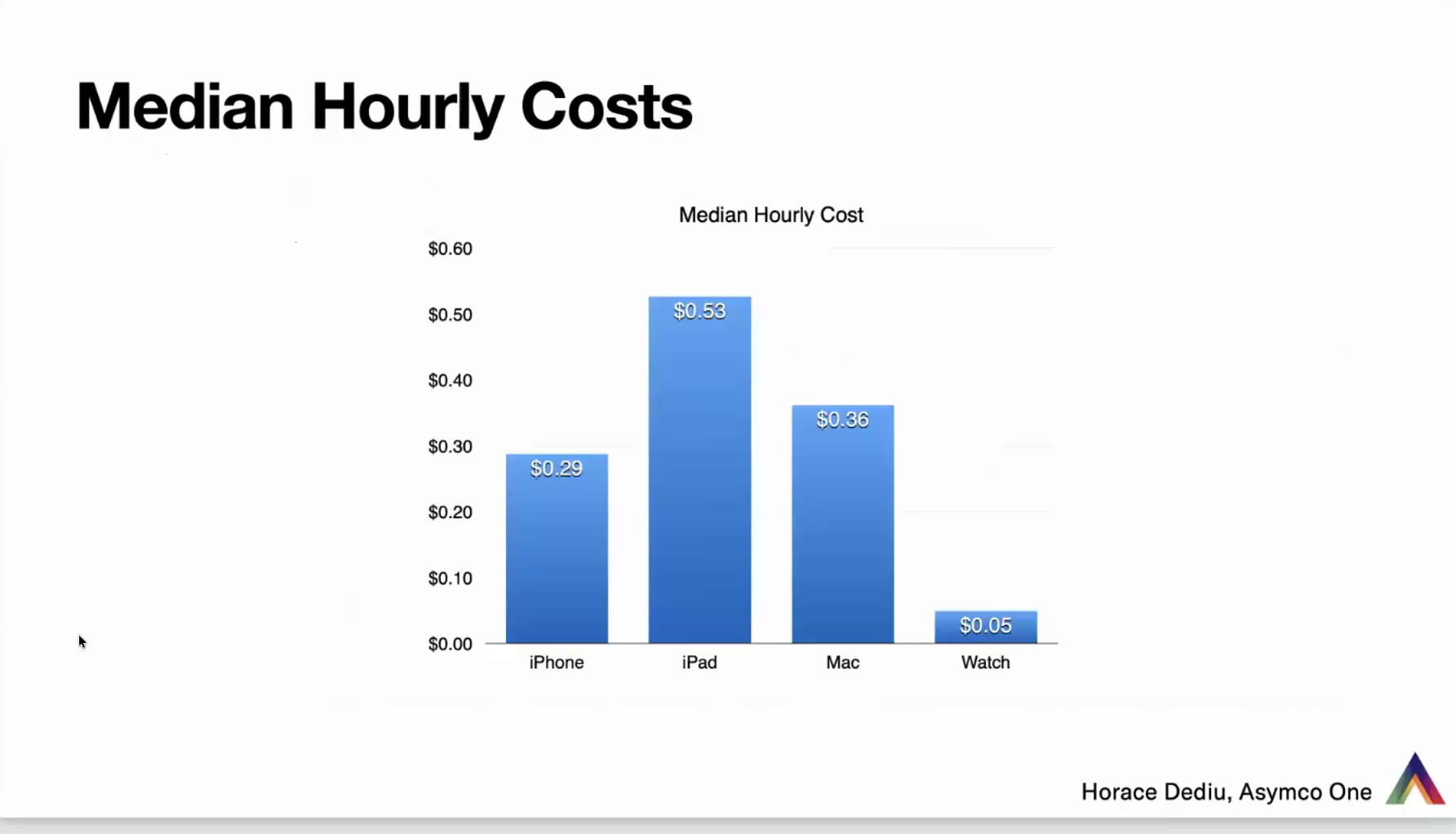
    Median Hourly Costs

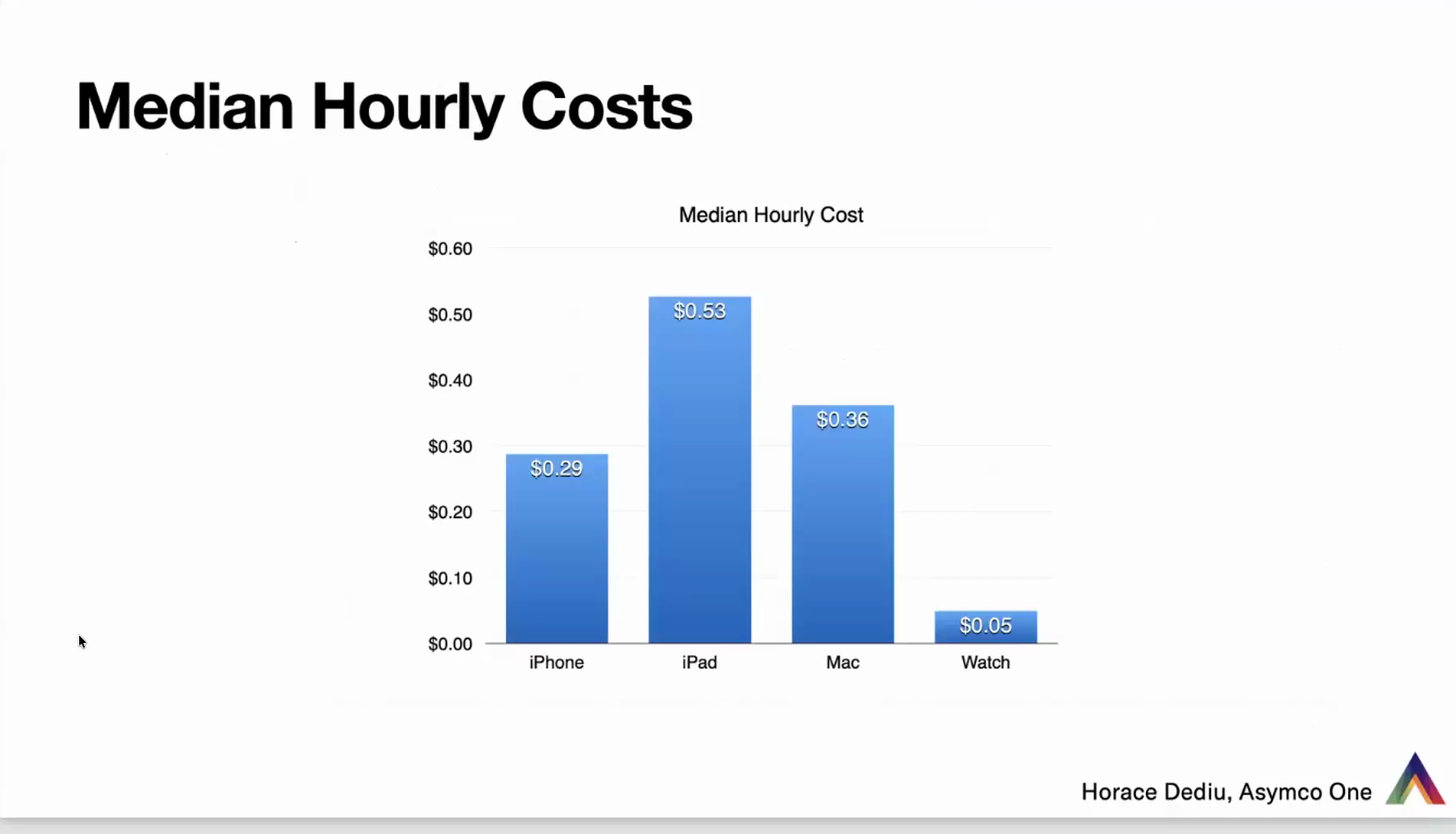
    On top of that, you could ask: how many hours do you use this? That's one more graph — the cost per hour. The iPhone is used four hours a day; take that as an estimate. The average usage of an iPad is lower per day, therefore it's more expensive per hour. The Mac has a higher number of hours, but the product is more expensive. So we're looking at about $0.30 per hour, on average.

    We could go a step further and ask: what about the number of times I use the product? It's hard to know how to measure the Mac, but in the case of the iPhone it's easy, because you can get it through your iPhone itself in Screen Time — it's called pickups: how many times you picked up the phone and turned it on. That number is about 100 on average. (It used to be 80; it's going up.) You can find out your own, take the amount you spend on a daily basis, and divide it yet again by the number of uses. The iPhone comes out to, if it's a dollar a day, about a penny per use. A penny each time it's unlocked.

    And not only is this important from the consumer's point of view, it's a way to define the proposition of value for the whole company. Take every instance of use, multiply it by the number of people using it, multiply it by the number of days in a year, and you start to see how many transactions, how many interactions, and how many pennies add up to the value Apple creates. It's an absolutely phenomenal way of doing unit economics for the iPhone.

    -- End of Presentation --


    Editor's Note: This presentation is made available to non-subscribers for a limited time. Subscribe to Asymco One for full access to this and other content.
  3. WWDC Special: Asymco Office Hours - June 2026 - Live Q&A with Horace Dediu: Recording & Transcript

    Office Hours

    Recording and transcript of the June 9, 2026 Asymco One Office Hours, recorded the day after Apple's WWDC 2026 keynote. Horace Dediu shares his impressions of the event and takes questions from Asymco One subscribers.

    Recording

    Subscribe to Asymco One to listen to the recording and read the transcript.

    https://asymco.com/wp-content/uploads/2026/06/Office-Hours-June-9-Recording-Final.mp3

    Transcript

    Farshad Nayeri: Okay, we're live. Hi, Horace.

    Horace Dediu: All right. Hello. Hi Farshad. Hi everybody. I think we're going to spend most of the time in Q&A, but before we do, I wanted to give some of my impressions. Granted, it's still quite early. It was an interesting event, because at first it seemed very different. There was a lot about safety, a little bit about architecture, and a huge amount of fairly slow demos — not the usual. It felt a bit slow and a bit dense, and I was a little puzzled. I was watching it without a lot of enthusiasm. But after reflection, and after reading some of the documentation that was released, I came to think this is probably one of the most important WWDCs ever.

    This isn't taking into consideration some of the great ones, of course. I remember being at the one in '08, when Steve Jobs told everyone there wouldn't be native apps — which actually drew a lot of boos from the audience. We were going to have web apps only on the iPhone. But the other big one was two years ago, in 2024, when Apple Intelligence was first announced. In many ways this felt a little bit like that event all over again. The difference was that they addressed an architectural question.

    So I have a note I'm going to publish, and the key element of it is that there's effectively a move toward what might be considered the next generation of operating systems. Not necessarily that there's a new version of iOS, or that iOS gets replaced, but something that moves in the direction of what I call intent computing. We have touch computing, and we have spatial computing in parallel, but somehow we're moving — within touch, or maybe across all these platforms — toward an architecture for intent: computing according to an outcome that's desired, as opposed to a tool or a platform of options available for you to pick and choose from. That's the app model we're familiar with. Moving beyond it, we're looking at what Siri always promised. You want to do something, you make an inquiry, a request, and then it decides how to serve you.

    It decides, firstly, by parsing what type of input you're actually communicating through — are you visual, are you audio, are you text, are you capturing an image? Then your intention is parsed or understood, and it's passed to different models that can be used to help you. Those models are assembled, and some of them might end up being enough, but in some cases it might go on to connect with an app that finally completes the request. So the app becomes something of a module that plugs into this intention model. And Siri is the other way of having this experience of getting a result — the Siri model would be exclusive of apps, but the app model is still there.

    What's interesting is that the app now changes character. The app becomes a module. In many ways this integrates into the operating system the execution modules and the data models necessary to complete an inquiry. This is why, in many ways, this is moving Apple into a more integrated model, and into becoming far more a combination of Google's search and a set of core applications. It's quite profound. The implications are also profound — architecturally, but also in terms of economics. How does this get paid for? Because there might be a lot of computation needed. And how does it get monetized? How do users pay for some of that cost — presumably more than it actually costs, thus generating a surplus that can be distributed among developers, model suppliers, and Apple itself.

    We can get into a lot of this, but I thought that was very profound. If you wanted to see it, it was that concentric set of rings illustrating the user in the middle, surrounded by devices, then surrounded by — I forget the name, but essentially the types of media or input — and then what's called the orchestrator, which connects to the frontier models, and then finally whether the experience is delivered via Siri or apps. This concentric model is very different from the stack — silicon, hardware, operating system, services — that we're familiar with, where the point of integration was that Apple had the hardware, the operating system, and increasingly more system services that it opened up to developers, but the developers still had their apps on top. This model somehow puts the user in the center. By the way, in the stack model the user is at the top, because they're interacting with the apps only. Here we're going to see the user interact not even through their own inputs, but perhaps through their environment, through what they're observing, as an input to the whole system.

    It's a fascinating and far more profound architectural development than I had anticipated. I was thinking more along the lines of nice tools, maybe extensions, APIs, and so on. But we saw a lot more than that. We saw a hint toward what I call intent computing. In the piece I'm about to publish, I talk about the orchestrator — I call it the system orchestrator — and then compare and contrast intent computing with spatial computing. What happened to that? I think spatial computing is, if anything, a great foil, a great counterweight to AI-oriented computing. It takes almost the exact opposite point of view. And yet spatial isn't going anywhere; Apple just doubled down on it, in terms of support for the creation of media and applications, bringing Siri and AI and a lot of updates to visionOS.

    So it's a very different dichotomy. One is passive, one is ambient; the other is immersive — it's about every pixel that you see. Everything that hits your retina is computer-sourced, computer-generated, or computer-enhanced, versus a more low-bandwidth, passive environment. We debated whether these two things mean we have to choose: that the future is going to take touch into one of these domains, and first, that touch goes away, and second, that it picks one of the two. I argue it's none of those. Touch doesn't go away. There is more intent computing, but it's integrated within a touch environment — in fact integrated into a touchless environment as well, in the case of wearables, and integrated into an immersive experience, which is like a Mac, with even more of a sit-down, commitment-necessary kind of experience.

    We won't get too far down this road, because I'm going to eat too much time, and it's going to be written — it's coming out very soon. But these were my initial impressions. Very, very big changes. The market isn't even capturing the improvements in Siri that we're seeing. It's totally missing the point, which is not unexpected — they've always missed the point, as far as I can remember. Anyway — Farshad, any questions we want to deal with right off the bat that have been submitted in advance?

    Farshad Nayeri: Bob just asked a question in the chat. Everyone else — hello, and thank you for joining. Please feel free to queue your questions in the meeting chat, and if your mic is working you can ask yourself. So, Bob, please go ahead. Oops.

    Bob V: Okay. I was just thinking back to when the iPhone 4S came out, and the rumor mill was saying that Siri was its own operating system that would run alongside iOS. You were talking, Horace, about how the vision you could see was an intent-based OS, and that intent-based apps were coming. It made me hearken back to that original Siri thing and see it as just — what, thirteen years too early?

    Horace Dediu: Exactly. No, there's nothing really new here. I think people who have been tooling up these Claude-bot-type configurations have been using this term, intent computing. I'm not introducing anything new. I also think Siri's dream — back when it was a research project over at Stanford — was very much along these lines. In fact, I started my career in information retrieval, which was supposedly a natural-language interface to query computers before we even had search. The idea was: you don't need to know how to program, you don't need to know how to use a database system, you just ask what you need, and we'll give you answers sorted by relevance. All of that pre-existed in the 1980s. This is an old, old area of computer-human interaction research — the so-called natural-language interface. And we've come such a long way.

    Now, Siri is just moving right along, but I'm pointing out that you can pay lip service and create a neat chatbot, or create a great interface that fools a lot of people into thinking they're talking to another human being. But the fundamentals of restructuring the entire guts of the OS to enable this — that's what we started to see. I think this is finally a commitment by Apple to say: we need to re-architect everything in iOS, across all of our OSes, to surface this experience.

    I'm not as technical as I used to be, but let me put it this way. I came out with an article that said: show me the money. At the end of the day, none of this is interesting unless we see some economic activity. Because if there's no benefit from this, people are going to treat it like another feature that's unrequested, unloved, and unused. This is the bane of product development — the underutilized or unused feature, unused performance in the product, is a symptom of over-service. You're delivering things, and people are not taking them into use, and therefore are not willing to pay for them.

    It was Christensen who pointed this out. He said a commodity is a product where, if you make a marginal improvement in it, nobody pays any more for it. Imagine you're dealing with bushels of corn. It might be that Iowa corn is better than Kansas corn — I don't know. But when it comes to the Chicago exchange, where futures are traded, nobody prices corn from different farms differently. It's all a commodity, because although it might be better, it's not worth more. That's a commodity — not by the classical definition. If you look at a product and you're constantly updating it, constantly making it better, and nobody's using it, nobody's paying any more for it.

    So the problem with AI is that it has to be more than that. It has to be something really desirable that people are willing to pay for. Those who are paying today clearly are finding some productivity, something valuable about it. But we're talking about consumers right now. Apple is in a consumer device business — consumer products and services. So if Apple's 1.4 billion or so users are just treating this like a nice-to-have, like emoji or Memoji — it's cute, but not life-changing — then we're not going to see an economic impact.

    I do believe this is coming together into something useful. A lot of people will begin to use it on a daily basis, maybe more often, and then we'll see how much they're willing to pay for that extra power. Right now they're going to be paying for new devices; they're going to be paying for the fact that they need more hardware to execute a lot of this. But ultimately I think it gets repackaged into new services. We're probably already seeing that — iCloud itself gives you a certain allocation of compute as necessary for these AI services. In the future we might see those price tiers start to change, and we'll see the introduction of more pricing and more price sensitivity. Anyway, sorry, I'm rambling — but let's carry on. Great story about Siri, though. This is nothing really that new.

    Farshad Nayeri: Horace, just an addition — I've been watching some of the developer videos, and it feels like this time around the engineers at Apple took it on and started eating their own dog food, so to speak. They seem much more into how you really get AI into your applications. Very interesting videos. Bob, did you have a follow-up?

    Bob V: Yes. I researched the deal between Apple and Google for the frontier model they're using. All that was public, that I could find, was that it's a multi-year deal with no known end date. So this requires gazing into your crystal ball fairly far out: what happens after?

    Horace Dediu: When that came out, a couple of things happened — people started to jump to conclusions. I talked to Laura Martin about this, and she assumed Google's going to run this, and they're going to get all the data from Apple, and that's where the gold is. So even if they're not getting a lot of money out of Apple, they're going to effectively begin to control the user's data and experience. I was skeptical at the time that Apple would ever release any end-user data; if anything, we're just going to see a technology licensing deal.

    These questions have been answered in the follow-up sessions after the keynote. I've seen the tweets and threads from people who were there. People are saying Federighi and his staff have been adamant that Google gets nothing — there's certainly no data. Only one of the many models being accessed through Core AI is running on Google Cloud, which means it's outside of Apple's own private servers; that's the most powerful model, but it's a world model. It is not Google's — they don't have access to anything. So it's very much a technology licensing deal. The other thing people say is that it is not Google's tools in any way. This isn't their image tool — Farshad, what's it called?

    Farshad Nayeri: Banana — Banana, whatever.

    Horace Dediu: Banana, that's it. So they're not rolling out any of Google's branded or unbranded tools. It's not Gemini, it's not Banana — it's Apple's own model. I think they call them Apple Foundation Models. There are several of them, and one is running with Google in the cloud somehow, but it's private, it's pretty secure. A lot of people assume way more than what's actually happening with Google here. And, like you said, it's probably swappable. At some point Apple may decide to do it themselves — I don't know what the IP issues are, but there's something interesting there.

    Now, let's not forget that Google also sends $20 billion-plus to Apple. So now Apple sends back one. What's a billion between friends? Anyway — that's another area where I think people were jumping to a lot of conclusions. Even Apple's response to the initial queries on this topic wasn't very explicit about whose computers these are, whose data this is, whose data centers are being utilized, who's paying whom, for what, and how long. They were very cagey about it, and people jumped to conclusions — "aha, I see you didn't say this or that." I wouldn't worry too much about it. Apple's not going to give away the most important thing they have, which is their relationship with their customer.

    Farshad Nayeri: I'd add that some very core aspects of model development involve using Google's tensor stuff. So as far as competition with Nvidia, it might be interesting — a way of seeding the market with Google's way of doing things, as opposed to Nvidia's. But it's layered inside Apple's stuff, so you'd have to be very deep in to get at it.

    Horace Dediu: We talked about this on the last Office Hours — whether Apple would create its own silicon. Now it's clear they're not there yet for the server side, server-side compute. But ultimately they probably are working on it, and have been for a year or more, to bring an Nvidia-level chip — the highest level of Nvidia chips — to operate, as are many others, not just Apple.

    Farshad Nayeri: Right. The battle is on two grounds, though. It's the Nvidia chips and the API. Is it CUDA? Is it the tensor API? So there's something there.

    Horace Dediu: Everybody's going to go there.

    Farshad Nayeri: Okay. I think Roger had a question. Roger, would you like to ask yourself? I'll unmute you, see if that works. Thank you, Bob, by the way.

    Roger S: Hi, Horace. Yesterday I posted a question to the thread, replying back on the invite. Is the P/E of 38 getting too far ahead of itself? And today the market solved my issue and dropped it down to 35, and I feel better — that's what I posted in the comments today.

    Horace Dediu: It only took twenty-four hours.

    Roger S: It's crazy. If I was unhappy yesterday, I should have acted on it and bought it back today, but I didn't. What do you see as likely monetization, if there's going to be any besides hardware sales of more capable equipment — phones, Macs, iPads? Do you see a monetization here?

    Horace Dediu: Absolutely. I wrote this up, and I'm happy to answer it in advance of it being published. Here's how you go about it. They gave us an architecture. It's about intent, about orchestration, about routing the question through multiple models and multiple input types, and then deciding whether it goes through an app, or back to Siri.

    When you look at it strictly from a technical point of view — how do you architect it, how do you implement it, how do you do the right thing for the user, for privacy, for everything else — I was frustrated yesterday, thinking, where's the money? My answer was: follow the compute. If this works without compute, or it works on-device, then the user is happy. They're happy buying the device that does the job, presumably with the memory that's necessary, and Apple provides all of that as part of the purchase price. Everybody's happy. The developers probably still sell their apps, but they're not doing extra compute. They're not selling data services or compute. They're selling: here's my app, it has code in it that solves this puzzle for you.

    Now, if there's compute — if you have to do a huge amount of computation to deliver the result — on-device it wouldn't matter that much; that just uses battery. But if it's in the cloud and it's through an app, then you trace who's going to send you the bill. Where's that invoice going to come from for the compute? If it goes through a developer or a model supplier, then it's not free, and they're going to end up saying, "I need you to subscribe to a service to get the answer." Once you do, that could be priced as a fixed fee or it could be variable. We could end up in a situation where the app developer requests a subscription for that app to work, and within that subscription they've worked out the economics of how to get paid, and Apple gets its 30%, or 15%, or somewhere in between. If there are other services that Siri depends on that don't use an app, then Siri will probably charge back, through iCloud, for the compute.

    So in many ways, all they did is take the exact same business model — services with subscriptions, primarily — and say: we're going to either tweak these subscriptions to include compute, if that's necessary, or add new subscriptions for just that extra compute. And Apple gets the same distribution commission it's always gotten. Nothing's changing. In fact, the absence of any commentary from Apple on how this is going to have different economics is, to me, a tacit acknowledgment that there's no need for anything different. This is going to work within their existing models. That means the App Store, and if anything economically interesting happens, the App Store will have another kink in its trajectory. We got a kink when it went to subscriptions, after that model became dominant — you can see the kink in the App Store revenue rate — and now we might see another kink, which AI enables.

    As far as users are concerned, they don't see anything. Maybe their monthly services bills go up by 10%. Maybe they add a few more subscriptions, or maybe they cut one and add two. Who knows? Will there be some churn? But at the end of the day, it all reflects in services. And that's a 72%-plus gross margin. Apple's hardware will also probably see a nice uptick. It'll take time — I reckon it'll take ten years before this reaches 50% penetration. I haven't written this down, but I think it's a ten-year cycle before half of the Apple population are daily active users of AI services, paying something for them. So hardware is going to take its time, software and developers are going to take their time, and they'll just see more of the same, but bigger.

    Roger S: Just to fill in there — I've messed around a little with Private Cloud Compute inside Shortcuts, and very quickly I get cut off, or I exhaust my daily limit for the free tier. I'm an Apple One subscriber, so I may have a little bit more. I've read since yesterday that all users will get a little bit of processing, iCloud+ users get even a bit more, and people who want to process a real project may have to kick into another tier. But I think they're going to wait and see how strong demand is versus what they've contracted to process in Google's cloud, elsewhere, and their own.

    Horace Dediu: Yeah, that's the thing about AI, which I think is a little less disruptive than people imagine, because the more you use it, the more it costs. A lot of the early users are being subsidized — with venture or low-interest money, or whatever you want to call it. There's been a lot of that going on in all of these services over the last fifteen years. Whether it's food delivery, Uber, ride-sharing — they tended to be much, much better when they were new, because they were subsidized.

    The difference is that a disruption is something that goes down in price over time. We're seeing the opposite. We're seeing a lot of stuff that actually gets more expensive. You hear this term, enshittification. All that means is that businesses that gave stuff away for free now charge you, and everybody feels like, "Oh, it's gotten worse." Or they charge you in different ways, they make it harder, they slap on fees, they deprioritize service, and so on. All of that happens because you didn't have a transparent business model in the beginning that was actually clearly profitable. You were chasing growth instead of profit, and that causes people to get euphoric, but you're basically giving money away.

    For that reason, the problem with AI is actually the bills coming due for a lot of stuff that was subsidized. That's not the way it should be. If you look at the great disruptions, prices go down exponentially, asymptotically to zero. Think of the cost of electricity, the cost of aluminum, the cost of one unit of light, the cost of transportation, even the cost of food. It's all gone very, very quickly lower and lower as you get scale economies. We're not seeing that. Maybe it'll change. Maybe we'll see some oscillation.

    But fundamentally, Apple is neutral on this, because they're saying: we are just the pass-through as far as the costs are concerned. We expose things to users, keep it safe for them, and the user is in what they call the walled garden — it's a wonderful place to be. Whether the business models behind it are variable or fixed pricing, or economies of scale, all that's going to pass through. So I believe this is the ultimate sustaining business for Apple. They just get paid to distribute, which has been my thesis from day one.

    Farshad Nayeri: Roger, did you have a follow-up? I thought you had two questions.

    Roger S: I do have a different question.

    Farshad Nayeri: Okay, go ahead.

    Roger S: I thought a new wind was blowing in the EU with regard to Apple and gatekeepers. But on Siri AI not being available — meaning Apple's not going to release it and allow app developers full accessh to a user's data — why does the EU think it's okay for these other apps to have access?

    Horace Dediu: This is a hardball negotiation underway. At a higher level, the people who are negotiating are not the leadership — they're functionaries, bureaucrats. Whether there's a shift in the wind, that would have to come at the highest levels. There was a realization, maybe a year ago, that Europe was falling far behind in a lot of technology areas, that they regulated themselves into a dead end. That was expressed at the highest levels, and people took it into consideration as much as they could. I'm in Europe now. But before that trickles down and something happens — it's a bureaucratic system. It's got its benefits, but it's slow.

    I think Apple's strategy with a lot of this is to induce a sense of FOMO, fear of missing out, among the people who really do make these decisions, whether they're regulators or people in the courts: look, you're doing more damage to your constituents than you think. Part of that came out through that number I put out, the $1.4 trillion, which I increase with Apple's own products and services — the $1.4 trillion is on top, and then there's Apple's own, so together that's reaching $2 trillion. And beyond that, there are things that don't go through apps at all — stuff that's maybe browser-based. I'm sure the whole porn economy sits on top of that and is invisible to what these analysts are trying to quantify. So the overall economy could be even 50% higher than the $2 trillion, making it about $3 trillion. On top of that, you've got Android at probably about half of that. So I'd say the whole mobile economy is three-plus-one-and-a-half — four-and-a-half to five trillion. That is essentially the US companies, Apple and Google, enabling worldwide. You can break it down by continent or country as you wish.

    The implicit statement I'd encourage Apple to make is: if you screw this up, you're going to damage your core economy. A five-trillion-dollar economy is beyond a national economy — it's almost a continental economy, depending on your continent. It's not just "you've got a nice thing here, don't mess with it." It's an observation that this isn't only about competition; it's about keeping the lights on overall. The growth story of the whole economy depends on it. But let's not go too far down this road. I think this negotiation will get resolved. They're playing a lot of games right now on both sides. They're even using WWDC public forums — Federighi going out in public saying "Hey, EU, you're not getting this." That's not targeted at the bureaucrats; it's targeted at the users and developers who are being told they can't even test. Those developers and users need to connect with their decision-makers and point out that they're being left behind. The Indians are going to do better than us, the Chinese — well, China is still out of it, but that's a different story; that's easy to flip that switch. To flip the European switch requires some sort of consensus, which is much harder to gain than in an authoritarian regime. Anyway, I really hate doing too much on this, because it's easy to sound clever about it, but that doesn't mean you are.

    Roger S: Thank you.

    Farshad Nayeri: Okay, thank you, Roger. Dave Emery unfortunately couldn't join — he's an irregular contributor to these meetings, as well as to the site — but he sent two questions for us to ask. Question one: Horace, are we heading to an AI bust, or at least a meltdown of the large hyperscalers? Or, as the advocates claim, is there going to be a continuing increase in spending that eventually produces revenue? And if and when this crash happens, how will Apple adjust?

    Horace Dediu: There's revenue, though. There is revenue — there's just not that much profit. There's probably even earnings, but there's not much free cash flow, because everything's being reinvested. This feels a lot more like the early days of Amazon, which was also an infrastructure play. In the early days, Amazon reported almost no earnings, because their CapEx was huge, and there were fairly little margins on retail. So for years and years, their P/E ratio was ridiculous, because earnings were almost nothing — 400, or at least 100. Remember those years. But eventually they did begin to record earnings, retain some, and especially with AWS being the savior. But what I'm saying —

    Farshad Nayeri: But with Amazon, they were purposely setting their margins to zero, right? They had a predatory approach. There are ways you can play games.

    Horace Dediu: Remember: earnings are an opinion, cash flow is a fact. So yes, their opinion of what their earnings were was fabricated to some degree. They could manipulate it. They could declare all their software development as CapEx, or rather as R&D, as they did. But the question asks: is there a bust? Let's take that on. I think there's a valuation issue, but if you look at some of the hyperscalers, their P/E ratios are fairly modest — lower than Apple's, in the 20s. Microsoft is getting hammered. Google is way below its all-time high, even though a lot of people say it's doing really well. And they're all growing really fast — their top lines are growing. They're just so desperate for cash that they're even doing private placements, meaning they're selling equity. They're diluting their investors to get more.

    If you raise equity, I don't worry. My concern, if there were a crash, would be whenever we get into debt fueling a growth or speculative boom. Using free cash flow, or equity sales, is generally non-contagious — if you get hurt, it only hurts that company. When you're dealing with debt, there's a knock-on effect, a contagion. Almost all crises, all crashes, have been on the basis of debt, not equity, being mispriced. The dot-com crash was actually overvaluation, but that was because there wasn't even any fuel — there were no earnings at all, no revenue at all. You had 400 P/E on some names, which made no sense; the top ten companies were all at multiples in the hundreds. That was a little different, and fairly short-lived. But if you have a crisis induced by debt, then things have a long time to unwind, with repercussions across the economy.

    So far, my read is that AI hasn't yet become a debt story. There's some debt in there. If it does escalate, you'd have to imagine a scenario where banks, mutual funds, hedge funds, private equity go out and lend huge amounts to build data centers. The usual lending logic is that there's recurring revenue behind it, so you can pay back the interest. Very rarely do you see a hyper-growth or speculative business being backed by debt. The only exception, of course, is anything to do with Elon Musk, where he raised debt to buy X — presumably the people who lent him money thought it was a predictable business, until he wiped out half of it with bad decisions. But they still got out, because he managed to fold it into xAI, and that got folded into SpaceX.

    So — I'm not an expert in this, but my observation is that the AI bubble might burst, but only if people stop using it, if businesses run out of money to pay for it, or decide it's not worth it, that it's actually a productivity illusion or mirage, and as a result people say, "This was fun for a while, but we're not doing it anymore." So far, all the indicators I'm privy to are: boy, I wish we had more compute. We're constrained more by the fact that we don't have enough capacity to meet all this demand. That, to me, does not scream that there's a crisis here. Maybe a lot of that is growth-hacking, or they're giving away too much and not pricing. We're not seeing a pricing signal, and prices are important because they tell you how to allocate your resources. If you mess with the price signal — by subsidy, by monopoly behavior, whatever — you don't know what the market's really thinking, and that's dangerous. So for now, let's see how much truth there is in the pricing of AI. But that's a macro issue. There are other factors on the externality side — a lot of stuff floating around even today; we might be seeing some cracks in the foundations. But as far as Apple is concerned, these are externalities.

    Farshad Nayeri: Actually, while we were talking about valuations, there were two questions about stock buybacks, past and future, since that seems to be in flux. This is Joe Bond: in your opinion, what has been, and will be going forward, the cumulative impact of Apple stock buybacks — I guess that's been twelve-plus years? And Kenneth Kruger also asked about buybacks in general. I think we discussed this last time — the question was whether JT would change any of that.

    Horace Dediu: They signaled that they might no longer be targeting cash zero, or net cash zero, and that was a wake-up call for a lot of people about the buyback story maybe changing. But at least for the next year, that's not going to change, because the allocation has already been made. The board has approved it, so it kind of has to happen. Barring extraordinary circumstances, that's how I see it. So we might be seeing a very gradual transition away from the return-capital-to-shareholders strategy we've seen — partly influenced even by Warren Buffett's philosophy; maybe he rubbed off on Tim years ago.

    But fundamentally, this has nothing to do with the business. Whether the business chooses to keep the money or give it back to its owners doesn't change its prospects as a business. It's just what it does with that surplus of capital. There are old adages of finance, like: whether the company is financed using debt or equity doesn't change its prospects. There might be small effects, but fundamentally, what happens in financial terms is not the core of what the business is about. Investors should be thinking, first and foremost: is this a great business? Number one, are they creating customers? Number two, keeping them happy? Number three, is management smart enough not to screw up something good? Are the employees and the people who work in the business motivated and incentivized properly? That would be my hierarchy. Only after that do you ask: now that we've been wildly successful, are we being super efficient with our capital — with taxes, with handing it off to shareholders in the most efficient manner, or with whether we should be reinvesting, or be custodians of it and make it grow through other means.

    It's as dangerous to stupidly spend it on pointless adventures or acquisitions, when the owner can just as well buy that business by taking the cash out and buying equity in it themselves. It's the same thing. So why bring it in and overpay? There's a lot you can screw up. These are the priorities as I see them, and managing all that capital is, if anything, maybe the last piece of this short list. We'll revisit this in great detail as anything happens, but for me it's almost a hobby.

    Farshad Nayeri: Okay. I think Fred Stein had a question on the topic of the enterprise, and there was also a question from Frederick Hirsch, who couldn't attend. And I have my own addition on the enterprise. Fred, please go ahead — it's your question, and I'll add Frederick's first.

    Fred Stein: Sure, thanks. And by the way, Horace, thanks so much for your opening remarks about what's really going on, and how underappreciated it is by the market and analysts. That's worth the price of admission. My question is about MLX. They didn't even mention it during the keynote — maybe it's too in-the-weeds for a general audience — but it seems they've done something almost like a reverse Trojan horse. You write in MLX, you can run on Apple Silicon, and then migrate to the other guy's chip, the Nvidia chip. Most of the time people do it the other way: they make migration tools to go from the other guy's chip to your chip. I thought this was fascinating and wanted to hear more.

    Horace Dediu: I'm afraid I'm not an expert on that. But generally speaking, when you look at Apple's history with portability — and I think this speaks to that — they are very, very good at it. Months ago, when we had the Apple-50 celebration, I was watching a couple of videos of the old hands. The Computer History Museum — go to YouTube and you'll see interviews lasting two or three hours with some of these old-timers. I remember watching Avie Tevanian, Mike Markkula, Bertrand Serlet. I think it was Bertrand's interview that described the transition from — well, actually, PowerPC to Intel. This is way before the M series; it was in the early 2000s. When that shipped, people were shocked. How did you get OS X moved to both architectures? Nobody could imagine Windows doing this. Back then it was all about Intel. The idea that they moved lock, stock, and barrel, seamlessly, and even had sandboxes for runtimes that weren't going to run native —

    I actually met Bertrand at WWDC. He gave the State of the Union talk after the keynote and talked about this — I think he called the old system a skyscraper, and how they had to move the skyscraper. A beautiful talk. He sat next to me afterward, and I said, "That's really impressive, how you did this." And he was very much, "This is nothing. We've been sweating portability for decades, because of my background and where I came from." He'd been on different OSes back in the day of the Mach kernel, trying to be clever about the portability of Unix, which was the heart of OS X, dealing with that portability issue way back, before he even joined NeXT — where he did a lot of heavy lifting — and then into Apple.

    So you'd have to go back decades to see how entrenched this is in their psyche, in their DNA, to avoid becoming dependent on an architecture they don't control. Making stuff portable, being clever about the migration path — that's why they seemingly do this very easily, because it was really heavy lifting back in the day when portability was almost nonexistent and required a huge amount of work. If you remember Y2K, just fixing those things embedded in so many systems made people think we'd have a civilizational crisis. To think that the software engineering at Apple is so strong — the modularity, the attention to portability — it's not surprising they're doing this now at the level of chipsets for AI compute. I'm not surprised, even though I haven't dug into it.

    Fred Stein: Great. Maybe one follow-up observation: they also mentioned Device Hub, which basically allows apps to run on any Apple device. Just an observation — it's impossible for any other vendor to do that.

    Horace Dediu: You want to hear a funny thing? I don't know where this came up, but I saw it in one of my socials. Somebody was running macOS using an iPad as a display, and they said you can now use touch on the iPad to operate the user-interface elements of macOS. They said this just came out — correct me if I'm wrong, if it was already there, but I'd never heard of it. I sometimes use an extra screen — what's it called? It used to be called Sidekick —

    Speaker 6: Is it Sidecar?

    Horace Dediu: Sidecar — that's it. So this idea of getting an extra screen — but I never thought I'd control the Mac user interface from it, because it's not known to be touch-friendly; the elements are so small. But it's possible now. Imagine how much engineering went into making the whole user interface — the ability to click, select, right-click — already touch-ready, so that whenever, and likely soon, we have a Mac with a touch UI, it's already there. They probably built it years ago. It's just a matter of turning it on.

    Farshad Nayeri: They're very purposeful about portability — as opposed to Microsoft. I think part of the problems Microsoft has, even to this day, is because they always brought the customers along, no matter what.

    Horace Dediu: It just wasn't a priority for them. The hunger Apple has is because they went through multiple transitions. They probably bought Unix partly because — I suppose it was Avie who sold it to Jobs — he said, what we get is portability, scale up and down (we can make it a server, we can make it a device), and security, because it was a protected kernel, protected processes. All those came with Unix. When Mach came along, they got a lot of that with it. Back in the day, Microsoft never prioritized any of that, so their OS was a kludge, and it just got patched and patched and patched. That's history, but it's one of the stories that isn't told, because Apple didn't want to highlight what the engineering was all about back then. The engineering was top-notch, excellent.

    Farshad Nayeri: Right. Fred had also posted a question, which is the one I intended to ask, so I'll read it now. There are three parts. First, from Fred: the Mac continues to grow rapidly in the enterprise — it'd be nice, Horace, if you could do a graph, real-time or later. Second, a question from Frederick: I'm confused about Apple being a consumer company, yet venturing into the enterprise with Vision Pro. And third, my own: I didn't hear the word "enterprise" once during WWDC this time — maybe I missed it, but it was developers and consumers.

    Horace Dediu: I don't think I ever heard them talk about enterprise. The only time I hear about it is during the earnings calls, where they give a little example — Delta Airlines was one, some company in Europe, an insurance company — somebody switching to Macs or Apple devices across the board, and how they're getting wins in these large Fortune 500 companies. But fundamentally, from a messaging point of view, the two are opposite ends. Marketing to enterprise puts consumers off, and consumer marketing puts enterprises off. The idea that they're only getting consumer-grade technology is not attractive to many a CTO or CIO — though that may be changing. And consumers find enterprises to be jargon-filled and without any heart, any beauty or sensitivity. Besides that — you can do both, but with separate events for each. I think they're conflicted on this. It's great that they're getting wins.

    By the way, the Vision Pro right now is getting traction with a lot of enterprises, especially in healthcare. They're careful not to pigeonhole it, because they don't want people to assume it's only for that. There's no real publicity; the direct salespeople out there talking to enterprise have their list of wins, but it's not something Apple talks about publicly. So I'm not surprised they didn't mention it at WWDC. It's opportunistic if they do. Maybe there are non-keynote sessions where it comes up.

    And let's not forget, they spent almost fifteen minutes — maybe I'm exaggerating — on child safety. Ben Evans made a note of this. I saw him comment that it's uncharacteristic of them to talk about safety in such a lengthy, laborious, and dull way. But I think it's a political move. It's there to signal to authorities, who have probably been pressuring Apple in all kinds of ways — as usual, to do the wrong thing: to have a good ambition or intention with the wrong approach. That's very typical of regulators, because they're not engineers. Engineers work with constraints; regulators work with outcomes, and they don't think about how to get there. So my observation, like Ben's, is that this was very carefully calculated. They felt it was really important to dive into it and expose it at this venue, which was one of three tent poles.

    By the way, remember, no hardware was launched. How many stories before this event were like, "We're going to see this device, that device"? No. It was architecture, then safety, then AI. Actually, the first thing was a general update of the OS — there was something about Liquid Glass, a few things like that. Normally, in the past, they'd do a segment for each OS: here's what's coming in iOS, here's what's new in macOS, in iPadOS, and so on, segmented by OS. And maybe something special, like, "Hey, here's SwiftUI," or something new with HealthKit, or Metal — the old developer stuff, a lot of software. This one was very different. A lot of architectural tidbits, very light on the new features in the OS, and suddenly this big lump of safety in the middle. So you have to figure out what's going on.

    Farshad Nayeri: Well, first, a lot of developers have children, and developers are at the forefront of explaining things to the public. I also thought the format had to change a little, because they had these live-recorded sessions. The pacing seemed odd to me — they'd go from their usual rhythm to these places where people were typing things, and they had to live-record them so they didn't look fake.

    Horace Dediu: That's why the tempo is a bit off. But a lot of people complimented that, those in the know. Even Neil Cybart, even Gurman, said the way it came across was that this was real, not contrived, and as a result it had more sincerity. But, as somebody pointed out, the editors of this video would have been pulling their hair out — it was so bad from an editing standpoint. An editor wants to keep things snappy; they know exactly how long you should hold a shot, and nothing should last more than a second. If there's no change in one second, you're doing it wrong. Here we were, dragging with five, six, ten seconds per shot. It was dreadfully bad as a movie. But again, they said: we need to be sincere about this, we need to demonstrate that this is real, to fight against the perception that we haven't got it done yet. Which is why I'm irritated by Gene Munster's comment that this looks to be vapor, or unfinished. It's being tested right now by the hands of millions.

    Farshad Nayeri: Yeah. Greg, did you want to bring up your comment?

    Greg: Sure, can you hear me? First, thanks for doing this — it was great. My comment: my sense of the safety-and-kids part was partly about championing the walled garden and the structure it provides. Apple can do things other companies can't, and even if those other companies wanted to make the same safety choices, their business plans are predicated on using people's data and selling it. So it seemed like the segment was targeted as much at Facebook as it was at politics.

    Horace Dediu: Absolutely — this is super important. But the word I'd use is hygiene. I forget that I used it online, but here's the term: I remember this from when I was at Nokia. There are features considered hygiene, meaning if you have them, most people don't care, but if you don't have them, everybody complains, because it's unusable — how could you not? It's also a bit like plumbing. Plumbing is only noticed when it doesn't work; when it works, nobody thinks or cares about it. For that reason, safety — even automotive safety — is never a marketable thing. Volvo, maybe, but they're a super niche. Mostly, people don't want to hear about negative things. We had discussions, in public, watched by millions, about child abuse. We're talking about unpleasant things, things everybody wants to avoid. So from a marketer's point of view — as I said, the editors were cringing about how Siri AI was portrayed, but a marketer at Apple would have been suicidal about how that segment could have been used to create an enormous amount of euphoria on behalf of the consumer.

    Of course, it wasn't a consumer audience primarily — it was about developers, but my point is it actually targeted the policymakers. This was designed to induce a sense of: we are custodians doing our jobs really, really well, and we're making this very public. It's in your face; you can't ignore it. And: we're burning our cycles and our goodwill in front of millions of people to tell you that we're doing our jobs. That's a weird thing to do. There must be something behind the scenes going on there.

    Farshad Nayeri: Okay, next question. This was a little bit addressed already, but in case folks came late: will agentic AI replace the vibrant app economy? Would that be a consolidation of revenue to Apple and to the agent providers? Or will AI enable a new set of apps? That was from Dave Emery.

    Horace Dediu: This is in the post that's in the pipeline, but I'm happy to expand, because you never get the full story when you try to write it down. The premise of intent as an operating system — designing in intent compute, as opposed to touch UI, touch compute — is that you assemble the solution to a complex problem using a multitude of modules. Those modules include models, and they include data — private data, awareness of the context of the user — and multiple types of inputs, which aren't just single taps or swipes; it's pictures, it's audio. So you have a much more complex set of inputs and components that you're assembling. The orchestrator assembles the solution and decides whether to farm out, or hire, a solution or module provided by an app.

    In the post, I say that most people who assume intent computing assume there's a post-app future. But Apple doesn't. On the outer layer, they put either Siri or apps to create the full experience. By "experience," I mean it might even assemble a little mini-app — a set of questions you need to answer in order to get to the final thing you need — and then it assembles a solution to the job being asked, the intention being asked.

    My further observation is that within apps lie a lot of the permissions we entrust. You have a banking app with your banking credentials; you have various other things you protect inside apps. The reason it's done that way is that you trust the institution behind it, and vice versa. These places where you've entrusted something have earned your trust. The Claude theory goes: just harvest all of these permissions — find out what the bank access code is, the social-security number, the mother's maiden name — give me all the access as an orchestrator, and I'll go do all those things that apps, or websites, were hired to do. I'll become your agent to execute all of these.

    Now Apple says no. What they're hoping to do, because they're so concerned about trust, is to not have those things that have earned your trust be disintermediated. We're not going to fire all the things you've already hired because of the trust you've given them. That relationship is very delicate. Apple doesn't want to betray that trust, especially if things go wrong. So if you get hacked, it's: well, it wasn't my OS that lost your keys — be careful you don't get hacked in your Bank of America account, but that's on Bank of America to preserve. That's why they're going to eventually hand off to the institution with the credentials necessary to assemble the final solution, rather than try to take over completely.

    So what apps used to do is provide interfaces, plus data, plus various other things you've established as a relationship with the provider. What they're possibly taking away from apps is the interface — and that was the costliest part of building an app anyway. Millions of developers are recreating the same basic thing: "Okay, we need a drop-down menu, we need a bunch of steps to authenticate," and so on. So what Apple might do is allow that interface to dissolve a little, or maybe just pop you into it. I think they're going to try to move away from it. That's the intent. Yeah, go ahead, sorry.

    Farshad Nayeri: No, I'm sorry — it's like a reverse hub strategy. Instead of the Claude model, where Claude is the hub doing everything, Apple is distributing it to each of the apps. And in a sense, they're all sandboxed already, so that gives you a layer of protection. And now that everything's running on Swift — something they brought up is that they've open-sourced these tools, and you can run their AI stuff on Linux — eventually they could say, "Oh, this workflow that used to go through the app, you click a button and we'll run it for you on our Private Cloud Compute."

    Horace Dediu: So once again, they're bootstrapping to some later model of this — guide rails and scaffolding to make stuff happen behind the scenes. The thing about Claude, which was super, super exciting, was that it did all this stuff the orchestrator is supposed to do. When I first heard about it, I thought, man, this would be great if it were an OS-level thing inside iOS. I thought iOS, or macOS, should be that thing you currently have to cobble together — why not have that be super, super secure? But what you see appearing now is, yeah, we're going to do that, but we're not going to take on the liability, as Claude did, to lose all your stuff and be compromised by attacks. Those were notoriously bad at security. The warning I always gave people was: you can experiment with that, but be very careful to keep anything sensitive and private out of it, and keep anything with money out of it. But people love to play with it.

    So for Apple to do this properly, they understand inherently that it's about managing liability and trust issues. It's not just, "Oh, I'll take it from here, thank you, we're going to destroy the app economy." Yes, there's money in the app economy, but there's much more than that.

    Farshad Nayeri: And Horace, one other addition to what you said about apps — that was a really wonderful explanation. You were talking about what developers spend a lot of time on. As a developer, another thing you spend a lot of time on is integration into content, and loading all the sample data. You know how Apple stores always have all the beautiful pictures. And not just that — you want end users to be able to do those things efficiently: importing all their photos and so on. I just watched a developer video about creating an app very similar to Duolingo — this tutorial is about making an app to learn Chinese, which is near and dear to your heart. The developer uses AI models running locally to speak the Chinese words; she's taking pictures of things and saying, "This is a piece of wood," and the model figures out the description in Chinese. Then later she says, "Okay, now I'm on the Mac, I want to load my entire photo album from this trip" — a completely different workflow from what you do on the iPhone. As a developer, you have to cover all these workflows if you want your apps to be used. Now they're a few minutes of work instead of a few days. That's very exciting. I'll send a link — it's a little technical.

    Horace Dediu: Yeah, app development is going to get a little easier, a little different. I use this phrase, modularity, a lot, and the idea is that apps become more like modules that can be assembled into something else. Disruption theory suggests that when a value network consolidates, or integrates, or modularizes, there's a transition in the point of profit capture — what Clay calls evaporation and condensation at different points in the value chain. As the value chain evolves, there's this transition or transfer between modules of value capture.

    As I said, the Apple stack — the historical compute stack, from silicon to applications — was such a value network. What Apple did is control the interface between the operating system and the hardware, and between the operating system and the apps. Microsoft didn't get into hardware; they got a few core apps, actually got more into apps. So there's a difference between the two stacks when we look at PC versus Mac. The Mac did very well in profitability because of that integration, but not in scale. With phones, they did well in scale as well.

    But the point I was making — and this is in the article — is that if the module at the top of the stack is the app, but now we're starting our journey of the interface through Siri, into the middle, into the orchestrator, and then it goes to the app and pulls from it, suddenly the app is a callable API. That seems like a demotion — like it's less important. But that's why I put the caveat: they're going to hold on to critical data, to critical elements. So they might even deliver the ultimate experience — they'll get stuff populated and then still deliver it, so the app opens and you go to the right place inside it and still interact with the app. Apple is going to invoke the app, but keep it there, because they don't want to take over all of it. Nor could they, because there are millions of them. I think they'll offer something so that app developers are incentivized to continue developing and innovating.

    And the old way of doing things — invoke the app and do everything outside of intent computing — that's going to live on, no question. In fact, it can probably live on fifty years. What I concluded with this dichotomy question is: no, we're going to have both. We're going to have intent, and touch, and vision, and all these things. It's like a tree that branches off into many different branches — like evolutionary trees. Just because something evolves into something else and forks, doesn't mean it has to go extinct. It just goes on in parallel. That's why there are still apes and humans. Anyway — stay tuned, it's coming out.

    Farshad Nayeri: All right, thank you for that. This is a question from Salvatore Saiva — I hope I got that right. Apple felt it was important to own their map technology. Is it similarly important for them to develop IP for foundation models and so on? Well, I think they are.

    Horace Dediu: This is the thing. Again, just reading the commentary afterward from people who were there listening to the deep dives — there are four or five foundation models that Apple is going to deploy, or make available, whatever the word is. And only one has anything to do with Google.

    Farshad Nayeri: Google technology — I don't know precisely. I think they use Google the way they used Mach. They started with it. Mach was open source, but their next step wasn't open source; they started with it and built on top of it whatever they needed.

    Horace Dediu: They took just something from Google, because obviously they'd have wanted to do it all themselves, but they wanted something from Google. And I think they built a lot of stuff: there's on-device, there are world models, there's stuff in the cloud, there's Private Cloud Compute — and they're controlling all of it. The question is: can they swap out what they use Google for today? Or is their relationship indefinite, hard to break? Or can they actually replicate the whole thing and eventually do it themselves? So: can they swap, or can they do it themselves? That's the question of how important Google is to this story.

    I think they're keeping their options open — it's always a relationship. When people said, "Oh, they've thrown in the towel, it's all Google now," I said: the way they deal with suppliers is as a very tough negotiator. This is legend. I don't see them treating a software supplier, or a technology supplier, or even a cloud-service supplier, any differently than they treat their hardware-component suppliers. They're a tough negotiator. They probably actually pissed off OpenAI, which wanted to sue, because OpenAI wanted to be in that position. Apple effectively derailed them: they said, "We're going to bring you in," way back in 2024, and OpenAI somehow had reason to believe they'd get huge distribution — that with Siri you'd actually do ChatGPT. Not much came of it, because they dreamt of riches but nothing came, and then they got kicked to the curb and replaced by Gemini, their nemesis. That's very typical, though. Maybe Google will be kicked out too. I think even Microsoft was in the running at some point. Everybody wanted to be in that position of being the supplier of some models to Apple.

    Farshad Nayeri: Yeah. But for OpenAI, it feels like the ChatGPT integration was more like the ROKR situation —

    Horace Dediu: Yeah, they got used. But from Apple's point of view, it's not malicious. It's: let's try it; doesn't work; we'll move on. People interpret it differently, obviously — they feel they've been betrayed somehow, or deceived.

    Farshad Nayeri: Yep. Okay, moving on. Related to this, there was a question: evidently Apple was number 12 on the Wall Street Journal's "best companies for the future," and Nvidia was at the top, of course. I also saw some list about innovation, and it was funny — I guess that's confusion about the word "innovation." What's going on with Apple's brand image here?

    Horace Dediu: First of all, Nvidia. If you look at their history — Farshad, you collected this — there used to be these graphs showing the revenues, the FAANG group, gross margins, profit, and so on, comparing Apple versus the usual suspects. The new suspect is Nvidia. But if you look at their history beyond the last few years, it was literally flat, and then the last few years it's not. Usually you think of growth as a nice hockey stick — which doesn't really look like a hockey stick to me, but it's a sort of exponential, a beautiful curve. Nvidia's is not that. It's a line, and then another line at a very steep angle.

    Here we go — yeah, there it is. I'll reduce the screen so you can see. Compared to everyone else. Now, Tesla doesn't belong here, but you have to include it, because it's one of the seven. They haven't had growth for years, they're tiny, and they have no profits. But look at the others — beautiful, right? Meta looks nice, somewhat linear but with a bit of a curve. Microsoft looks brilliant. Google looks brilliant. Apple, of course, because it's a consumer company, has seasonality, so it's very spiky — and so is Amazon, because of the holidays. Amazon is also a low-margin business, because sales are huge but retail sucks as a margin business. But then look at Nvidia. It's zero to one. It's not even a curve. It is a slope.

    Farshad Nayeri: Yeah, it's one of those overnight successes thirty years in the making, right? They started around 2008.

    Horace Dediu: They were very lucky, because the type of chip they'd been making for a long time turned out to be very useful — first for crypto, which got them that first little bump; you see that wobble. They were a graphics-chip company, and that was extremely commoditized, because even major players decided to put graphics on the main system-on-a-chip; you didn't want a separate chipset. It was a messy way of doing graphics — it was an accelerator. Remember, back in the day, instead of the CPU doing the heavy lifting on graphics, you'd use a graphics accelerator, and that's been their legacy. But it turns out that to do graphics fast, you needed the same kind of circuitry — a digital signal processing, Fourier-transform type of thing — that does one thing, just one thing, scaled up. That turned out to be super useful for graphics, then for crypto, and then suddenly super useful for AI, because it's doing nothing more than giant matrix multiplications, matrix linear algebra. So they suddenly won the lottery.

    Now, they're smart people — I don't want to take anything away. They took the advantage and weren't stupid about it. They're developing ecosystems and platforms on top of it. All that is true; I'm not against Nvidia in any way. But to suggest, as the Wall Street Journal does, that a lottery winner — even a smart one — is the best company of the future because they won the lottery, doesn't say much about their sustainability, their processes, their priorities, or their market scale. Because, again: how many customers does Nvidia have? Five, maybe, because they're the big hyperscalers. And how many chips does it sell? As we discussed when Ben Bajarin was on the call, tens of millions, maybe — each costing tens of thousands. So that's a big number, very profitable. But tens of millions, versus Apple shipping probably 400 million A-series, plus now more and more other series of chips. The amount of silicon Apple is going to output and put into people's hands is orders of magnitude higher — not a single order, multiple orders of magnitude.

    So if Apple's roadmap includes the same functionality Nvidia provides — these types of computations, which, by the way, they already had on the chip for machine learning — and now they move toward exactly what AI needs, baking that into their chipset going forward for decades, where's Nvidia? It's great that they've done a great job with what they were given. But maybe they'll be in the PC business. Maybe they'll be the next Intel. How many customers do they have, at the end of the day? They're trying to wiggle their way, after winning the lottery, into other things: "Hey, I won the lottery, I'm going to get into real estate. I'm going to buy a liquor store. I'm going to become a golf pro." That's great, you're going to diversify — but it's a different story about distribution, market creation, customer satisfaction, dealing with end users.

    So the premise that this is a company with an unassailable advantage — that's how you should judge a company's potential, right? What Buffett calls the moat, what the business-theory people call sustainable competitive advantage. It's a mouthful: sustainable competitive advantage. Meaning you have an advantage, and it stays — somebody doesn't leapfrog and copy you. I'm not convinced Nvidia is that kind of company. IBM, in its heyday, had far more diversity in its business opportunities and business logic, even though it wasn't in consumer — well, maybe the IBM PC was their first, or the PCjr, God forbid. The great thing about those graphs is they give you a perspective of about ten or twenty years. And yeah, Nvidia is, to me, a decent, very good company — but a very lucky one. Comparable, I'd say, to Qualcomm. Qualcomm is a great company too, but building communications chips is not a foundation for becoming the world's greatest company forever.

    Farshad Nayeri: Actually, in one of the talks, Jensen brought up Qualcomm as something similar — they're very similar companies.

    Horace Dediu: The narrowness is what bothers me most. And every one of those five customers it has is dying to get rid of them. They're looking every which way to fire their supplier.

    Farshad Nayeri: Right. Although, lately, I think they've become — we'd need Ben and Jay here to explain — more of a Cisco. We used to think of them as an Intel for GPUs; now they're kind of a Cisco for networks, helping the build-up.

    Horace Dediu: All that's consuming them right now is: how do we keep this ball rolling? And how do we build contingencies for the fact that everyone is painting a target on our back? That's the question of sustainable advantage.

    Farshad Nayeri: Yeah, related to that, Horace — there are a lot of comparisons between Nvidia and the late-dot-com stuff about dark fiber, building capacity. But these are GPUs and machines that have to be amortized — in five years they'll have to be replaced — whereas dark fiber is going to stick in the ground and stay there forever. So I don't understand that comparison at all.

    Horace Dediu: It's true, and that's one of the hidden liabilities of data-center, compute capital. In the old days, capital was defined as machinery used to manufacture things, and the idea of a machine used to make things was that it compounded value. At the heart of capitalism is this notion that you can compound value — it's a magical thing for wealth-building, and that's what created the tension with labor, because labor can't do that. Labor is a linear process: more bodies, more people, increase output linearly, whereas machines can grow exponentially. That created the tension between capital and labor that fueled the industrial revolution and every revolution thereafter, socially speaking.

    But the machines we're dealing with now — these new pieces of capital, these new looms and mills, replacing the old lathes and tooling for manufacturing — these new machines are far more fragile. In the old days you'd say, "These will run for a couple of years until they wear out," because they had consumables, parts to replace, and then obsolescence: a better machine improves productivity significantly, so we'll obsolete it. But those were measured in many years. The challenge with new compute capital is that its lifespan is unpredictable. It also has externalities — cooling costs, energy costs — and we're not sure what the impact of those externalities is.

    With industrialization, we had pollution. One of the unaccounted-for, invisible liabilities of those old machines was that pollution was generated, and societal tension — two things factory planners had no idea about. Now we have data-center planners suddenly facing a lot of popular opposition, again an unrealized liability, plus energy, water, and other consumables that are probably also finite resources. The economics of all that — even for capital back in the industrial revolution — took decades, if not a century, to see the implications. We ran through the 19th century trying to figure it out. Now we're trying to figure this out in three years.

    Farshad Nayeri: We don't have to go that far back. From the dot-com to the dot-bomb — I put up a picture of the leading hosting companies. Exodus Communications: their peak capitalization was $32 billion, and they sold for $750 million, which was their initial capitalization. Above.net was $1.2 billion at peak — actually four and a half billion at peak — and they went to zero. I invested in these companies and got out at a pretty good time. These were all companies that invested in this kind of infrastructure. We think of the fiber, but when you see somebody like Oracle doing that now, it just feels like this is where they're going, possibly.

    Horace Dediu: Yeah, there's a lot going on.

    Farshad Nayeri: Okay. We have a couple more questions, and we're about half an hour beyond time, so let's wrap up. You recently talked about Apple's CAGR of an impressive 26.6% over the last twenty years. Can you talk about your forward idea of Apple — without, obviously, giving stock advice, which we don't do?

    Horace Dediu: So, forward CAGR. Well, first of all, the point of my article was that more than half of analysts had a hold, a sell, or no opinion on Apple, and I found that surprising. By chance, I went through the process of trying to aggregate all the known ratings and targets. I know Philip Elmer-DeWitt does a great job with that, but I wanted my own copy of the current opinion out there. You see an upgrade or a downgrade once in a while; I just like to see them all together. At first I had a collection of 20, then it grew, and I found a site that aggregates them and suggested it was more than 60. But when I looked them all up, I found about 10 had actually stopped covering — leftovers in the list. So it settled to about 50 actively covering. Of those, the split was about half yes, half no.

    I thought: wait a minute. If you have an opinion of "hold" — and I'm not giving any recommendation — that suggests the stock is fairly priced. That's okay. But it also suggests that if the company is growing at 20% a year, it's probably going to double its revenues in about three to four years. Rule of 72: divide 72 by the growth number, and that's how many years it takes to double. At 25%, you're talking three years or so. So if that's the growth rate Apple would have in the future, then why would you not buy? That's a funny thing to suggest.

    So I thought: what is the historic return? I'd never calculated this before. I calculated the CAGR. The trouble is, it depends on when you buy. So I calculated it from every year — assuming you buy on, say, January 1st, then compute from that year to the present — and did that for about twenty years. The curves are very volatile at the beginning, then they settle around 20–25%. You could do it for every day, every millisecond; it doesn't really matter. My experiment showed they all aggregate. Now, with a drop of 10–20%, maybe that 26% becomes like 22% — there's huge volatility here. But the point, back to these analysts, is: why would they do that? Then I realized they're making recommendations for one year ahead, very short-term, whereas all these CAGR calculations are multi-year returns. You're going to see a lot of volatility short-term, but a lot of steady growth long-term.

    I became a little disappointed that nobody is doing this on a more-than-one-year basis, because it would make a lot of sense to have, say, 20 analyst ratings of a five-year CAGR for Apple. So the question was, essentially: what's my expectation for the five-year CAGR? My answer is, I'm only dumb enough to assume that twenty years of history can be projected forward. Now, I know all about the fact that history does not represent the future. But we could have had this same conversation every single day for the last fifteen years, and we'd have seen even faster growth, actually, in the first five years of those twenty — and still, it just kept growing. So it's actually extraordinary to assume that this massive flywheel, with all this momentum, just keeps spinning — and then somehow is not going to continue. That's much harder to argue than to say, well, it's continuing.

    It's like the old story: what's the stock price tomorrow? The most probable price of any stock tomorrow is exactly what it is today — random-walk theory. It could go up or down with 50-50 probability, so the most probable thing is to be where it is now. So with a consistent growth rate, knowing quite a lot about the business and what's in the pipeline, you'd say, "I'm just going to be dumb and guess." By the way, you can do this with GDP. Look at the history of country GDPs, world GDP, city GDPs — they're like 2–3% compounding for 200 years. And what's the future going to look like? Most people say catastrophe, end of the world — or hypergrowth, utopia. Dystopia, utopia. No — the most likely outcome is 2% compounding for the next 10, 15, 20, 50 years. It's a natural thing to extrapolate a long-term trend out one, two, three, four years. That's not an extraordinary claim. In fact, it's an extraordinary claim to suggest it doesn't continue.

    So why are half the people making extraordinary claims about a business they follow? The only excuse is that they're looking one year out and completely swamp their thinking with near-term, non-fundamental analysis. They're saying there's a lot of crap going on and it's all going to go wrong in the next few months. Otherwise — and this is the other point I made — what stands up to scrutiny? That they're going to lose the core business of being the user interface for most devices in the world? That customer satisfaction is going to evaporate, that they'll get swapped out by this or that? All the usual suspects, all the threats we've heard a hundred times before. I've heard them before. They never happened. So why should I believe you now?

    Now, had we done this in 2008 or '09, it was a completely different story, because the history wasn't the iPhone — it was the iPod, or the Mac. It was a lot more volatile, but growth was far faster. The iPhone came out of the gate with triple-digit growth. It was a very dynamic period, and that probably conditioned me not to think about CAGR in the long term, because things were just very dynamic. Now we're in a period where things are far more predictable, simply because there's so much more stability, consistency, scale, size — what they call the flywheel. Yes, there are problems with that, and there's less dynamism. But you're an analyst, and you're going to tell me it's all coming to an end tomorrow? I don't know why you wouldn't just make basic assumptions. Does that make sense?

    Farshad Nayeri: Yeah. Oh, we have Philip joining at the last minute — he missed the shout-out. Hi, Philip, wherever you are.

    Horace Dediu: We have this recorded, right? So we're good.

    Farshad Nayeri: Yes, we can release this. So, one last question, from Lalit: does Apple TV — some future version of it — morph into a data center for the family, or for a small business, but definitely the family? And they did talk about Home a lot, I thought, with AI.

    Horace Dediu: I haven't written a post about Home yet, because I already had three others in mind first. But the Home thing was something I'd anticipated for years, and I finally thought maybe this is the year. Home needed a big upgrade in terms of its intelligence, its reach and power. I felt that had been idling — literally just spinning its engine — and what it needed was AI. Because it's all configuration. Anybody who tries to set up their smart home thinks, "Oh my God, I have to be a programmer." It feels like the old days: what are events? What are triggers? What are scenes? You get all this language about setting everything up, and then it doesn't work. I don't want to tell it every single thing it needs to do, every trigger. I need it to be far more self-aware of my needs. So the missing ingredient was some sort of inference, some intelligence.

    Where it got interesting was the rumors of a new device type — some sort of screen-based device. Think of it as a HomePod with a screen. The old HomePod had a tiny screen, but this would be a display that follows you, creates eye contact. I saw a startup do this once — pretty clever. The idea is something more anthropomorphic, more like the Pixar lamp — articulating, moving, something more like a pet.

    Now, Apple TV is currently the hub, and that's by convenience: first, it has a display that happens to be a TV; second, it has enough horsepower to act as a gateway, and it does the integration work effectively, with the necessary security. The question is what's going on with that — will it remain the hub? The answer might be that there's a new hub coming, another device. Or maybe we get this idea of distributing between the two: some people may choose to enable their Apple TV.

    The challenge is this: with AI, you're going to need to upgrade more often, because the hardware will probably get obsoleted faster. One thing I notice about my own use of Apple TV is that I have stuff that's really old, and it doesn't compel me to upgrade, because I don't change my TV often. I actually have a TV from 2008. I'm embarrassed to say it's so obsolete that in Finland, where I am now, the TV signal — it's digital — is no longer processed by this TV. We have to dispose of it, because it's non-functional as a TV. But it still displays my HD output. There are very few reasons for you to replace it. Unless you upgrade to a bigger screen, very few people will need to. It's an appliance — it's like a refrigerator, which doesn't get replaced unless it's broken. So the thing attached to it, the Apple TV, also tends to wither. You're not rushing around going, "Honey, can we get a new Apple TV this year? It's super cool." Hardly ever. It's an appliance.

    For that reason, I'm a little worried that whatever they build has to have some reason to be a software object. Right now, their appliances tend to feel more like hardware that doesn't dynamically evolve. I used to say, years ago, that the problem with smart homes is that they're the most expensive things we own. The second is the car. The most expensive thing is the house — and it's the least intelligent thing. We put much more intelligence in our wristwatch than in our homes. A wristwatch is $300; a home is possibly $3 million, or $300,000 at least. Somewhere between those two there's no brainpower at all — no software, no network, nothing. It's been like that for decades, as long as we've had computers; we just never bothered. Cars are the second-worst offender — stupid, unintelligent by every metric — and yet they resist the injection of software, for many reasons. Many people actually don't want them to be that smart. They're holdouts. Those who try feel quixotic; they're tilting at windmills, fighting against the tide trying to bring intelligence into the home, and users feel betrayed every time, because it's hard to use.

    So the struggle continues. Home and health are huge problems to be solved, and I think they're going to take another run at it. With AI, it's a huge opportunity to reinvent these holdouts — or reinvent the attacks on these holdouts that are still unintelligent and unpenetrated by software. So, to the question about Apple TV specifically: I think the idea of a home hub is very likely. Not necessarily as a storage device, but as a secure gateway, and a place where you might interact more — especially if it gains an always-on interface. The problem with Apple TV is that the TV doesn't stay on all the time. But if you had this thing on a countertop or a shelf, and it greeted you every time you came home, it'd be better than a faceless speaker and a TV that's hired to do other things. "Hey, I'm your home assistant. I'm your home orchestrator." A home hub.

    By the way, the dreams of the utopians with robots are an interesting observation — the idea of, let's say, Optimus, but there are hundreds of others, especially in China: these robotic assistants, humanoid robots. This completely baffles me, because I don't think people want that. Number one, they'd be freaked out by them; they're not comfortable objects to have. But more importantly — never mind the cost — I think we like to buy appliances. We like things in our homes that are single-purpose, very approachable, and simple. The idea of a speaker with a tiny screen that moves is far more attractive than a robot, which would feel scary and probably not do the job as well as that little thing could in managing your home. If you think labor is what you need, that's a different conversation — hiring labor for your home is a completely different psychological problem. But we could get into that next time.

    Farshad Nayeri: Okay, thank you, Horace. I think we've exhausted all the questions, but it took us two hours. Thank you to everyone still here — we appreciate your support and your joining us, the Asymco One subscribers who fund this, and your guests. We'll be doing the usual transcript and recording, and you'll see this in other forms in a few days. Meanwhile, if you feel there are things we can improve, please reach out — everyone has my email, or just send a note to our contact address. With that, we'll close.

    Speaker 6: Thank you. Bye-bye, everybody.

    Sign up and latest updates at asymco.com/live.

  4. Office Hours — Apple Fiscal Second Quarter 2026 Review: The Presentation

    Office Hours · 2 comments

    https://asymco.com/wp-content/uploads/2026/05/Asymco-Office-Hours-Apple-2026FQ2-Review.mp4

    ⬆ Watch Presentation ⬇ Download Slides

    A transcript of the May 1, 2026 Asymco One Office Hours, recorded one day after Apple's Fiscal Q2 2026 earnings call. Horace Dediu presents his analysis of the quarter and takes questions from Asymco One subscribers. Hosted by Horace Dediu and Farshad Nayeri.


    Horace Dediu: So I'll do a short presentation, and then we're going to open it up for questions. We are speaking approximately one day after Fiscal Second Quarter 2026 earnings call. Let's dig into it and see if we can understand it even better.

    First, I think that there was a comfortable beat from already a highly elevated expectation.

    So we had a range of estimates— I collected those from Yahoo and TipRanks, each one had about 30 [analysts], probably a lot of overlap between them. So we had a range of about 105 to 115 in terms of revenues in billion, and then we had EPS in a range of about 1.6 to about 2.15.

    And not only did it beat the consensus, but also you can see what happened a year earlier, which is the circle at the bottom of the graph. So the beat was from already a pretty high growth rate expected from the year before.

    So we have a measure of how each of us, myself included, performed relative to the actual results.

    I was about 1.8% under revenues delivered, and 1.6% on EPS. And then you can see red is Yahoo and blue is TipRanks.

    So speaking for myself, I was perhaps a little bit too conservative on my revenues, and I was a little bit more accurate, relatively speaking, on EPS. Roughly speaking, again, I think these are not big errors, 1% to 2%. Worst case, 3% on the consensus basis.

    Now, on the segments, these are the actual growth that we ended up with, iPhone almost 22%, 16% on services, 8% on the iPad, which is impressive. 5.7 on the Mac, we'll talk about that a little bit, and 5% on wearables and growth.

    Segment level, again, the worst case, you're looking at an 8% overestimation on the Mac. The Mac— I think a lot of people, once they saw the Neo come out, once they heard about the Mac mini stockouts, when they heard about the Claude bots, you know, everybody buying up all these Macs, there was an expectation of a big boom in the Mac, but those all happened fairly late in the quarter. My expectation was a little bit over, but not as much. I was off about 3% on that estimate. So although we saw 5.7% growth, some people expected double digits. Also, the pros had the same fault there.

    Overall, though, I think these are pretty impressive. I didn't break out the geographic segments. China grew extremely well. Rest of the world, that grew very well. Management also pointed out that they're doing very well in developing markets. So overall, regionally, there were some extraordinary performances. But as we see here, just the iPhone was incredible, 22%. Very similar to performance in the previous holiday quarter, where, again, unprecedented growth, or at least in the near history of the product.

    And we'll get into some reasoning why that is. People talk about super cycles, people talk about the assumption that we have these giant surges once in a while. Well, here's how to look at it.

    There are two graphs here. The bottom graph shows in green the net sales, but trailing 12 months, so it's smoothed out, so we don't see the spikes on the holidays. That's the green line. Above that, we have the EPS line. Now you'll see how they tracked very similarly for a while, and then they began to diverge. That occurred around COVID. It also occurred during the surge in services, especially subscriptions and services. But still, there's a similar pulse, if you will, a cyclicality to it.

    I mean, part of that has to do with the introduction of a new form factor. This has been true all the way back since 2012. When a new iPhone comes, especially a new, distinctive-looking iPhone, people will go out, especially in China, buy it for showing off that they have the latest, which there's nothing wrong with that. But then the second year usually is not the same, the phone is not new, it's the same form factor. That has to do a lot with tooling. That's a long, old story, that the tooling is depreciated on a two-year schedule, so you're going to produce roughly the same look a couple of years in a row, and then by the next cycle, you'll see people upgrading or replacing their older phones. So you're going to have this— I guess what they used to call a super cycle.

    And you see it also in the upper graph, where I try to separate out of sales just the phones. Now this is an estimate because we have no unit sales for the phones since 2018, so some of that is an estimate. But you'll see again, once you smooth out the cyclicality, you'll see these surges once in a while. Now, again, this is a valid observation, but I don't think it's the main driver. The oscillation isn't huge, it might be significant, but it's a blend of many things.

    The bottom graph is particularly interesting. The gray areas are when the stock price fell. And the red line represents the derivative of EPS. And you'll see how, when that is about to dip, there's usually a stock price sale going on. I wouldn't say it's predictive, but it's an interesting pattern to go through.

    So what's happening now? You'll see from the iPhone, there's a new surge happening. Now, when Tim has been asked this question, he says that, well, the iPhone 17's really nice, people really love it, and that's a good answer, but the fact is, it's a distinctive-looking product. Some say it's the orange color, but it's certainly attractive. So we're seeing this pattern, a nice surge.

    We'll get into the guidance in a minute, and that actually demonstrates that we're in some kind of an acceleration. But here's the thing, underneath all that, services is just absolutely steady growth, compound growth, and as a result, it just lifts the whole story.

    What Are the Mobility Design Surfaces?

    Here, services is at the bottom. Normally, in a graph like this, you want to put the oldest products at the bottom and the newer ones at the top, but I wanted to highlight the fact that services is foundational, in the sense of showing how it holds up everything else.

    Most people put it the other way, they say the iPhone holds everything up, but services is looking more and more to be the thing that keeps people in the ecosystem. There's a lot of value there. There's a lot of things people depend on there, and I think it's one of the reasons people don't switch. So it's another one of these stories that people aren't appreciating enough. It's been years and years of pounding the table on services, but here you see it, just how important it is. It's the tide that lifts all the boats, and the boats being all the products.

    So let's now talk a little bit about margins. Unbelievable, unbelievable margins. We just hit almost 50% on gross margins. Gross margin here is the blue line. And that's composed of two subcategories. We have services in red at the top, and we have products with the purple triangles.

    The great memory panic of 2026

    And although products margins are exceptional— they're right around 40%— those services, again, are pulling the whole average up, and you can see that bend in the curve in the blue line, where we were very steady around 40%, but as services took more and more; it just pulled the whole curve up.

    And we also see here operating and net margins, which also are going up, naturally. There is a little bit more operating expense. We'll get into that, which maybe decreases the slope of the bottom line. But this gross margin is absolutely incredible. We just haven't seen anything like this since 2010-11. We saw that surge back then, and then it sort of leveled out, and everybody was happy with 40%, and now we're flirting with 50. I just cannot believe it.

    Just one more thing. I remember being an analyst decades ago, when I was looking at different companies in hardware and software, in phones and computers and so on, and everybody was really impressed by Microsoft, because Microsoft, had an 80% gross margin, because there was very little cost of sales. That's exceptional. An 80% margin business is a money printing machine. And everybody was impressed and jealous of Microsoft that they could pull that off. Of course, Microsoft, a software company, is going to have extraordinary margins, right?

    And so for a phonemaker like Nokia, there was something to be jealous of. And here we are with Apple services, a significant component on the business, approaching also almost 80% right now. And it's still rising. I just can't get over how impressive this is.

    R&D Acceleration

    A little bit about the difference between gross and net— you have to take out the operational expenses, and this is what we have here. It's interesting what's happened. Obviously, you see R&D overtaking on the absolute basis. So R&D overtook SG&A already in 2021. And now it's just [going] almost vertical.

    Why won’t Apple become a cloud company?

    By reading a little bit the guidance, I think it's going to taper a bit into the next quarter. But what we see is a significant R&D increase, also as a percent of sales, which you're seeing below in the graph below, but in a stacked fashion. In that sense, the two of them together are now approaching— haven't yet reached— a percentage of sales that was in evidence around 2007 and 8, when the iPhone was just emerging. But you'll see back then, R&D was tiny, SG&A was huge as a percent of sales. So much so that R&D—this is during Steve Jobs era, R&D was like 2% of sales. And now it's approaching 8%, which is extraordinary. Because that's an engineering company that's doing breakthrough work.

    And that's something that Apple's not recognized for doing. There's a negative side of spending a lot on R&D. The positive, though, is that Apple is doing a lot of fundamental research now. This isn't fixing products, this isn't updating OS. This is engineering that is really driving what might be considered breakthrough. And that's something— and I've said this to the media when interviewed about Ternus and the succession— I said, the new CEO will need to be— this is before he was announced— I said [the CEO] would need to be someone who is acceptable to engineering, because Apple is an engineering company today. Fundamentally, culturally, operationally, it's an engineering company, and it is being now led by an engineer.

    Steve Jobs was not an engineer. And none of the other CEOs were engineers. Tim Cook was an operations manager. He was excellent in a fundamental part of the business. And that is acceptable to engineers, culturally speaking. But the thing is that John is an engineer's engineer. He understands the culture of engineering and will understand how to motivate and retain talent, as well as to allocate capital effectively, not wasting it on pipe dreams. Engineers have a tendency to try to chase dreams, by the way, so you got to be harsh sometimes to shut things down. So, keep an eye on the R&D— it's a great story.

    However overdoing it can be a problem. There are downsides to an engineering-led company where, again, it turns into kind of an engineering welfare state. Engineers tend to get projects and do a lot of navel-gazing, which needs to be managed carefully.

    Now, let's just touch on ACTIVE. Active is the number of users, the fundamental measure of the value of the company. It's not counting iPhones. It's counting users, and these are the comments from management, just so we capture them. They come every quarter. Sometimes some products are mentioned, sometimes they're not.

    Margins or revenue: which matters more?

    So here's what we have exactly on the topic. Record upgraders and customers new to the Mac. They mentioned that Mac lifespans have been long, which is good and bad. They talk about the iPad, half the customers being— over half— new to the product. Same with the Apple Watch, this has been going on for a while.

    So this is going to be important when we measure installed base, because if we see every quarter an estimate for the number of watches, or Macs, or iPads, you just take half of that and allocate it to the installed base, and the other half is growth of the installed base. So there's an interesting way to measure that, and I've been applying it. We're going to keep an eye on this.

    And finally, there was a mention with respect to India during an answer to the question. The citation is that the iPhone, Mac, iPad, watch, all of these have a majority of customers that are new to the product in India. As you would expect, part of the developing market story. But this drum is still getting beaten. And that's a positive. Always want to look forward to that every quarter.

    So let's jump in now to what I thought was the most unexpected comment during the call. I've pasted in here exact, verbatim the comments from the CFO. I need to point out a few things here, and I've highlighted these things in bold.

    One is the dividend. The dividend number is 3.8. Last quarter was 3.9, so that's not a surprise. However, open market purchases were only $11 billion. Now, that is represented in the graph by the buyback, and that is this mustard color. And you'll notice it is extremely low. The previous quarter, we were over 25 on buyback, so we're less than half that. This is an anomaly. You'll see that it does not match the rest of the graph at all.

    The blue area is dividends. The reddish area is net share repurchases, or settlements. And there's a pattern to both. Dividends has been growing in a predictable fashion, very steady. Buybacks have been somewhat steady, but up and down a little bit. During the last few periods, we've seen something unprecedented.

    Now, you'll see that the 11 from last quarter was offset by a much higher number the previous quarter, but on balance, we're still down. And there's also these comments that say that they are abandoning the net cash neutral position. And I'm wondering if it's already started, because this $11 billion caught me by surprise.

    I've highlighted that "our repurchase activity at any time can be affected by a number of factors that we take into account." So this was essentially explaining why sometimes there's a difference in the amount of purchases, right? And then in the middle of that commentary, he says, "as you're aware, we recently announced a CEO transition." Why does that comment fit in the middle of a paragraph, talking about the general theme?

    I read this as it suggests that already the CEO choice is deciding how much to allocate to capital returns. And it appears— and again, I could be wrong— but it appears that John is probably against the idea of huge returns to shareholders in capital form. So keep an eye on this. This was, I found, very, very strange and out of character in a way. Very out of character of a Tim Cook presentation. I'm not judging it, I'm just pointing out that it isn't normal.

    So here's the bottom line. This is the graph representing what's happening with the entire cash position and return of capital. The debt has decreased slightly, and it has been decreasing. And that's a good thing. As interest rates go up, you don't want to hold debt. A lot of that is fixed rate, but they're not taking on more. It seems like they're paying it down.

    Net cash, which is the blue dotted line, has now been increasing two quarters in a row. Now, it's increased in the past, but never for long. It's had only one tick, during the holiday period. Here, where we're seeing two ticks— holiday and the quarter after.

    Now, if you'll notice here, I'm going to try to zoom in. Those red lines represent what I would say were the trajectories to get to net cash zero. So that blue line, since they announced it, they kept missing the target. You would see that, another year goes by, and there's a notch up. Overall, the trend is down, but they haven't kept that path down all the way to zero. And that is now completely abandoned.

    Again, we'll have to figure out why. The buyback, as I mentioned, halved— at least more than halved— to 11. Net cash zero abandoned, $100 billion net cash reduction. You'll see that this blue dot line has gone down by about half. It was down even further than that until it came back a bit. So that is going from about $160 billion net cash to the current $62 billion, which is why we get to 100 reduction. And $1 trillion overall return, which is, again, something they mentioned. In fact, they're at $1.085 trillion. And still $100 billion will be allocated further. Whether they actually spend it is another matter, but that's been approved.

    So now— is this good news or bad news? I don't think it matters. I think at the end of the day, the value of the company doesn't change because of this. The value might be captured in the share price, or it might be captured as a percentage of the company that has been increasing.

    In fact, let me just pop into the next slide. What does this mean? Are we never going to reach what I call the halving? Well, we were at the maximum 26.5 billion shares. And now we've reduced that to about 14.6. Half would be 13.2. So we're still going down. But there's 1.4 billion shares to go before it's half of what the max was. Now, this is an arbitrary figure. I just thought it was an interesting target to have. And as you can see, it's getting asymptotic as the price goes up. It should be harder and harder to get there. But we have $100 billion allocated. $260 billion at the current share price would need to be spent to get to half. But probably we're not going to get there. I really don't— if I were a betting man, I would say we're probably going to see this taper.

    Let's look a little bit at guidance. This is based on what management already communicated. So if you put in the numbers they gave us, you will get revenue growth of 16%, coming at about— well, they guided 14 to 17, so I'm estimating 16 conservatively right now. That gets you to $108.7 billion. If you put in the other numbers— the margin, the OI&E and the tax— and do something about this share reduction. (We're still going to probably see a share reduction.) We're going to look at EPS 1.92. Which is another 22% growth. This is what we had last quarter as well.

    I'm putting gross margin at the top of the guidance. [Last quarter] they went over. They guided high, and even so they went over, so I'm going to assume they're going to still hit towards the upper end of the range. I'm exactly at the upper end of that range.

    If those things are true, the iPhone almost necessarily has to grow about 19%. Now, here, I'm dialing the Mac way up to 18% growth, because I do think they're going to get a lot more Mac Neos into customers' hands. Now, that's a lower price point, but it will drive sales. So yeah, I could be a little bit high on this. If I am, then iPhone needs to go a little bit higher because I still think they're going to get the revenue there.

    They did warn that iPad is facing a tough comp, so I'm putting iPad down 3%. Wearables and home, 4%. It was 5% last time, so maybe consistency there. And Services, just the same as before, 16%, could come in a little bit less. But if it does, again, it's going to be put into something else like the iPhone.

    So overall revenue growth, I think 16% is very much being telegraphed. And as I always say, they already have April on their books. They're communicating exactly at the end of April. They're not going to lie to us and withhold data from April. They know about a third [of the quarter] already, so that's why this guidance is so useful.

    And, as you saw with my error analysis, nowadays, people's estimates are very close. There's a lot of consistency. We're not off more than a couple percentage from each other. That's just because they're so accurate on their guidance.

    And speaking of analysts, one more graph. This is just some of the latest price targets. I'm just trying to bring everything together that came out today. This is all very brand new. A lot of targets moved up. Not that it's all that important, but people are getting more and more excited. Almost all the targets from anybody who has a positive— effectively a buy rating— is now above $310 as a target. There's two who are negative, that are at 270 and below. This is Barclays and Rosenblatt. And then there's a few which have no ratings. So they're typically neutral.

    Big shoes to fill: will the haters spare John Ternus?

    But overall, all these numbers are higher than they used to be. Now, again, I don't use that very much, but it's worth keeping an eye on things just to get a sense of how the sentiment is out there. And it looks like the stock is responding positively today. Not by much— 3% or so, last I checked. But that's the story today.

    So given that, this is my first take on the quarter. Love to take questions.

    -- End of Presentation --

    Editor's Note: This presentation is made available to non-subscribers for a limited time. Subscribe to Asymco Oneforfull access to this and other content.
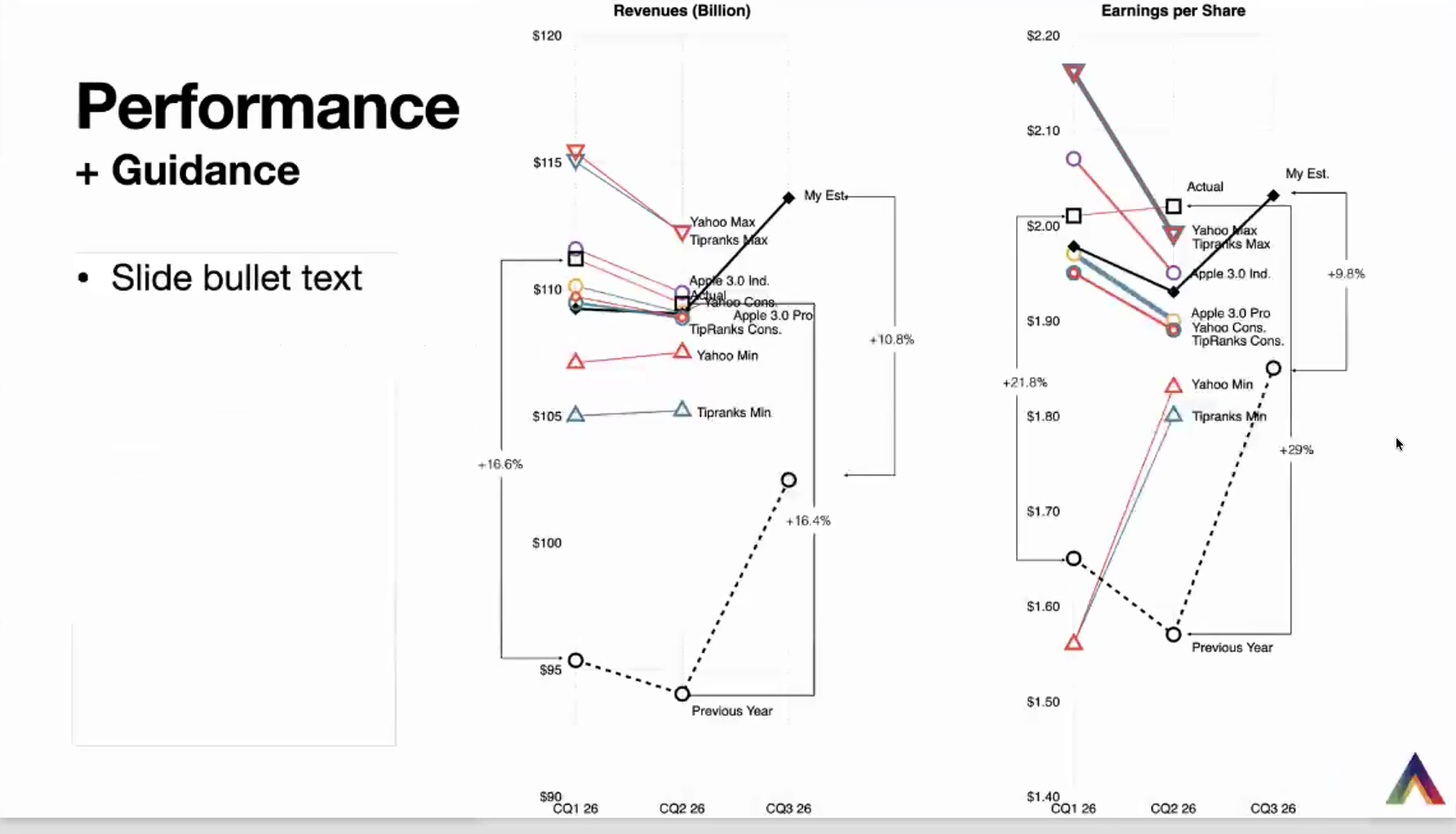
    Recording of Q&A Section

    https://asymco.com/wp-content/uploads/2026/05/Apple-2026FQ2-QA.mp3