Asymco

Asymmetric Intelligence

Samsung

  1. My questions for Tim Cook

    Research · 253 comments

    Next week at AllThingsD's D11 conference in LA, Apple CEO Tim Cook will be interviewed by Kara Swisher and Walt Mossberg.

    Here are some questions I'm hoping they will ask:

    1. Why is the iPhone not sold as a portfolio product? Meaning, why, after six years, is there no iPhone product range being updated on a regular basis. Having a portfolio strategy is not only followed by every phone vendor but also by Apple for all its other product lines, including the iPad, which came after the iPhone. In other words, please explain why the iPhone is anomalous from a product portfolio point of view.
    2. There are more than 800 operators world-wide so why are there only about 250 of them carrying your phone? Competitors large and small (from BlackBerry to Nokia to Samsung) have cited relationships with more than 500 operators so Apple is being uniquely selective. My question does not stem from a lack of patience: this total number of iPhone distributors has not increased markedly for over a year. Are you limiting distribution through conditions placed on operators (like the availability of sufficient quality data services) or are operators finding the distribution agreement too onerous (e.g. too high a minimum order quota)?
    3. In 2012 Apple's capital spending has reached the extraordinary level of $10 billion/yr, higher than all but the most capital-intensive semiconductor manufacturers. This is unusual for Apple as it was less than $1 billion in the year before the iPhone launched. It's also unusual for Apple's competitors in phones, PCs or tablets. It's on a level matched only by semiconductor heavyweights. What is the purpose of this spending and what should we read into it leveling off at $10 billion for 2013?
    4. Depending on one supplier is an operational faux pas, and yet Apple has found itself in that situation with Samsung for mobile microprocessors. It may be excusable in PCs with Intel having an architectural monopoly but it's not excusable for a chip that you designed yourself and purchase in massive quantities. Why did you give Samsung such a concession, especially knowing their potential as a competitor vis-à-vis alternative suppliers who had no such potential? Does the answer have something to do with the previous question?
  2. Interview with Chosun Daily of Korea about Apple

    Research · 65 comments

    The following interview took place by email on April 15th, 2013.

    1. What are the truth and false about the 'Apple shock' currently? In what perspective should we see this?

    First, I'd point out that during Steve Jobs' time the company suffered many such shocks. The stock fell many times far further than it just did for trivial and irrational reasons. Recently Warren Buffett himself pointed out that his own company had 50% drops in value four times in the past. Share prices are not always good indicators of potential and markets are not always efficient. I catalogued the dramatic share price declines in Apple during the last decade here.

    Second, I'd point out that the number of people watching and commenting on Apple has grown almost as fast as its sales and earnings. When Apple was small the people who studied Apple were few. (You could see this today for other, modest tech companies. There aren't 50 analysts writing reports every day and 2000 bloggers tweeting about Lenovo even though it's a successful and growing PC company.) Because of this growth, I would guess 80% of the observers have not observed Apple's prior painful episodes first hand. For them this is the first time a "dominant" Apple has slowed. The amplification of so many voices raising alarm makes it seem truer, but it isn't.

    Third, the failures being cited are not significant. In terms of increased competition, before Samsung there was Nokia and Motorola and the mobile Operators and Microsoft and Dell and many others long forgotten. They were all about to "defeat" Apple. As a quick example when Apple was "the iPod company," iTunes was considered vulnerable and fragile due to DRM concerns or the Beatles not being on it. Microsoft was launching "Plays for Sure" and Zune and Creative was suing Apple over patents. These battles are long forgotten. Before those there were concerns about the viability of the Mac that go back decades. At the time those were actually very valid concerns. At the time Apple did not have half a billion users. It depended on one product. But what saved them was a process of development of new products not the products themselves. iPod faded, Mac faded. What mattered is that they created new things to replace them.

    Finally, what is not commonly understood is that the mechanism for creating things at Apple is unchanged. Its functional organization is inherently unstable and chaotic, sometimes looking like it will derail. But that's the way it was designed to be. You just have to have faith that it's a system that works. Those who did in the past were well rewarded.

    2. What possibilities out of 1~10, do you think, Apple will suffer the same downfall as Steve jobs has left the company in the past in current?

    The threat is negligible. During the first departure of Jobs, the intention of management was to make the company into "a proper company." The plan was, essentially, to remove the chaotic model that Jobs had put in place and replace it with something more "rational" and "grown up." After he returned he set about not just returning the company to the way it was but to also codifying and identifying exactly what that was so that it did not happen again. You have to appreciate that the greatest thing Jobs ever created was not a product but Apple itself.

    Note that Apple managers stay in their roles the whole time they are there, sometimes for decades. There is no "general purpose" manager and the whole company has been organized along these functional lines. The way to think about it is that during his first departure the new management tried to undo what Jobs had built which is why it became dysfunctional: the DNA did not match the body it was operating. His return re-aligned the culture and operations to what was originally developed. As long as new management does not try to undo that, they'll be all right.

    3. Apple is now defined by some people, as 'the company who modifies well', not 'the company who innovates' well. What they made was ipad, ipod, iphone, apple tv and all the modifiers of the original products. Do you agree? If you do why?

    Innovation is not invention. Innovation is the application of invention in ways that solve new needs. I'm always amazed at how misunderstood this term is even though the definition is easy to understand:

    ("Innovation differs from invention in that innovation refers to the use of a better and, as a result, novel idea or method, whereas invention refers more directly to the creation of the idea or method itself.")

    Apple is an innovation machine. It does invent but that's not valuable in itself. Not all inventions are applied and not all innovations depend on internal inventions. Innovation is applied invention just like engineering is applied science. A better way to think about Apple is to think about Pixar. It's a blockbuster manufacturer. It makes blockbusters and nothing else. That means it does not make many of them and not always regularly and that the ideas may not be original, but the results are always very popular. Pixar is not like any other studio that makes some hits and some flops. Pixar is also a functional organization. It's not an accident that they were both built by the same person and that they are both successful after he left.

    4. Google is forecasted to release lots of products this year, but Apple isn't really looking forward to so many innovations. Inside Apple, is the innovation team really making a new innovative product? what are their longterm plans to fight with Google, or Samsung and the rest of the competitors?

    People outside of engineering organizations, especially large ones, don't appreciate the time scales involved. Products you see today were designed, planned and developed many years ago. We see plenty of evidence of this but we tend to ignore it. Consider that some prototypes end up on ebay showing they were built years before launch. It is the same with evidence presented in trials proving work on the product 4 to 5 years before it was launched. This is not the case just for Apple but all other technology companies.

    For this reason, what is happening in the market and what is happening inside the company are two completely different universes. The tendency is to assume a direct relationship between market momentum and current management decisions. These are connected but with many years in-between.

    For example, globally accurate Maps require a minimum of five years of development. Decisions on what ended up being Apple Maps had to have been made by Jobs himself. Namely, he must have decided whether to buy or build Maps. Contrast with Nokia's decision in 2007 to buy maps for a cost of $8 billion; instead Apple licensed and then decided to build later. In 2007 Jobs decided that it was more important to work on the product itself, meaning the iPhone (while Nokia didn't prioritize product innovation.) The results are visible today: Apple is behind and needs to accelerate with Maps and Nokia with its great maps must find a way of staying in business.

    Apple is not only working on the next product but probably 15 new products, of which 14 will be discarded. Again, I cite Pixar. Each movie is produced with multiple stories, multiple character decisions and different plots in parallel. Much ends up being thrown away. We don't see any of that.

    Apple is extremely "myopic" in that it is very concerned with execution and there is no visible "strategy plan".  That's by design. The product comes first and then comes the market and then comes strategy. To create great products you need to tune out almost everything else. However, they do have a "strategy" and that has to do with which problems they should attack and which they shouldn't. Usually they are successful because what they can attack nobody else can. That is due to their integrated, functional approach.

    5. Isn't Apple, relying too much on semiconductor manufacturers? Meaning, isn't Apple only try to be 'stable company' to supply their products on time? sometimes when companies have disruptive technologies, they have hard time supplying products.

    You're touching on the question of the problems of integration. Yes, there are vulnerabilities but that's the way it has to be. To mitigate this Apple is increasing its integration of the value chains. For example developing its own chip design and owning a lot of capital equipment.

    6. If you were Tim Cook, what would you do?

    I'd buy Intel and turn them into Apple's microprocessor design and manufacturing group. They won't have much to do in a few years and they'll be cheap.

    7. what are the reasons that Apple try to make a 'apple watch', 'apple bicycle'? How do you define these products, since, watchs and bicycles are a total different paradigm which is a totally different industries? Is Apple realizing that smartphone industry is hard for them to innovate?

    Computers are becoming more personal, intimate. It's a natural evolution from large to mini to micro to portable to handheld. I don't see this slowing and Apple should re-define the user experience during every such shift. Here again integration is essential.

    8. what are some of the stuff that we don't know about Tim Cook?

    I can't help you there. Only thing I can say is that people who know him have told me he's not soft and gentle as a manager. He's tough.

    9. How will Samsung and Apples patent fight come to conclusion?

    Again, I can't add much to this. Litigation is often a decision made outside of market conditions so it can be arbitrary.

    10. how does employees or executives inside apple think about their company?

    It's hard to describe this without sounding soft, but the employees at Apple tend to love the brand. You can't measure that but I can think of one proxy: the number of applicants to retail jobs are in the hundreds for each opening.

    [Update: Bono made an important observation regarding Jony Ive which was published after this interview: What the competitors don’t seem to understand is you cannot get people this smart to work this hard just for money. Jony is Obi-Wan. His team are Jedi whose nobility depends on the pursuit of greatness over profit, believing the latter will always follow the former, stubbornly passing up near-term good opportunities to pursue great ones in the distance]

  3. Samsung vs. Google: an Interview with Rafael Barbosa Barifouse of Redacao Epoca

    Research · 60 comments

    On Mar 18, 2013, Rafael Barbosa Barifouse - Redacao Epoca - Editora Globo asked (and I answered):

    Q: Why is Samsung creating Tizen?

    A: I believe they are collaborating on Tizen development because they want an alternative to Android and because Bada was not good enough to meet that goal. Tizen's roots include contributions from Intel, Nokia and several Japanese companies so it's not Samsung's OS per se. Historically it was the "open" alternative operating system for embedded and mobile systems. See https://github.com/kumadasu/tizen-history/blob/master/tizen-history.pdf for a historic perspective.

    In some ways Tizen seems to be a blend of several pieces of code including proprietary Samsung user interfaces. Samsung is presumably interested in having a unique, differentiated experience. This is something every device maker seeks. Put another way, if they did not seek this then it's unlikely that they would be profitable which would also imply that they would not invest in marketing and development of products. As Samsung invests both in marketing and development it can be concluded that they seek to offer a unique value proposition and, in today's market, that means a unique experience.

    Does it make sense to create a new mobile OS when it has had so much success with Android?

    Samsung would argue that the success it's had is not due to Android but to its products. Arguably they are right because if Android were the valuable component in a phone then buyers would buy the absolute cheapest device that runs Android regardless of brand. That is not the case. People still seek out a particular brand of phone because of the promise it offers. Consumers have been buying more Galaxies than no-name Android phones.

    Why is Samsung the most successful company between the Android devices makers?

    In my opinion it's due to three reasons:

    1. Distribution. Success in the phone business depends in having a relationship with a large number of operators. Samsung had these relationships prior to becoming a smartphone vendor [because it sold all other kinds of phones]. Few alternative Android vendors have the level of distribution Samsung has. For comparison Apple has less than half the distribution level of Samsung and most other vendors have less than Apple.
    2. Marketing and promotion. Samsung Electronics spent nearly $12 billion in 2012 on marketing expenses of which $4 billion (est.) was on advertising. Few Android vendors (or any other company) has the resources to match this level of marketing. For comparison, Apple's 2012 advertising spending was one quarter of Samsung's.
    3. Supply chain. Samsung can supply the market in large quantities. This is partly due to having their own semiconductor production facilities. Those facilities were in a large part built using Apple contract revenues over the years they supplied iPhone, iPad and iPod components. No Android competitors (except for LG perhaps) had either the capacity to produce components or the signal well in advance to enter the market in volume as Samsung did by being an iPhone supplier.

    Tizen was being treated as an OS for low and mid level devices, but recently Samsung said that it will launch a high-end device with Tizen on Q3, an area where it's very successful with Android. What has changed? What does this announcement mean?

    Planning for these product launches is done a few years prior to launch. I believe alternatives to the Android line (i.e. Galaxy) have been planned for a long time. Note that Samsung also has a line of Windows Phones and historically has supported Bada, Windows Mobile, Symbian, PalmOS and LiMo smartphone platforms. Samsung's involvement with Android is only about three years old, and arguably only enjoyed two years of prominent growth. That's less than one product launch cycle and far less than a platform or OS development cycle.

    I believe the company has a long term perspective and that includes a time span beyond the likely lifetime of Android [Note that platforms do have finite lives]. Keep in mind that phones last less than two years. If users are not loyal to a platform then they will very quickly move on. The "stickyness" of a platform depends on media or software consumption by the user. That level of consumption is not particularly high for most Android users. The same phenomenon happened with Symbian and BlackBerry and Windows Mobile users. Hundreds of millions switched or will switch out of those platforms. This happens far less with iOS, Mac OS X and Windows because of the significant investments users make in the ecosystems above the OS.

    Is Google dependent on Samsung's sucess with Android? Or Samsung is more dependent on Android since its the most popular mobile OS nowadays?

    Google is not dependent on Samsung because it's not dependent on Android. Samsung is not dependent on Google because Samsung is not dependent on Android. Android is valuable in theory but in practice its value is hard to identify. Historically it was planned as a defense against the hegemony of Windows, BlackBerry and iOS. In that respect it has succeeded. But playing defense is not enough to win a game. For Google to truly succeed in mobile it needs to define a better business model.

    So far its profitability from mobile is very weak and has not shown up in the bottom line. Furthermore, it's probable that Google has 'control' over only about 40% of Android devices in use. Control here means a guarantee that users will use those devices for the benefit of Google, and, more importantly, not for the benefit of its competitors.

    You can also think of it this way: If they "divorced" there would be minimal to no impact to their fortunes in the foreseeable future. Buyers of Samsung phones will still buy Samsung phones because they will look and feel very similar and Google services will still be available through browsers or apps (e.g. Google maps on iOS). Conversely, users of Google services will continue to use them because they will be available on Samsung devices, no matter what OS is running. The services Google offers are independent of Android and are cross-platform. They will make sure they are available on all major platforms (as they were before and during Android). Google is far more loyal to Search and Maps and Gmail and YouTube than they are to Android.

    Do you think Google is going to merge Android with Chrome OS?

    Google's chairman said they would so I assume they will.

    If so, how this could make an impact on Samsung?

    It depends on how the new OS would enforce licensing terms. If the result would be a restriction on Samsung services like S Pen, AdHub, Samsung Wallet, SmartTV, ChatON etc. then Samsung might reject the OS and either fork Android or move to Tizen more broadly.

  4. The cost of building Galaxies (and iPhones)

    Research · 33 comments

    Although Samsung and Apple are acclaimed as the leaders in profit capture for smart (and otherwise) phones, what is not lauded is how much they spend on capital equipment used in the making of these phones.

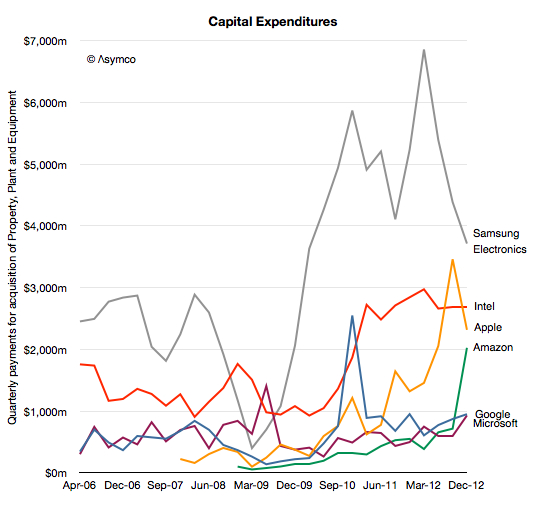
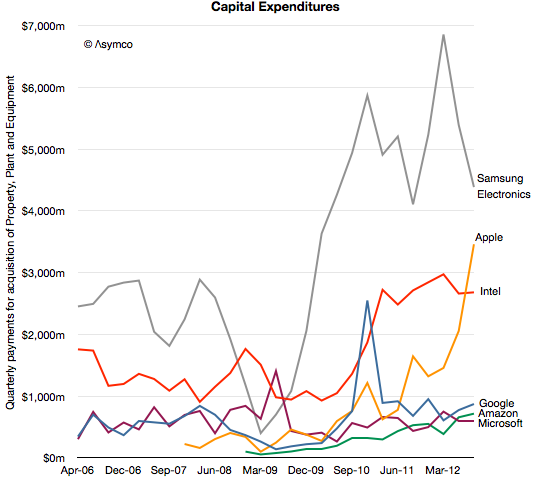
    In 2012 Samsung spent around $20 billion while Apple spent about $10 billion (excluding leasehold improvements or Apple stores but including real estate).

    Compare these figures with Intel at $11 billion, Google at $3.2 billion, Microsoft about $2.8 billion and Amazon $3.8 billion (including presumably new distribution centers.)

    Screen Shot 2013-04-04 at 4-4-5.51.15 PM

    What each company spends on differs depending on its business model, but as the graph above shows it's easy to see that there is a class of "big spenders" who spend so much that it makes it hard to imagine just what $10 billion/yr could actually buy.

    To get an idea of just how big that figure is consider that a Nimitz class aircraft carrier costs about $4.5 billion to build and it takes several years to do it. Or consider that the largest data center in the world probably costs about $1 billion or that the largest office building will cost between $4 and $5 billion. Either of these infrastructure projects are massive multi-year projects. Apple, Intel and Samsung spend well more than this every six months.

    So it's a special class of equipment which falls in the multi-billion dollar range: semiconductor process equipment.

    Whereas in the case of Intel it's the obvious target for the funds, how can we assume it's the case for Apple and Samsung.

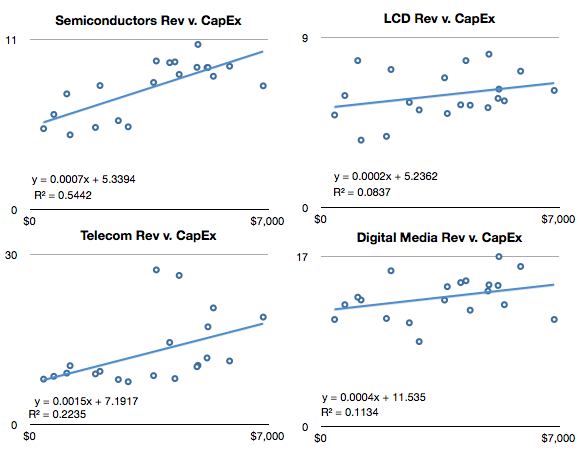
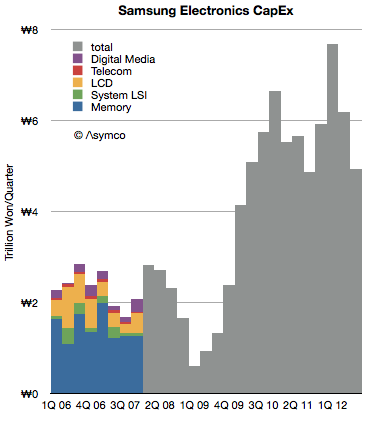
    We don't have proof but there is a remarkable correlation between CapEx and Semiconductors in Samsung's divisional financial reports:

    Screen Shot 2013-04-04 at 4-4-5.58.22 PM

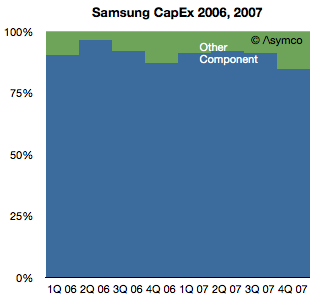
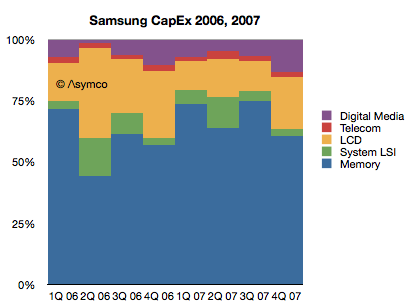
    We also have the historically reported allocation of CapEx as reported prior to 2008:

    Screen Shot 2013-04-04 at 4-4-6.00.26 PM


    Therefore I consider it safe to assume that the bulk of Samsung's Capital Expenditures are in support of semiconductor production (note that this does not include display panels).

    Note however that in the first graph, Samsung's expenditures seem to be declining. Measured in Won, the level in Q4 '12 was about the same as that in Q1 2010 and down 30% y/y. Apple's spending also dropped sequentially in Q4 but was up 75% y/y. It's also nearly ten times higher than what Apple spent in Q1 2010.

    So the question I would ask is whether Samsung's reduction CapEx (which is safely assumed to be supporting semiconductor production, and which, in turn, is, to a large degree, supporting Apple) is being picked up by Apple.

    If so then then this would be evidence of the re-alignment of role and control in the value chain of a terribly important industry.

  5. The cost of selling Galaxies, updated

    Research · 63 comments

    Thanks to @jtk0621 via twitter I was able to obtain a quarterly view into Samsung's SG&A expenditures by cost category.

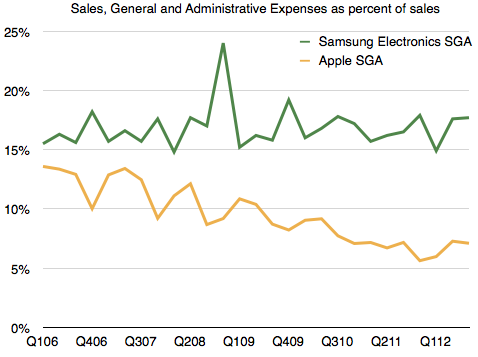
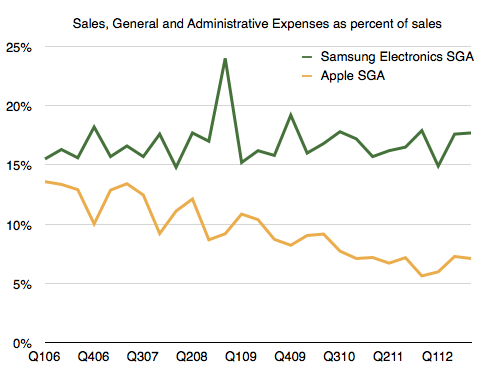
    The value of this data is in being able to understand why Samsung SG&A as a percent of sales remains fairly constant. To recap, the discrepancy with Samsung's SG&A is that it has grown in proportion to rapidly rising sales. Normally, when sales grow, SG&A grows but when sales grow very rapidly, SG&A grows a bit more slowly since it's primarily a function of headcount and hiring is necessarily organic and hence slower as a process.

    The contrast is shown in the following comparison between Apple's SG&A and Samsung's SG&A as a percent of sales. [For more detail on Samsung revenue composition see: The Cost of Selling Galaxies].

    Screen Shot 2013-04-02 at 4-2-3.09.39 PM

    Apple's SG&A has declined as a percent of sales, as one would expect, but Samsung's hasn't.

    I have hypothesized that the reason for this might be in the practice of "outsourcing" many marketing functions. As Samsung expands promotional efforts, it does so partially by hiring people but even more so by farming out a lot more work. In this way, if and when sales subside, it can pare costs. This practice ensures that it's not exposed to a huge cost structure that is hard to control. The downside to this approach might be obtaining "quality" marketing as oversight is still depending on inside teams who still have limited resources.

    To test this hypothesis, I looked at the types of costs it reports and divided them into two categories:

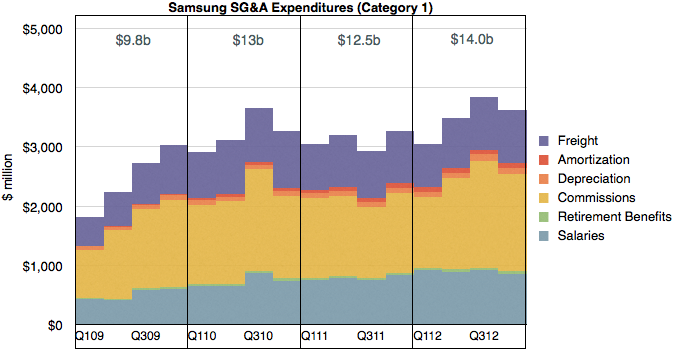
    Category 1 are what might be considered "internal" costs which are in function of employees or operations. These costs are:

    • Salaries
    • Retirement Benefits
    • Commissions
    • Depreciation
    • Amortization
    • Freight

    I graphed these costs over time below:

    Screen Shot 2013-04-02 at 4-2-3.12.09 PM

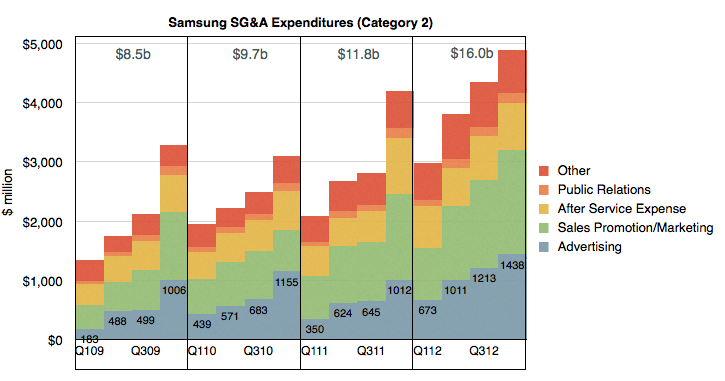
    Category 2 costs are those which can be "outsourced" and are in function of budget items. These are:

    • Advertising
    • Sales Promotion/Marketing
    • After Service Expense
    • Public Relations
    • Other

    I graphed Category 2 costs below:

    Screen Shot 2013-04-02 at 4-2-3.12.58 PM

    In both cases I created year-sized buckets summarizing these expenditure categories.

    It becomes apparent at first glance that through the period shown (2009 through 2012) Category 2 costs grew much more rapidly than Category 1. In 2009 Category 2 were less than 1 but the order was reversed in 2012. On a yearly basis Category 2 nearly doubled while Category 1 grew by about 40%.

    When seen in this context, the hypothesis is proven. The growth in Samsung SG&A has been driven by a vast expansion of primarily Advertising and Sales Promotions.

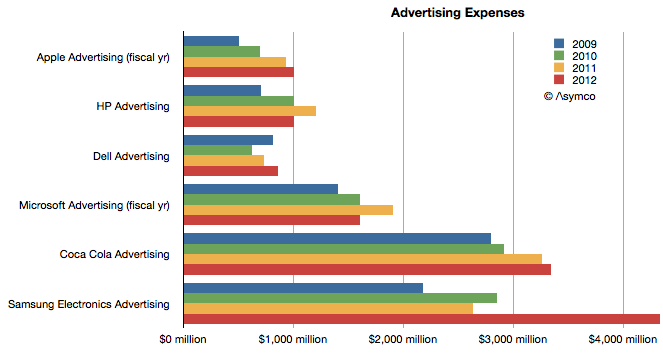
    It's hard to get an appreciation of the scale involved due to the lack of comparable SG&A category reporting from other companies.  What we do have however is that US companies typically report their advertising spending on a yearly basis.

    So taking only the Advertising figure from Samsung Electronics, we can get the following comparison with Apple, HP, Dell, Microsoft and Coca Cola.

    Screen Shot 2013-04-02 at 4-2-3.20.48 PM

    In this context we can see that while both Apple and Samsung grew their  advertising almost at the same rate, doubling their budgets during the last four years, Samsung Electronics has a far higher ad budget. More than four times higher, actually.

    Regarding Sales Promotions however, the comparison is far harder to make. I haven't any way to guess how much Apple spends relative to the $5.3 billion Samsung spent.


  6. Interview with Anouch Seydtaghia of Le Temps regarding the Galaxy S4

    Research · 78 comments

    This interview took place on the eve of the launch of the Galaxy S4. Anouch Seydtaghia is Deputy Head of the Economic & Finance Section chez Le Temps Geneva, Switzerland.

    ---

    Q: How can you explain that Samsung organizes such a huge event in NY for the S4?

    A: The S4 is a very important product as it's probably the second most profitable mobile phone in the world. Samsung is trying to position it as a premium product and is using every means available to do so.

    What are your thoughts about the huge marketing budget of Samsung?

    Samsung's marketing budget has been a constant percent of their sales (approximately). As sales have risen, the budget has risen. This is not considered a normal situation if sales grow very rapidly but Samsung seems to consider x% of sales to be appropriate spending level. Note that Apple's marketing has fallen as a percent of sales while its sales have grown dramatically.

    If we read the media, we see a lot of speculation about the features of the future S4. Can we now compare that to the expectations before a new iPhone?

    There are speculations about all phones, from Nokia to HTC and BlackBerry. I don't see the speculation to be different between all the major companies.

    Can Apple regain the lead in the smartphone market? If yes, how?

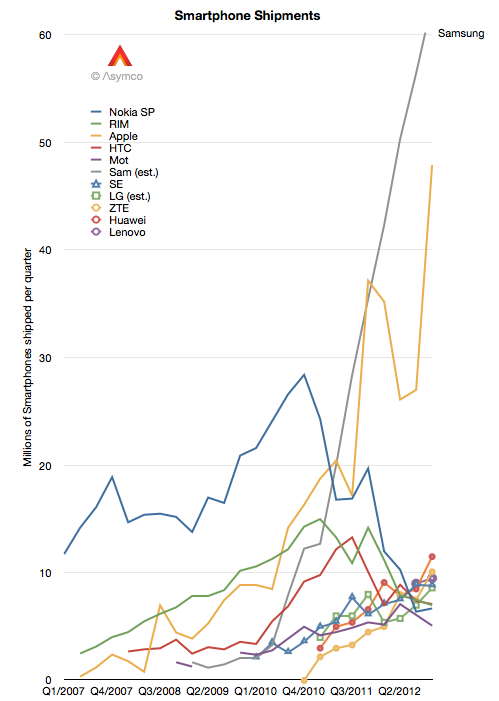
    Apple had leadership in the phone market for two quarters (see graphic below.)

    Screen Shot 2013-03-14 at 3-14-6.09.03 PM

    It's a myth to think that Apple was dominant for any extended period of time. The top spot is very difficult to obtain unless a company has a large portfolio of products which are sold in all markets. Apple has less than half the operator distribution of Samsung and keeps only one new product in the market each year.

    Apple also has a very high price due to the distribution model it uses for the iPhone. The primary buyers are operators who made large volume purchase commitments a few years ago. The iPhone strategy can be summarized as "skimming" where they pick the most profitable customers rather than "penetration" where there is a focus on market share. It's therefore very surprising that Apple was able to ship as many phones as it did.

    Is there a difference between what Samsung and Apple invest in R&D?

    Of course, but we don't have details. Samsung Electronics has to develop semiconductor processes and build large fabrication plants. Apple has a vast software engineering operation. Apple has iTunes and web services while Samsung has appliances and TVs. The two R&D efforts are vastly different.

    What could be the new features in the next smartphone?

    The most important innovation in smartphones will be a product that is not a smartphone. The category will be eliminated through a disruptive approach just like all other technologies that have come before it. My expectation is that when it comes it won't be recognized as important or relevant.

    As a follow-up:

    - Thank you very much! So do you mean that for Apple, marketing is just 1% of sales?

    It's difficult to compare the two exactly.

    We don't have specific data on Apple's marketing. We have either Advertising or SG&A (which includes marketing.) Samsung reports “Marketing Expenses” every quarter but these figures appear to be the sum of Ad spending, Sales Promotions, Public Relations and a portion of “other” expenses as a part of SG&A.

    You can see a comparison here:

    What seems to be happening is that Samsung increases its spending in proportion to sales while Apple grows marketing a bit more slowly.

    Basically, Samsung is treating SG&A as a "variable" expense which is tied to sales whereas Apple is managing it as organic growth.

    The difference might be that Marketing at Apple is mostly an internal effort and thus depending on headcount while Samsung might be spending mostly externally. If costs are internal then it would be hard to pare them down if sales slow whereas if they are external then they can easily be made variable.

    I've received comments suggesting that Samsung's approach is unorthodox and that the quality of marketing cannot be maintained if it grows as quickly as Samsung has grown it. This is a matter of speculation however.

  7. Bits v. Bytes: Follow the money

    Research · 68 comments

    Google announced its first computing product: the Pixel. It's not the first Chromebook but it is the first device which is uniquely branded as a Google product (Motorola notwithstanding.)

    It's a curious choice given that companies which have "crossed-over" from being service or software oriented to hardware have started with more "mobile" devices. Amazon launched the Kindle as a low-end product and gradually moved it up-market. Microsoft launched with the Surface tablet and then followed with the Pro version as a hybrid laptop/tablet.

    It's also curious since Google has spent years contributing to the development of mobile phones and tablets under the Nexus sub-brand. This was an approach consistent with earlier Chromebooks as well.

    But the Pixel is a high-end product. It's priced at the top of the range of what a laptop computer might cost (given the dimensions).  Perhaps it's part of a pattern where Google will hone its hardware skills toward releasing a phone or tablet it can call its own. Starting with a more traditional computer is "easier" than trying to deliver on the more demanding smaller form factors.

    And yet, the more obvious question is why would Google want to be in the hardware business? Isn't being a web-focused company implicitly suggesting that hardware is a commodity to be farmed off to perpetually impoverished and violently abused OEMs?

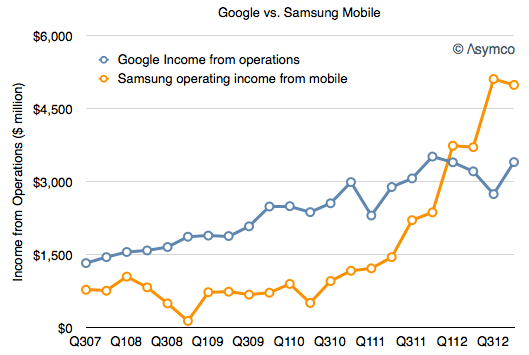
    The truth is quite different from this. Samsung currently makes far more operating profit from Android phones than Google does from all its operations. 

    Screen Shot 2013-02-22 at 2-22-3.47.58 PM

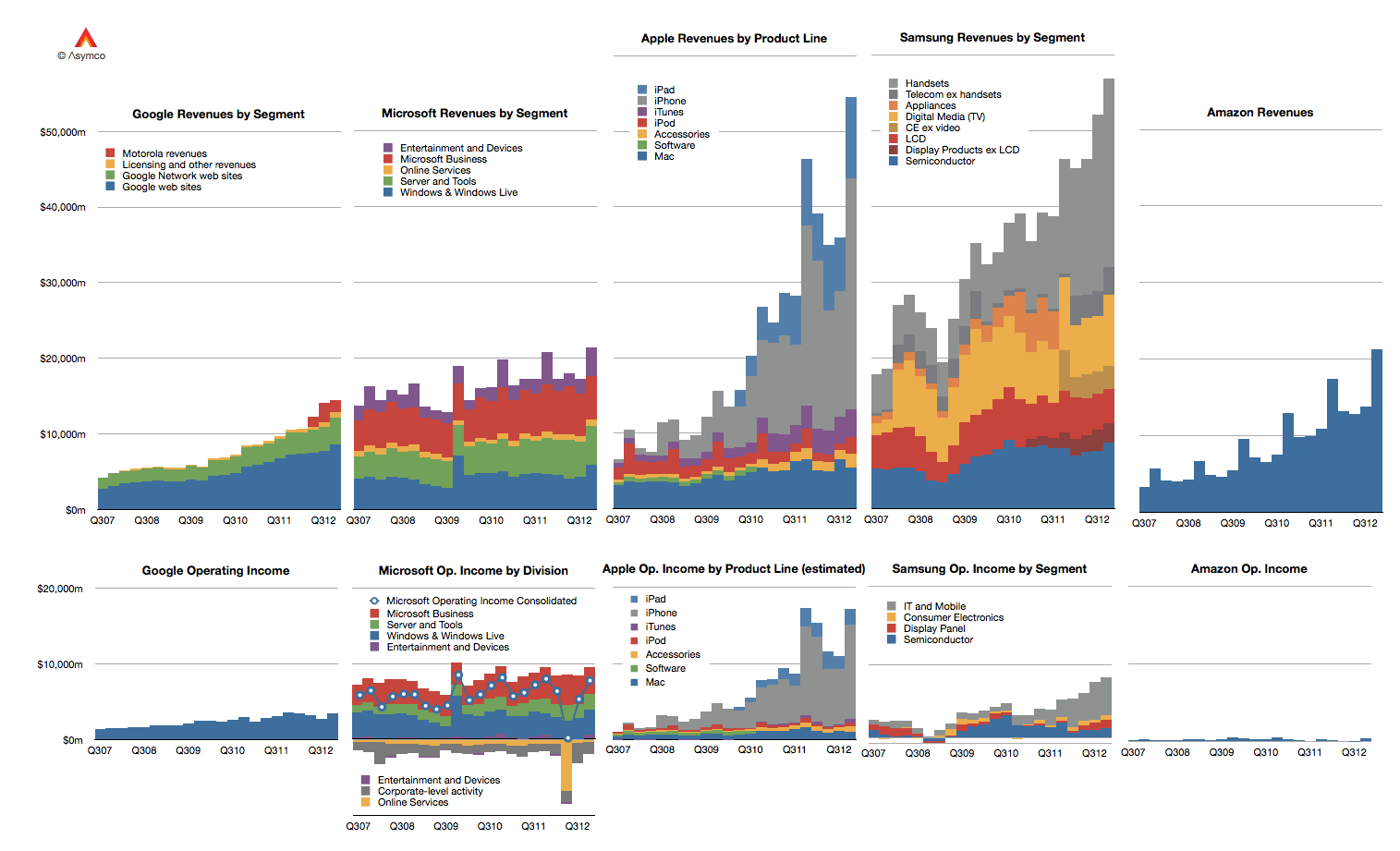
    When looking at the patterns of sales and profit capture for hardware vendors since 2007 the contrast is stark:

    Screen Shot 2013-02-22 at 2-22-3.32.46 PM

    Apple and Samsung tower over the fortunes for software only Microsoft or service-oriented Google and Amazon. Although all companies are growing, the value, as defined by the buyer, resides in the whole product. Putting aside all the theory, the numbers are staggering. Google, Microsoft and Amazon are skimming profits but they are not particularly efficient at profit generation vis-a-vis the integrated Apple (and increasingly integrated Samsung.)

    The question is which of the companies illustrated above will prosper from the value chain evolution under way?

  8. In search of Apple's microprocessor

    Research · 62 comments

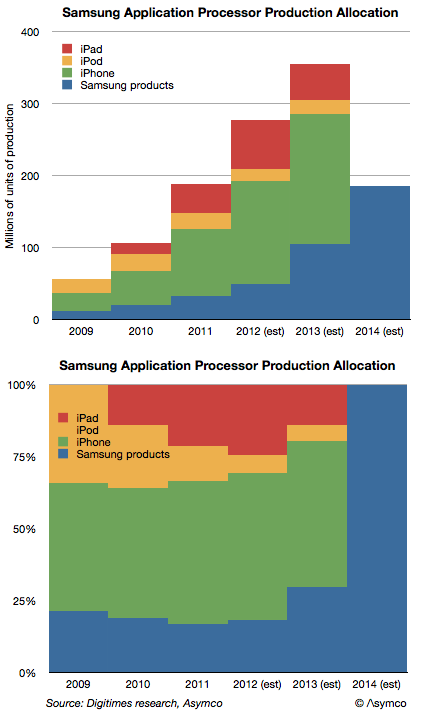
    Digitimes Research published an estimate of the allocation of production of application processors by Samsung. It suggests that Apple will transition away from Samsung as a processor supplier during 2013 and stop sourcing altogether by 2014.

    Most current capacity (nearly 70%) is said to be allocated to Apple's products. The iPhone, iPad and iPod touch consumed an estimated 226 million processors in 2012. That demand is expected to increase but it will increasingly to be met by other suppliers in 2013. However, Samsung's own products will take up some of the slack.

    The following graph shows the estimated production schedule by customer.

    Screen Shot 2012-12-28 at 12-28-9.57.37 AM

    There are several questions that this data raises:

    • Does Samsung's microprocessor production exceed that of Intel?
    • Who will produce Apple's processors after 2013. Will it be one or more suppliers is also an open question.
    • Is Apple's CapEx (est. $10 billion/yr.) being spent on some of this future capacity? A modern fab costs about that much.
    • As the iOS processors are Apple's own designs, will Apple be integrating production and design?

    Prior to his departure Intel's Paul Otellini had begun speaking about manufacturing. He argued that the "fabless" model was no longer competitive and that design and manufacturing should be re-integrated.

    I think we're about to find out to what degree that will happen.


  9. The new age of Capital Intensity

    Research · 117 comments

    In the post reviewing Samsung's Capital Structure I noted that its component divisions have historically taken 90% of capital investments and that the overall capital intensity for Samsung Electronics has increased in proportion to its component revenues.

    In another post regarding the capital structures of other technology companies with different business models I noted that Apple has changed its capital structure to a significant degree over the previous three years.

    In the following graph I combined these observations to show how capital expenditure patterns may be used to discern the underlying business model.

    I would group "cloud" or "platform" based companies like Google, Amazon and Microsoft as a cohort which, although spending significant amounts on capital equipment, do so mainly to support services. Their primary employment of capital is to sustain the infrastructure of data centers necessary to deliver the services underpinning their business models.

    I would group Intel and Samsung as "component" based companies which use capital to build production capacity that delivers, hopefully, a control point in the value chains they participate in. Note that I am assuming that Samsung Electronics' CapEx primarily targets semiconductors and displays as it did during the 2006 and 2007 period when data was available.

    Therefore, given the patterns over the last six years, it might be possible to classify a company's core business by just looking at its CapEx: The services group showing growth but relatively stable patterns and the components group showing more volatility, macroeconomic sensitivity and an overall higher level of spending, especially as a percent of sales.

    The question that pops up then is in what category does Apple fall?

    My observations for over a year have been that Apple is increasing its capital spending to such a degree that it is neither fish nor fowl. It operates data centers but presumably does not operate fabrication plants. And yet it spends more than Intel and Google combined.

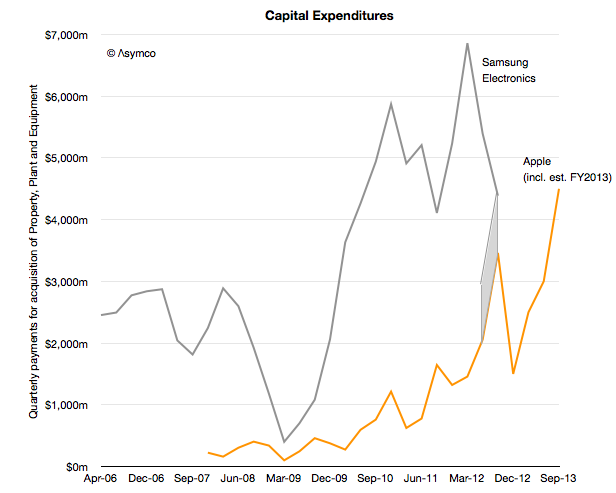
    Contrasting Apple and Samsung Electronics tells an even more interesting story. In the following graph I've added two additional items of information: First, although CapEx spending is recorded in the cash flow statement, Apple reported in its yearly (10K) report that it spent an additional $2 billion for equipment which did not pass through cash flow.

    If we were to add $1 billion to each of the previous two quarters, the graph would look like this:

    The second piece of information is that Apple projected its spending for the following fiscal year. I've added that spending in a pattern matching the last fiscal year.

    Apple is still spending less than Samsung. In its fiscal year 2012 Apple spent about $10 billion while during the same time frame Samsung spent nearly $22 billion. However, Apple has begun to bump against Samsung's spending level on a quarterly basis.

    I consider this extraordinary evidence of an extraordinary shift in strategy.

    For a year we've been debating here to what degree Apple has a "capital intensive" business and what exactly could it be spending capital on. One early hypothesis has been that it's on data centers or on real estate for spaceship campuses. These can be easily dismissed on the knowledge that they can't cost that much (and that the spending happens gradually). Another hypothesis is that the tooling for milled aluminum cases and other mechanical components is expensive and Apple has to buy a lot of it. But, again, the level of expenditure is in the league of Intel and Samsung which make vast quantities of semiconductors in very expensive plants. It's hard to imagine milling machines being cost equivalent to chip foundries.

    The comparison with Samsung, whose vast capital commitments are legendary and are its primary strategic asset puts Apple in a new light. Perhaps we can't yet call Apple a semiconductor company or even a fabricator but they are putting their "money where their mouth isn't". We can infer that it's not going where the company currently operates. The capital is being deployed almost silently and, though vast in scale, barely gets a mention from analysts. Not even a single question has been raised at any earnings call about this spending.

    So what tale does this capital tell?

    One interpretation is to apply the value chain disruption theory and ask whether Apple is acting to counter a potential disruption. In other words, that this is a specific threat response from an incumbent. There is some logic to this because  the antagonism between Samsung and Apple is so strong that it might justify a reaction of this kind.

    However, I believe that there is a more measured process at work over a long period of time. The one distinguishing advantage and attribute that Apple has  is its preference for integration. This preference is not a secret and Tim Cook repeats it often. The integration is evident with their move into retail and component design, in other words in both directions along a value chain. So my hypothesis is that this is part and parcel of an ongoing re-alignment of their role in the value chain.

    This second explanation suggests that Apple simply wants to control all the areas which affect the value they produce. First because they feel that there are areas that are not good enough and the product/experience cannot be good enough if its constituent parts are not good enough. Second because without control there are constraints to what it can do strategically.

    Whatever the reason, I read the evidence of increasing commitment and engagement in parts of the value chain as part of a continuous evolution of Apple's role. Furthermore, it's something that should be seen as a signal of a new era in how technology companies operate. We see hints of "vertical integration" with Microsoft building hardware, and Google buying Motorola and Amazon selling devices. Apple did all these things and now it casts an eye over the next frontier: components.

    ---

    If you want to learn more about the future of the technology industries and the evolution of value chains, consider participating in Asymconf.

  10. Samsung's Capital Structure

    Research · 28 comments

    Having described the Revenue, Operating Margin and cost structure for Samsung Electronics it's time to review their investment strategy.

    The Economist summarized it well:

    [Samsung's] businesses look remarkably disparate, but they share a need for big capital investments and the capacity to scale manufacture up very quickly, talents the company has exploited methodically in the past.

    Samsung's successes come from spotting areas that are small but growing fast. Ideally the area should also be capital-intensive, making it harder for rivals to keep up. Samsung tiptoes into the technology to get familiar with it, then waits for its moment. It was when liquid-crystal displays grew to 40 inches in 2001 that Samsung took the dive and turned them into televisions. In flash memory, Samsung piled in when new technology made it possible to put a whole gigabyte on a chip.

    When it pounces, the company floods the sector with cash. Moving into very high volume production as fast as possible not only gives it a price advantage over established firms, but also makes it a key customer for equipment makers. Those relationships help it stay on the leading edge from then on.

    The strategy is shrewd. By buying technology rather than building it, Samsung assumes execution risk not innovation risk. It wins as a “fast follower”, slipstreaming in the wake of pioneers at a much larger scale of production. The heavy investment has in the past played to its ability to tap cheap financing from a banking sector that is friendly to big companies, thanks to implicit government guarantees much complained about by rivals elsewhere.

    Can we find evidence of this capital intensity?

    To answer, I reviewed Samsung Electronics CapEx as reported in their quarterly cash flow statements. The following graph illustrates the data:

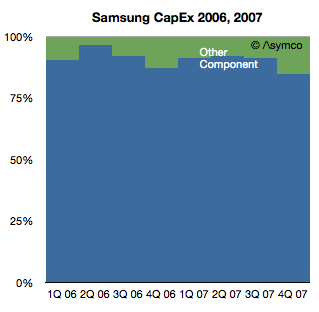
    Note that during 2006 and 2007 the company specified expenditures on an operating divisional level. Since 2008 it has reported only a total. For the years where divisional detail is available, the percent split looks as follows.

    If we combine the Semiconductor division (Memory and System LSI) with the LCD group and classify this as "components" the split looks as follows:

    Therefore, for the two years when information was available, the component divisions consumed 91% of expenditures and Consumer Electronics (Digital Media) together with the Telecom (mobile phones, mainly) were a combined 9%. The least capital intensive division was Telecom, the mobile phone group, with only a 2% allocation of capital.

    The other observation is that, after a contraction in the recession years of 2008 and 2009, CapEx expanded greatly in 2010 and 2011. [1]

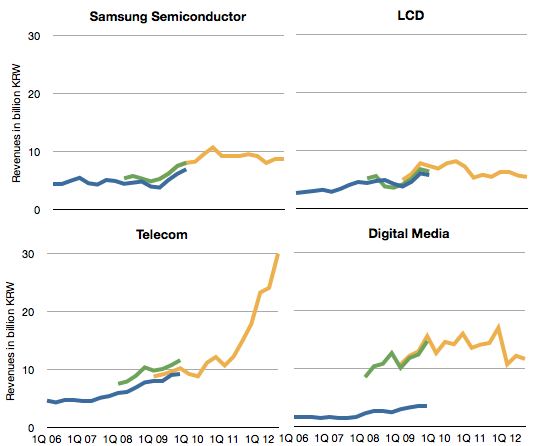
    Coincident with the growth in CapEx, the company's revenues grew dramatically as well. However, as the graphs below show, the growth has come predominantly from the Telecom division.[2]

    I calculated the correlations between each division's revenues and the growth in CapEx (total) for the time periods 2006 to present and 2008 to present and obtained the same results: The division with closest correlation to CapEx remains the Semiconductor group.

    This stands to reason. Capital expenditures are mainly in the service of semiconductor manufacturing. Semiconductors, or components in general, require more capital than assembly of devices or consumer electronics.

    However, the revenues and operating income for devices have grown far faster. Samsung's investment in capacity would have been largely profit-free had they not also been assembling the devices which capture the margins.

    One might conclude that Samsung would be better off abandoning its capital-intensive components business and focusing on the devices. However, as James Allworth points out if you only do the devices, you may find yourself vulnerable to value chain disruption. Whoever is involved "upstream" in the value chain will inevitably learn the device business from a base of "commodity" manufacturing and pose a threat.

    Now the question poses itself: Which of the usual suspects understands this?

    Stay tuned for evidence of an incumbent response.


    If you want to learn more about the future of the technology industries and the evolution of value chains, consider participating in Asymconf.

    ---

    Notes:

    1. Some of this growth is due to a new (K-IFRS) accounting standard in use after 2010, but the expansion was significant regardless.
    2. The revenues data is was reported using three different accounting methods and each is shown with a different line color: Blue is "Parent basis", Green is "Consolidated basis" and Yellow is "K-IFRS".
  11. The real threat that Samsung poses to Apple

    Podcast · 430 comments

    [The following is a post written by James Allworth.

    James is the co-author of How Will You Measure Your Life?. He has worked as a Fellow at the Forum for Growth and Innovation at Harvard Business School, at Apple, and Booz & Company. It follows and builds on a discussion we had on the 56th Critical Path podcast.

    You can connect directly with James on Twitter at @jamesallworth -ed]

    A lot of ink has been spilled in the wake of the recent Apple Samsung patent disputes, and the legal wars see no sign of abating any time soon. The rise of Samsung's phone business has been meteoric, and Apple is right to be concerned. But the real threat that Samsung poses to Apple has very little to do with the copying (or not) of Apple's designs. The lawsuits have simply been a convenient (if expensive and risky) way to attempt to quash a threat that is of Apple's own making. While there's no doubt that Google has played a key role in Samsung's success by handing out a free mobile operating system to pretty much anyone who wants to build one — it is actually Apple, more than any other company, that is responsible for Samsung's present success.

    How? By outsourcing as much work to Samsung as they have. And it's impossible not to wonder whether Tim Cook's announcement yesterday on bringing back Apple's manufacturing to the USA is the beginnings of an attempt to rectify the problem.

    But first, I want to establish why copying is actually less of a threat to Apple than you might think. Daring Fireball's John Gruber wrote last year on what he termed "The New Apple Advantage". Like most people who appreciate Apple and its products, the starting point for Gruber's appreciation of Apple is its design — he says as much in the article. But the realization that Gruber has in the article on Apple's true competitive advantage is what's really interesting:

    So let’s be lazy for a second here, and attribute all of Apple’s success over the past 15 years to two men: Steve Jobs and Tim Cook. We’ll give Jobs the credit for the adjectives beautiful, elegant, innovative, and fun. We’ll give Cook the credit for the adjectives affordable, reliable, available, and profitable. Jobs designs them, Cook makes them and sells them.

    It’s the Jobs side of the equation that Apple’s rivals — phone, tablet, laptop, whatever — are able to copy. Thus the patents and the lawsuits. Design is copyable. But the Cook side of things — Apple’s economy of scale advantage — cannot be copied by any company with a complex product lineup. How could Dell, for example, possibly copy Apple’s operations when they currently classify “Design & Performance” and “Thin & Powerful” as separate laptop categories?

    This realization sort of snuck up on me. I’ve always been interested in Apple’s products because of their superior design; the business side of the company was never of as much interest. But at this point, it seems clear to me that however superior Apple’s design is, it’s their business and operations strength — the Cook side of the equation — that is furthest ahead of their competition, and the more sustainable advantage. It cannot be copied without going through the same sort of decade-long process that Apple went through.
    (emphasis mine)

    The argument is beautifully made. The design part of Apple's equation is to their ability to redefine new industries as they did with the iPhone. Whether they go after the TV market next, or something else, it's this integrated design component that will be crucial to their initial success. But compared to the business side of Apple, design actually generates much less sustained strategic advantage in any one product category, once performance in that category becomes "good enough". The tech industry has always revolved around copying. Once folks work out how it's done, everyone piles on. And at that point, it becomes much less about design than it does about how you operate your business.

    It is the last part of the Gruber quote that really drives things home. "It cannot be copied without going through the same sort of decade-long process that Apple went through". He's right — it's very hard for a competitor to outright replicate what Apple has achieved without going through all the same steps. But it got me thinking of a concept — and a related story — that I learned from someone I was fortunate enough to have as a teacher: Clayton Christensen. Perhaps a competitor didn't have to copy Apple.

    What happens if Apple had already taught them?

    Christensen first wrote about the dangers of outsourcing in The Innovator's Solution, explaining how seeking to maximize efficiency by employing third party vendors to do the "low value-add" work for you can be a lethal strategy. In the Solution, Christensen and Michael Raynor gave the example of two fictional corporations—"Component Corporation" and "Texas Computer Corporation". I had the good fortune to work with Clay on his most recent book, How Will You Measure Your Life?, and we recount a similar story; only without any of the players being disguised. The story is that of Asus and Dell, and how by outsourcing its work—starting with just basic circuit boards—Dell equipped a competitor:

    Asus came to Dell and said, “We’ve done a good job fabricating these motherboards for you. Why don’t you let us assemble the whole computer for you, too? Assembling those products is not what’s made you successful. We can take all the remaining manufacturing assets off your balance sheet, and we can do it all for 20 percent less.”

    The Dell analysts realized that this, too, was a win- win...

    That process continued as Dell outsourced the management of its supply chain, and then the design of its computers themselves. Dell essentially outsourced everything inside its personal-computer business—everything except its brand— to Asus. Dell’s Return on Net Assets became very high, as it had very few assets left in the consumer part of its business.

    Then, in 2005, Asus announced the creation of its own brand of computers. In this Greek-tragedy tale, Asus had taken everything it had learned from Dell and applied it for itself. It started at the simplest of activities in the value chain, then, decision by decision, every time that Dell outsourced the next lowest-value-adding of the remaining activities in its business, Asus added a higher value-adding activity to its business.

    There are two sides to this story: the part that relates to Dell, and the part that relates to Asus. Dell, in its quest to maximize its financial efficiency, continued to outsource way beyond manufacturing components and assembly. They outsourced a long way up the value chain. But there's also the side of the story that relates to Asus — a small components manufacturer that was, in effect, nursed to success by Dell. The extent of the schooling delivered by Dell to Asus was pretty profound, given how far up the value chain Dell outsourced its operations.

    But here's a question: at what point did Dell seal its fate? When was it that Dell had outsourced enough that Asus, with a desire to simply get out of the low-value work, could have made it all the way to the point that it did? I'm beginning to wonder whether just component development and assembly was enough. In the case of Samsung, it seems that everything else they needed to learn, they did by entering the emerging market, which Apple has largely left alone.

    Now, it's obvious that there are some very clear differences between the decisions that Apple have made in terms of outsourcing, and the decisions Dell have made. Dell outsourced its business all the way up to the design of its products. In many respects, Apple is doing the opposite — going so far as to even bring chip design in house. Horace has done some fantastic work detailing the extensive amount of investment Apple has made in its supply chain and it's clear that they've spent a lot of money investing in equipment used in production.

    But there's also no denying that Apple has begun to rely extensively on a network of suppliers across Asia.

    It's when you start putting the two arguments together that you realize that Apple may have a more serious problem on its hands. I want to again recount the final two lines of Gruber's argument:

    It’s their business and operations strength — the Cook side of the equation — that is furthest ahead of their competition, and the more sustainable advantage. It cannot be copied without going through the same sort of decade-long process that Apple went through.

    He's right — generating that scale requires a long gestation period — one that Apple went through. And it can't be copied without significant time and effort on the part of a competitor. But there's one big implicit assumption here — that suppliers won't turn around and start developing their own offering. Because when Apple went through this transformative process, where the design whittled down the broad range of offerings to just a few, and they generated the scale on the business side that accompanied that — they weren't actually the only one to go through that process. Apple's partners — their suppliers — went through it with them. And they've got very big, and very good at what they do. Samsung, obviously, is among those partners.

    Now, the response I often hear to this line of reasoning is: Apple hasn't outsourced anywhere near as much as Dell has. How are the situations analogous? But I think it's actually the wrong question. Instead, the question is: has Apple already outsourced too much?

    For all intents and purposes, we're at a level of maturity in the smartphone market where I believe design — particularly on the hardware side — has largely become commoditised. Performance is now "good enough". Whereas it was not so long ago that consumers sat on the edge of their seats to find out what the new iPhone had to offer ("please, fix the battery life", or "please, make it faster") the recent release of the iPhone 5 seemed not to generate the same intense reaction. Now, I'm not saying it won't sell well — in fact, it will probably become the best selling phone of all time — but people aren't making these decisions based on huge design differences between the devices. The basis of competition has shifted. HTC recently learned this the hard way when it introduced the One X — a phone that, to the critics, at least, was considered the best Android phone available — "a masterpiece",  "one of the best mobile devices I've ever used". Yet it has been absolutely crushed in the marketplace by Samsung.  How? Well, Samsung used its business scale to, as Horace put it on Twitter, "invite operators to a better party with an eye-watering marketing budget". This has nothing to do with Samsung making a better phone (they probably didn't), or Samsung copying Apple (indeed, HTC may have just done a better job of copying Apple). Instead, it has everything to do with the fact that Samsung has had its business sucked along in Apple's slipstream.

    There's another way of seeing just how deep the problem lies. Jobs promised "thermonuclear war" on the copied devices, and so far, the biggest target of Apple's many legal warheads has undoubtedly been Samsung. Getting a $1 billion judgement certainly proves Apple was serious about it. But doesn't it seem strange to you that the target of such a devastating strategy on the legal side, just so happens to be… one of the most important suppliers for Apple's new phone?

    The problem that Apple is facing right now has nothing to do with their designs being copied. There is a long history of copying in the tech industry; patents being deployed in lawsuits by giants often signify desperation more than anything else. Rather, the problem that Apple faces is that it now is going up against at least one competitor that has been a beneficiary of the scale that Apple has achieved on the business side. Samsung has clearly demonstrated that, like Asus, it was not satisfied being a low-margin ODM — of doing all the menial work while somebody else made the big bucks. Suing Samsung over Android patents isn't going to change that — if Google's operating system gets too expensive to use, there'll be a switch made to Microsoft. Or to another operating system altogether. It doesn't really matter, because design in the smartphone space has been commoditized. It's good enough. Manufacturers are now creating performance that most consumers aren't able to absorb. Instead, as we've moved into a world where performance is now "good enough", the world has flipped into one where it's the business side — operational scale — that matters most.

    Apple have taken steps to minimize the ability of competitors to duplicate their business advantage. There's a great post here on Quora describing how Apple has used its supply chain as a competitive advantage and how competitors end up subsidizing Apple's use of the technology. But the approach of "locking in" key new technology so nobody else can get them works best in a world where consumers need more performance from their devices — a world is rapidly slipping away.

    So, what's Apple got to do? In so much as it is able to trust its suppliers of key components not to become competitors, it can continue to use them. But where it can't, or where those suppliers have already become competitors, it has only one sensible choice — replace them. It has two choices here: the first (and obvious one) is with another supplier. But that risks the same thing happening all over again — Apple nursing another supplier into a competitor. The second choice: for components and services that are critical to maintaining competitive advantage in the markets which Apple plays, Apple needs to build the components themselves.

    Most companies wouldn't be in a position do that. But Apple is almost already there. I also hear that there might be a country out there with relatively high unemployment rate, looking for some jobs to be brought back home. Funnily enough, it seems that's just what Tim Cook is doing right now. This approach might just be a good way of on-shoring some of those untaxed offshore profits (I imagine the tax benefits for building a few factories in the US would be quite high), all the while taking away business from competitors — both current and future.

    But there's one question that still remains. In the instance of the threat that Samsung poses to Apple: is it already too late?

    –

    Looking for more information on the renaissance of production and its effect on the technology industries? Then come to Asymconf and take part in the debate.