Asymco

Asymmetric Intelligence

Samsung

  1. Apple's new factories

    Research · 87 comments

    Two years ago, almost to the day, I wrote a post titled It’s time for Apple to look at owning factories again.

    What I argued then was that of the problems that Apple had the means to fix, production was what most needed fixing.

    Since then we've seen evidence of significant investment in manufacturing tooling, where Apple is effectively purchasing the means of production rather than just renting or contracting it out. This capital equipment investment is the equivalent of owning one of the three asset classes that make up a manufacturing operation:

    1. Tooling or capital equipment. The "Capital" at the root of the concept of "Capitalism".
    2. Skills, talent and knowledge. This is the softer kind of asset that turns out to be harder to replace or buy.
    3. Labor pool. Although considered a commodity even unskilled labor is difficult to obtain if flexible employment is needed in a regulated environment.

    It did not stop there. It has also used capital to ensure capacity through pre-orders thereby allowing the skills and labor to be more predictably applied by its suppliers (and preventing competitors from having sufficient supplies). Apple has also taken control of chip design for the vast majority of its CPUs thus building a more bespoke supplier chain.

    However these are not enough steps to make production "good enough" to meet the demands of a billion customers buying a new product every other year.

    An insidious problem emerges when outsourcing:  suppliers tend to become competitors. It happened in the PC industry with Acer vs. Dell. But it's also happening to Apple. Consider how Samsung's foreknowledge of Apple's orders allowed them to anticipate the demand for large screen smartphones. Receiving orders years in advance for memory, screens and CPUs in the hundreds of millions would be a clear indication of demand. Receiving funds with which to build capacity is an enormous help when turning on production for your own versions of the product.

    With that knowledge and the capacity built to serve Apple, Samsung was able to go from near zero market share in smartphones to being the largest vendor in two years a feat that Apple itself could not accomplish.

    The supplier-turned-competitor is one of the risks of outsourcing production and is at the root of disruption from value chain evolution.

    Hence it's gratifying to see that Apple has committed to "in-sourcing" assembly of at least one product. Tim Cook in an interview with Rock Center:

    And next year we are going to bring some production to the U.S. on the Mac. We’ve been working on this for a long time, and we were getting closer to it. It will happen in 2013. We’re really proud of it. We could have quickly maybe done just assembly, but it’s broader because we wanted to do something more substantial. So we’ll literally invest over $100 million. This doesn’t mean that Apple will do it ourselves, but we’ll be working with people, and we’ll be investing our money.

    For the first time since the 90s, Apple is taking steps to control the last pieces of the value chain it participates in.

    It's a baby step and perhaps it's going to remain symbolic, but one can imagine a trajectory for this effort which will pay off as well as retail has paid off ten years after the first Apple store opened.

    –

    Looking for more information on the renaissance of production and its effect on the technology industries? Then come to Asymconf and take part in the debate.
  2. The mystery of Samsung Electronics SG&A

    Research · 40 comments

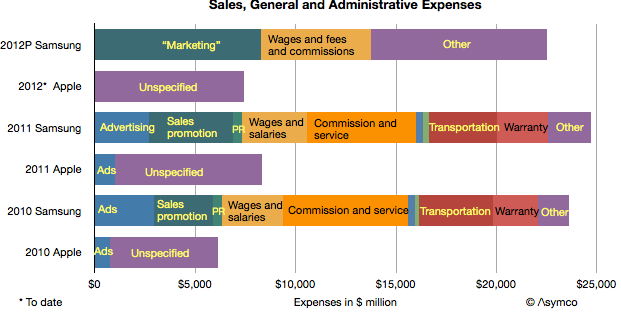
    Samsung Electronics' SG&A expenses are curiously high. Consider the following graph:

    It shows SG&A as reported by Samsung and Apple over the periods 2010, 2011 and the sum of the first three calendar quarters of 2012. Note that Samsung appears to be spending three times as much as Apple on sales and administration.

    The company offers a break-down of these SG&A costs and they are also shown (Apple does not provide a break-down except for advertising in its yearly report). The suspicion that something is not right comes from looking not only at the overall picture but the notion that Transportation, Warranty and "Other" for Samsung are higher than overall SG&A for Apple.

    Note that Apple's SG&A includes the cost to operate its retail stores. This includes the salaries and operating costs of over 300 stores.

    Considering that many of these costs are borne in the sale of products for consumers (and not borne in the sale of components such as semiconductors,)  the percent of sales of some of these expenses are:

    • Advertising: 3% of consumer sales
    • Sales promotion: 5%
    • Transportation: 4%
    • Warranties: 3%
    • Public relations: 0.5%

    Excluding wages and commissions shows a total of 15.5% of consumer sales paid in SG&A expenses. Apple's total cost for SG&A was only 6.5% overall. Advertising was 0.78%.

    I also added to the graph data for 2012 (through first three quarters.) It looks like Samsung SG&A will easily reach $30 billion this year, staying at three times Apple for another year.

    I don't have any explanation for this disparity.

  3. Samsung Electronics Segment Revenues and Operating Income in Context

    Research · 42 comments

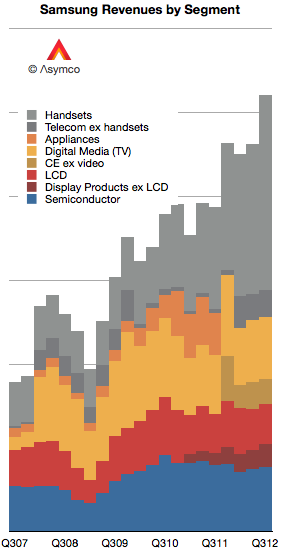
    As first introduced last week, Samsung's revenues have grown primarily due to the expanding volumes of smartphones. In today's post I convert the revenues and operating incomes to US Dollars and compare them to a set of companies.

    First, I should note that Samsung has changed both the designation of its divisions and the way it reports revenue. Broadly speaking, Samsung Electronics has four major divisions:

    1. Semiconductors. This includes memory products as well as systems such as CPUs.
    2. Display products. This used to be called "LCD" but has been re-named Display Products.
    3. Telecom. This is mainly mobile phones but includes additional products and services for telecom operators and PCs. The division has recently been re-named IM (IT and Mobile communications).
    4. Consumer Electronics. This group has changed names from Digital Media and Appliances to CE. The majority of sales value comes from televisions but also includes consumer electronics and appliances.

    The company further combines Semiconductors and Display Products into a group called DS (Device Solutions) and Consumer Electronics and IM into DMC (Digital Media & Communications).

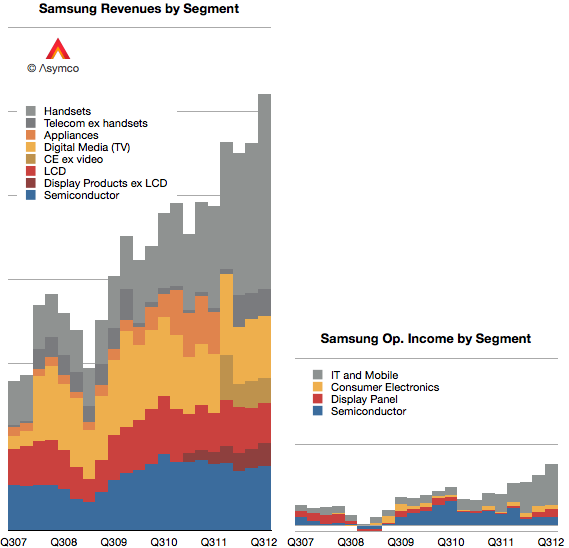
    I tried to reconcile these various nomenclatures with color coding in the following graph. Semiconductors are blue, Display components are red, Consumer Electronics are Yellow and Mobile are grey.

    Each gridline represents $10 billion.

    One more point to note about revenue recognition: Relatively recently the company has switched from reporting consolidated revenues to gross revenues. This means that current sales include inter-segment sales. So, as much as it is possible, the data above shows sales from division to division as well to external customers.

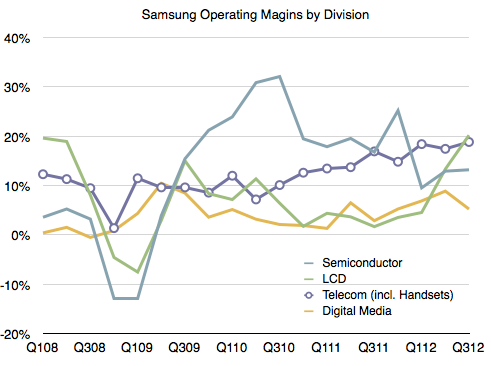
    When it comes to reporting operating income, the company offers four segment values: Consumer Electronics (Appliances, TV, "Digital Media"), IT and Mobile (including mobile phones), Display Panel (formerly LCD), and Semiconductor.

    I used the same color coding to show the income values in the same scale as the graph showing income:

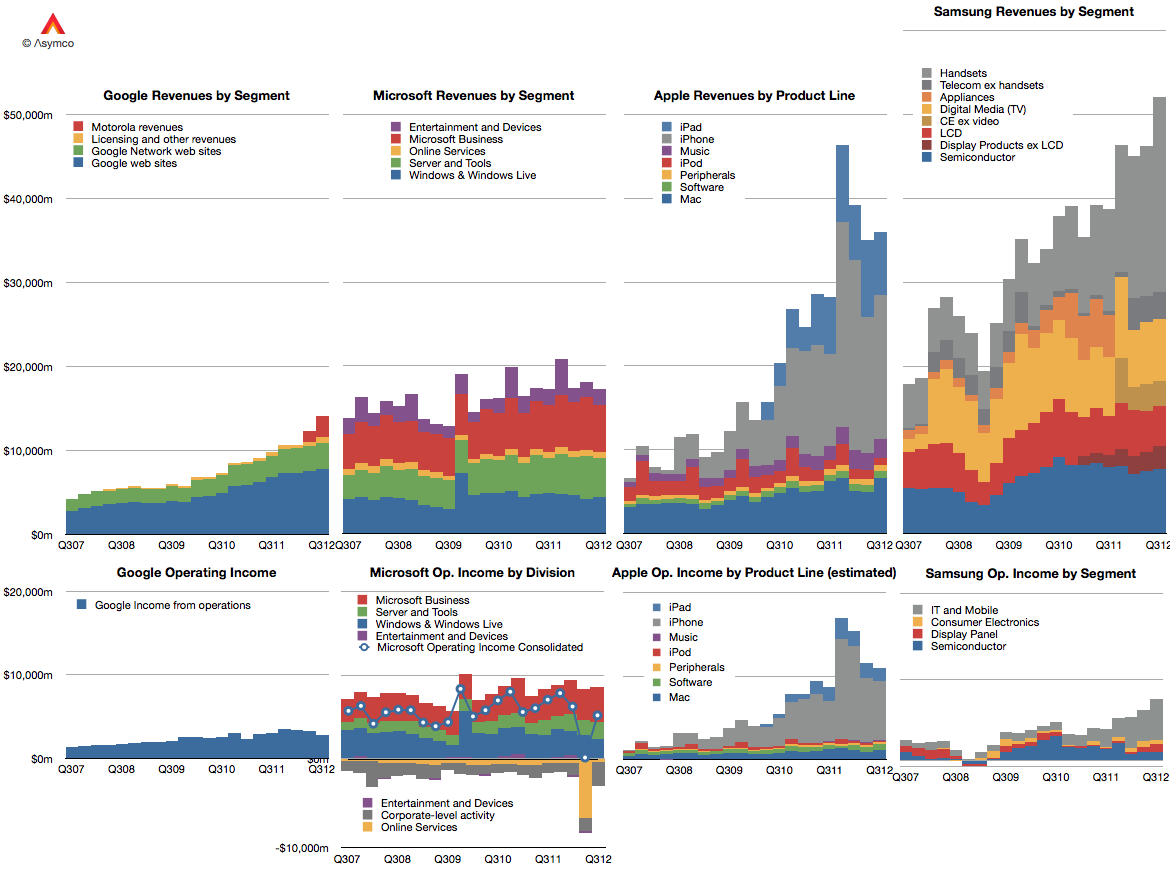
    It's now possible to compare Samsung Electronics with Google, Microsoft and Apple in terms of divisional (as a proxy for product-line) revenue and profitability over a five year period.

    At this time, a portion (majority?) of Samsung's grey area in the operating income graph represents the vast majority of profits obtained from Android across the entire ecosystem.

  4. The cost of selling Galaxies

    Research · 234 comments

    In the post "Google vs. Samsung" I compared the profits of Google and Samsung Electronics' mobile (aka Telecoms) division. It showed how Samsung has grown its mobile business to such a degree that, if sustained, could conceivably influence the way Android is controlled.

    However, we should not analyze Samsung's mobile group in isolation of the entire company. Samsung relies on internal transfer of technology and capacities of production which are quite unique for device vendors today. In other words, Samsung is a relatively integrated enterprise. Understanding the whole is necessary before understanding the part.

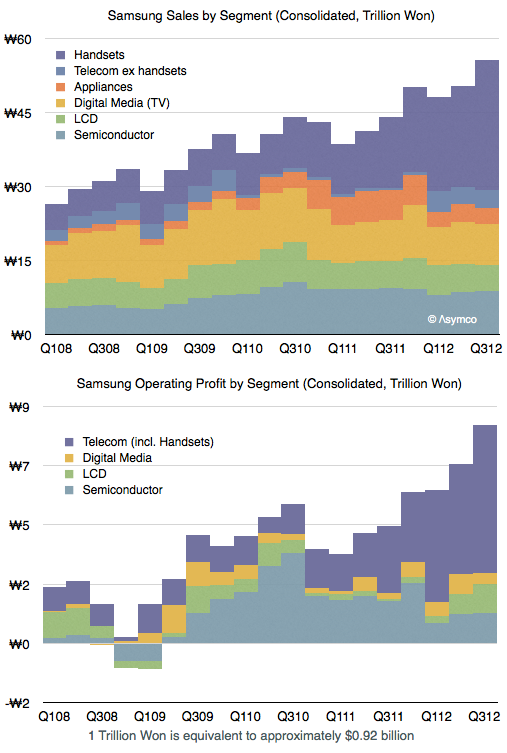
    The following graph shows the sales and operating profit for  Samsung Electronics as a composite of its divisions since early 2008.

    As one would expect, the mobile group (Telecom) is the source of both top and bottom line growth. The group has also been leading in terms of margins and increasing those margins steadily. 

    The margins averaged 11% during 2007 and 17% during the trailing four quarters. This 54% increase in margin has been matched by a 55% increase in average selling price (from $151 in 2007 to $234 in the latest quarter).

    One could argue however that a 17% operating margin from a group that is now leading in volume and price is still a bit weak. At its peak Nokia enjoyed a 25% operating margin, RIM 30% and HTC 27%. Apple's iPhone operating margin is around 45%.

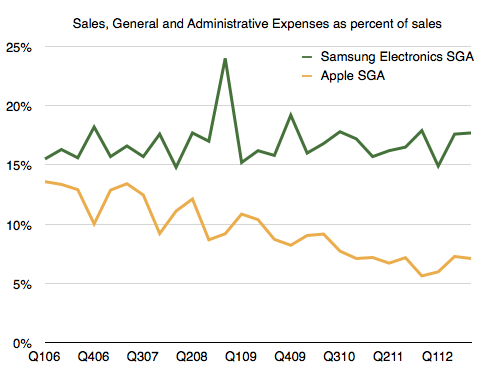
    I think a large part of the margin story is a relatively high level of spending on SG&A (Sales, General and Administrative) which includes advertising, sales promotion and commissions. In the case of Samsung Electronics, as sales has grown these expenses have grown in proportion. As a percent of sales SG&A have held relatively steady at around 17%.

    Note that as Apple's sales have grown its SG&A has grown less rapidly resulting in a smaller percent over time. We might see Apple's SG&A drop to 5% during the present quarter, an all-time low.

    So one of the more remarkable aspects of Samsung's success has been their willingness to increase promotional spending. Considering that their other divisions don't require as much "marketing expense" (semiconductors, LCD certainly, and TVs and Appliances to a lesser degree due to a smaller sales growth) we can imagine that the vast majority of this promotional spending has been in support of their mobile brands, Galaxy in particular.

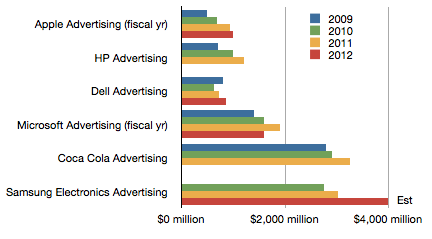
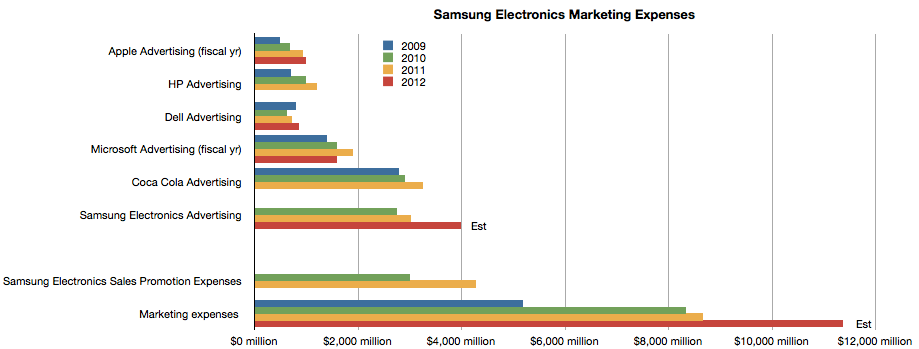
    In fact, we can obtain advertising spend data from annual reports.

    The chart above shows comparable ad spending from a cohort of technology companies as well as Coca Cola and Samsung Electronics.

    It might be surprising to note that Samsung spends considerably more than Apple and Microsoft. But it also spends more than Coca Cola, a company whose primary cost of sales is advertising.

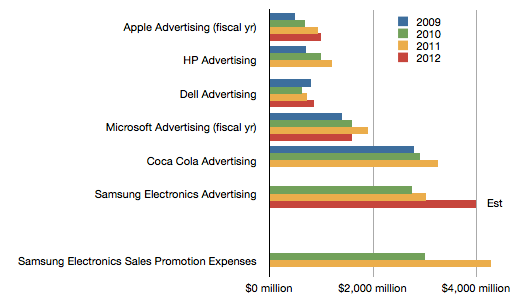
    However, advertising is not the only form of promotional spending. Samsung also pays commissions and "sales promotion". The following chart shows the value of these sales promotions relative to the ad spending budgets above.


    We don't have data on the current year since that is released after year's end, but it's interesting to note that promotions cost more than ads, which themselves are substantial relative to other companies.

    The company also reports "Marketing Expenses" every quarter[1]. These figures appear to be the sum of Ad spending, Sales Promotions, Public Relations and a portion of "other" expenses as a part of SG&A.

    When considering all marketing expenses, Samsung Electronics' sales efforts begin to look quite astonishing.

    ---

    Notes:

    1. The data used in the latter three charts are available as a Google spreadsheet here.
  5. The iPhone Addressable Market

    Research · 125 comments

    The iPhone is a severely constrained product. We're used to thinking that it's production constrained—and it is, but it's also distribution constrained. It has a business model that is almost completely dependent on operator subsidy. Few end users pay the $650 average price that Apple obtains and that price point has held for a remarkably long time. This price point is largely invisible to the user.

    In this regard it's very different from all the other products Apple sells. Historically, the company has preferred having its customers to also be its users and maintained a direct relationship with them, strengthening that relationship through its own retail channel for the last decade. Pricing is used by Apple as a signal to clearly illustrate value to the user and pricing is part of the communication about the product that Apple makes very explicit. This has been true for the iPod and Mac and is still true of the iPad. But this is not so for the iPhone. The entire marketing strategy for the iPhone (and hence the entire product concept itself) is "off message".

    Why is this?

    Before we get into causes, let's try to measure the distribution channel for the iPhone. Apple occasionally reports the total number of carriers it has relationships with. The last update was in the summer when Peter Oppenheimer, Apple CFO discussed the quarter ending June:

    We added several small regional carriers during the quarter and now have iPhone distribution through over 250 carriers in over 100 countries.…

    We added China Telecom as the second [Chinese] carrier in March…

    We also don’t expect to add any significant new country or carrier additions in the September quarter…

    In addition, Apple publishes the list of operators it sells through on its web site. The last time I counted I got 227 listed operators.

    If we contrast this with the total number of global operators (excluding MVNOs) there might be a way to measure distribution penetration. I compiled a list of all such operators based on information available in Wikipedia. You can browse the list here (Google Docs [1]).

    This global list includes 802 operators. The list is not current, being mostly based on 2009 data but it's pretty close. I've read that a more recent (non-public) estimate is 816.

    By this measure we can say that Apple has distribution through about 30% of the total operators. Consider also that RIM reports that it sells BlackBerry through 565 wireless carriers in over 175 countries. By this metric alone BlackBerry has twice the addressable market of the iPhone.

    But we can do better than counting operators. We should account for the fact that some operators have more subscribers than others.

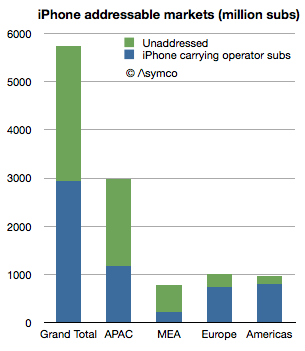
    Using the same database, I measured the subscriber count of iPhone distributing carriers vs. overall subscriber count. The ratio was about 50%.

    iPhone "addresses" about 2.8 billion connections whereas there are about 5.7 billion available connections. Note that this is not users but subscriptions—essentially SIM cards.

    The ratios vary by region:

    • Middle-east/Africa has 29%
    • Asia/Pacific is at 39%
    • Europe 73%
    • The Americas 83%


    We can take it a step further and identify which countries hold the highest opportunity for iPhone distribution. The top 5 are:

    1. India: 658 million
    2. China: 622 million
    3. Pakistan: 116 million
    4. Russia: 102 million
    5. Nigeria: 89 million

    But the opportunity is not only in emerging markets. Japan is a 69 million subs opportunity and even the US has 80 million subs without direct (i.e. subsidized) access to the iPhone.

    So we can now return to the question of why the iPhone is sold the way it is.

    First I should point out that the addressable market of Samsung or Android in general is larger than that of the iPhone. Samsung has relationships with far more operators, at least on the scale of RIM or Nokia, perhaps even more. It might be safe to assume that Android is completely unconstrained in distribution and therefore its addressable market is the entire subscriber space (meaning that Android has twice the addressable market of the iPhone.) For Apple to compete on the basis of volume or market share it would make sense to broaden this network. So what's holding it back?

    I think the answer is the other constraint mentioned: production. The company is still iterating the product on a yearly basis and needs to ramp production to reach all its carrier partners in a timely fashion. The carriers use the iPhone as differentiation and a way to uplift their core business. Therefore they want the latest version as quickly as possible. To satisfy this, Apple needs to manufacture the latest variant very quickly. But that's not easy. Peak production is one thing but getting there quickly is another. This is the problem which Apple's vast capital expenditures is trying to solve.

    So far the production capacity has been increasing at nearly 100% per annum. This is an astonishing achievement but it's still not enough. The product is supply constrained during much of the launch quarter. Therefore, to summarize, the entire business model for the iPhone revolves around this question:

    Can enough units be shipped in a sufficiently short time frame to allow a limited (but large) subset of operators to create competitive advantage which sustains a generous up-front subsidy.

    At this time the answer seems to be that the model can work for about 30% of operators serving 50% of subscribers. The crucial question for the business is how much higher can these numbers get?

    Note that this is not a debate about market share or consumer preference but about delivering a particular value proposition to network operators, (which sustains a premium price point.) The iPhone is built around this business model and to alter it would alter the very essence of what the product is. The addressable market is one piece of the product but it interconnects with the price, margin, design, production and breadth of offering. You cannot change one without changing the others. It's a product whose distribution model is part and parcel of its design.

    I believe that the particular way this product translates into a business is very rigid, which is why it has not changed much during the life of the product. This is in contrast to Apple's other products which exhibit more market flexibility. Inter-dependency is not a new concept for Apple products (e.g. iPod/iTunes, Mac/MacOS) but the iPhone shows a level of inter-dependency with distribution and production the likes of which has never been seen.

    This topic will be further discussed at Asymconf in January as the fourth quarter data will then be available and there will be an opportunity to debate it live with an august audience.

    ---

    Notes:

    1. The database is neither current nor complete. If you would like to help maintain the data based on local (public) information, please get in touch and I can grant access to edit it.
  6. Google vs. Samsung

    Research · 283 comments

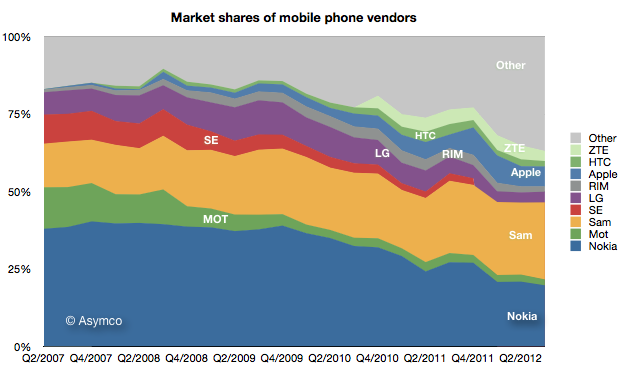
    Samsung's recent success in mobile phones has been spectacular. It overtook Nokia for the top spot in overall unit sales. 

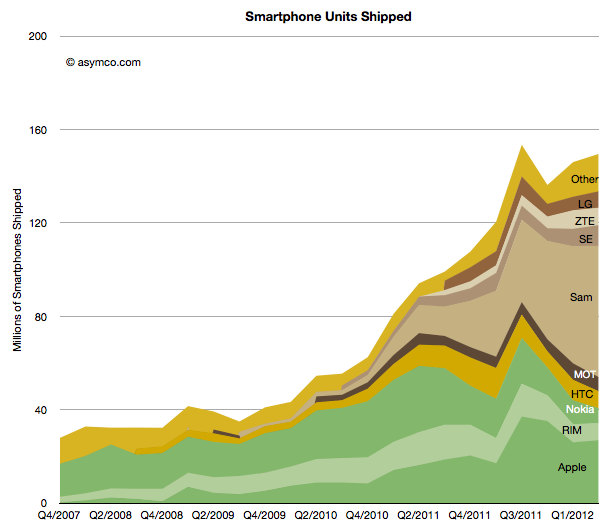
    It went from having almost no smartphone sales to selling over 50 million units per quarter in a matter of two years.

    It now accounts for nearly 40% of all industry profits.

    A key decision which made this success possible was to shift its portfolio to smartphones and to offer a large variety of such phones.

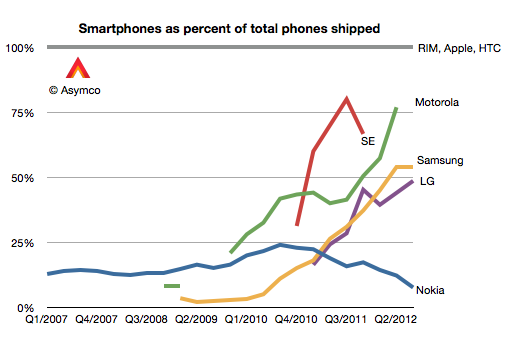
    In Q1 2010 only 3% of the phones Samsung sold were smartphones. In the latest quarter the ratio was 54%. 

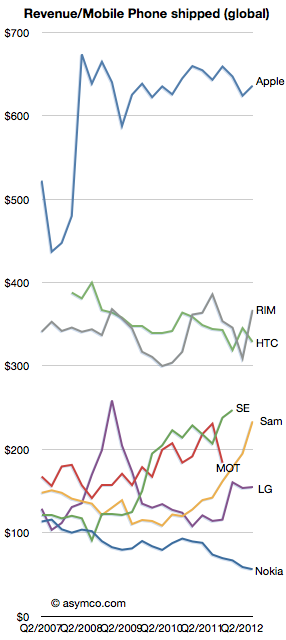
    As a result the average selling price more than doubled, from $115 to $234.

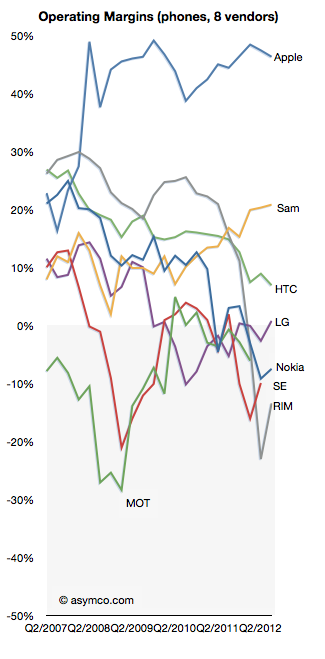
    Profit margins also soared in proportion: from 12% to 21%.

    All this plus an overall growth in volumes from 64 million to over 100 million per quarter has meant that the company is raking in enormous profits. Not only did it overtake Nokia, the market share leader for 14 years, but is making more profits than Nokia ever did.

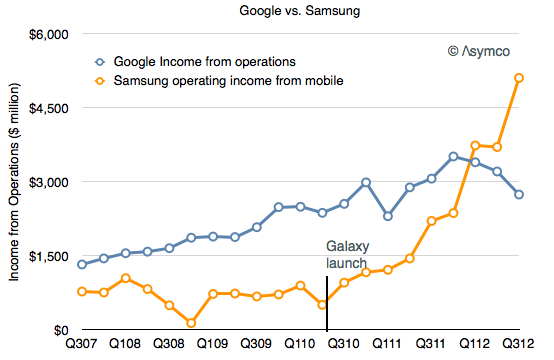
    So much profit in fact that it has overtaken Google's decisively.

    The reason I point this out is that Samsung's success is dependent on having ridden on the back of Android. Samsung's ascent can be precisely timed to their adoption of Android. The groundbreaking Samsung Galaxy launch was the Galaxy S which shipped in June 2010.

    Meanwhile, indications are that "mobile" is causing a contraction in Google's margins.

    If nothing else, Android has created a very interesting industry. There are many questions of course: Is Samsung's trajectory sustainable? Why aren't there other vendors successful with Android? Why isn't Google successful with Android? Why isn't Google's Motorola successful with Android? What would happen if Samsung soaks up so much profit from mobile that it's in a position to acquire Google and control the trajectory of their enabling platform?

  7. An interview about Microsoft's Surface

    Research · 15 comments

    This interview was conducted with Bruno Ferrari Editor of Exame magazine in Brazil.

    First, do you have forecasts for tablet market share including Microsoft for next years? (Apple, Android, Amazon etc)?

    I have some guesses but I don't think it's something that is defensible. Too many things can change. Fundamentally I believe Microsoft sees the tablet as a PC and intends to migrate a substantial portion of would-be PC customers to tablet forms. If they are successful then they preserve the existing PC user base and allow it to grow a bit.

    In contrast Apple sees the iPad as a new type of device that is used for things not directly related to PC style computing. In that sense the iPad competes with PC non-consumption. It means people may own both a PC and an iPad and some will own only an iPad. The iPad will expand the market while taking share from the PC. Windows tablets will try to hold the Windows share steady.

     How do you analyze Microsoft’s strategy with Microsoft Surface? Don’t you think they’re admitting themselves that Apple was right since the beginning?

    We don't know the strategy yet. Without pricing and an idea of how the other OEMs will respond, I have more questions than answers. The fact that they are doing their own PC hardware does indicate that they see the industry architecture changing and that a large number of vendors offering hardware "choice" is not really the basis of competition in PCs. In other words, buyers are not willing to pay a premium for Windows because the hardware it's available on is offered in a wide range of options.

    Do you think MS growth at tablet market will surpass the lost at PC (desktop and notebook) market in the next years?

    This is a crucial question. It's possible that Windows 8 on tablets will create new markets, like the iPad has done and it could take the leading role in expanding computing in a post-PC era. However, to do this, Windows 8 and its successors need to be optimized to solve the new jobs people may have for mobile devices. They have to do this even though they need to sustain the old use cases and business models. To succeed Microsoft needs to "fork" the business model and create new ways of profiting from hardware and software. The rumors that Windows 8 RT devices will be sold at a loss is perhaps a hint that this is the plan.

    Did you see the rumor of a 199 dollars Surface? If it’s true, do you think is a good strategy?

    It all depends on what will be the alternate source of revenue. I assume there will be some sort of subscription service, taking a page from the telecom industry. Perhaps a mixture of Windows Live services (media, documents in the cloud and software updates). We have to see whether subscription computing makes sense for consumers.

    How do you see the problem that MS is creating with its OEM by turning itself on a tablet maker?

    There is a problem, of course. However here again the question is whether they are moving to an "ecosystem subscription" model and whether they want to offer revenue share to OEMs. If they offer something then Microsoft plays the role of the operator and device makers are paid some up-front subsidy in exchange for keeping their systems locked into the network.

     One more questions: did you already estimate the shipments of Samsung Galaxy Tab since its launch?

    Sorry, I don't have the Galaxy Tab estimate. However, here is what I found:

    A week after its release, Samsung announced that they had sold 600,000 units. On the 4 December, it was reported that the 1 million mark was reached, two months after launch. However, an executive at Lenovo claimed that Samsung had only sold 20,000 out of the 1 million Galaxy Tabs that were shipped. In January 2011 Samsung announced they had shipped 2 million units to stores. In August 2012, actual sales figures were released in the patent infringement court case against Apple showing that a total of 725,000 Galaxy Tabs were sold through Q2 of 2012.

    Source: Wikipedia.

    Note that the figure of 725k is US only.

  8. How many Kindle Fires were sold?

    Research · 71 comments

    Last September I argued against the potential of the Kindle Fire acting as a low end disruption in the tablet market.

    Now that the first version of the product has reached is end of life, it's time to review the discussion.

    The first problem is finding out how well the product did. Amazon just released a statement that the Fire accounted for 22% of tablet sales in the US in the nine months it was available. The challenge becomes knowing how many total tablets were sold in the US during this time frame.

    Fortunately we know the vast bulk of that total based on the Samsung v. Apple trial. Both Apple and Samsung submitted as evidence sales of the iPad and the Tab product lines in the US. The iPad added up to 16.14 million units (Q4'11 through Q2'12) and the Tab was 540k units. That makes the iPad and the Tab add up to about 16.7 million units. Assuming an additional 1 million units for the other (non-Kindle) total yields an estimate of 22.7 million tablet devices sold in the nine months ending June.

    Applying the 22% claim to that total gives a Kindle sales total of 4.987 million. That's awfully close to a round number of 5 million.

    Since Amazon admitted that they ended production prior to launching a replacement (and presumably did so quite early in order to drain inventory,) then we can safely assume that the original production order was 5 million units.

    Five million Kindle Fire units becomes the first reliable estimate of Kindle sales (based on Apple, Samsung and Amazon supplied information rather than guesses from analysts.)

    So the question now is whether this is consistent with the hypothesis that the Fire is disrupting the tablet business.

    Bearing in mind that this 5 million total was reached with prominent placement on Amazon.com and a loss-leading pricing, I would conclude that this is not an auspicious start for a disruptive product.

    As I argued nearly a year ago, the business model for the Kindle is limited to the footprint of the Amazon franchise, which is small internationally. Amazon itself implicitly admitted that the product was a US-only phenomenon. Further worry comes from the way the company approached production. It was not planning it as a maximization of reach into the market. What they did was order a batch production and then wait for it to be sold through.

    Perhaps Amazon is being patient for growth, but I don't see a hunger for profit in this strategy. We know that Kindle probably lost money at the price charged. Perhaps it's on the order of $40 per unit. Five million units would imply a charge against the business of $200 million. Did Amazon earn a profit on content sales of $40 on each of those five million units? The margins on content sold through Amazon are so low that I have a hard time imagining that Fire users are that ravenous in their consumption.

  9. Deus ex Machina

    Research · 75 comments

    Apple Inc. v. Samsung Electronics Co., Ltd. makes for powerful courtroom drama. Calling it drama, however, is faint praise. It's entertaining and thrilling but the effects are shallow and they don't last.

    I have been asked to comment on the trial that just concluded and I find it difficult. The problem for me is that I've seen too many of these dramas. From the United States v. Microsoft to NPD v. RIM and Nokia v. X, Y or Z to make sweeping conclusions. This frustrates the journalist.

    The problem is that the process of litigation leads to little satisfaction for any of the parties. There is always the anticipation of catharsis, but it never comes. The expectation is understandable. We are led to believe that the law is decisive, the ultimate adjudicator. The reason it isn't is that the system was established in a different era. A time when technological change was slow, or non-existent. As a result the institutions of law move so slowly that they are nearly futile in administering justice or righting wrongs.

    Here are just a few problems I can cite without any research:

    1. Legal processes are glacial. They tend to last longer than the lives of the products being litigated. In the case of phones with shelf lives of six months to a year, the trials are unlikely to get underway before the accused infringer is already off the market.
    2. The law is ambiguous. IP law varies and is subject to interpretation. What one jury (or judge) finds unanimously infringing another will find non-infringing. This gets even more dramatic when comparing decisions across countries and legal systems and through appeals processes and the influence of political considerations.
    3. It's a big world. Even though patents can be internationalized, the way they are enforced varies.
    4. The financial penalties or awards are arbitrary. As exposed during the Apple v. Samsung (US) trial, the impact of infringement can be calculated numerous ways, all hypothetical.
    5. It is incredibly complex. The technicalities are so onerous that they baffle judges and lawyers and legal experts, not to mention company management and lay jurors.
    6. It is costly. Only major companies or those backed by legal hit squads can participate in litigation. This means it sustains incumbents rather than facilitate entry. By necessity, entrants need to "route around IP."

    But the most damning thing about the litigation process is that it's assumed to be decisive. Decisive in terms of altering the success (or failure) of companies. That rarely happens. Instead it adds friction to an existing, inevitable outcome. Sometimes it cripples the winner and rewards the loser.

    Therefore strategists need to be careful to avoid placing their faith in this system. It's a lottery at best, a time and money sink at worst. Considering the analogy to litigation as drama, I would re-phrase this caution as a warning not to treat litigation as Deus ex Machina. It's not something that will get your business out of a jam or reward you for a violation, perceived or real.

    Practically, these exercises in drama are used to signal. Signal to competitors, partners, customers and employees. In other words, they are used to create psychological effects. But we know that psychology can be effectively shaped with other messages. Signals that products themselves give (positioning), or that are shaped by communications via advertising. And these means for signaling are much more effective than using the legal system. So why not use traditional means of signaling?

    This is the crutch of Deus ex Machina. That this artifice will help tell a story. That "a seemingly unsolvable problem is suddenly and abruptly solved with the contrived and unexpected intervention of some new event, character, ability, or object."

    It won't.

  10. It’s costly and has unpredictable consequences

    Research · 26 comments

    ``It’s costly and has unpredictable consequences. That makes it a very bad business model. I suppose both companies have agendas that are not visible in court and perhaps Apple is signaling to other parties, and perhaps Samsung is using it to raise its profile. It still seems that unintended consequences may arise and the result could be very bad for everybody,’’ said Horace Dediu, founder of equity-research firm Asymco, in an e-mail interview with The Korea Times.

    The above was a quote from the article  Samsung can’t afford to lose Apple fight by Yoo-chul Kim from The Korea Times. Yoo-chul contacted me via email with a series of questions. I want to share all his questions and my answers as well:

    Samsung wides market gap with Apple, according to research firms. You think the gap will further be widen and please tell me why

    As Samsung converts its phone portfolio to be all smartphones, it is very likely to reach much higher smartphone volumes. One year ago Samsung sold about 56 million feature phones. Last quarter it sold about 43 million. The smartphone portion increased from 20 million to 50 million. At the same time, Apple has maintained a growth in its smartphone business of about 100% on a yearly basis. I expect that to continue into 2013 as well. Therefore it's possible that Samsung could sell 290 million smartphones in the next 12 months and Apple could sell about 200 million in the same time frame.

    However, it's important to understand that the companies compete on different bases. What I mean is that what generates a profit (i.e. payment by the consumer above what a product costs) is different for each company. Apple is a platform company that sells access to the iOS ecosystem across many other device types. Samsung sells consumer electronics with limited "network effects" but desirable features. In this view, the gap in device sales is "asymmetric" and not reflective of the actual competition which is between Google's Android and Apple's iOS as forms of access.

    Samsung's rapid rises mainly due to the company's heady dependence
    on Google Android. If Google applies better software for Motorola,
    then you think Samsung will face difficulties?

    Think of Google as a supplier to Samsung. No manufacturer wants to have a situation where they are dependent on only one supplier, especially when there are huge substitution costs for another supplier. And even more especially if that supplier owns one of your competitors. However, it's unlikely that Motorola will become a strong competitor to Samsung. I also don't expect Google will damage their OEM "customers" by favoring Motorola. Motorola can't become big enough quickly enough to be a threat to Samsung. What is more likely to be a problem for Samsung is ZTE and Huawei. They are on the same trajectory that Samsung was on 10 years ago. For Samsung to beat them in the future it will need to develop products that nobody can copy.

    How about software? Samsung is good to roll out price competitive
    models, however, software is always problem. Any advice for this
    issue?

    Software is hard and expertise can't be quickly acquired. It takes time. Only advice [I have] is that efforts must be patient and there need to be many experiments like Bada and Tizen. Google started with Android in 2005 and Apple started with iOS in 2003 or 2004.

    How about the patent dispute with Apple and Samsung. The patent war
    is helping Samsung see a rise in its brand awareness and that also
    worked for Samsung to grab more shares in smartphones?

    It's very difficult to measure the impact of litigation, both in the positive and negative. It's costly and has unpredictable consequences. That makes it a very bad "business model". I suppose both companies have agendas that are not visible in court and, perhaps, Apple is signaling to other parties and perhaps Samsung is using it to raise its profile. It still seems that unintended consequences may arise and the result could be very bad for everybody.

    Samsung wants to become a market creator not just a fast follower.
    For me, it's quite negative for Samsung to create a wholly-new
    eco-systems because Samsung's edges are coming from manufacturing, not creative thinking. What do you think? If Samsung wants to be a
    creator, what conditions should Samsung need and what things should
    the company do?

    Unfortunately, manufacturing excellence is not enough to remain successful long term. US companies were successful, then the Japanese, Taiwanese, Hong Kong, and now Chinese. Companies either adapt or become irrelevant. Building ecosystems is the new basis of competition but it's not the only option. Unfortunately we don't know what will be necessary to build the next basis. What matters is experimentation and the building of new businesses. I can't offer specific recommendations as there is no recipe book for how to create new markets.

    For your views, who is much better so far since the trial has begun
    in the US. Samsung or Apple?

    I cannot comment on this. Performance in court can only be judged by those present and I'm sure everybody present disagrees.

    You think Apple is enjoying its so-called a homeground advantage
    for the trial and is there any possibility that the issue to go for
    the highest court in the US. My Samsung contacts say that's the
    possibility, though.

    Again, I don't have an opinion on legal matters. Broadly speaking, IP litigation is similar to playing the lottery.

    Need your perspectives about Google's support for Samsung. Google
    confirms its supports for Samsung for an united front against Apple
    because the fight between Samsung and Apple is a kind of version that
    represents Google and Apple fight.
    Any comments about that?

    I believe Google does support Samsung. I question however how this relationship will develop over time. I attached below commentary from a researcher at Deutsche Bank on Android in China. I think it has some clues about how Google treats its partners.

    What are pre-conditions before Samsung making an action to sign a
    peace treaty with Apple?

    It depends on the motives behind Apple's actions. I think they want to see a "no copying" rule. They don't mind competition and Android could be a help in the long run by moving users from feature phones to basic smartphones which could later be upgraded to Apple phones. But what I think they want is to signal to others that direct copying is unacceptable. Essentially, the work of their designers is very important to them and copying destroys [the designers'] incentives to do breakthrough products.

    ---

    See also: Who Cares If Samsung Copied Apple? by James Allworth - Harvard Business Review

  11. American exceptionalism

    Research · 45 comments

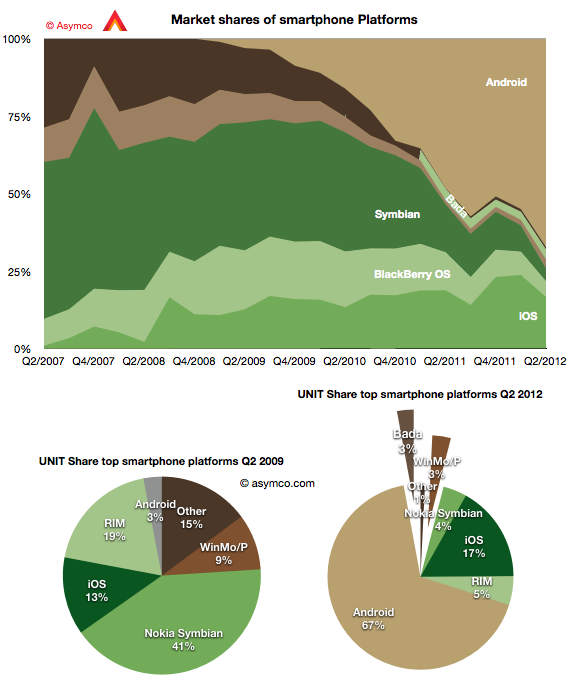
    The second quarter showed continuing growth for Android with 19 points of share growth from a year ago. Only Windows Phone showed a gain y/y in share up 1.6 points to about 3%. In the same time, Bada lost half a point, iOS lost 2.1 points, RIM lost 7.2, Symbian 11.4.

    The result is shown in the graph below:

    I also show a "before-and-after" pair of pie charts which show the difference in smartphone platform market share from the same quarter three years ago. Android went from 3% share to 67% while Symbian went from 41% to 4% and RIM went from 19% to 5%. iOS increased its share from 13% to 17%.

    If this trend continues Android could reach 50% of all phones sold in a few years. That's a run rate of 200 million per quarter. And it's likely that 100 million of those will be shipped by Chinese vendors.

    However, looking at the global picture can also miss some important trends in local markets. Had one looked at the global smartphone business in 2005, the conclusion would have been that Symbian would be the dominant platform in perpetuity.

    What affected the global market was a change in the US: the launch of iOS and thereafter of Android. The US, a smartphone backwater until then, became the most vibrant market and today it's the most penetrated and has the highest ratio of smart to non-smart of any of the major regions.

    The curious thing about this vast market is that it's still not truly open. There are technology and political reasons why some platforms are permitted to sell in one region or not. The iPhone is not available on either the largest Chinese operator or on the largest Japanese one. It's largely absent from India because of distribution (i.e. subsidy) and much of South America. Even in the US, the iPhone is still, after five years, not available on one of the top four operators and has only reached another less than a year ago.

    What intrigues me is what would the market look like if distribution were not an issue. What if there was equal choice to all buyers. We can't test this question directly but we can ask. But there is some pattern we can look at in the US data. Thanks to recent revelations at the Samsung vs. Apple trial we can see the effect of increasing distribution in the US.

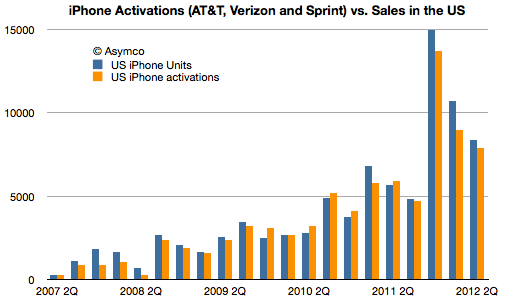
    The data on smartphone market share by carrier can be blended with data from carriers about iPhone activations (which are a proxy for sales, see note below) to give a more precise figure of market share in markets where iPhone participates.

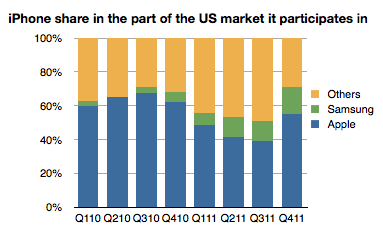
    For example, when the iPhone was only available on AT&T, one could measure iPhone market share vs. the global smartphone market, or the US smartphone market or within AT&T alone. Some assumed that the AT&T share would be reduced once the product would become available on Verizon or other US carriers. However there was no appreciable drop. Share in Q4 2010 was 63% at AT&T and it was 63% a year later after the iPhone was available for four quarters at Verizon.

    So the share of iPhone within those operators which carry it tells a story independent of distribution.

    The following graph shows the share of the iPhone vs. Samsung in the market defined by its availability. (I.e. the volumes of smartphones sold by AT&T throughout the time period, Verizon Q1 2011 to end and Sprint in Q4 '11).

    The share of iPhone thus defined shows a slight decline but it's an overall number that is remarkably resilient as distribution increases and is remarkably high overall. Note that globally, the iPhone gets only about 17% share of smartphones--a value that has not varied greatly since mid 2009.

    So at least in the US, on carriers where it's available, the iPhone is holding on to a significant share. In a global market it's expanding distribution but not yet covering the world. As a consequence it's keeping up with overall market growth and staying between 17% and 20% share.

    The big question is what will happen if and when its availability matches that of Android in terms of points of sale. Or even that of BlackBerry or Symbian. Is America a different market from the rest of the world? It was different in being isolated while Symbian roamed globally. It was different in being a launch platform for BlackBerry and then iOS and then Android. But now that iPhone is beginning to be widely available there, will it be exceptional in how it rewards Apple?

    ---

    Note:

    1. Activations data can be seen next to Apple's testimony of US sales in the following graph. Note that more phones were sold by Apple than were activated in total of the life of the product. 86 million sold and 80 million activated. This implies that an analysis based on activations undercounts the iPhone.