Asymco

Asymmetric Intelligence

Services

  1. Owing how much to how few?

    Research · 7 comments

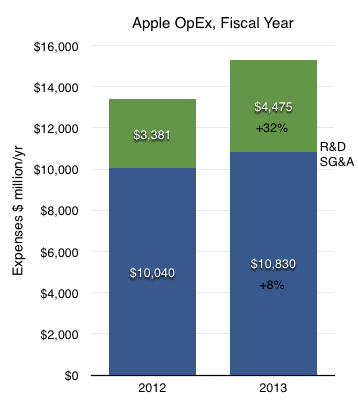
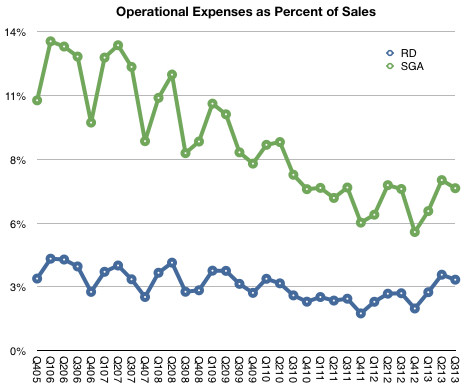
    For the year ending October Apple's R&D costs were $4.475 billion. These costs have been rising. Though, as the company explains, not faster than net sales:

    The growth in R&D expense was driven by an increase in headcount and related expenses to support expanded R&D activities. Although total R&D expense increased 32% and 39% in 2013 and 2012, respectively, it remained fairly consistent as a percentage of net sales.

    [My emphasis]

    We can see this in the following graph:

    Screen Shot 2013-11-01 at 11-1-4.37.48 PM

    R&D has remained very nearly 3% of sales since at least 2005.


    SG&A Expenses barely grew however:

    The growth in SG&A during 2013 was primarily due to the Company’s continued expansion of its Retail segment and increased headcount and related expenses, partially offset by decreased spending on professional services.

    The change in R&D and SG&A on a full-year basis is shown below.

    Screen Shot 2013-11-01 at 11-1-4.42.06 PM

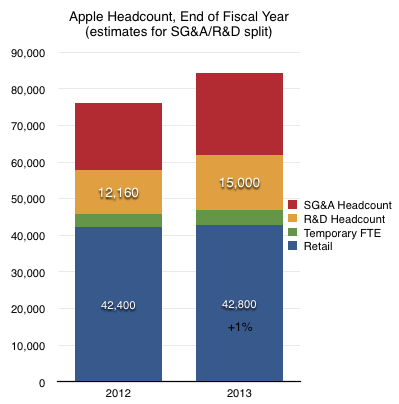
    I emphasized the mention of increases in headcount. We cannot know with any precision what portion of last year's $15 billion in operating expenses went toward wage expenses since there are other costs such as advertising ((Apple's advertising expenditures for fiscal 2013 were $1.1 billion or 10% of SG&A or 0.64% of sales.)) commissions and public relations in the case of SG&A and outside services, equipment leases, in the case of R&D. However, it's more likely that wage expenses are a far larger proportion of total R&D than they are of SG&A.

    My estimate, based on wage rates, is that there are approximately 15,000 R&D staff at Apple.

    Screen Shot 2013-11-01 at 11-1-4.42.49 PM

    If we divide sales by this number we get $11.4 million in sales per engineer.

  2. The newly integrated company

    Research · 25 comments

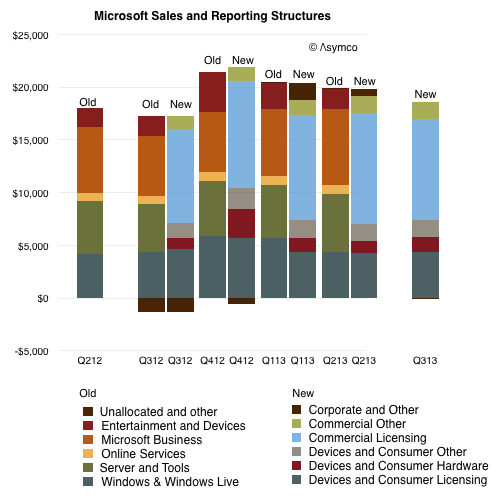
    During the first quarter of fiscal year 2014, we changed our organizational structure as part of our transformation to a devices and services company. As a result of these changes, information that our chief operating decision maker regularly reviews for purposes of allocating resources and assessing performance changed. Therefore, beginning in fiscal year 2014, we are reporting our financial performance based on our new segments; Devices and Consumer (“D&C”) Licensing, D&C Hardware, D&C Other, Commercial Licensing, and Commercial Other.

    The previous reporting segments were:

    • Windows & Windows Live
    • Server and Tools
    • Online Services
    • Microsoft Business
    • Entertainment and Devices
    • Unallocated and other

    The new are:

    • D&C Licensing: Windows OEM licensing, Consumer Windows, Consumer Office, Windows Phone (including related patent licensing)
    • D&C Hardware:  Xbox 360, second-party and third-party video games, and Xbox LIVE subscriptions; Surface; PC accessories
    • D&C Other: Resale, including Windows Store, Xbox LIVE transactions, Windows Phone Marketplace; search advertising; display advertising; Subscriptions including Office 365 Home Premium; Studios including first-party video games; retail stores.
    • Commercial Licensing: Windows Server, Microsoft SQL Server, Visual Studio, System Center; Windows Embedded; volume licensing of Windows; Microsoft Office for business (Office, Exchange, SharePoint, and Lync); Client Access Licenses;  Dynamics, Skype.
    • Commercial Other: Enterprise Services, including Premier product support services and Microsoft Consulting Services; Cloud Services, comprising O365, other Microsoft Office online offerings, Dynamics CRM Online, and Windows Azure.

    From Microsoft's FY14 Q1 10Q via Microsoft Investor Relations - Press Releases

    The mapping between the old and new is not straight forward. There is overlap between D&C Licensing and the old Windows and perhaps between Entertainment and Devices and D&C Hardware but there are many gaps. There is also some overlap between the old "Business"/"Server" segments and the new "Commercial" but, again, they cannot be matched.

    I show the difference between the two structures in the way revenues are allocated below, using color to try to show similarities.

    Screen Shot 2013-10-25 at 10-25-11.25.07 AM

    Given the re-stated quarters it's possible to compare one year's historic performance at a segment level. For example, the company states that "Devices and Consumer revenue grew 4% to $7.46 billion" while "Commercial revenue grew 10% to $11.20 billion".

    Since we don't have data older than one year, our ability to assess the company over longer time periods will be drastically reduced and a new picture will take a long time to emerge.

    There is however one aspect of the new structure that needs to be appreciated right away: the allocation of costs has changed fundamentally. The company explains:

    Cost of revenue is directly charged to the D&C Hardware segment. For the remaining segments, cost of revenue is directly charged in most cases and allocated in certain cases, generally using a relative revenue methodology.

    We do not allocate operating expenses to our segments. Rather, we allocate them to our two segment groups, Devices and Consumer and Commercial. Due to the integrated structure of our business, allocations of expenses are made in certain cases to incent[sic] cross-collaboration among our segment groups so that a segment group is not solely burdened by the cost of a mutually beneficial activity as we seek to deliver seamless experiences across devices, whether on premise or in the cloud.

    [my emphasis]

    In that brief paragraph Microsoft has formally and in a financially binding way declared itself to being a functional organization. ((Welcome to the club.))

    The mechanism seems banal: operating costs are no longer assigned to product divisions but to two large buckets. In practice this means that profitability (P/L) cannot be assessed or assigned to individual managers. The lack of P/L responsibility means that incentives from top to bottom have to be re-engineered. If this goes wrong, the Assets ((read: people)) of the company could evaporate.

    If the assets go, then processes and priorities are for naught.

    In other words, what the company is undertaking is a priority shift (to a  functional structure to create integrated experiences) which requires a process change (whereby employees work according to new incentives) while preserving the fragile assets the company depends on (a motivated and skilled base of employees.)

    This makeover is as ambitious as a re-org gets and the context, scope and target are as difficult as they can be. This is, after all, the largest software company operating the the most dynamic industry whose multi-sided markets are notoriously volatile due to disruptive forces.

    The challenge also suggests why Ballmer left and who should replace him. A priority transplant operation requires a different set of skills than those held by the manager who created the processes for the previous set of priorities. That's the manager's dilemma: even if you foresee the changes needed and push for them to be enacted, your reward might be to be replaced by someone who can make the changes happen.

    Those who envision and persuade for change are rarely allowed to enact it.

  3. The value of zero-priced software

    Research · 129 comments

    Apple's latest product launch (new OSX, iPads, Macs and iWork/iLife) came with a change in pricing for software. OS X and iWork and iLife and updates are now made available free on new Macs and, in the case of the suites, on iOS devices as well.

    Recall also that iOS updates are now free as well and that OS X had been reduced in price from about $129 to $29 with Snow Leopard in August 2009 and to $19 with Mountain Lion in July 2012. The iSuites have also dropped in price over time so the pattern of evaporating software prices is long-running.

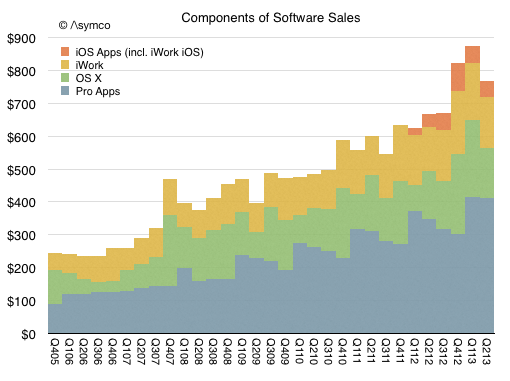
    But how fast and what is the impact? The historic performance Apple's Software business is not easily determined since it was always blended with additional businesses. Until September of last year, Software was reported as part of "Software and Services" and since then as part of "iTunes, Software and Services." Some assumptions allow the following picture to be drawn:

    Screen Shot 2013-10-24 at 10-24-5.07.03 PM

    One additional wrinkle to the Apple software story is that OS X and iWork/iLife are not all the software titles available. Apple's software includes Pro apps as well as the non-free OS X server. The non-free software US prices are:

    • Aperture: $79.99
    • Final Cut Pro: $299.99
    • Motion: $49.99
    • Compressor: $49.99
    • Logic Pro X: $199.99
    • MainStage 3: $29.99
    • OS X Server: $19.99
    • Apple Remote Desktop: $79.99

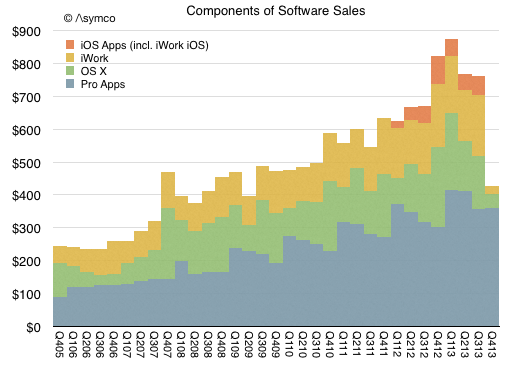
    Given that and additional assumptions can lead to the following picture of the components of Apple's Software sales (in $ million/quarter).

    Screen Shot 2013-10-24 at 10-24-5.08.54 PM

    Given this picture of the software business and the change in pricing, here is my forecast for the third and fourth quarters (in $ million/quarter):

    Screen Shot 2013-10-24 at 10-24-5.21.30 PM

    The foregone revenues could be as much as $450 million from what would have been received with existing pricing model.

    So the question that naturally arises is whether this is "worth it". Whether by offering free software hardware or service revenues rise.

    Perhaps. Certainly service revenue in the form of iCloud might rise with more usage of iWork and iLife. But I don't think that this is the calculus underlying the decision. Remember that Apple does not have a Profit/Loss accountability. It's not necessary (and perhaps not even preferred) that a division balances costs and revenues. ((The graphs in this post (and the preceding 1900 on this blog) were created using Numbers.))

    Fundamentally Apple remains a systems company where software is a key element in its definition of value. That is not changing. What is changing instead is the bundling of application software with the systems software and the system itself. The presence of iWork and hassle-free updating of that suite (and the same for the OS) means that utilization rates will increase.

    I believe the logic for Apple is that usage of the products determines their value and therefore placing powerful software in the hands of more users means they will value the entire system more. This leads to the notion of greater "stickiness" or "lock-in" but also to higher satisfaction and loyalty, rate of upgrades and even more third party purchases and yet more usage.

    This is the virtuous cycle platform custodians seek to engender. This is what Apple is trying to build and the transition of apps into the system bundle is part of this re-enforcement.

    One wonders how long before Apple's approach becomes the norm for other platforms.

  4. S is for Service

    Research · 96 comments

    One of the enduring mysteries of the iPhone has been its lack of a portfolio. After six years it seems that Apple has finally acquiesced that there should be one, albeit currently limited to two items. The second enigma is related to the price, namely why does Apple ask so much for its phones? At an average sales price of $600 it's a shocking premium to the average phone, and with a six year run, a shocking resistance to the corrosive effects of competition.

    The obvious answer to why Apple asks so much is because it can. Anybody would if they could. That's a poor question. So the right question should be: why does anybody pay this much? One could answer that few do and it's not a mystery that some feel better paying more simply because they can. But those who pay Apple's prices are, mainly, not consumers. They are operators. Exactly 270 of them.

    So then let's re-ask the question: Why do so many operators pay so much for Apple's phones? We can't answer that with the psychological slurs usually directed at the brand. Surely Operators aren't competing in beauty contests or need to soothe their collective egos. The decisions operators make on whether to range a phone are driven by hard economic realities: ARPU, churn, network costs, depreciation, ROI, etc. Some clearly can't make the iPhone fit their economic models and indeed about two thirds of them don't. But the most prominent ((Arguably the most important)) do. DoCoMo, the largest in Japan just did after holding out for five years. Verizon held out for years, as did T-Mobile. China Mobile's acceptance also seems imminent.

    But that still leaves the question of why are those operators who do carry the iPhone willing to pay so much for it? I only assume that their decision process is likely to be rational. Mainly because we have a large enough sample but also because there is a lot of money at stake requiring quite a bit of internal consensus and vetting before committment. We have to conclude that operators place the orders because they obtain value from the iPhone even when it's priced at a premium to the average alternative.

    The question which follows then is how do they obtain value? I've argued that this follow-the-money process leads one to conclude that the iPhone helps in moving users to higher revenue data services. These are more profitable services for operators and the subsidy model creates more loyalty and thus reduces churn and creates a stable cash flow which can then be leveraged through debt to upgrade networks and attract yet more loyal iPhone users.

    Therefore the iPhone is "a data service salesperson" receiving a large commission (in the form of a price- and hence margin premium) for doing what few others can do. In that sense the iPhone is hired by the operator to do a unique and valuable job and is paid well for doing it.

    This answers the question of why Apple can get away with charging so much for its phone: because operators love it. The entire product depends on a reward system and for years we've heard fears that it's going to end. But it hasn't. Operators love subsidies and they've been honing them for long before the iPhone showed up. ((Recall that the first iPhone was sold without subsidy and with a separate, secret revenue sharing plan. It did not last because it was cumbersome and because operators convinced Steve Jobs that their way was better.))

    But this is not the end of the money trail. The premium is initially paid by the operator but they tend to get most of that payment back from the consumer. In other words the subsidy that inflates the iPhone price is at least partly if not mostly paid by the consumer in the form of a higher phone bill.

    You won't see it itemized on your bill, but it's likely that $10 to $15/month from a subsidized phone service plan goes toward paying for your phone.

    So in a way, Apple has managed to place itself on many people's monthly phone bills. It's a nice place to be. It's nice for the same reasons operators like post-paid customers: predictability. It's also nice because recurring services are a better business model than products; they have higher levels of loyalty and are more "sticky".

    But this placement is not transparent. It smacks of misdirection. The link is not made in the mind of the consumer that they are paying for a phone through their service plan and many see it as a thinly veiled con. The value of the iPhone to the user may be evident through its use but the payment for that value is not.

    But in many ways this is similar to how many services are valued: through bundling. We pay for the value of a great retail experience through a higher price on items purchased. But we still associate that price with the good sold not with the place where it was bought. We get great value from Google's services but don't know how to quantify the cost of their peering into our minds. In fact the whole Internet and all business plans that are built on it depend on a subtle "something for nothing" type of misdirection. The Internet runs on the arbitrage between a consumer service market where everybody consumes but nobody pays and a separate data market where nobody consumes and everybody pays.

    The iPhone could thus be finally understood as a complex service business. It captures value through the phone bill but delivers value through a screen. A misdirection magic trick which many have tried to pull off. It's essentially tapping into the $1.3 trillion communications market, skimming profits by delivering the "content" which lights up the wires.

    It's great except it does not work everywhere. Not yet at least. The complexity of services means that they are usually found in more advanced so-called service economies and rare in less developed so-called goods economies.

    Economists have observed this process and even have a name for it: servitization: The process whereby almost all sufficiently advanced products are indistinguishable from services.

    As a service, the iPhone's strengths are easier to understand. Its weaknesses as well. Services simply don't work in economies which don't have robust institutions of credit, capital intensive infrastructure and distribution networks.

    It's also the reason why Apple is so slow to penetrate all markets. It's not in the business of selling phones. It's in the business of enabling and creating services.

  5. Who's next?

    Research · 168 comments

    In February I asked Why doesn't anybody copy Apple?

    Put another way: Why is it that everyone wants to copy Apple’s products but nobody wants to copy being Apple?

    Being Apple means, at least:

    • Insourcing all aspects of operations which affect the customer experience. Increasingly that has meant insourcing everything, a toxic idea to every MBA-trained professional since forever.
    • Organizing functionally and having no product level P/L responsibility. That also means removing almost all incentives for employees to climb ladders and thus prove their worth.
    • Developing products using integrated "heroic" efforts which shun  every best (or even adequate) process for product development.

    I asked somewhat rhetorically because it's an open question. Apple's operating model and devotion to integration have been asymmetric to technology dogma for decades. To the casual (read: naïve) observer, pursuing the Apple way seemed also to be tied to one individual. You could not "be Apple" unless you were also Steve Jobs and there was only one of him.

    But it seems I did not give enough credit to other observers.

    According to Microsoft, they began negotiating the buying of Nokia assets in earnest (coincidentally) in February. It has, also since February, been planning a massive re-organization along functional lines. Thus, by owning significant hardware operations and organizing functionally, Microsoft might go about two thirds toward "being Apple-like". The development process is the final hurdle and it may be a bridge too far, but my thesis that nobody wants to copy Apple is now in tatters.

    And it gets worse. We can see a similar, though far weaker, example in Google's approach to integration. Their purchase of Motorola did not result in an integrated business, with Motorola being kept at arm's length and allowed to wither on the vine. Crucially, while Google bought Motorola's IP, Microsoft only licensed Nokia's. Microsoft clearly valued Nokia for something different than  what Google valued Motorola for.

    Nevertheless there is a semblance of similarity. We can generalize enough and say that Apple (iOS), Google (Android/Chrome) and Microsoft (Windows (Phone)) are all becoming near facsimiles of each other. They are all producers of Software, Services and Hardware. Each came from a different basis but expanded into areas which were missing.

    • Google started with a service, expanded into systems software and bought into hardware.
    • Apple started with hardware running its own software, expanded into application software and is developing services.
    • Microsoft started with software, expanded organically into services and bought into hardware.

    All three major platform companies are now racing to offer that which completes them as an integrated producer and eliminates the dependencies on others as a modular producer.

    This is re-integration of the computing industry--a reversal of the dis-integration brought about by the personal computer. Mobility, it turns out, was as important to the evolution of the computing value chain as microprocessors were to the previous era. It just had the opposite effect.

    I should point out that Apple was more lucky than enlightened through this sea change. Having always been integrated, Apple was out of favor during one period of the computing epoch, but, simply by surviving, its model came back into favor in the next. I don't think anybody there foresaw just how dramatic the shift would be and how important their structure was to being successful.

    But there is one company which seems left out of this discussion. Samsung is absorbing a large part of the available profits in computing today and it's not an integrated hardware/software/services player. Does this mean that there is room to be a module in an interdependent world?

    I argue that no, there isn't. Samsung must either stretch into becoming one of the ecosystem contenders or be relegated to a commodity hardware company--a path clearly visible when looking at Chinese entrants. Samsung itself benefited from disrupting from below and should be aware of the threat it faces as it races up-market. More importantly though there is the ability of creating new markets altogether. This new market creation and rapid iteration due to integration is what the Google/Microsoft/Apple trio are seeking.

    Without the components of software (ecosystems included[1]) and services, Samsung will depend on the good graces of suppliers. They may not be as keen to share when profits accrue to the whole rather than the part.


    ---

    Note:

    [1] e.g. BlackBerry

  6. Who's buying whom?

    Research · 116 comments

    When a prosperous company buys a struggling company you have to wonder what they're really buying.

    Here's how to think about it. A company is defined as the sum of three values: resources, processes and priorities (RPP). Everything of value can be classified into these three categories.

    When one company buys another it's the equivalent of one set of RPPs trying to engulf or swallow another set of RPPs. The simplest (naïve) interpretation is that an acquisition is the purchase of Resources in terms of customers, sales, profits, etc. It might be of assets like employees, intellectual properties, brand etc. I say this is naïve because Resources are the easiest to value because they can be measured and valuing only what can be measured while ignoring what can't be measured is deeply mis-pricing.

    So most people look for the "R" value or the value of Resources in an acquisition. It's may be naïve but it is what markets typically value because it's what they can price. But what happens when the "R" is flimsy or fleeting?

    The answer has to be that it's  the processes or even priorities which are valued by the acquirer.

    These are difficult to value which, as I've argued in The Innovator's Curse, is why they are not reflected in a share's price. When there is a price paid for these fuzzy assets, they are often interpreted as a "premium" to the market price. But that may not be the way a buyer sees it.

    When buying a set of Processes, a buyer may see a bargain because their costs for building a similar process could be enormous, even infinite. In the case of Nokia, the process of building hardware may be infinitely valuable to Microsoft as they have had dreadful luck doing it themselves. But they're seen as value free to the market because it seems that there are many others who are building hardware.

    The trickiest thing to perceive though is the value of a set of Priorities. Priorities are the answers to the "Why" question as much as Resources are the answers to the "What" and processes are to the "How." If you were to think in terms of software engineering Priorities are the "Specifications" where the Resources are the data and Processes are the algorithms. They determine the direction and reasoning of why a company even exists. If you have bad specs, it never matters whether the algorithm is efficient and you have all the data: you are building the wrong thing.

    Acquiring Priorities is also fundamental in that they are usually exclusive. A company typically only has room for one set. If there are conflicting priorities, they need to be sorted out else the company can end up in a state of internal conflict and dysfunction. So if you're acquiring a set of Priorities, it's likely that you'll have to discard your own. It makes most sense when a company which might otherwise be prosperous needs to change direction.

    So, in a way, an acquisition of Priorities is almost a reverse acquisition. The acquired is actually "buying" the acquirer. The acquired company's Priorities (and hence Processes and Resources) become the guiding principles in the acquirer. It's what happened when Apple bought NeXT and may have happened when Disney bought Pixar.

    Some companies are "Resource-heavy", some are "Process-heavy" and some are "Priority-heavy". Great companies tend to have great sense of priority. They may also have greatness in the other asset classes but it's rare to find a great company without a great sense of purpose.

    So the question for the Microsoft Nokia deal is what is Microsoft buying?

    Resources? Sure, there is IP and a team. But the chances are that not all the team members will be kept on. See what happened to Motorola after it was acquired by Google.

    Processes? Absolutely. Microsoft needs device development processes desperately.  They may seem a commodity but it turns out that running great hardware businesses is hard, very hard.

    Priorities? Here we have to pause. To acquire Nokia's priorities means acquiring its business model; its belief system. Perhaps they will be discarded and they're not valued. Perhaps, as is often the case, the acquirer becomes allergic to the new priorities.

    But Microsoft has made it clear that they are now a "Devices and Services" company. As much as Apple changed its name to exclude "Computer," Microsoft is almost changing its name to exclude "software". It will still make software, to be sure, but for it to get paid it needs to integrate that software into hardware and services.

    My first thought on this is that Nokia's priorities are not sufficient for the company that Microsoft wants and needs to become, but there are some priorities which are necessary and which it values.

    It may be too much to say that with respect to Priorities, Nokia acquired Microsoft, but insofar as Microsoft is having to transform its business model, what Nokia devices brings is an integral component of the new.

     

  7. The Revenue Table (imperial units edition)

    Research · 40 comments

    Tim Cook famously said:

    We can put all of our products on the table you’re sitting at. Those products together sell $40 billion per year. No other company can make that claim except perhaps an oil company.

    For those of you laughing, that was three years ago. The revenues quadrupled since to a total of $170 for the last four quarters. But the more interesting thought is that the table has not gotten bigger. When Tim spoke the iPad had just been announced but was not yet for sale. So we can't be sure if he thought it should be on the table or not, but it does not take up that much space.

    It would be fun to actually lay out all the Apple products on a table to see how big it would be. The trouble is that there are many things Apple sells which take up no space at all. Things like iTunes content or services and AppleCare.

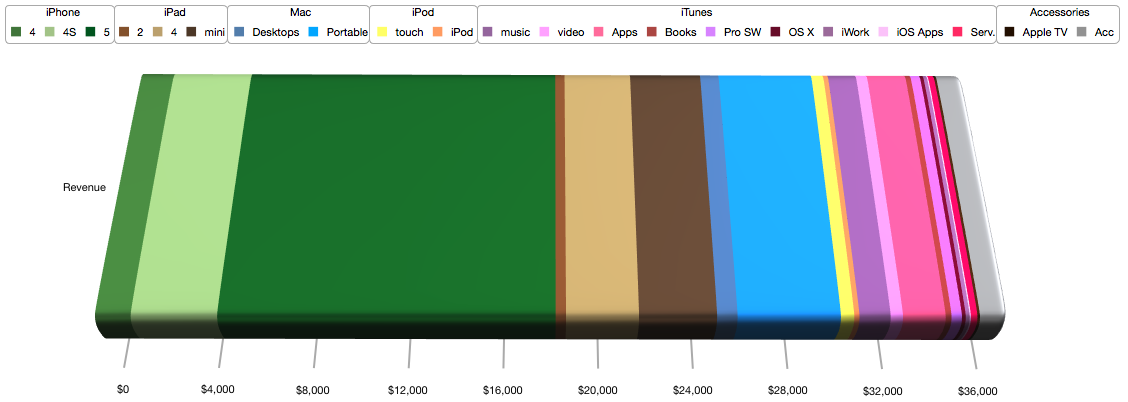
    So rather than trying to imagine a table full of Apple products (some of which are non-phyisical) I thought a more fitting analogy would be to allocate the revenues from these products to a table and thinking about how much space relative to each other the products would take.

    To make conversion easier, I picked a rather large table; 10 feet long, big enough to fit a small conference room. What would this table covered in product revenue look like?

    My estimate is that it would look like this:

    Screen Shot 2013-08-22 at 8-22-11.50.54 AM

    I color coded the product lines as shown in the legend: Greens for iPhone, Browns for iPad, Blues for Mac, Yellow for iPod, Red/Purples for iTunes and Grey for Accessories.

    At this categorization the table would allocate the following space to each category:

    • iPhone (Greens): 60 inches or about half the table.


      Product
      Inches
      iPhone 4
      4.7
      iPhone 4S
      11.4
      iPhone 5
      44.5
    • iPad (Browns): 21 inches


      iPad 2
      1.4
      iPad 4
      9.6
      iPad mini
      10.3
    • Macs (Blues): 5 inches


      Desktops
      2.7
      Portable
      13.6
    • iPod (yellows): 2.5 inches


      touch
      1.8
      iPod
      0.7
    • iTunes (reds), software and services: 15.5 inches


      music
      4.1
      video
      1.6
      Apps
      5.6
      Books
      0.8
      Pro SW
      1.4
      OS X
      0.5
      iWork
      0.5
      iOS Apps
      0.2
      Serv.
      0.9
    • Accessories (Greys): 4 inches.


      Apple TV
      0.3
      Acc
      3.6

    If this colorful table were used to support the actual products, where each product would have to fit within its color band, then the truth of one saying would become apparent: good things come in small packages.

  8. Measuring the iTunes video store

    Research · 41 comments

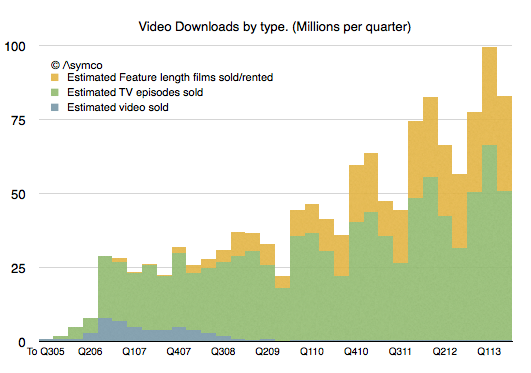
    It's been five years since we had an update on TV show downloads and six years since we've had an update on movie downloads from Apple. In Q3 2008 Apple announced 200 million TV show downloads and in Q2 2007 2 million movies. That's a long period with no information making a tough extrapolation to the present.

    Nevertheless, I tried. My estimates for these two quantities were 963 million TV Shows and 108.2 million movies to date.

    So I was quite surprised to see that figures for both TV show downloads and Movie downloads were published today. The figures were 1 billion and 380 million respectively.

    My TV show forecast has proven to be very accurate but I severely underestimated movie download rates. Apple states that the movie download rate is 350k/day. My estimate  was only about 126k/day.

    After adjusting for the new data, the picture of downloads that emerges looks like this:

    Screen Shot 2013-06-19 at 6-19-6.20.31 PM

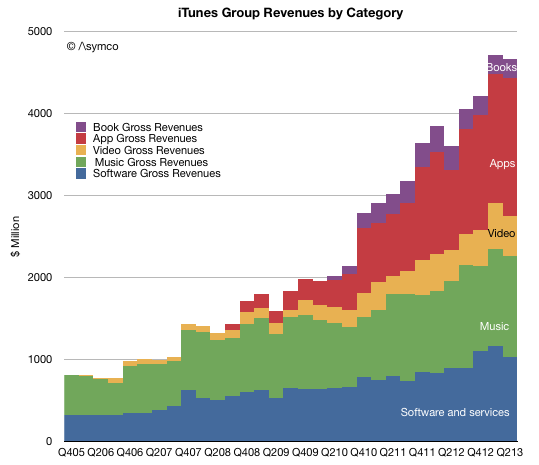
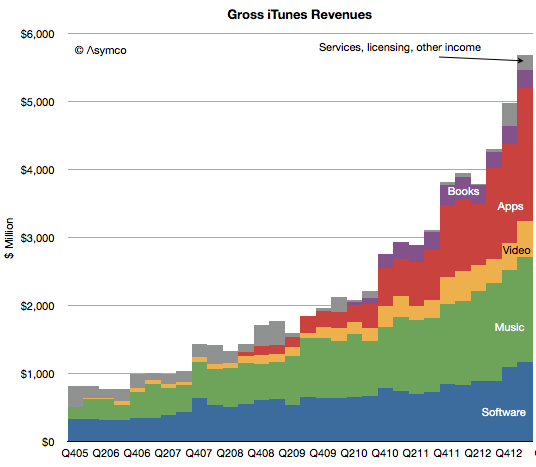
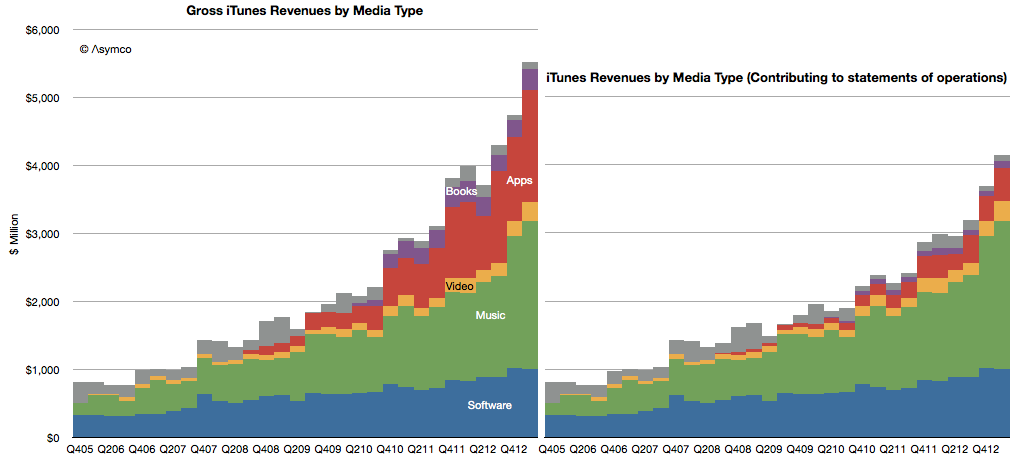
    The overall iTunes gross revenues by sub-component becomes:

    Screen Shot 2013-06-19 at 6-19-6.22.04 PM

    As a result, my new estimate for the rate of spending on iTunes video is about $1.75 billion/yr. This is much more substantial than prior estimates mainly because movies are much more valuable. A tripling of the download rate shows up as a significant rise in the profile of video vis-à-vis the other media types.

    Apps and software are firmly defined and music was somewhat clear. The upward adjustment in Video means that I have to reduce either Music or services. I presently am reducing service revenues but might adjust music as well.

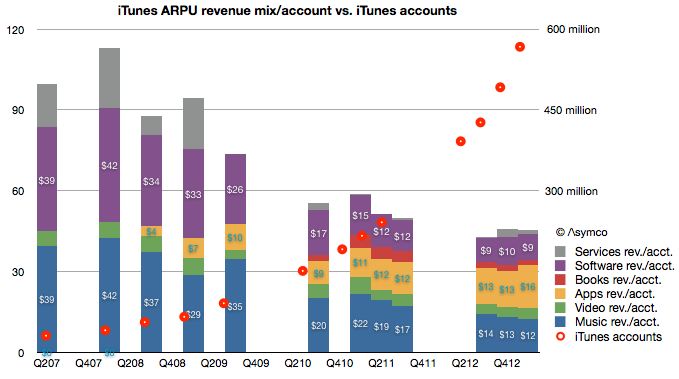
    The overall picture of iTunes is becoming clearer every day. We have more information about number of users (575 million), what they spend on media and software and services ($20 billion/yr.) and, increasingly what they spend on each media type (about $9/yr on Software, $2/yr on books, $16/yr on apps $12/yr on music and $4/yr on video.)

    Screen Shot 2013-06-19 at 6-19-6.34.18 PM
  9. Tim Cook's answer to my first question

    Research · 114 comments

    Tim Cook was asked the first question (on the iPhone portfolio). His answer is paraphrased here:

    We haven't so far. That doesn't shut off the future. Why? It takes a lot of really hard work to do a phone right when you manage the hardware and software and services in it. We've chosen to put our energy on doing that right. We haven't been focused on working multiple lines.

    Think about the evolution of the iPod over time. The shuffle didn't have the same functionality as other products. It was a really good product, but it played a different role — it was great for some customers it was strikingly different than other iPods. The mini played a different role than the classic did. If you remember when we brought out the mini people said we'd never sell any. It was too expensive and had too little storage. The mini proved that people want something lighter, thinner, smaller. My only point is that these products all served a different person, a different type, a different need. For the phone that is the question. Are we now at a point that we need to do that?

    …

    At a macro level, a large screen today comes with a lot of tradeoffs. When you look at the size, but they also look at things like do the photos show the proper color? The white balance, the reflectivity, battery life. The longevity of the display. There are a bunch of things that are very important. What our customers want is for us to weigh those and come out with a decision. At this point we think the Retina display is the best. In a hypothetical world where those tradeoffs didn't exist, you could see a bigger screen as a differentiator.

    Full interview here, answer begins around minute 37.

    Here is how I interpret the answer:

    • The iPhone portfolio may still arrive. It hasn't so far because the cost/benefit is not there for Apple. On one hand it would take a great deal more sourcing effort and risk while dealing with constraints in production. On the other it would not not offer meaningful additions to the customer base. At least so far. The economics and the demand may change (or have changed) and the time will come for a broader portfolio.
    • The comparison to iPod is not entirely appropriate because as a music player, the iPod had a relatively small set of jobs to do. It was hired for exercise, escapism, isolation, etc. It was not hired for apps and services which extend the medium itself. In other words it was not a computer. As a computer, the iPhone has a near infinite set of jobs to be done and it's the hundreds of thousands of apps which help it perform them. But as a result the iPhone needs to conform to the dynamics of ecosystems and that means consistency of APIs and user experience. It cannot vary in terms of input methods, or be below minimum requirements of screen size or memory and power.
    • Because of the rapidly expanding job space, Apple believes the iPhone was not "good enough" for all these years. The improvements shipped for each generation were all "meaningful" in that they were valuable and absorbable. Users would use the new features (like better screens, cameras, battery, etc.) and they were willing to pay for them (as evidenced by the sustained high average price).
    • On the question of what the extension might be, changing screen size is one dimension but it has to be balanced by performance gains that don't detract from other dimensions. Engineering is all about compromise and consumers pay Apple to make these compromises in an intelligent way. Apple does not come to an answer to the question of balance by launching many products and seeing what works. It cannot afford to dilute its brand with a long list of failures. Other brands may not be affected by trial-and-error approaches to the market but they are discounted by the customer accordingly.


  10. iTunes users spending at the rate of $40/yr.

    Research · 77 comments

    In the latest quarter the iTunes top line grew by 32%. Additional newly reported items:

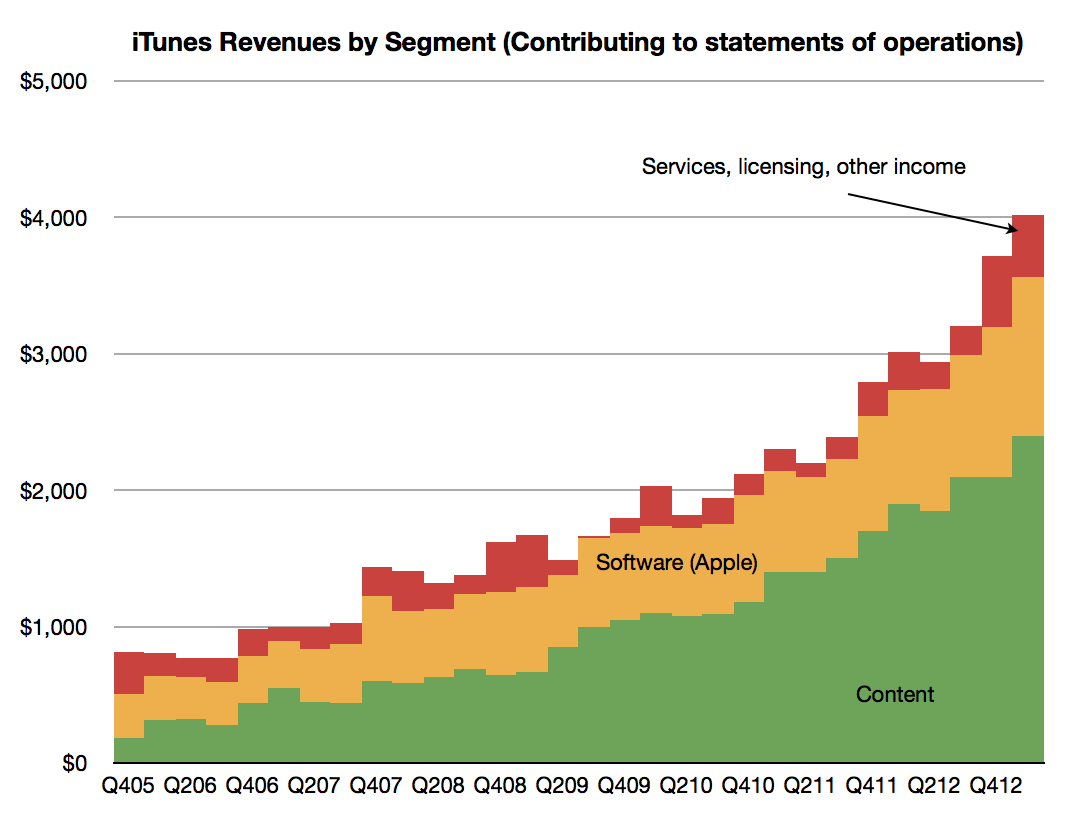
    • Quarterly revenues topped $4 billion (a new high) and the company suggests that this rate is maintainable by stating it has a “$16 billion annual run rate”. The pattern of revenues is shown below.
    Screen Shot 2013-05-12 at 5-12-8.12.30 AM
    • The content portion of iTunes revenues was $2.4 billion, up from $2.1 billion sequentially. Growth into Q1 is not unusual as many holiday iTunes gift cards are redeemed during January.
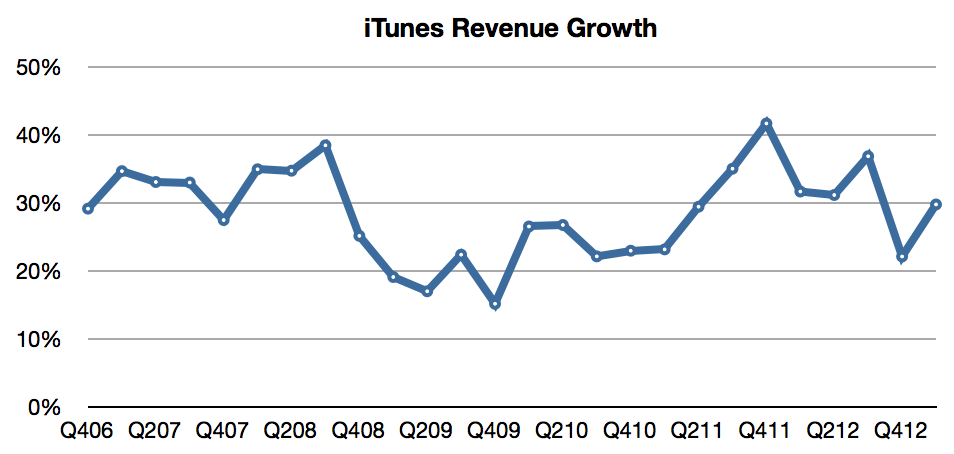
    • Revenue growth has been surprisingly steady, averaging 29%/quarter for more than six years.
    Screen Shot 2013-05-12 at 5-12-8.20.06 AM
    • Music is now available in 119 countries.
    • The Music catalog now consists of 35 million songs.
    • Movies are available in 109 countries. 60,000 titles are offered.
    • iBookstores are present in 155 countries offering 1.75 million iBooks.
    • There are iTunes App Stores in 155 countries whose residents make up about 90% of the world’s population.
    • iOS developers have created more than 850,000 iOS apps, including 350,000 made for the iPad.
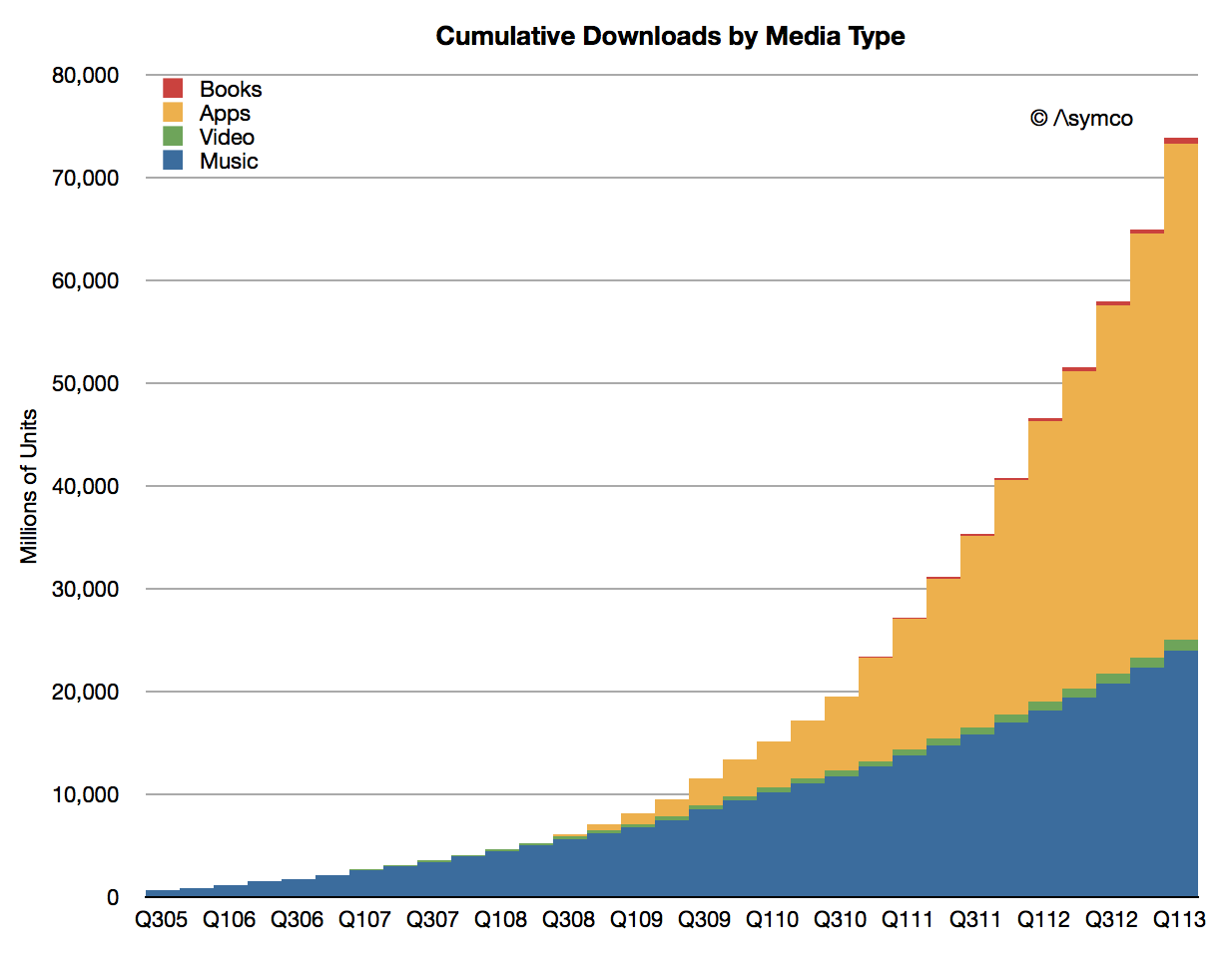
    • Cumulative app downloads have surpassed 45 billion and are on track to reach 50 billion at time of writing (estimated to be reached mid May).
    Screen Shot 2013-05-12 at 5-12-8.21.31 AM
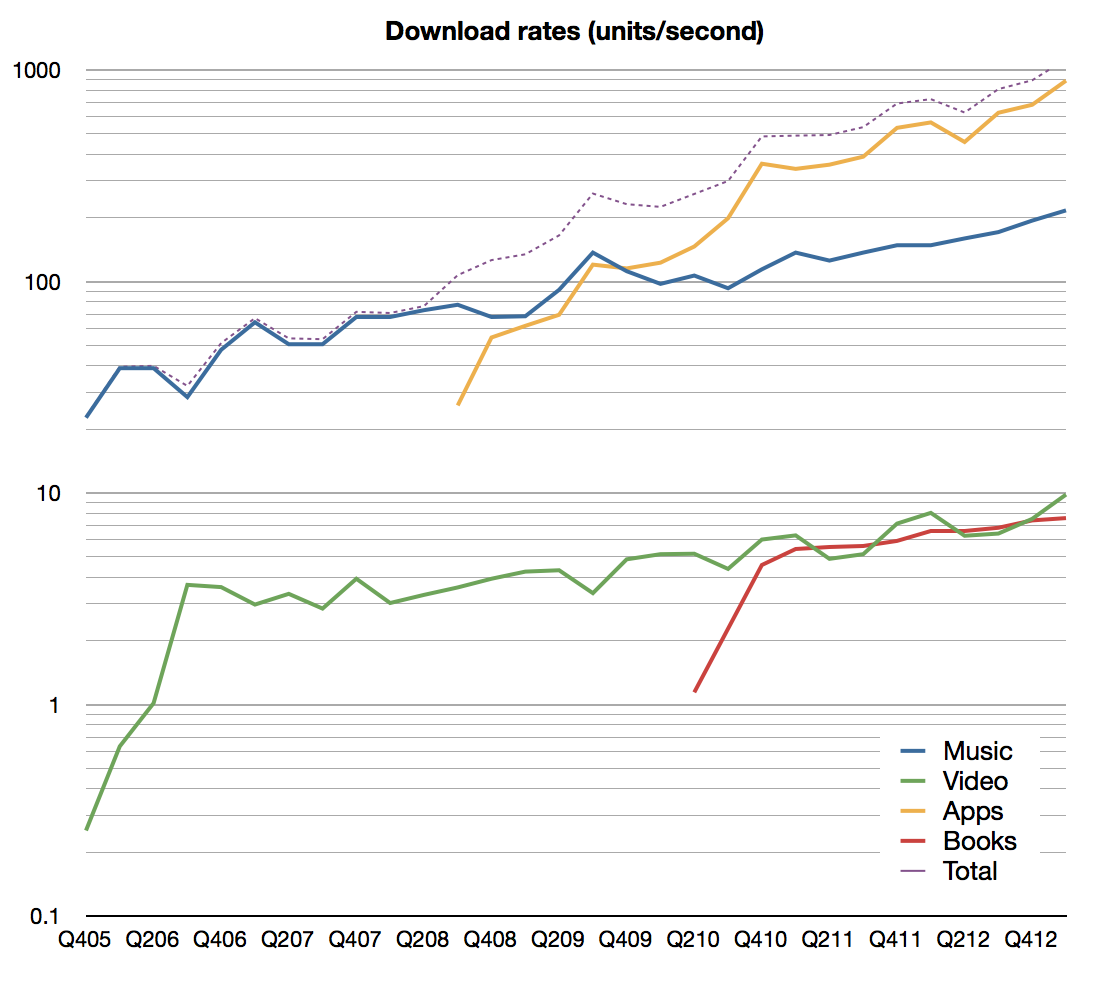
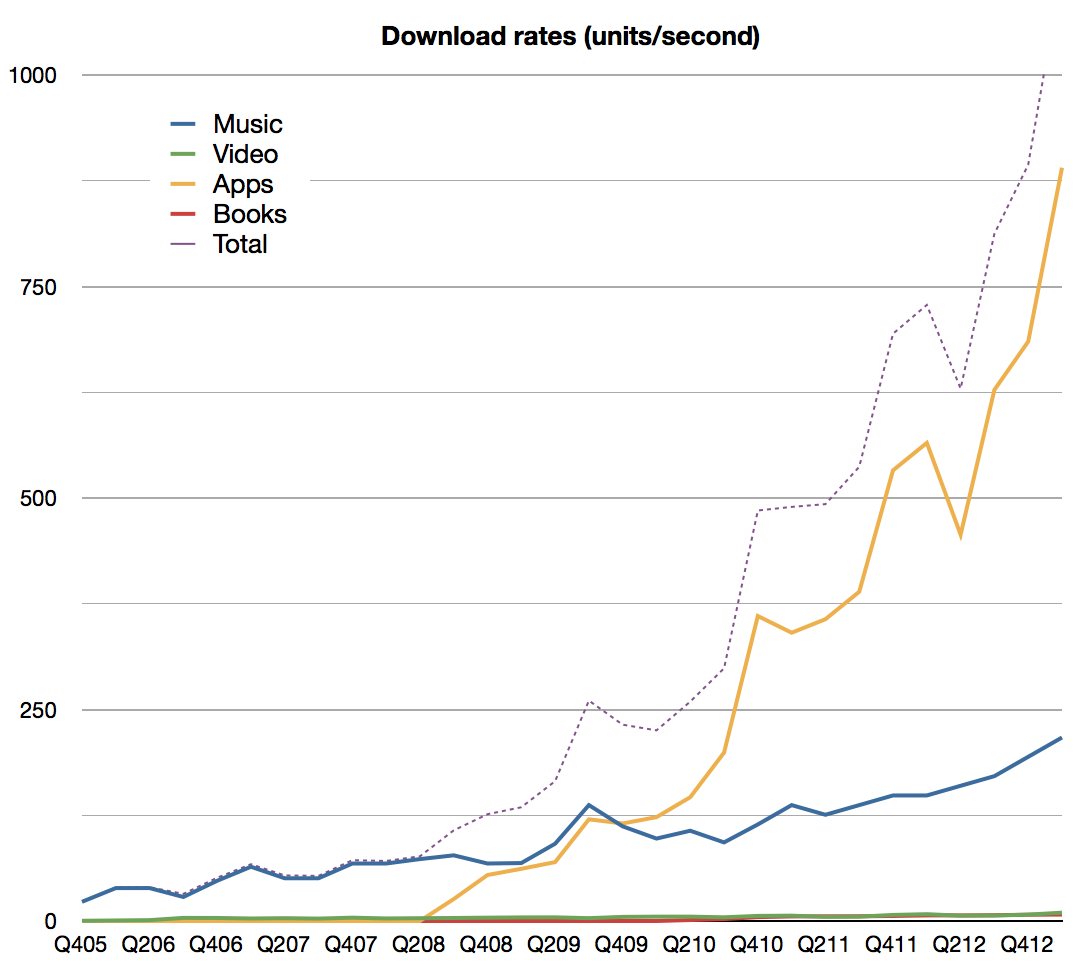
    • The company reports that over 800 apps are downloaded per second. Including all media, the download rate is now above 1000 items per second. Estimated download rates by media types are shown below (note: first graph is plotted on a log scale):
    Screen Shot 2013-05-12 at 5-12-8.34.37 AM


    Screen Shot 2013-05-12 at 5-12-9.07.49 AM


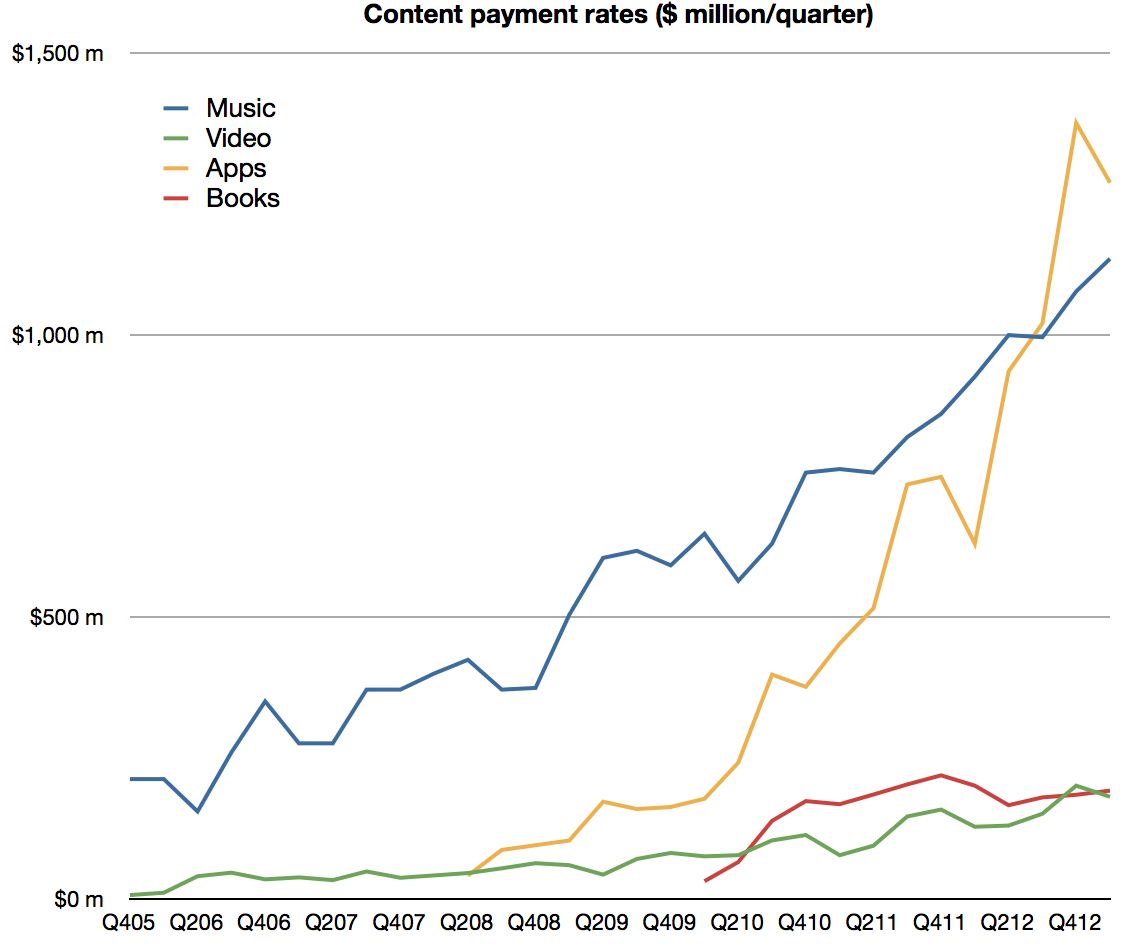
    • App developers have been paid over $9 billion for their sales through the App Store including $4.5 billion in the most recent four quarters. I estimate the split between media types as follows:
    Screen Shot 2013-05-12 at 5-12-9.13.48 AM
    • Canalys estimates that sales from iTunes App Store accounted for 74% of all app sales worldwide in the March quarter.
    • iOS app revenues more than doubled year-over-year.

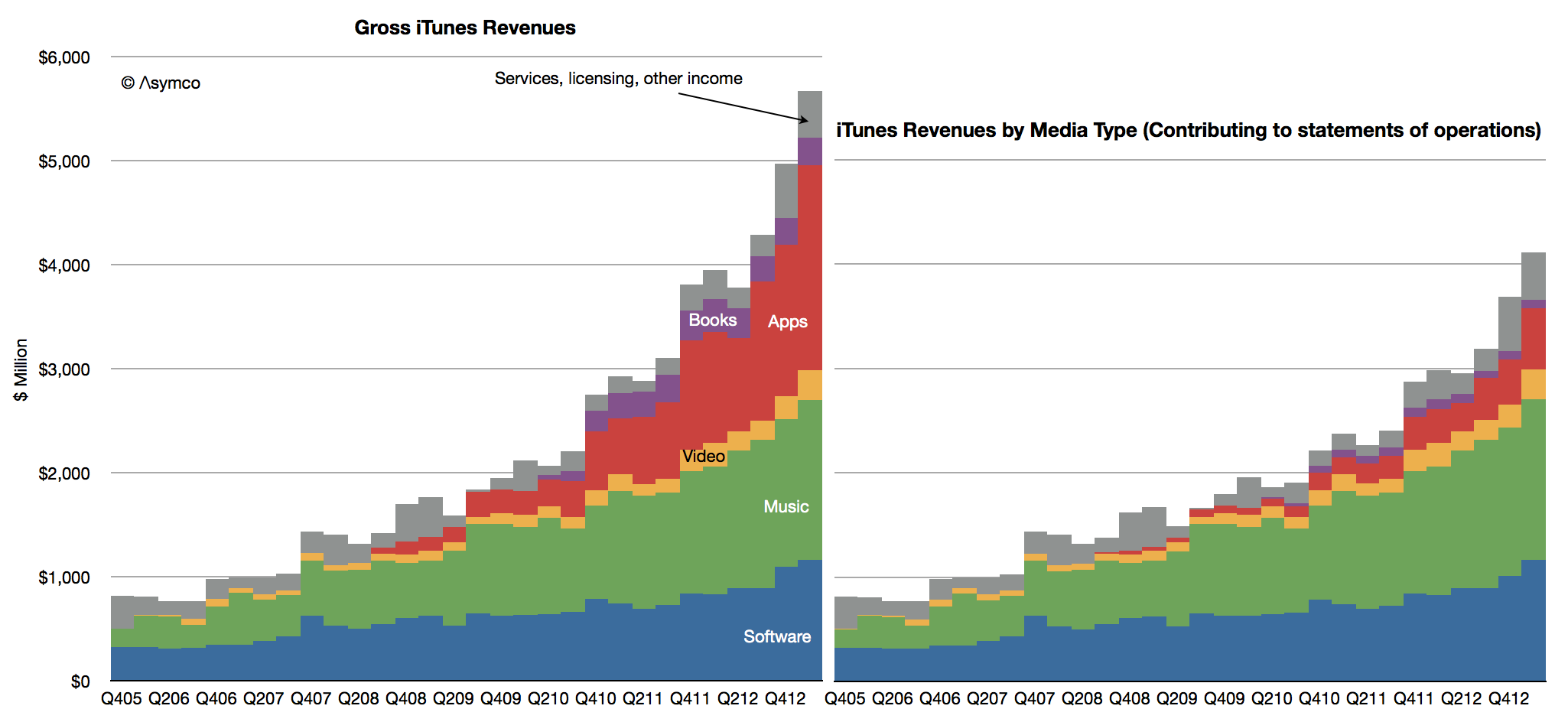
    Including all (gross[1]) content revenues, the sales rate is now nearly $5 billion per quarter ($4.94 billion). Including services, the iTunes consolidated business cleared over $5.5 billion.

    Screen Shot 2013-05-12 at 5-12-9.18.30 AM

    In March Apple reported that they have 500 million iTunes so one way to think about the iTunes business is to say that  iTunes users purchase content and services at the rate of about $40 per year.[2]

    Bless them.

    ---

    Notes:

    1. "For third-party applications sold through the App Store and Mac App Store and certain digital content sold through the iTunes Store, the Company does not determine the selling price of the products and is not the primary obligor to the customer. Therefore, the Company accounts for such sales on a net basis by recognizing in net sales only the commission it retains from each sale. The portion of the gross amount billed to customers that is remitted by the Company to third-party app developers and certain digital content owners is not reflected in the Company’s Consolidated Statements of Operations." From Apple SEC filing 10-K, October 2012.
    2. Apple users spend about $1/day for each Apple device in use making the iTunes franchise an incremental 11% marginal revenue source (assuming one device/user.)
  11. Happy Birthday iTunes Store

    Research · 16 comments

    iTunes (including software and services) revenues in Q1 topped $4 billion and were 30% higher than (re-stated) 2012 Q1 revenues. Accompanying this revenue figure were additional data points from the company:

    • Cumulative app downloads have surpassed 45 billion
    • Payments to developers reached a cumulative total of $9 billion
    • Payments to developers were $4.5 billion in most recent four quarters
    • Now paying $1 billion to developers every quarter
    • 800 apps are downloaded every second
    • iOS app revenues doubled since year-ago quarter
    • App Store accounted for 74% of all app sales in the quarter (citing Canalys)
    • App stores reach customers in 155 countries (850k Apps, 350k iPad apps)
    • iTunes music downloads are available in 119 countries (35 million songs)
    • Movies are sold in 109 countries (60k titles)
    • iBookstore is available in 155 countries (1.75 million titles)

    This data allows for a few inferences:

    • Nearly 70 million apps are downloaded every day
    • The average revenue per game is about 23 cents
    • Gross app revenues are about $16 million per day (of which 11 million is paid to developers.)
    • Gross iTunes revenues were $5.4 billion last quarter of which I estimate:
    •  …App revenues were $1.6 billion
    •  …Music revenues were $2.2 billion
    •  …Video revenues were $287 million
    •  …Book revenues were $312 million
    •  …Apple's software generated $1 billion
    • In addition, I estimate that Services generated $100 million

    Note that there is a difference between the amounts transacted through the store and what the company reports. The difference is shown in the following graph

    Screen Shot 2013-04-29 at 4-29-1.02.50 PM

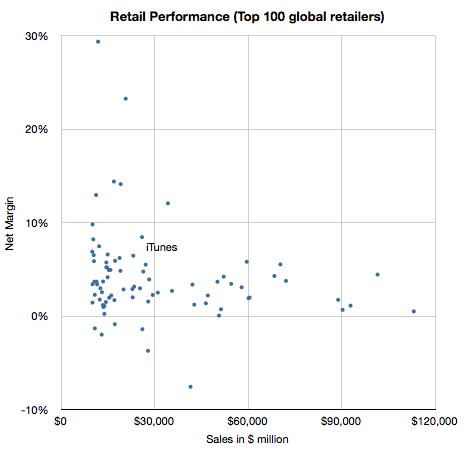
    To mark it's 10th year, I wrote a segment for Billboard Magazine describing what iTunes has become. I suppose it's easy to become numb to these numbers, but there is perhaps one way to look at iTunes that is still compelling:

    Selling $20 billion a year would put iTunes in the top 20 US retailers and top 50 Global retailers.

    Screen Shot 2013-04-29 at 4-29-1.36.41 PM

    Not bad for a 10 year old.