Asymco

Asymmetric Intelligence

Services

  1. The Disruption FAQ

    Research · 28 comments

    Q1. What is disruption?

    Disruption happens when the strong are defeated by the weak. More precisely it’s when those with unconstrained access to resources have them taken away by those with minimal or no resources. It's a phenomenon that is in contrast to sustaining competition where the strong get stronger.

    Q2. How can disruption happen? Don’t the strong always have an advantage over the weak?

    The strong can be defeated when the fight is unfair. More precisely, "strength" is only a perception based on convention or historic precedent. The entrant may be weak in resources but may be strong in a way that is not seen as conventionally useful or valuable such as agility or a willingness to learn.

    Q3. What makes a fight unfair?

    A fight is unfair if the opponents fight according to different rules. This is also called asymmetric competition. Asymmetry is an important concept in game theory, economics and military science.

    Q4: Is there a way to know disruption is about to happen?

    Disruption theory is an attempt to reliably identify winning challenges. It includes a method of analysis of "the setting" of the fight and "the weighing” of the fighters. In other words, it measures whether the challenger is sufficiently asymmetric and whether the incumbent is flexible enough in their likely response. If there is insufficient asymmetry the theory would suggest the challenger will lose, and vice versa.

    Q5: How often does it happen?

    In some industries it happens quickly and in some industries slowly and in some never at all. Determining the cause of the rate of disruption is an important research topic. We can hypothesize that industries which show frequent disruption also show a high degree of wealth creation. The inverse is also true: industries that don't get disrupted don't create much wealth.

    Q6. How do incumbents react to asymmetric challenges?

    This quote (mistakenly attributed to Gandhi) describes it best: "First they ignore you, then they laugh at you, then they fight you, then you win." The main test of asymmetry is to ask whether a challenger’s entry is ignored (or welcomed) by the incumbents. Most asymmetric challenges are not taken seriously because they initially benefit the incumbent. The side-effect is that it lulls them into a sense of security resulting in a lack of response. Challengers have the child-like advantage of rapid growth and learning while incumbents are encumbered by their size and lack of flexibility.

    Q7: Why don’t challengers respond in kind?

    Mainly because they don’t feel that they need to. The newcomer is either not seen as a threat or welcomed because the customers they obtain that are not seen as valuable. In some cases the business model of the entrant is contrary to that of the incumbent. In other words, the challenger makes money in a way that would cause the incumbent to lose money. Often the challenger is actually invisible because she misdirects attention. They may be seen as competing in one market with a certain set of competitors but their effect is in another market which never had to deal with a challenger.

    Q8: If there are different ways disruption can be observed, doesn’t that mean there are different types of disruptions?

    Yes. When a competitor challenges with a cheaper product that seems to perform poorly and has low margins and the incumbent accepts the entry because it allows them to concentrate on more profitable customers then this is called a “low-end disruption”. Here the asymmetry is in cost structure. The entrant has lower costs and accepts lower profit margins and may “make money” in new or different ways.

    When a competitor misdirects attention by selling a product that draws usage from existing customers and adds non-consuming new customers because it enables new uses, then the incumbent feels no pain from the entry because they don’t sense a reduction in customers. We call this a "new market disruption". The challenger gains a foothold and grows/evolves, eventually capturing customers exclusively. Here the asymmetry is in the basis of competition and measurement of "performance". The new product does not actually do the same thing as the incumbent product or does a subset of valuable tasks poorly while excelling at menial tasks. The entrant may be highly profitable but they are not taking profits away from incumbents because they "grow the pie", capturing value by fulfilling unmet needs.

    Disruption can also happen to professions and institutions when less skilled individuals are enabled to perform complex jobs or when professionals can establish good enough services that used to take institutional support. This is called professional services disruption.

    Technological change is often (but not always) the core enabler in creating disruptions. The analogy is that technology is a weapon that allows asymmetric combat but the combatant is the disruptor, not the weapon ((See David vs. Goliath: using a projectile allowed David to overcome Goliath but only when wielded skillfully)).

    Q9: It sounds like the trick to spotting disruption is in perceiving when the fight becomes “unfair” and an outsider advantage is gained. Does the theory make this easy?

    It makes it possible but not easy. Understanding when a basis of competition changes and where competition is shifting is still very difficult. It is notoriously difficult to sense when it’s happening to you because you are working toward a strategy with assumptions that have been tested and proven to be correct. In other words, you, your colleagues, your competitors and everyone you’ve ever met knows the rules of the fight. Insider status makes you an expert, your knowledge is far beyond a lay person’s and you have a track record of winning. Hubris and pride makes it difficult to accept a challenge from an ignorant outsider.

    Furthermore, an outside analyst who is not suffering from these psychological weaknesses may not have the means to measure change because they don’t have access to market metrics. So you can’t typically hire a consultant to help you spot it. This is where the theory helps. If you are a practitioner then you can use the theory as a lens to see the patterns in the operating data.

    The proper application of the theory requires domain knowledge or deep reading of weak signals. It’s best employed by incumbent operating managers analyzing their own industry. It’s a tool that can be used to overcome the perception of incumbent invulnerability. It is not a tool that can be used by armchair generals. They can pick up the lens but, not having any data to look at, they have have no patterns to recognize. (This last point is disputed. See comment.)

    By the way, entrants don’t benefit much from it either because they act disruptively by instinct. They enjoy the freedom of having nothing to lose.

    Q10: How long does this take? Isn’t a shift in competition natural over a few decades?

    The speed of disruption is changing rapidly. It used to take decades but now it takes years and in some software industries it could be happening in less than one year. When it used to take decades it did not matter much because the “victims” of a disruption usually could spend a career in the firm being disrupted and would not have to adjust their behavior or assumptions. The consequences would have been felt by future generations. The rate of disruption today is so rapid that many careers and lives and families are having to deal with the consequences, sometimes more than once. Estimating the acceleration and scope of disruptive change is a great research topic.

    Q11: Is the theory complete? Can't we just write an app for it?

    It’s not complete. It cannot be encoded as a deterministic algorithm. It’s not even likely that expert systems or neural networks or machine learning can help. This is because perception of change in competition is a skill informed as much by intuition as by data and rules. If the theory is developed further, through a process of theory building, then it might become an app.

    Q12: If the theory is not complete, then isn't it useless?

    A theory is not useless if it's imprecise or difficult to use. Data that would make conclusions precise is often missing or unavailable. The theory relies on weak signals and explains what used to be unexplainable. Many sciences developed from empirical analysis similar to where we are with disruption theory. Theories benefit from development.

    Q13: Is the theory being developed further?

    Yes. There is a process for theory building which has been ongoing for over a decade where many researchers, students of disruption and practitioners are contributing.

    Q14: Can the theory be applied outside of business competition?

    Yes, institutions can be disrupted as can individuals. Possibly even economies and states. This is because a growing technological base and communications enable asymmetries of ever-greater scope and speed. The research needed to establish how this happens is under way. However it's important to know the limits of the phenomenon. Incumbents are getting wiser as they wield the theory and some "settings" show resistance to change and thus prohibit technological cores to be utilized disruptively. The study of these anomalies is essential to the process of theory building.

    Q15: Is disruption a force of nature? Has it always existed? Will it never end?

    Oral traditions suggest that people have been aware of disruptive forces for all of history. We feel it in the school playground and in many personal relationships. It's in the Bible and the classics that predate it. It's visible in all cultures. Disruption theory as applied to business and government is only an extension of this causal individual behavior into complex systems. It’s possible that awareness of it might cause the behavior to change, or, put another way, that if you observe and understand the phenomenon, that knowledge could cause it to stop happening. But the systems involved are vast and learning curves are long. Enlightenment may take a few lifespans.

    Update:

    Here are questions which have been added based on reader feedback. Please feel free to suggest others in the comments.

    Q16: Isn't Disruption just evolution of business models?

    Business models evolve, but if the evolution sustains an existing incumbent then it's not a disruption. If an evolution is  adopted by an entrant who then proceeds to strip the assets and profits from an incumbent then it's a disruptive change. The key question is why do some changes get adopted and not others.

    Q18: What have been the major improvements in the theory since its introduction in 1997's The Innovator's Dilemma?

    From Clay Christensen's work alone: New Market Disruptions, Professional Disruption, Value Chain Evolution Theory, Jobs to be Done Theory. The Innovator's Solution including how to respond with autonomous self-disruption, the role of acquisitions, the study of Healthcare and Education as targets of (and anomalies to) disruptive change. The process of theory building. The Capitalist's Dilemma and how economies create incentives and disincentives to disruptive innovations.  Many other contributions from researchers too numerous to cite here.

    Q19: What industries cannot be disrupted

    Industries which experience no disruptions are "anomalous" in that the theory suggests that technological progress forces change and technologies have proliferated in almost all industries..  Industries or institutions which have remained largely undisrupted include Energy, Education, Government, Healthcare, Airlines and Hotels. The study of these anomalies continues and explanations identify conditions that prevent growth. Dependencies on regulation, infrastructure, and absence of technological core enablers caused some of the atrophy to date. However signals of change are appearing in all these industries and paths to disruption are clearly possible.

    Q20: How is it possible that companies which were claimed to be disrupted are still around and some which are claimed to be disruptors have vanished?

    Being disrupted does not mean ceasing to exist. Being disrupted is a loss of a specific encounter, but not necessarily a terminal loss. Being a disruptor is a win in a specific encounter and not a guarantee of immortality. Indeed many disruptors come to be disrupted and the theory suggests sustainable growth requires self-disruption. Also a disrupted company can be re-configured post-disruption into another entity or can muddle along with limited value indefinitely. Sometimes they can rise up and become disruptors again.
  2. Twenty Questions from Catalin Stelian Andrei

    Research · 17 comments

    Catalin Stelian Andrei, Editor of The Day, INTERNET PROTV asked me twenty questions:

    1. What phone do you have in your pocket right now? Why that model?

    I carry the iPhone 5. The last iPhone I bought was an iPhone 5C which I gave to a family member.

    2. Apple is going to launch, form all we know, an iPhone with a bigger screen, long after their market rivals. Is Apple one step behind, being forced to take this road in the fight with Android and Windows Phone devices? Because many smartphone users were hoping that an big screen iPhone, a redesigned model, will be lauched long time ago, and that didn’t happen.

    Making bigger phones is easier than making smaller phones. First because miniaturization has always been the most difficult engineering challenge, and second, because a smaller phone has a smaller battery making efficiency much more important. The larger the phone, the simpler it is. The third reason smaller is more valuable is that it’s easier to carry and use. The largest phones cannot be put in pockets and cannot be used with one hand. In the history of consumer, electronics size reduction has been the most consistent measure of performance, and the most rewarding. Usually the most exceptional reductions in dimensions create the highest price and profit bands. There have been niches for larger portable devices but they are consistently a small part of the overall market. If Apple were to introduce a larger device I hope they will be able to solve usability problems and make the category attractive to a larger audience.

    3. What do you expect from the new iPhone 6?

    I expect it to run the latest version of iOS and, with the new apps developers will ship, that should make the most impact in people’s lives. I imagine health maintenance and home automation will become valuable new franchises. Of course iOS 8 will also run on older iPhones, but I suspect the newest iPhone will somehow run the new software better and have smoother integration with services.

    4. What’s the “not to do” lesson that Apple needs to learn for the now iPhone from it’s own past experience or their competitors?

    The biggest challenge is to move rapidly with scale. The company has managed to grow from zero phones a year to hundreds of millions. That’s great but it’s still frustrating to wait one year for major improvements. The “cycle time” of innovation for Apple remains one year. I wish it could be faster but perhaps this is also too fast for some. In some services like maps and iCloud and iWork, which are independent of hardware (mostly,) speed is of the essence.

    5. The iPhone is the most expensive smartphone on the market right now. In Romania, it certainly is. But where does Apple gains it’s most money from, selling products to users or selling services, like iTunes, App Store? And having that in mind, what will be their next step: better – breakthrough products or bigger, more complete services?

    The answer to where a company “gets its profits” is best answered by asking where a buyer “gets his value” from the product. For instance you might answer the question of where a car company gets its value by saying that it’s from making people be in more than one place in a day. So the “differentiation” of a car is in answering the question slightly differently. If it’s hard to see a difference to this answer between cars then it’s hard for any one company to make a profit. For a company like Apple, we need to ask what its users value about the experience and why they are willing to pay for that. My hypothesis is that the brand's value is in making life a little bit easier. That’s what Apple competes on. Of course, some people are not willing to pay to have an easier life and some even want to make their lives more complicated so Apple’s proposal to make life easier, for a price, is not accepted by everybody—which is ok by them. But for many, paying for comfort, productivity and ease of mind is worth quite a bit. The reason Apple is able to gain a premium over the competition is that this value proposal (of paying for simplification) is either weak or non-existent for competitors. Indeed, many competitors compete on the basis of making life more complicated.

    6. What does innovation means for Apple right now? What are their options for assuring a next decade of success? A new Steve Jobs person or a Steve Jobs tipe of group thinking. How hard is that to achieve?

    Innovation is meaningful invention—bringing useful creations to a large number of people who then make use of that creation. The interesting aspect of making money from innovation is that it’s a rare phenomenon, requiring many disciplines to work together. It’s like a big movie that somehow works and becomes widely popular but costs little to make. Many movies are made, few are successful and very few of those which are successful are built at low cost. What we know about technology innovation is that it’s a combination that comes together under strong leadership but that leadership alone is not sufficient. The myth of Steve Jobs is that he was both necessary and sufficient to success. The truth is that he was necessary but not sufficient. To make successful innovations requires strong leadership and teamwork and a process of incentives and passion that is hard to create a formula for. How this works at Apple is its biggest secret.

    7. Who are the key Apple employees right now? Do they need another Jobs or do they already have him?

    All Apple employees are key. I would say that’s the magic formula. There is no chief magical officer (and there never was.)

    8. What will be the next best thing for Apple? […]

    I don’t know. It’s probably not knowable.

    … Are they capable of another breakthrough in the market?

    Yes. This is almost certainly knowable.

    9. Is the smart-home project something that will really happen in the next, let’s say, two decades?

    If the project requires replacement of existing infrastructure, it will not happen. If the project allows adding new items to existing infrastructure, it will almost certainly happen.

    10. Growth comes from the middle and low-end smartphones, according to IDC. Would or would not be a good idea for Apple to release a handset cheaper than the 5c?

    If Apple were concerned with growth then they should. But we have to ask why they avoided doing this six years ago. Not only was it obvious to do so but a portfolio strategy was the modus operandi for every competitor and had been for decades. The question isn’t why Apple does not broaden its line-up but why do the others diffuse their efforts and have such poor focus.

    11. What feature or software you think would be the main battleground in the future, in the smartphone market? Apps? Battery? Camera?

    Integration of all the above. When new experiences and services emerge those who are able to make them usable succeed. Usability requires integration.

    12. Who puts more pressure on Apple: Apple itself, Samsung, LG, HTC, Microsoft and Nokia? And how.

    I suspect competition is part of motivation but it’s not the entire story. Let’s not forget that Apple is considered to suffer from competitor pressure from software companies, services companies, media companies, hardware companies and everything in between. For instance, Apple is in competition with Microsoft, Amazon, Google and Samsung but the competition is not transitive. In other words Amazon is not perceived as being in competition with Samsung and neither is Google competing with Nokia. So somehow Apple should be sensitive to every perceived alternative to every aspect of its products. This quickly becomes an absurd idea. Apple is a system of things and systems can’t be compared with components.

    13. What is Apple’s sensitive spot today. What do you believe Apple fears the most?

    Losing people. The problem of retaining talented people is the most difficult challenge, especially when they become very wealthy due to the success of the firm.

    14. In 2012, you described the fall of Nokia in competition with Samsung at the Guardian Mobile Business Summit due to the disruption theory: the launch of the smartphone. Is Apple in danger of becoming a victim of the same story in the near future? What technology could replace the smartphone and when?

    Yes, every company is vulnerable to disruption. The defense is not to protect against it but to self-disrupt or enable self-destruction. Self-preservation is an instinct in humans so this is psychologically very difficult. The crisis comes not from a technology change but a business model change and that implies a cultural change. Companies embrace any and all technologies which sustain their business models and reject, resist and ignore any and all technologies which disrupt their business models. Changing business models is like a brain transplant; it happens so rarely that we can count it on one hand. By the way, because it’s so rare is why companies who attempt it are discounted by the market.

    15. You've been a Nokia executive. From this perspective, how do you see the deal with Microsoft and the future of Windows Phone and the Lumia brand?

    This is a long story. I can’t really do it justice now but I will say that it seems that Microsoft understands that they need to become an integrated systems company and not a component supplier. The same became evident to Nokia so they needed to merge.

    16. You've also worked with people from RIM. Do the have the capacity to innovate?

    Perhaps but scale also matters. RIM and HTC may not have the time to grow.

    17. Let’s imagine that no big company owns my personal information. If I wanted to sell that to someone, what would be the right price to ask? How valuable are individuals in the war for gaining personal information?

    The price of your personal information will be set by auction. It’s up to you to decide if you want to create a reserve price or to let the highest bidder win. As of today most people would trade all their personal information for almost zero price. This will not last and consumers will find out their value over time. I can’t predict how it will change but it will be a combination of offers being made and personal data catastrophes which will act as warnings.

    18. Do you believe in phoneblocks project from Motorola?

    Only people who want more complicated lives will want to build their own products. There are some such people (for example children) but they are not willing to spend a lot for that complication so the overall market for increasing complexity is small.

    19. The last question. What could trigger an Apple fall and when?

    The most common trigger for failure is success. To continue succeeding is very hard because motivation disappears. What can cause a crisis of motivation would be that there is a loss of belief that there are problems left to solve.

  3. Questions for Eddy Cue and Craig Federighi

    Research · 65 comments

    The Re/Code conference begins this week, and Apple executives Eddy Cue and Craig Federighi will be answering questions from Kara Swisher and Walt Mossberg.

    Here are some questions I hope they ask:

    For Eddy Cue:

    1. Why is there no app store for Apple TV? Even though the product is running essentially the same hardware and software as the iPhone and iPad and iPod touch and even though it connects to the iTunes stores, there is no option for developers to build apps for it or for consumers to use their TVs to run iOS apps. I might add that it’s been seven years since the platform launched and that’s a long time to wait.
    2. As Amazon has been granted a monopoly on the distribution of ebooks by the US federal government, why not compete by selling ebooks as apps? Apps were used as ebook containers well before the iBookstore launched and there were tens of thousands of “book apps”. Why not encourage authors and publishers to build apps by offering tools which make it easy to do so? I might add that if you do this for authors, why not do it for musicians and video producers? Why have separate stores for different media when they are all just content?
    3. YouTube is becoming the TV of choice for millions. Before it becomes that choice for billions, what are you doing to encourage user-generated video content distribution through your ecosystem?
    4. Apple’s Services revenues are growing remarkably quickly. The number of users is over 800 million. Do you see an opportunity for services to become a more independent business at Apple? In other words, why not bring iTunes to Android?

    For Craig Federighi:

    1. Marc Andreessen uses the phrase “Software is Eating the World” to describe the disruption that software-enabled businesses are having on those who don’t depend on software. You are the head of software at Apple; what’s on your plate? In other words, what do you see the opportunity for software at Apple beyond enabling device sales? I might add that although you are leading Software Engineering at Apple, Software and Services are part of Eddy’s organization. Does this separation make sense?
    2. It’s likely that iOS will be used by more people than Windows in the near future. What do you see as the obstacles to iOS replacing Windows for what most business users use daily?
    3. If you believe that iOS can replace Windows (at least in some tasks), do you think the iPad will ever replace the Mac?

    This was originally posted on LinkedIn on May 28th.

  4. Measuring Not Getting the Cloud

    Research · 140 comments

    This is what "Not getting the Cloud" looks like:

    Screen Shot 2014-05-09 at 5-9-3.30.03 PM
    Screen Shot 2014-05-09 at 5-9-4.04.33 PM


    "Not getting the cloud" means that in the last 12 months Apple obtained:

    • 800 million iTunes users and
    • an estimated 450 million iCloud users spending
    • $3 billion/yr for end-user services plus
    • $4.7 billion/yr for licensing and other income which includes
    • more than $1 billion/yr paid by Google for traffic through Apple devices and
    • $13 billion/yr in app transactions of which
    • $9 billion/yr was paid to developers and
    • $3.9 billion/yr was retained as operating budget and profit for the App Store. In addition,
    • $2.7 billion/yr in music download sales and
    • more than $1 billion/yr in Apple TV (aka Apple's Kindle) and video sales and
    • $1 billion/yr in eBooks sold

    In summary, iTunes, Software and Services has been growing between 30% and 40% for four years and is on its way to $30 billion/yr in transactions and sales for 2014.

    This is what can be deduced from a reading of Apple's financial statements of operations. If there are comparable details for companies which do get the cloud, I'll be happy to tally the comparison so we can calibrate this failure.

  5. Monthly Apple Users

    Research · 70 comments

    In the postmodern computing world that we live in, the measure of success isn't revenue or profit or units sold but the number of users that an ecosystem can attract. Therefore the monthly active user (MAU) unit of performance seems to be in vogue right now. E.g.:

    • Facebook claims Messenger has more than 200 million MAUs
    • WhatsApp has 500 million MAUs, 48 million of whom are in India
    • Line last month announced that it had 400 million users (active or not)
    • WeChat claimed 355 million MAUs
    • Viber claims 105 million MAUs

    Startups are aggregating these millions of MAUs in order to obtain valuations for raising capital ((It's been said that it's difficult to get funded with only 10 million MAUs)) and the faster the growth in MAUs the more "successful" the company is considered.

    When companies are acquired it's common to take the transaction value and divide it by MAUs to get an idea of "what an user is worth". This is because there are no revenues to measure and MAUs are taken as a proxy. However, the process by which a MAU becomes a dollar of profit is, to put it kindly, circuitous.

    For most (all?) it's not yet clear how it happens especially since not all MAUs are created equal and MAU loyalties can change rapidly and if we added all the projected revenues each MAU will contribute to each app on her device we might reach some absurdity. In actuality, today, for the companies listed above, there are no revenues at all directly from their services.

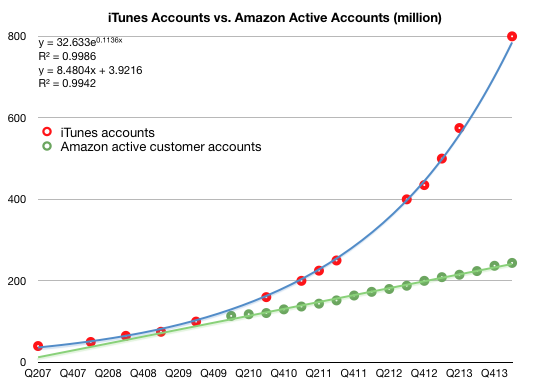
    In violation of this convention, there are some companies which manage to obtain revenues from their users. Two such are Apple and Amazon.  In the last quarter Apple reported having 800 million iTunes accounts. ((adding, for some unknown reason, that most of them have credit cards.))  These aren't MAUs since the activity level is not noted, but we do know how much is spent on iTunes and services. In addition, Amazon cites 244 million active customer accounts  representing accounts which generated purchases within the last 12 months.

    This allows us to compare Apple and Amazon in terms of accounts, revenue per account, and, via some analysis, even profitability per account.

    The following graphs tell this story. First, the total number of accounts:

    Screen Shot 2014-04-29 at 4-29-11.25.29 AM

    Note that I added trend lines to both graphs and their formulas.

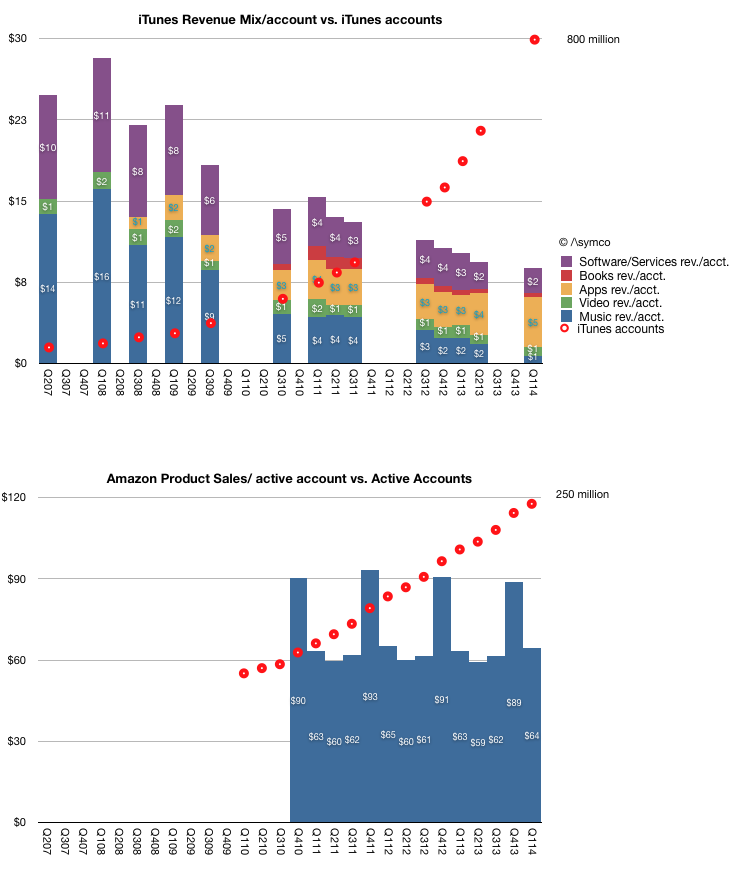
    The following are the revenue per account for iTunes (further broken into estimated iTunes segment revenues per account.) and for Amazon. Note that the vertical scales are different.

    Screen Shot 2014-04-29 at 4-29-12.05.06 PM

    This view shows just how different the economic value of users can be. In the case of Apple, it's growing its user base at (literally) exponential rates. The revenues per user does, understandably, decline. This is because new/later users don't spend as much as early users. There might be some stability toward the later stages of adoption in revenue per user. The other point about iTunes data is how the mix of revenues has shifted from music to Apps and Services pointing out how users can be migrated across revenue sources over time.

    In the case of Amazon it's growing its user base at a linear rate (note equation). The revenue per account remains very steady however.

    Broadly speaking, it would seem logical that the speed of user growth has an effect on the quality of those users. This relationship should guide further thinking about the quality of hundreds of millions of users acquired within a few months.

    Apple's user growth is a function of expanding its device portfolio and distribution. Apple has shown that there are limits this type of growth. Achieving 830 million or so iOS device sales within 7 years is an amazing feat and one can forgive not having achieved billions more since they managed to obtain significant hardware and service/content revenues from most of them and that those who reached higher figures more quickly didn't manage the same revenue per user.

    Amazon's user growth is a function of expanding its logistics and merchandise mix. This is also not easy to do globally. Arguably, Amazon cannot scale in the exponential rates seen by Apple or the other MAU aggregators because it has to depend on trucks and roads and regulators to complete most of its sales.

    I suppose, in conclusion, that there is no "right" or "wrong" business model for a user base. Both Apple and Amazon are doing well in building their customer bases and creating loyalties which will serve them well in the future. However whereas there is no right or wrong revenue structure per user, it seems to me that there ought to be some such structure. In most cases this remains a matter of faith rather than reason.

  6. Postmodern computing

    Research · 99 comments

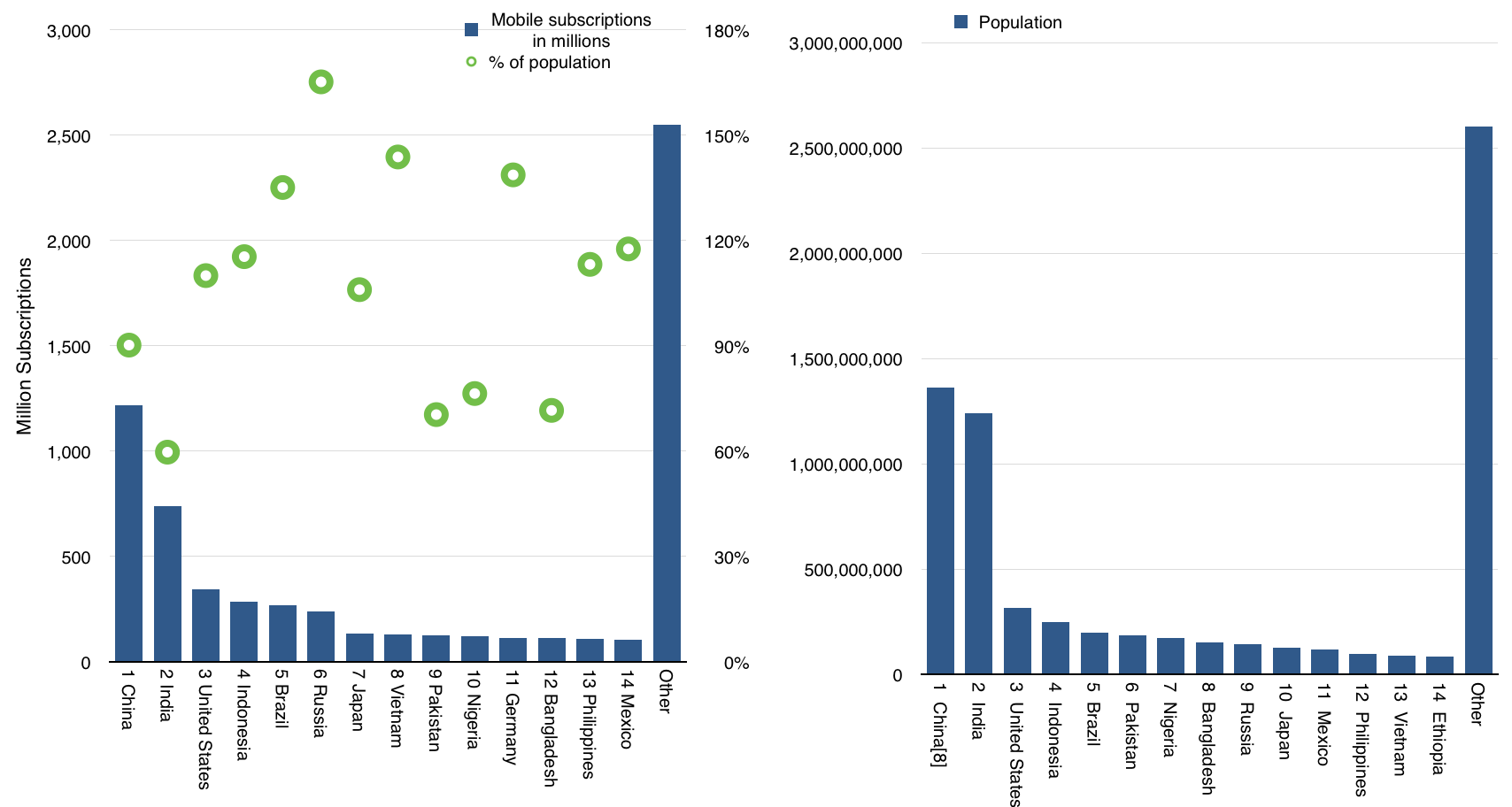
    There are 7.1 billion people on Earth. Coincidentally there are also 7 billion mobile connections.  Those connections are held by 3.45 billion unique mobile subscribers. ((GSMA)) Unsurprisingly, the largest national mobile markets (by number of subscriptions) correspond closely to the most populous nations.

    Screen Shot 2014-04-07 at 7.21.46 AM

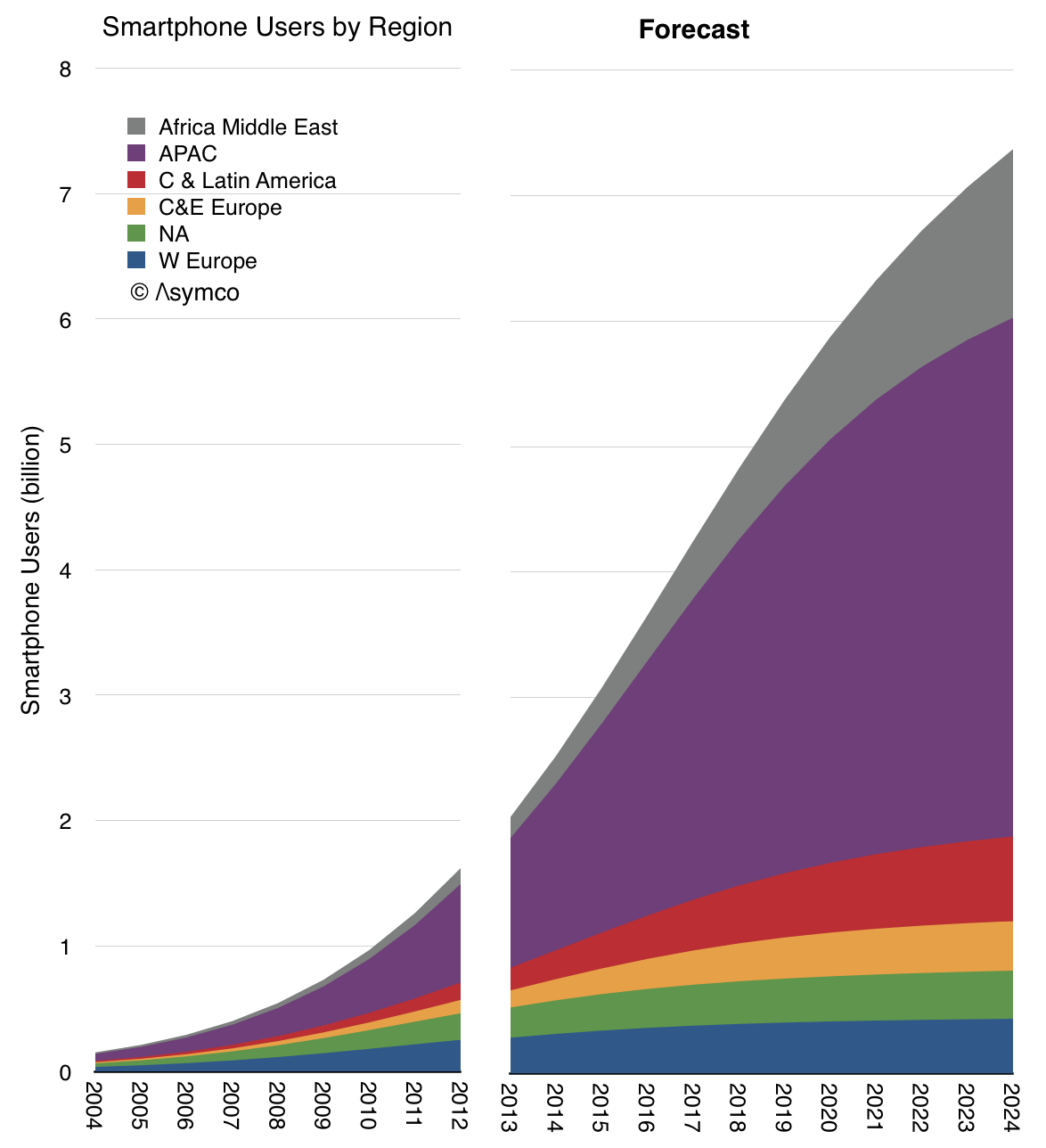
    Considering smartphones, last year 1 billion smartphones were sold and the number of smartphones in use is about 2 billion ((There are also about 2 billion 3G/4G connections world-wide))

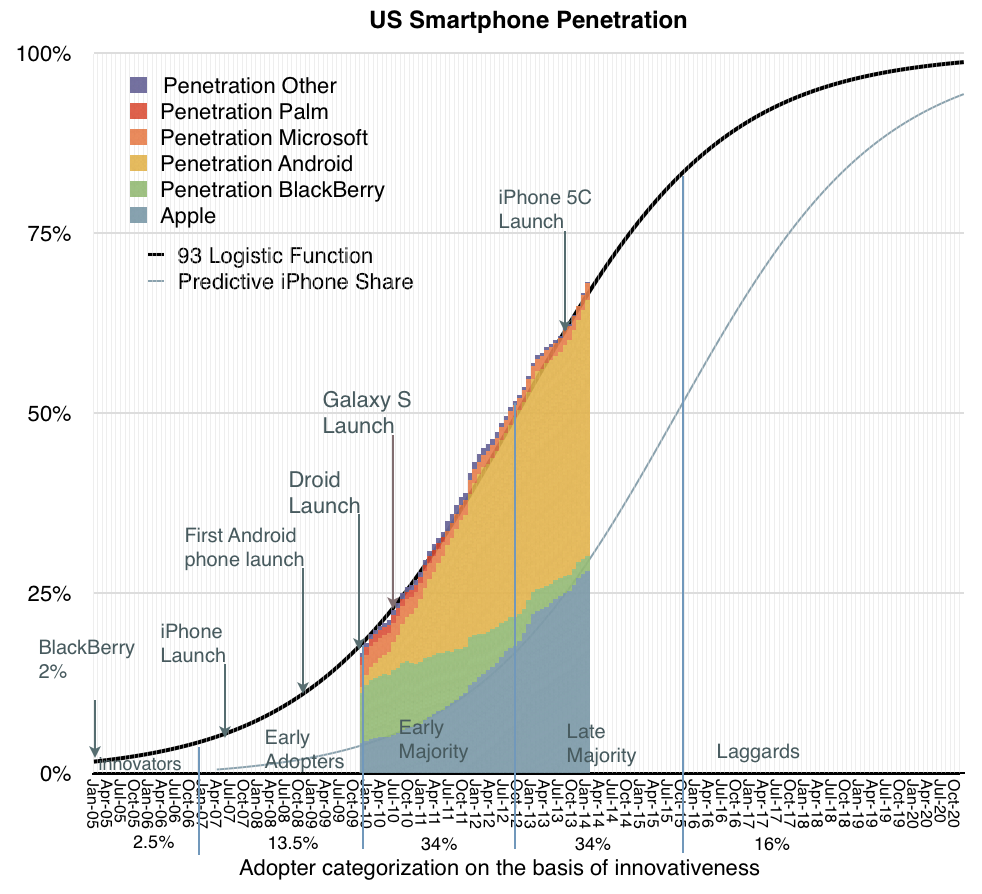
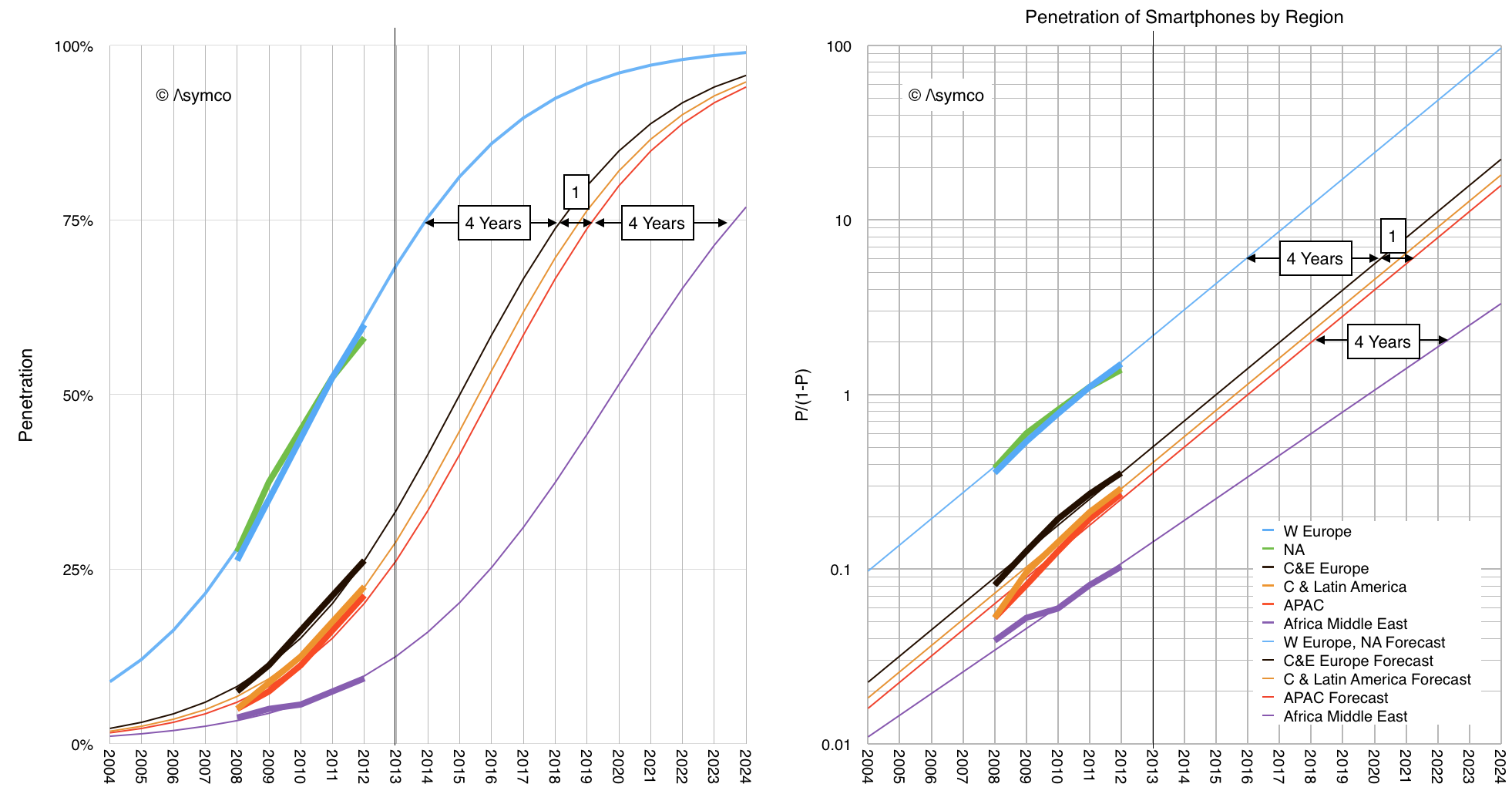
    Given the rapid adoption of smartphones, it's also safe to assume that smartphone penetration will follow population distribution. In the US, where comScore data is published monthly, penetration is following a predictable logistic curve.

    Screen Shot 2014-04-07 at 7.55.13 AM


    Assuming similar patterns world-wide we can forecast regional smartphone penetration.

    Screen Shot 2014-04-07 at 7.56.49 AM

    This yields the following forecast for smartphone usage world-wide.

     alt=

    Three years ago the notion of smartphones becoming as ubiquitous as toothbrushes seemed far fetched but it's now gradually being accepted. The smartphone is well on its way to becoming the most successful technology in history.

    So what?

    What will the smartphone do for us? Does smartphone ubiquity change anything? Besides increasing ARPU slightly in a $1.2 trillion industry? Besides doubling the size of the device business? ((

    Screen Shot 2014-04-07 at 8.17.26 AM

    ))

    Besides creating a $20 billion app industry? How do we assess the impact of having a connected computer in one's pocket? In everyone's pockets? With us all day. Every day.

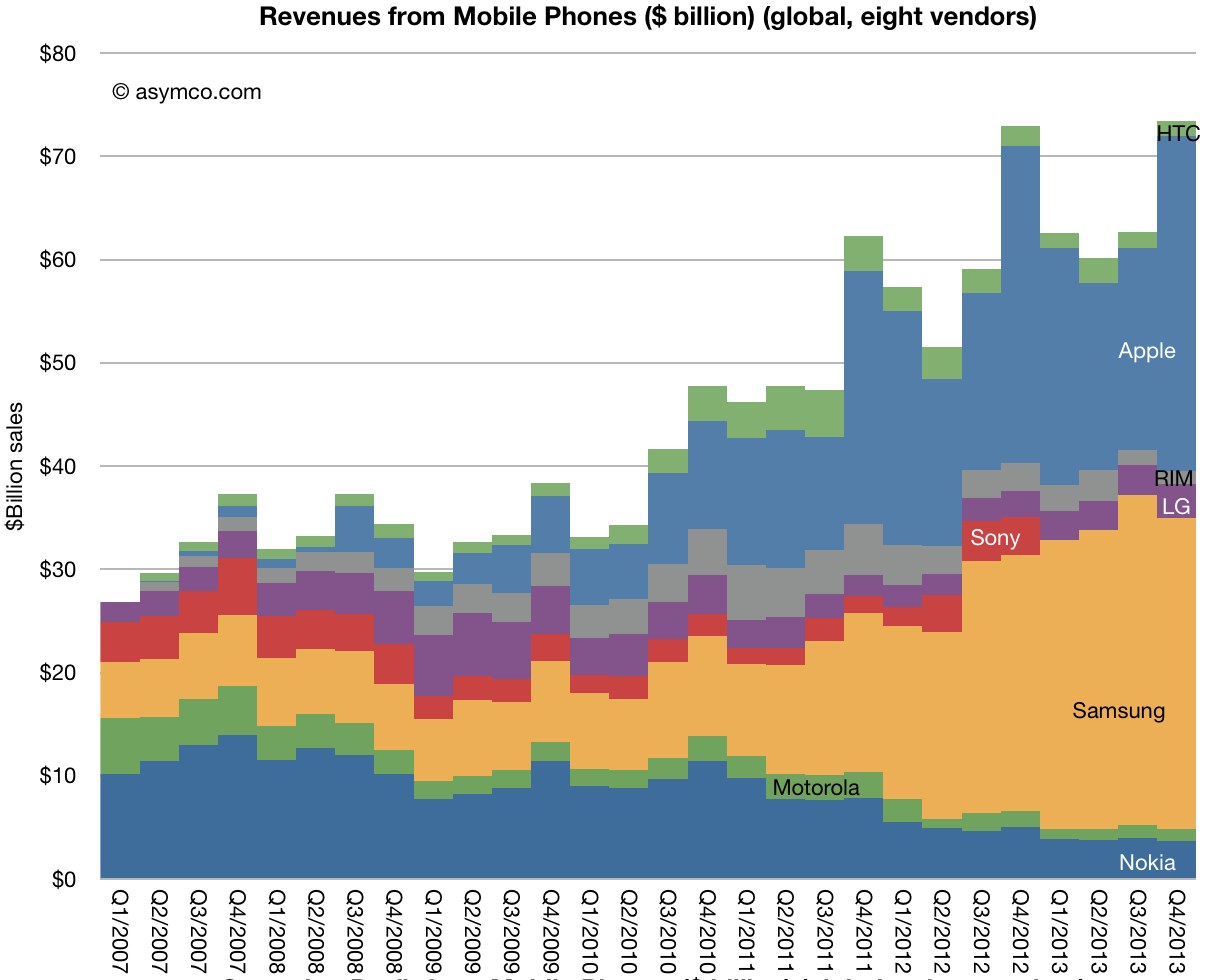
    Before we answer, we have to realize that the smartphone has been disruptive. Which means it has that special quality of not affecting the world in a predictable way. Its growth has been largely unforeseen and has affected the fortunes of the incumbents. As big and ubiquitous as it has become, the companies which were most intimately aware of it, its very own creators, were cursed by it.

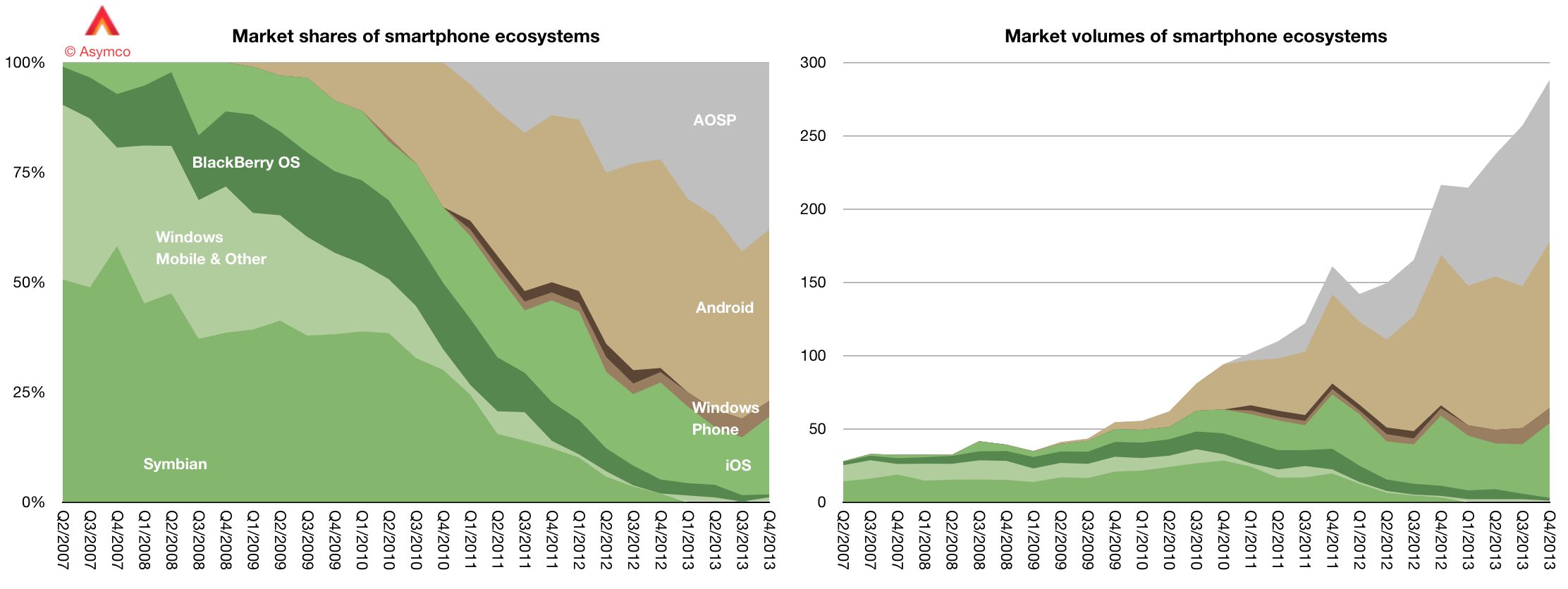
    The evidence is in this graph:

    Screen Shot 2014-04-07 at 8.32.19 AM


    As the market exploded, the incumbent platforms all but disappeared. The innovators fell into the trap of treating the complex new product as a niche whose appeal was for selected "segments" described by the coarse data they were able to gather. Ubiquity itself was asymmetric to the basis of competition they established.

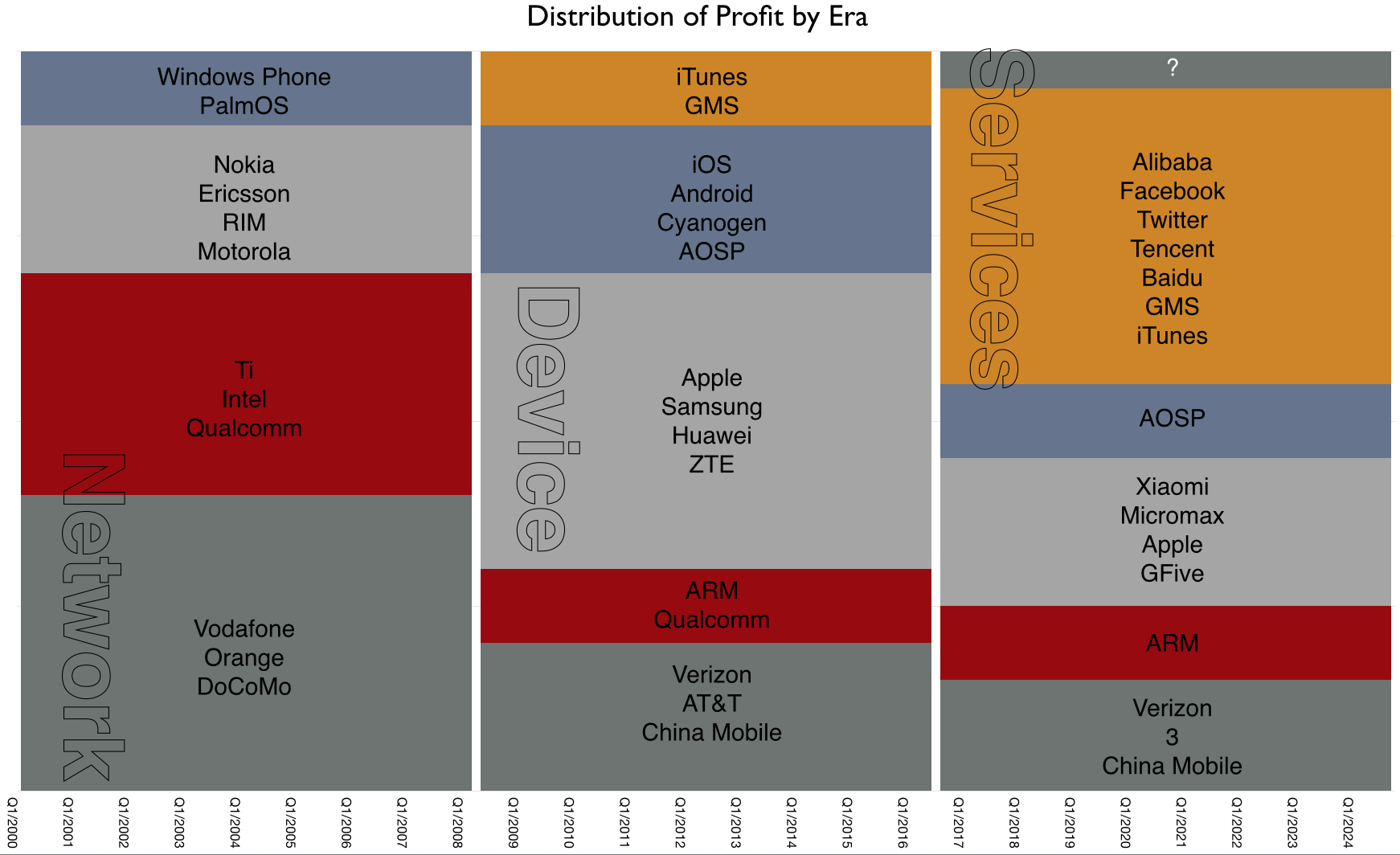
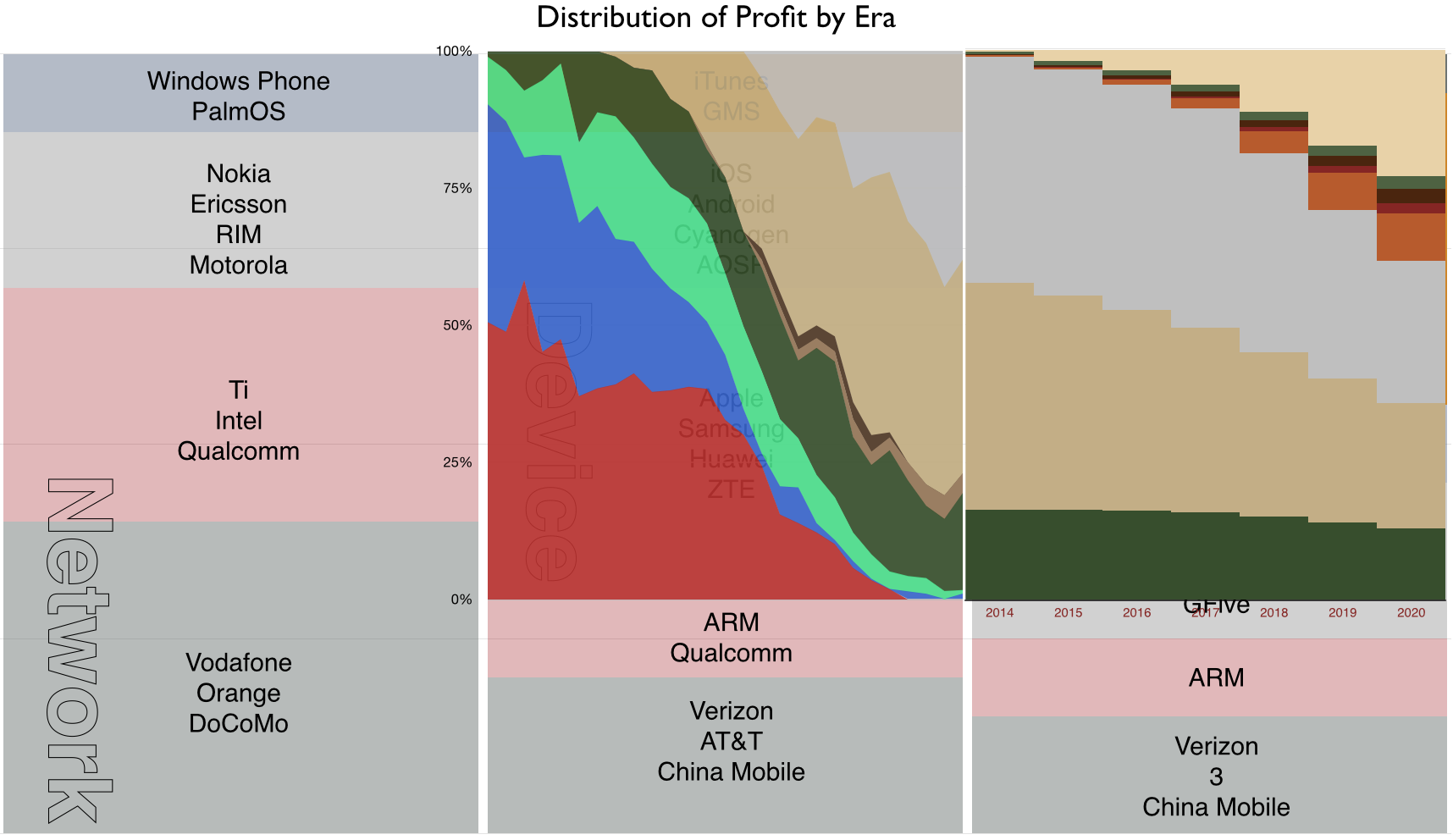
    Today we can note how even the usurpers iOS and GMS Android are being swamped by the more modular alternative AOSP. Indeed, if we squint a bit we might notice that the OS/platform churn we see is part of a trend where the value is migrating up the stack from Components and Networks, through Devices and Operating Systems and on to Services and Experiences.

    I call these the three mobile eras: (Firm names used are representative of a cohort and are not a complete list of participants.)

    Screen Shot 2014-04-07 at 8.51.45 AM

    The thesis is based on Value Chain Evolution Theory which states that disruptions cause profits to evaporate from commoditized segments and condense in adjacent spaces, usually toward more modular, more convenient or lower cost innovations.

    Note that the eras have specific time spans. If the pattern holds then we can overlay the time frame of smartphone penetration on these eras and even plot ecosystem entrants.

    Screen Shot 2014-04-07 at 9.06.55 AM


    Disruption suggests that we are likely to see yet more shifting of fortunes. It means enabling new ecosystems to take advantage of the modularization of platforms. But how can it happen given the entrenched nature of the incumbent duopolists?

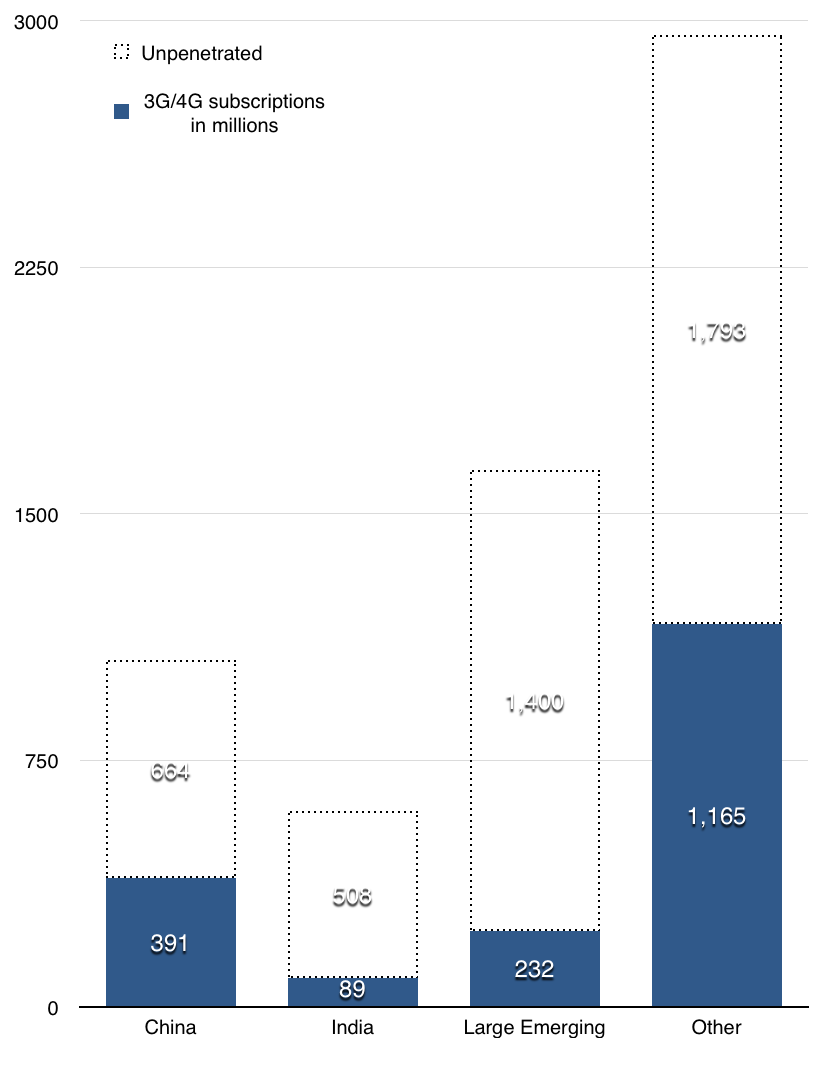
    The clue lies in the first graph in this post: It suggests a geographic segmentation. The largest markets are large enough to sustain independent ecosystems. Note that China and Russia have already established alternative local service ecosystems. We may dismiss the possibility of localized Google and Facebooks in emerging markets but China and India are universes in and of themselves. But there are another 10 markets of more than 100 million users. That's another billion users among them.

    Screen Shot 2014-04-07 at 9.31.22 AM

    But it's not just the availability of a vast pool of new users. The rapidity of growth of services like WhatsApp and SnapChat and Tencent shows that barriers to entry are low. We see increasing indigenous innovation in payments, logistics and business models in the newest markets. We see no shortage of talent and capital to start these businesses. We see increasing language and culture clustering in social media. We see political resistance to hegemony.

    Focusing on the established, highly penetrated markets as an indicator of opportunity would be a mistake. Those markets foretell the rate of adoption but not the evolution of the value chain. Apple and Google will continue to anchor in those markets but there is no reason for the remaining two thirds of the world to follow. Indeed, there are incentives not to.

    Incentives exist to localize services. Indeed, service businesses have always been local businesses. There are few global service brands. This has been true in retail, transportation, banking, hospitality, media and communications. Why should we believe that ecosystems can overcome the advantages of localization? Services are local because they are delivered by individuals and have high "touch" with the user.

    Fundamentally, ecosystems are social systems and social systems have cultural and political dependencies. ((Post-modernism is a typological world view which  sees truth as socially constructed and a rejection of 'totality')) Technology does not homogenize unless it is centrally controlled. The control of mobile computing has already been abdicated by its creators.

  7. A margin of error

    Research · 142 comments

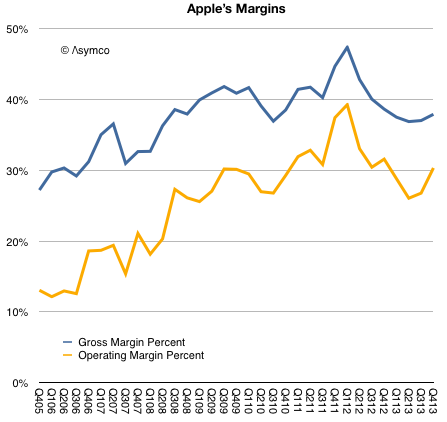
    Prior to Apple's earnings report I read at least one article suggesting that the most important indicator to watch was Apple's margin. I suppose this was due to a recent decline in margins from a peak gross margin of 47.4% in Q1 2012 to 36.7%.

    As the graph below shows, margins began to recover by Q3 2013 and are nearly on par with year-ago levels.

    Screen Shot 2014-02-12 at 10.32.50 AM

    The guidance for the present quarter is a gross margin between 37% and 38%. This would imply a flat q/q GM line (blue line above.)

    This is not quite catastrophic.

    To better understand margins, it helps to compare them with other companies. When Apple reached that peak of near 50% gross margin I noted that such a level was higher than Microsoft's and Google's. The irony being that Apple was nominally an (implied) low-margin hardware company while Microsoft was an (implied) high-margin software company and Google was an (implied) high-margin internet services company.

    Here is the picture with the last two years added:

    Screen Shot 2014-02-12 at 10.02.17 AM

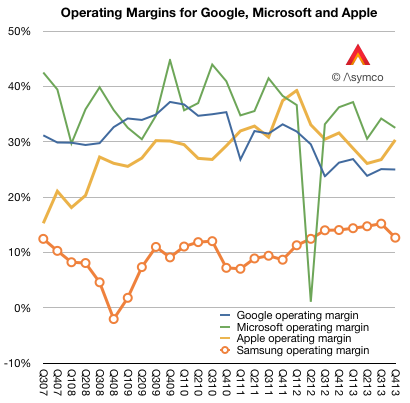
    In the last two years Apple's margins have declined but so have Google's. And although Microsoft's fell, they fell less than Apple's and thus overtook it to remain slightly more profitable (32.5% vs. 30.3%) into Q4.

    I also added Samsung Electronics' operating margin. ((As a large conglomerate, Samsung will have a lower blended average. Separating the Telecom group's operating profit shows a 16.14% divisional operating margin.))

    So although Apple stabilized, it did so at an extraordinarily high level, well out of band for a hardware company. Thus the question remains: Are Apple's margins a fluke? Is the recent rise of margins to levels far above those of a comparable hardware company and into the realm of software and services sustainable?

    The simple answer is to assume that the iPhone and iPad, which make the bulk of revenues and which explain much of the rise, enjoyed a temporary buzz which allowed them to be priced at a premium but as that buzz wore off, the pricing and margins would decline. This is common with fads and fashions.

    But the situation is far more nuanced. If the margins were due to mere novelty, the effect should not have persisted over so many years. Pricing data shows that the iPhone remains exceptionally valuable and that the iPad, excluding line extensions, has also held the line on pricing.

    The missing piece in the puzzle is that the iPhone and iPad and iPod touch and Apple TV are pieces of an inter-dependent network of assets. The iTunes stores, Apple's services and Apple Retail are easily ignored because they are not "profit centers" but I believe they are a key component to the sustainment of these margins.

    In other words, the iPhone and iPad enjoy margins not just because they are new and well designed. But also because they form part of a ecosystem. The key word is 'system'. The user buys into a system not just what the device embodies.

    This is why I've always said that the iOS product businesses should be thought of as "hardware as a service". The inspiration comes from the notion of "software as a service" which posits the idea that software purchases should be thought of as services and thus recurring revenues.

    iOS devices are part of a service matrix: the user experience in the stores, the after-sales support (including the easily ignored Applecare), the broadband supplied through operator service (which is part of a trillion dollars of value), the apps and content that can be purchased (which add up to a mountain of money), the network effects of iMessage and iCloud and now iRadio and Match and Siri.

    These services attachments are well understood as great business models and underpin some of the most celebrated businesses to emerge in the last decade including Google, Amazon, Facebook, Box, Dropbox, Windows Live, etc.

    It's curious therefore that whereas these other businesses are highly valued as services, in the case when the service is a component within a larger system, the value is missed. In an integrated context the connection between services and high margins is not understood. The reason may be the absence of robust systems analysis and a preference for the facile explanation.

  8. Fortune 130

    Research · 74 comments

    The increase in net sales of iTunes, Software and Services in the first quarter of 2014 compared to the first quarter of 2013 was due to growth in net sales from the iTunes Store, AppleCare and licensing. The iTunes Store generated a total of $2.4 billion in net sales during the first quarter of 2014 versus $2.1 billion during the first quarter of 2013. Growth in the iTunes Store, which includes the App Store, the Mac App Store and the iBooks Store, was driven by increases in revenue from App sales reflecting continued growth in the installed base of iOS devices and the expansion in the number of third-party iOS Apps available. Net sales of digital content, including music, movies, TV shows and books, from the iTunes Store was relatively flat in the first quarter of 2014 compared to the first quarter of 2013.

    Apple Inc. Form 10-Q.

    During the last quarter Apple changed the pricing for iWork and OS X to zero ((OS X server is still priced at $20 and iWork for previously unlicensed devices and computers is still priced above $0)).

    I estimate the net effect to have been a reduction in revenues from those software titles of about $350 million for the quarter. Nevertheless, increases in services and app revenues means that the iTunes total reported revenues increased to a new record.

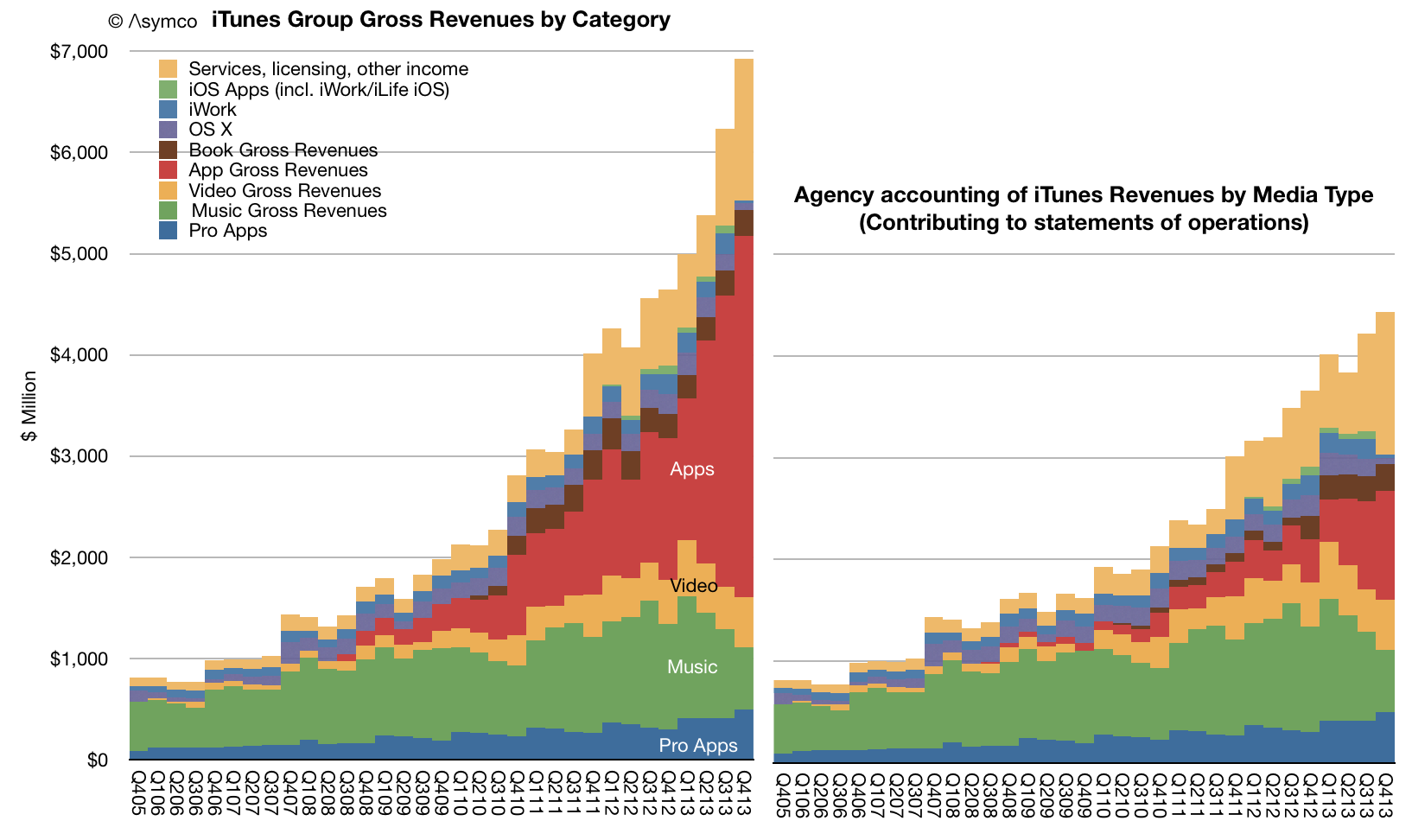
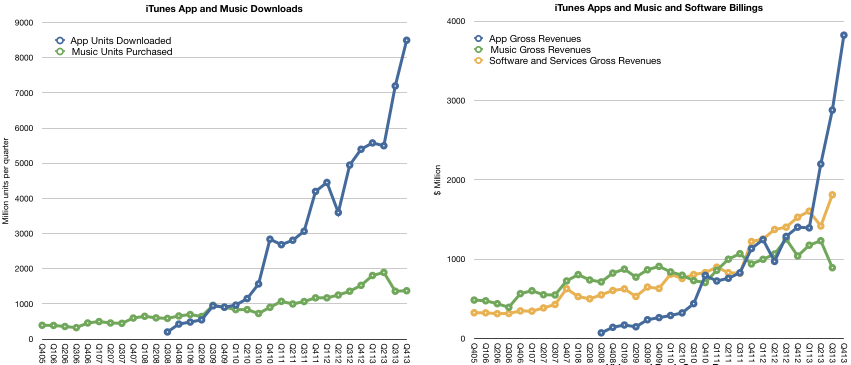
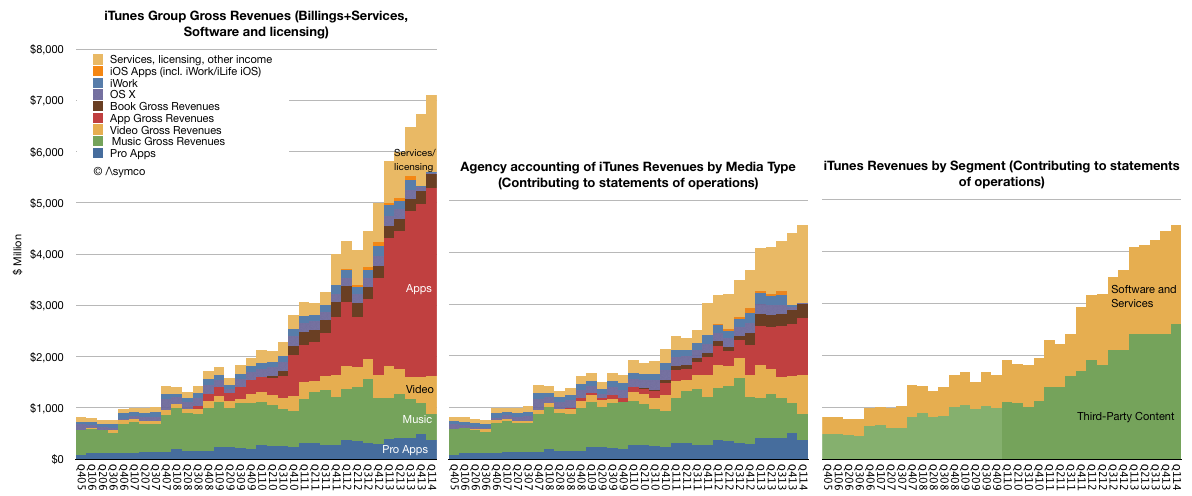
    The total with estimated contributions by media and service components is shown below right.

    Screen Shot 2014-02-10 at 10.05.11 AM

    Note that revenues do not reflect total billings. As Apple reports only the 30% of App transaction values, the full iTunes/Software/Services transaction values are shown in the above graph on the left.

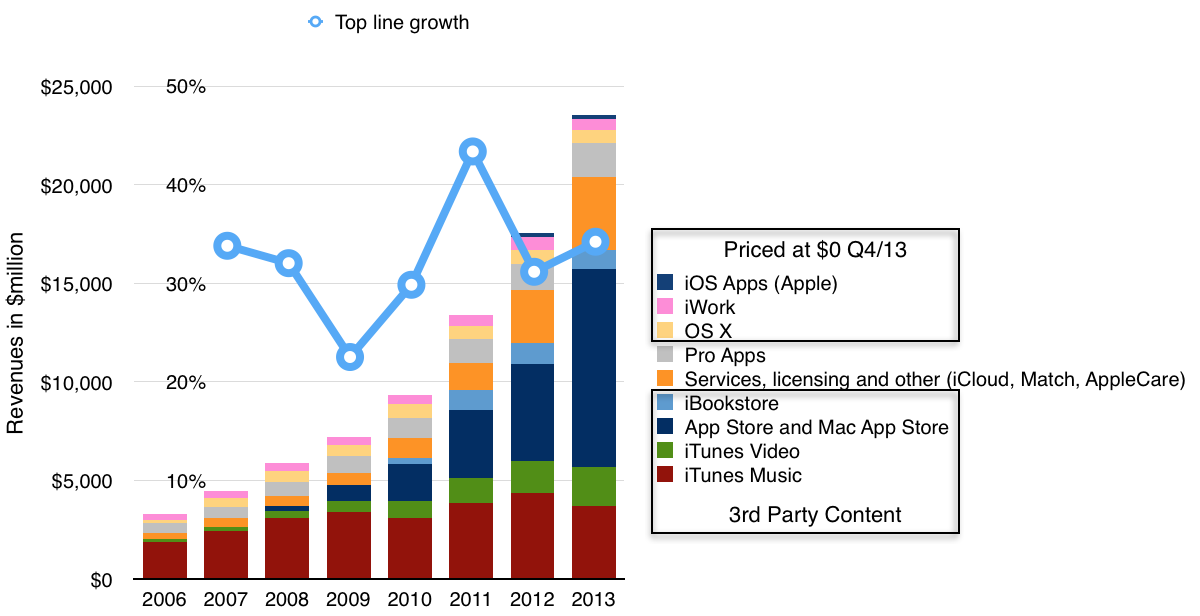
    The "gross" revenues are now nearly $7 billion per quarter. On a yearly basis the iTunes/Software/Services group had gross revenues of $23.5 billion with growth of 34% y/y.

    Screen Shot 2014-02-10 at 10.03.28 AM

    Other estimates for full year 2013 growth are:

    • Third party content +46.6%.
    • Music downloads -14%
    • Video +19%
    • Apps +105%
    • Books -9%
    • Services +37%
    • Pro apps +29%
    • OS X -8%
    • iWork and iLife -8%

    Although iTunes/Software/Services are not usually included in a "sum-of-the-parts" total contributing to Apple's overall enterprise value, the scale of volume and value of transactions is becoming harder to ignore.

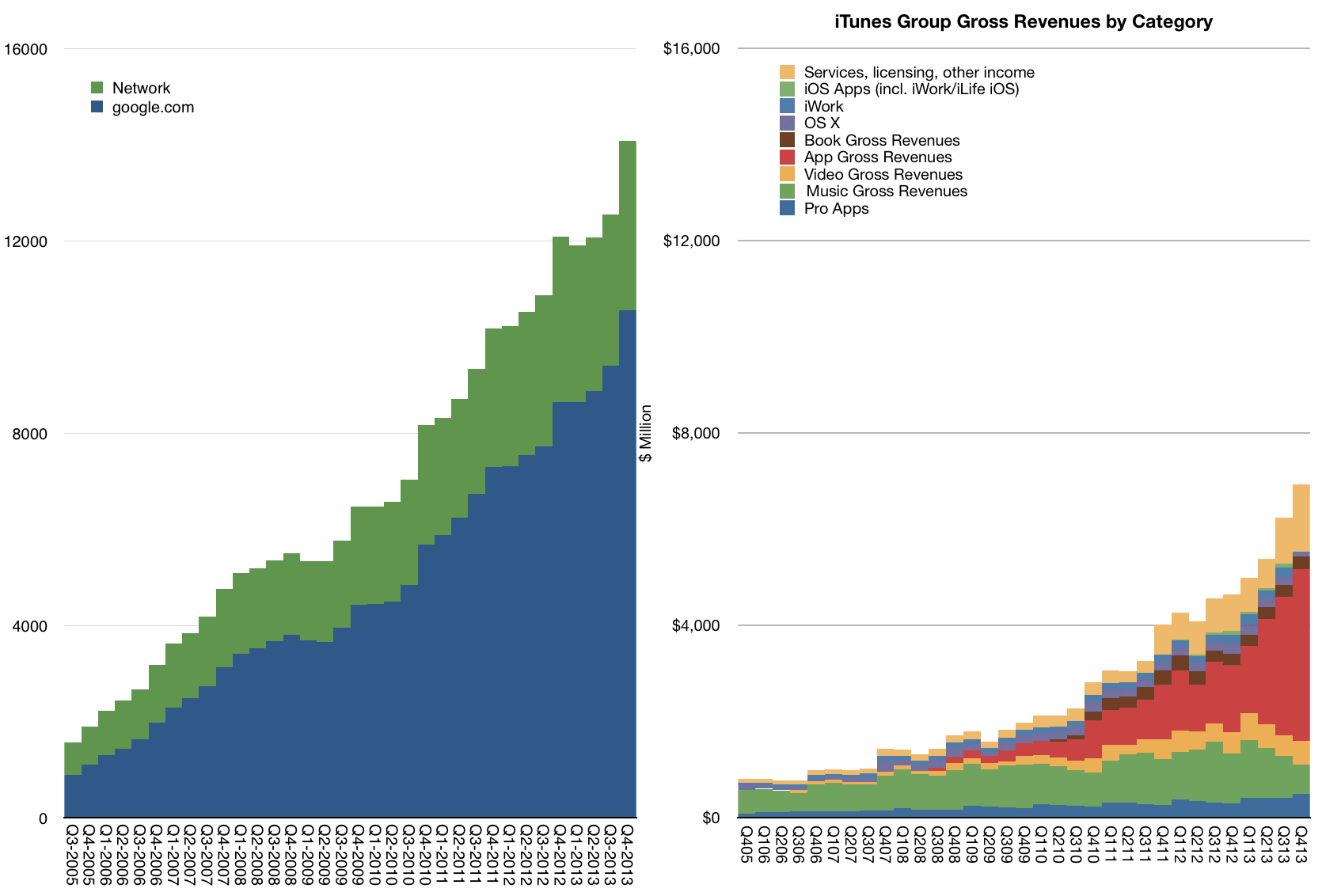
    To illustrate this, I plotted the history of gross iTunes revenues vs. Google's search business ((Excludes Motorola and "Other" segments as reported by Google))

    Screen Shot 2014-02-10 at 10.03.55 AM

    On a yearly basis iTunes/Software/Services is nearly half of Google's core business and growing slightly faster.

    The iTunes "empire" of content and services would be ranked as number 130 in the Fortune 500 ranking of companies (slightly below Alcoa and above Eli Lilly).

  9. Apple Fourth Quarter Estimates

    Research · 56 comments

    As Philip Elmer-DeWitt is still interested in my estimates I provided the following:

    Revenues ($B) 57.8
    EPS ($) 14 (908m shares)
    iPhone (units) 56.4 million
    iPod (units) 7.6 million
    Mac (units) 4.14 million
    iPad (units) 26.5 million
    iTunes/Software/Services ($) 4.2B
    Accessories ($) 2.2B
    GM% (percentage) 37.1%

    I arrived at these estimates without looking at anyone else's (except for Apple's own published guidance). Soon after sending them I noticed that Daniel Tello published his own.

    In the same format as above, I quote them for comparison. Please visit his post for additional detail.

    Revenues ($B) 59.0
    EPS ($) 14.92 (895m shares)
    iPhone (units) 56 million
    iPod (units) 9 million
    Mac (units) 4.65 million
    iPad (units) 25.5 million
    iTunes/Software/Services ($) 4.3B
    Accessories ($) 1.8B
    GM% (percentage) 37.8%

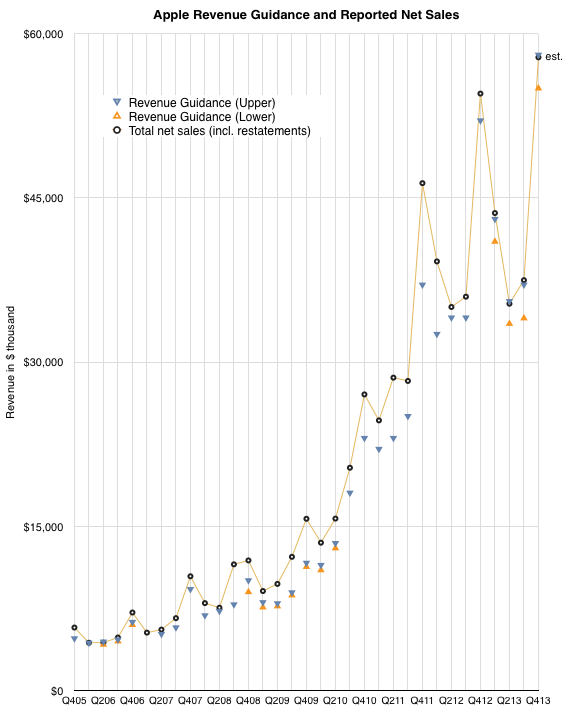
    The graph below shows the history of revenue guidance vs. revenue reported. The last quarter shows my estimate for net sales.

    Screen Shot 2014-01-15 at 1-15-4.06.58 PM

    Note that the company achieved at or slightly above its upper guidance ever since they started offering a range for guidance (i.e. since Q1 2013). My estimate for sales is therefore very near the top of guidance. The figures for units earnings and margins all result from this assumption.

  10. Of bits and big bucks

    Research · 90 comments

    Exactly one year ago, on January 7th, 2013, Apple announced that the App Store reached 40 billion downloads ((Unique downloads excluding re-downloads and updated)). Here are additional data points from that release:

    • 20 billion downloads in 2012
    • 2 billion downloads in December 2012
    • 500 million active iTunes accounts
    • 775,000 apps
    • sold in 155 countries
    • 300,000 native iPad apps
    • over $7 billion in developer payments

    This year, on January 7th, 2014, Apple announced a new set of data points:

    • $10 billion spent on the App Store in 2013
    • $1 billion in December 2013
    • 3 billion app downloads in December 2013
    • 1,000,000 apps
    • sold in 155 countries
    • 500,000 native iPad apps
    • $15 billion in developer payments

    The obvious:

    1. 225,000 apps were added in 2013
    2. 200,000 native iPad apps added in 2013
    3. App download rate for December increased by 50%
    4. No new countries were added in 2013
    5. $8 billion was paid to developers in 2013 (more than in all previous years put together)

    The less obvious:

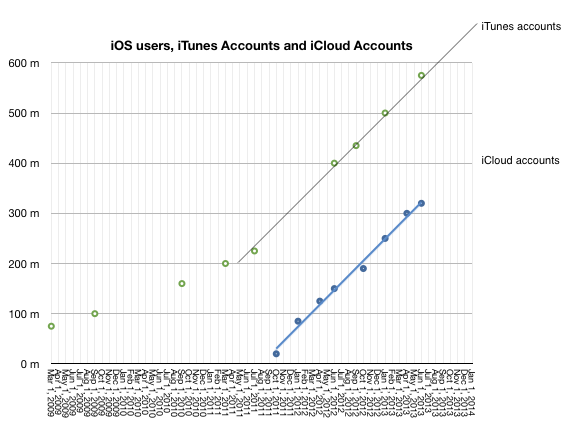
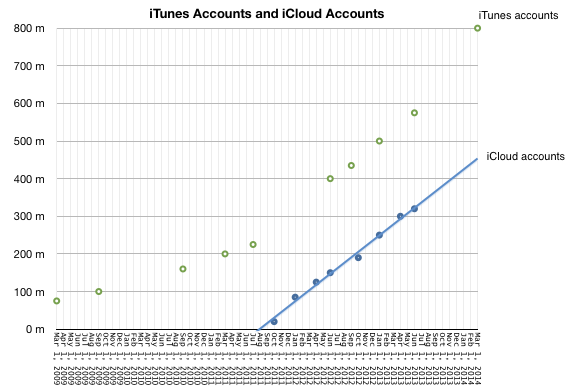
    1.  No update on iTunes accounts this time but there was a mid-year update (June 10th) which put iTunes accounts at 575 million. iTunes accounts have grown linearly since mid 2011 so it's quite probable that the current total is above 650 million. 
    Screen Shot 2014-01-08 at 1-8-9.28.41 AM
    1. Given mid-year updates to earnings/revenue and the October 22nd update that 60 billion total apps were downloaded and the May 15th update that 50 billion total apps were downloaded it's possible to estimate with confidence that there are now 68 billion total apps downloaded and that were about 27 billion app downloads in 2013. This is an increase of 35% in the yearly download rate. As noted above, the December growth alone was 50%.
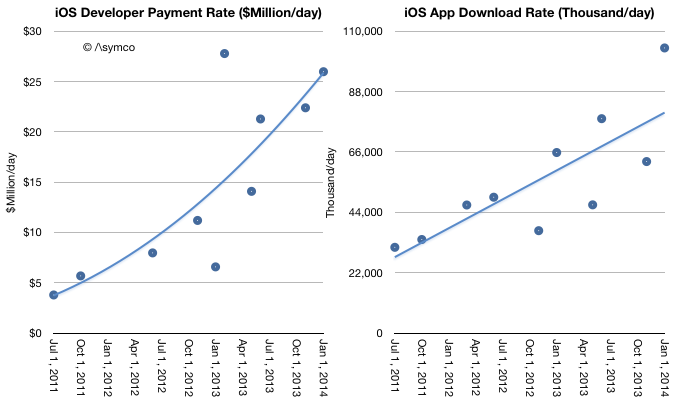
    2. Given mid-year updates on developer payments, and download rates we can estimate revenues per app have increased. As in-app purchasing has taken off it's no longer meaningful to assign a "purchase value" to each download. The rate of payments to developers is increasing faster than the download rate. Currently $26 million is paid out every day while about 100 million apps are downloaded daily. Note that the trend lines below are arbitrary: 
    Screen Shot 2014-01-08 at 1-8-9.41.18 AM
    1. As other reports have noted, there was a decrease in music downloads in 2013. This is also evident when backing into a download total for music given the earnings data and the above evidence of app growth. My estimates below may be overly generous for music unit downloads as they also assume lower pricing. Overall gross music revenues through the iTunes music store ((Excluding new iTunes radio and revenues from services such as Match)) are flat for the year and may even have begun declining precipitously. App revenues are more than compensating for this. 
    Screen Shot 2014-01-08 at 1-8-9.50.37 AM
    1. The iTunes content economy is grossing about $17.5 billion/yr. Apple's own software and services (reported as part of the iTunes segment) add another $6.2 billion/yr. The combined total of $23.7 billion/yr. is slightly lower than what Apple net sales were during its fiscal 2007 year or what Amazon sold in 2009.
    2. A complete report on the iTunes economy and pro-forma iTunes income statement is available for purchase at store.asymco.com.

    So much for the data. What is really happening?

    First, it's tempting to look at music and suggest that music downloads are suffering from streaming, just as it was tempting to suggest that CD buying was suffering from piracy (and later, downloads.) But this is falling into the trap of defining a product's use by the metrics used to measure transactions. These metrics are but a proxy for what consumers are actually doing with their time.

    Consumers have a fixed time budget, a more rigid constraint than their spending budget. Competition for a slice of a consumer's time budget is far tougher than competition for a slice of a consumer's wallet. So what's amazing is that apps have successfully grabbed a share of this time budget. I believe that the reason they succeeded is that they initially fit into niche time slices that were previously unoccupied. ((Interestingly, this was how music, especially digital music as enabled by the iPod, gained traction))

    Downtime or "boredom" was filled with app interaction. This includes some social media consumption. These are not immersive experiences. They are "casual",  inconsequential and trivial. At first anyway. And that's the rub. As apps enter a consumer's world they initially take on non-consumption, which is easy to beat. But as the experiences become increasingly compelling they "move upmarket" and compete more aggressively with existing media consumption patterns.

    For instance, one might allow casual gaming to take root in non-consuming contexts such as commuting, waiting, and escaping time niches. But if the experience becomes addictive, the gaming takes over time previously spent watching TV or using console games. The same can be observed for app-based experiences of social media, shopping and chatting.

    This is the insidious march of a disruptor. It gains a foothold in a context where it has no competition and then relentlessly gets better, eventually displacing the far better suited alternatives. This is what I believe is happening with apps. They are asymmetric in their competition with established media and as a result they are easily ignored and brushed off as irrelevant competition. That is until the incumbent media sees a sudden drop in consumption. Even then, the culprit blamed is not the upstart but some structural issue.

    Music would appear less vulnerable to this app-based substitution because it's an eyes-free experience and can be easily consumed concurrent with another activity. There is however, a subtle de-emphasis and hence devaluation of the experience as it fades into the background. The "job it's hired to do" changes.

    Second, and relatedly, the other meta-observation is that apps are media. They are produced, marketed and priced in ways analogous to other media types. This has implications for the artist/producer/creator. For them movement into apps is natural and effortless. It's how developers moved into them without thinking twice. Trouble is that this transition is not at all simple for those who distribute media.

    I tweeted that the media industry deplored the shift of "digital pennies for analog dollars" ((Original quote was made by Jeff Zucker, president of NBC Universal, in 2008 in reference to the future of TV)) as the packaging of their product changed. The angst and trauma suffered by the media industry when dealing with what could be seen as a trivial change in the encoding of content are the stuff of lore and legend. Moving to apps could be even more troubling. Mainly because there is already a distribution channel in place. And it's owned by a set of companies whose motives and business models are completely different.

    The app economy shows that there are big opportunities in "digital pennies" and that the figures are beginning to match even the "analog dollars". In fact, I suspect eventually digital pennies will dwarf analog dollars. The trouble is that these pennies will not be earned at the same control points. Bits are already big bucks. They're just not the bits we are used to.


  11. What's an Active User worth?

    Research · 86 comments

    Apple has sold 700 million iOS devices. Google claims one billion Android device activations. Microsoft has about 1.5 billion Windows users and Facebook about 1.19 billion. LinkedIn has 259 million users and Twitter has 232 million. Amazon has 215 active account holders and PayPal 137 million.

    Markets place a value on these users implicitly when company shares are priced. For example, Twitter whose users are worth about $110 or FaceBook's $98 and LinkedIn at $93.

    This consistency suggests a universally accepted value per social media user but what is the value of an ecosystem user? Apple, Google, Microsoft and even Amazon aspire to enable ecosystems which should be seen are more valuable than mere communities. Ecosystems enable a higher level of economic activity because they are unbounded by the medium itself. Any number of media can be created. Or so the theory goes.

    If we could determine a value for an ecosystem user we could test it against the going value of a social media user. Fortunately we have enough data to do so.

    The total number of iOS devices sold per quarter allows us to measure the install base of device users. With some assumptions regarding the retirement and attrition rate we can get the following history:

    Screen Shot 2013-11-11 at 11-11-11.52.34 AM

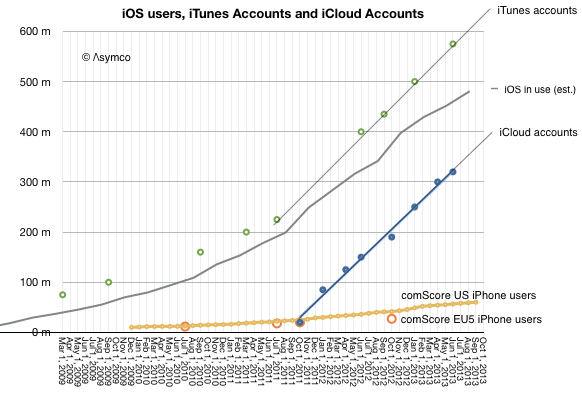
    Since the total number of iTunes accounts is updated with some regularity I've added it to the graph. I've also shown on the same graph the total number of iCloud accounts. For calibration, I included survey data showing the number of iPhone users in two regions (US and EU5).

    These combined graphs give us an upper bound of active users (iTunes accounts) and a lower bound (iCloud) calibrating our device-based estimate. The regional iPhone data offers some additional test on growth.

    The result is "about 500 million" ((482 million by my count but with quite a bit of margin of error)) with a growth of about 11 million per month.

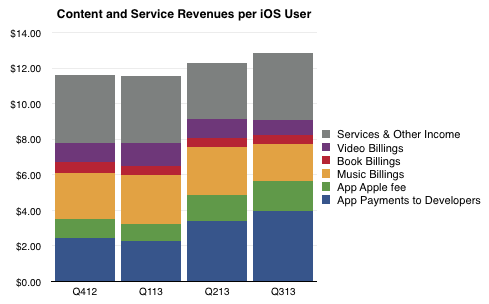
    So if we know with some confidence that there are about 500 million active users as part of the iOS ecosystem, how do we know how much value they generate? The answer is in the consolidated iTunes revenues as reported by Apple: $4.26 billion/quarter. With some attention to the reported media retail and purchases, the following picture of the average iOS user's quarterly spending emerges:

    Screen Shot 2013-11-11 at 11-11-11.50.23 AM

    The bottom line is that in the last 12 months the average iOS user contributed  about $48/yr to the ecosystem via Apple's own properties. They also bought the device and paid for cellular service in most cases. They may also have engaged in quite a bit of browsing and online purchases which fed other ecosystems. But as far as Apple is concerned, it transacted about $48 per user.

    As Twitter revenues last year were $317 million, the Twitter user today generates about $1.36 of revenue per year or one thirty-fifth of what an iOS user generates through iTunes and iCloud alone. And note that the number of iOS users is about twice that of Twitter.

    Of course one could argue that the iOS user's participation is not profitable for Apple. It does obtain massive cash flow from iTunes which finances its fashionable data centers and bandwidth but it does not presume to value itself primarily through this revenue.

    Or at least the market doesn't think so. We don't hear much about how Apple is worth so many dollars per user. ((I suppose the corollary to this is that Apple users are disloyal or fickle or fleeting, and quite contrary to observed behavior.))

    The paradox is that while the device which enables this commerce is where Apple guides the consumer's perception of value, markets discount devices and bid up services. In other words, users continue to pay for the devices which delight them enough to participate in services (especially the monthly billable kind) but markets walk right by these shiny baubles and and shower money on services which have negligible sales and even fewer profits. There must be some serious misdirection going on here. The question is who's being fooled.