Asymco

Asymmetric Intelligence

smartphone

  1. Nokia: We depend on uninformed customers, deception preserves brand value and uncompetitive software will keep us competitive

    Research · 99 comments

    In a previous post I asked whether Nokia's strategy is dependent on a "built-in assumption that end users are inherently stupid."

    Nokia confirmed that this is indeed the case.

    “Millions of consumers are oblivious to the announcements that we have made,” she said. Those consumers value Nokia’s brand, she said, and will continue to buy devices provided the company keeps making competitive products.

    via Nokia's Jo Harlow on the Move To Windows Phone, the Future of Symbian and More | Ina Fried | Mobilized | AllThingsD

    There are three statements being made:

    1. Nokia is counting on uninformed customers, not just end users but the shops and operators which will keep stocking the end-of-life product lines. There needs to be a conspiracy of stupidity for this plan to work.
    2. Nokia's brand will survive even after customers are deceived into buying lame duck products. The idea that buyers value a brand that is offering products that the company does not believe have a future is cynical.
    3. The absurd implication that Nokia's products will be "competitive" even though management asserted clearly and emphatically that the software they run--the very basis of competition for any smartphone--isn't. If a smartphone is expected to be competitive even though its software isn't then it's not competing on the basis of software. If it isn't then how smart is this smartphone?

    One gets the sense that Nokia is undergoing significant ethical decay.

    [UPDATE]

    To paraphrase the ethical dilemma:

    "We want a three horse race. We're not there yet. In the meantime we have a sturdy donkey that can still walk. We expect 150 million people to bet on it."

    [UPDATE 2]

    I take issue with the ethics of jumping off a burning platform while selling tickets to tourists to come visit.

  2. The platform as a promise

    Research · 39 comments

    In a recent answer on quora, I wrote that I did not believe developers are tempted primarily by economic incentives when choosing which platforms to work on. I suggested that they hire platforms because of their star-making potential and that star-making value is not a something that money can buy. Using Hollywood as an example I suggested that subsidies decrease the perceived value of a talent-oriented platform.

    The notion that a platform signals meaning to developers led me to think about how mobile platforms signal meaning to consumers. I have a hypothesis that platforms can and should be treated as brands. This point of view allows platform orchestrators to develop a comprehensive market-driven strategy for platforms that transcends technical debate.

    First a word about what a brand is.

    Brands are vaguely defined. They are identities, names, symbols or attitudes or all of the above. Marketers struggle to define brand value because they are trying to encapsulate what they sell into a single symbolism. The problem is that there are vast varieties of things being sold. Every product or service has different meaning to buyers and it cannot be captured the same way. Because I cannot rely on a single definition I have to create a specific definition of brand to the context of mobile platforms.

    I choose to define brand in this context of platforms as the "promise of the platform". A platform is a promise that the products will function in ways beyond what's "written on the box"; that the product is extensible and has value provided by an ecosystem bigger than the original vendor.

    For example, although the iPhone is based on iOS platform, iOS is not the brand. "iPhone" encompasses the platform brand and it's a promise to users that they can expect apps and content and an extended flow of innovation to continue well beyond the initial purchase of the device. This brand value is attached to iPod touch and iPad even though it's not communicated as a unified platform. In other words, consumers don't look for "iOS inside" but the implicit value of "there's an app for that" covers all the products.

    When looking at platforms as promises or brands, we can observe how some are more powerful than others.

    Symbian or Series 60 was never marketed as a brand and Nokia users are generally unaware of what OS or platform their phone runs. Does Symbian make a promise of an "extended flow of innovation to the device" after the time of purchase? It's hard to make that promise when you can't communicate clearly anything but device specs.[1]

    Conversely, Android has become a strong brand. The Android label (and mascot) is frequently used by device vendors to signal platform brand value.

    How did Google achieve in a year this value with Android while Nokia continued to squander any brand goodwill around Symbian for a decade? The answer lies in marketing decisions. Nokia wanted to focus on the hardware as value (and the Nokia brand as the way that value is encapsulated). Google and Android OEMs wanted to lift their own device brands into becoming smartphone brands and attached the value of Android branding to them.

    Which brings me to the question of how to design platforms as powerful brands. Creating awareness of extensible value is the way to signal to developers and all members of an ecosystem that a platform is valuable. Apple did this very well with their iPhone ads which focused on the app value of the product. They showed the product in use and did not rely on metaphors. Developers saw other specific apps being advertised by Apple and it engendered huge star value in the platform. Every developer wanted a shot at being featured in an iPhone ad. The iPhone could and did make stars.

    But you can't make the great promise of the platform without the ensuring consistency, reliability and longevity. Fragmentation, malware, copyright infringement and arbitrary termination amount to the confiscation of platform value by the orchestrator. Poor custodianship results in the destruction of both ecosystem and end user value.

    --

    Notes:

    1. The lack of platform promise for Symbian may also explain why Nokia believes they can sell 150 million Symbian devices which have a deprecated platform. Those devices could be sold as feature phones, not platform products. The challenge for them will be to get a smartphone price for a feature phone product.

  3. Platform sunk (cost): What is the value of a quarter billion Symbian users?

    Research · 38 comments

    In the quarterly smartphone summary published here, I noted the significant acceleration of Android sales at the expense of "other" and Windows Mobile/Phone. Some share was also lost to Symbian. This might be seen as justification for the "platform jump" that Nokia undertook.

    In a second discussion, I published the history and life cycles of the smartphone platforms, identifying 10 platforms (out of 16) still in the market. This challenged the view that it was a two horse race today and that it will become no more than a three horse race in the future.

    Questions came up about the "quality" of these platforms. Clearly some are barely viable while some are thriving. To explain the value of a platform, one metric we can use is the cumulative sales which allows us to derive the installed base.

    The following charts do just that.

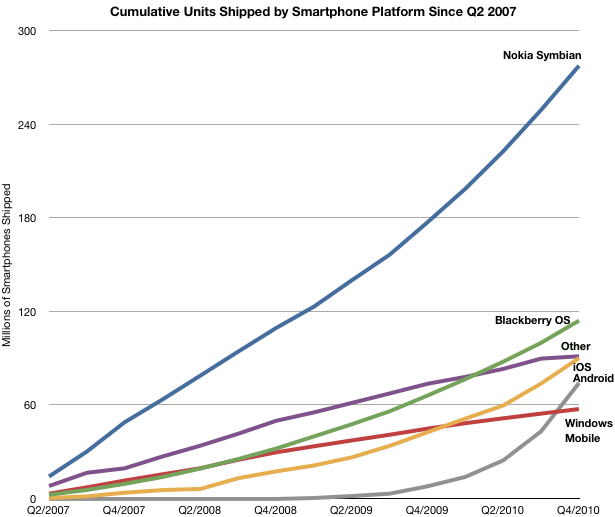
    This first chart shows the cumulative total of units sold since Q2 2007. This is the sum of all smartphones sold in the last 3.5 years. There are some interesting patterns here, but right now we want to focus on the installed base.

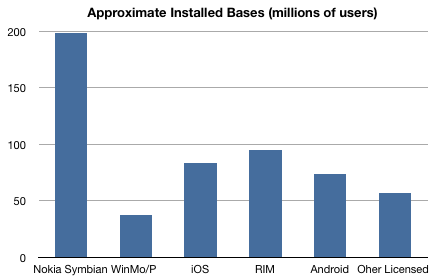
    3.5 years of cumulative sales is an upper bound on the installed base. We can get a better estimate the phones in use by subtracting from the base phones older than 2.5 years. This is shown in the second chart below:

    As of the last quarter, Nokia's Symbian is likely to have 200 million in use. Apple may have about 85 million iPhones in use (this excludes iPod touch and iPads) and Android about 75 million. RIM is around 95 million and Windows Mobile less than 40 million.

    What's interesting is that of these installed bases, the largest is the one that's just been abandoned, and the smallest was chosen as its replacement. Even that's not quite fair since Windows Mobile is not a valid replacement. It's Windows Phone that was chosen and that probably has an installed base of about 1 million [Unlike the measurement of units shipped, Microsoft reported two million licenses were sold to OEMs who had to build those into phones which would be shipped to carriers and distributors. One million may be a generous estimate.]

    The bottom line is that there are about 5 Windows Phone users for every 1000 Symbian users. In other words, Nokia jumped from the "burning" 200 million user Symbian platform to the "ice cold" 1 million user Windows Phone platform.

    The disposal of such a large installed base must count among the largest divestitures in technology history and, when coupled with the adoption of the least-tested alternative as a replacement, elevates platform risk-taking to a new level. It may seem bold, but there is a fine line between courage and recklessness.

    I'll do my own "dive" into the possible justification for this in a future posting.

  4. The price of Windows Phone: Nokia's evaporating smartphone share

    Research · 61 comments

    In the last quarter Nokia sold 28.3 million Symbian phones. The average selling price was €156 or approximately $210. That price was down 17% year-on-year.

    According to the company,

    The 17% year-on-year decline in our converged mobile devices ASPs was mainly driven by general price erosion and an increase in the proportion of lower-priced converged mobile devices sales.

    ASP erosion has been a fact of life across all of Nokia's products for quite some time, checked only by the increasing mix of smartphones. However the smartphones it sells have been consistently positioned for lower price points. This is consistent with Nokia's long-term goal of serving "billions" of users.

    The trouble with the new strategy is that the Windows Phone product lines currently in the market are not likely to be priced in the $200 range. The reason is that the minimum specifications for Windows Phone 7 are:

    • Capacitive, 4-point multi-touch screen with WVGA (480x800) resolution
    • 1 GHz ARM v7 "Cortex/Scorpion" or better processor
    • DirectX9 rendering-capable GPU
    • 256 MB of RAM with at least 8 GB of Flash memory
    • Accelerometer with compass, ambient light sensor, proximity sensor and Assisted GPS
    • 5-megapixel camera with an LED flash

    These don't add up to a product that can be sold profitably at $200. The bill of materials is likely to be in that range (and one has to add $15 for Microsoft).

    So there are two possible implications for Nokia's new smartphone strategy.

    1. Windows Phone will be ported to lower spec/cost hardware to allow the traditional Nokian market growth model to continue and perhaps combat Android proliferation
    2. Nokia's smartphone portfolio will consist of high-priced products, and exclude mid-to-low price products.

    Option 1 is difficult to imagine. The user experience that Microsoft is putting forward as its differentiation depends on significant hardware which is unlikely to become very cheap very soon. It is an interesting exercise to think through however. What would we have to believe for this option to become real?

    Option 2 is more likely as Nokia conforms to this a new definition of smartphone as "high-end" only. This seems to be the default option given what is visible to observers today.

    If Option 2 is in fact the outcome of the new strategy, then it leaves Nokia very vulnerable to a low-end disruption (after it's succumbed to a new market disruption.) The $50 smartphone will be reality this year.

    Option 2 also most certainly guarantees that Nokia's current market share of 30% in smartphones is likely to be lost and never regained.

    Some might argue that's no great loss. After all, Apple does very well with low share and high prices. However, Nokia is almost religious about market share. The reason being that scale offers significant purchasing power and logistical leverage. It sustains a cost structure, distribution network and a business model that is central to the company's core competency. It's also presumably the reason Microsoft partnered with Nokia in the first place: volumes and wide distribution.

    So we're back to the old question: how does the new deal lead to a thriving ecosystem? Does it depend on vendors other than Nokia? If so how does Nokia benefit from the sale of Samsung phones?

  5. Mobile World Congress: Revisiting the $85 smartphone

    Research · 9 comments

    While a low-end 3G Android smartphone could be sold currently at U$80 (wholesale price) and the adoption of ARM’s Cortex A5 should allow smartphone costs to fall to around US$50, they’ll still have some way to fall to catch up with the cost of 3G feature phones that are already reaching price points of below $30.

    via » #MWC11 Day 3 – Same old song. (Informa)

    The ubiquity of smartphones is inevitable.

  6. The certainty of unforeseeable growth: The rise of ZTE and Huawei

    Research · 37 comments

    • According to rumors, Huawei shipped 30 million phones last year. The target for this year is 60 million of which 15 will be smartphones.
    • According to IDC ZTE is now the fourth largest mobile phone vendor with 51.8 million units in 2010. Assuming 70% for 2011, ZTE could ship 88 million units in 2011, 25 million of which would be smartphones.
    • These data imply that ZTE and Huawei will ship nearly 150 million phones in 2011 of which 40 million would be smartphones.
    • That would imply approximately 7% share of the global smartphone market for these two companies together.

    What is remarkable about this is that the market share of these vendors was zero in the previous year.  It's hard to get comfortable with this market entry. The challenge for forecasters and analysts is that there is little history to draw upon. How will the entrants affect the rivalry between firms? Will the distribution be overlapping with incumbents or will the entrants be competing with non-consumption?

    The only thing we can be certain of is that the adoption of smartphones is increasing at a faster rate than is foreseeable.

  7. In memoriam: Microsoft's previous strategic mobile partners

    Research · 223 comments

    Microsoft's new "strategic partnership" with Nokia is not its first. For a decade the software company has courted and consummated relationships with a variety of companies in mobile and telecom. Here are the ones I can remember:

    • LG. In February 2009 Microsoft Corp. signed a multiyear agreement for Windows Mobile to be included on devices from LG Electronics Inc. LG would use Windows Mobile as its "primary platform" for smartphones and produce about 50 models running the software.

    What happened? LG made a few Windows Mobile devices but with WinMo uncompetitive, they abandoned the platform and moved to Android losing years of market presence and all their profits.

    • Motorola. In September 2003, Motorola  and Microsoft announced an alliance. "Starting with the introduction of the new Motorola MPx200 mobile phone with Microsoft Windows Mobile software, the companies will collaborate on a series of Smartphone and Pocket PC wireless devices designed to create a virtual "remote control" for the Web-centric, work-centric, always-on-the-go mobile professional." In addition, the alliance includes cooperation on joint marketing and wireless developer programs.

    What happened? Motorola launched a series of Windows Mobile phones culminating in the Motorola Q "Blackberry killer". As Motorola hit the rocks in profitability new management reached for the Android liferaft. The company now relies exclusively on the Droid franchise.

    • Palm. In September 2005 Palm and Microsoft announced a strategic alliance to "accelerate the Smartphone market segment with a new device for mobile professionals and businesses. Palm has licensed the Microsoft Windows Mobile operating system for an expanded line of Treo Smartphones, the first of which will be available on Verizon Wireless’ national wireless broadband network."

    What happened? Palm shipped a few Windows Mobile, famously dismissing Apple's potential entry as something "PC guys" could never achieve. A new CEO, a private placement and an acquisition later the company is a division of HP making its own operating system.

    • Nortel. When Steve Ballmer was famously laughing at the iPhone and saying that he likes the Windows Mobile strategy "a lot" he was sitting next to the then-CEO of Nortel (Mike Zafirovski formerly of Motorola) with whom the company had just closed a strategic deal.  "an alliance between Microsoft and Nortel announced in July 2006 ...  includes three new joint solutions to dramatically improve business communications by breaking down the barriers between voice, e-mail, instant messaging, multimedia conferencing and other forms of communication".

    What happened? Nortel declared bankruptcy two years later.

    • Verizon. In January 2009 "Verizon Wireless has selected Microsoft Corp. to provide portal, local and Internet search as well as mobile advertising services to customers on its devices. The five-year agreement will go into effect in the first half of 2009 when Microsoft Live Search is targeted to be available on new Verizon Wireless feature phones and smartphones." The deal would ensure Bing distribution to all of Verizon's smartphone customers.

    What happened? Bing did ship on some devices but in October 2009 Droid came to Verizon.

    • Ericsson. In September 2000, "Ericsson and Microsoft Corp. today launched Ericsson Microsoft Mobile Venture AB. This previously announced joint company will drive the mobile Internet by developing and marketing mobile e-mail solutions for operators. The first solutions are expected to be on the market by the end of the year. The company is part of a broader strategic alliance between Ericsson and Microsoft"

    What happened? Ericsson divested itself of the mobile division forming a joint venture which would go on and make more strategic alliances with Microsoft over Windows Mobile culminating in a loss of profits and eventual flight to Android.

    • Sendo. In February 2001, Microsoft announced a partnership, in which Microsoft bought $12m of Sendo shares and a seat on the board. Sendo was to be Microsoft's "go to market partner" for the Stinger smartphone platform that would become Smartphone 2002.

    What happened? Sendo after litigating IP issues with Microsoft went bankrupt in 2005.

    And finally,

    • Nokia. No, not this OS deal, but in August 2009 "The worldwide leader in software and the world’s largest smartphone manufacturer have entered into an alliance that is set to deliver a groundbreaking, enterprise-grade solution for mobile productivity. Today, Microsoft Business Division President Stephen Elop and Nokia’s Executive Vice President for Devices Kai Öistämö announced the agreement, outlining a shared vision for the future of mobile productivity. This is the first time that either company has embarked on an alliance of this scope and nature."

    The plan was to bring "Microsoft Office Mobile and Microsoft business communications, collaboration and device management software to Nokia’s Symbian devices."

    What happened? One and a half years later the same Stephen Elop announced that Symbian will be deprecated.

  8. A review of Asymco Predictions on Nokia’s new platform strategy

    Research · 25 comments

    Predictions on Nokia’s new platform strategy: new OS for the US | asymco.

    Here are my predictions from January 27 for the February 11 Nokia strategy announcement followed by the actual quotes from Nokia's press release:

    • Prediction: There will be a multiple OS strategy.

    Actual: The following sub-units [make up] Smart Devices: Symbian Smartphones, MeeGo Computers, Strategic Business Operations. To support the planned new partnership with Microsoft, Smart Devices will be responsible for creating a winning Windows Phone portfolio.

    • Prediction: The US market will be the first to see a new non-Nokia OS. I would guess Windows Phone with AT&T.

    Actual: "Plans for a broad strategic partnership with Microsoft to build a new global mobile ecosystem; Windows Phone would serve as Nokia's primary smartphone platform"

    • Low end devices will remain with Symbian due to price considerations for the chipsets, components.

    Actual: "Symbian becomes a franchise platform, leveraging previous investments to harvest additional value. This strategy recognizes the opportunity to retain and transition the installed base of 200 million Symbian owners. Nokia expects to sell approximately 150 million more Symbian devices in the years to come."

    • Prediction: MeeGo will be phased out in phone products but development will continue for tablets

    Actual: Under the new strategy, MeeGo becomes an open-source, mobile operating system project. MeeGo will place increased emphasis on longer-term market exploration of next-generation devices, platforms and user experiences

    More details to follow, but so far it looks like there are no surprises.

  9. Android and iPhone: Conquistadors or pioneers?

    Research · 93 comments

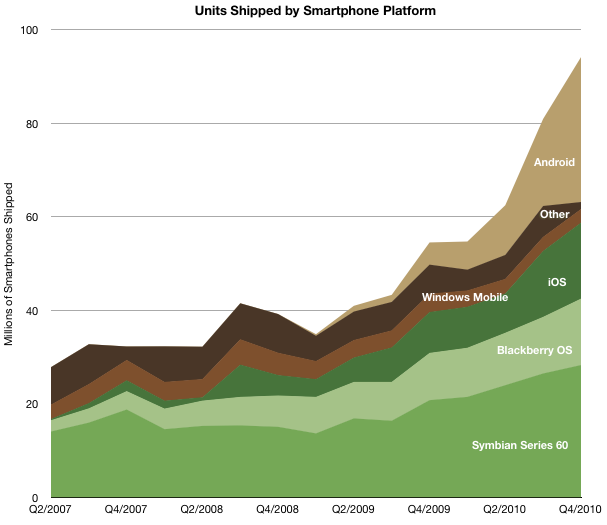
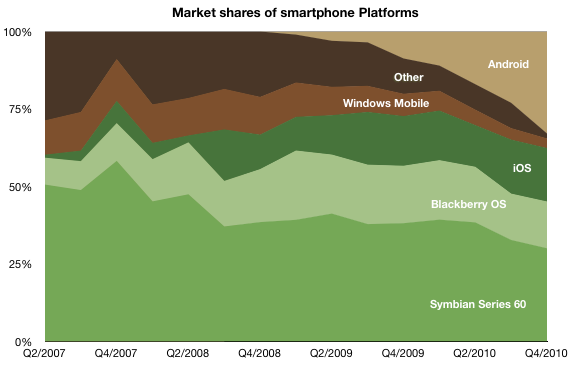
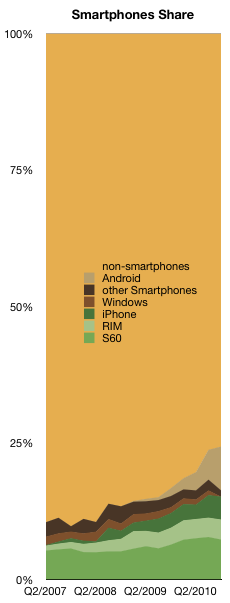
    Picking up the discussion of vendor share, I used Canalys estimates of platform shares to visualize the effect of Android on the smartphone market:

    Not wishing to belabor the point, but Android and iOS are less than 2 years old as platforms. In that time frame these two johnny-come-latelys have taken 50.2% of the most competitive technology market on the planet.

    Here is the share data:

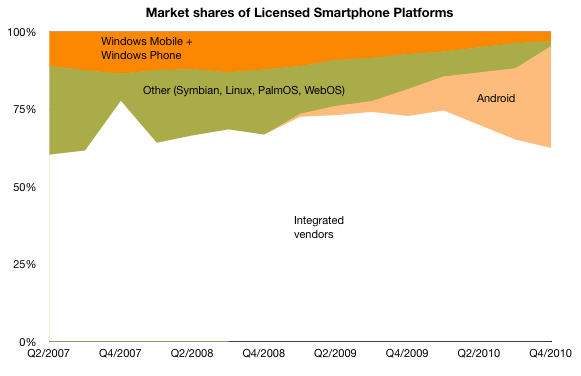
    Since the market is not a zero-sum game, I prefer the first chart, but this second view stresses the transition away from incumbent "others" / Windows Mobile toward Android in the licensed OS market.

    The final chart shows the competition against smartphone non-consumption. I like this chart best of all as it shows the effect of Android in growing the entire pie for smartphones.

    What would have happened without Android is anyone's guess but my bet is that the market would not have grown as quickly. Apple is producing iPhones at capacity and RIM is growing into new markets. Symbian's strongest markets also do not overlap (much) with Android.

    However, the trend seems to be for consolidation of platforms (fragmentation within platforms notwithstanding). This trend, however, is over a very short time span. The smartphone industry started a decade ago and the time frame shown in these charts is a mere 3.5 years.

    The question remains whether the headroom visible in this chart still allows for new entrants or whether the platforms we see today are the last we'll ever see in mobile computing.

    I'm still willing to bet that there is room for innovation and for new platforms. Just like the two newcomers that came to conquer half the market emerged seven years after its inception, new contenders like Windows Phone, Bada, MeeGo, WebOS can still make an impact.

    The conquerors came with new business models and a focus on computing not telephony. Can factor innovation and the ubiquity of mobile broadband keep this market open to newcomers?

  10. Smartphone users still prefer branded phones

    Research · 23 comments

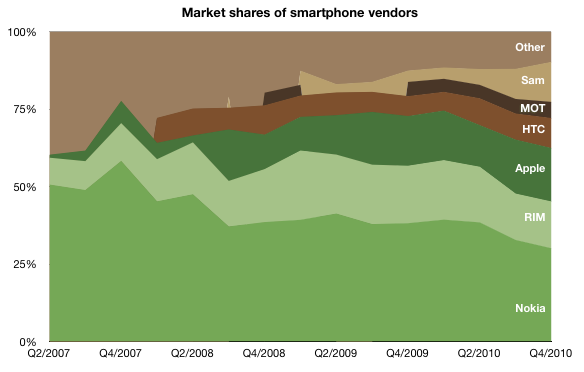
    The smartphone market has grown threefold in the span of three years. However, as noted previously, the share of units running a licensed OS has not grown dramatically. The following chart shows the vendors' shares with the same brown/green dichotomy between licensed and unlicensed OS's.

    In order to gain some insight into this licensed OS area (and who the "others" are) we need some visibility into which OSs are being licensed and what their shares are.

    The following chart shows the share of the various licensed platforms[1]. (I blanked out the Integrated vendors.)

    Before we dive in to understand the effect of Android, we have to understand the licensing of OSs in 2007.

    The chart shows Windows Mobile and "Other" splitting the market. Windows Mobile is rather easy to understand. It was still growing as a platform and Ballmer was famously quoted in 2007 as saying he liked their strategy "a lot".

    But "Other" is something of a mystery. What "Other" actually mostly meant was Symbian[2]. But not only the Symbian that Nokia was shipping and licensing to some vendors. At the time, Symbian also had a version called MOAP "Mobile Oriented Applications Platform" which was in use in Japan (somewhat analogous to the variants of Android now in use in China).

    Fujitsu, Mitsubishi, Sony Ericsson and Sharp developed phones for NTT DoCoMo, using an interface developed specifically for DoCoMo's FOMA "Freedom of Mobile Access" network brand. This UI platform was based on the UI from earlier Fujitsu FOMA models[3]. The user could not install new C++ applications and therefore these were not platform devices, however the industry still included these units as "smartphones" .

    So what we've witnessed in the last two to three years is the replacement of MOAP and Windows Mobile share with Android TAPAS and OMS.[4]

    But, more significantly, when looking at the rise of Samsung and Motorola and HTC we were also witnessing the demise of Palm, Fujitsu, Mitsubishi and Sharp (plus a myriad of Windows Mobile licensees even larger than the Android army).

    The significance here is that "other" in smartphones is still mostly about branded vendors. This is in stark contrast to the low-end of the phone market where “others” are quickly replacing branded vendors.

    So we can conclude that the smartphone market is so far showing a distinct preference for branded vendors. The value of the brand is still evident. But ZTE and Huawei are quickly developing Android competencies. How long will it be before the branded vendors feel the pressure from the upstarts?

    ----

    Notes:

    1. The Other category includes WebOS which was not licensed during this time frame but is not material enough in terms of share.
    2. A few million units running flavors of Linux were also on the market in 2007/2008.
    3. FOMA was also implemented with a Linux OS and the same UI.
    4. It should be noted that except for Windows Mobile, all the licensed mobile OSs including LiMO and Symbian are now open source. Android's success is not therefore due to being the only OS that is "open".
  11. Comparing Share of Growth: Integrated smartphone vendors held their own in Q4

    Research · 24 comments

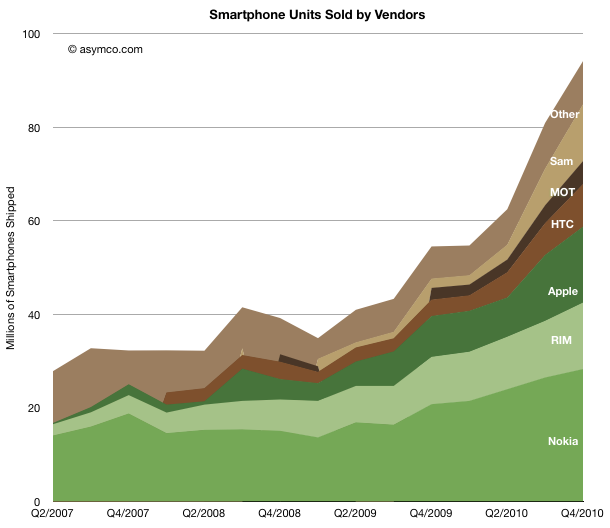
    The smartphone market grew to about 100 million units last quarter. That's nearly double what it was a year earlier and triple what it was three years earlier, the year the iPhone made its debut.

    Few markets grow this quickly, especially as this tripling happened during one of the worst recessions for a century. 100 million units a quarter is not a small number. The rate at which smartphones are growing makes clear the trajectory of where all phones are going.

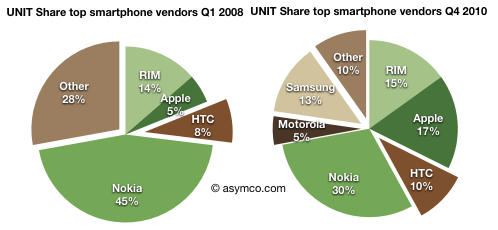
    As I've shown in profitability charts, vendors have been benefiting to differing degrees. The overall smartphone market with individual vendors is shown below:

    I've used the color coding of shades of green for vendors which use their own operating systems and shades of brown for vendors which use a licensed operating system (licensees).

    What remains interesting is how the share of licensed OS products has changed since 2007. I selected two snapshots in time: Q1 2008 and Q4 2010 and compared the shares that licensees were able to obtain.

    The shares of licensees was then 36%, and is now 38%. Not a huge increase, but an increase nevertheless. In the last such analysis in Q3, the share of these vendors (which I also call "Modular") was actually lower than in early 2008.

    RIM has held steady in terms of share. HTC has added a few points of share. Apple seems to have gained a healthy share which Nokia seems to have lost. Samsung and Motorola have certainly made a bigger mark in the last few quarters.

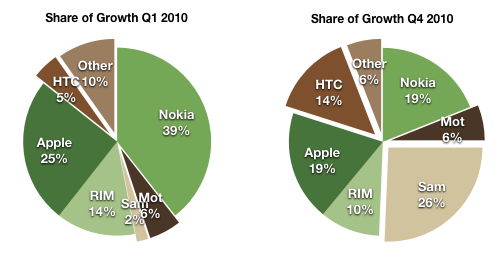
    But I would caution that share comparisons when the market is growing at nearly 100% are not very meaningful. All vendors are increasing their sales, though a different rates. What would be more meaningful would be a "share of growth" measure where each vendor's increase in units is divided by the overall market's increase.

    That analysis gives us the following chart. (I added Q1 2010 for comparison).

    Samsung did very well, but surprisingly perhaps, so did Nokia, tying Apple for second place.

    The licensees (whose pie slices have been exploded) added up to 52% of total growth (y/y) and the integrated vendors had 48%. A pretty even split.