In previous posts I detailed shares for units, sales and profits. I also offered different ways to look at the data like rankings and profit "area" maps.
This article is about the absolute numbers. What is the total market in terms of units sold, sales and operating profits.
The time frame remains from the second quarter in 2007 to the third quarter of 2010. The same eight vendors are analyzed (with "Other" available for units analysis only).
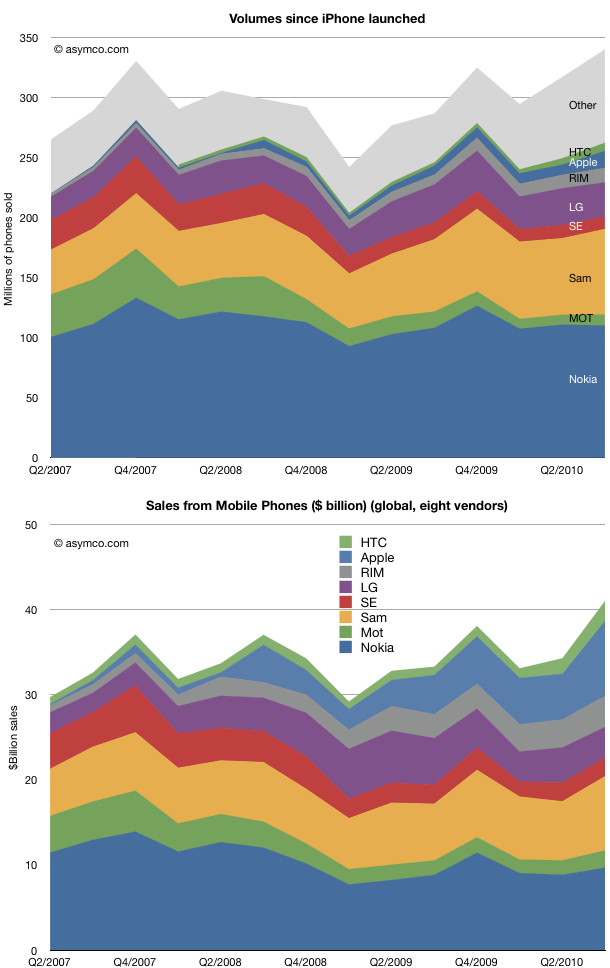
The first observation is that the market grew to new heights in Q3. 340 million phones in the quarter means that we might be looking at a very good holiday season. The market was range-bound due to the recession and its over-hang, but there seems to be a good indicator of macro-level recovery
On an individual competitor basis, the share snapshot pictures we saw earlier gave a good summary of the condition of competitors. Here we see the evolution of absolute units and sales over time. It's instructive to scan the two charts as a pair to see how units and sales are affecting the positions of the participants.
I clustered the "pure smartphone" vendors at the top of the charts so you can visually separate them from the broader portfolios of the others.
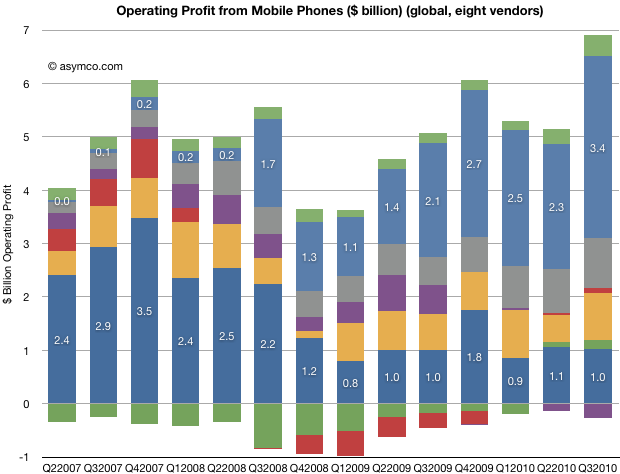
Finally, here is the evolution of total profitability (operating) for the participants. I annotated Nokia and Apple for calibration.
(note the color coding legend in the pervious charts).
What is most impressive is how LG, Motorola and Sony Ericsson seem to be in the same boat. At the same time, Apple, RIM and HTC are outstanding in performance. And Nokia and Samsung are stuck in a dilemma. On the other hand, every vendor is different in many ways, and it's inaccurate to paint them with the same brush.
Overall, we see a pattern of increased absolute value in the market. All but one vendor is profitable, and sales are increasing. A large part of the growth is due to the transition of the market to smartphones.
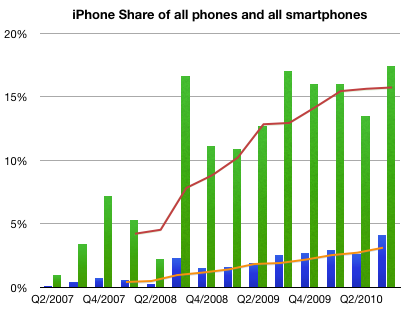
There is some confusion with the latest Canalys teaser press release. The implication is that Apple has lost smartphone platform share due to the Android surge.
Using the published data, it's easy to see that Apple has continued to increase share in both smartphones and handsets as a whole.
I used green bars to represent quarterly share of smartphones and blue bars to represent quarterly share of all phones.
I used orange line to show trailing four quarters (TTM) share in regular phones and red for smartphones.
Here are the Q2 to Q3 changes in share for the vendors whose data is published:
Nokia 38.4% to 32.7%
Motorola 4.32% to 4.7%
Samsung 5.11% to 9.71%
RIM 18% to 15%
Apple 13.5% to 17.4%
HTC 8.65% to 8.41%
Other 12% to 12%
Sequentially, Nokia lost 5.6% of share, Samsung gained 4.6%, RIM lost 3% and Apple gained 4%, Motorola, HTC and Other remained largely unchanged.
A complete market overview will follow when all the top tier vendors report the last quarter, but in the mean-time here are some data that are available:
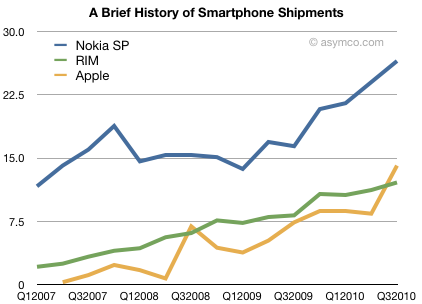
Smartphone volumes for Nokia, Apple and RIM:
Whereas Nokia is often criticized for being weak in smartphones, the fact is that they have grown at a decent rate over the last two years. In fact, they've opened a gap with RIM. Apple has increased share but it will take quite a while to overtake Nokia.
So why is Nokia's smartphone performance so under-valued? Partly it's because ASPs have been dropping. A lower price and lower margin is sometimes seen as a sign of weakness. But Nokia has had a strategy of expanding into more price brackets in their core markets (i.e. outside the US). Half of Nokia's smarpthones are sold through distributors not operators and probably end up being sold unlocked and unsubsidized. Price matters in those markets.
The other problem that Nokia takes a beating over is that their products don't get used as smartphones. Many are sold without data plans at all which makes one wonder what exactly makes their phones "smart". So many of these 100+ million/yr. smartphones are really hired to do a feature phone job. They're "overqualified" and thus underutilized. The statistics in terms of app downloads, browser and ad impressions all lag as a result. The ecosystem suffers.
Lastly, they are all but absent from the US. Due to accidents of history (CDMA) and various mistakes, Nokia never got a foothold in what turned out to be the most important mindshare market. A decade ago the US was a mobile data backwater, with lower data ARPU than Nigeria. It was not a market Nokia felt particularly deserving of investment. In hindsight, this was a big mistake.
But these knocks against Nokia still should not detract from the fact that they do sell a lot of Symbian phones. Distribution still matters as does having 600 operator customers. And in many parts of the world, Nokia is synonymous with mobile phone. Many of those buyers will migrate to future Symbian devices.
My mobile platform thesis has been that as long as penetration is not 80% and as long as operators are still in the value chain, mobile platforms will remain fragmented and split shares. The graph above shows exactly how that has evolved among the top three smartphone vendors.
One of the most hotly debated subjects in the mobile phone business is the importance of market share. It's also a topic of lore in the PC industry. Briefly the two arguments are:
Market share matters more because it drives network effects which ultimately drive competition out of the market, creating the opportunity for monopoly rents.
Profit share matters more because profit is the only fuel that can drive innovation. Any macro downturn or shift in strategy can cause a company to cease investing in unprofitable projects.
The old disruptor's adage: "Be hungry for profits and patient for growth" is challenged by the equally disruptive: "Grow share with lower prices in exchange for new revenue sources."
There are many rich anecdotes to support each strategy, but how about some data? Fortunately we have some: the market and profit shares for vendors covering 80% of the world's largest technology market over a three year period. The vendors are a good proxy for the market, the time frame is long enough to cover seasonality and anomalies and the market is very big (over 1.2 billion devices) and very broad (world-wide).
The only question is how to measure success. One measure is how various strategies benefit the asset owners, i.e. the share holders. Benefit to society, employees and consumers are very difficult to measure. But share holder benefit is easily obtained by measuring change in share prices.
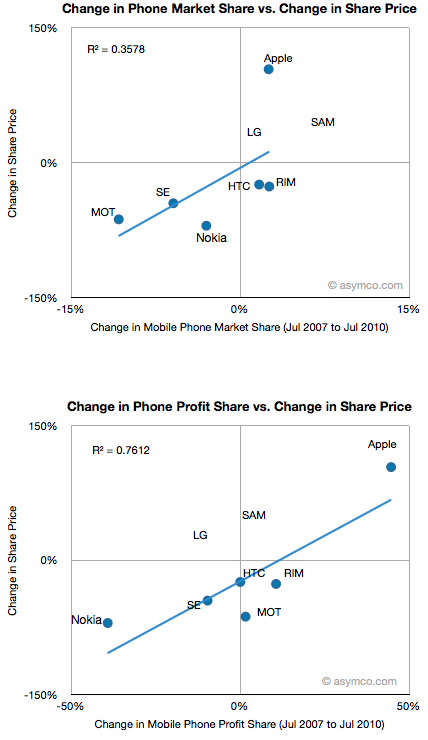
So, here are two charts:
The percent change in market share vs. percent change in share price for the top mobile phone vendors.
The percent change in profit share vs. percent change in share price for the same vendors. (see note 1 for time frame discussion).
I showed the R-squared value of the correlations. (See note 2 regarding LG and Samsung). At r-squared of 0.36 share price is not well correlated to market share while at 0.76 it is rather well correlated to profit share. To a financial analyst this would seem obvious. After all, share price reflects the present value of future cash flows which are clearly coupled to profit and hence to profit share growth. However, as many technology observers would point out, market share determined the success of Microsoft and Google, and to some degree Nokia.
High market share can cause competitors to be starved of components or ecosystem developers. At the same time, high profit share can cause competitors to be starved of capital.
What does this analysis add to the argument? Note that this data covers a hardware business. Is hardware relevant? It does not scale as rapidly and has a short shelf life. It's also notoriously difficult to distribute. However, outside of the service revenues for cellular voice and data, device hardware is the only pool of money that has any material dimension in the industry. It's also the pool of money with the highest margin in the industry. For the time being and the foreseeable future, hardware is the only business model worth anything in mobile computing.
The data shows that in this particular but substantial market profit share is closely correlated to shareholder value creation. It also shows that profit loss is closely correlated with shareholder destruction. The dominant data comes from Apple and Nokia, which appear to be polar opposites in performance on both measures.
In other articles I've shown how profits have shifted from incumbents to entrants in the smartphone disruption. This shift has resulted in direct benefit and loss to the owners of the two asset classes. To suggest that market share alone is a determinant of "success" in the device market must exclude the effect on shareholders and, ultimately, the management and employees of the companies concerned. The virtuous/vicious cycles will be fed by the profit variable more than any other.
I don't think the market share argument holds water in this market and this data supports my belief. It may be that as value shifts over time away from hardware the benefit will shift as well, but business models alternatives to hardware have not emerged after ten years of experimentation. If anything, the idea of selling hardware as a way of capturing service revenue was pioneered by RIM and perfected by Apple. Nothing I've seen so far is challenging this model. Whoever attempts to siphon the device pool of money (which has remained fairly constant over the smartphone disruption) needs to solve system-wide problems like the dependence on the network and the life-cycle of portable electronics.
----
Notes:
The dates when performance was sampled are are July 1 2007 to July 1 2010. The latest quarter (3Q10) has not been included in this data as it has not been fully reported. The data will be updated with the latest quarter as soon as it's possible.
For many competitors the share price is dependent on more than performance in the mobile phone market. In particular, LG, Samsung, Motorola and Apple have diversified product lines which affect their share prices. Two of those companies (LG and Samsung) are conglomerates and their share performance is dominated by businesses other than mobile so I did not include their data in the correlation measure (though their place on the chart is shown). Motorola and Apple's stock prices were, to a very large extent, driven by their mobile phone performance over the same period so their data is included in the correlation analysis. The other vendors have been primarily focused on mobile phones.
“Our third consecutive quarter of profitable results illustrates that Sony Ericsson’s overall performance is stabilizing. Our strategy to focus on the smartphone segment is succeeding and smartphones now comprise more than 50% of our total sales,” Chief Executive Bert Nordberg said in a statement.
With the launch of RIM's tablet computer based on QNX and HP's confirmation that WebOS will not be licensed, we have
Apple the largest tablet and music player company,
HP the largest PC company,
RIM the largest smartphone company in the US, and
Nokia largest smartphone company in the world
avoiding Android.
These are the companies which today are profitable and enjoy large market shares. Why did they choose integrated (aka "closed") software with their hardware vs. the modular (aka "open") approach offered by Google and Microsoft?
“I am sure there are things we could have done better and innovations we missed,” Ms. Suominen added. “But that happens to all companies. We have been very successful with some other innovations.”
She cited Nokia’s large patent portfolio and its 770 Internet Tablet, a compact, flat-screen device without a phone, released in 2005. It worked with a pen stylus and was made for Internet browsing but is no longer sold.
If I may suggest a better list of innovations for Nokia to stand behind:
The first GSM call in 1991 was made on a Nokia phone and a Nokia network
The first mass-market smartphone, the Communicator in 1998
First compact smartphone, the 7650 in 2002.
While these innovations and "firsts" happened many years ago, Nokia's ability to innovate is just as important at the low end. Nokia was the first company to address the lowest tiers of the market with over a billion customers served. This was no small feat and many observers faulted the strategy when it began in the middle of the decade.
I would not discount the difficulty and determination required in reaching those customers. Engineering a profitable low end product is as hard if not harder than engineering a high end superphone. More importantly, you have to find a way to distribute to these hard-to-reach customers and find ways to make the product useful, usable and affordable. Were it not for these efforts, the company would be facing collapse today, similar to the fate of Motorola or Ericsson: squeezed in the mid-range.
Blaming "culture" is nothing more than suggesting bad management. The culture of Nokia did not change between the few years when it was successful and the years when it was not.
The challenge Nokia faces is not complacency. It's that the business model for selling voice-oriented phones is diametrically opposed to the business model for selling data-oriented phones. In one case you cooperate with and sustain operators, in the other you compete with and disrupt them. It looks damn near impossible to do both with the same organization. Everything must be done differently. The real problem is that Nokia has not realized this and therefore can't build its own replacement.
What do Palm, Kin, Nexus One, and the Simon have in common?
Beside being market failures, it's the fact that they were efforts by large companies that had no business in smartphones. What's more important is that the motivation for participation was not well thought out.
HP, Microsoft, Google and IBM tried (or are still trying) to capture a piece of the hardware revenues from smartphones, but their results were dismally poor. It turns out that with the exception of RIM, HTC and Apple, there have been no smartphone entrants which have succeeded against the incumbent voice phone makers.[1] Furthermore, Apple is the only large technology company to succeed. Studying the efforts that the successful entrants undertook shows that (1) it takes a very dedicated effort, led from the top, and (2) it takes a lot of capital or a lot of time. Those who tried and failed were not dedicated to the concept at a high enough level and were not patient enough for growth.
I think the real motivation to enter the market is rooted in vanity: appealing to the need management to feel a part of something new and important. If you are an ambitious internal champion skilled in political maneuvering, it's fairly easy to appeal to this vanity in order to secure funding for these efforts.
This string of vanity-induced failures is not likely to end anytime soon. No doubt Dell will keep trying with the Aero, and we might see the PC companies rush in again as they did with PDAs.
We also hear today of the evolution of INQ's product (INQ Social Mobile) into some sort of Facebook phone. However, is the Facebook phone project a vanity phone? Maybe, but the counterpoint is that this is not likely to be a smartphone. It's more likely to be a feature phone and, as such, it's not attempting to be something so grand or vain.
The real comparison might be to the Kindle. A specific, purpose-product built by the most motivated and best-positioned service provider. The Kindle has had some (unspecified) amount of success because it was developed to light specs and with a well-established distribution channel (amazon.com).
So although the motivation might be more sound, the challenge for Facebook will be the same as for Google: distribution. At the end of the day, without operator support the product will still remain a niche.
[1] I note here that Android and Windows Mobile are not phones but platforms and this article deals specifically with hardware.
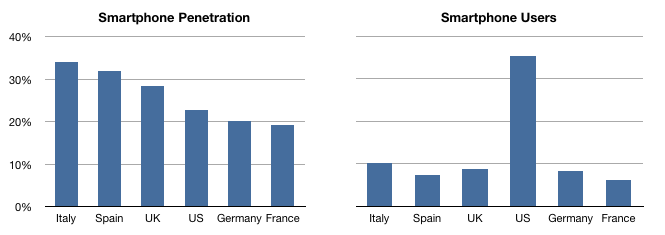
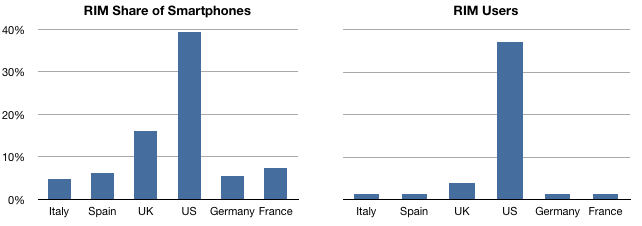
Following up on survey data showing that up to 25 percent of Americans have moved to smartphones, here is another survey (Comscore) which shows that US smartphone users are at about 23 percent.
Comscore also surveyed European countries, and we can compare the popularity of smartphones vs. the US.
I also indexed the share to population to show the relative populations of smartphone users across these countries.
It may come as a surprise to some that smartphones are more popular in the UK, Spain and Italy than in the US. Considering that these are countries with lower levels of disposable income, and that in Italy and Spain pre-paid plans are overwhelmingly more popular. Buyers in those countries are much more likely to pay full, unsubsidized prices plus 20% or more VAT. Overall the price differential for an Italian buying a smartphone vs. an American is likely to be a factor of 5. It gets even more peculiar when you consider that many Italians have more than one phone, with overall phone line penetration above 100%.
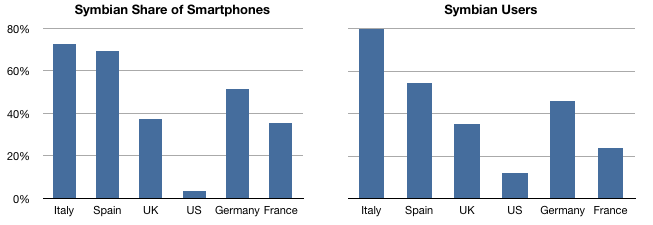
The explanation for this remarkable appetite for smartphone goodness is the early lead that Symbian had in Europe. Buyers who entered the phone market ten years ago became accustomed to upgrading their Nokia phones. Symbian phones were aspirationally positioned as feature-rich camera and messaging devices. Many were also purchased without data plans and were thus used as high-end feature phones. In other words, consumers in those countries were comfortable paying full price for unlocked Nokia devices and using them with multiple SIM cards.
This can be seen in the share of Symbian in these charts:
The data points to how normative behavior evolved and how different that can be even among culturally aligned Western nations. When looking at Asia and South America, it gets even more interesting.
Whereas in Europe it was Symbian, in the US RIM got the ball rolling.
The contribution of these platforms in shaping expectations, not to mention pricing, for the iPhone and Android should be noted.
“The N8 is certainly a step in the right direction, it’s much more multimedia,” Per Lindberg, an independent technology analyst at MF Global in London, told Marayam Nemazee on Bloomberg Television’s “Countdown.” “But whether it will move Nokia’s market share upwards is more debatable,” he said adding that Android phones are becoming an “formidable force.”
This is the same Per Lindberg who, in January of this year, reiterated his February 2009 Sell rating on Apple and the entire smartphone industry:
"There is no doubt, in my mind, that the whole sector is hugely overstretched," says the London-based physics PhD and MBA graduate who joined MF Global Ltd. in 2008 after 10 years at investment bank Dresdner Kleinwort.
"The whole sector is priced as if the average player would sustain 25 per cent margin in eternity," he adds.
"It's bordering on absurdity. This will end in tears."
He is willing to use the b-word: "Many stock bubbles are generated by sell-side analysts generating enthusiasm for the companies they cover."
To date however, it's Mr. Lindberg's call that's been the costly one for investors. He has maintained his sell rating on Apple since early February of last year, causing investors who followed his advice to miss out on a more than 110-per-cent surge in the share price.
Nearly all U.S. adults have cell phones, and 1 in 4 uses a smart phone, compared with about 16 percent last year, Carson said.
Nielsen, which surveyed 4,000 mobile-phone subscribers in August, predicts that the majority of mobile subscribers in the United States will have smart phones by the end of 2011.