Asymco

Asymmetric Intelligence

Steve Jobs

  1. 5by5 | The Critical Path #34: Climax and Anti-climax

    Podcast · 6 comments

    Horace and Dan talk about Asymconf 1.0 focusing on the risks taken and rewards obtained. We cover the concept, technical implementation, dynamics and where the show will go from here. Horace describes the fascinating "lost tapes" of Steve Jobs and Nokia's latest anticlimactic results.

    via 5by5 | The Critical Path #34: Climax and Anti-climax.

    Show notes:

  2. Steve Jobs didn't

    Research · 114 comments

    • Steve Jobs did not create products. He created an organization that predictably and reliably created emotionally resonant products.
    • Steve Jobs did not make movies. He made a company that predictably and reliably made blockbusters.
    • Steve Jobs did not wrest market share from competitors. He created new markets that attracted and sustained competitors.
    • Steve Jobs did not design anything. He gave others the freedom to think about what jobs products are hired to do.
    • Steve Jobs did not re-engineer processes. He brought engineering processes to works of creativity and the creative process to engineering.
    • Steve Jobs did not develop new management theories. He showed by example that innovation can be managed.
    • Steve Jobs was not a visionary. He put the dots together and saw where they led.
    • Steve Jobs was not a futurist. He just built the future one piece at a time.
    • Steve Jobs did not distort reality. He spoke what he believed would become reality at a time when those beliefs seemed far fetched.
    • Steve Jobs was not charismatic. He spoke from the heart compelling others to follow him.
    • Steve Jobs was not a gifted orator. He spoke plainly.
    • Steve Jobs was not a magician. He practiced, a lot.

    He had taste. He was curious. He was patient. He was foolish. He was hungry.

    These things many others can do. Maybe you can.

  3. Visualizing the Steve Jobs era

    Research · 44 comments

    On October 4th, Tim Cook will take the stage at Apple’s fall event. With Steve Jobs’ transition to head the Board of Directors of Apple and after serving as CEO for fourteen years, it is time to take a look at his reign.

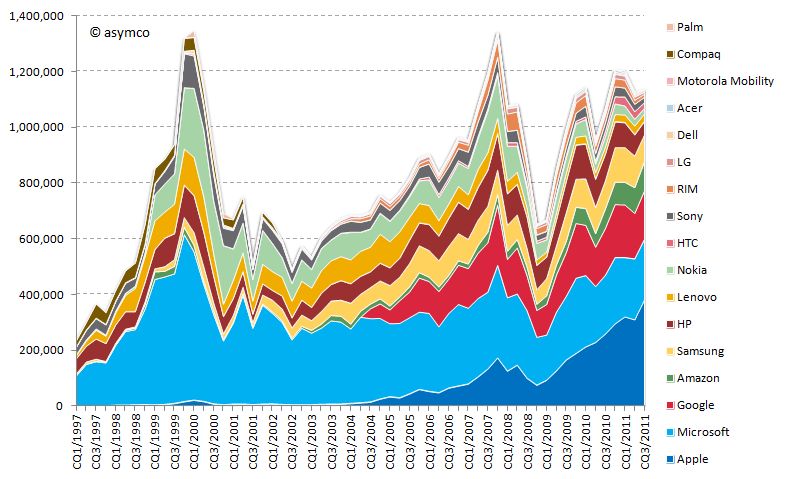
    Looking at his performance vs. peer companies from a capital market performance, I have composed the following two charts:

    Market capitalization of selected peer companies by calendar quarter in USD million sorted by most recent market capitalization (1997-2011)

    Market capitalization of selected peer companies in USD million sorted by recent market capitalization (1997-2010)

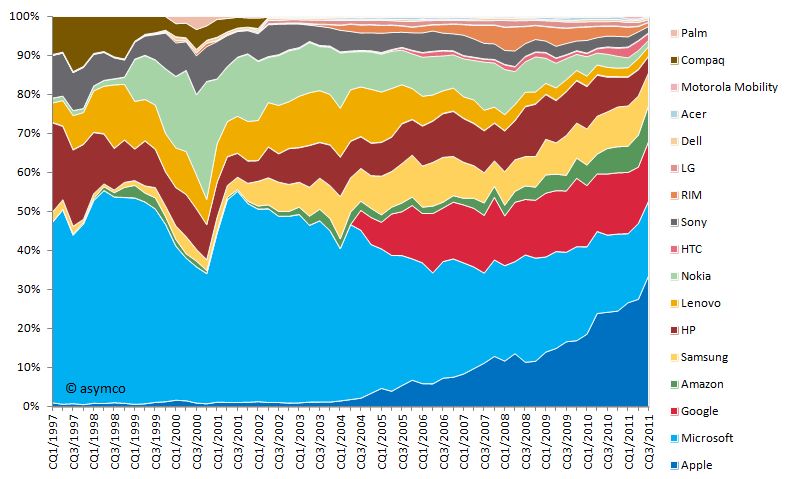
    Market capitalization as share of combined market capitalization by calendar quarter sorted by most recent market capitalization (1997-2011)

    Market capitalization as share of combined market capitalization sorted by recent market capitalization (1997-2010)

    You will note that I included more companies than in previous analysis. The new additions are:

    • Compaq (acquired by HP in 2002)
    • Palm (acquired by HP in 2010)
    • Amazon (a popular request by readers)

    I divided this era into three distinct periods:

    Restructuring of Apple 1997-2000

    In the beginning of 1997, Apple’s market capitalization was lower than almost all of its peers. In absolute terms the market capitalization moved only slightly upwards towards 1999 and the dent in 2000 is significantly lower compared to the market capitalization increase of other companies, first and foremost Microsoft's. Especially in the early part of this period restructuring and streamlining efforts took precedence. The introduction of iMac in 1998 and the iBook in 1999 set the tone in terms of design, quality and "thinking different" for many years to come.

    iTunes era 2001-2006

    With a stable core business and healthy profitability, Apple introduced the first iPod in October 2001 complementing the earlier introduced iTunes music player. Two years later, Apple introduced the iTunes Store offering downloadable music for the Mac and Windows operating systems. The venturing into the music and portable music player business and the halo effect for the Mac business is reflected in the market capitalization increasing significantly during the following years surpassing HP and Nokia.

    Mobile iOS devices 2007-2011

    Market capitalization further increased with the entry into the smart-phone market in 2007. Note that market capitalization of all selected companies combined at that time was as high as in the dot.com era of 2000. But this time Apple accounted for more than 10% of it. From 2008 to 2009 market capitalization of all companies declined severely due to the financial crisis. Rapid recovery followed during 2009 and early 2010. Apple introduced the iPad in March 2010 further fueling its rise to the top, surpassing Microsoft’s capitalization and topping Exxon Mobil as the world's most valuable listed company.

    During the time of Steve Jobs as CEO, Apple's market capitalization increased on average by 42% every year--an unprecedented track record. According to his own admission, Steve Jobs became CEO when Apple was 90 days away from bankruptcy. He resigned 14 years later after leading Apple to becoming the most valuable listed company in the world. From a value creation point of view, it's hard to think of a better performance from anyone, ever.

  4. Decoding Steve Jobs: Select Commentary from HBR.org - Harvard Business Review

    Research · 2 comments

    Announcing a new HBS PRESS BOOK

    Decoding Steve Jobs: Select Commentary from HBR.org

    by Norm Smallwood, Kate Sweetman, Dave Ulrich, Rosabeth Moss Kanter, Jeffrey Pfeffer, Horace Dediu, James Allworth, Max Wessel, Rob Wheeler, Bill Taylor

    Source: Harvard Business Press Books

    14 pages.  Publication date: Sep 22, 2011. Prod. #: 10973-PDF-ENG

    "The news of Steve Jobs's retirement from Apple may be losing steam but observations on his legacy - and Apple's leadership future - are only beginning. In recent years, leading thinkers have contributed their thoughts on the Jobs phenomenon on HBR.org. We've compiled a few of the best here, and we invite you to read them through the lens of business lessons to be learned.' We've selected six pieces: two from after Jobs's August 2011 announcement and four from before. We hope you will enjoy them, learn from them, and continue to turn to HBR.org for ideas and inspiration.

    Available for download for $1.99 via Decoding Steve Jobs: Select Commentary from HBR.org - Harvard Business Review.

  5. Why Apple's shares rose after Steve Jobs resigned

    Research · 36 comments

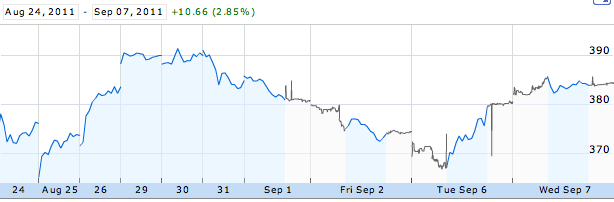
    CEO resignations often cause share prices to rise. Witness the effect of the latest CEO departure on Yahoo!. This typically happens because CEO replacements are not necessary when companies are successful. In times of crisis, the market sees management change as a hopeful sign. But Apple is doing well. So it was commonly believed that if Steve Jobs were to leave the helm at Apple the stock would fall. However, as the chart below shows, the stock price has since risen.

    Apple's share price rise of 3% even out-performed the Dow Jones index, and this phenomenon is not for the short term only. The Jobs resignation sent Apple puts to one-year lows.

    So how do we reconcile this? How can such a valuable person be priced as a liability?

    First, I should mention that not everyone shared the opinion that the departure of Steve Jobs would cause a decline in the price. Over a year ago, in August 2010 Horace wrote in a comment:

    Since I've shown repeatedly that Apple is trading at a discount to its growth and to its historic value and to its peer group, and since the health of their CEO is an uncertainty which must be discounted, the possibility exists that the depressed value assigned to Apple is due to Steve Jobs's continuing presence in the company. If that is true then his departure should increase the stock price.

    His argument of why the departure of Steve Jobs would cause an increase in the stock price was based on the fact that the market would have discounted it and the only question would be when it would happen. Since that uncertainty of when was unresolved, it would weigh on the shares until the uncertainty would be lifted and the price would resume its value based on other factors.

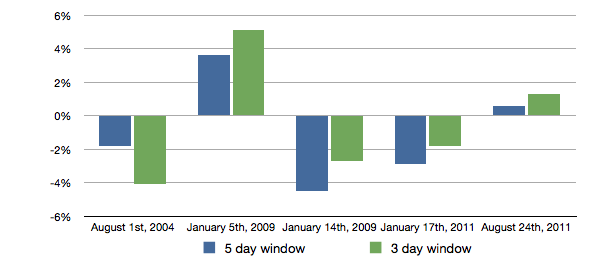
    To demonstrate that effect, we can turn to data. The discounting was visible in the reactions of the stock in previous events when the tenure of the CEO came into question. Those reactions are shown in the following chart:

    Each of the bars above shows the cumulative abnormal returns after all the events when tenure issues cropped up in the news.

    If we excluded the first time we learned about Steve Jobs’ health issues, we can see that the stock market likes certainty (January 5th, 2009: health issue but remains CEO; August 24th, 2011: definite resignation as CEO) and rejects uncertainty manifested in medical leave announcements on January 14th, 2009 and on January 17th, 2011 leaving the top organization in a temporary form. We can also see that Apple investors are becoming more comfortable with Tim Cook running the company as the negative cumulative abnormal returns diminish and turn into positives ones when he is appointed CEO.

    We can conclude that Steve Jobs’ resignation as CEO, as sad as it may be, has reduced unsystematic risk from the stock and therefore “boosted” the share price performance.


  6. Polymath

    Research · 87 comments

    In a rare reflective moment Steve Jobs, after the launch of the iPad, mentioned Apple's DNA. He said:

    "Technology alone is not enough. It's technology married with the liberal arts, married with the humanities, that yields the results that makes our hearts sing.

    Nowhere is that more true than in these post-PC devices...that need to be even easier to use than a PC, that need to be even more intuitive than a PC; and where the software and the hardware and the applications need to intertwine in an even more seamless way than they do on a PC.

    We think we are on the right track with this. We think we have the right architecture not just in silicon but in the organization to build these kinds of products."

    Steve Jobs' legacy in product development has been clearly established and celebrated. What remains now is to determine his legacy in company development. If indeed Apple has the "right architecture in the organization" to serially build disruptive products. The collection of evidence begins today.

    If Apple has indeed become Jobsian then it will have been a grand achievement. John Gruber is already convinced. He points out

    Jobs’s greatest creation isn’t any Apple product. It is Apple itself.

    If indeed he has built Apple sufficiently well to last then he has built an admirable process and not just a product. But this would not be a unique achievement. There have been other companies which preserved their founders' cultural imprints, at least for significant periods beyond their departure. Consider that Disney, Ford and even HP and IBM remained successful for many years after the departure of their founders operating much the same way. They were infused with an indelible culture and preserved it for some time.

    But a leader should aspire to do more. A leader should claim to have left a legacy not just on their company but on all companies.

    Is it not more worthy to have changed civilization than the fortunes of a few?

    I believe that Steve Jobs has actually sought just that. He put it as "making a ding in the universe." This can be interpreted as developing products that "change everything". But if the thing that Steve Jobs should be most proud of is the creation of Apple Inc. then how exactly could an Apple Inc. benefit the world?

    This is where Jobs' quote above strikes me as valuable. The lesson the world should take from Apple is that a company needs to become multi-dimensional. It needs to mix the core business with the disruptive innovation. It needs to combine the intellectual with the artistic. It needs to maintain within it the rational and the lunatic.

    Apple's violent success should serve as a powerful beacon that others should follow. Rather than copying its products other companies should copy Apple's processes--its way of thinking. They should copy how Apple harbors the creative process and the technology processes under the same roof.

    If they do heed this call then we should look forward to the the post-Jobs era as that time when large companies gained the ability to intertwine multiple core competencies. A time when humanism balanced corporatism. A time when we came to reconcile the rational and spiritual.

    --

    This post has be re-published in The Harvard Business Review Blog as: Steve Jobs's Ultimate Lesson for Companies - Horace Dediu - Harvard Business Review

  7. Staying Hungry

    Research · 47 comments

    During the June 2005 Stanford University commencement speech Steve Jobs famously cited the farewell message placed on the back cover of the 1974 edition of The Whole Earth Catalog: "Stay hungry, stay foolish."

    That's a nice, pithy statement. I interpreted "Being Foolish" in a Quora answer as "being naive about how things should be and thus allowing oneself to see how things could be."

    But what about staying hungry?

    A clue comes from the recent Fortune article "Inside Apple" (currently only available in print or as an app). Even with nearly $70 billion in liquidity Steve Jobs claims "Apple is a company that doesn't have the most resources." A former executive claims "We've always fought for resources...Steve and Tim in general want to be sure you need what you're asking for."

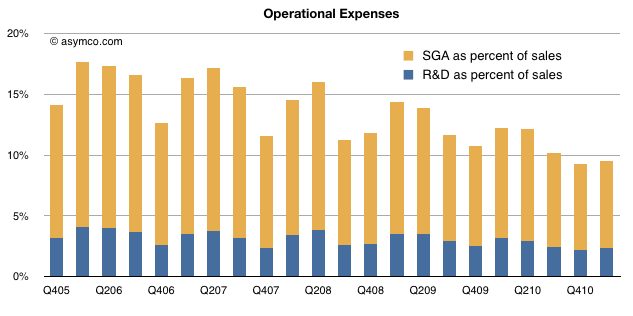
    Note that "resources" here does not mean capital. It means people. Apple is very constrained in the number of people it has available to put on projects. The evidence is in the company's operational expenses. They make up only 9.5% of sales (nearly an all time low). R&D in particular is only 2.4% of sales ($581 million).

    Although R&D doubled in three years sales nearly double every year.

    Looking at the totals over the last full year, the company spent about $2 billion on R&D. A remarkably efficient way to generate $47 billion in sales or $13.3b in operating income. Another way of thinking about it is that every dollar spent in engineering resulted in $23 in sales.

    So the way to interpret the "stay hungry" metaphor is as a low cost structure. It has great advantages beside efficiency. There is a constant demand for focus and justification of spending. There is a certain level of cross-fertilization as people are assigned to varying projects to maximize their utilization. Finally, there are the subtle but powerful influences of hunger: motivation, invention and intense attention to details.

    For Apple this aphorism seems to be more than a motivational poster quote.

  8. Flummoxed, again

    Research · 184 comments

    The last time I took a snapshot of the iPad death watch it was March 9th, 2010. Almost a year ago. The now-classic quotes are reproduced here.  Last May I wrote:

    Apple keeps a tight lid on new products so that competitors don’t get a head-start on copying, but in the case of the iPad, advance knowledge would not have had any impact. Competitors look at the iPad and see nothing.  They’ll only react once the market explodes and they start to feel belated pain.

    I thought that would be that. As the success of the product would become self-evident, predictions of imminent demise would trail off. The pain of share loss would prompt a wave of challenger copycats. Imitation would be the the best form of flattery.

    But no.

    Critics were not silenced. One year, 15 million units, and $9.2 billion later I went back to the source of the quotes and found the following (published quotes dated after March 9th 2010). (Cited from aaplinvestors.net with some editing for brevity and relevance):

    “Problematically, the Android competition is just as expensive as the iPad lineup, so Apple obviously feels free to continue gouging consumers on iPad pricing.” Paul Thurrott, Windows IT Pro, 3 March 2011

    “Apple’s iPad 2 might be ‘magical’ but it still should’ve been better ... It needs more G’s. It’s still just a toy” Zach Epstein, Boy Genius 2 March 2011

    “11 reasons NOT to buy an iPad 2 ... Reason 5: Competition David Gewirtz, ZDNet, 23 February 2011

    “Given what I’ve seen of Honeycomb and Motorola’s excellent tablet, Cupertino will have some serious catching up to do with their iPad 2.” J.P. Mangalindan, Fortune, 4 February 2011

    “We very carefully chose our tablet processor, the Nvidia Tegra 2, and to really compete it will take [Apple] some time. You know, [Nvidia] is well known for graphics.” Jonney Shih, Asustek Computer, 3 February 2011

    “If you were to ask me in two years time, will Apple have less than 50 percent of the global tablet market, I think that’s a certainty. Neil Mawston, Strategy Analytics, 31 January 2011

    “We have an extreme focus on the innovation of LePad and LePhone because these products will dominate the future market. Though Apple is winning a significant share in the Chinese market, it has not gained a clearly leading position yet. Our advantage is we know this market better.” Liu Chuanzhi, Lenovo, 27 January 2011

    “The iPad may still be the lone leader, but with 100+ competitors on the way, it won’t likely keep its majority market share unless the pending next generation iPad really addresses all the complaints about the current version, like a missing camera and a lack of a USB port, and the company has to add those features without a major price increase - a tall order, to be sure.” James Brumley, Investopedia, 13 January 2011

    “Hands-on PlayBook demonstrations at CES showed its differentiation in multitasking and performance, which may be difficult for Apple/Android to rival.” Mike Abramsky, Royal Bank of Canada Analyst, 11 January 2011

    “Apple Inc.’s popular iPad is getting its strongest competition thus far as consumer-electronics manufacturers unveil tablet computers with bigger screens, front-facing cameras for video chatting and more.” Rachel Metz, AP Technology Writer, 3 January 2011

    Apple may be simply trying to get in ahead of Research in Motion’s aggressively priced PlayBook or combat the early success of Samsung’s Galaxy Tab.” Rick Aristotle Munarriz, The Street, 29 December 2010

    4. Competitors are coming. Brett Arends, Wall Street Journal, 22 December 2010

    Reason 6: WiFi is still unreliable David Gewirtz, ZDNet, 16 December 2010

    “I can’t imagine anyone under the age of 30 wanting an iPad. A PS3, Wii, GameBoy, or even a useful laptop maybe, but an iPad? Furthermore, I do not recall ever seeing anyone under 30 actually using an iPad.” John C. Dvorak, PC Mag, 13 December 2010

    “We hope our tablet PCs can reach a global market share of 10-20% initially, and become the market leader in two to three years.” Gianfranco Lanci, CEO and President, Acer, 26 November 2010

    “It’s a nice-to-have product, for those of us who don’t have a budget, but is it a must-have product? I don’t think so.” Ashok Kumar, Analyst, Rodman & Renshaw LLC, 12 November 2010

    “Steve Jobs never says anything without thinking through it carefully. But I think in this case he may be a little afraid of this category. And he’s finding whatever he can to attack because he sees [seven-inch tablets] as a challenge to the dominance of the iPad.” Adam Hanin, VP Marketing, Viewsonic, 1 November 2010

    “There could literally be millions of first-generation iPads gathering dust in people’s home offices already. This product is the tech industry’s biggest MacGuffin yet.” Paul Thurrott, Windows IT Pro, 23 October 2010

    “I cannot see a need for the thing.”John Dvorak, MarketWatch, 22 October 2010

    ”For those of us who live outside of Apple’s distortion field, we know that 7″ tablets will actually be a big portion of the market and we know that Adobe Flash support actually matters to customers who want a real web experience.” Jim Balsillie, Research In Motion, 20 October 2010

    “iPhone and iPad have been amazing products that have opened new markets. But I do not think they will own either market in a few years. Android will.” Fred Wilson, AVC.com, 18 October 2010

    “The constant search for an ‘iPad killer’ and the sheer multitude of tablet computers launching in the next 18 months should make Apple aware that its competition is fierce and will only become tougher.” Barbara E. Hernandez, PCWorld, 5 October 2010

    “HP’s New Tablet Could Be an iPad Spoiler HP’s decision to bundle a tablet computer with its new $399 printer could make trouble for competitors.” Cliff Edwards and Aaron Ricadela, Bloomberg Businessweek, 23 September 2010

    “Our tablet will be better than the iPad.” Chang Ma, VP Marketing, LG, 20 August 2010

    “Not only is Apple typically lost in the enterprise, but it focuses very little of its time there. And with a new, potentially more compelling tablet coming — the Cisco Cius — the iPad’s success in the corporate world could be short-lived. Here’s why:... 10 The power of Windows” Don Reisinger, Channel Insider, 5 August 2010

    “I don’t think there is one size that fits all…I’ve been to too many meetings with journalists who spent the first 10 minutes of the meeting setting up iPad to look like a laptop.” Steve Ballmer, Microsoft, 29 July 2010

    “ [...] It still isn’t the device that I’d take to a meeting because it has no input.” Bill Gates, Microsoft, 2 June 2010

    “Which means I end up on the iPad — and tablets more generally — where I started. Tablets will not create a new category, but will supplant (or merge with) one or more of the current substitutes: smartphones or netbooks.Here I am less optimistic about the iPhone and webOS than I am about Android. ” Joel West, professor of Innovation & Entrepreneurship, College of Business at San José State University, 30 May 2010

    “The iPad is useless. Beautiful, but useless. The iPad is too heavy. It’s awkward to hold and view in public. It’s fragile. It requires expensive accessories to protect it and extract more functionality. ”Josh Belzman, MSNBC.com, 20 May 2010

    “Mum, the iPad is not ‘amazing.’ It’s just marketed very well, both by Apple and its culpable partners in mainstream media. ” Paul Thurrott (in response to comment by Mum), Paul Thurrott’s Super Site for Windows, 26 April 2010

    “In short, I don’t get the ‘magical and revolutionary’ vibe that Apple chief executive Steve Jobs touted at the iPad’s January unveiling.” Rob Pegoraro, Washington Post, 9 April 2010

    “The first troubling sign is the fact that you can still get an iPad today. They didn’t sell out. The pure slate form factor has failed all these years because, other than for vertical applications, people want and/or need a keyboard for regular use. The fact of the matter is that a touch screen or bluetooth keyboard just doesn’t compensate.” Jonathan Yarmis, Ovum, part of Datamonitor Group, 6 April 2010

    “I don’t get it. It costs $500 for the basic model, when you could get a laptop with a lot more functionality for about the same price. The iPad hype machine has been in full effect this week, and I still think it’s just that—hype. ” Alex Cook, Frontier Outlook, 3 April 2010

    “As far as what this means to Apple, one thing to keep in mind: Even if the iPad sells more than the iPhone did in its first year, it’s still only around 5% of the company’s revenue. So it’s a very small slice. From there, it probably doesn’t grow as large as the smartphone market. So, if you’re buying under rumors, keep perspective in mind. The iPad’s a great product, but it’s probably not a game-changer.” Eric Bleeker, Analyst, Fool.com, 31 March 2010

    “The iPad will remain an expensive, niche device compared to all-purpose netbooks.I think that one of the iPad’s most important uses will be for reading ebooks and publications. Even so, though, when it comes to the marketplace, netbooks will sales still far outstrip those of the iPad.” Preston Gralla, PC World, 30 March 2010

    “Don’t Believe the iPad Hype. Apple has sold out pre-orders of the forthcoming device, but it could all be a marketing tactic. By not manufacturing enough iPads for the initial launch date, is this a case of Apple shooting itself in the foot?” Mike Schuster, Minyanville.com, 29 March 2010

    “‘iPad Killer’ May be Palm’s Last Hope”Tom Bradley, PC World, 20 March 2010

    “Even if your company has relented and now supports the iPhone, as growing numbers of businesses do (70% of the Fortune 100 are at least testing it, says Apple) you’ll want to say “No” to the iPad and other tablets. Here’s why: 8. Speaking of money, there is no money in the company budget to pay for iPads. 9. Not supporting iPad will be the enterprise norm. Robert McGarvey, CIO Update, 16 March 2010

    “This morning, the fool’s parade gets started. Apple is taking online “pre-orders” for its iPad tablet, which is supposed to begin shipping on April 3. Buying a new kind of product sight unseen is foolish. Especially given how mysterious Apple has been on what the iPad can do and what restrictions on capabilities and media access it will place on users and content providers.” Galen Gruman, InfoWorld, 12 March 2010

    “The recent launch of Apple, the iPad tablet, has won the award for the second edition of Fiasco Awards delivered this Thursday in Barcelona. From the more than 7,000 people who voted via the website www.fiascoawards.com, 4,325 have considered it the fiasco of the year. Fiasco Awards, 2010, 11 March 2010

    “I think I’ve mentioned this once or twice before, but it bears repeating until it sinks in: the Apple iPad is not unique, nor necessarily the best of breed in the media tablet sector it is spearheading. And it ain’t gonna help Apple shareholders any.’” Anders Bylund (TMF Zahrim), 11 March 2010

    From this critical review, it looks like 2011 will indeed be the year of the iPad 2.
  9. Apps are 15 times more popular than ebooks

    Research · 71 comments

    “It doesn’t matter how good or bad the product is, the fact is that people don’t read anymore,” he said. “Forty percent of the people in the U.S. read one book or less last year. The whole conception is flawed at the top because people don’t read anymore.”

    The Passion of Steve Jobs - NYTimes.com

    It was almost exactly three years ago that Steve Jobs dismissed the Kindle reader as a futile attempt to change user behavior.

    Yesterday, Steve Jobs announced that the iBooks store served 100 million ebooks in its first 11 months of operations.

    So do we have another example of Steve's classic misdirection where he dismisses a category only to enter and dominate it at some later time?

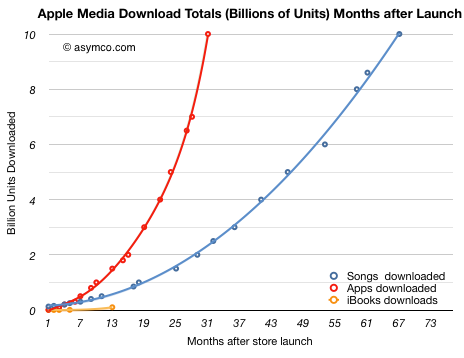
    Let's look at the data. The chart below shows the sales ramp of three media types served by Apple: songs, apps and books.

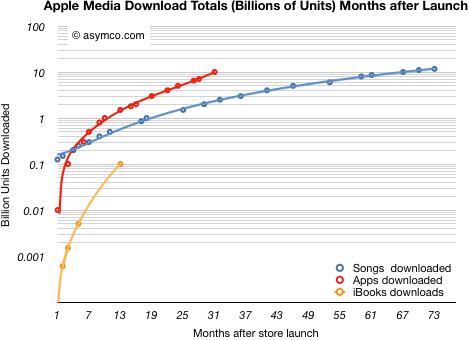
    At the same point in time (11 months post-launch) there were five times as many songs downloaded and 15 times as many apps downloaded as ebooks. You can see the relationship between different media consumption more clearly on a log chart:

    The conclusion that can be drawn so far is that apps/songs show an order of magnitude more popularity than ebooks. Perhaps Kindle ebooks outsell Amazon music downloads, but we don't have comparable data from Amazon and it would be a challenge to compare the two Amazon media as they are packaged and dlievered in different ways (Amazon's digital music is not an integrated offering while their ebooks are.)

    Books are a 400 year old medium. Songs only 100 years old and apps a mere 10. For three centuries, the book medium had a monopoly on solitary entertainment. The download data shows how quickly new media displace the old. Therefore, in this context, it's perhaps fair to say that Steve was right three years ago when he said "People don't read anymore."

    Today he could add that people use apps instead. Many of the apps available are hired to do the same job for users: solitary, immersive entertainment.

  10. Remembering January 14, 2008: The day the market lost faith in Apple

    Research · 106 comments

    In a recent but recurring lament I asked why Apple shareholders are not being rewarded for the company's growth. I pointed out that there is no fundamental reason why the company should receive such a low P/E multiple (about 18 ex-cash trailing and 10x forward while maintaining 70% earnings growth for over a year).

    There were many objections in the comments. Most of them dealt with recent reasons why doubts might have arisen among investors: Android hegemony or some perceived lack of competitiveness leading to margin compression or some macro hangover from the recession.

    In this article I argue that none of these objections hold water. My argument hinges on the fact that there is a precise date when Apple ceased being seen as an exceptionally valuable company and that date precedes any of the causes being suggested.

    The day of disillusionment was almost exactly three years ago: January 14th, 2008.

    How to pin down the date of disillusionment

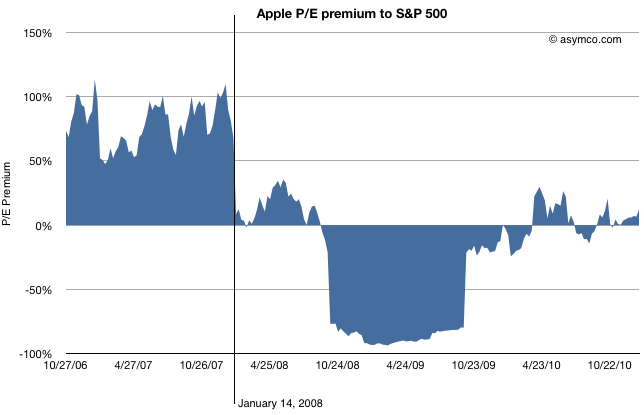
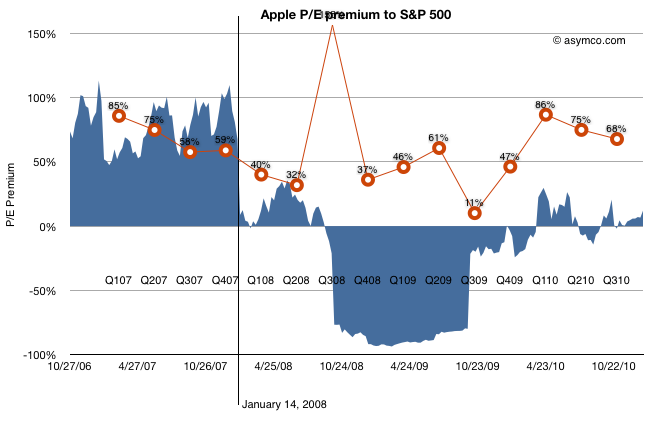
    Consider the following chart.

    The blue area represents either a premium (above 0) or a deficit (below 0) of Apple's P/E (ex-cash) relative to the S&P 500 P/E. This is a re-imaging of a chart, first introduced in June 2010 when I first pointed out that Apple was being discounted relative to the S&P 500.

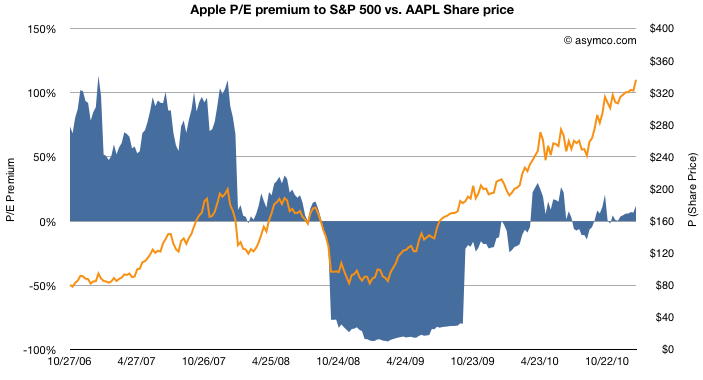
    By measuring P/E I am focusing not on the stock price, which has grown nicely, but the ratio of the price relative to earnings, which hasn't (see the next chart below). P/E is a fundamental measure of potential (its reciprocal is the stock's earnings yield.) It is usually highly correlated to the company's growth. If that P/E is uncorrelated to past growth, there is some significant discounting of future growth. It's the most significant (and simplest) measure of "faith" in a company.

    By measuring the company's P/E relative to an index of other large companies (S&P 500 P/E) we can assess whether the company's potential is being valued as extraordinary or whether it's being valued as ordinary. In other words we are measuring whether a company is "special".

    The chart shows that until January 14th, 2008 the company was valued at a significant earnings premium--a P/E consistently 50% higher than the norm.[1]

    Following the collapse (about 40% drop in share price but 100% drop in P/E premium), there was a small recovery followed by a huge trough in valuation. During the recession quarters Q308 to Q309 S&P earnings fell to zero or below. As a result of S&P earnings collapse the S&P P/E shot up astronomically (as E approaches zero, P/E approaches infinity). Apple's earnings dropped as well but remained positive throughout that period bottoming at 37% growth(!) in Q408. As a consequence Apple's P/E fell as low as 11 while the market's went well above 100 (122.41 peak). The P/E deficit for Apple went 80%: Apple was valued as basically worthless (3x cash).

    After the earnings recession, the S&P P/E recovered close to historic levels but Apple's P/E did not. It's in-line with the S&P but does not obtain the 50% premium preceding the recession.

    So we can establish that the day that Apple's potential was discounted was nearly six months before the onset of recession.

    What other discounting factors can we discard?

    How about earnings growth itself? Did the collapse foretell an earnings collapse?

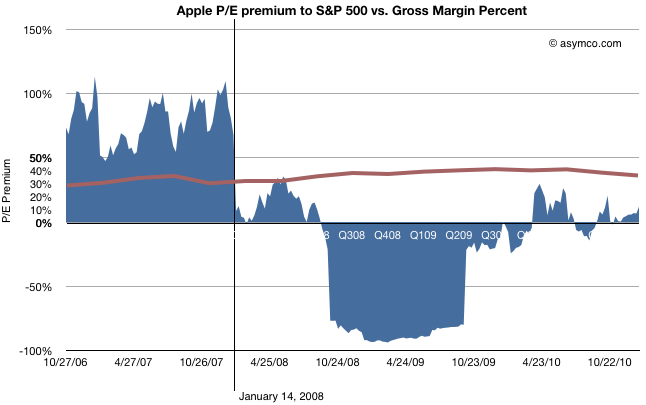
    The chart above shows the P/E premium vs. earnings growth (in red). Although earnings growth began to slow soon after the 14th (earnings for CQ407 were not yet announced at that point), growth recovered six months later after the launch of the iPhone 3G[2]. Growth continued throughout 2009 and 2010 reaching new heights last year of 86%.

    Still, the company received no premium to the S&P 500 P/E. Companies in the index averaged, at best, a quarter of Apple's growth in earnings.

    What about Android? The first Android device did not ship until October 2008 (HTC Dream or T-Mobile G1). There were no appreciable Android volumes until 2009, one year after the drop in relative value and no talk of a threat until 18 months later.

    The last objection to be put aside is that of margin compression.

    This last chart shows how margins (in brown) behaved during the same time period. They went up. The only slight decline took place during the last few quarters, after the launch of the iPad, long after the collapse.

    Regardless of the adjustments with product launches, Apple's GM is the envy of the world and is not at all correlated with the loss of faith in the company.

    So What happened on January 14, 2008?

    Having led you this far in the story, I'm afraid I'm going to let you down at the end: The cause for the loss of faith is a mystery to me.

    There is only one noteworthy event that took place on that date: Macworld 2008 (January 14-18). During the keynote, Steve Jobs introduced the Macbook Air (and Time Capsule and Leopard and pre-announced the iPhone SDK which, six months later led to the app supernova). I remember that day and I remember that the stock began selling off exactly at the point when the Air was mentioned. It has never been the same since.

    Obviously, correlation is not causation. The Macbook Air need not be the cause for the loss of faith in Apple as an investment. Or can it? I'm hoping someone can explain this because to me it makes no sense. The product was not a home run but it did not do badly either and its current incarnation seems to be a hit. Whatever sins the original Air may have had have surely been expurgated by now.

    Regardless the cause, the bottom line is that, in the eyes of investors, Apple stopped being "special" that day. Its valuation dropped to in-line the S&P and, given its growth, well below what a large growth company should be worth. The company's shares went into the bargain bin and are still there today.

    ---

    [1] I should point out that the P/E ratio is based on post 2009 re-stated earnings. The restatement changed the P/E as the "E" changed. This was based on the abolition of subscription accounting for the iPhone. Although it may seem unfair to hold the market to this standard, restatement did not actually change cash flows which were transparent and visible to all, even to amateurs such as myself and the other unaffiliated analysts that published throughout this period. Earnings may be an opinion but cash flow is a fact. Valuation on the basis of cash flow should have yielded the same results as shown above.

    [2] That quarter showed a y/y growth of 150% while the stock was in freefall. In fact, it was during that earnings day that Steve Jobs came on the conference call and pointed out the astronomic iPhone cash flow to an audience of analysts more concerned about their own jobs.

  11. Steve Jobs forecasts iPhone sales to grow at least 50% y/y

    Research · 6 comments

    Well, not exactly.

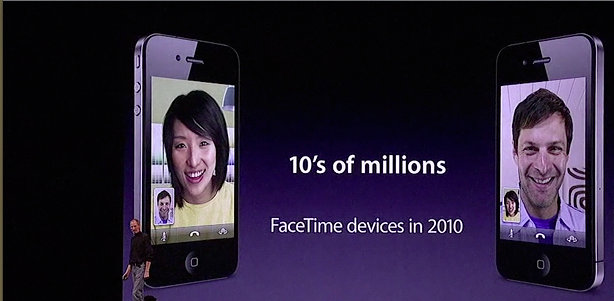
    During the WWDC keynote Steve Jobs announced that "we will ship 10's of millions of FaceTime devices in 2010".  Since only iPhone 4 currently runs FaceTime(*) then it stands to reason that there will be "10's of millions" of iPhone 4 devices sold.  And since the year is half over, it means we can divide "10's of millions" over two quarters.  That puts sales in the 10+ million range per quarter.

    My current forecast shows 11 million in Q3 and 13 million in Q4 corresponding to 50% y/y growth.

    Steve Jobs seems to be indicating this is well within reason.

    (*) one exception to this assumption is that he's including a future iPod touch running FaceTime.  This may very well be the case when the iPod line-up will be released probably in October.