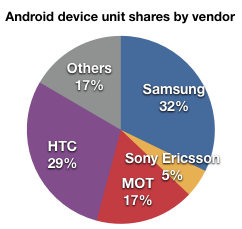
Gartner released sell-through data for the handset market. In the release appears an estimate of total Android 3Q Smartphone sales (20.5 million). Combining this with what some of the vendors have reported in terms of units sold, we can estimate the share of Android by vendors.
Note that this is a rough estimate. We don't have data on Sony Ericsson's smartphone units sold and we don't know the mix of HTC's Windows Mobile vs. Android. I'm also assuming LG as part of Others. The data from Gartner is claimed to be sell-through whereas vendors report sell-in so there is more roughness about each vendor.
Regardless of these potential sources of error, it's a very safe bet that Samsung and HTC are the largest Android vendors by a fairly large margin.
It's perhaps noteworthy that both are also committed Windows Phone vendors. According to pdadb.net here is the count of Windows Phone SKUs by vendor:
HTC 12
LG 5
Samsung 2
Dell 2
Toshiba 1
Motorola is keeping its Windows Phone options open, leaving "Others" as the only likely exclusive Android vendors.
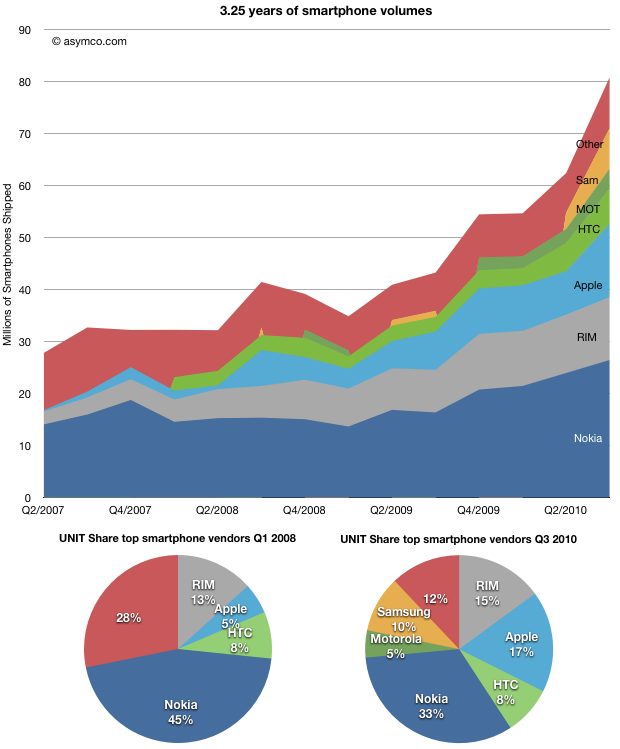
If we look at the growth of smartphones independently from all phones, the category looks impressive:
Smartphones are now almost 24% of all phones, up from 10% three years ago.
What's also impressive is all participants in the market grew their volumes. The rising tide did lift all the boats.
For this reason it's somewhat perplexing to hear absolute statements about the imminent death of certain smartphone competitors. The non-smartphone market is still 76% of the total phone market. And it's the biggest and easiest target for all smartphone competitors. The data shows that, for the time being, calling the end for vendors or platforms in a market that's doubling every three years is premature.
But what I really want direct attention to here is a subset of the market: modular platforms.
If you recall from the modular vs. inter-dependent dichotomy discussion, modular architectures are a way to implement products by licensing core components rather than keeping an integrated development model. I stated that modularity tends to be the better approach when markets are mature/over-serving and inter-dependency is the better approach when markets are young and the products not-good-enough.
Looking at the chart above you should note that the market is growing extremely quickly so it's not "mature" in that sense, implying a healthy future for inter-dependent players.
So how are modular vendors faring at this stage of the market and what are the prospects of module suppliers (i.e. mobile operating systems).
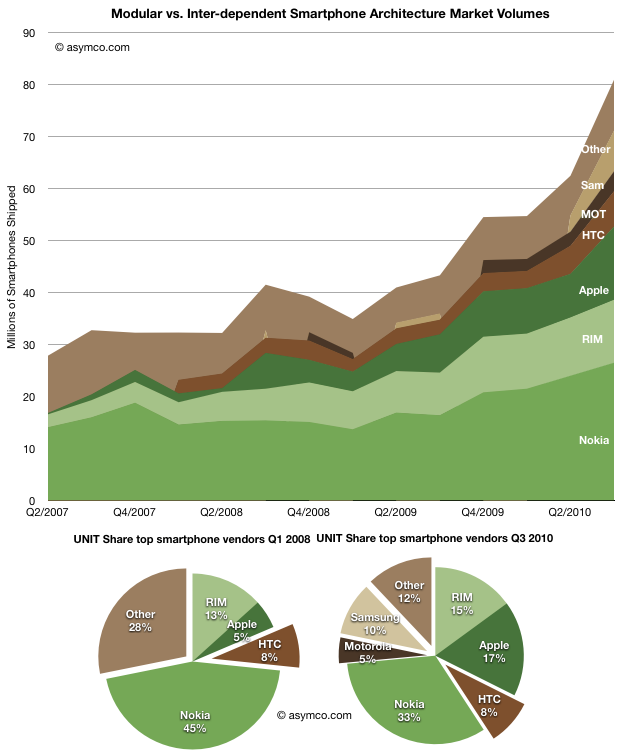
To help clarify, rather than looking at vendors individually I grouped them by architecture. I took the charts above and changed the colors so that modular vendors (in shades of brown) are represented separately from inter-dependent vendors (in shades of green).
When looking at the market this way we can make some important observations:
Even though the overall market grew, the share of the market held by modular architectures is smaller than that for inter-dependent. It's also not increasing. In 2008 modular players held 36%, in late 2010, they held 35%.
The suppliers to the modular market changed over the same period, so to a large extent they are fungible. During 2007, the vast bulk of the brown area above was using Windows Mobile. The vast bulk in 2010 is using Android.
The addressable market for Android is constrained to the modular market. Therefore the growth potential depends on whether that brown area increases dramatically relative to the green.
Vendors don't change architecture easily. My knowledge of the competitors makes me believe that none of the green players will change from Inter-dependent to modular, and even if they wanted to change it's not a simple thing to do. Conversely, changing from modular to inter-dependent is enormously challenging. Company processes, competencies and priorities must change dramatically.
So what's the bottom line?
For an Android dominant future, several conditions must be met; one will need to believe all of these to be true:
The addressable market for modular solutions will have to grow much faster than that of inter-dependent vendors. [The chart shows in-line growth--again due to the overall growth of the market. The green guys above won't just roll over.]
The split of licenses between Android and Windows Phone within the addressable market must favor Android. [Again, this is unlikely as "politics" will interfere. (I won't even touch IP issues.)]
The current modular vendors will not become inter-dependent or the current inter-dependent vendors will become modular. [Now why would they tear themselves apart if they are growing?]
The profitability of Android vendors must be high enough to make modularity sustainable [more about this later.]
Talk of Android (or iOS) "domination" is still wishful thinking. With the acceptance of Windows Phone within the value chain (device vendors, operators, developers), the brown area above will be served by two very powerful and motivated competitors. Politics and lawsuits will add drag on growth. Established brands are important to consumers and new brands (like ZTE and Huawei) will have a hard time joining the top tiers with or without Android. Established integrated vendors like Nokia, RIM and Apple don't have modular DNA but do have massive distribution.
In the end, the real limitation is that the brown area itself is not going to get disproportionately large. Android is limited by its addressable market and that market is a lot smaller than the whole market.
Looking at the world through modular/inter-dependent lenses lets you see that mobile platform dynamics will not evolve as they did in the PC era. At least not for the foreseeable future.
Sony Ericsson is to stop making smartphones featuring Nokia’s Symbian operating system.
The move means that the troubled Finnish mobile maker is likely to be the only significant user of Symbian.
Analysts said Sony Ericsson’s decision confirmed the “failure” of Symbian as an open source platform, given that it was supposed to be used by several large mobile makers.
As of two weeks ago, AT&T was to be the launch partner for Windows Phone. AT&T had been expected to unveil phones from HTC, Samsung and LG, according The Wall Street Journal.
Microsoft Corp. said Friday it has filed patent-infringement lawsuits with the International Trade Commission and in the U.S. District Court for the Western District of Washington against Motorola Inc., targeting Motorola mobile phones based on Google Inc.’s Android software
This follows infringement suits by Apple against HTC targeting Android and by Nokia against Apple targeting GSM patents (with obligatory counter-suits, of course.)
There was a time when Motorola was a key design win for Microsoft and their Windows Mobile in 2003 with the MPx series. In fact, Motorola still ships Windows Mobile devices like the ES400 and FR68. These are for industrial applications but there were many mainstream Motorola Windows Mobile volume products. The most famous perhaps was the MOTO Q in 2006.
I'm sure part of the value pitch for Windows Phone is indemnification from IP infringement. Windows Phone will be the only licensed OS that offers this coverage and it's a non-trivial selling point.
The chances are extremely small. There are three scenarios where this would make sense:
If there was a specific market that required it. It would also need to be a large opportunity since developing a new platform and diluting existing platforms need significant upside. The only such market is the US, but there are better options available, namely Android that have better potential and Android is treated as a toxin by Nokia (see metaphor).
Specific users. Windows Mobile used to be justified for business users, but Windows Phone is not targeting business users.
The last option would be "strategic" i.e. Microsoft paying Nokia for using the OS (directly or indirectly through marketing co-spend or other symbolisms). I don't think Nokia is desperate enough yet.
Although it's never prudent to say never, I just don't see any logic for Nokia to add to its bill of materials for phones while facing price pressure.
With Verizon shaping Android into its image, you can read AT&T's embrace of Microsoft as the deeply-held belief by operators that they need multi-platform balance in their portfolio.
The idea that operators will tolerate "dominance" of a platform is looking less and less tenable.
Microsoft executives told Goldberg during a recent visit to company headquarters that the company, carriers, and manufacturing partners, would spend "billions" of dollars in the first year on marketing and development of Windows Phone 7. Another source estimated a $1 billion price tag for the launch, with half of it going to marketing.
Note the scale of spending here. The number quoted is twice Apple's yearly ad budget, for all its products.
$500 million is roughly the equivalent of Apple's entire advertising budget for its 2009 fiscal year. In its 2009 Form 10-K filing to the SEC, the Cupertino, Calif., company listed $501 million in advertising expenses. Microsoft's fiscal 2009 advertising budget was $1.4 billion.
But beside the unrepentant destruction of Microsoft's shareholder wealth, one other thing jumps out at me: why are the operators and vendors going along with this?
Fragmentation increases the cost of development, marketing, operations and hinders the creation of cohesive ecosystems.
Most companies are very aggressive in consolidating around internal platforms and standards. Supporting R&D teams and marketing teams around each platform is costly and dilutive to one's brand.
With hundreds of Android devices and RIM and Apple increasing distribution, why would operators be willing to spend hundreds on a venture to promote a new platform? This decision is even more puzzling when realizing that the vendor of the new platform left nothing but business model carcasses behind the last time they got involved in the industry.
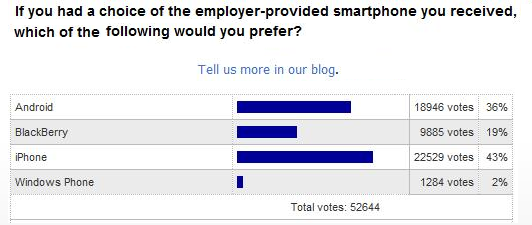
In addition the positioning of this product is suspiciously awkward. One could argue that as a vendor or operator, having an unaddressed or underserved market (say, business users) might mean this platform could expand the distribution of your product or service. But Windows Phone is being positioned as a consumer brand and that's a crowded space where every other platform is also targeted. See the survey data below (unconfirmed source: US Army)
So again, why would operators and licensees spend hundreds of millions to introduce yet another platform in the market?
The OS market in the mobile space is dominated by other players. Is that a cause of worry?
I think it’s a temporary issue. I don’t put a lot of face and snapshot and time into what is going on. On a global basis, I see what is growing and what is shrinking. Text messaging is the fastest-growing on simple phones part of the mobile market. That’s where growth is. The smart phone part of the market, or the premium market, is in the downward part of the market. It will not be there for a long time in the future.
People want something that’s simple. The design goal for the Windows Phone 7 is that with rich experience you get simple stuff easily. Great keyboard or touch or both – so you can have that. It is too early to talk about dominating, but I’m excited about it. Android coming into the market says there is room for more innovation and we see ourselves playing a role in that space. People talked about the iPhone and thought that was the end of the world for OS. Windows Phone 7 will prove there is more room for innovation.
In other words, Android's entry in the market and remarkable growth, there is room for Windows Phone. And because Windows Phone is easy to use and has a keyboard and touch it will have a chance at dominating.
Microsoft's enthusiasm for yet another mobile platform joining the fray (along with iOS, Android, RIM, Symbian, Windows Mobile, Meego, various sundry Linux and Bada) is not just delusion. I'm sure that they gathered positive feedback from operators. By this time next year there will be dozens of Windows Phone devices on the market. After all, Windows Mobile attracted 1700 licenses.