Asymco

Asymmetric Intelligence

Windows Phone

  1. Microsoft has received five times more income from Android than from Windows Phone

    Research · 197 comments

    Microsoft gets $5 for every HTC phone running Android, according to Citi analyst Walter Pritchard, who released a big report on Microsoft this morning.

    Microsoft is getting that money thanks to a patent settlement with HTC over intellectual property infringement.

    Microsoft is suing other Android phone makers, and it's looking for $7.50 to $12.50 per device, says Pritchard.

    HTC Pays Microsoft $5 Per Android Phone, Says Citi.

    A rough estimate of the number of HTC Android devices shipped is 30 million. If HTC paid $5 per unit to Microsoft, that adds up to $150 million Android revenues for Microsoft.

    Microsoft has admitted selling 2 million Windows Phone licenses (though not devices.) Estimating that the license fee is $15/WP phone, that makes Windows Phone revenues to date $30 million.

    So Microsoft has received five times more income from Android than from Windows Phone.

    Looking forward and assuming that Microsoft can receive this type of settlement from about half of the Android license takers, then the prospects of a windfall from Android dwarf the expected income from Windows Phone.

    Google's Android seems the best thing that could have happened to Microsoft's mobile efforts, ever.

    I could also calculate how the Android license income could be further funneled to Nokia (via their current agreement with Microsoft) for promotion of its phones. Thus, an Android licensee could reduce his margins in order to promote a competitor's products.

  2. HTC and self-determination

    Research · 74 comments

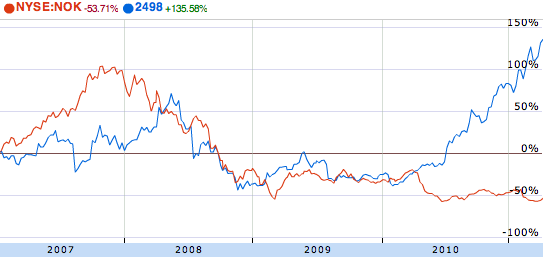
    HTC's market cap has just overtaken Nokia's. While market capitalization is a fickle thing, shifting with sentiment, this is still a remarkable feat. Nokia's market capitalization has almost halved in the space of a year while HTC has more than tripled from $10 billion to over $33 billion.

    If you roll back to 2007 and the start of the modern era of smartphones, you can see how the two companies stocks traded places:

    (source: Google finance)

    The recession was hard on everybody but HTC soared during 2010 while Nokia never recovered. Markets reward unforeseen growth and typically that means above-market growth.

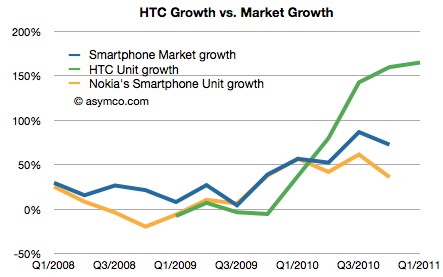
    That's reflected in the following chart (admittedly units and not profits, but pricing and margins for both have remained relatively steady.)

    As Nokia's growth lagged the market the stock was punished. As HTC's growth exceeded the market's growth, the stock was rewarded.

    But there are a few more observations to make:

    • HTC's smartphone business was under-performing the market for most of 2009. In fact, it was even in negative growth for three quarters.
    • The surge in growth coincided with HTC adding Android to its portfolio and given no other changes, seems to be causal.
    • Although not within the time range of the charts above, HTC had another period of rapid growth in the mid 2000s.

    A year ago HTC was making excuses and apologizing. Today they are more valuable than the largest phone vendors. All thanks to Android.

    But why no thanks to Microsoft?

    HTC was the primary Windows Mobile vendor a few years ago. They claimed at one point to have shipped over 80% of all Windows Mobile devices. They were also the leader in the Pocket PC franchise as they were the ODM behind the iPaq brand from HP/Compaq. HTC would not exist today were it not for Microsoft.

    The relationship is such that HTC is paying Microsoft for protection from (potential) Android IP infringements. HTC has also licensed Windows Phone though the relationship between Nokia and Microsoft must give them pause.

    But that's the whole problem. Those who live by the sword shall die by it. HTC was a Microsoft dependent and now they're a Google dependent. As the basis of innovation shifted, HTC was agile enough to make the transition. Perhaps they can execute a portfolio switch yet again as their upstream suppliers change whims or business models.

    But then again, as we saw with Windows Phone, perhaps not.

    If HTC wants to control its destiny it needs to control its suppliers. Now that its power and brand have grown, it needs software because in their market software is self-determination.

  3. The controversy of playing it safe: What's IDC's Smartphone Market Message?

    Research · 53 comments

    IDC released a new forecast for the worldwide smartphone market which included a long range forecast--all the way to 2015.

    Most people fixated on the share data in 2015. Not hard to do since whoever wrote the press release highlighted this flashy headline. Putting aside the three significant digits of accuracy on every data point and the hard to swallow declaration that a painfully underperforming (in more ways than one) Windows Phone will overtake iOS and BlackBerry to become the second largest platform by units/year in 2015, there is much more to the report.

    Using only the public data from the press release we can put together a pretty good picture of the transition being forecast and determine some of the (unstated) assumptions being made. It's these assumptions about the underlying market dynamics which illuminate far more than the falsely precise share data.

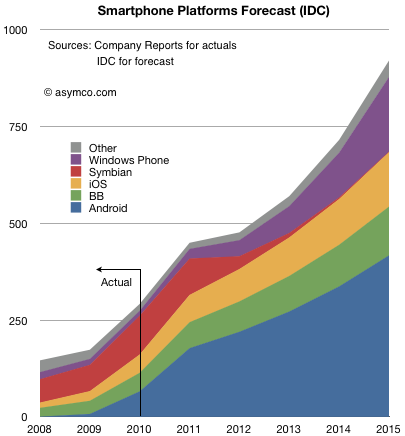
    The following chart shows both historic platform performance (which is detailed in the Asymco Interactive data sets on a quarterly basis) and the forecast based on the given compound growth rate published.[1]

    I see three main assumptions being made:

    1. Nokia (or more precisely Symbian) share will be swapped for Windows Phone. The transition period 2011 to 2015 shows approximately 150 million Symbian devices will be sold which is the stated goal for Nokia. IDC is making an assumption that the hardware vendors will roughly maintain their respective shares irrespective of platform dynamics and that Nokia will switch its share of users from one platform to another in a predictable way.
    2. iOS and BlackBerry will maintain share. Presumably this is also driven by hardware channel dynamics and relationships with carriers.
    3. Android will grow share slightly but the vast bulk of growth will come from market growth.
    4. Market growth is strong but undramatic.

    Overall this is not a controversial set of assumptions.

    Except perhaps that it assumes that the basis of competition in the market is unchanging. Of course it's well understood that the basis has shifted during the tumultuous 2007 to 2010 and forecasts made before the iPhone was launched sound absurd today.

    But IDC says that the unpleasantness won't happen again. From listening to the conversations going on today on this blog and elsewhere, their assumption that things will not change (again) is fairly deeply ingrained, indeed conventional wisdom. In that sense IDC is not taking any liberties with the future. The projections of current realities onto the future leads to this type of forecast and status quo defenders should be satisfied, if not rejoice.[2]

    However, there are a few more consequences of even this uncontroversial forecast which should make keen observers sit up and notice.

    If we look at more than the before and after snapshots and comfortable pie-splitting sound-bites there are some profound seismic things being implied.

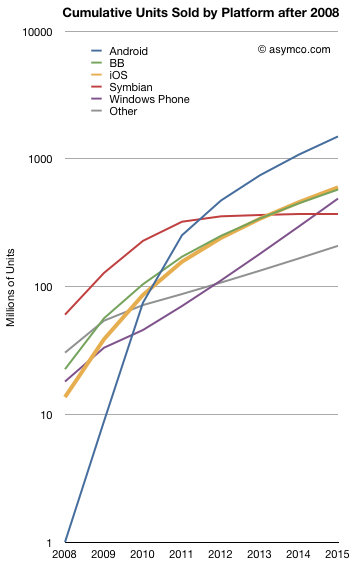
    For example the entire market will be nearly 1 billion smartphones a year (in four years!). Even more startling, considering the "race to a billion" discussion we've been having, some of the platforms seem to be reaching that threshold rather quickly. The following chart shows the cumulative unit sales for the candidate platforms on a log scale:


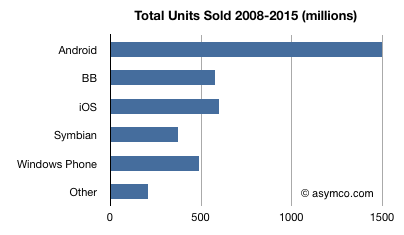
    Android is considered likely to break one billion units in five years post-launch. Windows Phone will sell nearly half a billion units and Blackberry will be well over that number.

    I tallied the cumulative platform unit totals below:

    No less than four platforms will have sold half-billion units by 2015. The suggestion that Android will "win" by having the most units sold seems as hollow as the suggestion that Symbian "won" by having the most users in 2008. Not so much because it will go on to lose them, but because there were plenty of viable alternatives for users to buy and developers to build for. Half a billion users cannot be easily ignored.

    So even "safe" assumptions can lead to astonishing results in this market. Namely, IDC is saying that the smartphone market will not have any platform losers.

    There is one more thing the report implies. If you look at the ranking of leading platforms (by units/year) in 2008,  2015 and, with a little extrapolation, 2016/2017 you get:

    Rank in 2008Rank in 2015Rank in 2016/2017
    SymbianAndroidAndroid
    OtheriOSWindows Mobile
    RIMRIMiOS
    Windows MobileWindows MobileRIM
    iOSSymbianOther
    AndroidOtherSymbian


    In other words, there is a complete reversal being projected. An almost perfect flip: those on top end up at the bottom and those on the bottom end up on top. That's about as controversial as it gets. Pretty impressive for a set of safe assumptions.

    --

    Notes:

    1. You should ignore the shape of the curve between 2011 and 2015 as it assumes the CAGR is applied to every year. Although the press release shows a CAGR, the actual report may include various fluctuation in yearly growth. The starting point of 2011 and the end result in 2015 however should be the same.
    2. If, on the other hand, you believe that exponential growth, rapid gains in communications speed, new breakthroughs in interaction with devices, and entrants winning with new business models are causes for a disruption, then perhaps extrapolation may not be the way to forecast this market.
  4. The Allegory of Treo

    Research · 35 comments

    The following is a work of fiction.

    The combination seemed unthinkable just a few years ago. Nokia envisioned itself as a substantial rival to Redmond, threatening to head off its computing dominance as the power of desktop computing shifted to pocket-size devices. But a series of miscues substantially weakened the company, leaving it little choice but to team up with the world's largest software maker.

    Although Nokia has pledged to continue using the Symbian OS in both handhelds and phones, the company has now significantly tied its fortunes to the rival it once denounced.

    In doing so, Nokia is making a tough bet. The company is gambling that Microsoft's operating system has advanced far enough to power a decent cell phone, while still having enough rough edges that Nokia can carve out a niche by going beyond the standard Windows Phone software. In doing so, Nokia hopes it can avoid the fate of being just another clone cranking out hardware on Microsoft's behalf.

    Microsoft, meanwhile, has scored a significant win in its decade-long quest to crack the mobile market. In wooing Nokia, Microsoft has brought a one-time rival into its fold and ideally gained a new creative force as it tries to move its PC empire into the burgeoning market for cell phones.

    "Nokia always did great work, and so we lusted after some of those things that they do well," Ballmer told reporters at Monday's launch.

    The partnership is not totally out of the blue, of course. The two companies offered a glimpse at the detente last year, announcing a pact that allowed Symbian OS-based smartphones to connect directly with Microsoft's Exchange servers for corporate e-mail and calendar information.

    In its secret meetings, Nokia execs managed to convince their Microsoft counterparts to build several software hooks they needed into the latest version of Windows Phone. The changes allowed Nokia to add some handy features into the Windows version of the N series phones. One new trick allows Nokia owners to ignore an incoming cell call, instead sending a brief text message to the caller. A second feature allows Nokia owners to navigate multiple voice-mail accounts using VCR-like buttons, rather than having to know that "5" is the key for fast forward or remember that "7" saves voice mail at work, but deletes it at home.

    A key question, though, is whether Microsoft will give Nokia enough room to innovate in the future, now that it has successfully wooed the device maker. By going with Microsoft, Nokia is letting go of one of the key differentiators between its products and those from better-known competitors.

    Elop said he understands the risk and only undertook it with assurances that Nokia would be able to build enough software on top of the OS to make his products stand out.

    "It was the only way we felt it could work for us," he said at the Monday press conference.

    Executives from both companies suggest that the Nokia-Microsoft relationship, forged at those meetings in Cannes and New Orleans, will continue to be close. But it remains to be seen whether Nokia will retain its individuality now that it has the Microsoft imprimatur.

    Wirt acknowledges that there are no formal procedures in place that ensure that Nokia will get the things it asks for the next time, or the time after that. "It's functioned more as a relationship-type thing."

    Elop said Nokia could try to patent particularly strong advances, but in general he said the company believes the best way to stay ahead is to keep cranking out new products.

    "We have ideas about many things that we didn't get to do in this version," he assured reporters.

    But for all its ideas, Nokia is still a relatively small company. And given that it has pledged continued support for the Symbian OS, it must now divide its limited engineering resources between two incompatible efforts.

    Elop acknowledged that the challenges of developing for two entirely different operating systems are enough to keep his firm hopping. He emphatically shook his head back and forth when asked if Android and MeeGo-based Nokia phones might be next.

    "We don't need another operating system," he said, adding later, "It's too much effort."

    This fictional article was created by taking an actual article from 2005 about Palm and Microsoft (Palm's tale of Treo intrigue - CNET News) and changing the words "Palm" for" Nokia", and "Colligan" for "Elop", "Ballmer" for "Gates", "Treo" for N series (or Nokia) and "Symbian" for "PalmOS". A few paragraphs about the mechanics of the deal process were deleted.

    Credit: This tweet from Charles Arthur.

  5. Platform sunk (cost): What is the value of a quarter billion Symbian users?

    Research · 38 comments

    In the quarterly smartphone summary published here, I noted the significant acceleration of Android sales at the expense of "other" and Windows Mobile/Phone. Some share was also lost to Symbian. This might be seen as justification for the "platform jump" that Nokia undertook.

    In a second discussion, I published the history and life cycles of the smartphone platforms, identifying 10 platforms (out of 16) still in the market. This challenged the view that it was a two horse race today and that it will become no more than a three horse race in the future.

    Questions came up about the "quality" of these platforms. Clearly some are barely viable while some are thriving. To explain the value of a platform, one metric we can use is the cumulative sales which allows us to derive the installed base.

    The following charts do just that.

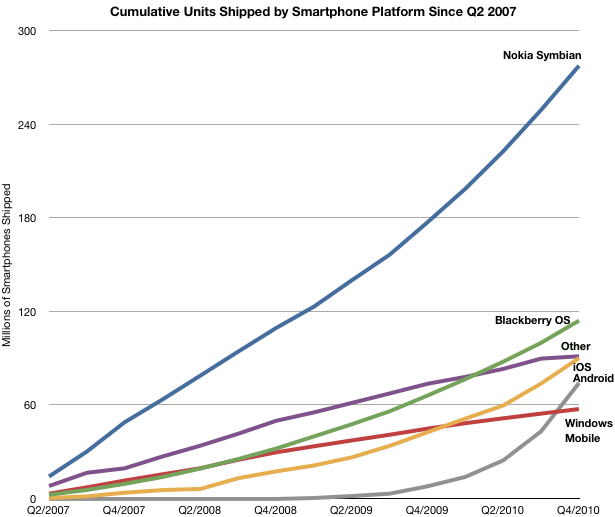
    This first chart shows the cumulative total of units sold since Q2 2007. This is the sum of all smartphones sold in the last 3.5 years. There are some interesting patterns here, but right now we want to focus on the installed base.

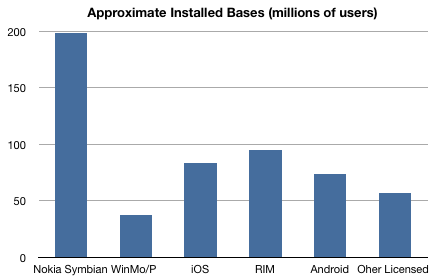
    3.5 years of cumulative sales is an upper bound on the installed base. We can get a better estimate the phones in use by subtracting from the base phones older than 2.5 years. This is shown in the second chart below:

    As of the last quarter, Nokia's Symbian is likely to have 200 million in use. Apple may have about 85 million iPhones in use (this excludes iPod touch and iPads) and Android about 75 million. RIM is around 95 million and Windows Mobile less than 40 million.

    What's interesting is that of these installed bases, the largest is the one that's just been abandoned, and the smallest was chosen as its replacement. Even that's not quite fair since Windows Mobile is not a valid replacement. It's Windows Phone that was chosen and that probably has an installed base of about 1 million [Unlike the measurement of units shipped, Microsoft reported two million licenses were sold to OEMs who had to build those into phones which would be shipped to carriers and distributors. One million may be a generous estimate.]

    The bottom line is that there are about 5 Windows Phone users for every 1000 Symbian users. In other words, Nokia jumped from the "burning" 200 million user Symbian platform to the "ice cold" 1 million user Windows Phone platform.

    The disposal of such a large installed base must count among the largest divestitures in technology history and, when coupled with the adoption of the least-tested alternative as a replacement, elevates platform risk-taking to a new level. It may seem bold, but there is a fine line between courage and recklessness.

    I'll do my own "dive" into the possible justification for this in a future posting.

  6. Where is the Windows Phone Tablet?

    Research · 78 comments

    The Windows Phone platform currently has hardware specifications that imply a cellular phone device. What is interesting in light of the new WebOS TouchPad, the newly announced Android tablets, the RIM Playbook and the iPad is that this supposed "third horse" of Windows Phone has no hint of present or future presence in the tablet form factor.

    That might have something to do with the plans to move Windows to the tablet form factor. Perhaps Microsoft thinks that pocket size devices deserve a separate operating system, platform and ecosystem than portable mobile computers. Perhaps Microsoft plans to have two separate interfaces for these tablets (slates vs. tablets?) Then again, Ballmer held up a Windows Phone and said "This is Windows too."

    It gets confusing.

    The bottom line is that without a tablet implementation, Windows Phone developers and content providers will find that the WP ecosystem will have a limited addressable market and will not be suitable for all forms of media or apps. Tablets are currently expected to grow even more rapidly than smartphones did and so there will be significant numerical advantages to those platforms that support multiple screen sizes and form factors.

    Now that Nokia has anointed the Windows Phone platform as its exclusive conveyance to the device market, the question in the headline becomes: Where is the Nokia tablet?

  7. The price of Windows Phone: Nokia's evaporating smartphone share

    Research · 61 comments

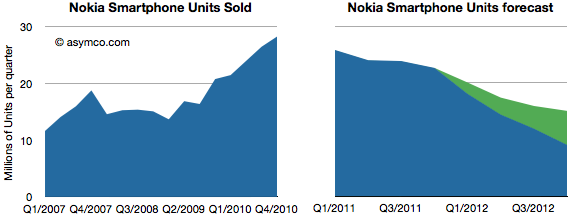
    In the last quarter Nokia sold 28.3 million Symbian phones. The average selling price was €156 or approximately $210. That price was down 17% year-on-year.

    According to the company,

    The 17% year-on-year decline in our converged mobile devices ASPs was mainly driven by general price erosion and an increase in the proportion of lower-priced converged mobile devices sales.

    ASP erosion has been a fact of life across all of Nokia's products for quite some time, checked only by the increasing mix of smartphones. However the smartphones it sells have been consistently positioned for lower price points. This is consistent with Nokia's long-term goal of serving "billions" of users.

    The trouble with the new strategy is that the Windows Phone product lines currently in the market are not likely to be priced in the $200 range. The reason is that the minimum specifications for Windows Phone 7 are:

    • Capacitive, 4-point multi-touch screen with WVGA (480x800) resolution
    • 1 GHz ARM v7 "Cortex/Scorpion" or better processor
    • DirectX9 rendering-capable GPU
    • 256 MB of RAM with at least 8 GB of Flash memory
    • Accelerometer with compass, ambient light sensor, proximity sensor and Assisted GPS
    • 5-megapixel camera with an LED flash

    These don't add up to a product that can be sold profitably at $200. The bill of materials is likely to be in that range (and one has to add $15 for Microsoft).

    So there are two possible implications for Nokia's new smartphone strategy.

    1. Windows Phone will be ported to lower spec/cost hardware to allow the traditional Nokian market growth model to continue and perhaps combat Android proliferation
    2. Nokia's smartphone portfolio will consist of high-priced products, and exclude mid-to-low price products.

    Option 1 is difficult to imagine. The user experience that Microsoft is putting forward as its differentiation depends on significant hardware which is unlikely to become very cheap very soon. It is an interesting exercise to think through however. What would we have to believe for this option to become real?

    Option 2 is more likely as Nokia conforms to this a new definition of smartphone as "high-end" only. This seems to be the default option given what is visible to observers today.

    If Option 2 is in fact the outcome of the new strategy, then it leaves Nokia very vulnerable to a low-end disruption (after it's succumbed to a new market disruption.) The $50 smartphone will be reality this year.

    Option 2 also most certainly guarantees that Nokia's current market share of 30% in smartphones is likely to be lost and never regained.

    Some might argue that's no great loss. After all, Apple does very well with low share and high prices. However, Nokia is almost religious about market share. The reason being that scale offers significant purchasing power and logistical leverage. It sustains a cost structure, distribution network and a business model that is central to the company's core competency. It's also presumably the reason Microsoft partnered with Nokia in the first place: volumes and wide distribution.

    So we're back to the old question: how does the new deal lead to a thriving ecosystem? Does it depend on vendors other than Nokia? If so how does Nokia benefit from the sale of Samsung phones?

  8. Who will buy the next 150 million Symbian smartphones?

    Research · 94 comments

    Stephen Elop stated that Nokia expects to sell approximately 150 million more Symbian devices before the transition to Windows Phone is complete. Assuming that figure is achievable (which is far from certain) I tried to understand how that figure will affect the volume and share numbers for Nokia in the coming years.

    It's very likely that the first WP phones will not ship in large volumes until 2012. Product development cycles being what they are, unless there is an ODM rebranding (i.e. taking an HTC phone and gluing a Nokia sticker on it) the minimum development time is at least 12 months. Keep in mind that Nokia does not have engineers to build such a product today and hiring them alone can take months.

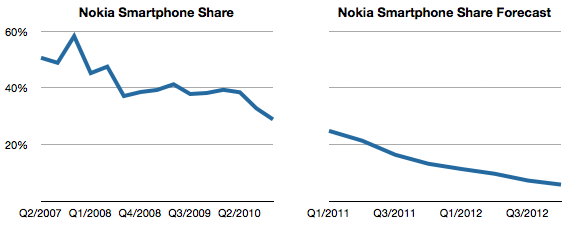
    The following two charts show what a two year forecast that adds up to 150 million Symbian devices looks like. I assumed Windows Phones begin to ship in 2012 and, keeping in mind that WP7 is designed for a higher hardware specification than the current Symbian phones, I show a modest ramp for a total of 15 million units in the first year.

    I also forecast the overall market assuming continuing growth levels and calculated the effect of Nokia's share.

    The share at the end of 2012 would be approximately 6%.

    Note however that the share above depends highly on Nokia selling 150 million Symbian units in the next two years. One could question why would anyone buy a product whose platform that's been declared end of life. Perhaps there is a built-in assumption that end users are inherently stupid. However even in that scenario the question is which distributors will make the same bet with Nokia? Or, even more perplexing, which operators are willing to stock EOL products for two years when that shelf space is getting strong bids from Nokia's rivals.

  9. A review of Asymco Predictions on Nokia’s new platform strategy

    Research · 25 comments

    Predictions on Nokia’s new platform strategy: new OS for the US | asymco.

    Here are my predictions from January 27 for the February 11 Nokia strategy announcement followed by the actual quotes from Nokia's press release:

    • Prediction: There will be a multiple OS strategy.

    Actual: The following sub-units [make up] Smart Devices: Symbian Smartphones, MeeGo Computers, Strategic Business Operations. To support the planned new partnership with Microsoft, Smart Devices will be responsible for creating a winning Windows Phone portfolio.

    • Prediction: The US market will be the first to see a new non-Nokia OS. I would guess Windows Phone with AT&T.

    Actual: "Plans for a broad strategic partnership with Microsoft to build a new global mobile ecosystem; Windows Phone would serve as Nokia's primary smartphone platform"

    • Low end devices will remain with Symbian due to price considerations for the chipsets, components.

    Actual: "Symbian becomes a franchise platform, leveraging previous investments to harvest additional value. This strategy recognizes the opportunity to retain and transition the installed base of 200 million Symbian owners. Nokia expects to sell approximately 150 million more Symbian devices in the years to come."

    • Prediction: MeeGo will be phased out in phone products but development will continue for tablets

    Actual: Under the new strategy, MeeGo becomes an open-source, mobile operating system project. MeeGo will place increased emphasis on longer-term market exploration of next-generation devices, platforms and user experiences

    More details to follow, but so far it looks like there are no surprises.

  10. Microsoft's mobile effort: back to the future?

    Research · 41 comments

    Windows Phone 7 launched on 10 devices over 60 carriers in over 30 countries with 1.5 million of channel inventory in 6 weeks. Given the breadth of distribution, that number is not huge, amounting to less than 10k phones per operator.

    Curiously, Windows Mobile was still selling in significant volumes last quarter. Maybe even higher than WP7 is selling now. In Q3 2009 Canalys reported 3.6 million WinMo units sold. In Q3 2010  Gartner estimated 2.3 million were sold through to end users. Even nine months ago Windows Mobile was running at 3.7 million units or over 1.8 million every six weeks.

    Microsoft also announced they have 18,000 developers with 4,000 apps on the WP7 marketplace. That's one developer for every 83 devices in inventory.

    Microsoft's Achim Berg:

    our numbers are similar to the performance of other first generation mobile platforms...

    We're comfortable with where we are, and we are here for the long run; Windows Phone 7 is just the beginning.

    In terms of first generation platforms, I assume he is referring to Android and iPhone. That claim of similar volume growth is perhaps a bit too optimistic. However, he's very wrong about WP7 being the beginning for Microsoft's efforts in mobile. Not even close.

    Microsoft has had mobile software products in the market for over a decade. In 2003 Gartner declared that Microsoft would sweep Symbian aside. In 2006 they were the odds-on favorites to win the mobile platform game on the basis of developer support.

    Microsoft's Windows Mobile was selling more in 2003 than Microsoft's Windows Phone is selling in 2010. At the time, Microsoft also boasted of having a huge developer base (larger, in fact, than the number of users of the product; their .NET developer base being counted as mobile developers.)

    Furthermore, prior to the launch of iPhone's App Store, Microsoft spokespersons scoffed at the idea that Apple could field a catalog larger than Windows Mobile which led with over 13,000 apps in August of 2008.

    Dragging out these old figures isn't meant to deride Microsoft. They were not alone in failing to capitalize on early leads in mobile. Palm, Nokia, DoCoMo and Qualcomm all failed. RIM is arguably failing as we speak. Some have argued that Apple is also about to be undone by Android.

    The point is that dramatic, violent change was possible even five years after foothold markets were established.

    The question for today is: Is it still possible? Can a new platform still gain traction?

    Microsoft is clearly betting that it can. Their seemingly quixotic attack on the market can only be justified on the basis that it's still early days. They must reason that un-penetrated markets are huge and that the existing platforms are not sticky enough to prevent switching.

    At least one analyst agrees. IDC made the forecast that 32 million “Windows Mobile/Phone” devices will sell during all of 2011. I took issue with those forecasts at the time but if they deliver that volume they will get around 10% share, enough to stay on the map. If they don't then Microsoft will look more like Mobile Zune than Mobile Windows. The stakes are high.

    So even though they may have airbrushed Windows Mobile from history, Microsoft's current strategy is a direct consequence of them having failed with a seemingly strong platform.

  11. Samsung like Windows Phone, Android not so much

    Research · 9 comments

    Samsung's mobile marketing lead for the country, Sitthichoke Nopchinabutr, also provided a surprise and hinted that the company might turn on Google and focus primarily on Windows Phone. About 15 to 20 phones based on Android, Bada and Windows Phone would ship in 2011, but the majority of them would use the Microsoft OS. For every 50 Windows devices, 24 would be Android models and just five would use the in-house Bada OS.

    via HTC, Samsung see Windows Phone, Android dominating phones | Electronista.

    Shocking!