Asymco

Asymmetric Intelligence

Horace Dediu

  1. Codifying asymmetry: How Apple became Jobsian

    Research · 79 comments

    Any student of organizational theory must struggle with the question of how to assign weight to the influence of the leadership of a company. In the case of Apple, the question is:

    Is Jobs is the embodiment of Apple or is Apple already Jobsian, imbued with his ethos?

    John Gruber summed up (start at 8:00 min) the "Apple is Jobsian" argument by saying that Apple is Steve Jobs' greatest creation and that he has been working on crafting the company as much as he has been crafting products. The result being that it's well designed for sustainable longevity.

    The arguments for "Jobs is Apple" are mostly rooted in anecdotes of a supreme leader that is indispensable to every decision and detail. There are also ample examples from history of companies who foundered after the departure of founders (Apple itself is notably cited.)

    But beside armchair quarterbacking, what evidence is there that Apple is being engineered to operate independent of its founder? Unfortunately there is almost no organizational analysis for Apple. Unlike many of its contemporaries, there aren't org charts or tell-all accounts on life in Cupertino. There are no anonymous "mini-aapl" blogs or tales from the disgruntled.

    For this reason, a recent quote about the mysterious "Apple University" in Fortune caught my eye.

    First a brief review of what was known.

    Apple University was first mentioned in 2008 when Joel Podolny was hired from running Yale Management School to join Apple in creating this new "University". I remember at the time thinking what such a thing might be. To leave the top job in one of the top business schools to join Apple must require some powerful incentives. I envisioned Apple entering into a far more ambitious iTunes project where they could be offering degree programs or teaching resources through the familiar store front.

    But nothing was heard about Apple University again. Until yesterday.

    According to the article in Fortune and some additional details from another source, Joel Podolny has been building an understanding of how Apple is run. He's then been asked to codify this understanding into a curriculum that can be taught to Apple employees.

    The idea that Apple is trying to capture its institutional processes and knowledge is very compelling. Few companies have self-knowledge. Fewer still try to codify it and teach it to new generations of leaders (Disney, McDonalds and Toyota have in-house training programs but they are mostly aimed at new hires).

    For those who don't bother, the consequences are a more rapid descent into disruption. I've experienced the consequences of the failure to remember decision processes. Knowledge about decisions disappears once the decision maker moves on, leaving a new generation to figure out the causes of success (and failure) all over again.

    The evidence of the forgetting of history abounds at companies like Sony and Microsoft which seem to be behaving exactly opposite to how they once did. Sony, once a serial disruptor, turned into a sustainer. Microsoft who pioneered software as a business, cannot find new business models for software.

    Apple's decisions and outcomes are the stuff of legend. They famously act asymmetrically to what is "conventional wisdom". Wisdom imparted supposedly through business schools but systematically contradicted by Apple's principles:

    • Accountability without control
    • Lack of "P&L responsibility" for top management
    • Saying no to "better things"
    • Building products before markets are identified
    • Functional vs. hierarchical or divisional organzation
    • A disregard for polite consensus

    So if this type of decision process is not codified, how is it going to persevere when convention dictates otherwise?

    If the article is correct and there is an effort under way to codify and teach new generations "the Apple way" then the case for Apple being Jobsian grows a lot stronger.
  2. Staying Hungry

    Research · 47 comments

    During the June 2005 Stanford University commencement speech Steve Jobs famously cited the farewell message placed on the back cover of the 1974 edition of The Whole Earth Catalog: "Stay hungry, stay foolish."

    That's a nice, pithy statement. I interpreted "Being Foolish" in a Quora answer as "being naive about how things should be and thus allowing oneself to see how things could be."

    But what about staying hungry?

    A clue comes from the recent Fortune article "Inside Apple" (currently only available in print or as an app). Even with nearly $70 billion in liquidity Steve Jobs claims "Apple is a company that doesn't have the most resources." A former executive claims "We've always fought for resources...Steve and Tim in general want to be sure you need what you're asking for."

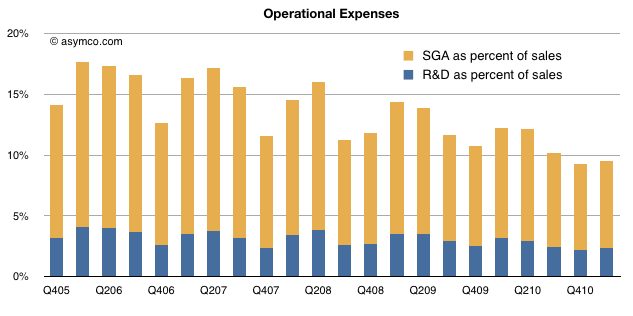
    Note that "resources" here does not mean capital. It means people. Apple is very constrained in the number of people it has available to put on projects. The evidence is in the company's operational expenses. They make up only 9.5% of sales (nearly an all time low). R&D in particular is only 2.4% of sales ($581 million).

    Although R&D doubled in three years sales nearly double every year.

    Looking at the totals over the last full year, the company spent about $2 billion on R&D. A remarkably efficient way to generate $47 billion in sales or $13.3b in operating income. Another way of thinking about it is that every dollar spent in engineering resulted in $23 in sales.

    So the way to interpret the "stay hungry" metaphor is as a low cost structure. It has great advantages beside efficiency. There is a constant demand for focus and justification of spending. There is a certain level of cross-fertilization as people are assigned to varying projects to maximize their utilization. Finally, there are the subtle but powerful influences of hunger: motivation, invention and intense attention to details.

    For Apple this aphorism seems to be more than a motivational poster quote.

  3. Phone Tipping Point Countdown Reset

    Research · 23 comments

    comScore's latest survey data is in and the news is good.

    In March an additional 3 million Americans became smartphone users. That translates to 700,000 every week or 100,000 every day switching from a non-smart or feature phone to a smartphone.

    The smartphone is now in use by 31% of the phone users in the US. A year ago 80% of Americans did not use a smartphone. Today non-consumption is down to 69%.

    It also means that only 19% more penetration remains before half of the population is using smartphones and that penetration is increasing at an average of 1.3% per month.

    I reset my Phone Tipping Point countdown clock to reflect the new data.

    I call it the Phone Tipping Point because it's the moment when I expect we'll stop using the word "smartphone".

    It's nearly one year away.

  4. Feature Tablets

    Research · 48 comments

    Andrian Georgiev, a reporter from the Bulgarian business newspaper "Capital weekly" wrote an article for which he asked me some questions. My answers are below. The article is available here (Bulgarian).
    Q: How many tablets will be sold worldwide this year and in 2012?
    A: We can only guess the answer. The total will be constrained by parts shortages for 2011, but my estimate [through the end of 2012] is over 100 million. Perhaps even 120 million is possible.

    Q: Do you think Amazon is working on a tablet? Could it be a game-changer?
    A: If Amazon (or Facebook or Baidu) were to build a tablet the greatest innovation will be in their business models. In other words how they make money. I suspect Amazon's hardware will be free or nearly free but users will be incentivized to buy content or other goods from Amazon. Similarly for other businesses that will take a hardware product and make it an accessory to their core business. In that regard the "game will change" because hardware will conform to "the application" above it. In other words, that the device will be an accessory to the service, not the other way around.

    Q: Why is it so hard for manufacturers to create a tablet that rivals iPad?
    A: The iPad is a collection of components. Some are easy to duplicate or to source. This includes memory, microprocessors, communications components. Other components are harder to find and may be expensive once found. This includes the right kind of batteries and the screen. Yet other components are impossible to find or duplicate. That includes software.

    --

    Some additional thoughts:

    The changing of the game may not happen for some time. "Feature tablets" (analogous to feature phones) will however be viable as niche businesses quite soon. I believe "conforming" operating systems will be more popular with tablet makers than with phone makers.

  5. The trouble with halos

    Research · 45 comments

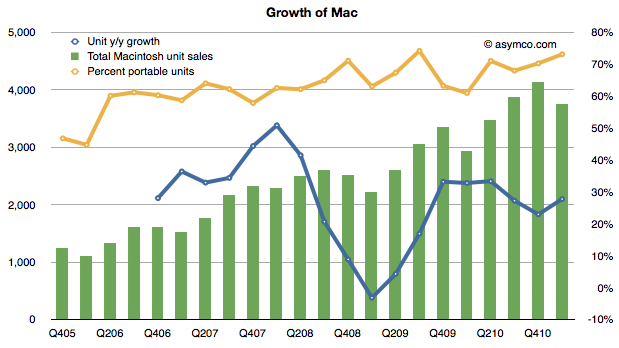
    The Mac grew at 28% while the overall PC market contracted at 3%. The Mac has outperformed the PC market overall for 20 consecutive quarters.

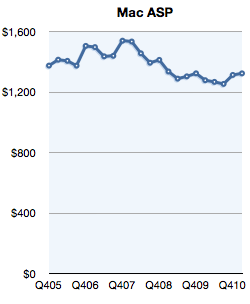
    Prices increased sequentially and year-to-year.

    I've mentioned the increasing shift of Mac mix to portables as a possible reason for the growth of the business. The Mac was one of the first to move to a portable form factor and has been pushing portability over performance for many years.

    The following chart shows the relationship between growth and portable mix:

    The trouble is that mix is not enough to explain the increasing gap with the rest of the PC industry. Windows PCs have also embraced portability and have even run down the path of over-serving portability with the netbook.

    Clearly something else must also be at work. This was even noted by Apple's COO Tim Cook in the last conference call in response to question on the effect of iPhone growth on the Mac:

    [iPhone] clearly seems to be creating a halo effect for the Mac. And I think that's one reason we see the growth that we are seeing on the Mac. It's amazing when you see the 28% year-over-year versus the worldwide market in PCs contracting by 3 points. It's an astonishing delta.

    The delta has been there for a while but it's widening and it's persistent.

    I've never been comfortable with the halo effect. Not because it's not happening but because we don't have a way to measure it. I've never seen reliable data that establishes a causal link. Lots of anecdote but little proof.

    The other problem with halo is that it implies illusion and hence impermanence. The halo effect is a cognitive bias which can mislead. An example would be judging a good-looking person as more intelligent.

    This effect is often exploited in marketing. It's quite common in the automotive industry where halo vehicles (e.g. Ford GT 40 or Dodge Viper) are created which promote sales for the entire brand even though they may lose money. These efforts often fail or have temporary benefits at best.

    When it's deliberate and an attempt to prop up something unworthy it seems deceptive, dangerous and temporary (buyers may be disappointed when they buy a Ford or Dodge and realize that they are not supercars and a reverse halo effect can emerge.)

    A halo effect should be used to boost a product that is under-rated not badly rated. This is when the effect creates benefit over a long period of time like the five years over which the Mac has over-performed.

  6. Combating superlatives fatigue

    Research · 18 comments

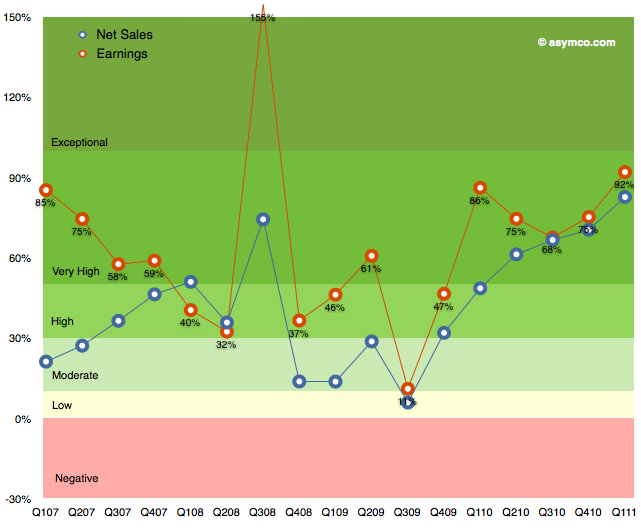
    The following chart shows Apple's growth for net sales and earnings over the last few years. I've used a grading system with color coding to show bands of growth.

    It's easy to become de-sensitized to the scope of these numbers, but it bears repeating: the growth has been steadily increasing since 2009.

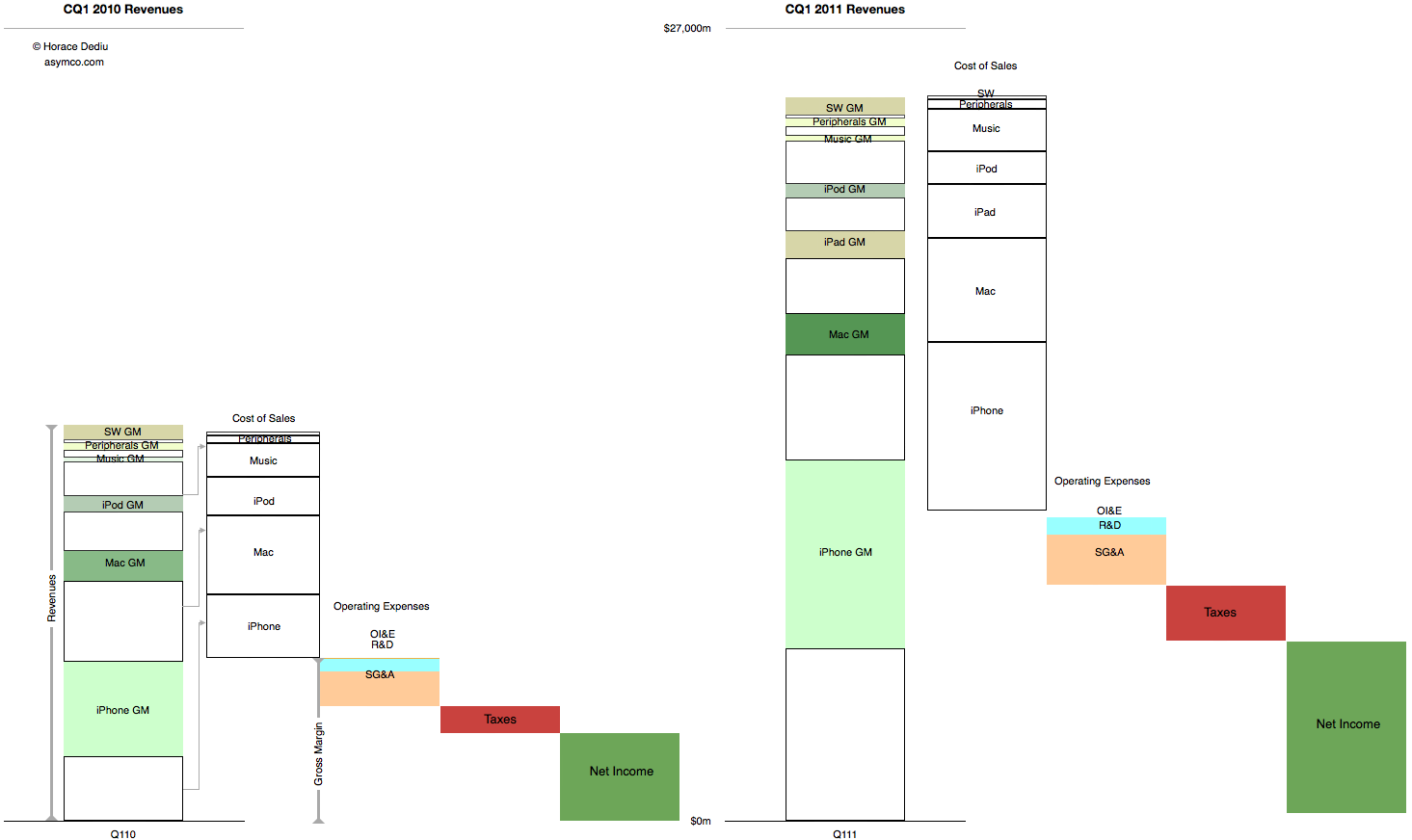
    These abstractions in growth can also be shown in a direct "before-and-after" view of the income statement.

    This latter view gives an idea of how much bigger the company's business is now vs. a year ago. Not just on the revenues but also the cost of these revenues and what is retained.

    This story never gets old.

  7. Windows generates less than a third the profit of iOS + OS X

    Research · 35 comments

    While a lot of the credit for Apple's success is rightfully assigned to the iOS franchises, the OS X business has more than quadrupled in five years. This has happened without drastic price fluctuations. Neither holds for the overall PC industry which has seen both volume and sales decline while prices have eroded along with profitability. On top of that, growth has nearly evaporated.

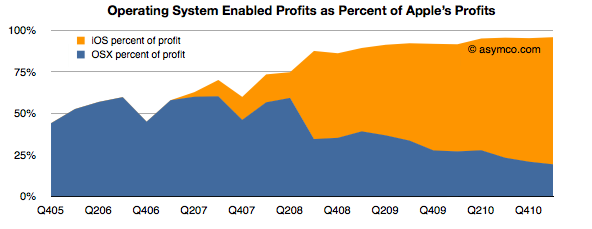
    Even with this success, as a percent of total value created, the Mac accounts for a mere 13% of Apple's profit. Including software as part of the OS X franchise implies that OS X is enabling about 20% of Apple's profits.

    iOS, on the other hand, is accounting for more than 75%. These two platforms combined amount to 96% of Apple's profits (up from 50% four years ago).

    That's $9.8 billion from integrated platform-based devices. One can be very confident that this profit would be negligible without the software differentiation only Apple can offer.

    So $10 billion is a lot of profit to obtain from a business enabled by operating system platform software. How can we get a handle on this size? How big is this? We could compare this with another operating system business: Microsoft Windows.

    Microsoft's Windows and Windows Live Division obtained sales of $4.445 billion in the last quarter with an operating income of $2.764 billion.

    So although Windows earned about twice what the Mac earned[1], iOS and OS X together enable 3.5 times the profits of Windows.

    The end of an era is the end of growth in one dominant business model. The PC era was epitomized by the concentration of profits in a dominant operating system vendor. That growth has slowed if not ended. The post-PC era is being kicked off by a new business model where profits are being concentrated in a hardware+software+service integrator.

    --

    1. Or you could read this as: The Mac generates half the profits of Windows while iOS devices generate 2.3x Windows profits.
  8. The market values Apple's balance sheet, not its income statement

    Research · 79 comments

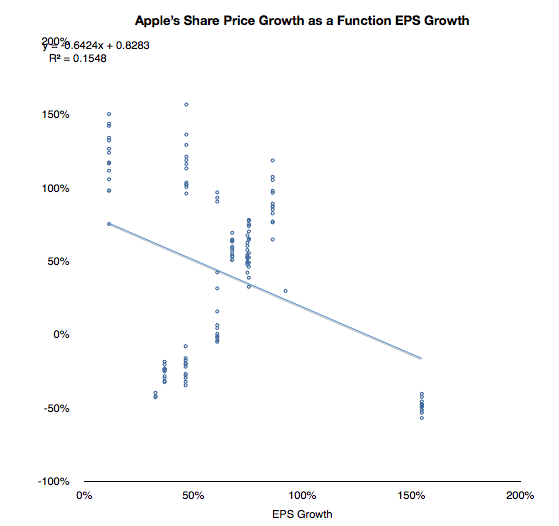
    As I have tediously repeated in this blog, Apple's share price has been de-coupled from its earnings for many years. Consistent earnings growth above 70% is not seen as valuable. As the chart below shows, there is no correlation between EPS growth and value growth.

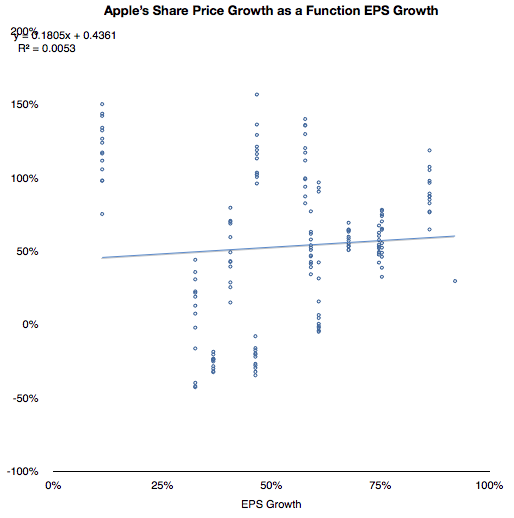
    With the outlying quarter when 154% growth was matched by a negative 50% price change, the correlation does not look much better:

    If we cannot correlate share price with growth then what is being valued? This has been a vexing problem because growth is the traditional, and logical, metric of valuation. Share prices, by definition (net present value of future cash flows) reflect future potential. That potential is more sensitive to growth than to anything else.

    But I've been leaving one factor out of the share price definition. Share price is NPV of future cash flows plus current assets.

    Since future cash flows are being thrown out of the equation, the company must be valued as a multiple of its cash. Does this relationship hold true?

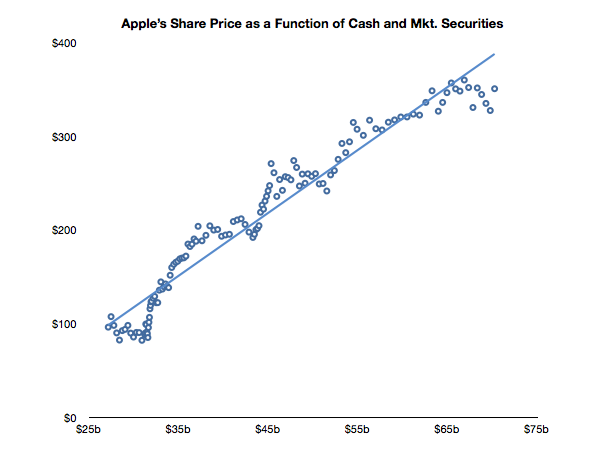
    In the chart below I show the weekly closing price of the shares and the corresponding value of the interpolated cash (and marketable securities) per share over the last two and a half years.

    A strong correlation can be observed. The R squared value is a healthy 0.94. Of course this is not to imply causation. Correlation is not causation, but it is a hint.

    Can predicting the cash per share be a strong indicator of future stock price? Perhaps. As long as this relationship holds, then having a reliable earnings model would still give us a solid predictor for the share price. Not because we can use EPS forward estimates multiplied by P/E but because we can estimate cash flows and the increase in retained earnings.

    Of course, the market "is being irrational" because it values on the basis of the present only (not its future.) But who are we to argue? This valuation has held since October 2008.

    As far as the market is concerned Apple's future is irrelevant. Its value is defined as a constant multiple of cash.

  9. When exceptional growth is not an exception

    Research · 69 comments

    Apple's last quarter's sales growth was an impressive 83%. It was not as high as the 92% earnings rise because there was a higher mix of iPhones this quarter than in the past. The iPhone is the most profitable product in Apple's portfolio so it impacts the gross margin significantly.

    The iPhone is, in fact, a huge part of Apple's business. In units it reached 5% global share and 14% US share. I'll go over the overall industry data as soon as all the major reports are in, but already it has been estimated that Apple is the largest phone vendor by profit and sales.

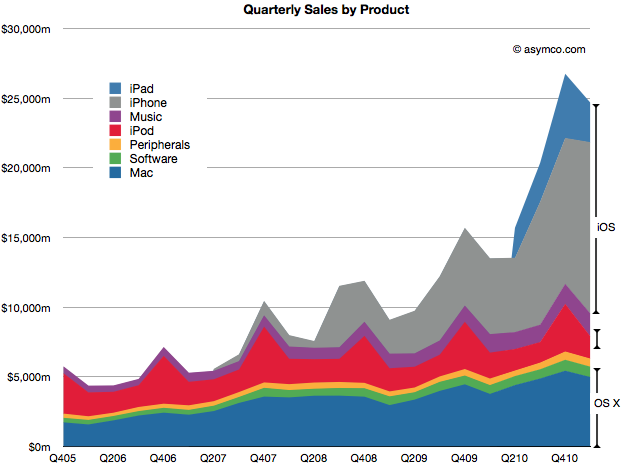
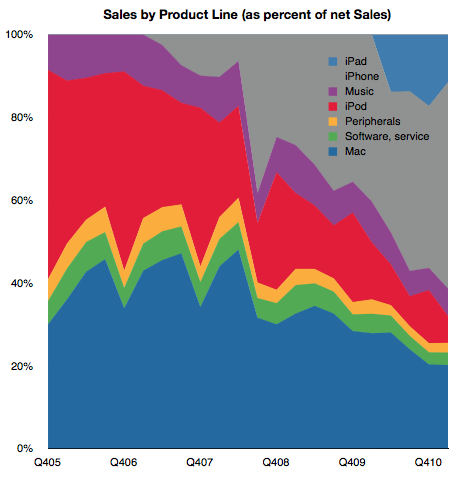
    In the following chart, you can see just how important the iPhone has become. Together with the iPad and iPod touch, iOS-powered devices make up about 65% of sales. That's almost three times the value of OS X based products which make up 23% of sales. That also leaves just 12% of sales not directly affected by these two juggernaut platforms (though music and peripherals are clearly indirectly affected by Apple's own platform products.)

    The following chart shows the same information as shares of total net sales.

    I've read that some of the uncertainty around Apple's future prospects is driven by the perceived vulnerability of these new blockbuster iOS products. At first glance this growth looks quite unprecedented and hence risky. 65% of sales from iOS did not exist four years ago. If you look at the sector it's hard to find any company that has doubled its sales in a few years from completely new product lines. Especially a mature company over 40 years in the business.

    Well, there is one.

    If you look again at the second chart above, you'll note that the proportion of sales held by iOS devices has mostly replaced the sales share that used to be held by iPod, itself a product that did not exist four years prior to the time of these charts.

    Apple consistently doubled its sales on the basis of the iPod. It's now consistently doubling on the basis of iOS.

    Exceptional claims require exceptional evidence. But that's exactly what the investment thesis for Apple should be: Exceptional growth is no exception.

    Steve Jobs himself said it well once: "I wasn't alive then, but from everything I've heard, Babe Ruth only had one home run. He just kept hitting it over and over again."

    Even this exceptionalism is not unique. It happens not just at Apple, but at another of Jobs' creations: Pixar.

    Perhaps this magic formula for exceptionalism is itself a fluke but what if it's not. What if blockbusters are really something that can be built with repeatable consistency. What would that be worth?

  10. The Apple Growth Scorecard

    Research · 127 comments

    Apple's revenue for the first quarter was $24.7 billion, which at 83% was the largest quarterly revenue growth they ever experienced. Operating margin was an all-time high of almost $7.9 billion, representing 31.9% of revenue and yielding 95% EPS growth.

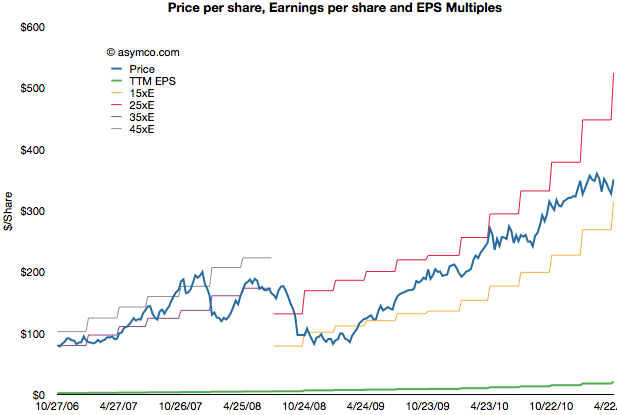
    After earnings were announced the share price reached $350.7. This includes $70 in cash. Trailing twelve months' earnings were $20.97. That makes the Price/Earnings ratio 16.7. Excluding cash, P/E is 13.4. The average growth over the past four quarters was 77%.

    The following chart shows the share price vs. earnings. The green line is price and the blue line is share price. I also added multiples of the earnings to show how the stock traded in certain multiple bands.

    During the period of 2006 to 2008 the company shares traded roughly in a range of 35 to 45 P/E. Since late 2008 the company shares have traded in a range of 15 to 25 P/E.

    Share prices normally reflect potential earnings growth and past growth is often a good indicator of near term continuing growth. This is why the P/E is usually a proxy for growth. The faster the growth, the higher the P/E. Or so one would think.

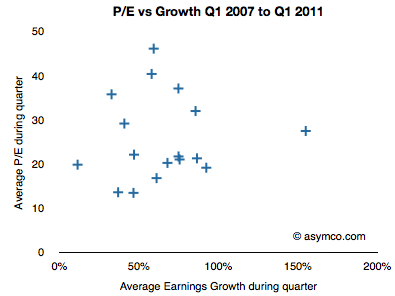
    If we look at the P/E vs. earnings growth for Apple, the picture is not encouraging.

    P/E and Growth don't seem at all correlated. In fact, if we drop two outliers it almost seems that P/E is insensitive to growth.

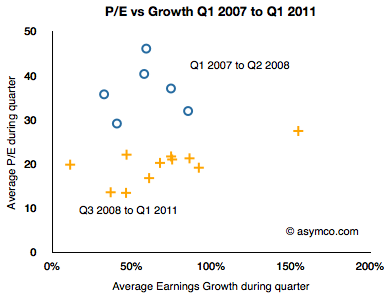
    I took the data a step further and separated it into two clusters: pre-recession and post-recession.

    The blue circles are Q1 '07 to Q2 '08 and the orange plus signs are Q3 '08 to Q1 '11. As the share price chart implies, there is a clustering of averages where during the 2007 and early 2008 period P/Es were in the 35 range while growth was in the 50s and P/Es below 20s with similar or higher growth ranges.

    As the following scorecard shows, the company's growth is exceptional. That does not seem to be something that is being valued by investors.