Asymco

Asymmetric Intelligence

Horace Dediu

  1. Is Android more efficient than iOS at generating search revenue?

    Research · 63 comments

    Thanks to David Chu for forwarding the data that made this possible and reader Narajanan for spotting the divergence in platform efficiency.

    iOS and Android are both growing rapidly. According to Gartner, during the first three quarters of 2010, about 44 million iOS devices and 36 million Android devices were put into use. That's 80 million devices. An amazing achievement for two platforms that did not exist 3 years earlier.

    But obviously not all devices are used the same way. Devices which have unused capabilities limit network effects for a platform and for the category of product in general. Question is: how can we measure the "smartness" of a device; how much more likely is a device to be used as a mobile computer vs. being a regular phone?

    The best proxy I can think of is a measurement of browsing use. The smarter the device, the more browsing is a joy and the more it is actually done. Browsing leads to more data load on the network and creates a virtuous circle of revenues for the mobile computing value chain.

    If we could measure the increase in browsing generated by each additional phone, we could compare whether one platform is better (specifically, more efficient) at generating value asymmetric to voice.

    Fortunately we have data from Netmarketshare.com (see sources below) which attempts to track browser consumption and hence allows us to measure this variable. What we need to pair that with is the incremental increase in the installed base of devices.

    In the chart below I plotted how much browsing share increased for every phone sold by platform over the first three quarters of 2010.
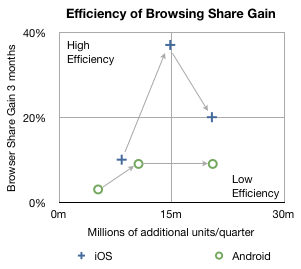
    The arrows indicate the sequence in time from Q1 to Q3. The vertical axis shows gain in share three months after the corresponding number of units shipped in the previous quarter on the horizontal axis. So, for example, the second circle means that in the second quarter approximately 10 million new Android devices created a gain of about 9% in browsing share. In the same quarter, 14.8 million iOS devices created about 37% gain in browsing share.

    In the third quarter approximately the same number of iOS and Android devices shipped (iOS  including iPads and iPod touch) but the browser gain was 20% for iOS vs. 9% for Android.

    A line drawn diagonally from lower left to upper right (0,0 to 30m,40%) could represent the average gain in share per units sold--the sort of measure we're looking for.

    Measuring that slope tells us that, on average, every million devices sold should generate a gain of 0.75% share[1]. I took the additional step of labeling two quadrants which are orthogonal to the expected trend. If browsing increases dramatically faster than 0.75%/million units then I call those devices sold as creating "highly efficient" browsing gain. If browsing increase lags dramatically below 0.75%/million units then those devices added share with "low efficiency".

    So four data points follow the trendline down the middle of the chart, however, there are two notable outliers. Finding the causes for these outliers gives clues to what's happening with the platforms.

    I believe the explanation for iOS's second quarter's extraordinary efficiency is that was the quarter when the iPad launched. It seems to have yielded a very strong spike and the trajectory of iOS improved even into the next quarter as those iPads continued to be in use. iPad seems to be a very effective way to gain browser share.

    I also believe that the cause for Android's fall in efficiency in the third quarter was that it began to be sold in large quantities in the developing world. The third quarter saw a rapid acceleration of sales without a proportional increase in what was measured as sales in the US (and Europe).

    Interpretation

    If this trend continues, and there is no guarantee that it will, then a question could be raised about Android's value to, of all people, Google.

    The core value of Android to Google is the increased use of browsing and hence search. All the other Google services and in-app ads are tiny opportunities in comparison to the potential of search on mobiles. One could argue that the raison d'être for Android since day one was to create browsing consumption. In that regard it's not as good at doing that as iOS is.

    Perhaps Google can justify the under-performance of consumption of browsing (and hence search) on Android devices as benign since there is no marginal cost added to supplying Android to non-consuming devices.

    But I wonder. There is the problem of opportunity cost: Those iOS devices that create more browsing activity are going to take more share. The more they do that the more Google will have to pay Apple for placement as the default search in mobile Safari.

    It may be a stretch, and perhaps the data is wrong, but that's what this exercise is all about: how much can we learn from fragmentary data? Without a hypothesis there is no discovery.

    -----

    Notes:

    1. Since these platforms have very low shares (less than 2% for iOS and 0.3% for Android by November) almost all the gains can be assumed to be against other browsers (e.g. Internet Explorer) and not against each other.
    2. Update: the original Unit estimates excluded iPad and iPod touch which have since been added.

    Sources:

  2. Big in Denmark: iPhone captures 36% of phone market value

    Research · 35 comments

    Thanks for Rob Marsh for forwarding the following snapshot of data from Denmark:

    Salget af smartphones eksploderer i Danmark.

    According to GfK data in Denmark, during the first quarter of 2010 29% of phones sold were smartphones. In the second quarter, the share grew to 37%. In the third quarter, 51% of units and 71% of sales value was captured by smartphones.

    Looking at September alone, Apple's share of the smartphone market was 34%. In terms of value share, 51% of all the dollars that consumers spent for smartphones, was spent on the iPhone.

    In other words, in September in Denmark, iPhone captured 34%*51% = 17% of all units and 51%*71% = 36% of all mobile phone sales.

    Rob adds:

    iPhone 4 is now available on all (4) major networks in Denmark. iPhone 4 has not been advertised very heavily, whilst Android has received a lot of advertising. My experience travelling on public transport in Greater Copenhagen is that iPhone is everywhere, whilst Android and Blackberry is less prevalent.

    To get a sense of how that compares with the global average, in the third quarter Apple's unit share was only 4.1% while sales share comes to about 17%. Seems like there is plenty of room for growth.

    While Denmark is a small country (population: about 5.5 million) and it's not likely to reflect global patterns, it has been rated the happiest place on Earth.

  3. Remembering January 14, 2008: The day the market lost faith in Apple

    Research · 106 comments

    In a recent but recurring lament I asked why Apple shareholders are not being rewarded for the company's growth. I pointed out that there is no fundamental reason why the company should receive such a low P/E multiple (about 18 ex-cash trailing and 10x forward while maintaining 70% earnings growth for over a year).

    There were many objections in the comments. Most of them dealt with recent reasons why doubts might have arisen among investors: Android hegemony or some perceived lack of competitiveness leading to margin compression or some macro hangover from the recession.

    In this article I argue that none of these objections hold water. My argument hinges on the fact that there is a precise date when Apple ceased being seen as an exceptionally valuable company and that date precedes any of the causes being suggested.

    The day of disillusionment was almost exactly three years ago: January 14th, 2008.

    How to pin down the date of disillusionment

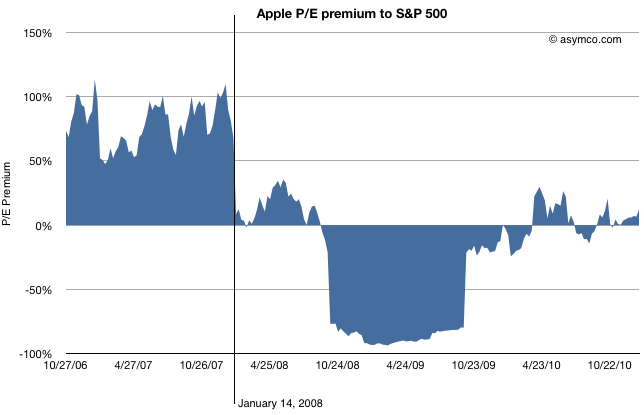
    Consider the following chart.

    The blue area represents either a premium (above 0) or a deficit (below 0) of Apple's P/E (ex-cash) relative to the S&P 500 P/E. This is a re-imaging of a chart, first introduced in June 2010 when I first pointed out that Apple was being discounted relative to the S&P 500.

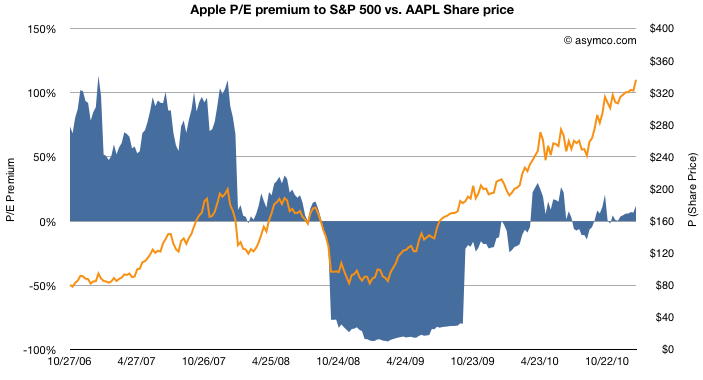
    By measuring P/E I am focusing not on the stock price, which has grown nicely, but the ratio of the price relative to earnings, which hasn't (see the next chart below). P/E is a fundamental measure of potential (its reciprocal is the stock's earnings yield.) It is usually highly correlated to the company's growth. If that P/E is uncorrelated to past growth, there is some significant discounting of future growth. It's the most significant (and simplest) measure of "faith" in a company.

    By measuring the company's P/E relative to an index of other large companies (S&P 500 P/E) we can assess whether the company's potential is being valued as extraordinary or whether it's being valued as ordinary. In other words we are measuring whether a company is "special".

    The chart shows that until January 14th, 2008 the company was valued at a significant earnings premium--a P/E consistently 50% higher than the norm.[1]

    Following the collapse (about 40% drop in share price but 100% drop in P/E premium), there was a small recovery followed by a huge trough in valuation. During the recession quarters Q308 to Q309 S&P earnings fell to zero or below. As a result of S&P earnings collapse the S&P P/E shot up astronomically (as E approaches zero, P/E approaches infinity). Apple's earnings dropped as well but remained positive throughout that period bottoming at 37% growth(!) in Q408. As a consequence Apple's P/E fell as low as 11 while the market's went well above 100 (122.41 peak). The P/E deficit for Apple went 80%: Apple was valued as basically worthless (3x cash).

    After the earnings recession, the S&P P/E recovered close to historic levels but Apple's P/E did not. It's in-line with the S&P but does not obtain the 50% premium preceding the recession.

    So we can establish that the day that Apple's potential was discounted was nearly six months before the onset of recession.

    What other discounting factors can we discard?

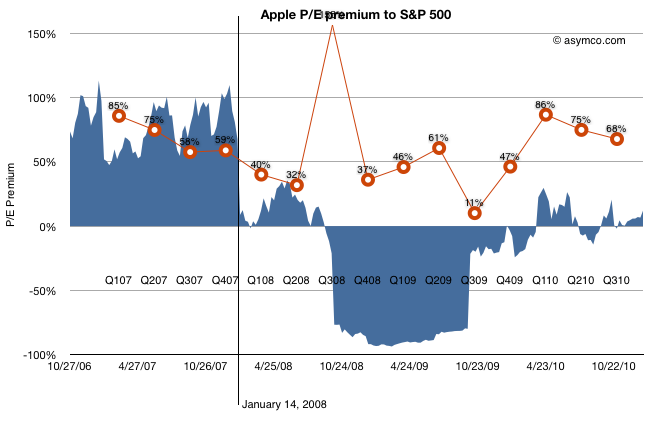
    How about earnings growth itself? Did the collapse foretell an earnings collapse?

    The chart above shows the P/E premium vs. earnings growth (in red). Although earnings growth began to slow soon after the 14th (earnings for CQ407 were not yet announced at that point), growth recovered six months later after the launch of the iPhone 3G[2]. Growth continued throughout 2009 and 2010 reaching new heights last year of 86%.

    Still, the company received no premium to the S&P 500 P/E. Companies in the index averaged, at best, a quarter of Apple's growth in earnings.

    What about Android? The first Android device did not ship until October 2008 (HTC Dream or T-Mobile G1). There were no appreciable Android volumes until 2009, one year after the drop in relative value and no talk of a threat until 18 months later.

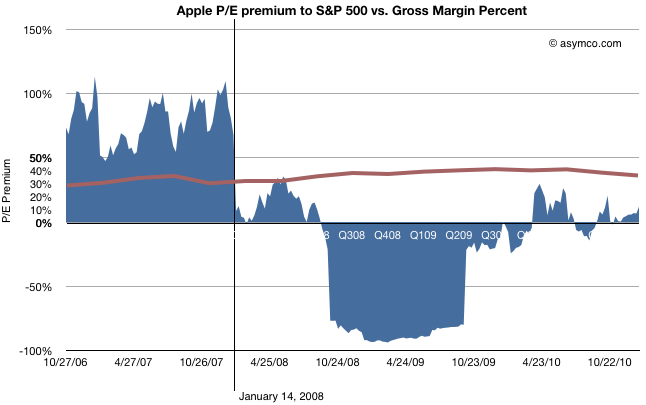
    The last objection to be put aside is that of margin compression.

    This last chart shows how margins (in brown) behaved during the same time period. They went up. The only slight decline took place during the last few quarters, after the launch of the iPad, long after the collapse.

    Regardless of the adjustments with product launches, Apple's GM is the envy of the world and is not at all correlated with the loss of faith in the company.

    So What happened on January 14, 2008?

    Having led you this far in the story, I'm afraid I'm going to let you down at the end: The cause for the loss of faith is a mystery to me.

    There is only one noteworthy event that took place on that date: Macworld 2008 (January 14-18). During the keynote, Steve Jobs introduced the Macbook Air (and Time Capsule and Leopard and pre-announced the iPhone SDK which, six months later led to the app supernova). I remember that day and I remember that the stock began selling off exactly at the point when the Air was mentioned. It has never been the same since.

    Obviously, correlation is not causation. The Macbook Air need not be the cause for the loss of faith in Apple as an investment. Or can it? I'm hoping someone can explain this because to me it makes no sense. The product was not a home run but it did not do badly either and its current incarnation seems to be a hit. Whatever sins the original Air may have had have surely been expurgated by now.

    Regardless the cause, the bottom line is that, in the eyes of investors, Apple stopped being "special" that day. Its valuation dropped to in-line the S&P and, given its growth, well below what a large growth company should be worth. The company's shares went into the bargain bin and are still there today.

    ---

    [1] I should point out that the P/E ratio is based on post 2009 re-stated earnings. The restatement changed the P/E as the "E" changed. This was based on the abolition of subscription accounting for the iPhone. Although it may seem unfair to hold the market to this standard, restatement did not actually change cash flows which were transparent and visible to all, even to amateurs such as myself and the other unaffiliated analysts that published throughout this period. Earnings may be an opinion but cash flow is a fact. Valuation on the basis of cash flow should have yielded the same results as shown above.

    [2] That quarter showed a y/y growth of 150% while the stock was in freefall. In fact, it was during that earnings day that Steve Jobs came on the conference call and pointed out the astronomic iPhone cash flow to an audience of analysts more concerned about their own jobs.

  4. Verizon back at bat: Revisiting the last inning

    Research · 69 comments

    A month ago I wrote an exposé on the problems I felt Verizon was facing with their smartphone strategy: Verizon Strikes Out in Smartphones [Updated]

    Given new information on subscriber growth and the relationship between Verizon and Apple, it's time to look back and assess how the conclusions are standing up.

    The conclusions I drew were that Verizon had three strikes against them:

    1. The iPhone has stolen their growth
    2. They are facing the prospect of a single OS platform supplier
    3. Android is not competitive vs. iOS

    Did iPhone really hurt Verizon?

    I pointed out that based on retail sampling data from ITG and what we know from AT&T own sales data, that iPhone at AT&T was outselling Android at Verizon by a ratio of 2.5 to 1.

    The latest comScore data closely matches the assumed units of Android shipped by Verizon. Here's why: The comScore data shows the number of active users of each platform. So, for example, as the number of Android users at Verizon grew, it follows that the new users had to buy new Android phones. However, you can also sell more phones than just those for new users. Some phones are going to go to replace those of existing users.

    When it comes to Android however, all the Verizon Android devices are pretty new, having been purchased less than a year ago. Replacements would only be sold for damaged or lost devices not covered by warranty.

    So from comScore the change in subs at Verizon comes out to about 2.2 million and my original estimate was about 2 million. That's pretty close.

    On the other hand, if you look at the chart, you'll notice that the number of iPhone users at AT&T grew by a similar amount (about 2 million). However, AT&T activated over 5 million. That means that about 3 million devices were upgrades. This makes a lot of sense since we know that iPhone is the bulk of AT&T smartphone users.

    This is highly supportive evidence that iPhone at AT&T did indeed outsell Verizon Android by at least a factor of 2. Each of those phones came with a 2 year lock-in so indeed AT&T did manage to "steal" growth from Verizon.

    Another data point in support of this conclusion was provided by Turley Muller in a comment.  AT&T smartphones make up a significantly higher proportion of contract subs at 44% vs Verizon at 23%. Effectively, as a result of their sweetheart deal with Apple, AT&T got double the penetration of smartphones than Verizon since these devices are targeted only to contract subscribers. Those are high ARPU customers that either moved from regular voice plans or switched from other carriers.

    So far, the first conclusion seems to be holding up pretty well.

    Was Android a strategic constraint to Verizon?

    Verizon revealed that they had been negotiating with Apple at least since 2008 and that they were testing the phone for a year. This is not as big a surprise as it may seem. Deals of this kind easily gestate for years. The commitment may not be made until the last minute.

    Nevertheless, my point was about the fact that Android was making up to 75% of Verizon's smartphone volume in Q3. This might be a strategic constraint. But "so what?" you may say: AT&T's dependance on iPhone was even greater.

    That's precisely my point though. As we've seen with the shift by Apple to multi-carrier distribution, AT&T is now facing serious constraints on growth and the share price is suffering. Although Verizon did not deal with Google as a direct supplier, they were at risk of having much of the IP on their network at least orchestrated by a company that was not always aligned with their strategic goals. Much the same predicament AT&T is facing now.

    The tale of AT&T and iPhone does lend support to the premise that Verizon felt a bit too constrained by Android hegemony on its network.

    Is Android Competitive with iOS?

    This last point was supported by the data showing a widening higher sell-through rate for iOS vs. Android on comparable addressable markets. Although the data has been confirmed with survey data, there are issues with this interpretation. First, because the addressable base for iPhone is higher at AT&T with the post-paid contracts being more popular there, iPhone had an easier time getting sold. Second, because 3/5 of the phones were upgrades.

    The jury is still out but the apparent pent-up demand (admittedly anecdotal) for iPhone on Verizon does seem to show that given similar pricing, and a similar demographic/geographic addressable market, people do prefer the iPhone.

  5. For every AT&T Android user there are 15 iPhone users: What will be the ratio at Verizon?

    Research · 103 comments

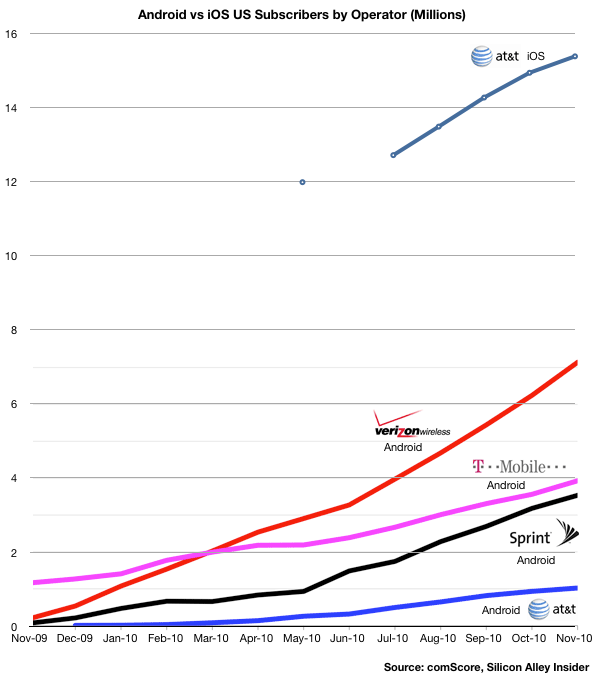
    The following chart uses comScore data to show the relative consumption of Android vs. iOS by the subscribers of the four major US operators. I modified an original chart published by Silicon Alley Insider.

    A few observations:

    • As of November, the ratio of iOS to Android users was more than 15 to 1 at AT&T.
    • iOS at AT&T has twice the users as Android at Verizon
    • Although T-Mobile had the Android franchise to itself for all of 2009, it was overtaken by Verizon within four months
    • T-Mobile Android consumption has also been nearly matched by Sprint within a year

    The rapid eclipse of T-Mobile smartphone penetration makes one wonder how effective Android is as a differentiator for carrier and device vendor alike. It also explains their new pricing model.

    The data also gives clues to how iOS at Verizon will grow.

    Since Verizon and AT&T have nearly the same number of subscribers, excluding RIM ,which is common to both, AT&T has a far larger penetration of smartphones (16.5 million vs. 7 million.) Is the cause iOS itself or the delay with the timing of Android launch at Verizon?

    Other data from comScore shows that much of the gains for Android at Verizon have been at the cost of RIM, so Android has not been entirely additive. Will there be a similar platform switching going on or will iOS be additive to the Android base?

    On one hand, the potential exists for a similar number of touch smartphone users at Verizon as at AT&T (15 million as of November). On the other, Verizon is "half-penetrated" with Android. How many will switch (as they did with RIM) and how many will be new users?

    I'm not going to make any predictions yet but I would not be surprised if Android at Verizon will flatline if not drop while iOS at Verizon will jump quickly to make the sum of both equal to AT&T iOS in about twelve months. That would imply about 10 million new Verizon iOS users by 2012.

    If Verizon users start to switch from Android to iOS, iOS could add as much as 15 million users. It seems that 10 to 13 is a reasonable estimate.

  6. Knowing me, knowing you

    Research · 12 comments

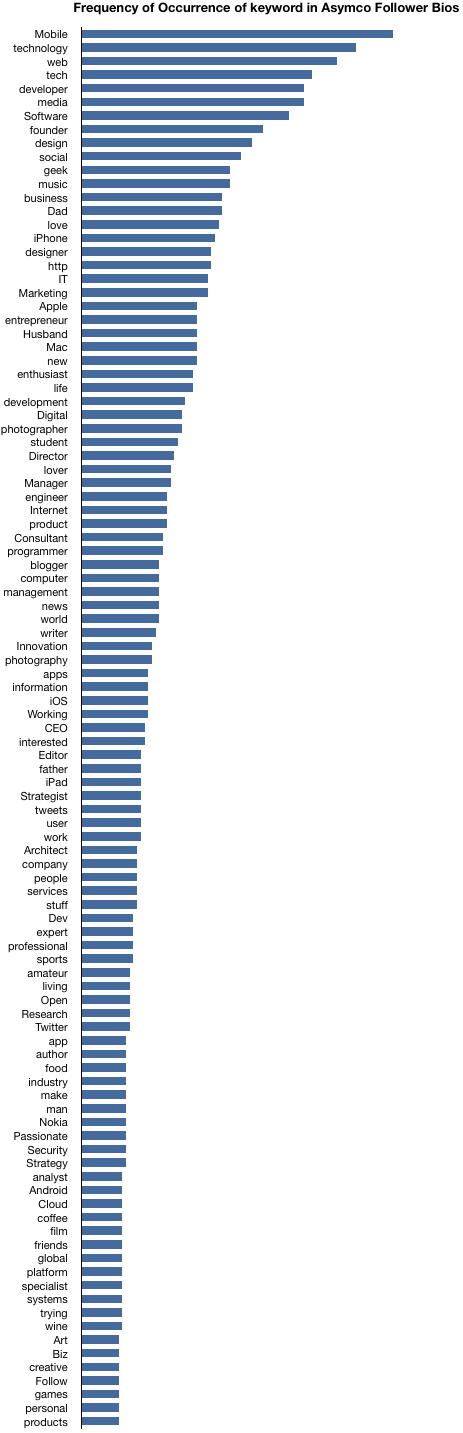
    Among the current (~1800) followers of Asymco on Twitter, about 1000 have published "Bios". In the interest of me getting to know you (and you one-another), here is a list of the most common words present in reader bios:

    Since I believe this is a representative sample of the readers feel free to write a profile of the typical reader in the comments below.

  7. Who killed the Intel microprocessor?

    Research · 76 comments

    The recently announced move by Microsoft to support the ARM architecture with their Windows product, indicates something profound is happening in the market for microprocessors.

    Dr. Hermann Hauser puts in bluntly:

    “The reason why ARM is going to kill the microprocessor is not because Intel will not eventually produce an Atom [Intel's low-power microprocessor] that might be as good as an ARM, but because Intel has the wrong business model,” said Dr. Hauser. “People in the mobile phone architecture do not buy microprocessors. So if you sell microprocessors you have the wrong model. They license them. So it’s not Intel vs. ARM, it is Intel vs. every single semiconductor company in the world.”

    via Intel Microprocessor Business ‘Doomed,’ Claims ARM Co-Founder - Tech Europe - WSJ.

    To make sense of that you have to step back and look at what's been happening in microprocessors and how mobile computing is affecting the whole processor value chain.

    The first observation to be made is that, as Dr. Hauser points out, ARM licensees use a different model than Intel. The development of an ARM-based microprocessor is done in a modular way; in contrast to the integrated way that Intel builds their products. ARM supplies a license, and designers build the chip adding various other circuits like Bluetooth or music decoding on the same silicon as the processor creating so-called SOC (system on a chip). Nokia has been doing this for years and Apple began doing it recently with their A4 SOC.

    The design is then sent to a fabricator who actually manufactures the chip (TI and Samsung are some of the bigger ones), often in smaller batches than what an integrated vendor produces.  SOC fabs need to be much more flexible in their production and are much more sensitive to the needs of their customers, the designers.

    In contrast, Intel has a proprietary microprocessor architecture that is not available for licensing and they have their own designers and their own fabs to build chips that they sell from a catalog to device builders. PC or device vendors only get to use what Intel offers and there is little in the way of customization (In a rare exception Apple famously forced Intel to modify the packaging of the first CPU fitted to a MacBook Air.)

    Because of the differences in business models, the markets for SOC and microprocessors are diverging rapidly with subsequent business model priorities becoming completely asymmetric.

    To illustrate, I draw upon an observation[1] that due to Moore’s Law, every year, through the equipment they deploy (e.g. from Applied Materials) fabs make 60% more transistors available on an area of silicon than were available the prior year. Intel almost always takes advantage of this by making more cores or adding more cache.

    But if you look at the ability of SOC designers to utilize transistors, they are only able to utilize 20% more transistors than they were the year before. The reason is that they have constrained design budgets; they don’t have enough money or time to design circuits that are complex enough to utilize all the transistors that Moore’s Law makes available. Plus, when it comes to devices, they don't need the power.

    What that means is, for most of the volume applications in the world, circuit designers are actually awash in transistors.  They are being over-served by the advances in fabrication equipment. However, Intel designers aren't. Being at the very high end they still need even finer line widths and demand that Moore’s Law take the next step to that next leap of technology.

    What value chain evolution theory would then predict is that circuits which had to be proprietary and interdependent in their architecture are following an over-service path. In contrast, to serve the needs of SOC designers, fabs, as suppliers, will have to change their pitch for winning new business to being fast and flexible and responsive and to being able to deliver systems on chips that offer every device exactly the functionality that they need and none of the functionality that they don’t need.

    Now in the world of mobile computing (and almost any situation where logic gets embedded in a system) it’s the device itself that is not yet good enough and, therefore, you cannot back off from pushing all the components to conform to your device's purpose.  For a device to be competitive it has to be optimized with a proprietary, interdependent architecture.  That means that the processor inside of a BlackBerry or an N8 has to be modular and conformable to allow the system to be optimized.

    This is a quirky idea so I'll repeat it: since the device is not good enough it has to be integrated, including the processor, which being good enough, has to be conformable. The processor has to bend to the will of the device market not vice versa.

    This then puts Dr. Hauser's point in perspective: a modular business architecture for microprocessors is a necessary condition to being successful supplying devices. The corollary is that Intel's integrated business model is obsolete in a device world. No amount of polishing of the Atom will help.

    The root cause for this obsolescence is the over-shooting of Moore's law when processing power (and hence circuit density) is superfluous while power consumption, size and flexibility of design are straining to eke out any improvement.

    So this renaissance of ARM is happening now because Moore’s Law has overshot what most circuit designers can utilize. And that overshooting is happening because mobile computing products don’t need a multi-core multi-gigahertz processor, allowing designers to back away from the frontier of what's possible.

    What it culminates in is that the places in the value chain where attractive profits can be earned are migrating in a very predictable way: away from Intel and toward ARM.

    So in a perverse way, it was Intel founder Moore's law that killed the Intel microprocessor.

    ---

    [1] This discussion is inspired by Clayton Christensen's "Capturing the Upside" presentation at the Open Source Business Conference 2004-03-17. Although taking place nearly seven years ago, Clay's vision regarding the future of the microprocessor was astonishingly, though perhaps unsurprisingly, prescient.

  8. Nearly 75% of iPhones are in use outside the US

    Research · 29 comments

    comScore reported that 15.4 million iPhones were in use in the US as of November. (25% share of 61.5 million total smartphones.)

    We also know that about 75 million iPhones were sold by November since the product launched. With about 17 million units older than two years, and assuming that half of those might still be in use and that all the iPhones less than 2 years old are still in use, we get an upper bound of 66.5 million iPhones in use globally.

    That means 23% of all iPhones are in use in the US and that 77% are in use outside the US.

    Can this be verified?

    The sell-through data we have supports a slightly lower figure.

    October 2010: 63 percent of iPhones were sold outside the US in Q3

    April 2010: Non-US iPhone sales approaching 70% of volumes

    This might indicate that comScore surveys under-represent the iPhone or that device attrition/retirement is significant. However, the data does seem to imply that the US is no more than one third and perhaps as little as one quarter of the iPhone's user base. Perhaps with Verizon, that figure will grow. But at the same time, new international markets (like China) may continue to outgrow the US.

    The 4:1 split could continue. After all, the US represents only 234 million out of about 5 billion mobile phone users globally--a mere 4.7%.

  9. Will T-Mobile's hundred dollar smartphone with ten dollar data plan win subs?

    Research · 21 comments

    Chief Executive Philipp Humm said in an interview that many of his smartphones will eventually be made up of Google-powered phones costing less than $100, half as much as the smartphones typically available at U.S. carriers. In October, to lower the cost of monthly bills, Mr. Humm introduced a limited data plan that costs $10.

    via T-Mobile Smartphones to Head Down Market - WSJ.com.

    T-Mobile seems to be attempting to differentiate on price. In a regular market reaching saturation that might be a viable strategy. However the market is neither regular not saturated. T-Mobile's chances of gaining large share are limited.

    Churn, or the chance that a user will switch networks is still very low. If anything, AT&T and Verizon are more sticky and lose fewer customers than T-Mobile and Sprint.

    Mobile computing saturation (25% to 30% penetration) is also not nearly at a point where competition on price leads adoption.

    Lastly, the $100 price point is being put against the standard $200 price point which itself is an illusion for the user. The drop in smartphone entry price is not as powerful going from $200 to $100 as it is from $300 to $200. Psychologically, $200 is an inflection point. Apple's $100 3GS pricing (now $49) is defensive and probably effective.

    In short, the market for telecom services is not very "liquid" and users are quite trapped in their carrier contracts, pricing is not yet a basis for competition and pricing illusions persist.

    In conclusion:

    Mr. Humm, in an interview at the Consumer Electronics Show in Las Vegas, acknowledged that the likelihood Verizon Wireless getting the iPhone as well could affect his subscriber numbers.

  10. Half of US population to use smartphones by end of 2011: Update

    Research · 10 comments

    Half of US population to use smartphones by end of 2011 | asymco.

    A month ago ComScore reported that in October 2010 25% of Americans above the age of 13 used smartphones. The latest report shows that share to have risen to 26.3%.

    That means there are 24 percentage points of penetration to go until the majority of Americans are smartphone users. In absolute numbers this implies about 56 million additional users (and hence units sold).

    The rate of penetration growth was 1.3 percentage points per month. Assuming no acceleration in this figure and assuming we rely on ComScore (vs. Nielsen which reports higher figures) then majority share is 18 months away, or mid-2012.

    However, assuming some acceleration and a different sampling method, I still believe that we could see this figure by end of this year.

    In either case the tipping point is near.

  11. Resetting Motorola

    Research · 31 comments

    Motorola—like HTC—is thus a bellwether for makers of Android phones, whose sales have now caught up with those of the iPhone—about 300,000 a day worldwide. Some industry analysts doubt that it will be able to create a big market for its devices and make enough profits before cheaper providers move in. If they are right, the smartphone market may eventually become like that for personal computers: a handful of huge competitors with tiny margins. The difference will be that these firms will hail from around the world rather than being mainly American.

    via Motorola: Breaking up | The Economist.

    When I argued that the meek shall inherit Android, the profitability data was the core evidence. That argument, made in August, was:

    So here we have the real challenge to Android:  partnership with defeated incumbents whose ability to build profitable and differentiated products is hamstrung by the licensing model and whose incentives to move up the steep trajectory of necessary improvements are limited.

    In other words, Android’s licensees won’t have the profits or the motivation to spend on R&D so as to make exceptionally competitive products at a time when being competitive is what matters most.

    The surge in emerging market Android entrants has been the latest setback for branded Android vendors. What should be the long term strategy for companies like Motorola and Samsung?

    Paradoxically, Motorola, being the weaker, has the best chance for successful recovery. The clue lies in both what Palm (now HP) and Microsoft did: starting with a clean sheet of paper and building their own platforms.

    This might seem futile given the network effects that current platforms are gaining, and there is a big execution risk, but the alternative is no alternative at all. The big incumbents cannot fight against the clone makers.

    Technically, building a new platform is not as daunting a challenge as it used to be. Palm, a small company, managed to do it in about 2 years. Microsoft, a large company, took 18 months. Google built theirs in about 2 years.

    They all took advantage of existing code bases (Linux or Windows CE). They also rely on web standards for their APIs (.NET or Java or HTML5).

    The challenge is bigger in attracting developers, though again, some core set of apps and developers can be obtained on the promise of brand power alone. Intel and Nokia is using this power for MeeGo.

    Motorola's advantage today is its new autonomy and singular focus on mobility. It has hit the reset button. There is no better time to be courageous and there are no sunk costs to confuse investment priorities. Android was a necessary stop-gap measure and the Droid timing was very good (before the clones and before iPhone distribution expanded). However, now would be a good time to start building a Motorola platform for the future.