I installed HTC's leaked version of 2.2 on my incredible last month. It has been noticeably faster, has better battery life, and the extra features are nice. As expected, Verizon put a lock down on the wifi tethering feature, and if I want to use it I have to pay an ADDITIONAL $25/month, which is completely ridiculous. Luckily, my phone has been rooted (it was the only way to get froyo on there) and I can use a number of FREE wifi tethering applications that don't cost anything extra per month either.
It's pretty sad that the only way to enjoy an android phone is to hack the crap out of it, and doing so requires relative technical expertise.
Reminds me of Windows Mobile in another way: the only real fans were those who could play with cooked ROMs. Conversely, imagine if the only iPhone fans were those who jailbroke/unlocked iPhones.
The OS market in the mobile space is dominated by other players. Is that a cause of worry?
I think it’s a temporary issue. I don’t put a lot of face and snapshot and time into what is going on. On a global basis, I see what is growing and what is shrinking. Text messaging is the fastest-growing on simple phones part of the mobile market. That’s where growth is. The smart phone part of the market, or the premium market, is in the downward part of the market. It will not be there for a long time in the future.
People want something that’s simple. The design goal for the Windows Phone 7 is that with rich experience you get simple stuff easily. Great keyboard or touch or both – so you can have that. It is too early to talk about dominating, but I’m excited about it. Android coming into the market says there is room for more innovation and we see ourselves playing a role in that space. People talked about the iPhone and thought that was the end of the world for OS. Windows Phone 7 will prove there is more room for innovation.
In other words, Android's entry in the market and remarkable growth, there is room for Windows Phone. And because Windows Phone is easy to use and has a keyboard and touch it will have a chance at dominating.
Microsoft's enthusiasm for yet another mobile platform joining the fray (along with iOS, Android, RIM, Symbian, Windows Mobile, Meego, various sundry Linux and Bada) is not just delusion. I'm sure that they gathered positive feedback from operators. By this time next year there will be dozens of Windows Phone devices on the market. After all, Windows Mobile attracted 1700 licenses.
When I wrote about Android's pursuit of the biggest losers, I made the explicit claim, backed by data, that Android was most attractive to device vendors who were in financial distress. Android is a lifeline to sustain failing business models. But underlying that claim was the more sinister implication that Android is sustaining to the incumbent operator business models. That means that Android is subject to operator manipulation and its market access as well as those of competing platforms will be throttled to maintain control.
The article below makes an even stronger case.
As a result, we now have a situation where the U.S. telecoms are reconsolidating their power and putting customers at a disadvantage. And, their empowering factor is Android. The carriers and handset makers can do anything they want with it. Unfortunately, that now includes loading lots of their own crapware onto these Android devices, using marketing schemes that confuse buyers (see the Samsung Galaxy S), and nickle-and-diming customers with added fees to run certain apps such as tethering, GPS navigation, and mobile video.
I would not say that Android is enabling the consolidation of operator power. I would say that operator power never wavered.
The article concludes:
Despite the ugly truth that Android is enabling the U.S. wireless carriers to exert too much control over the devices and keep the U.S. mobile market in a balkanized state of affairs, Android remains the antithesis of the closed Apple ecosystem that drives the iPhone and so it’s still very attractive to a lot of technologists and business professionals.
But, the consequence of not putting any walls around your product is that both the good guys and the bad guys can do anything they want with it. And for Android, that means that it’s being manipulated, modified, and maimed by companies that care more about preserving their old business models than empowering people with the next great wave of computing devices.
Gartner explicitly explained so in its press release: "Gartner's PC group does not track media tablet sales in this PC shipment data, so iPad sales are not included in these results
The reluctance of industry analysts to measure the iPad as a computer is a fascinating and vivid symptom of how analysts conspire with their customers to smother visibility of impending failure.
Before we dive into the motivation to ignore iPads, we need to understand how analysts in general and companies in particular group products into comparable piles. This process of grouping is called categorization. It should be distinguished from segmentation which groups buyers in a market. Categorization is essential for competitive analysis and measurement of the performance of a product (relative to other products).
Categorization is a challenging problem for most companies. To illustrate why, consider four possible methods for categorizing products:
By product attributes. The assumption here is that products with similar attributes compete in the same market. As an example hard disk drives might be categorized by dimensions of the cases and sub-categorized by capacity and perhaps transfer speeds.
By user attributes. This method is similar to segmentation where products are grouped by the type of buyer. Magazine titles might be properly categorized by the age and gender of the readers. This can also cover geographic data.
By user behavior. This method, sometimes called psychographics is a more advanced method than demographics where user personality, values, attitudes, interests or lifestyles are measured. You might have seen examples where users are defined with a "prototype" person and the products are attached to this prototype. This is a common way to categorize mobile phones (Nokia is a known leader in this method).
By modes of consumption. Determine what products are hired to do the same job. In this case you have to have real insight into what people actually do with their products and try to look broadly at what they substitute. The classic example of this is to understand that a power drill competes with products what make holes in walls not just with other drills.
When reading this list, it's easy to see that it's ranked in order of difficulty. The easiest thing to do is group according to things you can measure easily. Products are easier to measure than demographics which are easer to measure than psychographics and that's easier to capture than observed behavior.
Consider how you would structure a study to capture this data.
In the first case, you need an analyst to collect products (or just their descriptions) and record values in a spreadsheet.
In the second case, users need to be surveyed for basic data. This is hard because you have to find users and then you have to get a statistically significant unbiased sample.
In the psychographic study you need to ask a lot more questions about lifestyle in your survey and hope that the subject answers honestly. You still need a large sample.
In the case of consumption analysis you need to observe a subject use a product for a prolonged period of time in the usual context where the product is used and be able to interject questions when certain behavior is encountered. The observation of one person can take one research person-day per subject. To get statistically significant data requires literally man-years of work.
Now it should be clear why an analyst will only categorize according to product attributes. It's not only economically and temporally expensive to perform research on methods 2 to 4 but it also requires interpretation and insight into study development.
A few companies go beyond buying analyst market data and do their own research. As far as I know user studies are more commonly done by consumer products companies. But it's extremely rare to see this research done by low-margin technology companies. They don't have the budgets or skill sets to do any research.
However, in my experience, nobody performs the fourth, most difficult, form of categorization.
The result is that good, smart managers trained to always base their decisions on hard facts, pick up these lowest-deonominator analyst reports to help decide which products to develop. And it should be obvious why they are surprised when products that did not show up on any market study suddenly take all their profits away.
Once the pride and joy of the world's largest computer systems builder, consumer products now make up just 18% of Dell's total sales. That's probably a good thing in the long run, because this segment is notoriously margin-poor when compared to the less price-sensitive corporate computing market. I can't blame IBM for giving up on consumers years ago, and I think Dell should follow suit.
Step 2: Entrants grow and improve; incumbents choose flight. As disruptive attackers follow their own sustaining trajectories, they make inroads into the low end of the market or begin pulling less demanding customers into a new context of use. What happens when the disruptive entrant begins to make inroads? [...]
Incumbents naturally choose flight. What looks highly attractive to the entrant continues to look relatively unattractive to the incumbent. The asymmetric motivation leads to incumbents naturally fleeing the low end. They cede that market to the entrant. [...]
Remember, incumbents focus on delivering up-market sustaining innovations that allow them to earn premium prices by reaching undershot customers. They view flight as a positive development.
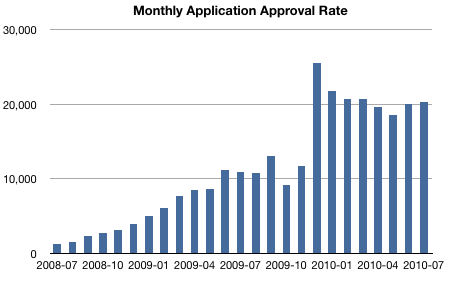
My initial estimate in February for the 200k milestone was by May 1st. I was clearly off by nearly 40 days. If the add rate is maintained at 20k/mo 300k will come around in August although I’m not as confident in this forecast. The rate of app addition seems to be accelerating.
As of today the Approved app counts are as follows:
The monthly rate of addition is shown in the following graph:
The 20k/month has been steady during the last 7 months so I think the last 4k apps will be added in the next week, making the 300k roll-over in August, as forecast. The approval rate did not accelerate however but stayed pretty steady. There was a similar plateau in the middle of last year around 10k apps/month.
LG Doesn't See Return To Operating Profit Until Early Next Year
By Roger Cheng and Jung-Ah Lee Of DOW JONES NEWSWIRES
SEOUL (Dow Jones)--LG Electronics (066570.SE), which readily concedes it is late to the smartphone game, said it plans to launch 10 more smartphones and sell 5 million devices by the end of the year as it scrambles to catch up with the rest of the industry.
But the aggressive move, which includes increasing the research and development budget by a third and ramping up its spending on marketing, means the company's once-flagship mobile devices unit won't likely return to an operating profit until early next year, said Chang Ma, vice president of marketing for the division.
"We have to just bear it," Ma told Dow Jones Newswires on Wednesday, adding that he hopes to see a turnaround after the fourth quarter.
Does it not strike everyone as odd that a company whose business is in the cloud also needs to peddle systems software...even devices?
It's like a philosopher at a conference trying to convince the audience of his idea requiring that they use a certain type of pencil to take notes. And only he can give you that pencil.
This should lead to serious questions: Firstly, maybe you don't need to take notes, secondly perhaps you don't use a pencil and thirdly why his pencil?
Analogously: Firstly, Google services don't need specific devices to be used because they're designed around web standards. Secondly, they don't need specific client software or APIs either and, thirdly, they certainly should not need specific systems software. Like the philosopher, Google does not charge for their pencil, but that's beside the point.
You can only conclude that either the philosopher's is a scoundrel or his idea is not that good.
I've been asked in comments on this blog who will win the "mobile war".
I use two analytical tools to answer this question: (1) history (2) value chain analysis.
History shows that operators are very important and hence very powerful in this market. That makes sense on many levels. They control what phones you get to buy, they decide the pricing and they decide frequently how you can use the phone. This is because the networks are expensive to build and maintain and there is an implicit bargain struck that the user and device should conform to the operator.
Value chain analysis tells me that as networks are not good enough, tight integration of the business models of the phone vendors and the operators is necessary to climb up the trajectory toward good enough as quickly as possible.
Therefore, given the distribution of value/bargaining power in the chain, it’s reasonable to assume that it’s operators who will decide which platforms win/lose and to what degree.
That simply means that no single platform can win a disproportionate share because it would threaten the balance of control the operators require. So talk of “dominance” of one platform or another is hyperbole. The most likely scenario is an even distribution of share between 4 or 5 competitors, so I expect iPhone and Android to get 20% share each.
This is not “fair” or economical or efficient, but it’s the way it’s going to be for a long time. If you're a fan, don't despair. In a few years, it still means hundreds of millions of units a year for each platform.
If you want to dream or hope for a more efficient outcome, you’ll have to look outside the cellular network model. I.e. think how iPod/iPad and Android tablets will evolve into communications products.
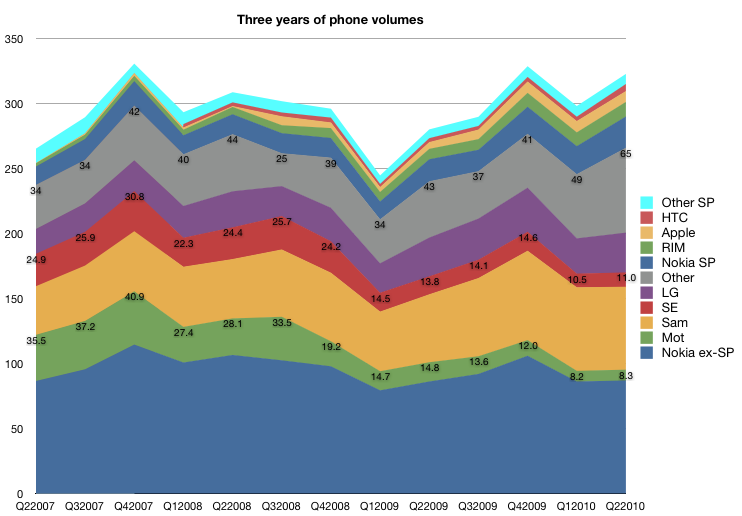
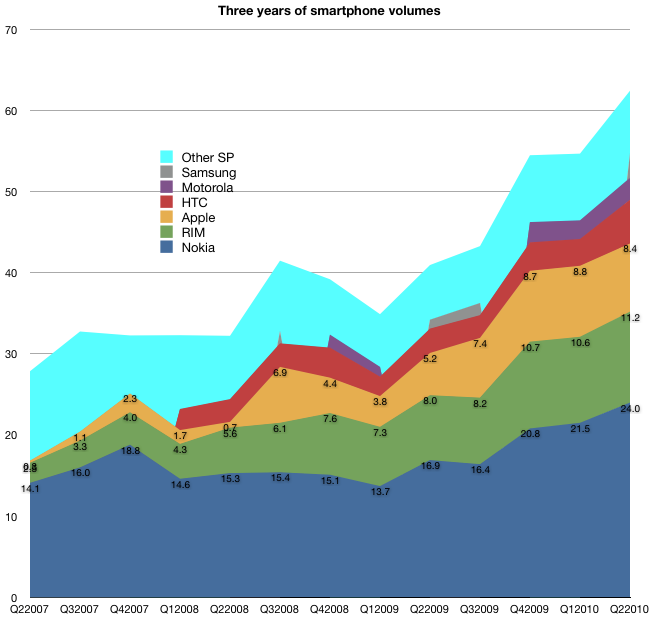
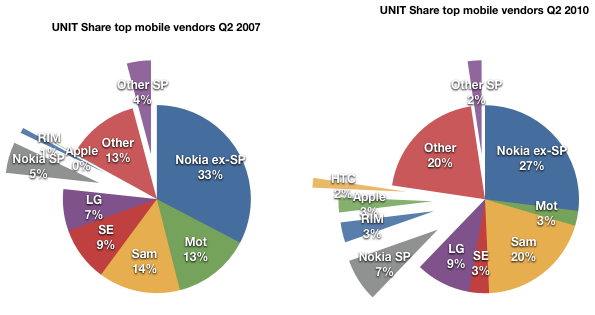
I did not include all vendors for various good reasons. The first survey (market share) did include an "others" category that made the volume data complete, but in the financial data sets, I chose to include the top 7 vendors that make up 80% of device volumes.
One noteworthy vendor that was not included was HTC. HTC is an important vendor for several reasons:
it's a pioneer in smartphones having made the first Windows Mobile devices and the first Android devices
at one point it sold 80% of all Windows Mobile devices
even if it did not brand its devices, it was the name behind many re-branded or white-label operator branded phones
it has a brand of its own today and is expanding its reach
HTC has been around building devices since 2001 and so it would be a pity to exclude them from any analysis of the effect of iPhone on the market or any discussion on the effect of smartphone disruption on feature phones.
The challenge with HTC was that historically their branded devices and white label devices were not reported by the company separately. This matters because white label devices are valued differently. Typically these devices are not marketed by the original manufacturer so SG&A is not applied to their cost base. Operating margins, ASPs and hence profitability is not directly comparable with other OEMs.
But HTC has recently changed its reporting. Thanks to a reader I discovered that, since 2008, HTC has been listing its ASP and Operating Margin making direct comparisons possible. I still don't have all the data, but enough to add HTC to the analysis.
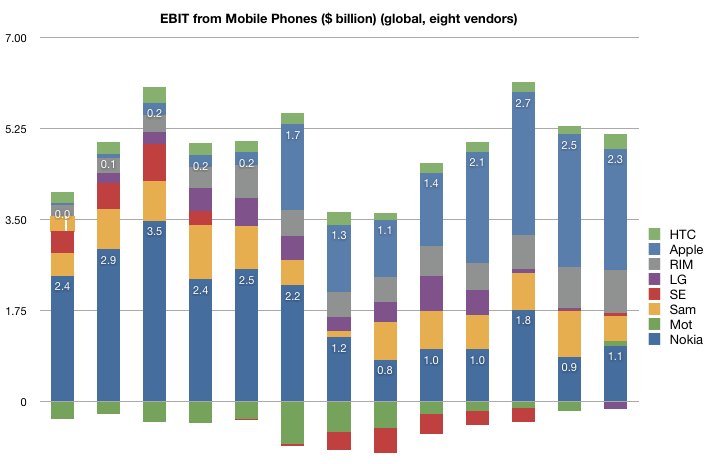
So, here are the 5 industry performance criteria, now with eight vendors listed.
Volumes
Note that HTC volumes start in 2008.
The volume of units HTC sold has been increasing at about the rate of market growth.
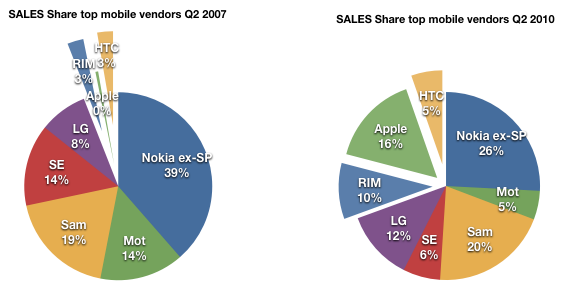
As a result, HTC's share has not increased as dramatically as those of the other smartphone entrants.
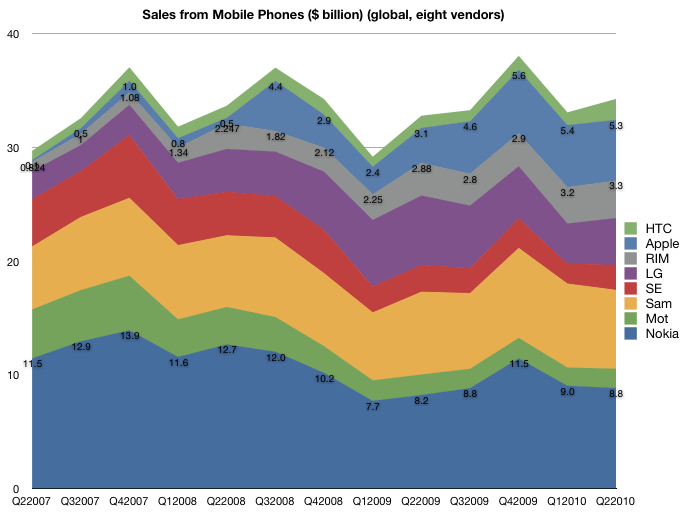
Sales
A similar story in the sales picture. Although a consistent performer, the growth has not matched that of RIM and Apple.
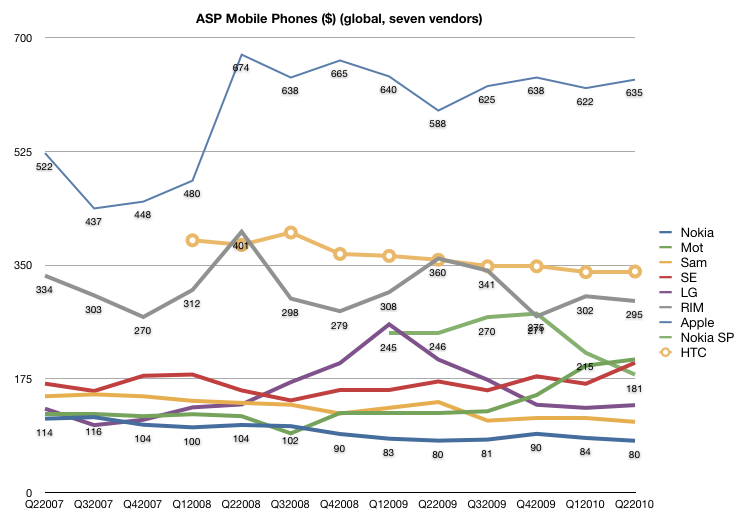
ASP
The pricing story is also a mixed one. Although HTC lies between RIM and Apple in price, the erosion is more consistent with RIM and the rest of the industry.
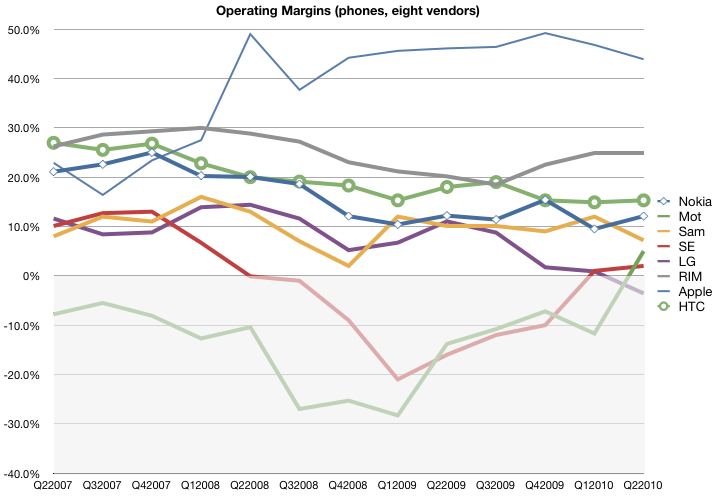
Margin
The margin story is also not as positive as one might expect. The margins for HTC started out above Apple and RIM but have dropped to closer to industry average. This is not what one might expect from an exclusive smartphone vendor.
Earnings
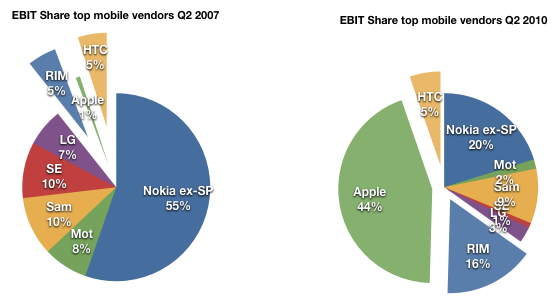
The share of earnings has remained unchanged at 5% over the period of iPhone presence. It's perhaps a credit to HTC that they did maintain their position in the market with the massive change that has come to pass.
However, here we also have to ask if HTC is riding a disruptive wave.
When I wrote the last series, my definition of “loser” was a company that had faced a long series of operating losses and has no viable software assets of its own, making it vulnerable to Android (and Windows Mobile). Motorola first, Sony Ericsson second and LG now coming into the picture. Nokia is not a loser in this sense since it has remained profitable and does maintain an investment in software. Same with RIM and Samsung (now with Bada). When/if they do have the near death experience, they might opt for the Android lifeline (flimsy as it is).
However HTC does not fit the mold of either "winner" or "loser". It's the Goldilocks company, not too hot, not too cold.
But I would add that HTC is not an example of a winner because of its adoption of Android. HTC’s dependence on Windows Mobile made their move to Android the most desperate of all. Unlike the larger OEMs, who had their low end devices to fall back on, they are completely dependent on a smartphone OS vendor. When WinMo was showing the first signs of crisis in 2007, they were the first to flee to Android (think of why they would risk the wrath of Microsoft for something so fragile as Android in 07). They are also trying hard to escape the dependence by building up their own UI (SenseUI) and I would not be surprised if they move to their own OS in the future. Being associated with Android does not confirm them as "winners" but in fact, shows their vulnerability.
What does this all say about Android?
Again here my thesis is that Google chose to sustain the industry rather than try to upend it. I don't judge their motives, but the fact is that with Android, Google is not in a position to disrupt telecom. There were high hopes dashed with the Nexus One and hearts broken with net neutrality and now there are patent wars to be fought. Android, with its licensees, is still at the mercy of operators.
On the iPhone, the firm raised their production forecasts from 14 million units to 18+ million, aided by easing constraints of display panels. Checks show consistent shortage of iPhone 4 inventory at Apple stores and there continues to be a three-week shipping delay from Apple's online store, the firm notes. As a result the firm has increased confidence in its 4QFY10 iPhone unit estimate of 11.6 million, which is up 39% sequentially.
On the iPad, the firm's build forecasts were revised up from 6 million to 7 million, which compares to their iPad shipments estimate of 4.75 million. The firm believes [there] is upside to the Q4 estimates and CY10 estimates of 13.4 million units, given the strong demand and anticipated production ramp heading into the back-to school and holiday seasons, as well as the high level of interest from business customers as expressed by AT&T.
These sound reasonable and credible. Note that production forecasts don't translate into sales forecasts as there is inventory, and some of that inventory will be held by Apple and some by the manufacturer.
My Q4 estimate sits at 12.1 million iPhones and 4 million iPads.