Asymco

Asymmetric Intelligence

HTC

  1. HTC: How They Compare

    Research · 17 comments

    In the last mobile market update series I wrote of  the evolution of market share, the shift in where dollars are spent, the tale of ASP erosion, profitability ratios over time and EBIT share over time.

    I did not include all vendors for various good reasons. The first survey (market share) did include an "others" category that made the volume data complete, but in the financial data sets, I chose to include the top 7 vendors that make up 80% of device volumes.

    One noteworthy vendor that was not included was HTC. HTC is an important vendor for several reasons:

    • it's a pioneer in smartphones having made the first Windows Mobile devices and the first Android devices
    • at one point it sold 80% of all Windows Mobile devices
    • even if it did not brand its devices, it was the name behind many re-branded or white-label operator branded phones
    • it has a brand of its own today and is expanding its reach

    HTC has been around building devices since 2001 and so it would be a pity to exclude them from any analysis of the effect of iPhone on the market or any discussion on the effect of smartphone disruption on feature phones.

    The challenge with HTC was that historically their branded devices and white label devices were not reported by the company separately. This matters because white label devices are valued differently. Typically these devices are not marketed by the original manufacturer so SG&A is not applied to their cost base. Operating margins, ASPs and hence profitability is not directly comparable with other OEMs.

    But HTC has recently changed its reporting. Thanks to a reader I discovered that, since 2008, HTC has been listing its ASP and Operating Margin making direct comparisons possible. I still don't have all the data, but enough to add HTC to the analysis.

    So, here are the 5 industry performance criteria, now with eight vendors listed.

    Volumes
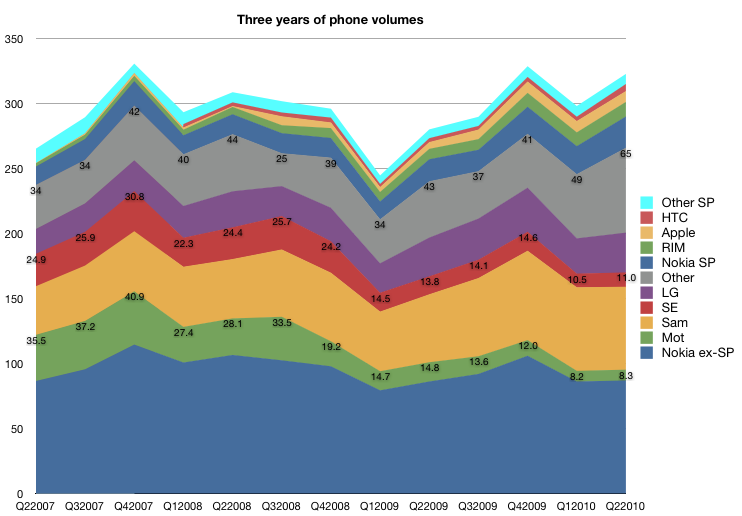
    Note that HTC volumes start in 2008.
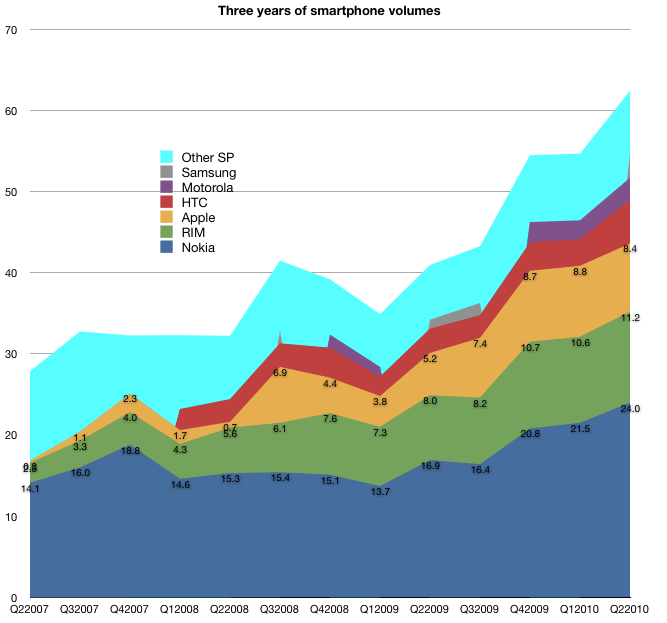
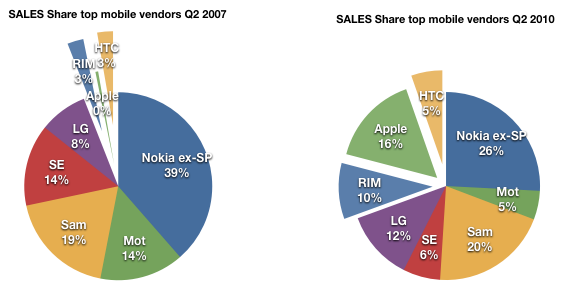
    The volume of units HTC sold has been increasing at about the rate of market growth.
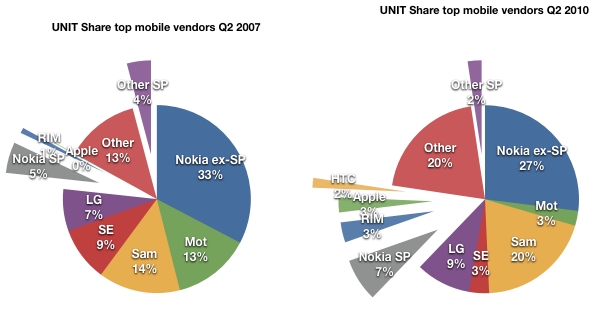
    As a result, HTC's share has not increased as dramatically as those of the other smartphone entrants.

    Sales
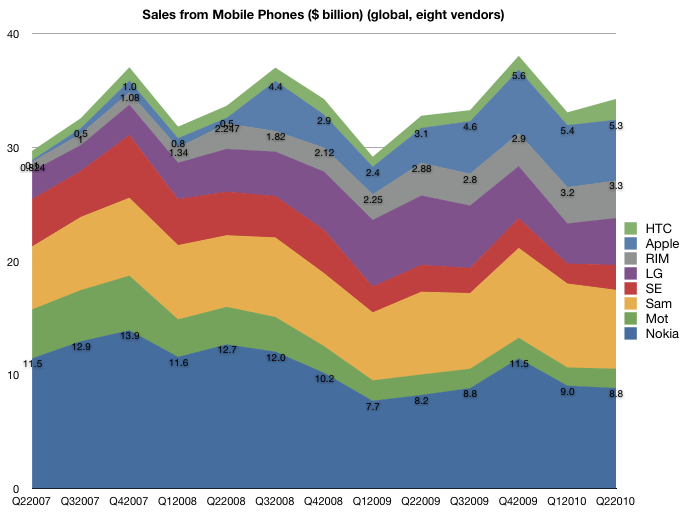
    A similar story in the sales picture. Although a consistent performer, the growth has not matched that of RIM and Apple.
    ASP
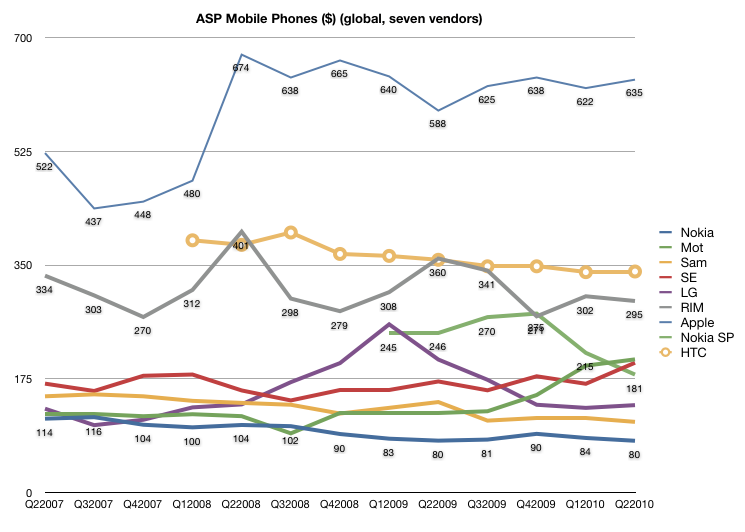
    The pricing story is also a mixed one. Although HTC lies between RIM and Apple in price, the erosion is more consistent with RIM and the rest of the industry.

    Margin
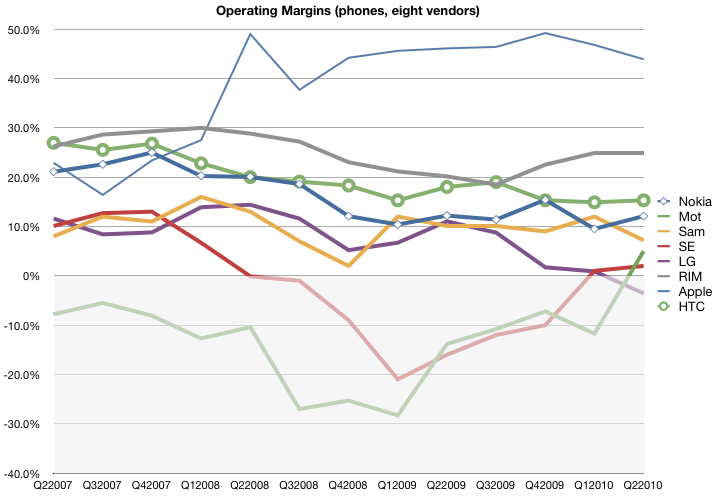
    The margin story is also not as positive as one might expect. The margins for HTC started out above Apple and RIM but have dropped to closer to industry average. This is not what one might expect from an exclusive smartphone vendor.

    Earnings
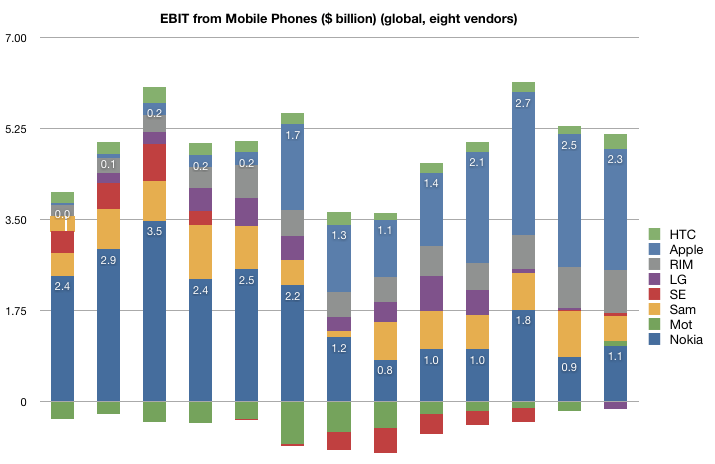
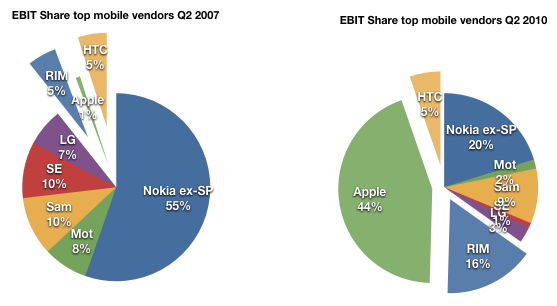
    The share of earnings has remained unchanged at 5% over the period of iPhone presence. It's perhaps a credit to HTC that they did maintain their position in the market with the massive change that has come to pass.

    However, here we also have to ask if HTC is riding a disruptive wave.

    When I wrote the last series, my definition of “loser” was a company that had faced a long series of operating losses and has no viable software assets of its own, making it vulnerable to Android (and Windows Mobile). Motorola first, Sony Ericsson second and LG now coming into the picture. Nokia is not a loser in this sense since it has remained profitable and does maintain an investment in software. Same with RIM and Samsung (now with Bada). When/if they do have the near death experience, they might opt for the Android lifeline (flimsy as it is).

    However HTC does not fit the mold of either "winner" or "loser". It's the Goldilocks company, not too hot, not too cold.

    But I would add that HTC is not an example of a winner because of its adoption of Android. HTC’s dependence on Windows Mobile made their move to Android the most desperate of all. Unlike the larger OEMs, who had their low end devices to fall back on, they are completely dependent on a smartphone OS vendor. When WinMo was showing the first signs of crisis in 2007, they were the first to flee to Android (think of why they would risk the wrath of Microsoft for something so fragile as Android in 07). They are also trying hard to escape the dependence by building up their own UI (SenseUI) and I would not be surprised if they move to their own OS in the future. Being associated with Android does not confirm them as "winners" but in fact, shows their vulnerability.

    What does this all say about Android?

    Again here my thesis is that Google chose to sustain the industry rather than try to upend it. I don't judge their motives, but the fact is that with Android, Google is not in a position to disrupt telecom. There were high hopes dashed with the Nexus One and hearts broken with net neutrality and now there are patent wars to be fought. Android, with its licensees, is still at the mercy of operators.
  2. What Happens When You Upgrade an HTC Hero to Android 2.1?

    Research

    HTC:

    TEXT AND PICTURE MESSAGES

    Text and picture messages will be deleted with this software update. You can back up text and picture messages by forwarding them to an email address.

    Open the Messaging application

    Tap and hold on the desired text or picture message

    Tap Forward

    Enter an email address then tap Send

    APPLICATIONS

    Applications will be deleted with this software update. You will need to re-download the desired applications from the Market after this update completes.

    Daring Fireball Linked List: What Happens When You Upgrade an HTC Hero to Android 2.1?.

    From the Hacker's Dictionary:

    kluge /klooj/

    [from the German `klug', clever; poss. related to Polish `klucza', a trick or hook] 1. /n./ A Rube Goldberg (or Heath Robinson) device, whether in hardware or software. 2. /n./ A clever programming trick intended to solve a particular nasty case in an expedient, if not clear, manner. Often used to repair bugs. Often involves ad-hockery and verges on being a crock.

  3. The Tale of the Spitzer Bullet Patent Lawsuit

    Research · 2 comments

    Apropos the IP lawsuit between Apple and HTC, it's perhaps instructive to look back at memorable patent suits. The following excerpt tells the story of how patent royalties were litigated for weapons that the litigants also used as belligerents against each other.

    The tale shows that not even global war can affect the outcome of patent law.

    From American Rifle http://www.amazon.com/American-Rifle-Biography-Alexander-Rose/dp/0553805177, Roosevelt's Rifle Chapter, Pages 271-278.

    On April 5 1905 the Treasury approved royalty payments of 75 cents per rifle plus 50 cents per thousand clips, up to a ceiling of $200,000. Seven months later, on Novemeber 6, Mauser's accountants were pleased to receive the first (for $11,367.53) in a four-year-long series of checks adding up to the $200,000 maximum.

    [General William Crozier who became Chief of Ordance of the Army in 1901 overseeing production for the nation's weapons] made an energetic start on the new .30-06 bullet, introduced on October 15, 1906. Early the following year he received an ominous visit from a very polite but insistent representative of Deutsche Waffen Munitionsfabriken (DWM), maker of the Spitzer bullets for the Mauser rifle.  The .30-06, he said, was a near-copy of DWM's "projectile for hand-firearms", which had been submitted to the Patent Office on February 20, 1905--about the same time, suspiciously, that Crozier had been finalizing the financial details of the settlement with Mauser--and approved on January 22, 1907.

    The good news was that DWM had a far weaker case than Mauser's--it was difficult to demonstrate that the shape and dimensions of such a common item as a bullet were unique--and Crozier's  patent attorneys advised him to fight the case. Crozier, again fearful that the newspapers would find out about this charge (even if it was trumped up by an opportunistic DWM), decided to fend off the accusers by stalling. He appointed his deputy, Lieutenant Colonel John Thompson (inventor-to-be of the famous tommy gun), to take care of the negotiations in the hope that they would go on for years.
    ...
    In the summer of 1914 [8 years after the accusation] his deputy Thompson had finally run out the clock regarding Ordnance's alleged infringement of DWM bullet patents. DWM had made repeated offers to Thompson asking him to settle quickly, and each time they had been rebuffed. On July 18, 1914, less than a month before the outbreak of the cataclysmic Great War, in which millions of men would be killed by pointed bullets, DWM finally lost its patience and sued the government in the U.S. Court of Claims for royalties on 250 million Spitzer bullets totaling $250,000. Ten days later, when Austria-Hungary declared war on Serbia, the suit was deferred.

    Crozier's position was saved by the sinking of the Lusitania in 1915 and the U.S. declaration of war on Germany in April 1917. Upon entry to the war, under authority of the Trading with the Enemy Act, the government created the Office of Alien Property Custodian to oversee the seizure of enemy-owned or enemy-controlled assets. To Crozier's immense relief, the DWM patent was ruled to be U.S. property, and the attorney general dismissed the company's suit out of hand.

    Crozier retired in 1919 and escaped the censure for the fallout from a reinvigorated lawsuit launched by DWM in 1920 [two years after the WWI ended]. Having given up on obtaining a favorable patent-infringement judgement, DWM's lawyers focused on whether the alien property custodian's seizure of the patent had been lawful. Impressed by DWM's argument that its bullet was protected by previous treaty, a tribunal ruled the U.S. government in violation and awarded DWM damages of $300,000.

    Washington immediately appealed the decision, and the case lurched on interminably, for another seven and a half years, until it was finally settled on the last day of 1928, a generation after its beginning. The judgement stood. With interest added on the original $300,000, the United States owed a German company $412,520.55 [for the rights to the bullet they used against Germany in two World Wars].

    Read more:

    http://en.wikipedia.org/wiki/Mauser
    http://en.wikipedia.org/wiki/Springfield_1903 "Still, the 1903's used so many design features from the German Mauser that the U.S. government paid royalties to Mauserwerke"
    http://en.wikipedia.org/wiki/Spitzer_(bullet)

  4. Why HTC (Part II)

    Research · 1 comment

    Starting in January, Apple launched a series of C-Level discussions with tier-1 handset makers to underscore its growing displeasure at seeing its iPhone-related IP infringed. The lawsuit filed against HTC thus appears to be Apple's way of putting a public, lawyered-up exclamation point on a series of blunt conversations that have been occurring behind closed doors.

    link: Apple talks tough to handset makers - Apple 2.0 - Fortune Brainstorm Tech

    Top-tier handset makers continued to avoid implementing multi-touch, but Apple could safely assume that they were hanging back to gauge Apple's response to Motorola and HTC. If there wasn't one, the OEMs would likely read the silence as a green light, especially after Google also moved to enable multi-touch on its Nexus One phone.

    Even before the lawsuit, handset makers were having second thoughts about Google, which with the Nexus One had become a direct competitor. Now their faith in Android as the easiest and cheapest way to counter the iPhone has been shaken, says Reiner.

    Seems pretty close to what I wrote here:

    Why HTC?

    Therefore it’s entirely likely that HTC was singled out to disrupt the business logic of modular mobile software. HTC is the pioneer and the hub as the largest licensee for both WinMo/WinP and Android and the inspiration for hundreds of OEM/ODMs to make modular products.

    ... Other vendors looking at this licensing model might think harder about participating, and that may be the whole point.

  5. Why HTC?

    Research · 6 comments

    In the suit against HTC, Apple's listed infringing phones include HD2, Touch Pro2, Tilt2, Imagio, Pure and Touch Diamond. These all run Windows Mobile and not Android. HTC shipped 80% of the Windows Mobile units in the field, a far larger volume than Android so it stands to reason that the law suit is as much targeting Windows Mobile as Android.

    In 2006 Microsoft announced that their partners/OEMs/Operators will get indemnification on IP suits regarding their OS. It's not a sure thing that Apple's patents cover any part of the Windows Mobile stack--vs. whatever parts HTC layered on top. However, there is a high probability that Microsoft will join Google in HTC's defense.

    I should also point out that the media's emphasis on Google as the exclusive target of the suit is sensationalistic. Focusing on Google possibly misses a hidden agenda.

    Namely that Apple is attacking the hub of the modular approach to mobile computing while largely leaving the integrated vendors like Palm and RIM alone (the dispute with Nokia is over license terms for GSM patents and not yet about UI patents).

    Therefore it's entirely likely that HTC was singled out to disrupt the business logic of modular mobile software. HTC is the pioneer and the hub as the largest licensee for both WinMo/WinP and Android and the inspiration for hundreds of OEM/ODMs to make modular products.

    HTC's defense will be complicated and difficult due to these dependencies. Legal risk weighs heavily on large corporations, especially when the payoff is marginal at best. Other vendors looking at this licensing model might think harder about participating, and that may be the whole point.

  6. Suiting Up

    Research · 2 comments

    Well, I don't want to talk about any specific company. I'm just making a general statement that we think competition is good. It makes us all better. And we are ready to suit up and go against anyone. However, we will not stand for having our IP ripped off, and we'll use whatever weapons that we have at our disposal. I don't know that I could be more clear than that.

    Tim Cook, my favorite Apple exec, in January 2009.

    One thing should be obvious: the accusations against HTC are aimed at Google and Microsoft or more broadly still, they are aimed at any mobile software competitor that intends to use touch and gesture inputs.

    When Jobs said in 2007

    We've been pushing the state of the art in every facet of this design. We've got the multi-touch screen, miniaturization, OS X in a mobile device, precision enclosures, three advanced sensors, desktop class applications, and the widescreen video iPod. We filed for over 200 patents for all the inventions in iPhone and we intend to protect them.

    he implied that Apple had approached this new input method with much more care than when they introduced the mouse and windowing interfaces in 1984.

    Unlike the fight over Windows, which was a copyright debate, this will be all about patents. Apple ultimately lost the GUI fight over the MasOS windowing interface, which is why I think they are much more prepared this time.

    Given this strategic intent, the only questions were how the war would be engaged and on what terms. A few skirmishes caused some head fakes.

    First, came apparent threats against Palm. Apple was certainly debating going after Palm, but I think they realized it would not be a good strategy. Mostly because the signal would be weak. There would be few consequences to Palm being punished. Palm's integrated model is not employed by many of the larger device vendors. Except for Nokia, all other vendors license their OS, Samsung, LG, Sony Ericsson and Motorola would not be infused with anxiety over Plam taking a hit.

    Second, came the pre-emptive attack from Nokia. Apple was not ready to go after Nokia last year because Nokia did not yet have a UI "worthy of being infringing".  In other words, there was no target to shoot at.  Nokia's suit was pre-emptive in that it centered on their desperate wish to have a cross-license agreement--trading GSM patents for touch patents.

    That skirmish should not detract from what's the real goal here:  securing monopoly rights to mobile computing interfaces.

  7. HTC: Hard to Compete

    Research

    HTC is the world’s fourth largest smartphone company. It ships 80% of all Windows Mobile and probably a similar proportion of Android devices. Like Microsoft in 2003, Google turned to HTC for its first smartphone, the G1 and its latest, the co-branded Nexus One. The company shipped a total of 11.7 million mobile phones in 2009.

    It would appear that HTC is very well positioned in what amounts to be the best industry in technology.

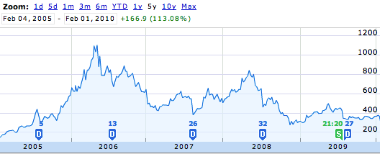
    However, not all is well. A few days ago HTC issued revenue guidance below analyst estimates and its stock price is at 2005 levels, 70% off its peak (see graph--source: Google finance).

    Part of this could be explained by its continuing reliance on Windows Mobile which is fading fast, but also it’s because, as management acknowledged, there is significant price pressure.

    HTC prides itself with having a “premier” product with typically high-end feature sets and positioning. HTC invested in its own UI to differentiate its products and has mounted a branding campaign to move away from being a white-label ODM.

    It seems all for nought. The rules of the smartphone market do not favor modular component players. As HTC does not front its own OS, it still struggles to stand out in the eyes of the consumer.

    Looking at the list of top 3 vendors: Nokia, RIM and Apple, we see hardware companies that field an integrated OS/service bundle.

    It’s hard to compete against this.