Asymco

Asymmetric Intelligence

Horace Dediu

  1. The iPhone at three

    Research · 4 comments

    The end of June will mark the third anniversary of the market release of the iPhone. When it arrived in June 2007, anticipation for the product was significant with high consumer awareness and expectations--though the 10 million/yr. target for 2008 was met with skepticism by many.

    The iPhone launched on June 29th 2007, with only a few days remaining in the quarter. 270k units were sold in that quarter and that was considered a solid start. When the company reported earnings a few weeks later (July 18th 2007) the company's stock price jumped to $140 a share.

    As a sign of optimism in the company's prospects, the P/E ratio showed that the company was expected to reach 35% growth (35 P/E).

    Was this optimism warranted?

    A huge world-wide recession started only six months after the iPhone launched and, by some accounts, it is still lingering today. That meant the company faced decreasing consumer spending and constrained markets world-wide. The recession was expected to challenge Apple's premium positioning across all its product lines. The optimism from 2007 seemed exuberant. Where do we stand today?

    This table shows the actual values of the iPhone's 2007 launch quarter vs. the estimated values for Apple's income statement exactly three years later.
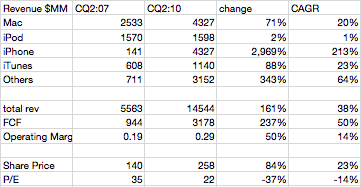
    Free cash flow grew 237% or at a compounded 50%, significantly above the 35% that the P/E of 2007 would have suggested. The exuberance of 2007 turned out to be pessimism.

    Although we don't know what the share price will be come July, as of today the share price has grown at less than half the rate of FCF growth: 84% or 23% compounded. As a result the P/E dropped from 35 to 22.

    It's remarkable that growth expectations today are lower than they were at iPhone's birth even though the company outperformed those expectations through an unforeseen economic crisis.
  2. Prepare for unrestricted iPhone distribution

    Research · 3 comments

    I'm picking up all kinds of signals that Apple is about to let loose with a storm of operator distribution deals.

    It all started with Tim Cook's comment in the last conference call:

    Over the past year we have moved a number of markets from exclusive to non-exclusive. In each case as we have done that we have seen our unit growth accelerate and our market share improve

    Now we are hearing of unrestricted iPhone distribution in France and today the rumor of T-Mobile picking it up in the US (which I always thought was more logical than Verizon).  There are other hints from the Nordic countries

    Three to Carry iPhone 4 in UK | News | The Mac Observer observes that there will be five (!) UK carriers selling it.

    In addition to the super-steep ramp of 88 countries launching in 3 months.

    It looks like Tim pulled all the stops.

  3. The next 100 million iOS devices

    Research · 9 comments

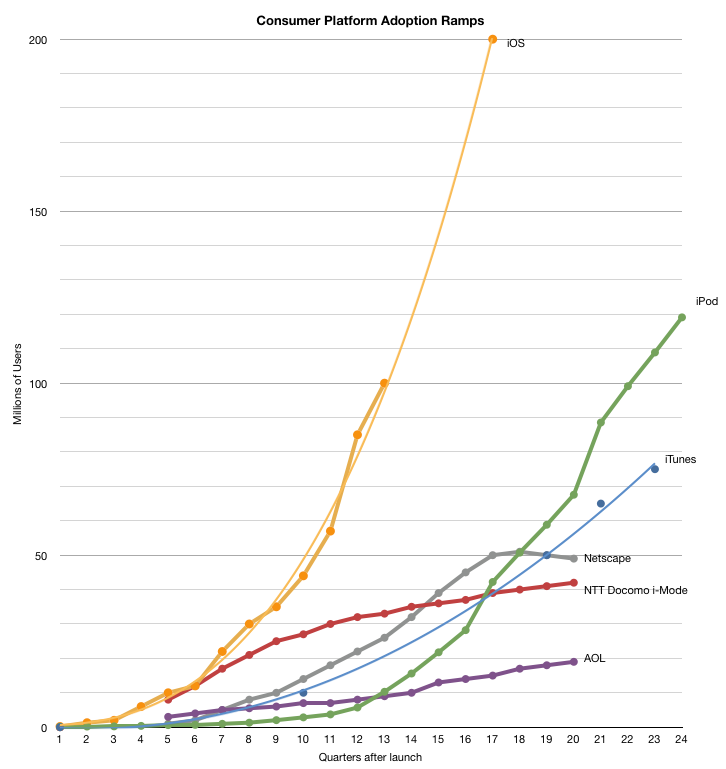
    As iOS crosses 100 million units sold 3 years after the platform launched, it's time to look forward to the next 100 million. My expectation is that well over 100 million iOS devices will sell during 2011, but even during the next 12 months (2H '10 and 1H '11) the total may well reach 100 million, making 200 million installed by June 2011 very likely.

    Here is where the numbers will come from:

    iPhone: Assuming only 50% growth (half of the average growth seen so far) gives 50 million units in the next 12 months.

    iPad: 15 million base assumption

    iPod: This is the most difficult to predict, but 46 million iPods will sell with a growth rate of -8% to -9%. If we consider the iPod touch part of the mix to be 40%, we get 19 million.

    The total with these assumptions would be 84 million. A slightly higher growth rate for the iPhone would easily push the total to 100 million.

    200 million devices in four years is quite a feat. Compare it to the growth of television which reached 50 million Americans in the first decade after commercial launch. Or consider the Netscape browser which only reached 50 million in its first four years or AOL which just crossed 20 million or in Japan where i-Mode reached 40 million users in the same time frame.

    At 200 million, the iOS platform will be 18% the size of the world-wide television audience.

  4. Steve Jobs forecasts iPhone sales to grow at least 50% y/y

    Research · 6 comments

    Well, not exactly.

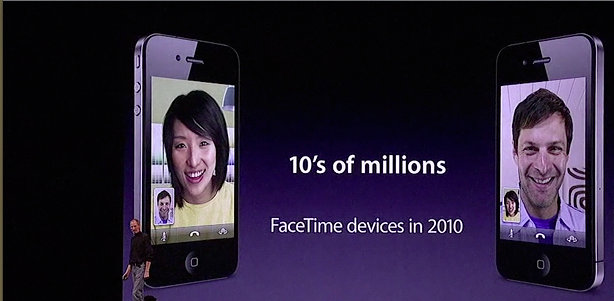
    During the WWDC keynote Steve Jobs announced that "we will ship 10's of millions of FaceTime devices in 2010".  Since only iPhone 4 currently runs FaceTime(*) then it stands to reason that there will be "10's of millions" of iPhone 4 devices sold.  And since the year is half over, it means we can divide "10's of millions" over two quarters.  That puts sales in the 10+ million range per quarter.

    My current forecast shows 11 million in Q3 and 13 million in Q4 corresponding to 50% y/y growth.

    Steve Jobs seems to be indicating this is well within reason.

    (*) one exception to this assumption is that he's including a future iPod touch running FaceTime.  This may very well be the case when the iPod line-up will be released probably in October.

  5. New data on iTunes: 11 billion downloaded

    Research

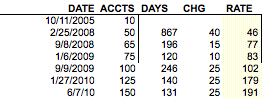
    When Steve Jobs announced 150 million accounts with credit cards on the iTunes Store, iBookstore and App Store, he stated that as far as he knows it has "the most accounts of any store on the web".

    More interesting is the claim that iTunes has enjoyed 16 billion downloads.

    Subtracting the 5 billion app downloads, that leads to Music+Video adding up to 11 billion (books at 5 million is still too small to make an impact.)

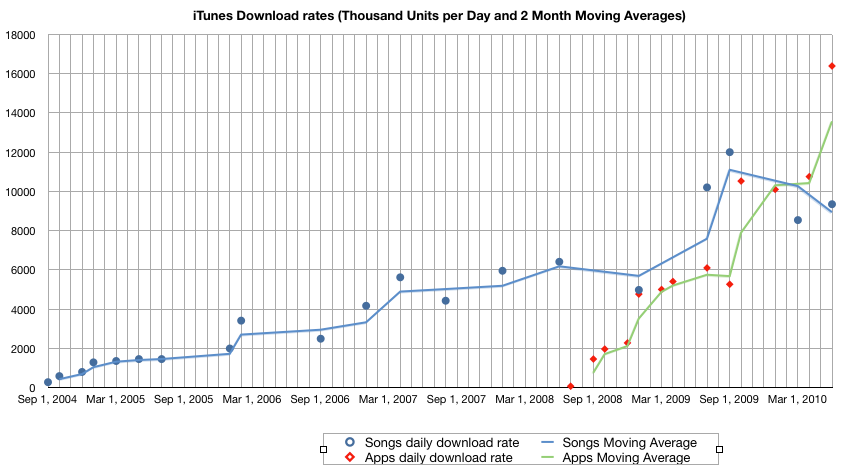
    The last download data on iTunes was in February when Apple reported 10 billion songs downloaded. The new data implies the daily download rate is about 9.3 million per day.  The forecast I had suggested 11.1 billion by June 1 so it's come in a bit less than expected.

    12 billion songs is expected in September.

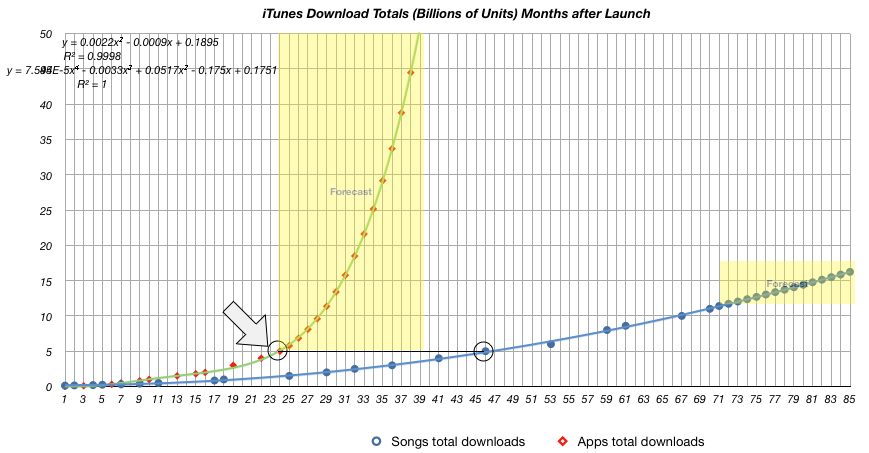
    The graph that follows shows actual and forecast cumulative downloads for the App Store and iTunes store based on months after launch.  As it shows, 5 billion apps took 24 months whereas 5 billion songs took 46 months.

    This graph shows the download rates.  The green line (apps) clearly overtakes the slowing blue line (songs/media).

  6. Android vs. Google Part III

    Research · 2 comments

    Revised language for section 3.3.9 of Apple’s developer agreement, concerning the use of data collection:

    The collection, use or disclosure is for the purpose of serving advertising to Your Application; is provided to an independent advertising service provider whose primary business is serving mobile ads (for example, an advertising service provider owned by or affiliated with a developer or distributor of mobile devices, mobile operating systems or development environments other than Apple would not qualify as independent

    via Apple Makes Good on Steve Jobs’s Promise, Invites Other Advertisers. But What About Google’s AdMob? | Peter Kafka | MediaMemo | AllThingsD.

    Apple is stating that user data must be handled by organizations that are strictly independent.  If the ad service provider is part of an organization that either competes with Apple's devices or platform, it's not independent.

    AdMob would have been allowed to operate unhindered on iOS but AdMob as part of Google is not.

    Conversely, if Google were to abandon Android, the path to riches would be open again.  As shown several times already, by pursuing a mobile device platform Google strategically abandoned some significant revenue opportunities in exchange for some extraordinarily high costs.

    Readers of this blog should not be surprised.

  7. Safari claims 200 million installed base, WebKit at 500 million

    Research · 1 comment

    Safari continues to lead the pack in performance, innovation and standards support," said Philip Schiller, Apple's senior vice president of Worldwide Product Marketing. "Safari now runs on over 200 million devices worldwide and its open source WebKit engine runs on over 500 million devices

    via AppleInsider | Apple releases Safari 5 with extensions, expanded HTML5 support.

    Safari's installed base includes Mac, iPhone, iPod touch, iPad as well as the number of Windows versions.  Assuming 45 million Macs, there are probably around 50 million PCs using Safari.

    WebKit includes all iOS devices as well all Android and Symbian/S60 and Palm Pre.

  8. Was Quattro a bargain? Was AdMob a rip-off?

    Research · 4 comments

    Apple's announcement of $60 million booked revenues for iAd, of which 60% is meant for developers implies $24 million operating profit for the second half of 2010.  Assuming this rate doubles $100 million for 2011, it becomes clear that the acquisition of Quattro for $250 million is reasonable (2.5x gross earnings) and that the AdMob price of $750 million seems expensive.

    Now Google may have justification for the $750 million along the lines of income from non-Apple platforms, but the CPMs for Admob are a fraction (perhaps 10%) of what iAd is able to obtain.  Therefore, it's a pretty fair conclusion that Google did not get a bargain.