Asymco

Asymmetric Intelligence

Horace Dediu

  1. Will Apple rule the iPad market?

    Research · 1 comment

    This question sounds like a tautology. It's like asking "Will Apple rule the iPod market?" But redundancy has not stopped WSJ journalist Benjamin Pimentel from asking. His answer to the question is below:

    But while Apple apparently has the edge in the emerging tablet war, it is unclear if the company will end up dominating the market the way it has come to rule the digital music player market with the iPod.

    Gartner's Fiering said the iPad has "raised the bar and suppliers are now scrambling to make sure they get it right."

    IDC now projects 6 million tablet devices to ship this year, including 4 million iPads, Shim said. But while Apple has taken the lead, he added, the company faces the "burden of lifting or defining this entire new market," because there are no other competitive devices available.

    "In the iPhone market, they learned from everybody else," he added in a video interview. "In this new space, there's nobody else to kind of bounce ideas of so to speak."

    But Apple may not have to feel so alone for long.

    Fiering specifically pointed to H-P's as the best positioned challenger, given its scale, reach and its upcoming merger with Palm.

    "There are not too many suppliers that can pull all those pieces together," she said. "H-P could if they integrate the Palm acquisition properly."

    Another IDC analyst, Crawford Del Prete, agreed saying, while the "buzz" from H-P had generally been defensive in relation to the iPad, "the longer term story is far more interesting."

    "Given H-P's massive scale, I think they have the ability to drive new price points for this kind of product," he said. "With a lower price point, the category becomes far more interesting."

    via PC Makers Look To Challenge Apple's IPad - WSJ.com.

    Before diving into the statements above it's worth noting where the journalist went to get opinions to fill his column. He called Gartner and IDC. Quoting industry analysts is a standard operating procedure to fill column-inches with material that does not offend. But how good are they?

    In my years of watching those who watch markets I formed a ranking of analyst types and their likely accuracy with respect to prognosticating a market shift. In order from most accurate to least accurate:

    1. The most accurate are rank amateurs (deagol, Muller, et. al).  Independent bloggers who do some fact checking tend to make the boldest but most accurate forecasts.
    2. The next most accurate are sell-side analysts (purveyors of analyst reports from established brokerages).  They follow financials for individual companies.  You might think their record is quite poor, but in fact they are much better than..
    3. Industry analysts (like Gartner, IDC).  Their forecasts and sensitivity to disruption are often off by an order of magnitude.  This is partly because they forecast a bit further out than Wall St. but also because they are closer to their industry clients-- the source of their ideas.  They spend a lot of time talking to the least accurate forecasters...
    4. The corporate analysts.  They are typically hired to advise management in the incumbent companies. These are people who have the most information about the way the industry is performing on a daily basis.

    You might notice a pattern here: the closer you are to the market, the less likely you are to observe how that market is crumbling around you. You cannot see the forest for the trees.

    How could this be? How can having more access give you a poorer picture? The answer lies in the asymmetry of a disruptive attack. The more you know about how things are the less you know about how things could be.

    In practice, the analyst information value chain works like this:

    Corporate analysts feed information to management that management is comfortable digesting. Those managers then hire industry analysts to validate their opinions. Industry analysts are keen to maintain a relationship with those firms and so they listen carefully to the prejudices of their clients. They then hold up a mirror to those myths and consolidate those opinions for wider distribution and quotation by journalists at respectable publications.

    Stock analysts listen with one ear to the chatter but with the other to the way the wind blows with the stock market. Sometimes they actually sample the data in the value chain directly by calling acquaintances in the market and hire interns to watch what's happening in the shops. They then build an opinion that has some level of surprise but that they hope will not stray too far into controversy so that they can keep their jobs in case they are wrong. The safe bet is always to say that things will stay mostly the way they are, but to say it in clever ways.

    So that just leaves only one group of analysts with independence from a paycheck who can make an opinion on the basis of facts alone.

    This post has become longer than I planned, so I'll dive into the exact answer to the article claims in part II.
  2. Apple's iPhone replaces Blackberry

    Research

    British bank Standard Chartered is replacing the Blackberry, currently its standard corporate communication device, with the iPhone.

    The process of migrating corporate email services from the Blackberry to the iPhone started about a month ago, said the spokeswoman, although she did not know how many of the Asia-focused bank's 75,000 employees used company-issued Blackberries or when the switchover could be completed.

    via Apple's iPhone replaces Blackberry for some bankers | Reuters.

    I remember reading once that the iPhone was not suitable for Enterprise use.

  3. The mystery of the Quantum Leap in the App add rate

    Research

    The app store crossed 200k apps in early may and is on its way to a quarter million apps approved by end of June.

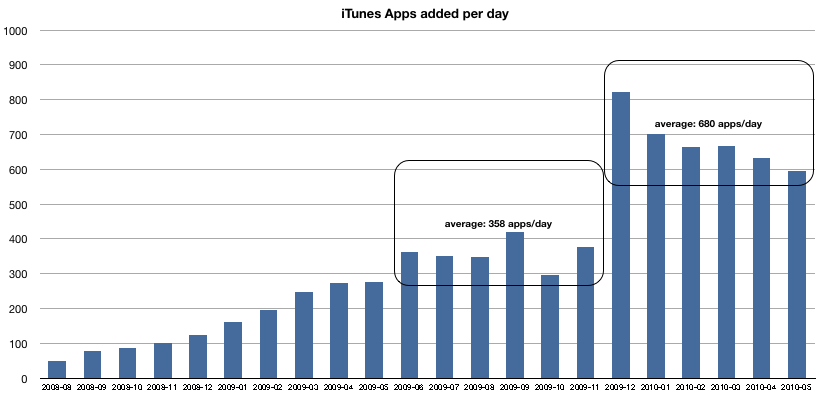
    On the way to this total, the rate of addition of apps has been increasing to around 630 apps added every day.  What's perhaps interesting is that this app add rate has not been increasing in a steady way.

    The graph below shows how the add rate has been increasing (sourced from 148apps.biz).  During the first year, the add rate was increasing steadily.  Then it reached a plateau of about ~350 apps/day for six months in the later half of 2009.  Then it jumped dramatically in December to over 800/day and then leveled off to an average of 680/day during the last 6 months.

    The pattern could be due to the rate of applications being submitted changing or due to the rate apps are approved. Clearly there is a seasonal explanation for the December jump, but the rate has held pretty steady after that month and has remained far above the rate during the trailing six months.

    My guess is that the app approval process and resourcing for the task has been improved during the last six months.  On a monthly basis the new normal seems to be around 20k apps/mo.

  4. Mobile data use overtakes voice in US

    Research

    Data use overtook voice on cellphones for the first time, according to CTIA data. Internet access and text messaging occupied more data on US carriers' networks than did the equivalent in calls. The reversal came both through a 50 percent jump in text messaging but also the rise of data-first smartphones like the Droid and iPhone.

    via Data use overtakes voice on cellphones | Electronista.

    This is a fundamental shift.  Data use is disruptive to an industry built on voice.  With data come new business models, new value chains and new core values and processes and user interfaces.

    The shift to mobile broadband will be more significant than the shift from fixed to mobile voice.

  5. Sony would say No to Walkman today

    Research · 1 comment

    Sony is “not convinced there is a large enough market to justify bringing out a tablet,”

    via Sony Considering Developing Tablet Computer to Compete With Apple's IPad - Bloomberg.

    I wonder what current Sony management would have said when the Walkman would have been presented to them in 1978 by audio-division engineer Nobutoshi Kihara.

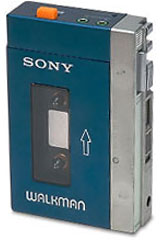
    The Walkman TPS-L2 from 1979:

    The original Sony Walkman

    The Walkman introduced a change in music listening habits by allowing people to carry music with them.

    There was a tiny market for such implements in 1978, promoted to professional journalists.  Sony even had a product called the Pressman and marketed it exclusively to reporters. These recorders lacked stereo sound and were very expensive. They also used (typically) microcassettes, which had no support from record companies.

    With the limited choices presented to consumers, the most popular cassette tape players were either home stereos or car players.

    I'm sure Sony's current management  would also have been unconvinced that there was a large enough market to justify bringing out a consumer-grade portable cassette player.

  6. Apple's product trajectories

    Research

    In a well written and reasoned essay, John Gruber observes how Apple evolves their products after starting with a perfectly narrow new product definition.

    Toward the end he brings us to the iPad saying:

    That brings us to the iPad. Initial reaction to it has been polarized, as is so often the case with Apple products. Some say it’s a big iPod touch. Others say it’s the beginning of a revolution in personal computing. As a pundit, I’m supposed to explain how the truth lies somewhere between these two extremes. But I can’t. The iPad really is The Big One: Apple’s reconception of personal computing.

    Absolutely right.  The iPad is as big as it gets.

    But in my way of thinking, the iPad itself is but a "rolling" of the original iPhone which itself was a "rolling" of the gesture-based UI that they gestated in Apple's labs for more than five years.  That UI itself was made possible by the modular nature of OS X and the frameworks on top that have their roots in Next Step. Next Step itself owes a lot to Unix which was born in 1968.

    via This is how Apple rolls | Tablets | Macworld.

  7. Apple's Valuation Struggle

    Research

    I don't know how many times I can re-write this story but here goes another try.

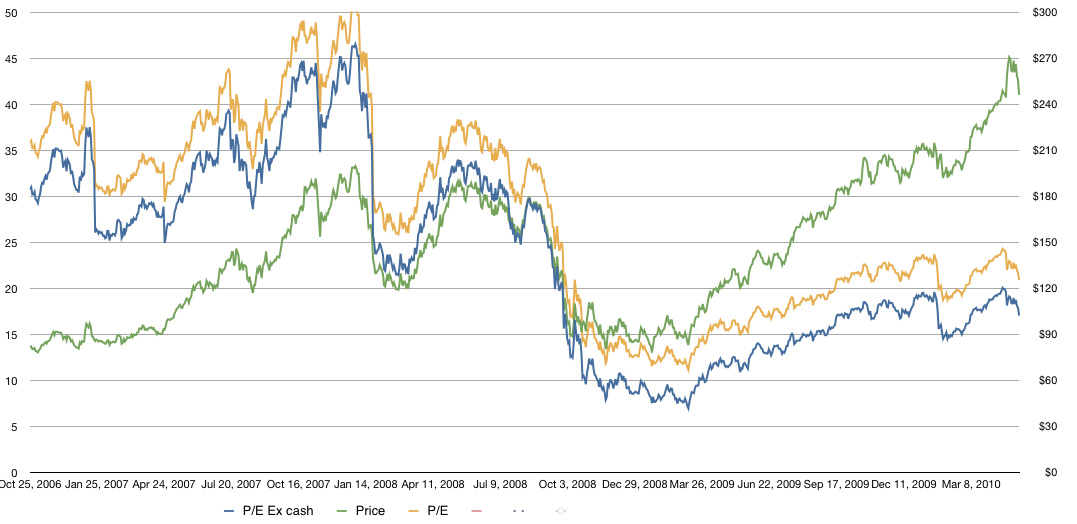
    In the graph below I show Apple's historic share price overlaid Apple's P/E (with and without cash).

    The share price is the line in green with the scale on the right and the P/E (trailing twelve months ex-cash) is shown in blue with the scale on the left.  The P/E including cash (which is what is usually cited) is shown in yellow.

    As the graph shows, while the stock has risen, the P/E has fallen.  This is due to earnings accelerating faster than the stock price. As valuation is usually correlated with growth, it stands to reason that Apple continues to be discounted as a growth stock.