Asymco

Asymmetric Intelligence

Horace Dediu

  1. Does iPhone really have 72% of Japanese smartphone market?

    Research

    MM Research does not count Symbian as a smartphone platform. This makes them inconsistent with any other analyst for counting smartphones.  So shouldn't Symbian be included?

    In a comment to iPhone has 72% of Japanese smartphone market | Asymco it's been pointed out that 12 million Symbian sold in the same time frame as Apple sold 1.7 million phones in Japan.

    It would seem then that the correct market share for iPhone would be 12%, with Symbian having 83% and "others" having less than 5%.

    However...

    Symbian in Japan is not the same thing as Symbian elsewhere.  Symbian in Japan is used as a low level OS by Fujitsu, Sony Ericsson Japan, Mitsubishi, Sharp and others to provide devices running the MOAP(Symbian) software platform.  MOAP (Mobile Oriented Applications Platform) is the software platform for NTT DoCoMo's FOMA (Freedom of Mobile Multimedia Access) service.

    Unlike Series 60 and UIQ MOAP(Symbian) is not a open development platform.

    MOAP is also supported by Linux with Panasonic and NEC using it in something called MOAP(Linux).

    MOAP(Linux) is also not an open development platform.

    So the "72% share for iPhone" in Japan must be stated with this important caveat: that Symbian and Linux are not included because, due to not having exposed APIs, they are classified as feature phone platforms.

  2. iPad outsells iPhone (part II)

    Research

    “Checks indicate that US iPad sales remain strong post-launch, driven by rising consumer visibility to iPad’s user experience, sustained PR/word-of-mouth marketing, 3G iPad launch, and broadening iPad apps/content,” Abramsky wrote in a note to clients this morning. “We believe Apple is now selling >200k iPads/week, greater than US Macs (est. 110k Macs/week) and just below US iPhone 3GS first quart (246k/week).”

    Retail checks in mid-May showing widespread iPad stockouts at Apple stores and Best Buy. The 3G iPad is sold out at many Apple stores and about 25 percent of them now have only selected Wi-Fi iPads available. Waiting lists are not uncommon.

    ... Abramsky raised his global iPad outlook for 2010 from 5 million to 8 million.

    via Apple Selling More iPads Than Macs | John Paczkowski | Digital Daily | AllThingsD.

    iPad is not only outselling iPhone version 1, but, soon, iPhone version 3.

  3. The Next Billion Users

    Research

    Five weeks ago Apple forecast 100 million iPhone OS devices will be sold by summer. This was fairly easy to predict but the question comes up: when will the next 100 million be sold? And what about after that?

    The iPhone OS three-legged platform is now the fastest growing platform ever and enjoying network effects which naturally accrue to platforms under solid custodianship. However, I am observing signals from Apple that they intend this platform to become the global standard for mobile computing, which, in today's world, means targeting 1 billion users. Here are the signals that I'm noting:

    1. Geographic and cultural universality. What plays in Peoria should play in Beijing.  As it has shown by being big in Japan, the iPhone crosses over cultural idiosyncrasies. Not long ago it was taken for granted that "mobile tastes" differ and "one size does not fit all" in mobile phones hence the need for hundreds of phone models in every portfolio. Apple has completely destroyed this myth. (One could ask why should mobile computers be polymorphous when their slightly larger cousins the laptops are rigidly monotonic?) By broadening the platform with multiple screens and connectivity options, Apple is cleverly spanning the jobs that he platform can be hired for.
    2. Avoidance of a pricing umbrella.  Note that this does not mean being low prices, but rather, the protection of their franchise through pricing. Apple has developed a way to stretch a single product across multiple price bands, and carefully builds product to price and margin targets that have strategic placement.
    3. Product cycles and product ramps. Apple has imposed upon itself a yearly product cycle for the iPhone and the iPod.  This is a brilliant move because it keeps the product fresh without having it seem disposable.  It also keeps competitors within its turning radius. However, the challenge is that the distribution network has to be filled rapidly and drained rapidly to maximize availability. This gets harder and harder as the volume grows. Imagine having to manufacture and ship into the channel a billion devices in less than a quarter.

    I would point out that all these are marketing, not technical challenges. They are thinly disguised questions about product placement, portfolio, pricing, production and distribution--classic Marketing 101. (Promotion, which is what most people equate with marketing is not particularly challenging, especially for Apple who mostly does it through PR).

    It is comforting perhaps to know that Apple is the best marketing organization in the industry today. So to answer the question, 100 million is in the rear-view mirror, 200 million will come up in no more than 2 years and 1 billion will take 5 to 8 years.

  4. Legal Tender

    Research · 2 comments

    About a month ago, we said we'd like you to use a credit card when you buy your iPad, and that was the best way we could think of to make sure that people only brought two per individual," said Johnson. "And then it came to our attention that Diane [Campbell], through your story, was very interested in buying an iPad with cash, and we made a decision today to change that."

    Johnson said our story triggered a company-wide policy change. As of today, anyone can pay for an iPad with cash.

    As a gesture of goodwill toward Diane Campbell, the woman whose experience brought the issue considerable publicity, two employees visited her home today to offer her an iPad free of charge.

    "I am just so excited," said Campbell. "Words can't explain right now."

    via Apple Axes 'No Cash' Policy for iPad Sales - Mac Rumors.

  5. What Happens When You Upgrade an HTC Hero to Android 2.1?

    Research

    HTC:

    TEXT AND PICTURE MESSAGES

    Text and picture messages will be deleted with this software update. You can back up text and picture messages by forwarding them to an email address.

    Open the Messaging application

    Tap and hold on the desired text or picture message

    Tap Forward

    Enter an email address then tap Send

    APPLICATIONS

    Applications will be deleted with this software update. You will need to re-download the desired applications from the Market after this update completes.

    Daring Fireball Linked List: What Happens When You Upgrade an HTC Hero to Android 2.1?.

    From the Hacker's Dictionary:

    kluge /klooj/

    [from the German `klug', clever; poss. related to Polish `klucza', a trick or hook] 1. /n./ A Rube Goldberg (or Heath Robinson) device, whether in hardware or software. 2. /n./ A clever programming trick intended to solve a particular nasty case in an expedient, if not clear, manner. Often used to repair bugs. Often involves ad-hockery and verges on being a crock.

  6. Apple's Growth Scorecard

    Research

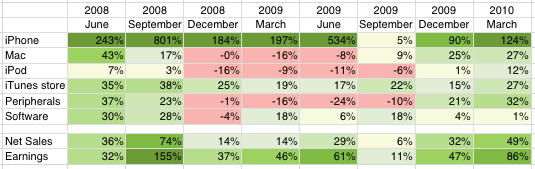
    Apple's growth and its disconnect with valuation has been a common theme on this blog. For another look at this conundrum I present here a table of Apple's year on year sales growth by product line and its top and bottom lines.

    I color coded the values so that a darker green signifies higher growth (and red, negative growth)

    I call this the growth scorecard.

    What does this scorecard say about the previous 24 months?

    • Earnings never grew slower than 30% for any quarter except for one quarter when the comp was ridiculously high at 155% (on the back of iPhone 3G launch).
    • Throughout the recession Apple grew sales.
    • The worst growth performance was on peripherals which is Apple's smallest business
    • The fastest growth was the iPhone, now Apple's largest business.
    • The iTunes store grew sales consistently throughout the previous 24 months.
    • Growth has been positive (green) across all lines for the past two quarters and has been accelerating.

    My estimate for the current (June) quarter is that Net Sales will grow by 47% y/y and Earnings will grow by 60%.

  7. Global smart phone OS shares (part II)

    Research

    On May 5th, I tried to fill in the blanks on Global smart phone OS shares | Asymco. I estimated that the shares for the mobile OS's were as follows (based on Canalys partial data):

    • Symbian (Nokia): 42%
    • Blackberry OS (RIM): 19%
    • iPhone OS (Apple): 16%
    • WinMo (Microsoft): 10%
    • Android (Google): 10%
    • WebOS (Palm): 2%

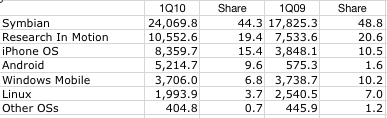
    Now Gartner has published their sell-through estimates:

    • Symbian (Nokia):: 44%
    • Blackberry OS (RIM): 19%
    • iPhone OS (Apple): 15%
    • Android (Google): 10%
    • WinMo (Microsoft): 7%
    • Linux: 4%
    • Other OSs: 1%

    My estimates were within 1 or 2 percent of actuals except for Windows Mobile where I over-estimated by 300 basis points.

    The analysis of Android vs. iPhone market shares (globally and within the US) which depended on this estimation does not change materially.

    The complete data from Gartner follows:

  8. iPhone has 72% of Japanese smartphone market

    Research · 3 comments

    In December I reported iPhone controls 46% of Japanese smartphone market | Asymco.  Five months later Apple's share has reached 72%.

    According the MM Research, 1.7 million iPhone were sold in the fiscal year ended March 31.  That's not a huge number relative to the 110 million subscribers in the country. But Apple's exclusive carrier Softbank has only 22 million subscribers so Apple may have penetrated over 10% of that user base.

  9. Will Apple rule the iPad market? (part II)

    Research · 12 comments

    Continuing from Will Apple rule the iPad market? | Asymco.

    The first claim is that

    it is unclear if [Apple] will end up dominating the market the way it has come to rule the digital music player market with the iPod.

    After hearing a thousand voices cry out that the iPad is nothing more than a bigger iPod touch (which, plainly, it is) it's amusing to read that its similarity with a sibling ends when it comes to market performance.

    Let me make one claim up-front: the iPad is more of an iPod than the iPod.

    The original iPod was successful because it had a significant integrated value chain bolted on. Apple disrupted music with a value chain, not a product. It changed the way music is bought, consumed and even how it is produced. It changed the economics from retail down to songwriting.

    This is why it came to dominate its market. Every competitor that took a run at it did so with a partial solution to the value chain. Often it was nothing more than a music player, and in some cases (e.g. Zune) it was bundled with some other pieces of technology, but poorly executed and too late.

    The iPad comes with an even bigger value chain bolted on: the App Store. Apple is flogging not just an "app player" but also a new way to develop and distribute software. If you cut "music" and paste "apps" you see the immediate parallel between iPod and iPad. The app ecosystem will quickly grow to be larger than the music ecosystem with the mobile software business already eclipsing the music business.

    A competitor launching a tablet device will have to somehow overcome the momentum of billions of downloads fed by hundreds of thousands of apps built by tens of thousands of developers for hundreds of millions of users.

    The iPod juggernaut pales in comparison to the iPad supernova. The iPod had no apps or dedicated developers. Its ecosystem consisted of a handful of music companies. The only thing that made it "sticky" was the tie-in with one type of content.

    The iPad on the other hand has a thousand other jobs to do for its users. It has a rich tapestry of functionality and a multi-dimensional (literally) user experience.  It's a platform. It's even powerful enough to impose new standards on the web itself and to suggest that search is a bygone activity.

    So to suggest that Asus or Dell will somehow build "iPad killers" sounds asinine. These competitors don't even grasp what the product is and what it's for.  Sony said they don't see a market for it. Microsoft, trapped in the innovator's dilemma and overshooting the market by miles, said they don't understand what the point is because users want full PCs.  Google asked what's the value of a big iPod. I could go on, but there was not a single company in the industry who recognized what they were looking at in January. Apple keeps a tight lid on new products so that competitors don't get a head-start on copying, but in the case of the iPad, advance knowledge would not have had any impact. Competitors look at the iPad and see nothing.  They'll only react once the market explodes and they start to feel belated pain.

    If, and it's a big if, they do recognize what an iPad is, their response cycle is going to be measured in years. On hardware, they were blown away with a product that had twice the power, half the bulk, twice the battery life with half the price of what they had on the shelf. They may catch up on hardware in a year or two and launch some sort of iPad-like assembly of components, but that is like making the first iPod killer in 2002.

    Then there is software. Their software supplier (Microsoft of Google) will have to build a platform that works. That will take years. Years during which the iPad will penetrate every geography, demographic and vertical market.

    Google might move more rapidly than Microsoft, but they will produce an open source poster child of a platform. Fragmented and rough around the edges to the point of looking like a hobby project. Their flea market store will also have the smell of fresh glue about it. Microsoft is so far behind the curve that I don't even think they will try to move the tiller.  Their view of the market was betrayed by the recently knifed Courier demoware. To suggest a challenge to the PC/Windows model inside Microsoft is a career-limiting move so don't expect their brightest to be lining up to propose new platforms to management.

    What about HP? Assuming they overcome the pitfall of NIH that kills 80% of integration efforts, they will still need to perform an enormous amount of heavy lifting to get WebOS to be a competitive experience on a tablet. Most opinions were that Palm came pretty close with a smartphone, but that was nowhere near enough to stay alive, never mind challenge iPhone.

    Then there is the ecosystem. Building it is just not something I can even begin to roadmap. What about developer tools, SDKs, frameworks and evangelism? With a Palm division, HP is the best positioned of the PC vendors but it has a chance at being a player as much as Creative did vs. the iPod, or needless to say, Palm vs. the iPhone.

    So the iPad challengers face five daunting obstacles:

    1. Recognition of a threat from a seemingly benign product
    2. Execution on hardware against the best integrator on the planet
    3. Execution on software against a new UI metaphor fortress surrounded by a patent moat
    4. Integration of hardware and software to a sublime whole
    5. Re-building a value chain for which they have no handle vs. a broad and deep existing universe of app/content creation distribution and consumption enjoying logarithmic network effect value.

    That does not even touch the logistics, sourcing, margin and pricing challenges of world-wide distribution of the whole value chain. Nor does it cover the lock-in of advertisers to new tools for creatives or the billions of daily views from a platform that is blindingly dazzling.

    To put it in the language of disruption, by the time the competitors launch symmetric attacks on the iPad, Apple will be the incumbent. And we all know that symmetric attacks never work against entrenched incumbents who have all the levers of power at hand to deploy in a withering counter-attack.