Asymco

Asymmetric Intelligence

Horace Dediu

  1. On Google's Future. Part 1

    Research · 85 comments

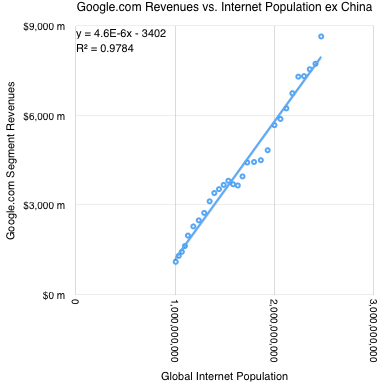
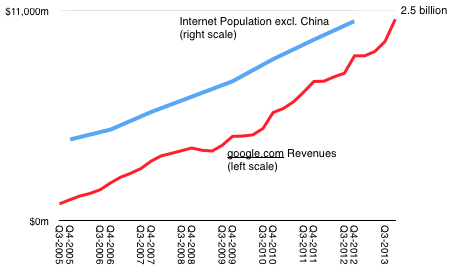
    From 2005 through 2012 Google site revenues ((Google revenues are reported as "Google.com", "Network", "Motorola" and "Other". For this analysis I am including only the Google.com revenues)) have risen at a rate consistent  with the growth in global Internet population excluding China ((Internet population is calculated as a combination of penetration as reported by the ITU and population data from the World Bank)). The Internet population and Google.com revenues for the period 2005-2012 are shown in the following graph.

    Screen Shot 2014-03-13 at 3-13-3.17.02 PM

    The correlation is shown in the following graph:

    Screen Shot 2014-03-13 at 3-13-3.17.21 PM

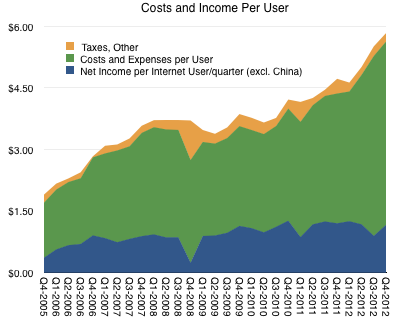
    Taking into account costs and expenses, on a per-user basis profitability per user (assuming all non-Chinese internet users are Google users) is shown below:

    Screen Shot 2014-03-13 at 3-13-3.17.14 PM

    The simple conclusion is that Google earns approximately $1.2 per user per quarter (net income is the blue area above). This figure is relatively constant with a slight increase (~20%) over 3 years.

    If the company does not alter its business model then the future potential of the business could be measured as a function of Internet (ex. China) population growth.

    How hard can that be?

    The next post will answer this question.

  2. Review: Jony Ive by Leander Kahney

    Research · 67 comments

    I don't usually find books about Apple to be quotable. There are certainly some interesting anecdotes and observations but few appeal to the analytical mind. The popular books on Apple have tended to cover what close watchers have already known and are thus compilations with few revelations.

    This is not the case with Leander Kahney's book on Ive. It certainly is the best compilation of detail on product development at Apple during the Ive years (and some time before.) Moreover, it's also filled with choice insights into the process of development.

    This process-orientation is what makes the book stand out for me personally. There are character observations and personality intrigues but they are not the main focus or ambition for the author. Rather, as befits the book's subject, there is an exposition of detail about how things are done. It's not a complete exposition--nor can there be one--but it goes much further than any other Apple book I've read.

    For this reason I found myself tweeting quite a few quotes from the book. Here are some examples:

    “In a company that was born to innovate, the risk is in not innovating. The real risk is to think it is safe to play it safe” - Jony Ive

    “Scott Forstall wasn’t allowed to visit. His badge wouldn’t even open the door.”

    “Design is the fundamental soul of a man-made creation” - Steve Jobs

    "I have seen buildings where, as far as the eye can see, you see machines carving, mostly aluminum."

    "I do not want any of my guys thinking about cost. They should not care…that is not their job”

    “The thing is, you could transplant me and this design group to another place and we wouldn’t work at all”

    "they wanted to give PowerPoint presentations, but Jobs quickly banned them. He saw PowerPoints as rambling and nonsensical”

    The book mostly follows Ive's career with chapters covering most significant episodes chronologically, however there are deep dives into the "how" rather than just the "what" happened. There is a hint of causality rather than correlation between events and outcomes.

    For example, there is a mesmerizing description of the actual Apple design studio even though it has never been depicted in any public photo or video or diagram. There is a great attention paid to manufacturing and materials, as indeed there should be if talking about Apple design (but not necessarily if talking solely about design in general.)

    There is an amazing revelation of the existence of the "ANPP" or the Apple New Product Process. This process directs the "extreme detail [for] every stage of product development". The presence of such a "giant checklist" implies a degree of process and rigor which is in contrast to the "heroic" effort that prevails in popular folklore about how Apple develops its products.

    If there was one disappointment it was that I felt as if half was missing. The half which would tie the dots together and see where they might lead. But that's perhaps too much to ask for what is essentially a biography of an individual rather than a company.

    Nevertheless, for anyone interested in the process of innovation that remains Apple's principal asset, Jony Ive, The Genius Behind Apple's Greatest Products by Leander Kahney is available at the iBookstore.

  3. The billion dollar hobby

    Research · 67 comments

    During the latest shareholder meeting Tim Cook revealed that Apple TV sales were above $1 billion in the last fiscal year (ending September 2013). The company later clarified that this figure includes device and content sales.

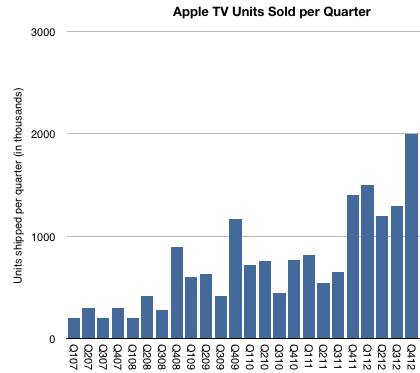
    This poses a problem. In previous statements the company cited device (unit) shipments rather than value. The statements made to date suggested that cumulative volume of 3rd (current) generation Apple TV totaled 6 million units as of January 1, 2013.

    The following graph includes an estimate of quarterly Apple TV sales based on comments made to date.

    Screen Shot 2014-03-02 at 3-2-8.07.43 PM

    As there were no additional comments during 2013, the "Billion Dollar" quote is all we have to go with for the year.  The problem with trying to separate content from hardware is complicated by several factors:

    • How are we to attach content revenues to Apple TV? For example, what if I purchase a series of shows on iTunes or an iPhone and decide to watch them on my Apple TV. Do these purchases count as being "attached" to Apple TV? Do we attach the full transaction value or do we attach the portion that Apple keeps (as in agency accounting)?
    • How does Apple account for channel placement on Apple TV? Do the channels prominently displayed on its user interface pay for this access (even though the user needs a cable subscription?) Is this the primary source of content revenue that is attributed to Apple TV?
    • What about Netflix, YouTube, etc? What is the content licensing deal with these channels? Does the Netflix channel actually cause an Apple TV purchase or does the Apple TV purchase cause a Netflix subscription?
    • Without content, one might think that the $1 billion revenue would yield total device shipments approximately 10 million units in fiscal 2013 (assuming $99 unit pricing). This is not quite right however as Apple's revenue per unit is unlikely to be $99 unless all units are sold through its own retail stores (including online). Sales through other retailers probably allow for some retailer margin so Apple's average selling price will be below $99.
    • Another question is the fiscal year accounting. We have visibility into the fourth quarter of 2012 (about 2 million units est.) so we only need to fill in the first three calendar quarters of 2013 to understand the Billion Dollar volume.
    • Finally, I already estimate separately the overall video market (in my iTunes Business Report) which, based on historic data and other inferences suggests a total video content gross (contributing to iTunes revenues) of $1.8 billion for the fiscal quarter. If a significant portion (50%) of this were allocated to Apple TV it would imply that the hardware business contracted sharply in 2013. Put another way, if I add what we know about C2012 units (6 million and an ASP of $89) to what I estimate video content revenues to have been in 2012 ($1.6 billion) I get a $2.1 billion business. This would be a "two billion dollar" business in 2012.

    All this makes the Billion Dollar Hobby a puzzle. The way I can make it square with existing assumptions is by saying that "Apple TV content revenues" are mostly, if not entirely, distribution revenues from channel placement rather than iTunes purchases. ((This revenue will end up in licensing/other revenues in iTunes/Software/Services segment and separate from Apple TV (which is a part of Accessories).))  As a result, my best guess now is that there were about 7.6 million Apple TVs sold in fiscal 2013, with a bit over 8 million for calendar 2013.

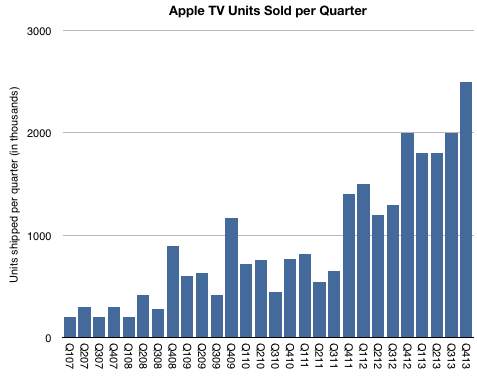
    If I'm right, the complete history of the shipments would be similar to this graph:

    Screen Shot 2014-03-02 at 3-2-9.08.24 PM

    By Apple standards this is indeed a modest story. The total units sold would add up to more than 25 million units with healthy growth. But it would not be in the same magnitude as other iOS devices which have so far sold 800 million units.

    More important than this picture however, or the Billion Dollar Business threshold, would be a better understanding of how Apple sees Apple TV as a business. We already knew that it was a low value hardware business. I even suggested that it's "Apple's equivalent of the Kindle": Hardware sold at low margins as a gateway for a high volume content business (iTunes). The problem with that model is that selling other people's content is never a good margin business. If it were to be sustained, Kindle may ultimately have to become an Amazon Prime salesman.

    So that leaves the Apple TV as a product without a satisfactory business model. Unsatisfactory, at least, to Apple's standards; hence the hobby label. But what if the model is turning out to be a platform for discovery of content and therefore the equivalent of (dare I say it?) a portal! ((Exclamation point.)) The TV UI certainly limits search or traditional browsing interaction but it enables eye candy for a few choice placed offers. It is a low interaction model. Think of how the prevailing UI for TV for decades has been that of pressing one button repeatedly, also known as channel surfing.

    If so , the business of Apple TV may be the auctioning of the real estate on the landing page. In some ways this is how iTunes is already behaving by "featuring" exclusive music content.

    There are all sorts of implications, which I will leave as an exercise to the reader.

  4. Horace Dediu drops in to chat on MWC 2014

    Research · 2 comments

    It’s a good thing Horace Dediu got ready to start our Mobile World Congress #MWC14 tweetchat #IBMMWCChat on 2/24 a few minutes early – because as usual, the dialogue took off fast and went full steam ahead for an hour. Here is our basic topic list (ordering is mine, chat was slightly different)

    • Android Commoditization
    • Nokia,
    • Microsoft and Google
    • The OS, The Platform and the Ecosystem
    • Tizen
    • Wearables
    • Monetize This
    • The Operator Challenge
    • Nest again
    • The odds and endings

    Read Tweet transcript here: Horace Dediu @Asymco drops in to chat on #MWC14 | Electronics industry.

  5. Nokia welcomes Android developers

    Research · 100 comments

    Barcelona, Spain - Today at Mobile World Congress, Nokia unveiled five new affordable handsets including a new family of smartphones debuting on the Nokia X software platform. Based on the Android Open Source Project AOSP, and backed by Nokias deep ties with operators, the Nokia X platform gives AndroidTM developers the chance to tap into, and profit from, a rapidly expanding part of the market.

    via Nokia welcomes Android developers; expands global developer footprint with momentum across Lumia and Asha » Nokia – Press.

    It's worth remembering the distinction between operating systems, platforms and ecosystems.

    Today's announcement is consistent with the declaration of Nokia is engaged in a "war of ecosystems." Note that this is in contrast to "a war of platforms" or a "battle of operating systems" or a "competition of devices."

    Devices are commoditizing, operating systems are commodities and the Android platform is a commodity. Value will not be captured in any of these technology modules. Ecosystems are another matter. It's where Facebook (and its acquisitions) reside. It's where Google lives and it's where iTunes has been for a decade.

    Nokia's adoption of AOSP as an operating system is consistent with the ecosystem strategy set forth three years ago, and is also consistent with Microsoft's competitive strategy.

    Which is why I believe Microsoft is not only comfortable with this development but had agreed to it over a year ago when work on this initiative was already well under way.

  6. Apple's Growth Scorecard

    Research · 88 comments

    Apple revenues grew at the rate of about 6% in Q4, while earnings grew at 5%. These were improvements over Q3 and Q2 but the rate of top line growth is has not been this low since 2009. The bottom line is also slower than it's been for the entire "epoch" or era of the iPhone.

    The components of sales growth are shown in the following table:

    Screen Shot 2014-02-05 at 12.05.10 PM

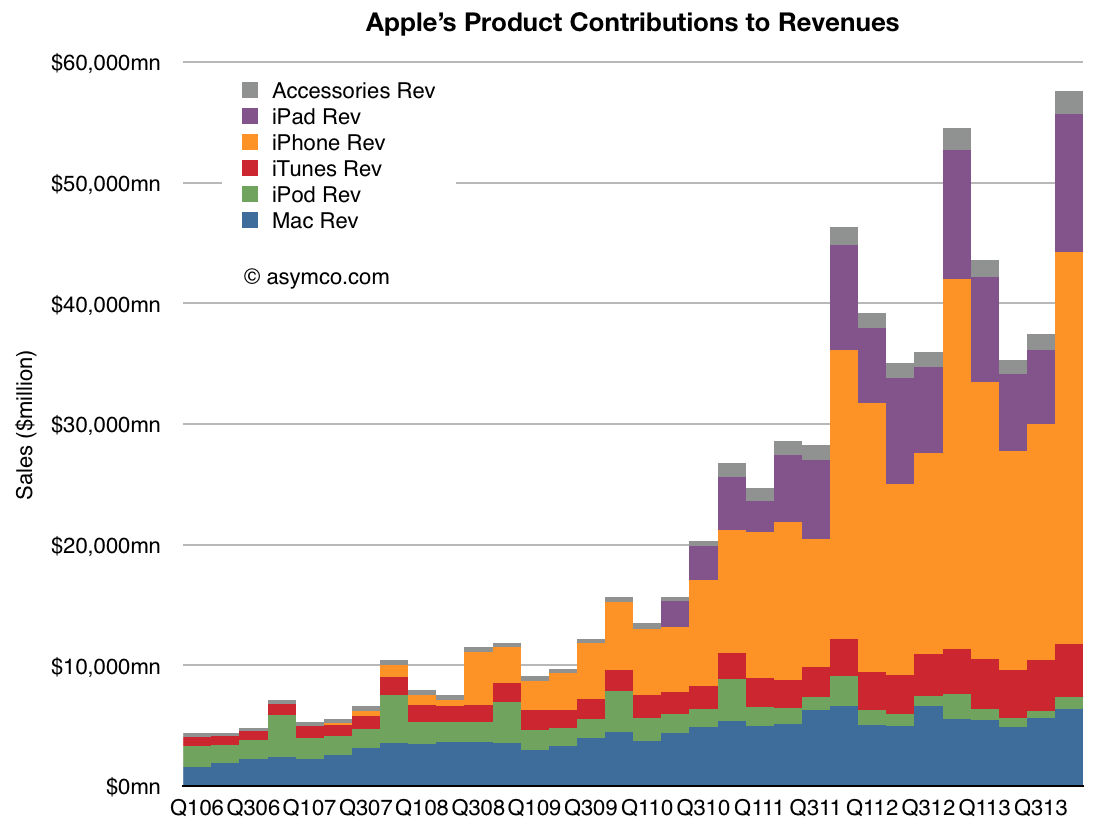
    The company delivered performance inline with its own guidance so there should not have been surprises in the top and bottom lines. However, the disappointment might be in the low growth for iPhone (at 6%) and iPad (at 7%). The Mac and iTunes grew at moderate rates (16% and 19% respectively) while the iPod continued its decline with -55% growth and Accessories remained fairly flat.

    As the graph below shows, the iPhone and iPad are the bulk of the business so their performance is a large part of what is observed.

    Screen Shot 2014-02-05 at 12.31.53 PM

    The speed with which products are introduced and scaled is phenomenal so it is more important than ever to see beyond the trajectory of existing products into the pattern of the introduction of new product categories.

    Markets are effective in anticipating the path of a technology as it ascends into the hands of users, especially if it is destined for ubiquity. But markets are completely incapable of anticipating the emergence of new technologies.

    In this regard markets are a reflection of common sense rather than uncommon wisdom.


  7. Google's three Ps

    Research · 185 comments

    A company is nothing more (and nothing less) than three things: people, processes and purposes. In the language of the software engineer these would be inputs, algorithms and specifications. In the language of classical business analysis they are assets (or resources), organization structures and business models. In military theory, these are logistics, tactics and strategy.

    This is the trinity which allows for an understanding of a complex system: the physical, the operational and the guiding principle. The what, the how and the why.

    When approaching any analysis problem, these questions form the foundation of causal inference. What is it, how does it work and why does it exist?

    When analyzing nature the sciences often help with the what and the how but rarely address the why. ((Religion attempts to answer the whys which science leaves as unanswerable.)) In contrast, man-made systems (e.g. systems of law, religion and commerce) require an answer to the why as there is a presumption of a will in their creation and preservation. The why allows ultimate judgement on the merit of an enterprise. The why may escape us but it's assumed to always be there. For instance, in criminal law the motive is often a crucial piece of evidence but it's not always found. In business, the motive for action or for organization is a crucial piece of the puzzle which often explains the what, who and how, but here the ultimate why is usually profit. This the characteristic of a for-profit business, the purpose is explicit.

    Some companies try to define their purposes beyond profit but they are often too vague or merely speak of values represent a quality not causality.

    This is the case with Google. The problem isn't only that "don't be evil" isn't a priority or a purpose, but also that its resources are not applied to cohesive goals. In fact, there seems to be no interest in pursuing a direction aligned with generating income.

    This is not in itself a bad thing. The notion of operating as a learning (vs. a deliberate) organization, informed but not driven by a goal, is the best approach when seeking new markets or discovering new needs and new business models. The difference with Google is that there seems to be no expectation of business model discovery. In other words, that the learning is not for any purpose other than learning itself.

    This might be noble but learning for its own sake has not been attempted by public, for-profit organizations ((The Bell Labs story in an interesting possible exception but on deeper inspection it was the by-product of a  government sanctioned monopoly and hence a ward of the state)) since there is an implicit fiduciary responsibility to generate profit and unrestricted experimentation, unguided by profit, is unlikely to ever learn the needs of markets.


    The evidence I note supporting this is in the persona the company maintains, both internally and externally. There is no representation of themselves as a "business seeking profit" or even as a commercial entity. It's not simply because their business model is embarrassing. It's because all business models are embarrassing.

    The representation is one of a research laboratory succeeding against difficult problems. Very similar to a successful academic or industrial laboratory sustained by grants from a benevolent (but messy) organization. Google becomes the embodiment of "big science" and "the world's laboratory" unfettered by politics and unsoiled by commercial interests.

    There is a business in Google but it's a very obscure topic. The "business side" of the organization is only mentioned briefly in analyst conference calls and the conversation is not conducted with the same team that faces the public. Even then, analysts who should investigate the link between the business and its persona seem swept away by utopian dreams and look where the company suggests they should be looking (mainly the future.)

    There are almost no discussions of cost structures (e.g. cost of sales, cost of distribution, operations and research), operating models (divisional, functional or otherwise) or of business models. In fact, the company operates only one business model which was an acquisition, reluctantly adopted.

    It's as if the management is not only uninterested in its own profit model but deeply scornful of it. For all the technology innovations the company can claim, it has not had one internally sourced business model innovation.

    But is this wrong? Again, we need to ask if Google breaks with convention then maybe convention needs to be broken. This is the radical bet underlying the Google thesis: are business models necessary? This is in fact a bet many VCs are implicitly placing within the current start-up culture. The notion of making a profit or even having an interest in doing so seems passé. This notion is directly traceable to the Google ethos as it acts as the source of acquisition funding and is driving the agenda of VCs and entrepreneurs. This is leadership by example and the example is one of blissful ignorance of market constraints.

    But we have to go back to the profit model, even if analysts, observers and the company itself sweep it under a rug. The reason is that this laboratory runs only as long as the grant money keeps coming. No bucks, no Buck Rogers. So far the money rains down from heaven, but that rain is not infinite nor permanent. The answer seems to be diversification, even the creation of a conglomerate. In other words, the answer seems to be that if enough great technology is developed or acquired, then a business model will appear (think about it as a probability problem) and the vulnerability of revenue sources is managed. Clever? Convenient? We'll see.

    But that's not the only problem. The deeper problem is in us knowing their intentions. The absence of a purpose rooted in profit makes Google resistant to analysis. There might be a purpose, known only to the founders ((or not known at all)), but it's one that is potentially naive, amoral or too abstract to be useful. Shareholders are aware of this and have agreed to entrust control to only three individuals. The purpose of the organization is in their hands alone and reflects their priorities. Bearing in mind that the road to hell is paved with good intentions, they must be brave indeed.

    This would not be too troubling if the effect would be restricted to the company stakeholders. The trouble lies in that organization also having de-facto control over the online (and hence increasingly offline) lives of more than one billion people. Users, but not customers, of a company whose purpose is undefined. The absence of oversight is one thing, the absence of an understanding of the will of the leadership is quite another. The company becomes an object of faith alone.  Do we believe?
  8. Apple Fourth Quarter Estimates

    Research · 56 comments

    As Philip Elmer-DeWitt is still interested in my estimates I provided the following:

    Revenues ($B) 57.8
    EPS ($) 14 (908m shares)
    iPhone (units) 56.4 million
    iPod (units) 7.6 million
    Mac (units) 4.14 million
    iPad (units) 26.5 million
    iTunes/Software/Services ($) 4.2B
    Accessories ($) 2.2B
    GM% (percentage) 37.1%

    I arrived at these estimates without looking at anyone else's (except for Apple's own published guidance). Soon after sending them I noticed that Daniel Tello published his own.

    In the same format as above, I quote them for comparison. Please visit his post for additional detail.

    Revenues ($B) 59.0
    EPS ($) 14.92 (895m shares)
    iPhone (units) 56 million
    iPod (units) 9 million
    Mac (units) 4.65 million
    iPad (units) 25.5 million
    iTunes/Software/Services ($) 4.3B
    Accessories ($) 1.8B
    GM% (percentage) 37.8%

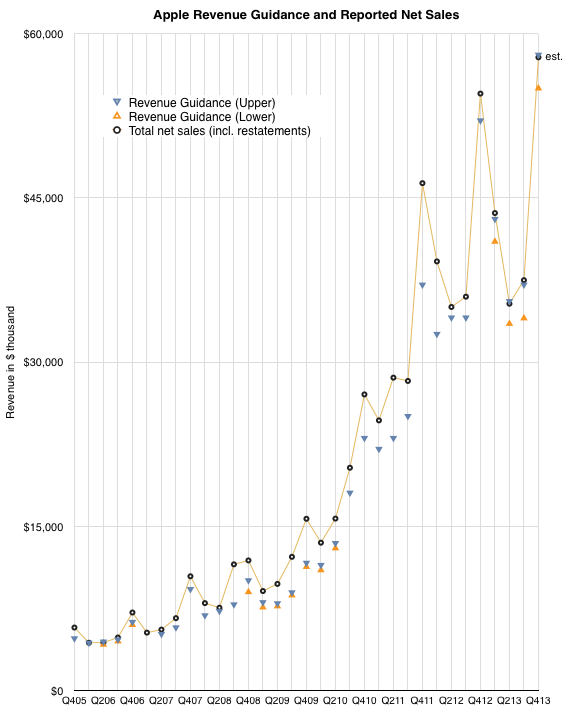
    The graph below shows the history of revenue guidance vs. revenue reported. The last quarter shows my estimate for net sales.

    Screen Shot 2014-01-15 at 1-15-4.06.58 PM

    Note that the company achieved at or slightly above its upper guidance ever since they started offering a range for guidance (i.e. since Q1 2013). My estimate for sales is therefore very near the top of guidance. The figures for units earnings and margins all result from this assumption.