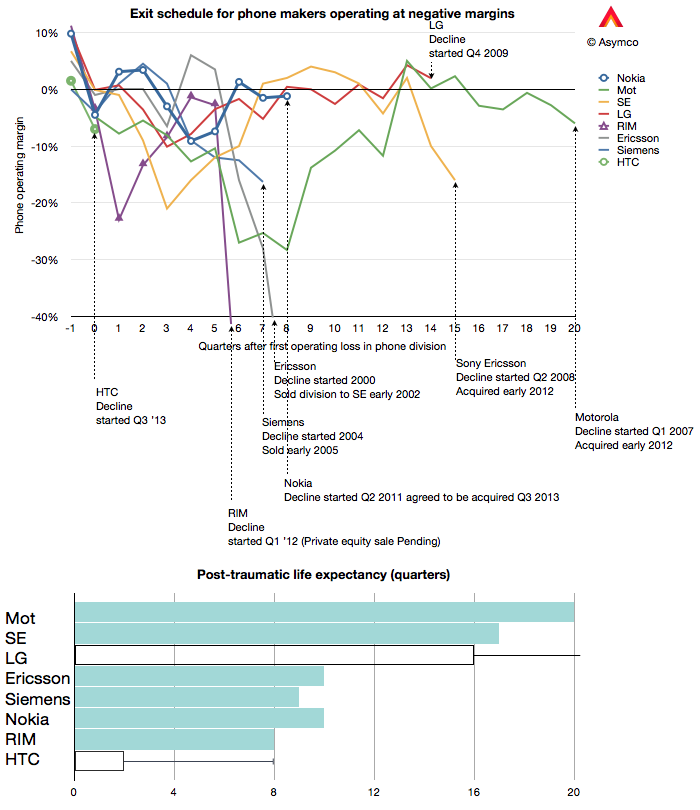
The pattern may be that companies either have short post-trauma lives of about two to three years or relatively long post-trauma lives lasting 4 to 5 years. What determines this life expectancy and how long do RIM, Nokia and LG have?
These comments came right after BlackBerry (then RIM) announced a loss and thus entered what I called the "post-traumatic" phase of its existence. ((The analysis began earlier, in June 2011)) The observation I have been making is that once a company begins to generate negative operating margins from phone sales, that phone business never recovers.
The question then becomes one of gauging how long they have before the business is sold, dissolved or merged. Since that update, both Nokia and RIM have tentatively agreed to be sold. If the sales go through then we can update the graphs as follows:
[Graph note: solid bars in the second graph indicate companies which exited and thus the duration of life post-trauma. Hollow bars indicate the companies have entered post-tramuatic period but have not yet exited. Lines extending from the hollow bars indicate life expectancy henceforth.]
It turns out that Nokia and RIM did indeed have "two to three years" of life left under the same ownership. Two years to be precise. But as Nokia and RIM change hands (and are thus re-classified in the graph above) HTC enters the schedule. ((Note that there are many companies not listed which also exited. I simply did not have data for Palm, Panasonic, NEC, BenQ, Alcatel, Hitachi, Casio, Fujitsu, Handspring or Danger or many other asian brands which are no longer in this business.))
HTC has just confirmed that they have lost profitability for the first time since going public in 2002. As the clock begins running the alarm is now set to a much tighter 2 years. The implication being that HTC will change ownership or control no later than mid 2015.
But there is a post-script to this story. LG, you may note, has not exited phones. In fact, it seems to be recovering nicely. Doesn't that give hope to HTC?
I don't believe it should. The caveat to this short post-tramuatic life expectancy hypothesis is that it applies mostly to companies which derive the bulk of their sales from phones. Companies which are conglomerates or which can offset losses from phones with cash flows from other businesses tend to live longer.
This does not mean however that LG's survival is assured. The factors at work in the phone business place continuing stress on the weakened while favoring the strong only temporarily. The dynamics are nothing like those in consumer electronics or in the computer industries. Reversals of fortunes are breathtaking.
Publicly, Mr. Lazaridis and Mr. Balsillie belittled the iPhone and its shortcomings, including its short battery life, weaker security and initial lack of e-mail. […]
Internally, he had a very different message. “If that thing catches on, we’re competing with a Mac, not a Nokia,” he recalled telling his staff.
The whole article is worth reading, detailing as it does the decision process inside BlackBerry during the painful disruption of its core business.
What struck me most however was how similar their decisions were to those of Nokia at about the same time. Consider:
The engineering priorities placed on optimization around constrained hardware. Although engineers knew how to build the right products, the business priorities caused them to be deployed in the wrong direction.
The delays these misdirected efforts caused. Mobile phones have narrow windows of opportunity but long lead times. A strategic mistake is very costly and most probably impossible to remedy. In the case of BlackBerry, buying QNX came too late while for Nokia the deprecation of Symbian was catastrophically managed.
The feedback loop from network operators which shut down any initiatives for improved user experiences. Your best customers provide all the wrong information when the market is being disrupted. Ignoring them is impossible while complying is a strategic mistake.
The demand from network operators to develop "killers" to competing platform-based products ((Ironically, Nokia was asked to do a BlackBerry killer)) and the subsequent "jumping at the opportunity".
Listening to large buyers at the expense of users. While BlackBerry was guided to omit consumer features from its enterprise buyers, Nokia never secured enterprise buyers of any significance ((though they tried very hard to get them)). Nevertheless it created the "E series" business-friendly phones which suppressed features like cameras and music.
The celebrity sponsorships and wasted promotional efforts in the face of structural failures. This is manifested today by HTC as well.
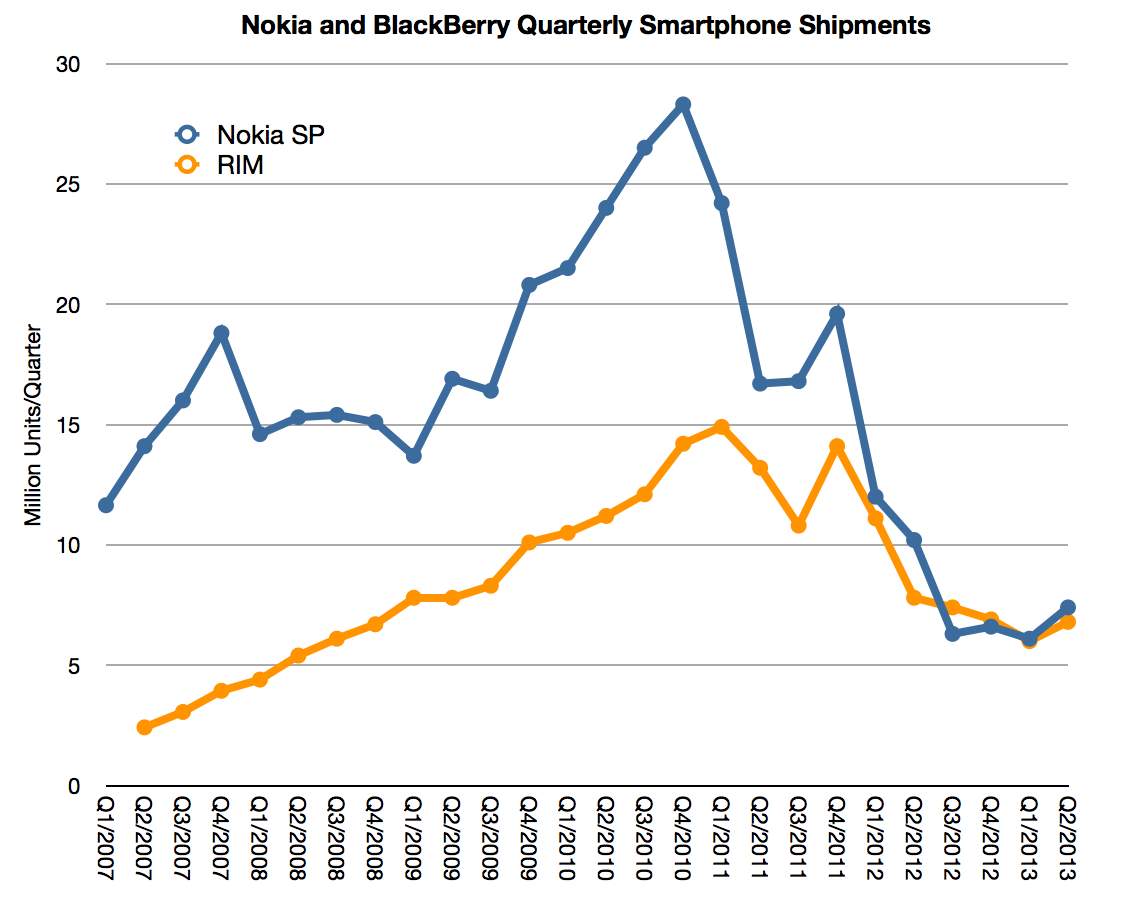
The parallelism of this synchronized failure can be seen in the following graph showing smartphone volumes.
The striking thing is how the two companies peaked are almost precisely the same time and how that moment (end of 2010) was not related to the entry timing of their nominal disruptor.
Recall that both companies cite the iPhone as the factor which caused a shift in the basis of competition. But the iPhone launched in mid 2007 (at the beginning of the graph's date range.) BlackBerry had 16 quarters of growth after the iPhone and Nokia nearly the same. The stock prices of the companies also prospered for a period long after the iPhone entered the scene validating a do-nothing approach. So this is the crux of the incumbent's dilemma: how do you rally a response when you don't feel any pain? It's worse actually: how do you embark on a painful course of action while feeling comfortable and safe?
The reason the companies did not suffer immediately from the iPhone was because it (and its Android equivalents) took time to reach the core customer bases. Remember that the iPhone was not "good enough" to be an enterprise product at launch and Android was not the first to serve the low end of the market, where Nokia was dominant.
Vision is worth exactly nothing without timing.
But enough about ancient history. The crucial question is what does it teach us. It's tempting to suggest that this disruption is happening again with the iPhone today.
There is one big problem with this. The iPhone was not a low-end disruption. It was exactly the opposite. The BlackBerry and the Nokia products were striving for the low end. They observed the discipline of constrained resources. They were expanding into emerging markets. They watched every fraction of a penny on the bill of materials. The low end was manna for the whole industry. Even Microsoft with Windows Mobile was better positioned for the low end than Apple.
Instead, what Apple did was unthinkable. It entered with a high end product. It even promoted its high price ($500, subsidized!) This is why it was laughed at.
Theirs was "the Mac in a phone" idea. The reason it worked was that it was not a phone. The reason it worked is because it was the hardest disruption to spot:
A new market disruption ((The reason Clayton Christensen and his disruption consulting black belts could not spot it is mostly because new market disruption requires deep industry domain knowledge))
Disruption is not a process that merely rewards breaking convention. Any fool can rebel against the status quo. To change it requires a process that rewards asymmetric competition. Finding a way to be seen as irrelevant and yet conquering at the same time. Being disruptive is, above all, being imperceptibly valuable.
For iPhone the core asymmetry was that it was a computing product and not a telecommunications product. Every decision thereafter flowed from the calculus of computing and not the compliance with telco convention. The ecosystem, the rapid rate of improvement, the rich user experience, the tie into other product lines.
It was this asymmetry which confused every observer. Predicting how a high end product can conquer the low end is fiendishly counterintuitive.
In contrast, spotting low end disruption is a parlor game. There is little challenge in observing a cheaper alternative competing as a commodity. For evidence look at how markets react. Whereas they could not understand the value of the iPhone (or iPod or iPad) they reacted instantly to the whiff of a commoditization play. Angst surrounding cheaper alternatives pervades. ((The contrarian should note that commoditization plays are hard bets to win since everybody can spot them.))
The problem with the low end disruption thesis is that low end is also much easier to respond to, especially now that everyone read the book. The incumbent simply needs to have a flexible cost structure and a vast margin to dip into. Most failures to respond to a low end disruption come from companies stuck in a high cost structure not from a failure to see a low end alternative. ((Christensen case studies almost always cite how the low end disruption was perceived easily but the response was felt to be marginally worse than not responding or fleeing upmarket.))
Apple's costs are mostly variable and their fixed (R&D and SG&A) are growing far slower than sales. There are huge margins and more cash being spun out than anyone can figure out what to do with it.
The distressed response to the low end tends to be a retreat into the higher margins and an abandonment of existing customers.
I don't see Apple doing either. Rather, it is gradually adjusting its portfolio toward lower end alternatives. Note that demand for the lower end product is far less than for the high end. Instinct would suggest that they should have stuck with the 5S alone. But it moved down anyway. It also did so with the iPod, iPad and Mac mini.
The idea that Apple is vulnerable to the low end is a relic of an idea. It goes back to the Mac of the 1990s, at a time when the world-wide computing market was orders of magnitude smaller than today and where purchasing and development decisions centralized in the hands of a few large companies ((essentially B2B as Ben Thompson points out)). And even when looking at that competition, the Mac somehow managed to survive.
That's not likely to be the case for those who found themselves in competition with the Mac in its pocketable re-incaration.
Horace discusses AirShow NYC and his appearance on Bloomberg Surveillance, plus opening weekend sales of 9 million iPhone 5s/c units. We look ahead to what else Apple may have in store through sustaining and disruptive innovation.
The most interesting juxtaposition in market data happened this week.
Apple announced 9 million units of the iPhone 5s/c sold in their opening weekend while BlackBerry recognized 3.7 million smartphones sold in the three months ended August 31.
I will state these data points with a different emphasis: while Apple explicitly reported, both in a press release and in an SEC filing, Sales of 9 million units, BlackBerry reported recognition of revenues on 3.7 million units. At the same time BlackBerry also reported sales to end users of 5.9 million units.
So, did Apple sell 9 million iPhones in three days? What about units ordered and not delivered? Which of these units will show up in the company's income statement? Conversely, did BlackBerry sell 3.7 million or did it sell 5.9 million smartphones in three months?
The answer is dependent on what constitutes a sale. I suggest re-reading the Sold and Shipped: A Brief Introduction post from last year. Understanding is complicated by many factors, not least of which could be intentional signaling by management. We may never come to a perfectly matched comparison of the two companies' situations but our job as analysts is to see through the signals and obfuscating language and interpret a pattern. A pattern that extends over a time and helps us learn.
My observation is one of contrast. The juxtaposition this time is that Apple emphasized sold and not shipped while BlackBerry sold more units to end users than it recognized revenue. These signals reflect precisely the inverted fortunes of the two companies.
For BlackBerry the higher sold than shipped recognition was due to a product launch failure. Units which were shipped (and recognized as revenue) last quarter did not sell and the company is not only writing off the inventory but has drastically reduced its deliveries of new units in order to drain inventory. The company explains:
During the second quarter the company recognized hardware revenue on approximately 3.7 million BlackBerry smartphones. Most of the units recognized are BlackBerry 7 devices, in part because certain BlackBerry 10 devices that were shipped in the second quarter of fiscal 2014 will not be recognized until those devices are sold through to end customers. During the quarter, approximately 5.9 million BlackBerry smartphones were sold through to end customers, which included shipments made prior to the second quarter and which reduced the Company's inventory in the channel.
The company is essentially saying that due to the unusual circumstances of a product launch failure, they will change how they account for their business. They don't have the confidence that units shipped will actually sell and will not recognize them since they fear they will have to write some off. They are signaling: They are being far more conservative, not reporting shipments alone because those shipments could essentially be value free.
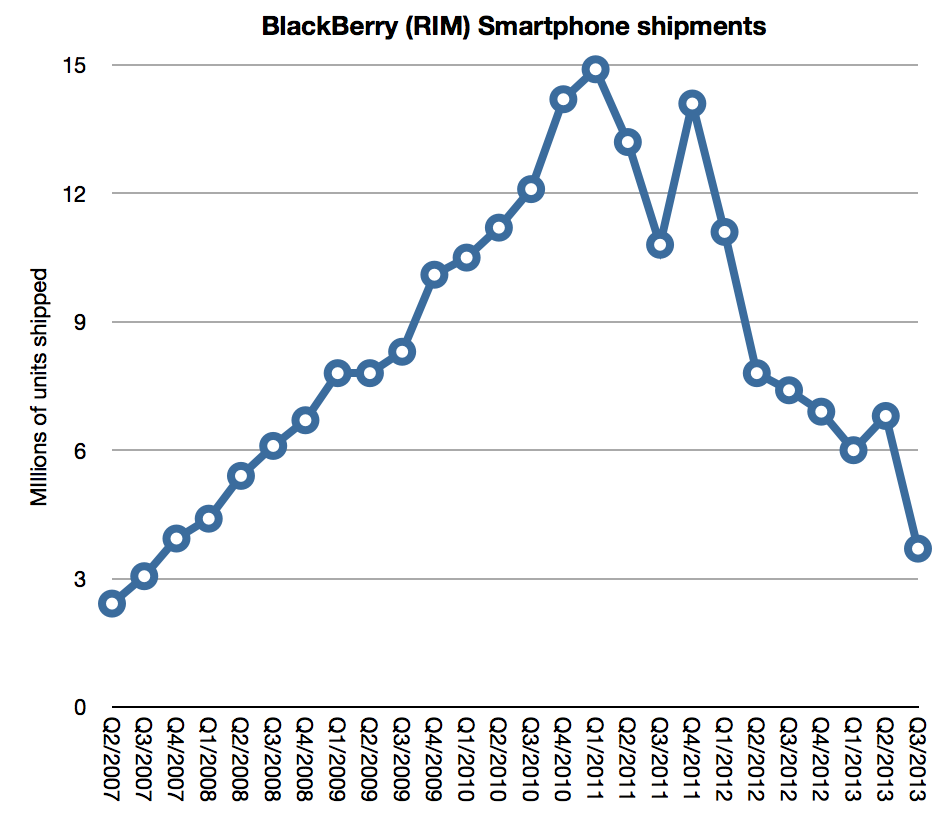
When seen as a pattern, the new figure on recognized revenue units needs to be shown relative to the history of recognized revenue units.
You can see the instability in volume recognition in the graph as a clue. Product launches cause erratic changes in what was previously a seasonally stable business. This is, essentially, the company being thrown onto its back foot. It is staggering from an unexpected blow and resetting expectations.
Now note the contrast with Apple. Apple provides every quarter shipment data on all its products. This is consistent with generally accepted accounting principles and consistent with reporting from other companies. ((Though many, e.g. Samsung, Google, refrain from reporting shipments any shipment data at all.))
Apple also offers "channel inventory" data on select products. This inventory data, when coupled with shipment data, offers insight into how many units are actually purchased by end users. If Apple runs a tight ship then its inventory is relatively low but if it has a reliable customer base that of its channel is also low. Moreover, if it can predict sales well then it avoids overfilling the channel and having to take a hit while draining it.
In that context the way the company reported the 5c/s launch is signaling optimism:
On September 23, 2013, Apple Inc. […] announced that it has sold over nine million new iPhone 5s and iPhone 5c models, just three days after the launch of the new iPhones on September 20.
Apple expects total company revenue for the fourth fiscal quarter to be near the high end of the previously provided range of $34 billion to $37 billion, and expects gross margin to be near the high end of the previously provided range of 36% to 37%.
The SEC filing language above refers to the following press release:
Apple® today announced it has sold a record-breaking nine million new iPhone® 5s and iPhone 5c models, just three days after the launch of the new iPhones on September 20
“This is our best iPhone launch yet―more than nine million new iPhones sold―a new record for first weekend sales,” said Tim Cook, Apple’s CEO. “The demand for the new iPhones has been incredible, and while we’ve sold out of our initial supply of iPhone 5s, stores continue to receive new iPhone shipments regularly. We appreciate everyone’s patience and are working hard to build enough new iPhones for everyone.”
The reporting of sales after a launch weekend has been a staple of Apple's communications about product for a long time. Therefore the evaluation of this performance should be made in comparison with previous launches.
But it's not necessarily a statement of end user purchases. Nor is it a statement purely of shipments. The term "sold" as used in a press release is not an accounting term and it is not something which is meant to be audited.
However, none of that matters. The signal is what should be observed. By deliberately and repeatedly using the word "sold" Apple is expressing confidence that demand for its products is strong. Sure, there is channel inventory in that 9 million unit number but there are also ordered devices which have not been shipped and thus are not counted as sales. There are also depleted store shelves and people angry about not getting their desired phone model. Apple knows this, Tim Cook is making it clear they know this. They have excellent visibility into the distribution of their products. They have excellent inventory management. They are typically conservative in their financial reporting.
So why would anyone interpret Apple's release as a negative signal? If you want an example of a negative signal, look at how BlackBerry reported its launch performance.
When interpretation of a signal is very different from the literal statement, it says more about the interpreter than about the company.
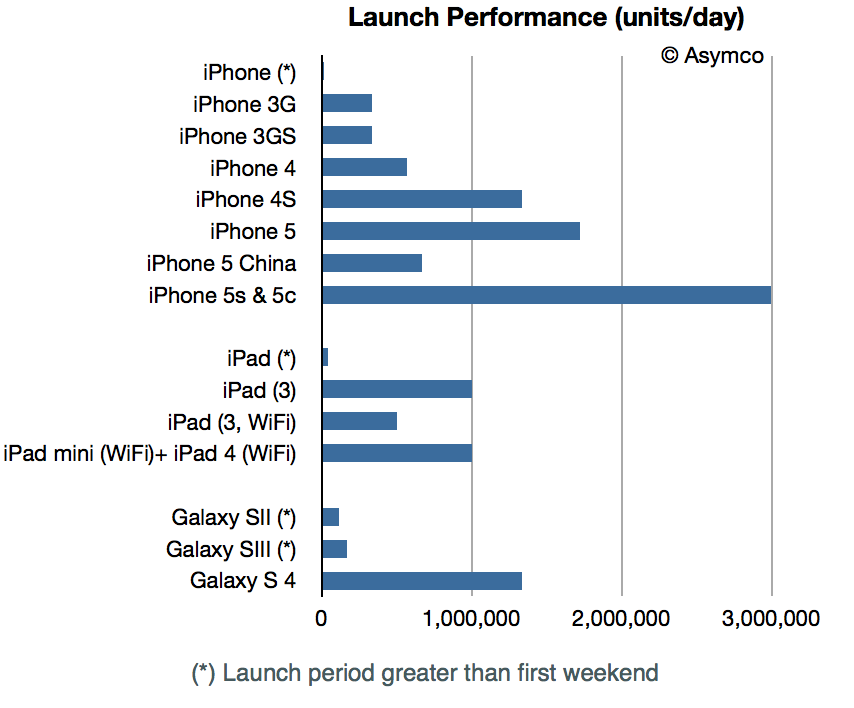
Apple today announced it has sold nine million new iPhone 5s and iPhone 5c models in the first three days after their launch. This performance is illustrated in the following graph:
Note that the data is normalized to units/day.
The launch countries this year differed from last year in that they include all of China whereas last year only Hong Kong was included. ((I am assuming that this year China includes Hong Kong. It would be good to confirm this.))
The absolute number of 5x devices sold (not just shipped) seems to be an 80% increase from the 5 launch (9 million vs. 5) but accounting for China the increase is a more modest 29%. ((The China launch event last year may have had a different dynamic as it occurred later and nearer to holiday season, but I'll go with the unqualified data.))
However, perhaps the more relevant comparison is between different "S" generations of phones.
The data shows that the 3GS was 3x more rapidly purchased on launch than the original iPhone. The 4S was 4x more rapidly purchased on launch than the 3GS and now the latest 5s/c are 2.3x more rapidly purchased than the 4S.
The growth is certainly lower but from a much higher base. This should not be surprising.
UPDATE: Galaxy S 4 launch data is updated to show weekend performance. Previous graph showed performance over the first 27 days.
Horace: Apple is an interesting company to study because its success comes from being a serial disruptor. This is a very rare type of success formula. I am trying to "reverse engineer" its operating model and I hope that such a model is one which others might learn from if they were to emulate it. The trouble is that very few others seem to want to emulate Apple. Why that is is also an interesting question.
Niaz: […] Do you think apple has lost its image that it has created over the years as a center of innovation and building excellent products?
Horace: I cannot comment on how Apple's image is measured by people in the industry. I have been listening to commentary on Apple for about a decade and I have never seen any change in pattern. The company has always been perceived as a failure by a majority of observers. With respect to its products, I also do not see a change in the pattern established over the last decade.
Niaz: Are you optimist about the future success of Apple? Like after 10 years and then 20 years?
Horace: Let me put it this way: if there were no Apple then somebody will have to invent an Apple to do the same thing Apple does. In that sense I'm optimistic that there will be an Apple in some way in perpetuity.
Niaz: What will be the next big innovation from Apple?
Horace: I have no idea but it's likely to involve refining new user interaction methods. Similar to the breakthroughs that came from the use of a mouse, a scroll wheel and a touch screen. It means making computers better at gleaning our intentions without our getting involved in explaining them.
Niaz: Will Apple, Google and Samsung be the major player for the future of computing? Or we can hope to see some new faces?
Horace: I am fairly sure Samsung will not be because they have not yet grafted software and services to their operating structure. I would give Amazon a higher probability in being a successful platform alternative.
Niaz: In 2011 you’ve written a blog post ‘Steve Jobs’ Ultimate Lesson for Companies’ on Harvard Business Review Blog and you have cited ‘A leader should aspire to do more. A leader should claim to have left a legacy not just on their company but on all companies.’ As you know Google, Amazon, Samsung, Facebook … all have learnt lifetime lessons from Steve Jobs. What do you think about the impact that Steve Jobs have created?
Horace: He led by example and like all great leaders sacrificed much as a way to inspire others to follow him. He also spent time in the wilderness and chose asceticism. This gave him authority. Many historical figures had the same quality. The problem is that few business leaders have it but I don't see why they shouldn't.
Much more on evaluating Tim Cook's performance, the iPhone portfolio, the rise of Android, Microsoft/Nokia, wearable technology and disrupting Google. Check it out on eTalks.
Are cars sold or purchased? Horace Dediu and Jim Zellmer discuss automotive “ecosystems” vis-à-vis Apple and Tesla’s direct sales model. We further dive into the rigidity and risk of such value chains and divert a bit into automakers' attempts at aviation. Finally, we consider the potential monetization of automotive metadata and what that might mean for new, perhaps “over the top” style entrants.
Also history lessons: Ford Trimotor, Ford production system, The Kaiser people’s car.
One of the curiosities of the mobile phone market is how vast it is but also how heterogeneous it has always been. I wrote about this in 2010: Smartphone parochialism: How operator policies prevent or promote platform adoption. This observation was influenced by my time at Nokia where I became amazed at how differently users behaved in different countries.
There were many causes. Some cultural, some historical, some economic and some policy-driven. The result was that it presented a challenge to any company with global ambitions and indeed it was rare to see the same company do well in every market. Japanese companies did well in Japan, European companies did well in Europe and US (and Korean) companies did well in the US. Nokia was most successful because it was able to apply an European model more broadly (but not in the US). Samsung succeeded by simply adapting to each and every market with hundreds of products. But it was a particularly "provincial" market.
My assumption was that when smartphones would become the majority of phones in use there would be a normalization of behavior and thus a homogeneity of preferences. This is, after all, what happened in other platform games. PC form factors are globally consistent, PC operating systems are equally preferred around the world, FaceBook, Google and Twitter are also, unless censored, uniformly popular. Apple's iPod eventually also became a global phenomenon with no material difference in preference by market. Likewise for game consoles. ((Although Japanese do seem to prefer Japanese platforms more.))
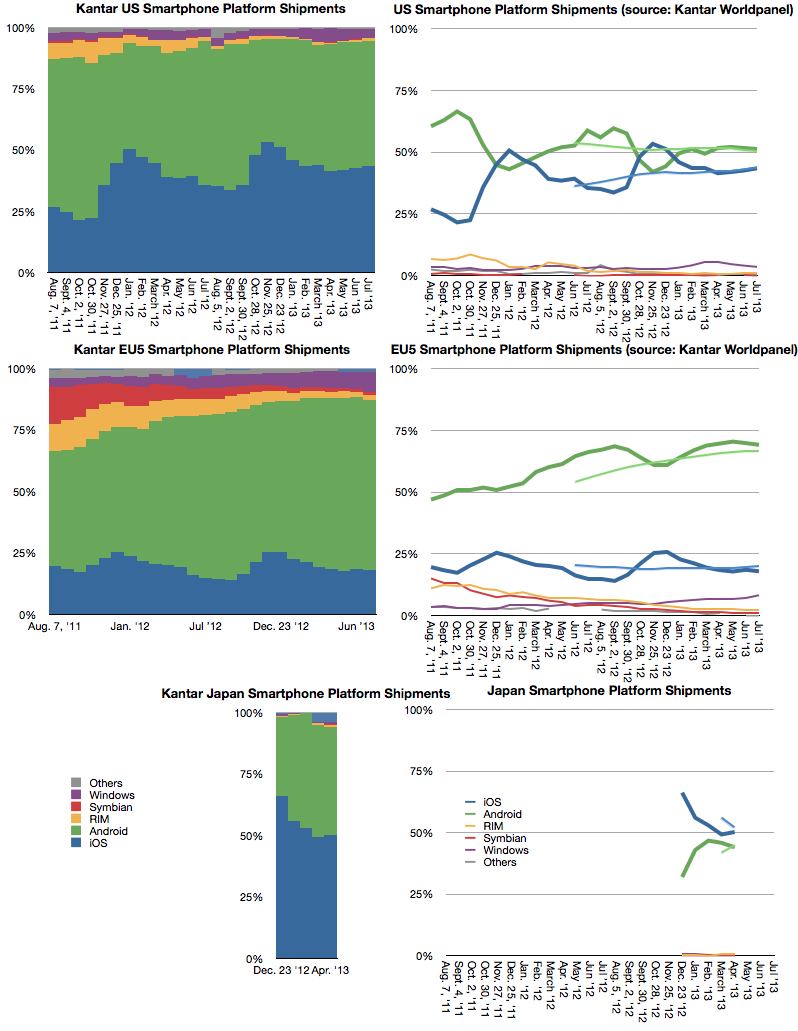
However, a decade after the broad adoption of smartphones, the relative popularity of various platforms is still unevenly distributed. Prior to the iPhone, Symbian was strong everywhere but the US and BlackBerry was very strong in the US but weak elsewhere. Windows Mobile had footholds in some markets but little traction in others. Today the picture has changed but it's still a patchwork of preferences. Consider the following graphs.
They are the most detailed sets of data on platform phone purchases but they not the only data: We also know that Android is vastly more popular in India from web usage statistics. We know that BlackBerry is sensationally popular in Latin America and the Middle East. We know that within Europe there is a gap between North and South in iOS vs. Android and even more pronounced between East and West. We know that whereas iPhone was a huge hit in Korea upon its launch there, Samsung and LG swamped it in the last two years.
But the data shown above is the story of iOS being very popular in Japan and increasing its share in the US while being flat in EU5. Again these three markets are different but each contradicts the global picture.
Note the differences in trend not just absolute performance. This is what is puzzling. There seems to be a divergence between markets: Markets are become more islands onto themselves rather than one whole. This contradicts all the theories of how computing markets should behave (network effects, ecosystems, monopoly power, etc.) It implies that there is still a great deal of friction in the market; friction which I suspect to be due to the peculiar nature of telecom economics.
I wonder if this observation is, as usual, late on my part and that Apple's iPhone product marketing has seen it years ago.
My thanks to Eric Jackson for his thoughtful questions and post on Forbes.com. You can read full interview here but I repeat a few non-biographical questions and answers here for discussion:
Q: Turning to Apple, where is it at right now as a company in this post-Steve Jobs period?
A: Still too early to tell. They seem to be cooking a lot of things and the great experiment of whether a company can be Jobsian without Jobs is still going on. I have been trying to put together a picture of how it operates. It’s hard because that’s their biggest secret. It’s also a picture that few people have ever seen, even those who worked there a long time. The glimpses so far are tantalizing but there is so much we don’t know and thus can’t assess how robust it is. One thing that is clear to me is that there is no absorption by mainstream observers of what makes Apple tick. It’s hiding in plain sight because what it is isn’t anything anyone can recognize. Case in point is the functional and integrated dimensions. It’s the largest functional organization outside the US Army and more integrated than Henry Ford’s production system. Just describing it sounds medieval and it’s so far outside convention that it’s not something reasonable people are willing to believe actually exists.
Q: Is Tim Cook the right CEO for the company at this time?
A: I hold the belief that he’s been CEO for much longer than it seems. Jobs was not a CEO in any traditional sense. He was head of product and culture and all-around micromanager. He left the operational side of the company to Cook who actually built it into a colossus. Think along the lines of the pairing of Howard Hughes and Frank William Gay. What people look for in Cook is the qualities that Jobs had but those qualities and duties are now dispersed among a large team. The question isn’t whether Cook can be the “Chief Magical Officer” but rather whether the functional team that’s around Cook can do the things Jobs used to do.
Look at it another way: I subscribe to the idea that any sufficiently large company is a system and needs to be analyzed using a lost art called “Systems Analysis”. This is a complete review of all parts and the way they inter-relate. However, since for most of its life Apple was personified as an individual, what came to pass for Apple analysis was actually the psychoanalysis of that individual. It makes for great journalism and best selling books. It’s also banal and almost certainly wrong. The proof is in the vastness of complexity and number of people involved. Engineers tend to think about constraints and the constraints on companies are innumerable.
Q: You’ve written extensively on the post-PC period, when will we come to the post-phone period – if ever?
A: I think less than 10 years. Maybe even five. A wristband today can have more processing power than the original iPhone. An iPhone has more power than a desktop did 4 years ago. The speed of change is incredible.
Q: What’s going to be the “next big thing” for Apple? Watches, TVs, something else?
A: I segment along “jobs to be done” which are basically unstated and unmet needs. Unstated because they are usually so deep and so pervasive that they’re taken for granted. We have the need to feel good about our lives, to be healthy and to be connected in meaningful ways to others. These jobs are very poorly served by technology today and there are many non-technology products that are hired as poor proxies to help. The speed with which technology changes means that the trajectory of improvement will undoubtedly intersect that of the job. Even a small job like losing weight and eating well is probably worth as much as half the mobile phone market. Imagine if someone gives us a magic tool that does that for us. How much would you pay? How many of us would pay? There are so many next big things that I cannot choose. (By the way think of the job Facebook is hired to do: make me feel good about myself because I can show others how good I am. Boom!)
Q: What’s your take on how they’re handling their expansion into China, India, and other emerging markets?
A: It’s depressing how slow things are moving on that front. We can draw lines on a graph but we don’t know the constraints. Again, the issue with adoption is that the timing is so damn hard. I was expecting smartphones to take off in mid 2004 and was disappointed over and over again. And then suddenly a catalyst took hold and the adoption skyrocketed. Cook calls this “cracking the nut”. I don’t know what they can do to move faster but I suspect it has to do with placement (distribution) and with networks which both depend on (corrupt) entities.
Q: As you look at the rest of the mobile internet competitive landscape, do you expect any big surprises from other players (good or bad) in the next 5 years?
A: The big question in my mind is the sustainability of the arbitrage models which underpin pretty much every internet business plan. Essentially we have two markets: one where everybody consumes but pays in metadata and another where everybody consumes aggregated analytics but pays in cash. An internet business is the arbitrageur who takes advantage of the inability of each market to price the other. History shows that arbitrage markets tend not be stable as information begins to leak across markets. Therefore what would blow the internet up is if consumers could become wiser about what they are giving up and advertisers would become wiser about aggregating consumer data. I imagine a system where each individual would allow bids on their consumption and a market mechanism where bidders competed for that data. This of course depends on users taking control and ownership of their own data. What might help is the realization of what mass state surveillance can do and the realization that internet giants have more information about us than the government could ever hope to possess.
It would create a new era which will have political dimensions. I imagine we’ll need an internet citizen’s bill of rights or some such movement which will reset expectations. Economically, could bode well for those who position themselves as protectors of the individuals and be a crisis for those who take advantage of consumer ignorance.
Product, Promotion, Price, Positioning and Placement: The iPhone at seven. The 5C as a new product and the prospect for price reduction. The positioning of the 5S and the potential for the M series and Touch ID.