Jim Zellmer and I were having fun talking about cars and thought why not record our conversations and put them up for others to listen. That's how Asymcar got started.
Besides having fun, what we plan to do is use the auto industry as a lens to understand how disruption works. Whereas Asymco is a narrative on an industry that is dynamic because of disruption, we hope to make Asymcar a narrative on an industry that isn't dynamic because of a lack of disruption. A sort of foil to Asymco (or maybe an Asymco Bizarro.)
The approach is to use stories that everyone can understand whether you care about cars or not. The inspiration was the TV program Top Gear which satirizes the adolescence of the male mind, and thus appeals to all. With Asymcar we hope to bring a rich set of new metaphors to describe similarly curious phenomena.
Anders Brownworth and I got together on a Perspective airshow and recorded our conversation about Apple's performance this quarter. We packaged it as a downloadable Padcast which you can listen to while looking at the motion graphics. After listening you can peruse the graphs and estimates at your leisure.
Requires an iPad of relatively recent vintage, the Perspective App and $19.99.
Nokia's Windows (Smart)Phone performance was drowned out last week by Microsoft's big announcement of the Surface inventory write-off. They are pieces of the same puzzle however.
First, a look at Nokia.
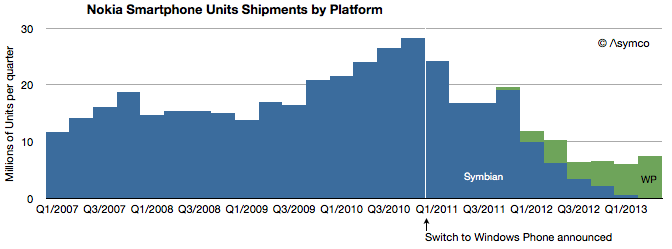
There were 7.4 million Lumia phones sold in Q2 with 0.5 million sold in the US. Although Windows Phones grew sequentially from 5.6 million the previous quarter, and up from 4.0 million in the same quarter last year, total smartphones are down y/y and nearly flat over the last four quarters. This is of course because Symbian phones have finally disappeared from volume shipments. The following graph shows the history of Nokia's smartphone shipments.
Although it's tempting to compare Lumia to iPhone (given the premium positioning in the US) the average price of €157 or $206 shows that Lumia is more adequately compared to Android. This is about a third of what Apple gets for its iPhones.
That's not necessarily a bad thing. Nokia's always had a knack for mass-market phones and certainly that was one reason Microsoft was attracted to them. Presumably, the promise of the relationship was to insert Windows Phone into the Nokia development and distribution pipeline, squeezing out costs and filling up channels.
The problem for the brand has been that although priced at Android levels, volumes are nowhere near and the gap is widening. At current activation rates, Android is selling 16.5x faster than Windows Phone (assuming 90% of Windows Phones are Lumia).
So Nokia's problems become Microsoft's problems. As bad as Nokia seems to be doing with Lumia, it's doing a lot better than Microsoft with hardware. Here the story of the great Surface write-off should give pause. Microsoft announced that it would write off $900 million of Surface. In terms of write-offs this is pretty significant. Compare it with the debacle of the PlayBook write-off when BlackBerry (then known as RIM) wrote off $485 million for tablets it could not sell. Or with Microsoft's own write-off for the Kin which took $240 million out of its shareholder's pockets. The only charge for hardware that I found higher was Microsoft's own Xbox 360 which cost it $1 billion for the "red ring of death".
But this is not an unusual situation at Microsoft. Besides Xbox, Kin and Surface, Microsoft also declared victory in (read: shut down) SPOT watches, the Smart Display, Tablet PCs and the Zune. This is why when I heard about the Surface I asked who would be Microsoft's Tim Cook.
By the way, $900 million write-off could amount to over 3 million devices, more if Microsoft is assuming some residual value in the inventory. Misjudging demand to such a degree that more units are disposed of than sold implies a basic failure of understanding of hardware businesses.
Which brings up the question of what Microsoft will do. They are likely to double down on hardware (also signaled by their re-org) simply because in a device world (read: post-PC) the economics of licensing Windows and Office are evaporating. The price points of EULAs simply don't hold and there are good enough alternatives in use by the hundreds of millions of iOS and Android devices out there already. By withholding Office from iOS and Android, Microsoft has shown a billion people that they can live without it and they already knew they could live without Windows.
So rather than fight, Microsoft chose to switch. Switching from software to hardware, however, is proving very hard. I'm sure quite a bit harder than management thought.
High Density is an interview show where we try to articulate what it means to be great. My guests offer observations and insights into the transformation of business and society through technology.
Episode 2: Tim Bajarin
Tim recalls the beginning, middle and end of the PC industry and we discuss the causes of each.
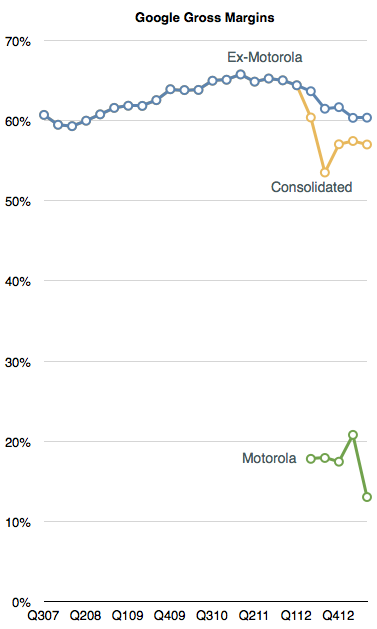
Excluding Motorola, Google's gross margins have dropped for six out of the last nine quarters. They peaked at 65.8% in early 2011 but have now dropped to 60.4%. Including the drag from Motorola they are down to 57%.
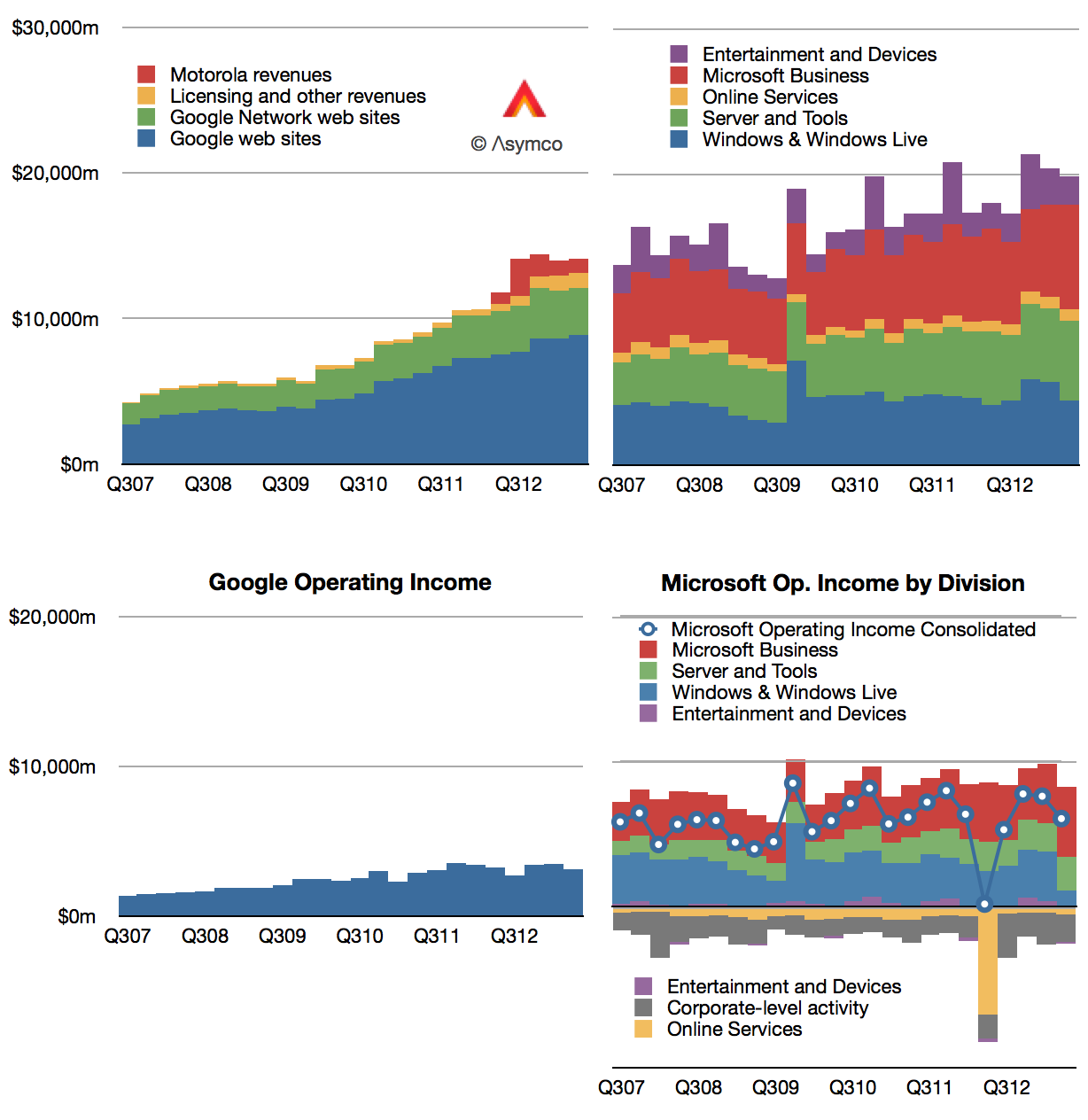
Gross margins include the effect of price, volume and direct costs of sales. Although sales have grown (see graph below), the pricing Google has been able to obtain (CPC) has fallen. The cause is unknown but there is a strong correlation between the growth in their mobile channel. For their part, management cites mobile as having an effect in reducing CPC though they caution that it's one of many factors.
The elephant in the room is indeed the effect of 900 million activated Android devices (with 1.5 million added each day.) These nominal billion devices are a new channel that could be said to have doubled Google's addressable market in only the last three years. The effect of this doubling is perhaps partly underlying the top line growth shown above.
How can we test this?
I placed Google's performance alongside Microsoft's for a reason. Since Microsoft has had precisely zero benefit from any new mobile channels, and since its software is broadly tied to business spending (as is Google's), we can consider Microsoft as a control in what baseline non-mobile growth could be. From Q2 2010 to the present (the Android epoch), Microsoft's consolidated revenues grew by 24% (31% if we exclude Windows). In contrast, Google's advertising revenues (excluding Motorola and licensing) have increased by a more robust 83%.
So it's possible that mobile contributed to top line growth. The effect could be 50% over three years. The downside is of course that this comes from a doubling of the channel. The new channel is therefore half as engaging. In terms for bottom line, the effect would be seen as more subdued growth. Overall, income increased 32% for a nominal doubling of usage.
Not that there's anything wrong with that.
Expansion of user base usually comes with lower engagement and margins. I demonstrated the same effect with the vast expansion of iTunes customers.
The only difference seems to be that markets reward Google's margin dilution but punish Apple's.
Put another way, hypothetically, as she spends slightly less, the market value for an Apple user is disappearing while as he spends a lot less, the value placed on a Google user is increasing.
As Intel has improved its products, their demand has decreased. Enormous efforts put into improvements are neither valued nor absorbed. The problem is not with the processors themselves but with the systems within which they are built:
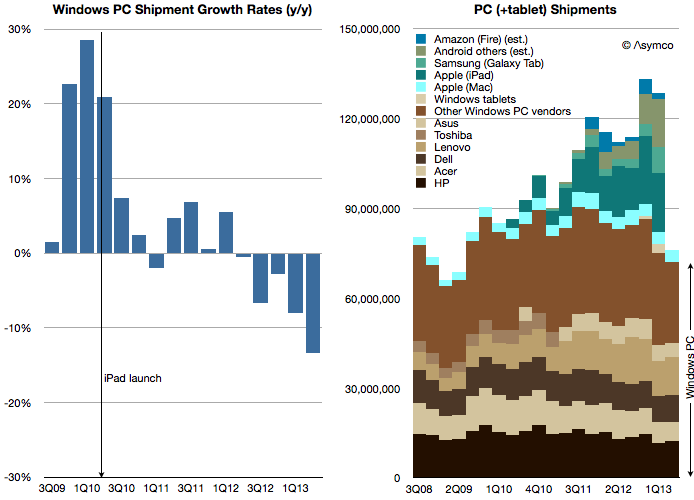
PC sales fell again last quarter and the contraction is likely to continue. We received affirmation of this as Intel cut sales and earnings forecasts and the crucial capital spending that creates supply in the longer term.[1]
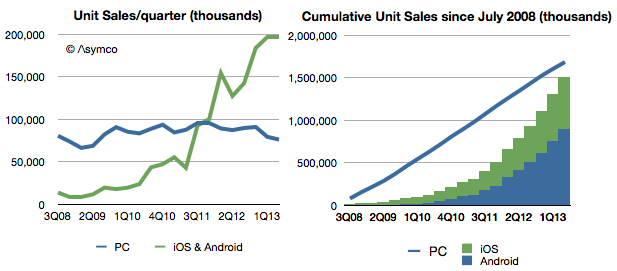
At the same time, computing device sales have soared.
Even excluding Android devices which don't register with Google's Play Store (and excluding Windows Phone devices), mobile ARM devices are selling at 2.6 times the rate of Intel-powered devices. Put another way, since the birth of Android nearly as many iOS and Android devices have been sold as PCs.
In terms of install base, a computing category that did not exist six years ago has come to overtake one that has been around for 38 years.
The calamity for Intel has been that they have had no part to play in the new category. Perhaps that is because they had every part to play in the old category.
--
Notes:
Intel said it was cutting 2013 capital spending to $11 billion. The cut follows a reduction from $13 billion to $12 billion in April. Apple's budgeted capital spending for fiscal 2013 (ending September) was set at $10 billion.
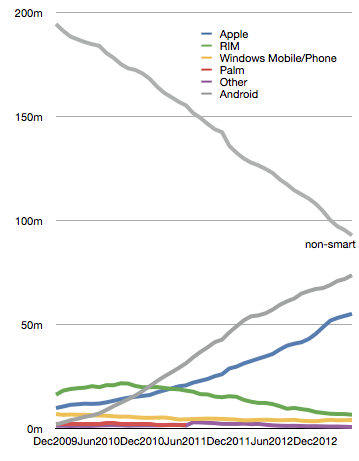
According to the latest comScore survey data, 98 million Americans above the age of 13 don't use a smartphone as their primary phone. That's 41% of US mobile phone users.
What's more, 2.5 million more people first started using smartphones in the three month period ending May vs. the three month period ending in April.
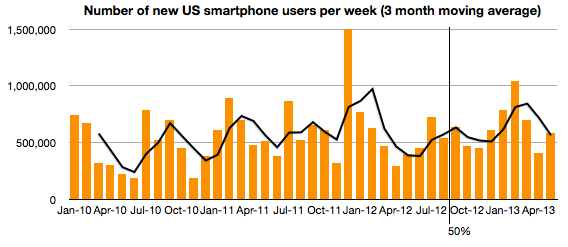
The switching rate to smartphones is shown below:
It shows the number of new-to-smartphone users who switched every week. It can be considered the "speed of adoption". The latest figure is 583k/week, above the 572k/week average maintained over the last 41 months.
[I also added a three period moving average which shows a seasonal change in adoption. I also added a vertical line showing the point when 50% penetration was reached (August 2012).]
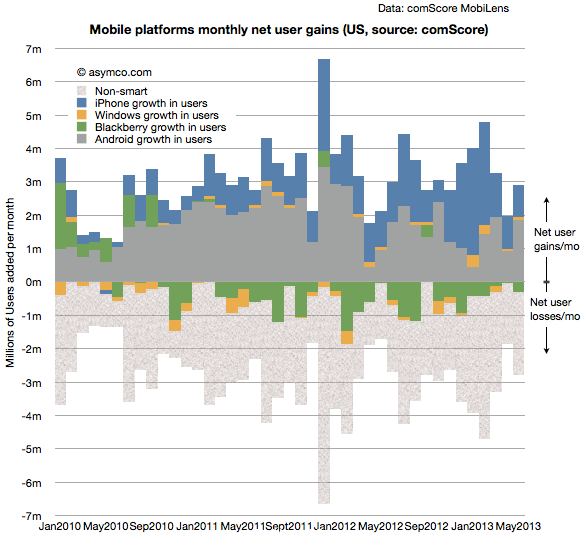
The switching rate by platform is shown in the following graph:
The data shows that churn between platforms (except for BlackBerry) is still negligible and that the majority of user losses can be attributed to non-smart devices.
To summarize, with penetration now at about 60% in the US, the rate of adoption of smartphones is not slowing in any perceptible way.
So not only is there no saturation, but there is no slowing of adoption of smartphones in the US, the most penetrated large market.
Globally, the penetration of smartphones is less than half of that in the US. About 4 billion people are about to switch.
Of course, they may not be willing to switch to what is currently offered to them in the market, but then again, the billion or so who adopted iOS and Android phones did not switch when the alternatives were BlackBerries, Palm, Symbian and Windows Mobile devices.
Horace talks about Microsofts reorganization from Divisional to Functional, and the implications on their Windows and Mobile OS roadmaps. In doing so, he and Moisés touch briefly on the subject of last episode, Scott Forstalls ouster from Apple.
Apple has hired a new VP who will report directly to Tim Cook. Paul Deneve is cited as having responsibility for "special projects" and will report directly to Tim Cook.
The previous roles as a manager in luxury brand companies has led to a great deal of speculation about what new projects Apple could be working on that might also fit this new manager's background and title.
The most commonly cited speculation is around the iWatch or TV product lines (with some surprised that he will not be heading Retail.)
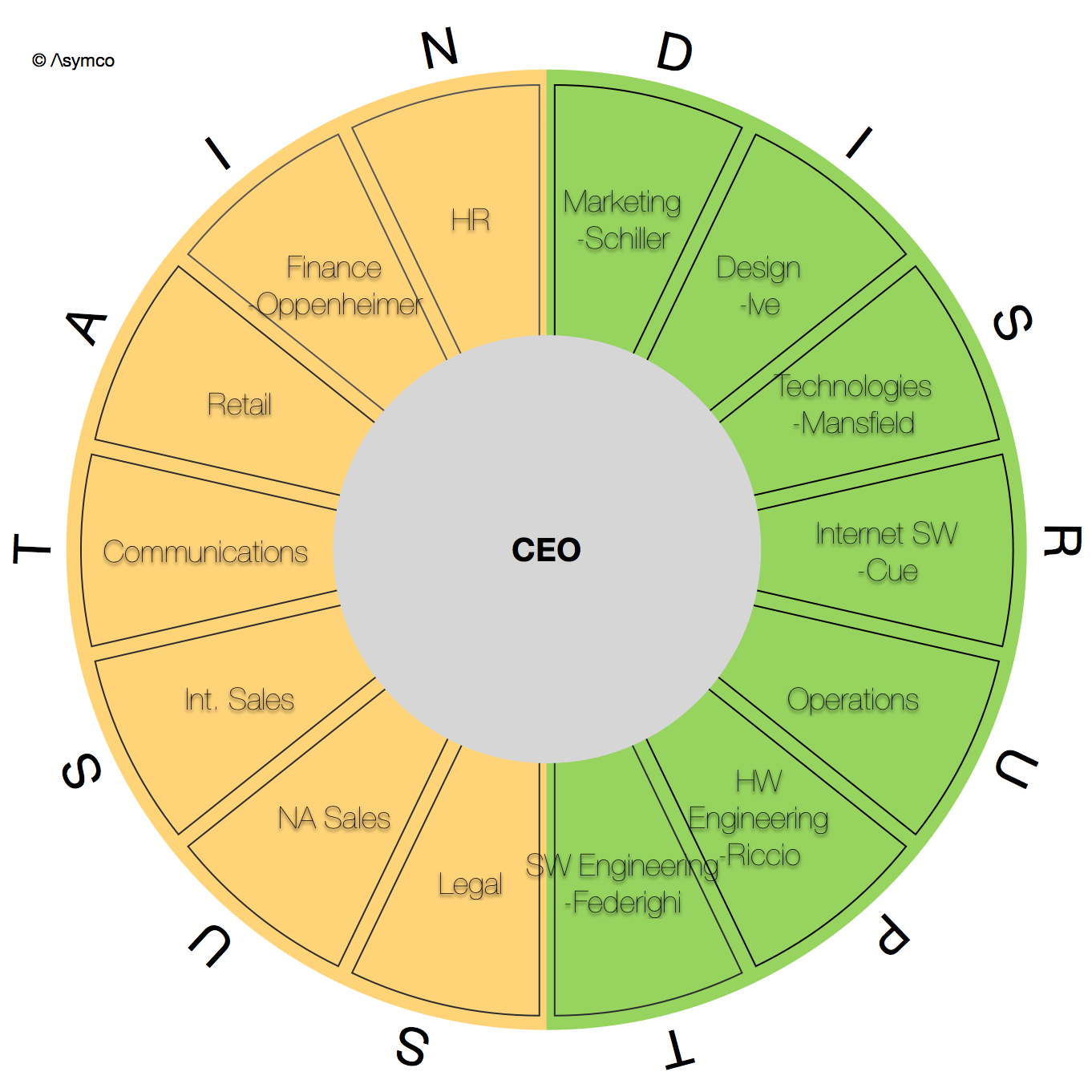
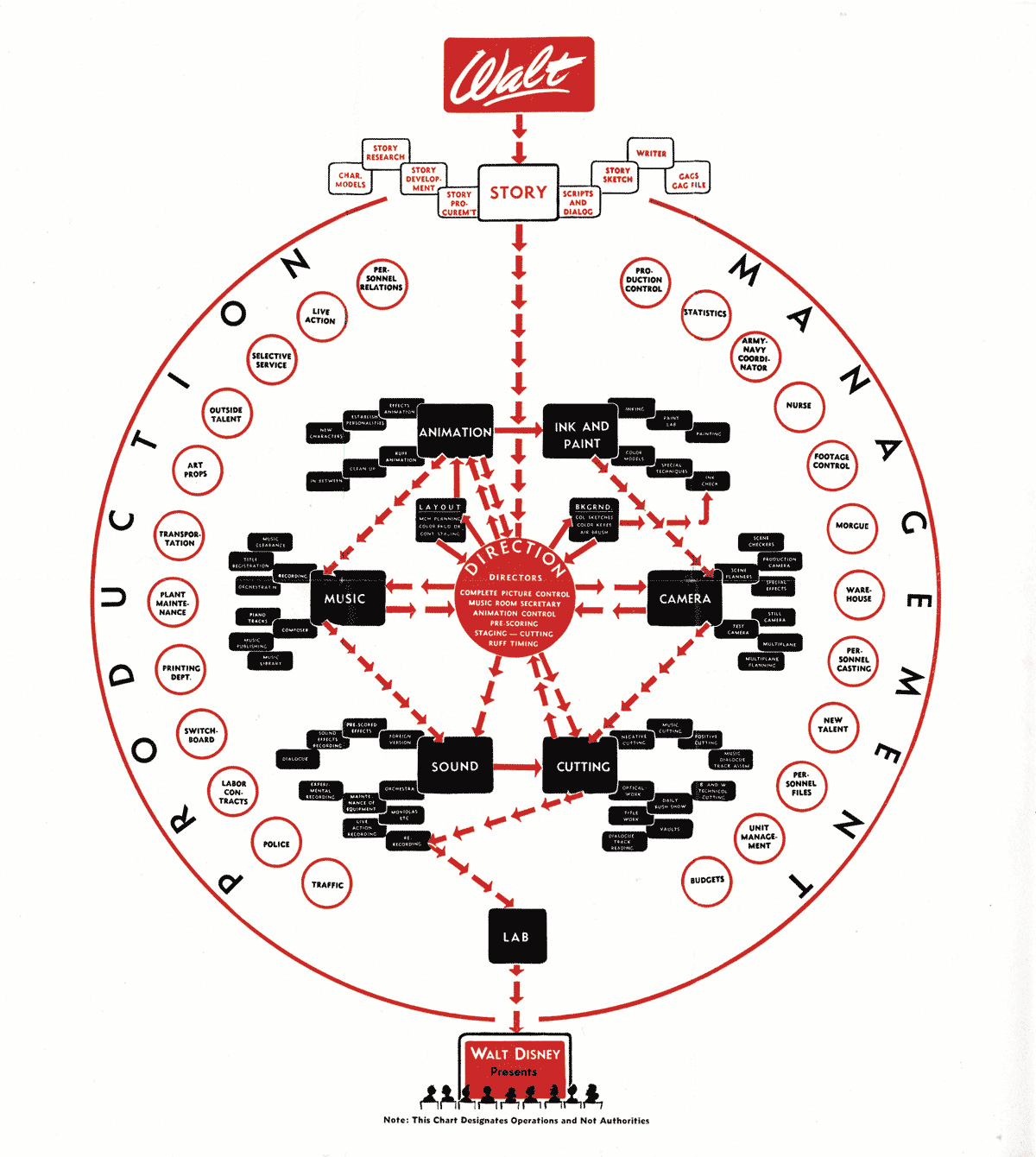
Although reading "luxury product CEO" and concluding "new luxury products" seems logical, a little knowledge about how Apple is organized dispels this notion. And a little knowledge happens to be about all we have, as Apple's organization is one of its most closely guarded secrets. Even employees at Apple have little idea of how the company is organized. What we do know is summarized into this org chart:
I've taken the liberty of splitting Tim Cook's direct reports into "Disruptive" and "Sustaining" functions—which I admit is a bit cheeky—but the point is to separate the product creation functions from the management and administrative functions of the organization[2].
When seen in this light, the first observation is that there is no "product business" ownership. Schiller's Marketing function includes product marketing by product line, but these are not business ownership roles (product marketing mostly deals with how products are positioned, promoted, priced, etc.)
There is no "head of devices" or "head of iPhone". Put more plainly, there is no organizational consistency with how the company reports its financial performance.
So it would make little sense to add a new direct report to this chart that did have a specific product ownership (or creation) role. Product is a "horizontal" responsibility for which every function is partially responsible.
In lieu of this, my reading of the chart shows another function for which there seems to be no leader: brand. Brand management is a crucial function in consumer-facing companies, and many brands-oriented companies orient their organizations (and power) around brand mangers.
In years gone by I would have said that Brand management was Steve Jobs' direct responsibility. Today I would say that it's something that needs a direct manager. This is something for which Paul Deneve might be well suited.
---
Notes:
The last chart published on this topic is from 2011.
Horace expands on last episode's discussion of organizational structure, as well as his recent appearance on Screen Time with Guy English. We begin speculation on the job iWatch would be hired to do, and preview the relaunch of High Density.
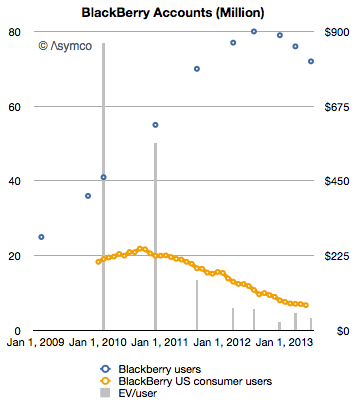
Last week BlackBerry announced that it had 72 million subscriber accounts. The current market capitalization is $5.4 billion and enterprise value (i.e. excluding net cash) is about $2.8 billion.
That implies a net present value of about $40 for each account. This is quite a drop from early 2010 when the value was $866.
The graph of BlackBerry subscriber accounts and EV/account is shown below:
I've also added a graph showing a derived value of US consumer BlackBerry users (derived from comScore's survey data).
There are several patterns which intrigue me:
First, the peak in US consumption seems to have happened about two years prior to global peak (lending credence to the notion that the US is a smartphone market "crucible".)
Second, that the collapse in value per user occurred in advance to the peak in users. This is, of course, linked to other user base leading indicators such as device sales momentum. But the drop indicates that there was no perceived value in the BlackBerry install base to begin with. As devices went, so did the company.
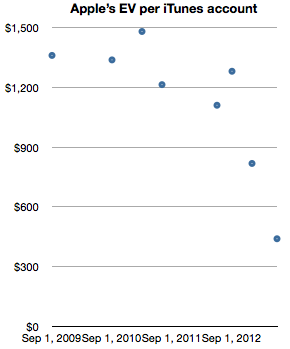
Third, this same lack of perceived value seems to be present within the Apple ecosystem (see below), where user value was cut to a third within a few months
.
In the case of RIM/BlackBerry, the drop in value per user accurately foretold the drop in user base. Does the drop in value per user for Apple foretell a reduction in users?
So far, iOS user base (as proxied by iTunes accounts) continues to expand, even in the US.