Asymco

Asymmetric Intelligence

Nota Bene

News Commentary from Asymco's Horace Dediu.

  1. Omdia releases first estimate for Q1 PC unit shipments

    Nota Bene

    Apple growing at double market rate.

    According to the latest research from Omdia, total shipments of desktops, notebooks, and workstations in 1Q26 increased by 3.2% year-over-year to 64.8 million units. Notebooks (including mobile workstations) saw a modest year-over-year increase of 2.6% in Q1 to 50.8 million units. Meanwhile, desktops (including desktop workstations) performed slightly better, up 5.4% to 14.0 million units. Growth was supported by vendors and channel partners pulling orders forward ahead o

    Source: Yahoo Finance

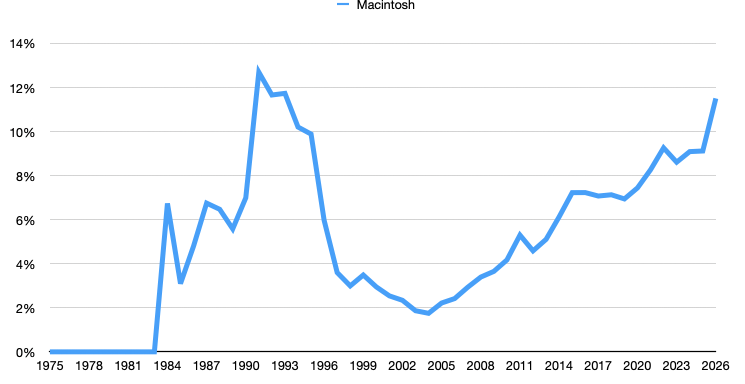
    NB: Omidia estimates that "Apple reached a market shar…

    …e of 11% with shipments growing 5.4% due to solid MacBook Air sales performance and the initial sell-in of the MacBook Neo.". This means 5.4% growth for Apple y/y. As I noted in my Office Hour yesterday, I adjusted my Mac growth from 0% to 6% based on the new products launched. This is an estimate of revenues not units but it might be pretty close. Omidia estimates 7,112 million units whereas I'm a little above 6 million. We seem to disagree on ASP.


  2. Bank of America raises Apple price target to $325 from $320

    Nota Bene

    Q2 forecast update

    BofA raised the firm’s price target on Apple to $325 from $320 and keeps a Buy rating on the shares ahead of fiscal Q2 earnings due after market close on Thursday, April 30. The firm, which sees upside to Street estimates given continued strong sales of iPhone and double-digit growth in Services revenue, forecasts Q2 revenue and EPS of $113B and $2.00, respectively.

    Source: TipRanks Financial

    NB: My own estimates for Q2 revenues and EPS are $110B…

    …and $2.0, respectively. These are equivalent to top line growth of 15% and bottom line 22%. It would be the highest growth since the Covid era.

    A $2/share implies a current P/E (inclusive of the Q2 that just ended) of 30.

    More to follow as we get closer to the earnings release date but this is a good preview.  


  3. Computer History Museum interviews Bertrand Serlet

    Nota Bene

    Pay attention to the quiet ones

    Interviewed by Hansen Hsu on 2023-09-20 in Mountain View, CA

    Serlet joined Xerox PARC’s Computer Science Laboratory in 1984, working in the Cedar/Mesa programming language and development environment, still creating design tools for VLSI, developing the multiprocessor Dragon machine. In 1989, Serlet followed Hullot to Steve Jobs’ NeXT Computer. At NeXT, Serlet worked with Hullot on the AppKit team, releasing OpenStep, the update to the NeXTSTEP operating system. With Hullot and Lee Boynton, Serlet wrote a new version of the Workspace Manager, the equivalent to the Macintosh’s Finder desktop environment. After spending a year working remotely in France, Serlet moved back to California and became a manager at NeXT, leading the effort to create the Foundation framework, factoring out fundamental data structures from the user interface-focused AppKit framework for the next release of OpenStep. Serlet’s group would go on to work on Enterprise Objects Framework (EOF) and WebObjects until NeXT’s acquisition by Apple in 1997.

    At Apple, Serlet led the development of Rhapsody, which became Mac OS X. During the following years, Serlet would lead the development of OS X, ultimately becoming Executive Vice President of Software after Avie Tevanian, all the way through the beginnings of 10.7 Lion. Serlet also worked closely with Scott Forstall, who was instrumental in the development of the Carbon framework and the Aqua interface for OS X, and ultimately led the iPhone/iOS software development team, which was derived from OS X. Serlet would leave Apple in 2011 after recruiting Craig Federighi to replace him, and would go on to found startups involved with the cloud and silicon.

    Source: YouTube, CHM

    NB: This is one in a series on Apple's quieter heroes.…

    …I think Bertrand Serlet is one of the key builders of the operating system at the heart of the 2.5 billion devices that make Apple what it is. I have a few of these quiet hero interviews which I will link to.

    The interviews may be long but I found them fascination. It helps perhaps that I overlapped with the careers of these individuals and can relate to the technologies and challenges they faced.

    That this interview only has 6000 views after three years shows how much untold history exists.


  4. All of a sudden, everyone is doomed except Apple

    Nota Bene · 5 comments

    Antler tipping doom denial.

    The MacBook Neo is turning the whole PC world on its head. Tip o’ the antlers to Horace [Dediu], who says:

    …a doubling of the Mac user base is certainly a worthy and achievable goal over the next decade.

    Now, before you sniff and say “Where were these customers when the Mac was dying? Where were these customers when we needed them? And where are we going to put them all now that they’re coming to the Mac? They’re not staying at my place. Kevin has much more room than I do and Kevin never does anything,” remember first that Kevin is still reeling from the heartbreak of psoriasis. So… you know. But also, while millions of people buying cheap Macs may not be the best thing for Apple’s margins, it does mean good things for Mac users.

    Source: Macworld

    NB: As honored as I am to be the recipient of an antlers tip, I must respectfully disagree…

    …Apple is always doomed is axiomatic. It was not long after the Neo took off like, well, Neo in the final scene of the Matrix, that the stories of failure came out. First it was noted that there would not be enough supply then the the A18 chip was "binned" meaning it was "flawed" or "defective" and thus "free" to Apple. But regardless, there were not enough of these broken chips.

    So Apple would have to raise prices or make more A18 chips or stop selling the Neo altogether.

    The only thing you could be sure of is that Apple is doomed.


  5. Apple Studio Display XDR Now Cleared for Diagnostic Radiology

    Nota Bene

    $3000 makes it low-end

    The Studio Display XDR's medical image calibration feature received FDA clearance, which means radiologists are now able to use the display for viewing medical images. Apple marketing chief Greg Joswiak confirmed today that U.S. radiologists can connect the Studio Display XDR to a Mac running macOS 26.4 to use DICOM medical imaging presets.

    The ‌Studio Display‌ XDR supports DICOM and has a Medical Imaging Calibrator for diagnostic radiology, so radiologists can view images without the need for a single-purpose medical imaging display.

    Source: MacRumors

    NB: The ‌Studio Display‌ XDR is priced at $2,899 with a VESA mount, and it is more affordable than many specialized medical imaging monitors.

    Apple equipment is as much as 90% cheaper than dedicated medical equipment. It's shocking. The Apple Vision Pro is even more shocking when used in a surgical theatre.

    It allows a new set of people to do what previously required only specialists to do and allows specialists to do more than they used to do.


  6. Monday Notes: Neo still sinking in

    Nota Bene · 5 comments

    260 million Mac users? Huge room for growth.

    It’s a massive untapped opportunity for Apple, whose Mac installed base of 260 million units lags far behind the iPhone installed base of 1.5 billion units. Mohan believes the total addressable market for the Neo could be $32 billion for 2026. If Apple can capture just 10% of that market for budget laptops, and do so with a 19% operating margin, the company can boost earnings per share by an incremental 3 cents, according to Mohan.

    “We see Neo driving meaningful adoption for first-time Mac owners with a distinct customer base relative to the Air and Pro models,” Mohan wrote.

    The Neo will dramatically disrupt competitors in the market for budget personal computers, Seaport analyst Jay Goldberg wrote in a Monday note, as the $500 to $700 price tier is one of the most profitable segments for PC makers. Both Mohan and Goldberg have a buy rating and $320 price target on Apple’s stock, implying over 20% of upside from current levels.
    Read: Apple turns 50. Here’s how it can shake its midlife crisis.

    As Apple expands into the budget computer market, the company is also looking to seize share from its smartphone competitors during a period of memory crunch. Artificial-intelligence infrastructure is gobbling up so much memory that many suppliers have sold out their capacity through at least next year. That has an impact on makers of consumer hardware that also count memory as a key component.

    Apple has been paying a premium to buy up memory chips in what Goldberg believes is a “is part of a deliberate strategy for the company to tighten conditions for its competitors.”
    This strategy forces competitors to either raise prices for customers or reduce the memory content in their products, according to Goldberg. Meanwhile, he believes Apple intends to maintain both the memory content and pricing of its phones, allowing the iPhone maker to gain share even as the overall phone market shrinks by roughly 10%.

    This strategy “will not come cheap for Apple,” Goldberg warned, noting that Apple’s product gross margin could sink to the low-30% range from the high-30% range seen a year ago.
    “That said, we think the company can make up for some of this lost ground through its share gains,” he wrote, as new Apple users are likely to subscribe to Apple’s higher-margin subscription services to offset the hardware costs.

    Mohan expressed similar sentiments, arguing that the Neo could lead to a stickier overall installed base for Apple and “increased services use over time.”

    Source: MarketWatch

    NB: Two analysts, two stories. The Neo will move the needle and the supply crunch will hamper competition…

    …These are not shattering news but the narratives are beginning to diffuse into consensus. I still take issue with Goldberg's assumptions about margin. Pricing can be very volatile but Apple is also the best at securing the best deals. So far the company has guided margins higher not lower. We will get an update in a few weeks.

    On the topic of Neo, the eyes should be on the growth in install base. The only indicator we have is the "50% new to the product" indicator every quarter. Management needs to update with some qualification of that measure. Look for "above 50%" when the Mac data is on deck.


    As I wrote before, the key metric is the number of Mac users. 260 million is a reasonable assumption. Over 350 million Macs have been sold in the last 20 years. If we assume half are new to the platform then 175 million have been added. The base in 2006 was probably in the 50 to 60 million range putting the total today at 250 million.

    It's a long way to go to 1 billion Mac users and I don't know if it will ever happen given that most will have to switch from Windows and the lock-in is strong regardless of a better and cheaper alternative being available.

    Nevertheless, a doubling of the Mac user base is certainly a worthy and achievable goal over the next decade.

  7. Gartner adds their Mac Q1 estimate to the pile

    Nota Bene · 2 comments

    Historic growth?

    The Omdia research group says Mac sales grew 10.7% year-over-year in the first quarter of 2026, while the IDC research system says the growth was 9.1%. Now Gartner says Mac sales grew 12.7% year-over-year.

    This research group says Apple sold approximately 6.7 million Macs in the first quarter of 2026 for 10.6% global market share. That compares to sales of 5.9 million Macs and 9.8% market share in the first quarter of 2025.

    Apple remains in fourth place among worldwide PC vendors. Ahead of it are Lenovo (26.5% market share), HP (19.3% market share), and Dell (10.6% market share). Note that none of the research groups count tablets, even the iPad Pro, as PCs.

    “Apple grew 12.7% year-over-year, which was the largest jump among the major vendors and resulted in a 0.8% increase in market share,” said Rishi Padhi, research principal at Gartner. “This performance was primarily driven by robust demand for the MacBook Neo, particularly among new Mac users and buyers in the education sector. This strategic positioning enabled Apple to attract cost-conscious consumers seeking high-performance devices, further solidifying its competitive advantage in the segment.”

    Worldwide PC shipments totaled 62.8 million units in the first quarter of 2026, a 4% increase from the first quarter of 2025, according to preliminary results by Gartner, Inc.

    Source: MacTech.com

    NB: I have historically tracked Gartner's estimates.

    Not necessarily because they are the most accurate--accuracy cannot be determined--but because Gartner has the broadest history and I can review it for decades.

    The quarter is shaping up to be quite astonishing for the Mac, whether it's 9% or 13% growth. It has potential to continue.


  8. Mac mini and Mac Studio orders booming

    Nota Bene · 2 comments

    AI boosting Mac sales.

    Mac mini and Mac Studio orders are facing unusually long shipping delays, stretching up to 4-5 months. This could hint at an upcoming M5 refresh or supply constraints.

    After a few months of delay, Apple refreshed the MacBook Pro and MacBook Air lineup with its new M5 family of chips in late February. The new M5 Pro and M5 Max chips bring a significant uplift in CPU, GPU and AI performance. The Mac Studio and Mac mini are also due for an M5 refresh, but it’s unclear when it will land.

    The extended shipping delays of these Macs could be an early sign of that transition. Apple may be winding down inventory of current models ahead of the refresh. Or it could be struggling to keep up with demand. Despite their age, the Mac Studio and Mac mini are great for AI tasks.

    In the US, the Apple Store currently shows a one-month delivery time for an M4 Pro Mac mini with 24GB of system memory. The shipping time jumps to a whopping 10-12 weeks if you bump the memory to 48GB.

    Source: Cult of Mac

    NB: The bias of the shortage toward the high end impli…

    …es the cause is not a refresh cycle. It's certainly the need for AI agent development. Beside the fact that Apple will have a killer quarter (or year) of Mac sales, the elephant in the room is that AI is benefiting Apple disproportionately more than any other platform. This is because AI needs power and power is best supplied by Apple. It's also the fact that the MacOS platform is modular enough and robust enough to run what amounts to server-level computing. Years of attention to performance are paying off.


  9. Morgan Stanley has a stark message for investors in Apple

    Nota Bene · 1 comment

    Run for the hills

    Morgan Stanley just published survey data that makes a strong case for owning Apple stock. The firm's AlphaWise Global Smartphone Survey was released March 22. It shows iPhone upgrade intentions hitting an all-time survey high.

    The data support the bank's above-consensus iPhone forecast. Morgan Stanley keeps its overweight rating and $315 price target unchanged. The stock closed at $247.99 on March 20. That target implies roughly 27% upside from that level.

    The headline number is a blended global iPhone upgrade rate of 37%, up 2 percentage points year over year. That is the highest reading in the survey's history. The driver is China, where upgrade intentions surged 9 points year over year to reach their own all-time high in the survey.

    On the switching side, Apple's net switching rate improved to 11%. That is a five-year high. Apple was the only major smartphone brand in the survey with a positive and improving net switching rate.

    Samsung, Xiaomi, Huawei, and others were all negative. That positions Apple to gain market share in 2026 even as the overall smartphone market faces pressure.

    Together, these data points support Morgan Stanley's FY26 iPhone shipment forecast of approximately 260 million units, which sits 3% above Street consensus.

    The most surprising result in the survey may be the level of interest in a foldable iPhone. Morgan Stanley found that 27% of global iPhone owners are “extremely interested” in paying for one. In China, that figure rises to nearly 40%.

    Morgan Stanley expects Apple to more than double the global foldable smartphone market within 18 months of launch. The base case puts foldable iPhone revenue at approximately $40 billion. The bull case reaches $60 billion.

    The foldable iPhone is expected to launch in fall 2026 alongside the iPhone 18 Pro lineup. If the survey data translates to actual purchases, the FY27 revenue impact would be significant. Morgan Stanley's FY27 iPhone revenue estimate is already 14% above Street consensus. The foldable is a big reason why.

    Apple Intelligence ranked seventh globally as a reason to upgrade to an iPhone.

    Willingness to pay for Apple Intelligence fell. Respondents said they would pay approximately $8 per month for an unlimited subscription, down from roughly $9 per month in the prior year's survey.

    Morgan Stanley flagged this as a risk worth watching. AI features remain important to smartphone buyers broadly. But Apple appears to be lagging Android competitors in consumer perception of its AI capabilities.

    Morgan Stanley laid out the key variables investors should watch this year:

    iPhone upgrade cycle. Record upgrade intentions suggest the aged iPhone installed base is beginning to refresh. Replacement cycles are expected to contract by 0.2 years in 2026, which supports shipment volumes.

    Foldable launch execution. The survey demand signal is encouraging, but first-generation foldable adoption is inherently uncertain. The revenue upside is large if execution is strong.

    Memory cost impact. Unprecedented memory price inflation is expected to push global smartphone prices higher. Morgan Stanley sees this as a bigger headwind for Android competitors than for Apple, given Apple's pricing power. But the June quarter gross margin guidance will be the first real read on how Apple is managing the cost pressure.

    Apple Intelligence revamp. The 2026 Siri upgrade needs to meaningfully improve consumer perception. The current trajectory is moving in the wrong direction.

    Morgan Stanley's $315 price target is based on 8.5x EV/Sales on FY27 estimates. That implies approximately 32x FY27 EPS of $9.74. Its revenue forecast sits well above the Street even as its EPS estimate is broadly in line with consensus.

    The survey does not guarantee an upgrade supercycle. But the data points in that direction. An aged installed base, record upgrade intentions, strong switching dynamics, and a new form factor in the back half of the year make for a compelling setup.

    Morgan Stanley thinks the market is not fully pricing that in yet.

    Source: TheStreet

    NB: the byline: Morgan Stanley just changed the Apple conversation …

    … Did you spot the change?

    Me neither. The original title was "Morgan Stanley has a stark message for investors" I was not sure what was stark or what change in conversation "The Street" is talking about. It seems they took an overwhelmingly positive report from MS and tried to bait readers by saying it's bad news.

    The report based on a survey is largely unremarkable. Higher upgrade rate, interest in new form factors (not very reliable) and AI hypotheticals. The interpretation of the report says more than the report itself and what it says is that editorial policy is to manufacture negative news on Apple.


  10. iPhone sales continue to surge into February - Bernstein

    Nota Bene · 1 comment

    Apple's iPhone continued strong sales in February

    Apple’s iPhone continued strong sales last month, thanks to the popularity of the iPhone 17 line, Bernstein analysts wrote in an investor note on Monday.

    According to the report, global iPhone sell-through increased 26% year over year in February. Overall, the analysts say iPhone 17 unit sales are up 20% versus last year’s iPhone 16 through September and January.

    The base model iPhone 17 accounted for 39% of that growth, while the iPhone 17 Pro Max made up 21% of the increase.

    Average selling price, or ASP, also climbed in February, growing 6.9% year over year. So far, ASP has improved each month since the iPhone 17 launched in September, with the exception of October, Bernstein said.

    The analysts said China provided the biggest boost to ASP, with growth of 20.2% year over year.

    Source: Yahoo Finance

    NB: Guidance provided by management was at the end of January and thus February was well within sight.

    It's unclear from this quote how Bernstein is measuring this degree of detail for global iPhone sales by model and price point. The article goes on to say "On the flip side, however, Bernstein said that January and February iPhone revenue is estimated to have been $35.7 billion, below the firm’s anticipated $56.5 billion."

    This sounds like complete nonsense. How could revenues be down as unit sales are up, ASP is up? The quote refers to January and February but the anticipated revenue cited sounds like the full quarter. My own estimate for iPhone revenues for the quarter is $57.2 billion.


  11. KeyBanc maintains a lack of clarity of thought

    Nota Bene · 1 comment

    Is this intentionally unintelligible?

    From a note to KeyBanc clients that landed on my desktop Monday.

    "We remain SW AAPL. Our KFLD shows Indexed Spending +37% m/m, which is above the three-year average of +12% m/m, and +11% y/y vs. +4% y/y in Feb. We think the inflection was likely driven by products launched in March. Our broad checks suggest demand remains strong and builds are increasing, and we are adjusting our estimates. We expect F2Q results in line with consensus, and F3Q guidance above, though with AAPL trading in line with its 3-year averages and a wide spread to the Nasdaq/S&P 500, we view AAPL as fairly valued."

    Source: Philip Elmer‑DeWitt

    NB: Fuller description on Philip Elmer-Dewitt's Apple …

    …3.0, with a take on the analyst but I would add that anybody who writes so cryptically and obfuscates any points should not be taken seriously. The paragraph I quoted cannot be parsed and is written with complete disregard for clarity.

    The methodology used is carrier survey but it's unclear how relevant this is to any thesis on Apple beyond one product in one region for one quarter. The lack of contemplation or reflection on a thesis suggests this is a pass.