Asymco

Asymmetric Intelligence

Nota Bene

News Commentary from Asymco's Horace Dediu.

  1. Apple's services continue to see increased engagement, spending
    Nota Bene · 1 comment

    3500 users surveyed

    In surveying roughly 3,500 smartphone users, the average monthly spend of a user has increased to around $13, up from the three-year average of roughly $9, “driven by broader application adoption and mix shift toward higher-value offerings,” analyst Amit Daryanani said. 

    Delving deeper, the survey indicated that roughly 63% of respondents now have AppleCare or Apple One, up from the three-year average of 44%. Apple Pay usage has increased as well, as roughly 40% of respondents said they use it, compared to roughly 30% for the three-year average. Other services also saw increases when compared to the three-year average, including iCloud (only 15% have no usage, down from the three-year average of 24%, while 28% say they now have 2 TB worth of storage, up from roughly 11%); Apple Music (roughly 61% compared to approximately 44%); and Apple TV, which roughly 54% of respondents said they used, compared to the three-year average of about 34%. 

    Additionally, Apple TV (formerly known as Apple TV+) is now the second most watched streaming service in the survey, surpassing Amazon Prime Video, Daryanani said.
    Aside from Apple's paid services, the survey indicated that Apple Intelligence is seeing some traction, though it was described as “muted.” 

    “Upgrade intent remained muted, with ~44% of users indicating willingness to upgrade for AI features, a ~2pt decline from our prior survey,” Daryanani added. “We think users are underappreciating the potential of Apple Intelligence 2.0 and 'AI Siri,' particularly as new capabilities are rolled out later this year, which will include Gemini model integration. Importantly, we see early signs of monetization, with underlying demand for premium features, as ~61% of respondents indicated willingness to pay for a personalized 'AI Siri' subscription.”

    Source: Seeking Alpha

    NB: The AppleCare number is interesting.…

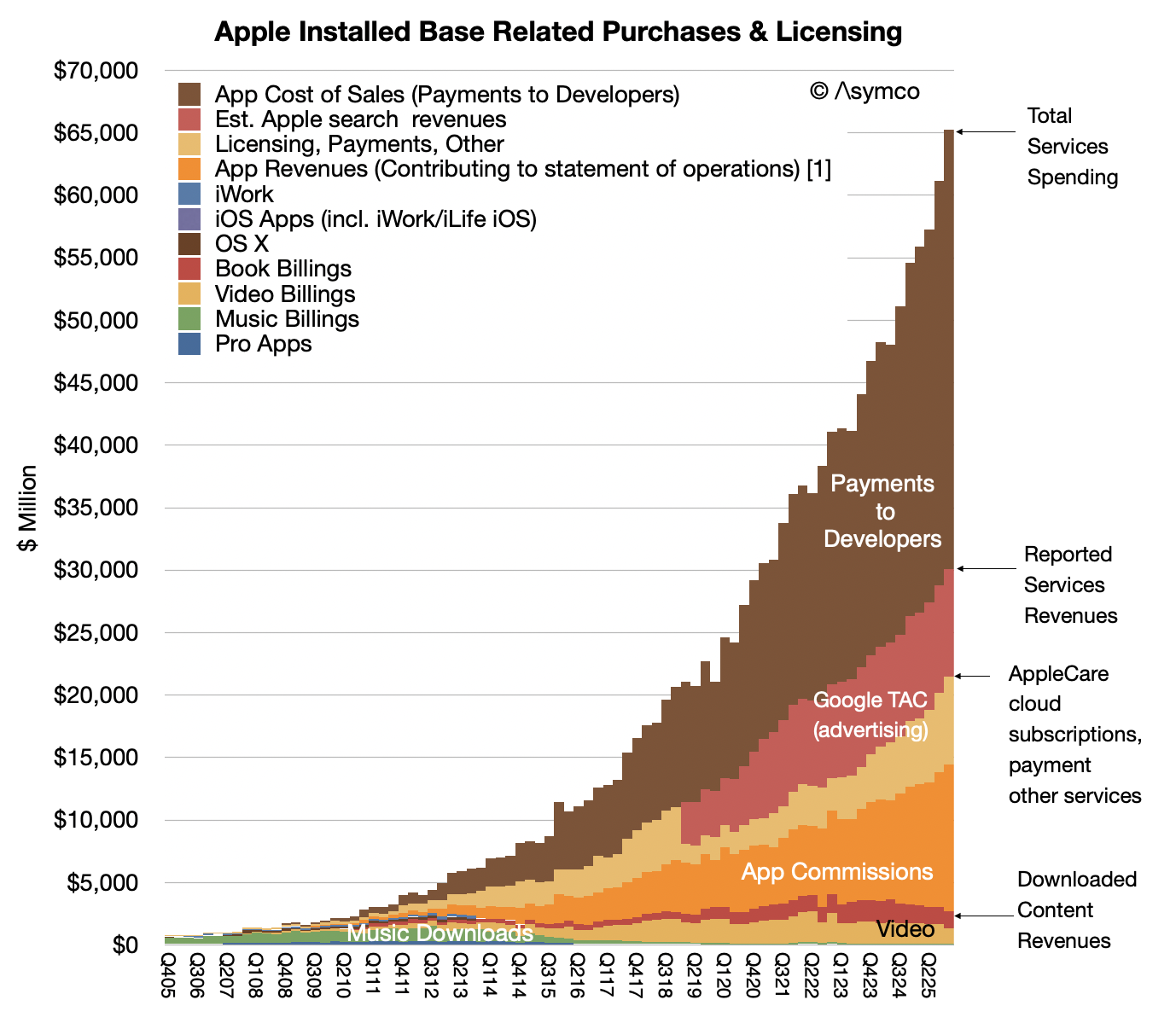
    ...As is the Apple TV usage being the most watched streaming service. I suspect that this survey skews to the US and should therefore be calibrated. Consider that the average monthly spend of $13/mo. would add up to $218 Billion for 1.4 billion users. Apple Services excluding Advertising (Google TAC) booked a total of $180 billion in 2025. Even with only 1 billion users (services users that is) the user spending should be $15/user/mo. However, directionally the trend shows an increase which is fairly strong.

    The AppleCare number is combined with Apple One which is not useful but again, directionally the increase from 44% to 63% is quite astonishing.
  2. The Motley Fool asks: Where Will Apple Stock Be in 5 Years?

    Nota Bene · 1 comment

    Not reading this article is probably a wise decision.

    Shares could perform in line with the S&P 500's long-term average

    Investors can follow a straightforward exercise to try and figure out where Apple's stock price will be in late March 2031. It's important to consider both the valuation and profit gains.

    We just released a brand-new report with the full story and the company’s name.

    Apple shares current trade at a price-to-earnings ratio of 31.5. I believe it's reasonable that this multiple could drop to 30 in five years, which is still a premium valuation.

    On the other hand, sell-side analysts hold a consensus view that diluted earnings per share will rise at a compound annual rate of 11.6% between fiscal 2025 and fiscal 2028. If we assume that this pace of growth continues in the years after this explicit forecast period, then Apple's stock price will be around $410 in five years. This translates to a 10.5% annualized gain.

    This is obviously a very rough guide that may or may not prove to be correct. Apple's earnings could surprise to the upside or disappoint to the downside. And market sentiment is also extremely unpredictable, which will impact the stock's valuation. [Seriously?-ed]

    That expected rate of return mimics the S&P 500's long-term average. But if the widely followed benchmark keeps up its performance from the past decade, then Apple will lag the market.

    Source: The Motley Fool

    NB: The Motley Fraud is not a reliable source of anything but bad stock picking advice…

    …. "Will AI create the world's first trillionaire?
    One little-known company, called an "Indispensable Monopoly" owns the technology Nvidia, AMD, and Intel cannot function without. And it is still just a fraction of Nvidia’s size..

    This is the sort of garbage you will be fed visiting their "articles". It's a shameful and disgraceful business whose existence for so long saddens me.


  3. Analysis: Mac grew 16% and iPad grow 15% in China in the fourth quarter of 2025

    Nota Bene · 2 comments

    Not just the iPhone.

    Both the Mac and iPad marketshare in China grew year-over-year in 2025, according to new data from the Omdia research group.

    Apple sold 700,000 Macs in the fourth quarter of 2025 for 6% market share. That compares to sales of 600,000 Macs and 5% market share in the fourth quarter of 2024. That’s 14% annual growth.

    Apple sold 2.3 million iPads in the fourth quarter of 2025 for 25% market share. That compares to sales of 2 million iPads and 24% market share in the fourth quarter of 2024. That’s 16% annual growth.

    Looking ahead, China’s PC and tablet markets face significant headwinds. Omdia forecasts PC shipments in China will decline to 37.9 million units in 2026. This decline will be more pronounced in the consumer segment, which is expected to contract 12% compared to 2025. Tablet shipments are also projected to fall 11% to 32 million units in 2026, following elevated performance in 2025.

    Source: Apple World Today

    NB: I make it out to be 16% Mac growth not 14% and 15% iPad growth not 16%.

    Not sure what's happening with the calculations here casting suspicion on the accuracy of the research. The precision to nearest 100,000 for both products seems also strange.

    Regardless, the growth in China sales overall is a matter of public knowledge. We are just usually not hearing anything other than iPhone. It stands to reason that the Mac and iPhone are also growing in the country.

    Contraction in 2026 is also being forecast on the phone market but Apple is expected to buck the trend. I can't assume that it's a different story for the Mac given the launch of the Neo.


  4. Mac market share to grow from 9% to 12% in 2026

    Nota Bene · 1 comment

    Bucking the Trend

    Global notebook shipments are showing clear signs of further weakening, according to TrendForce’s latest findings on the notebook industry. Subsequently, TrendForce has revised its 2026 full-year shipment forecast downward from -9.2% to -14.8% YoY amid expectations of deteriorating end-market demand and rising supply chain costs, reflecting a deeper industry correction.

    TrendForce estimates that Apple’s notebook shipments will grow 7.7% YoY in 2026, outperforming the broader market trend. This is based on Apple’s ability to expand into lower price segments, adopt a proactive pricing strategy, and maintain stronger chain control than its peers.

    Source: TrendForce

    NB: 8% rise for Apple coupled with a 15% market contraction…

    … Notebooks account for over 77% of the market share of all PCs. The analysis cited quotes notebooks but if the same assumptions for the entire PC market and, using Gartner estimates for the 2025 year, we have the following estimates for shipments and share.

    Mac unitsMac ShareWindows UnitsWindows ShareTotal Units
    202523,9259.1%238,57590.9%262,500
    202625,76711.5%197,88388.5%223,650

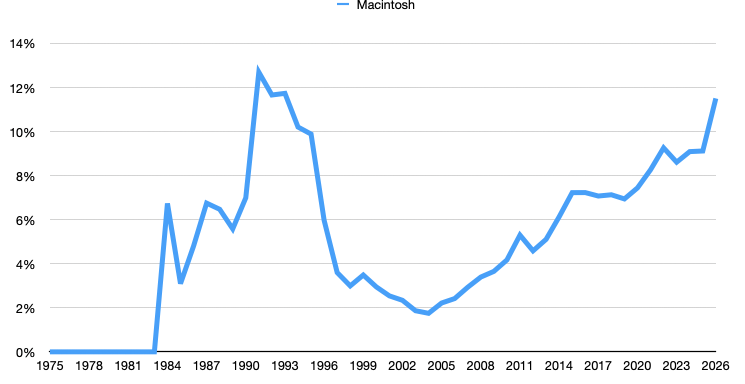
    This might be the biggest one-year increase in maker share for Apple's Mac business since 1991.

    Gartner adds their Mac Q1 estimate to the pile
    Yearly market share of Macintosh, 1975 to 2026.
  5. Apple Vision Pro users will be able to experience NASA’s Artemis II launch in immersive video

    Nota Bene · 3 comments

    An experience money can't buy

    NASA’s Artemis program is about to get the cinematic treatment it deserves — and Apple Vision Pro owners are in for an unforgettable ride…

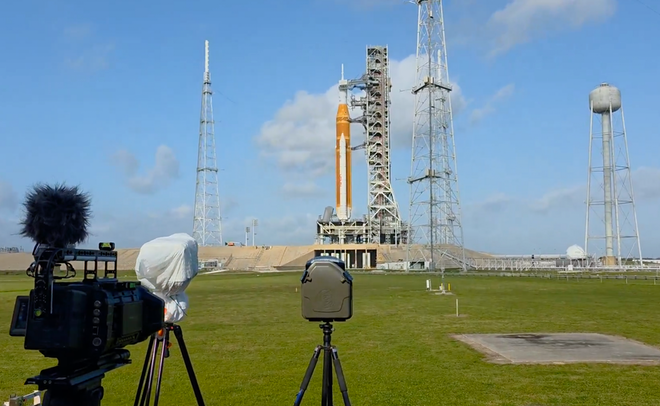
    On Monday, March 30, 2026, filmmaker and space documentarian Cosmic Perspective (@considercosmos) shared thrilling behind-the-scenes footage showing the first wave of high-end cameras being installed inside the launch pad perimeter at NASA Kennedy Space Center. The star of the show? A sleek Blackmagic Design URSA Cine Immersive camera, complete with its signature dual-lens stereoscopic rig, ready to capture the thunderous liftoff in true 3D spatial video.

    The short video pans across the massive Space Launch System (SLS) rocket standing tall on the pad, with the immersive Blackmagic camera prominently featured in the foreground. Other pro rigs — complete with furry windshields and sturdy tripods — dot the grassy viewing areas, signaling that this won’t be just another standard rocket launch broadcast. This is next-level, immersive filmmaking designed to put viewers right in the middle of the action.

    Source: MacDailyNews

    NB: Immersive video is angling for a cut of the live event business…

    …but the exciting part is also the ability to offer experiences that money can't buy. This is such an example. So is the "Flight Ready" video I experienced on Vision Pro. You can't buy tickets to observe flight operations on an aircraft carrier at sea.

    Stereoscopic 3D capture, ultra-high dynamic range, and color science, new cameras promise footage that will feel real when viewed in the Vision Pro’s immersive environment. "Being there" audio layered with 3D spatial video that lets you turn your head and look and feel all around you. 

    As "video" is the default social media and is produced by anybody with a phone, the premium experience is moving into something that no longer fits on a rectangular screen.

    What is that worth? What is the value of professional production? Is the profession of film making being commoditized? The answer isn't to just be better the answer is to move into a new market. It's to develop experiences not just a tableau.


    I can imagine these cameras being not only on the launch site but on the landing site on the moon as well. What would be the value of providing an immersive experience of landing on the moon?

  6. Warren Buffett tries to justify his hypocrisy

    Nota Bene · 5 comments

    Shameful.

    "I sold it too soon. But, I bought it even sooner, so," Buffett told CNBC's Becky Quick in an interview Tuesday on "Squawk Box" .

    Apple remains Berkshire Hathaway's largest holding even after the conglomerate trimmed its stake to $61.96 billion at the end of last year, according to InsiderScore.

    However, Buffett said Tuesday that he would continue to add to the position if it gets cheaper. He said the iPhone maker is not yet attractive even after falling more than 14% off its recent high, and dropping more than 6% this month. That's amid turmoil in the broader market, with both the Dow Jones Industrial Average and the Nasdaq Composite in a correction.

    "I'm very happy to have it be our largest holding," Buffett said. "I was not happy to have it be as large as almost everything else combined."

    "It's not impossible that Apple would get to a price, we would buy a lot of it," he added. "But not in this market."

    Buffett said the firm has made more than $100 billion in the stock pretax, and was favorable in his comments regarding Tim Cook's leadership of the firm over Steve Jobs.

    "Tim Cook has done better with the hand. Steve Jobs — he couldn't have done what Steve Jobs did — but Steve Jobs handed him a hand that Steve would not have done as well," Buffett said.

    "Tim was a fantastic manager, and he's a good guy, and somehow he gets along with everybody in the world," he added. "That's a technique I wouldn't have, for example, certainly my partner, Charlie Munger, wouldn't have had it."

    Source: CNBC

    NB: Warren Buffett said he sold Apple stock too soon but clarified he has no actual regrets. Buffett said it is better than any business Berkshire owns outright including its railroad, which is worth more in dollar terms but earns nowhere near the return on capital that Apple does. He also said his railroad might last longer than Apple.

    He said if Apple ever got cheap enough, he would buy a lot more of it. He owned a lot more of it priced a lot lower than what he would have to buy it back at. Complete nonsense.

    Also Warren Buffett:

    Quote: "Our favorite holding period is forever". Action: Trade Apple to realize gain.

    Quote: "Price is what you pay, value is what you get". Action: Trade Apple to make $100 billion pretax, mention that price determines decision.

    Quote: "At a healthy business, cash is sometimes thought of as something to be minimized as an unproductive asset that acts as a drag on such markers as return on equity" Action: Sell Apple and other equities and move $300 billion into unproductive cash.

    Quote: "Investors, of course, can, by their own behavior, make stock ownership highly risky. And many do. Active trading, attempts to ‘time’ market movements..." Action: time decision to trade Apple for cash on the basis of price, tax and market conditions.

    Quote: Apple is "probably the best business I know in the world," "we like to own businesses not stocks". Action: Convert Apple ownership into cash.

    Quote: "I'd love to own 100 percent" of Apple. Action: Sell 60% of Apple holdings.

    Quote: "I don't think of Apple as a stock. I think of it as our third business" Action: Sell Apple, move into unproductive asset cash.

    Quote: "I sold Apple too soon". Action: Also say that you don't regret it.

    Actions speak louder than words. The results will be felt by his shareholders.

  7. We know that Macs last longer in use. How much longer?

    Nota Bene · 1 comment

    What did I just say?

    A new analysis of computers used in the enterprise finds that Macs and iPhones last much longer and have far fewer problems.

    Macs in enterprise settings typically last for five years, besting the three-year lifespan for Windows PCs, according to a company that makes software to help businesses manage their computers.

    But the really shocking revelation from the report is that more than half of Windows PCs used in big business get replaced within a year.

    While factors like software compatibility, IT familiarity and customization options also play a role, upfront hardware cost remains the biggest driver for most organizations.

    By comparison, Macs are often seen as premium products, which can make them harder to justify at scale (although the recently released $599 MacBook Neo is changing that equation).

    Companies making these sorts of computer buying decisions should pay attention to a new report from Omnissa.

    “Compared to Windows, 6.5x more Macs are seen in service into year 6, and 3.3x more Macs are seen in service into year 3+,” noted Omnissa’s report.

    “Only 17% of macOS devices were replaced within one year, compared to 54% of Windows devices, reducing disruption tied to frequent hardware replacement,” said the analysis.

    Macs are far less likely to crash. The benefits of using Apple computers don’t stop at longevity, though. Employees using Macs also run into far fewer bugs.

    “The telemetry reveals that Windows devices exhibit 3.1x more total forced shutdowns (including system crashes and unexpected restarts) than macOS devices,” said Omnissa. “Windows devices experience 2.2x more app crashes and a staggering 7.5x more app hangs (unresponsive software states) than Macs.”

    “A forced shutdown is much more than an IT support ticket — it’s a disruption to an employee’s work that translates directly into lost work hours,” said Omnissa.

    Apple’s lifespan advantage extends to iPhones as well. When compared to Android handsets, “the data suggests that iOS devices display longer service life, with twice as many devices in service into year 6,” said Omnissa.

    “iOS is updated 8.1 times faster than Android,” said Omnissa. “macOS is updated 1.5 times faster than Windows.”

    The long-term cost benefits of using macOS or iOS in the enterprise are starting to overcome companies’ habit of making buying decisions based on short-term savings.

    Source: Cult of Mac

    NB: “Penny wise but pound foolish…

    …This report feels like deja-vu. I remember reading similar research in 2004. The total cost of ownership of Apple products has been lower for decades but all the feedback is that there's more to the choice than TCO. Software compatibility and other non-economic factors. It's tiresome. The biggest point about the Mac Neo is that it throws almost all arguments out the window. It will still take a long time for the adoption curve.


  8. The iPhone 50 years from now – and why Apple won't have AI execs

    Nota Bene

    iPhone 70th anniversary edition will have a new camera

    Apple CEO Tim Cook was also asked whether he could ever see the company being led by AI execs, and he said absolutely not, even in a 50-year time frame.

    “When you look at the leadership page,” he says of future Apple, “there will not be an agentic kind of model on there.”

    Joz said in a new interview that it’s hard to imagine that we won’t still be using an iPhone 50 years from now …

    Source: 9to5Mac

    NB: Initially I read that title as saying that there will not be anyone in charge of AI. That is far more interesting question…

    …The reason AI cannot operate as an executive is primarily legal. Officers in a company have legal liability. The legal code does not allow for artificial liability. The notion of a "head of AI" is more interesting as I would also assert that there will be no such responsibility. This is because AI is a horizontal technology. It would be akin to having a head of computation or head of energy.

    As far as iPhone lasting 50 more years, it would imply lasting beyond iPhone 70. We're about to see iPhone 20 (XX?). The Mac has made it to age 42 and it's not inconceivable that it should also last another 28 years, to age 70. Therefore the iPhone lasting 50 more years is merely the iPhone lasting as long as the Mac. The iPhone has broader appeal while maintaining a similar computing architecture. It's fully within reason to assume that it's a resilient platform. Only question is how many billion users there will be.

    [Incidentally the Mac and the iPhone are both existing on top of the Unix operating system. Unix was initially developed circa 1970 and it is thus already 56 years old demonstrating its resilience.]


  9. Melius highlights FCF while reiterating buy on Apple

    Nota Bene · 3 comments

    Measuring valuation in an era of AI.

    “Given Apple’s free cash flow and we are about to embark on one of its most lucrative product rollouts since the big screen iPhones in 2014 - there is a case for Apple’s stock regaining some ground,” Melius analysts wrote in a note to clients.

    Lately, Apple has announced the iPhone 17e and a refreshed iPad Air, a new MacBook Air, a MacBook Pro, new Studio Displays, the MacBook Neo, and an updated version of its over-the-ear headphones, the AirPods Max 2.

    Apple shares were modestly higher in premarket trading but have lost some 8% year-to-date. Over the past 12 months, shares have gained 12%.

    Source: Seeking Alpha

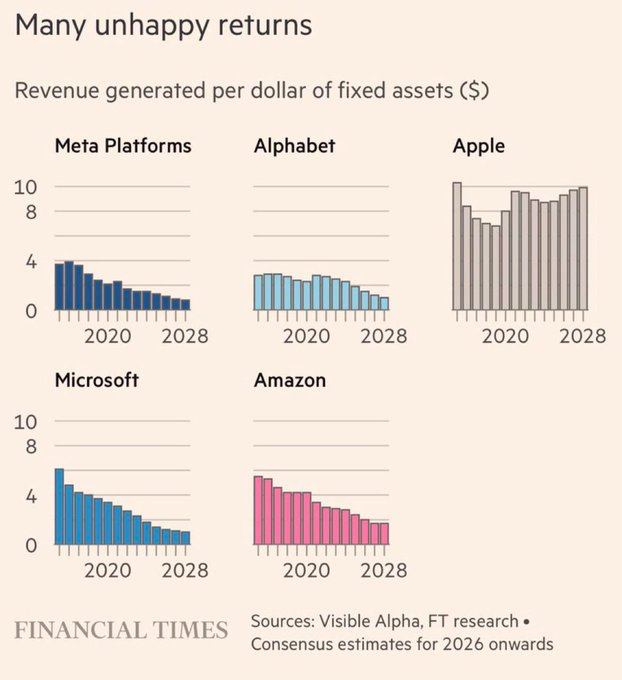
    NB: Free cash flow (FCF) is the amount by which a business's operating cash flow exceeds its working capital needs and expenditures on fixed assets (known as capital expenditures). It is that portion of cash flow that can be extracted from a company and distributed to creditors and securities holders without causing issues in its operations. As such, it is an indicator of a company's financial flexibility and is of interest to holders of the company's equity, debt, preferred stock and convertible securities, as well as potential lenders and investors. It has come recently into vogue when the bill for AI infrastructures has come due...

    ... To calculate FCF, look at the Income statement, start with earnings before interest and taxes (EBIT), add depreciation, subtract taxes and CapEx. The elephant in the room is that CapEx. Normally, investors are concentrating on earnings and can generate a picture with Price/earnings. But when CapEx is extraordinary then EV/FCF become a better picture.

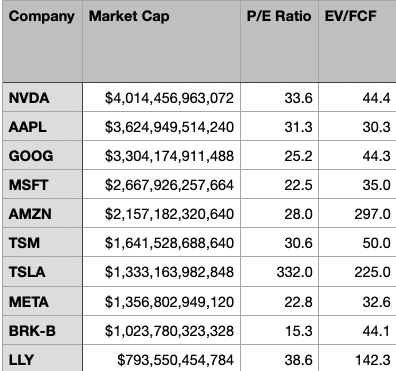
    By this measure, Apple looks to be not only reasonably valued but the only company among the largest companies that is normally valued (i.e. where P/E and EV/FCF are roughly the same).

    The table above shows the P/E ratios vs. the EV/FCF ratios of the top 10 largest market caps in the world.

  10. Apple's Business Strategy

    Nota Bene · 1 comment

    Remember the orifices?

    Apple’s top-line is benefiting from an expanding enterprise footprint. In the first quarter of fiscal 2026, the company saw strong adoption with Snowflake deploying more than 9,000 Mac devices while AstraZeneca rolled out more than 5,000 M5-powered iPad Pros to its pharmaceutical sales team. Mexico’s largest domestic retailer – Coppel – added MacBook Air to its growing fleet of more than 10,000 iPad devices.

    In the trailing 12 months, Apple’s devices have been adopted by the likes of BMW Group (tens of thousands of iPhones), Capital One added MacBook Airs, while the Czech Republic’s largest bank, Ceska sporitelna, is using more than 5,000 iPhones in addition to its existing thousands of iPads and Macs. Other notable users include PayPal, Roche, and Thailand’s Siam Commercial Bank. Apart from iPhones, iPads and MacBooks, Apple Vision Pro is gaining adoption. Apple’s visionOS 26 introduced new enterprise APIs that empower companies to build their own spatial experiences. This is expected to further drive the adoption of Apple devices.

    The company is now bringing Apple Business that combines built-in mobile device management, business email and calendar services with custom domain support. Apple Business can help enterprises grow their reach and connect with local customers across Apple Maps, Mail, Wallet, Siri, and more. Apple is set to introduce a new option coming this summer that will enable businesses in the United States and Canada to place local ads in Maps during key search and discovery moments. Beginning April 14, Apple Business will be available as a free service in the United States and more than 200+ countries and regions to new and existing users of Apple Business Connect, Apple Business Essentials and Apple Business Manager.

    Source: Yahoo Finance

    NB: Is it going to move the needle? I don't think that's the right question...

    ...Selling to businesses is not a strategy for Apple. It's money on the table after succeeding in consumers. Apple has a plan to leverage its base and wait for businesses to come to it. This story is 50 years old and nothing has changed. Apple’s installed base has surpassed more than 2.5 billion devices. If businesses don't want to join the popular choice, then it's on them if employees and customers are frustrated.

    Apple Business is there to provide a minimum requirement (hygiene) to accept Apple platforms into companies. Apple's call is: Solutions exist. Do the right thing.


  11. Survey shows iPhone improved retention, purchase intent, growth in services, service pricing, product mix, foldable upside

    Nota Bene · 1 comment

    Attach rates for iCloud reached about 42%, while Apple Music stood near 30%

    The iPhone ecosystem is showing signs of increased customer loyalty and steady demand, while its high-margin services business remains a key support to profitability, according to UBS analysts.

    The bank, which maintains a 'Neutral' rating on Apple with a 12-month price target of $280, cited findings from its Evidence Lab survey of roughly 4,000 iPhone users globally. The data suggests that iPhone “stickiness” continues to improve, even as replacement cycles remain relatively stable.

    UBS said the average age of iPhones in use globally was largely unchanged year-over-year at about 33 months. Outside China, device age edged slightly higher to around 38 months, a trend the analysts said could push some upgrade demand into 2027.

    At the same time, customer retention strengthened, with the global iPhone retention rate rising about 200 basis points to roughly 74%. Gains were particularly notable in the United States and China, where retention increased by 200 and 700 basis points, respectively. UBS belives that this indicates Apple is maintaining share despite a competitive smartphone market.

    Purchase intent also improved across regions, with more surveyed users indicating their next smartphone would be an iPhone. The UK recorded the largest increase, while China also saw a meaningful rise despite what UBS described as a challenging competitive backdrop.

    The report highlighted continued growth in Apple’s services ecosystem, particularly iCloud and Apple Music. Attach rates for iCloud reached about 42%, while Apple Music stood near 30%, trends UBS said should help sustain services gross margins above 75% through fiscal 2026 and 2027.

    Higher-tier iCloud usage is also increasing, even as Apple raises base storage on newer devices. Among iPhone 17 users, 77% reported subscribing to mid- to high-tier iCloud storage plans, compared with roughly 60% across the broader installed base. UBS noted that additional services uptake carries incremental gross margins of at least 90%, helping offset potential pressure from rising memory costs.

    On the hardware side, consumers are also opting for higher storage configurations. UBS wrote that 56% of iPhone 17 users purchased models with more than the base storage, up about 800 basis points year-over-year. This shift could support product margins, with incremental storage estimated to generate gross margins of around 75% on roughly one-fifth of sales.

    Looking at the installed base, UBS estimates about 68% of iPhones in use are from the 14 through 17 series, while around 40% are Pro or Pro Max models. The analysts said this premium segment could be a target market for a potential foldable iPhone, though they expect the opportunity to be relatively limited given the anticipated price range of $2,000 to $2,500.

    UBS estimates a foldable launch could result in as many as 8 million units in fiscal 2026, contributing roughly 6 million incremental iPhone shipments, or about a 2% uplift to its forecast of 251 million units.

    Source: Yahoo Finance

    NB: Neutral rating. Let's summarize the findings.

    Stickiness (loyalty) continues to increase. Retention strengthened, purchase intent improved, growth in iCloud, Apple Music, transition to higher tiers in service pricing, higher storage configurations in product mix, foldable incremental upside (2% uplift in units).

    If this implies a neutral rating (hold?) and a target below all-time-high set last year then this suggests that pricing reflects all this. Does it?