Asymco

Asymmetric Intelligence

Nota Bene

News Commentary from Asymco's Horace Dediu.

  1. UBS Raises Price Target from $280 to $287 but Maintains Neutral Rating
    Nota Bene · 1 comment

    Neo and Claw incrementals

    Apple is set to report fiscal second-quarter results on April 30, and investment firm UBS is expecting a “slight” upside to the consensus, based on Mac and iPhone-related strength.

    “Supply chain checks and analysis of sell-through data suggest modest upside to our iPhone estimates while demand for the Neo and Mac mini suggests demand at least in-line with our Mac rev forecast,” UBS analyst David Vogt wrote in a note to clients. Vogt reiterated his Neutral rating on Apple but raised his price target to $287 from $280.

    Turning to guidance, Vogt said he is expecting a “solid” offering for the June quarter and upped his earnings estimates as a result.

    “Rising memory prices and Apple's ability to secure adequate supply is driving smartphone share gains for the iPhone product line at the expense of the broader Android ecosystem in our view,” Vogt explained. “In addition, solid demand for the Mac portfolio in part driven by initial success of the lower priced 'Neo' as well as demand for the 'mini' increasingly used to run AI agents like OpenClaw should drive incremental upside relative to our expectations.”

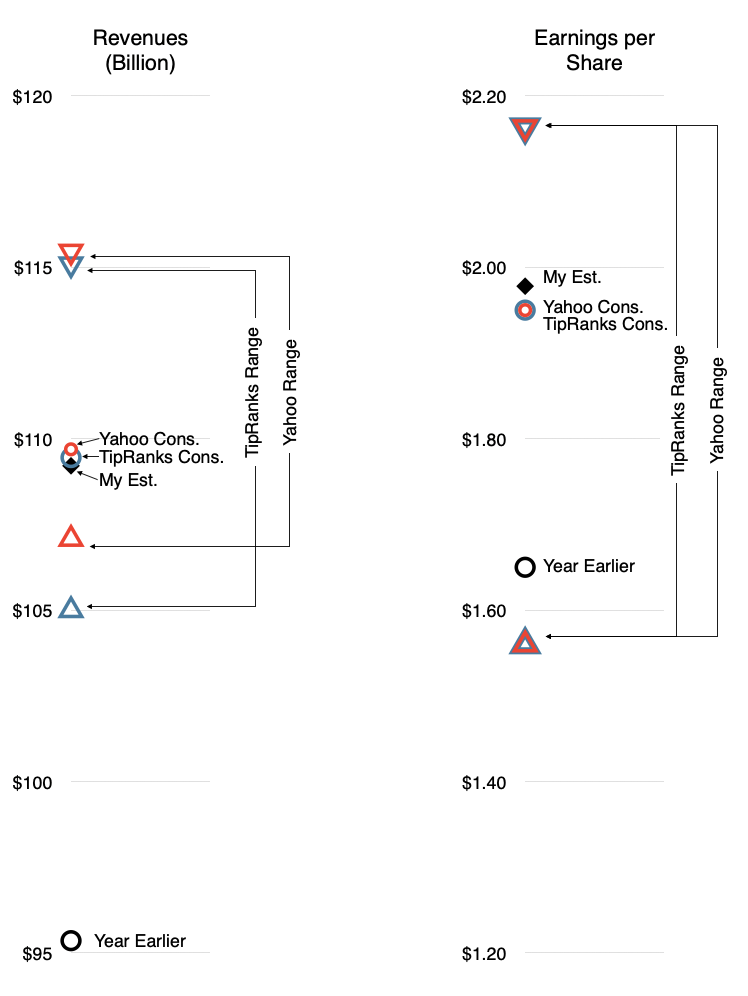
    A consensus of analysts expects Apple to earn $1.94 per share on $109.73B in revenue for the fiscal second quarter.

    Source: Seeking Alpha

    NB: Missing the forest for the trees. Tune in to the post earnings discussion on Office Hours.

    "At least in-line" is as weak as one can be in enthusiasm. “Supply chain strength and sustained demand/share gains for the iPhone 17 series should lift iPhone rev up ~20% YoY,” is more robust.

    The neutral rating suggests that he does not see any strategic leverage gain as weak phone hands are shaken out.  
     

  2. TD Cowen: 15% revenue growth, 10% growth guidance

    Nota Bene

    Share gains in both smartphones and PCs

    TD Cowen analyst Krish Sankar reiterated a Buy rating and a $325 price target on AAPL stock. He expects Apple to report over 15% year-over-year revenue growth for the March quarter and to guide June-quarter revenue up about 10% year-over-year, driven by healthy iPhone 17 demand and the new MacBook Neo.

    Key watch items: Apple’s ability to manage memory cost inflation and the launch of a compelling AI‑powered Siri. Sankar believes Apple will continue gaining share in both smartphones and PCs, with sentiment already positive heading into earnings.

    Apple is set to report earnings on April 30. Currently, analysts expect AAPL to post revenue of $109.45 billion in fiscal Q2, up from $95.36 billion in the year-ago quarter. Further, the company is expected to report earnings of $1.95 per share, compared with earnings of $1.65 in the prior-year quarter.

    Source: TipRanks

    NB: Consensus building that memory crunch will be neutral to positive.

    Forward looking growth guidance is the key question now. 10% is a good guess. I am not putting forward a number but double digits seems plausible given the apparent success of both the iPhone and Mac in this product cycle.


  3. The Economist Interview: Hints at the future direction of the company

    Nota Bene · 2 comments

    "Apple’s new boss needs to restore its magic for the AI era"

    If Mr Ternus does “nothing but keep the ship on course”, Apple could almost double its number of devices from 2.5bn globally to 4.5bn over the next 15 years, reckons Horace Dediu, a veteran Apple analyst. That would be a huge platform on which to run—and monetise—AI apps. As users subscribe to ChatGPT or other AI apps, “Apple will just take a cut,” Mr Dediu adds. By one estimate, Apple is close to generating $1bn in ai revenues so far this year via the App Store, despite having no flagship ai product.

    Azeem Azhar, author of Exponential View, another newsletter, adds that to overcome bottlenecks in cloud-based AI, routine queries may be shifted to “edge” devices, creating a big opportunity for Apple. In Mr Azhar’s telling, the future will involve “a combination of the highly portable phone with the persistent desktop or server. Both play to Apple’s strengths.”

    There is, however, a more radical path available to Mr Ternus, which is to develop a new “form factor” beyond the iPhone that is more suitable for the interactive nature of ai than doomscrolling on a touchscreen. Competitors are already trying to turn the smartphone into yesterday’s technology. Meta, the social-media giant run by Mark Zuckerberg, is selling millions of AI-powered smartglasses. Sir Jony Ive, the design guru who helped Jobs create the iPhone, has teamed up with OpenAI to develop a brand new gadget of unknown form. To keep up, Mr Ternus may have to reinvigorate Apple’s product line-up with a determination that eluded Mr Cook.

    Apple’s Vision Pro virtual-reality headset, though an over-priced flop, may help the new boss develop Apple smartglasses. The company is also reportedly working on a wearable AI pin. Mr Dediu says that one of Mr Ternus’s main strengths may be his devoted following among Apple’s engineers, who have been pivotal to the firm’s success. “Ternus will come out as an engineer’s engineer,” he says. “He is hard-core. That might energise the teams.”

    Source: The Economist

    NB: As is often the case, a 45 minute discussion turns into two sentences. The article sadly does not provide hints at the future direction of the company. But we can…

    …What we can foresee with certainty is what I said: the momentum is there for a doubling of the business without any new initiatives. The cultural fit for Ternus is 100%. That is based on the data we have but it is not the limit of what can be done. It is up to Apple to create the future.

    This is not about AI or any new form factors but about harnessing the new technologies with Apple's existing operational capabilities and existing market access in a way that competitors cannot replicate. Thus unforeseen growth can be created and, by definition, it's not possible to tell what that may be.

    But I can foresee that the organization is robust and well managed enough to create this unforeseen growth.


  4. The iPhone is ‘not getting disrupted’ by AI: Perplexity CEO

    Nota Bene

    AI makes the strong stronger. That is the opposite of disruption.

    The iPhone appears stronger than ever despite Apple’s AI struggles, and that’s not a coincidence, says Perplexity CEO Aravind Srinivas.

    Speaking on the latest episode of the This Week in AI podcast, Srinivas indicated that the iPhone only stands to benefit from continual AI improvement.

    "Here’s my opinion. I haven’t said this before. The phone, the iPhone is actually not getting disrupted by AI at all. In fact, the more AI works better, the iPhone essentially becomes your digital passport."

    Perplexity’s CEO touts Apple’s ecosystem and silicon advantages as some of the reasons why the iPhone is positioned for continued success. It’s also, in his view, why Apple can afford to move slow with its long-delayed Siri overhaul.

    "My sense is that even though a lot of people have opinions on how bad Siri is or good Siri is, [Apple has] the ability to take time and do things they want to do, because they have advantages as a brand that people truly trust. The ecosystem lock-in is underrated. Auxiliary hardware devices, the chip advantage, all of this is really underrated right now.
    Srinivas also mentions how the iPhone is central to people’s lives for many reasons that have nothing to do with AI."

    He says, “It has your wallet, it has all your cards, it has your passes, it has your health records, you connect with other human beings through it, you do FaceTimes, you do calls, you have photos of precious moments in your life.” All of these are extremely personal, and as a result, users won’t easily switch away from iPhone.

    Source: 9to5Mac

    NB: Knowing the theory of disruption provides a three year lead in decision making. The observation...

    ...is that the iPhone is "entrenched" or protected by a moat or ecosystem or some other euphemism of "lock-in". But these are not the reasons why iPhone is sustained by a new technology. It's simply that Apple is incentivized to embrace it. The company has all the resources necessary to participate and can observe that the new technology is beneficial to its customers.

    Therefore it will fold the new ideas into its business model. Disruption means it find the new thing either less profitable, not relevant or addressing customers that it does not have or want.

    None of these conditions apply to AI. AI leads to more profit for Apple, is very relevant and aimed squarely at its best customers.The question becomes not why would Apple not embrace AI but why wouldn't it.


  5. Apple 3.0: JP Morgan expects that Apple will beat its own guidance next week

    Nota Bene

    EPS: To $2.05 from $1.96

    "Our expectations for March-Q (F2Q) earnings include beats on revenue relative to the telegraphed outlook, helped by both better demand for iPhones... as well as better demand for Macs." — Analyst Samik Chatterjee

    Chatterjee has raised his top and bottom line estimates significantly in the last 3 months. Revenue: To $112.7 billion from $109.6 billion (up 2.8%) .

    Source: J.P. Morgan via Apple 3.0

    NB: Read the original for a more detailed commentary from Chatterjee. He implies Apple will grow EPS 24%…

    …My own estimate is about 20.2%. I look forward to a lively quarterly update. The primary source of growth must be the iPhone and I have that growing at 19% revenue growth. Last quarter the growth was 23%. Perhaps Chatterjee is assuming a similar growth rate into March quarter. That is not impossible but I am assuming guidance will be met rather than exceeded.


  6. What's the consensus on $AAPL?

    Nota Bene

    Buy:Sell is 15:1

    The analyst consensus price target sits at $297.46, with 31 Buy ratings against just 2 Sell ratings across 48 analysts. Both Citi and Morgan Stanley sit above consensus at $315, signaling above-average conviction. Apple stock is up 39% over the past year, so the transition arrives with the stock already reflecting significant strength.

    Citi and Morgan Stanley both maintained Buy/Overweight ratings with $315 price targets on AAPL stock.

    Source: 24/7 Wall St. via Analyst: Atif Malik

    NB: The consensus is positive though share price target does not consider significant share gains and service growth acceleration into 2027.

  7. Goldman forecasts fiscal second-quarter EPS of $2.00

    Nota Bene · 2 comments

    Second call for EPS $2.00

    Goldman Sachs is pushing back on negative sentiment surrounding Apple ahead of its second-quarter earnings, arguing that the stock's recent underperformance reflects fears that do not match the company's underlying position.

    But analyst Michael Ng said, "concerns for Apple are overly pessimistic given its much stronger relative position."

    Goldman Sachs forecasts fiscal second-quarter EPS of $2.00, above the Street consensus of $1.93, with outperformance expected across iPhone revenue, Mac revenue and gross margins.

    Favorable foreign exchange and strong Services revenue growth are also expected to flatter results.

    On Services, Goldman Sachs projects 14% year-on-year growth despite another slow App Store quarter, with iCloud+, AppleCare+, prior price increases on Apple TV+ and solid advertising performance cited as supporting drivers.

    Looking ahead, the bank sees advertising inventory expansion in the App Store and Maps as further tailwinds.

    Recent data points cited by Goldman Sachs include high-end smartphone outperformance flagged by TSMC on its latest earnings call, iPhone share gains in China, and reports that Apple is actively securing mobile DRAM supply while keeping pricing competitive.

    The bank sees further catalysts ahead, including WWDC, where new AI Siri features are expected, and the fall iPhone lineup, which Goldman Sachs described as likely "the most innovative ever with the introduction of the iPhone Fold."

    Source: Yahoo Finance

    NB: My target of $1.98 seems amiss.…

    There was little to argue in this. Management telegraphed more or less the same forecast and the note simply iterates more recent data points from supply chain. WWDC is the perennial "catalyst" though it never turns out that way. A catalyst is a compound or substance that accelerates a chemical reaction. The search for an accelerant is unnecessary as the reaction happens with or without it. Somehow we believe that without a catalyst nothing happens.

    What is always happening, the reaction that is always ongoing, is the creation of 100 million new customers every year. Accelerating this process is not a matter of just new products or change in sentiment with AI. Much of this rate is due to overall global economic and demographic change.


  8. MacBook Neo Sold Out Through April

    Nota Bene · 3 comments

    I keep holding out that this is not a problem

    Apple's MacBook Neo has been a huge hit, and it's still in high demand over a month after it launched. The ‌MacBook Neo‌ is just $599, and with PC makers raising prices because of global RAM shortages, the Neo's low price tag and Apple allure are even more appealing.

    Source: MacRumors

    NB: Microsoft's cheapest laptop is three times more ex…

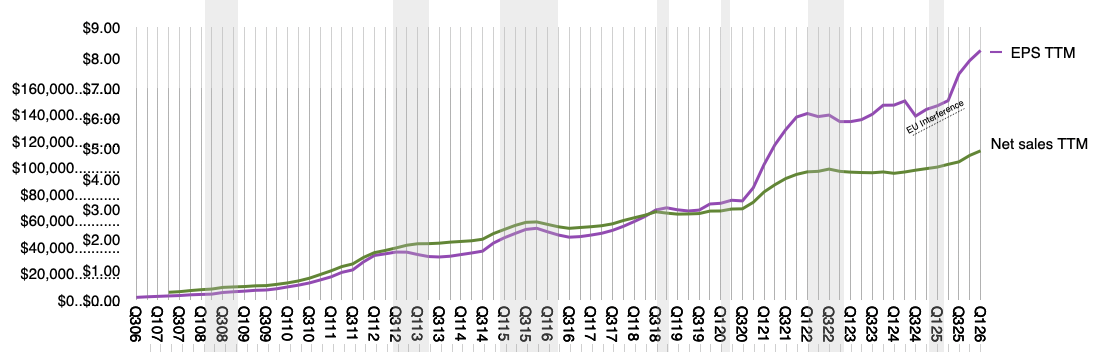
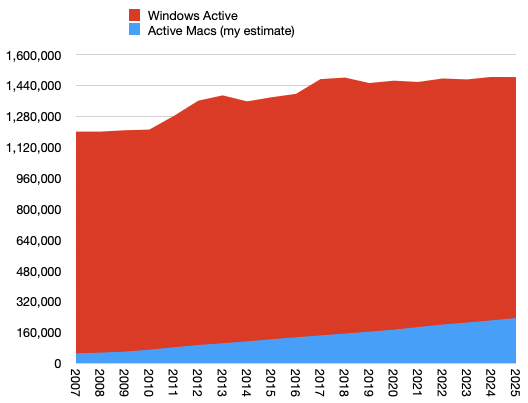
    …pensive. Selling out is a problem is customers will abandon the purchase and buy something else. I suspect some may but some may even buy another Mac. The Mac Mini and Studio are also in stockout status. It's a windfall for the Mac but the big picture is shown in the graph below. Can Apple bend the blue curve?

    As I will argue in a further post perhaps this is one of those pivotal moments.

    MacBook Neo Sold Out Through April


  9. IDC: Apple Grows 33.3% in China as Market Declines 3.3% in Q1 2026

    Nota Bene

    Counterpoint says 20% and -4%

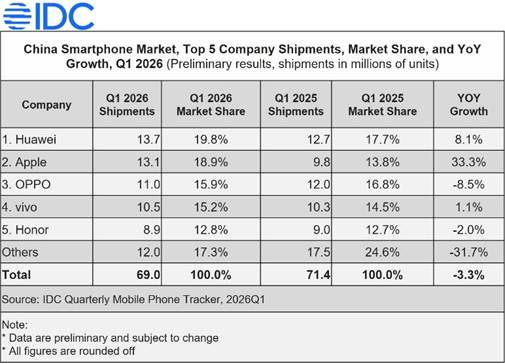
    China smartphone shipments fell 3.3% in Q1 2026 to 69M units, with Huawei and Apple driving premium demand despite rising costs and supply constraints.

    Source: IDC

    Separately, CounterPoint research reports;

    China’s smartphone shipments declined 4% YoY in Q1 2026, as memory shortages disrupted supply and drove up costs across OEMs.

    Huawei led the market in Q1, supported by its domestic supply chain advantages and stable pricing. As a result, the brand recorded its highest-ever quarterly share in China since Q4 2020.

    Apple delivered the strongest growth among the top six brands, and it is widely seen as best positioned to navigate the memory crunch.

    NB: Both researchers say Apple share in China is about 19%, nearly tied with Huawei at 20%…

    …. The big loser seems to be "Other" down 32%. Clearly Apple management saw this coming and guided accordingly.

    Some analysts are increasing their targets finally realizing that the memory supply crisis might be beneficial to Apple. This should have been noted already three months ago when Apple provided extraordinary guidance for the March quarter.


  10. iPhone vs Android Switching Rates

    Nota Bene · 3 comments

    Bitchin' ain't Switching

    SellCell’s Smartphone Loyalty Survey 2026 shows iPhone and Android loyalty at record highs, but Android users still switch more.

    Key findings

    iPhone loyalty stands at 96.4%, up from 91.9% in 2021

    iPhone switching stands at 3.6%

    Android loyalty stands at 86.4%, with switching at 13.6%

    Android users are nearly four times more likely to switch than iPhone users

    Samsung loyalty stands at 90.1%, up from 74% in 2021

    Samsung switching stands at 9.9%

    Google loyalty stands at 86.8%, up from 65.2% in 2021

    Google switching stands at 13.2%

    The loyalty gap between iPhone and Android now stands at 10 percentage points

    Price and value are the biggest drivers of switching

    Technology is the second biggest driver

    Overall, loyalty has increased across all major brands since 2021

    Source: SellCell.com Blog

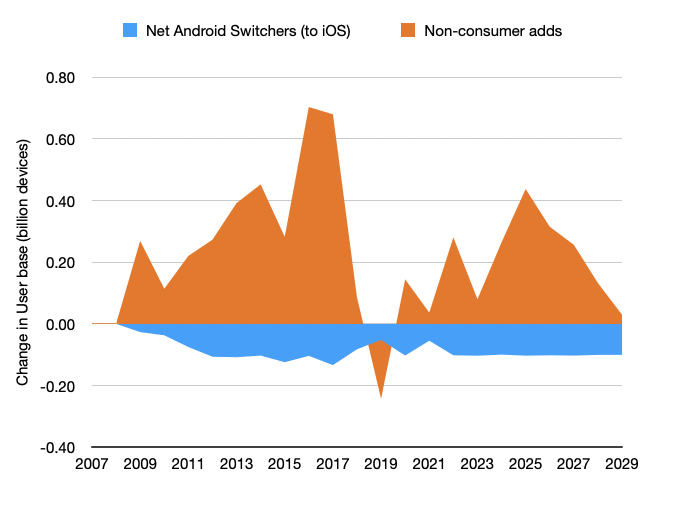
    NB: I did a deep dive into the data and came up with graph above. The original report shows intention numbers which seem quite high. For instance, the net switching rate between iOS and Android is 10% in favor of Apple. This would imply that the entire user base would flip in 10 years. It would also imply...

    ... that Apple gains over 400 million new users every year as Android base is about 4 billion. But we know that Apple gains about 100 million a year based on the active device tally (now at 2.5 billion active devices and 1.5 billion active iPhones).

    Therefore, based on the known install bases and growth therein, we can determine that the actual switching rate from Android to iOS is about 2.6% for any given year and the switching rate from iOS to Android is about 0.9%. Android still gains overall users since new users are converted from non-consumption.

    About 300 million are still being added to Android while 100 million are lost to iOS.

    As time goes on and saturation is reached (near 5 billion active smartphones) then the churn will imply that Android will eventually become a net user loser.

    That probably won't happen before 2030. When saturation does happen however, I will be watching to see if Apple chooses a different strategy to accelerate switching similar to what it is doing with the MacBook Neo at a time of PC market saturation.

    The lesson here is that switching intention surveys showing a net 10% churn rate don't mean that the actual switching rate is net 10%. The intention to switch is a sentiment but actual switching is often more difficult than a wish to do so.

    I think actual net churn is 1.7% of the base each year. That's still 100 million a year. For now it seems Apple is happy to maintain that rate.

  11. Apple and Amazon Partner on Satellite Deal

    Nota Bene · 2 comments

    Counting satellites and subscribers

    Amazon said on Tuesday that it’s agreed to acquire satellite company Globalstar, a major step for the e-commerce business as it works to build out a space-based Wi-Fi service through its Leo initiative.

    Amazon also announced that it signed an agreement with Apple to provide satellite connectivity for current and future iPhone and Apple Watch features. The partnership was made possible via an existing deal Apple already had with Globalstar.

    Amazon said on Tuesday that it plans to work with Apple on future satellite services. “Amazon will continue to support iPhone and Apple Watch models currently using Globalstar’s existing and planned upcoming low Earth orbit satellite constellations, being manufactured by MDA Space, and collaborate with Apple on future satellite services using Amazon Leo’s expanded satellite network,” a news release read.

    Source: Barron's via Apple Stocks

    NB: I assume Apple has wanted to steer clear of Starlink but it's not clear that was a primary consideration in choosing Globalstar.

    The deal gives Amazon access to Globalstar’s network of two dozen satellites. Amazon has the aim of deploying about 3,200 satellites in Earth’s low orbit by 2029. Amazon currently operates a network of more than 200 satellites and is preparing to roll out its satellite internet services later this year.

    Globalstar powers Apple’s “emergency SOS” feature and had received an investment of $1.5 billion for 20% share. Under that development, the network would expand to 54 satellites. Amazon and Apple have signed an agreement to continue the services.

    Incidentally, given the acquisition price, Apple's $1.5 billion investment is now worth $2.13 billion.

    The acquisition of Globalstar by Amazon is a positive for Apple as it ensures there is additional investment in space-based networks and thus there isn't the possibility for a single supplier situation. Apple's investment in Globalstar was already a signal of their intention to sustain competition. However, it should be understood that space-based networks were never going to rival land-based except for remote locations and emergency or military use.

    Starlink, considered the dominant player, serves about 11 million users. I would note that 11 million is 0.1% of the number of cellular subscriptions worldwide.