Asymco

Asymmetric Intelligence

Research

  1. How will we measure Apple's Watch success?

    Research · 55 comments

    It won't be easy. The company will not be reporting the Watch segment revenues or (presumably) unit sales and therefore we won't have an accurate unadulterated view of the business. In addition, the large number of products in the mix and wide price variance means that it will be difficult for analysts to determine demand and price.

    There is a hidden benefit to not having this data. All data is a creation and it tends to lead thinking in directions led by whatever is being measured (and whoever chose those measures and their motives). And yet without data there is no evidence and no credibility. In other words: You can't manage without measurement but you can't be sure what to measure.

    The analyst is then faced with a requirement to have good taste or at least judgement about what to measure. This judgement is based on experience and good theory. Given that, what could we measure to determine whether the Apple Watch will be a success?

    Here are some suggestions:

    1. Language. Measure whether "Watch" will come to mean "Apple Watch". "Phone" has come to mean not only "smartphone" but also all mobile/cellular phones and not just things used for calling but things used for all manner of information. This is a great test because the theft of semantics can only be accomplished through a degree of ubiquity of influential mindshare. Incidentally, the brand may well have been designed to do just that. ((It leaves open the question as to what watches as currently defined will come to be known as.))
    2. A measurable and significant reduction in the use of the iPhone. The Watch peels off uses from the iPhone and therefore the more it peels off, the less remains. However, that which remains will be more uniquely valuable to the incumbent. This is the process of carving and erosion that the PC experienced vs. mobile devices in general.
    3. An increase in the mix of large-screen iPhones. As iPhones are removed from pockets more rarely, the larger version might be more comfortable to carry and more useful to use for the immersive tasks that are outside the scope of Watch.
    4. An overall increase in iPhone sales beyond the foreseeable trajectory. This would suggest switchers from Android would be drawn to the platform purely for the value of the "accessory". Note that this is not inconsistent with the lower usage and higher spec mix measurements.
    5. Apps uniquely targeting the Watch. It's hard to imagine how this will develop as it involves millions of creative minds, but as smartphones created new economic value through the solving of new jobs to be done, the Watch should do the same. As a side-effect it should lead to new empires (or at least Unicorns) being formed around Watch use.
    6. Iteration. How quickly and deeply will the product be improved? Basic accessories like headphones and Apple TV have a leisurely update cycle. Smarter devices are faster. The cycle time of iteration should indicate how seriously Apple takes the platform and that itself should be fueled by positive consumer sentiment for the product.

    These indicators are vague and the data will be weakly signaled but in many ways it will be more meaningful than any financial performance figures.
  2. Luxurious

    Research · 101 comments

    Apple's new watches are priced in a pattern unlike any of the previous pricing models for Apple products.

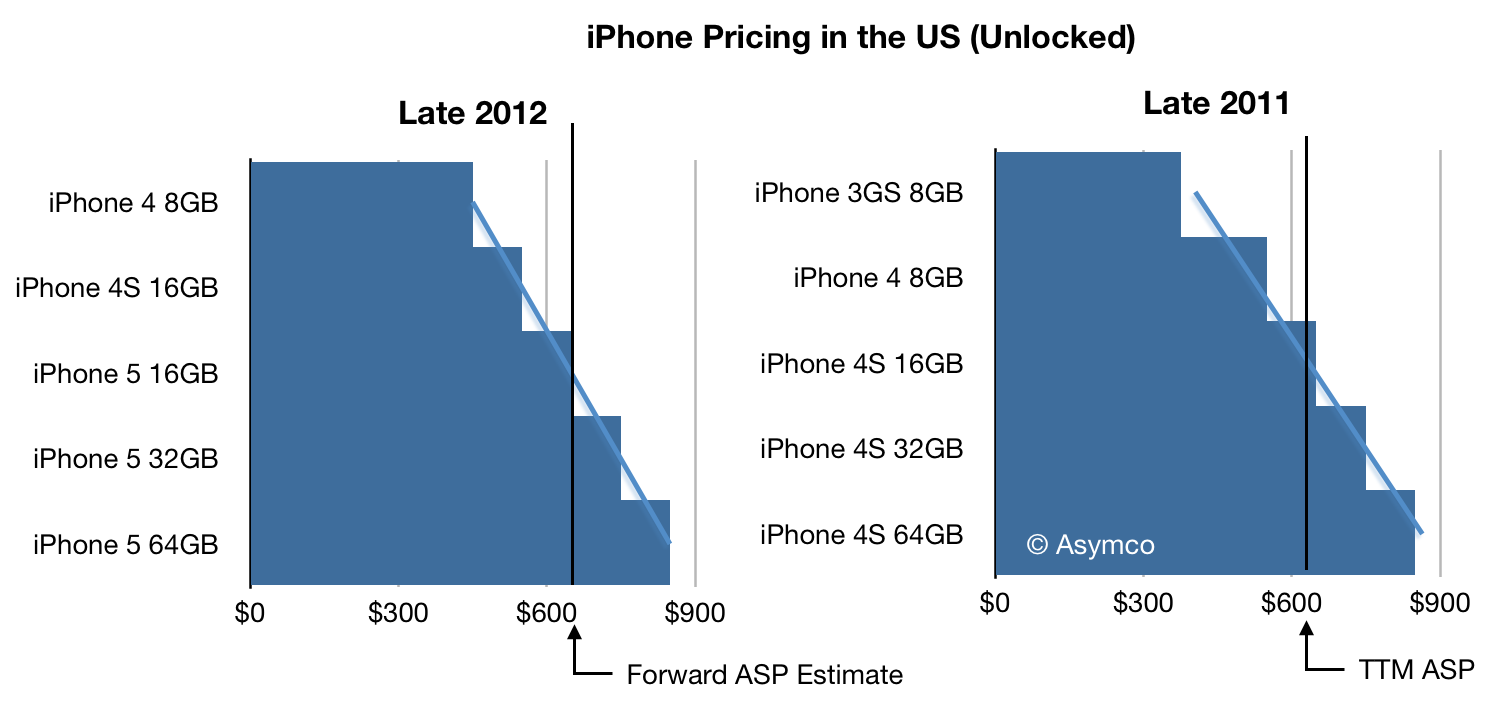
    Previous pricing models for iPhone, iPad, Mac and iPod were typically structured around storage differences. The higher the storage, the higher the price. The Mac had a slight variation where processor and graphics offered some additional configuration options. To illustrate, the graph below shows typical price bands for the iPhone (2011 and 2012)

    Screen Shot 2015-03-30 at 11.51.16 AM

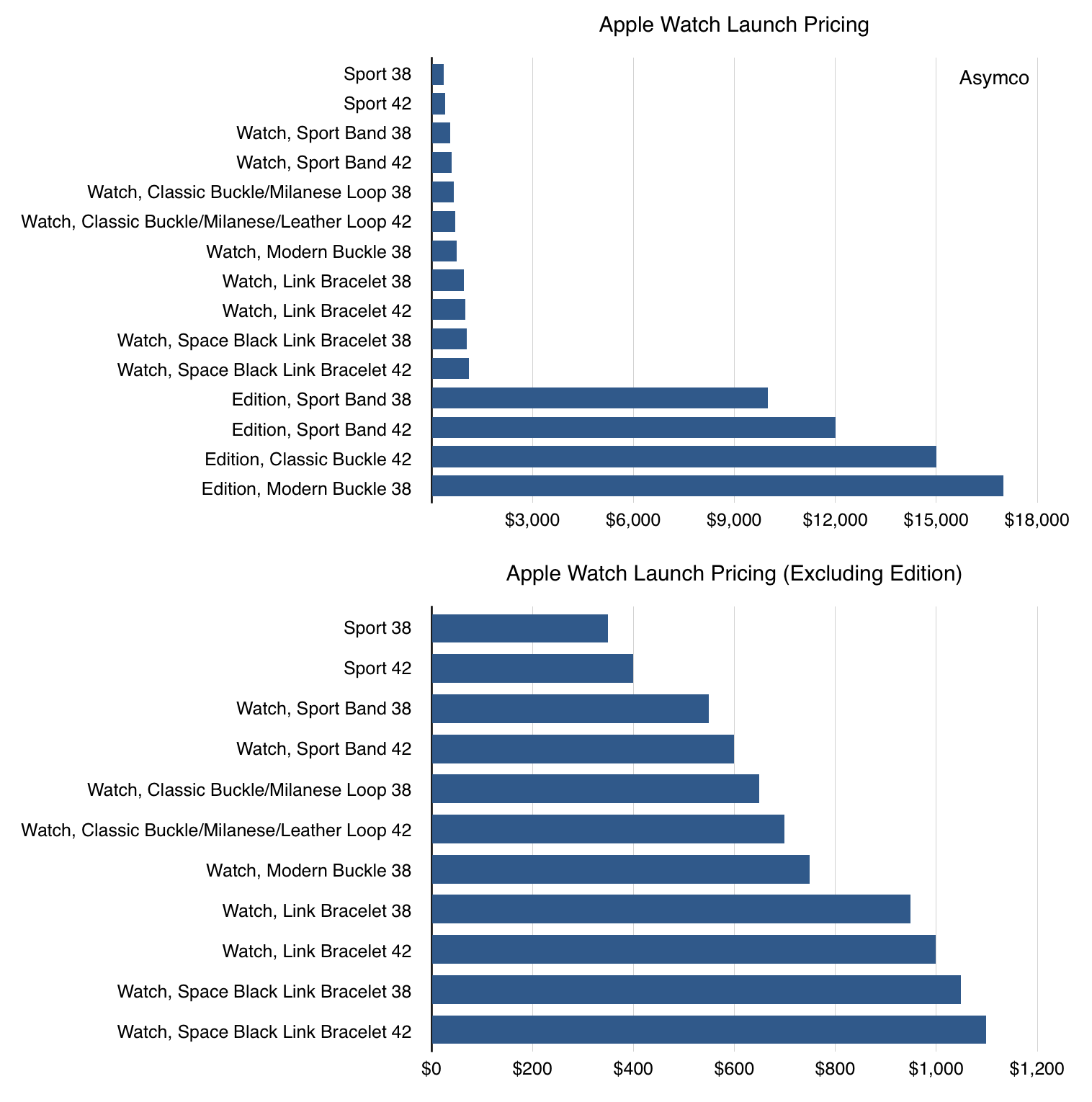
    In contrast, the watches are differentiated by size, materials and bands. There are also a total of 38 watch configurations available at launch (SKUs) and another 38 bands that can be purchased separately.

    The bands come in four price points and the watches in 15. Of these 15 watch prices, four are dramatically different. The pricing of the watches is shown in the two graphs below (with and without the Edition).

    Screen Shot 2015-03-30 at 12.03.19 PM

    This mix of product makes average pricing estimation more challenging, but the more pertinent question is what does this new pricing model signify? Is it something that Apple can "pull off"? Can Apple actually price not on functionality (or options thereon) but on materials?

    It used to be said that Apple's profit engine was fueled by the ability to price memory at a significant mark-up on its cost. The iPod earned the vast bulk of music player profits by offering additional memory increments at significant price increments. Even today, a 64GB iPod Touch is priced $100 higher than a 16GB version. Sounds reasonable, but a quick check shows that 64GB of Flash memory probably costs about $5. This exploitation of pricing/cost differences at the margin allows for great profitability and is rooted in the ways the buyers contemplate value.

    Therefore the difference between memory-based pricing and materials-based pricing is only in the choice of how to attach value in the mind of the buyer. In one case it's having the option on storage, in the other it's having the option, perhaps, of more durability, quality or glamour.

    The tricky part is understanding just how much the market will bear. What is the right differential for pricing of steel vs. aluminum? Or what makes gold worth so much more?

    The cost of these materials (and the processes needed to manufacture them) is not very important. As with memories, the differences are not that significant. It could even be that the Aluminum process is more expensive than the steel process--it depends also on volume.

    What matters most is how to gauge the perception of value.

    This is where one can take cues from the existing market. Gold is costlier than steel but the pricing difference is greater still. Multiplying $1000 (cost) by 10 (to get a price) yields far more profit than multiplying $1 by 20. This perception of gold as being worth it is far beyond its utility--a perception which has taken centuries to build. What Apple is doing with Watch pricing is simply leveraging existing perceptions of value for materials and using them to capture profits for an otherwise purely functional product.

    But that process of using perception to gain pricing advantage for function is how Prestige branding has always worked. The notion that materials, craftsmanship and attention to detail can be priced at huge multiples of cost is possible only with the right brand. That brand, itself built over decades, even generations, gives assurance of quality, perhaps exclusivity and comforts the purchaser in the moment of decision. It also provides assurance after the purchase and preserves the feeling of value well into the future. So-called Luxury brands are those which can impart these qualities on their products and extract the pricing advantage.

    Sounds great, so why doesn't everybody do it? The answer is that it takes time and perseverance, with typically low volumes. This is not something technology brands have been able to do. Mainly because the products are perishable but also because they have not been around for long. With technology, the value is high at purchase on a functional basis but diminishes rapidly afterwards. It's as if, in order to preserve notional brand value, a product needs to be a functional commodity, undifferentiated on what it does but differentiated on the way it does it.

    This is the unique value of Apple's brand: among technological brands it can stretch to cover the perception of value for design, materials, craftsmanship and prestige. At the same time it offers new experiences and introduces new products for new jobs to be done.

  3. Asymcar 22: The Goddess

    Research · 17 comments

    The incomparable Citroen DS (French homophone: déesse), 60 years old this year.  Hydropneumatic, self-levelling suspension aerodynamic and interior design efficiency, swiveling headlights, novel construction methods. Ahead of its time even in 1985. Why did this iconic design not endure?

    We use this parable to analyze Apple Car rumors.

    via Asymcar 22: The Goddess | Asymcar.

  4. Peak Cable

    Research · 172 comments

    Paying for TV has been a curious consumer phenomenon. There was a time when TV was free to consumers. It was delivered as a broadcast over-the-air and paid for either by commercials (US mostly) or by taxes on viewers (Europe mostly). The consumers were delighted with the idea as it was far better than radio and radio was delightful because it was far better than no radio.

    The process of convincing consumers to pay for something that used to be free was quite interesting. The first benefit to be articulated was that the quality of the picture would be much better. It would, in essence, be noise-free. ((This was in fact the birth of cable TV: a shared antenna for a community in an  electromagnetic shadow))

    The second benefit was an increase in the number of channels. VHF and UHF television would cover about three and 5 channels respectively while cable could offer dozens, many specializing on specific types of content like the Home Box Office (HBO) offering movies and ESPN offering sports only and MTV music videos and CNN news only.

    The third benefit was fewer (or no) commercials for some of the channels. This was especially valued by fans of movies whose interruption by commercials was often detracting from the immersive value and continuity of the cinematic experience.

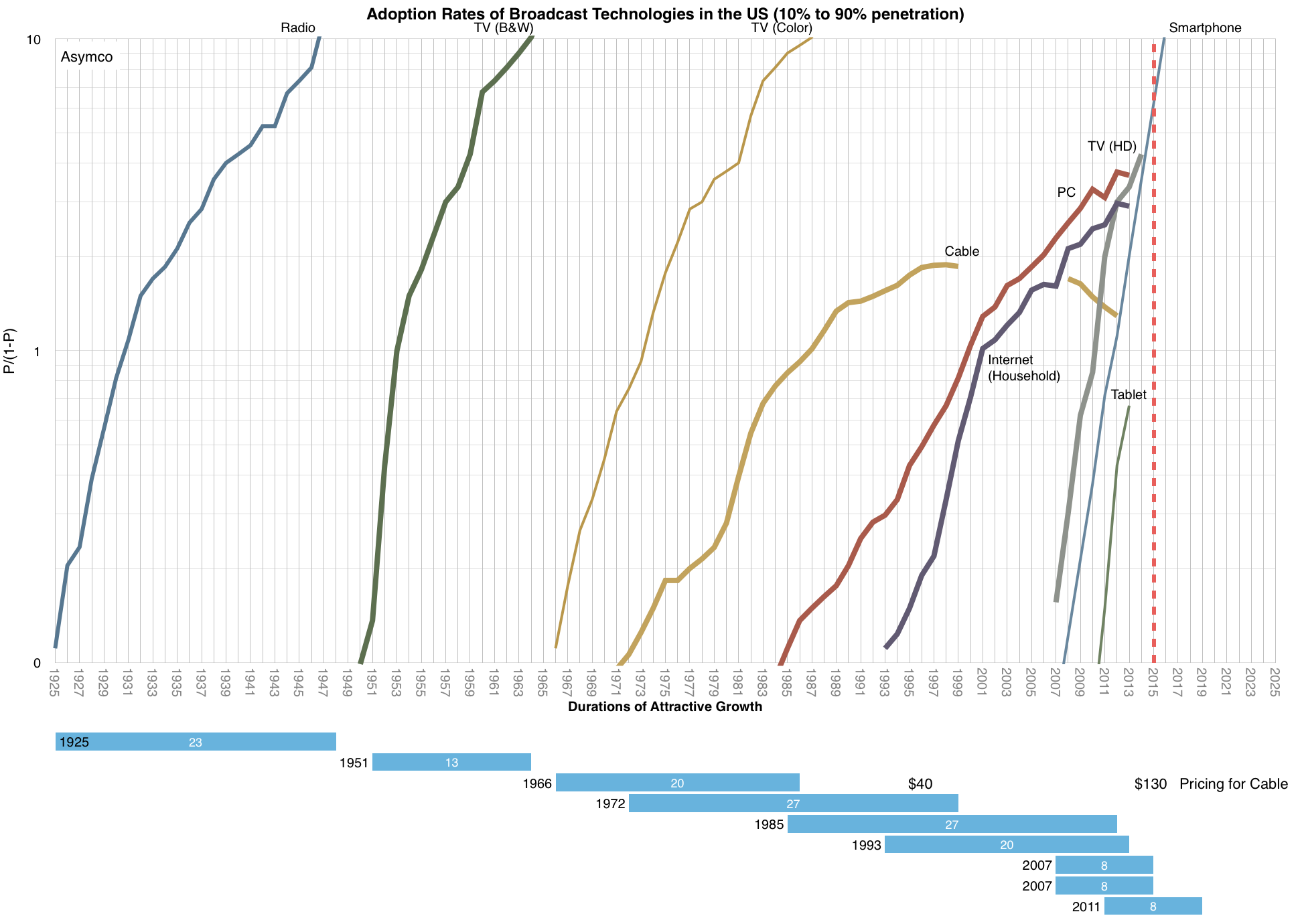
    These benefits were very attractive during the 1980s, to the extent that about 60% of US households adopted cable. An additional group later adopted satellite-based pay-TV as the technology became reasonably cheap.

    Screen Shot 2015-03-19 at 2.29.06 PM

    These benefits were priced modestly but as the quality and breadth of programming increased, prices rose. An average cable bill of $40/month in 1995 is $130 today ((a 6.1% compounded rate of price growth vs. a 2.4% rate of inflation)). Some of that revenue went into upgrading the capital equipment in use (the plant) and some into paying for the higher production values. Yet more went to the sports leagues and their players whose business models increasingly depended on broadcast rights.

    And so over a period of about 40 years, watching TV went from free to quite expensive. More expensive even than a family's communications costs (i.e. telephone service.) That's quite an achievement at a time when technology diffusions caused huge price reductions in other goods and services. Consider that the TV set used to watch the programming improved dramatically while decreasing in price over the same period.

    Meanwhile, some of the benefits began to be less relevant. Commercials are more abundant than ever. Ad buyers spend about $60/month per household to deliver ads ((Implying that the TV "business" has a $200/household/month revenue model)) The quality of the TV picture is actually worse due to compression than one might get with over-the-air digital broadcast. Finally, the abundance of channels is beyond anyone's absorption rate. Those channels which used to be "pure" became polluted and undifferentiated as each tried to be the other. ((A pursuit no doubt driven by seductive but toxic market research))

    On top of these paradoxes is the fact that actual penetration of the service has been declining. As the graph above shows, Cable TV has declined (though Pay TV much less so). The industry has reached saturation decades ago and has not offered anything meaningful in terms of innovation.

    Disruption theory suggests that once a product over-serves on meaningful bases of value creation (and underserves on value) it opens the door to disruption. Which leads me to ask not whether cable is past its prime but rather why it's still around?

    The answers are usually immediate and plentiful: conspiracies of monopolists, lobbying, back-room deals, lock-in of content and all kinds of other misdemeanors. To which I would say: You can fool some of the people all of the time and all of the people some of the time but you can't fool all of the people all of the time.

    So again, why have all the people been fooled all this time? Twenty years have passed since the industry reached saturation and prices keep rising. Today the average cable bill is projected to rise to $200/month by 2020.

    My answer is that disruption is predictable. Users are cutting cords, the "uncabled" or "never-cabled" are a significant portion of the population. 13.5% of broadband households with an adult under 35 have no pay-TV subscriptions. 8.6 million US households have broadband Internet but no pay-TV subscription. That's 7.3% of households, up from 4.2% in 2010.  Another 5.6 million households "are prime to be among the next wave of cord-cutters," according to Experian.

    The same phenomenon occurred with mobile vs. fixed telephony. For several years it seemed that mobile was sustaining to fixed or that fixed was immune due to lock-ins. The fixed telephone incumbents insisted that the data was inconclusive. Then the trickle of abandonment turned into a deluge. The quality of service for mobile kept increasing and, with data, it became clear that the mobile devices could unleash unfathomable functionality and value.

    And so it goes. A business dies first slowly then quickly. (('How did you go bankrupt?' Bill asked.
    'Two ways,' Mike said. 'Gradually and then suddenly.' -The Sun Also Rises (1926) Ernest Hemingway)) The exact timing is tricky because of the non-linearity of the phenomenon. It's also hard to declare end-of-life since business zombies are very common. What is clear however is that the economics will change dramatically and the alliances between talent and distribution will shift to entrants and away from incumbents. The point when we will look back and say that cable was finished will probably come by the end of this decade.

  5. Conversations with Apple's brand

    Research · 22 comments

    According to Folkore, in 1981 Apple took out a two page ad in Scientific American which explained that whereas humans cannot run as fast as other animals, a human on a bicycle is the fastest species on earth.

    Jobs had made the observation that a computer was "a bicycle for the mind" earlier, in 1980, at a time when the decision to purchase a computer was driven by an intellectual curiosity and justified as an improvement or assistant to the intellect. It was to make the lighten the labors of our intellect.

    Apple brand at the time as an appeal to the intellect via a humanistic argument. A more emotive positioning of a tool, but a tool nonetheless. This positioning evolved throughout the 80s and 90s into an "intersection of technology and the liberal arts."

    We can see how the conversation with the potential buyer was along the lines of appealing to the intellect while offering a humanist sweetener. Humanizing the product allowed it to be accepted into a world that feared the complexity and awkwardness of such a machine.

    During the 2000s, with the ascent of iPod, the conversation shifted to prioritizing  the emotions more than the intellect. The products had to appeal to those who wished to express and enjoy products of emotional value. Products like music and videos and the output of the arts rather than the sciences. The brand became emotional rather than intellectual. It created an aesthetic, and become culturally iconic.

    During the 2010s, with the ascent of iPhone and the emergence of the Watch, the brand speaks a language of instinct, leaving intellect and emotion as secondary or tertiary voices. Instinct is visceral, lust-inducing. It seems to short-circuit any of the rational. Non-rationalism does not mean irrational. It just skips right over the head and heart and hits the gut.

    One could argue that during these three decades, the organs the brand was engaging in conversation shifted from the mind to the heart and then to the glands. Those glands which release hormones and are directed by non-rational neurons. The evidence of the conversation would be in resulting products causing pupils to dilate, breaths to be quickly drawn and skin temperatures to rise.

    The brand therefore has managed to move from a rational, to a neurological, to an endocrine response.

    The curious thing is that during these shifts, Apple's entry into new biological spheres of influence has been largely unchallenged. I suspect this is because emotional or instinctive products are appealing due to their lack of rationalized value. In other words, what makes a product hormonally appealing is a lack of intellectual appeal ((and vice-versa in many cases)). Apple can enter into the world of lustful appeal while lustful brands can't enter into functional appeal.

    This is a classic asymmetry which perhaps no other brand can pull off. ((The reason is complicated but stems from the firm having been built to execute nothing but home runs. By shunning portfolio theory, Apple can wander into new categories far from its biological home grounds.))

  6. The Analyst's Guide to Apple Category Entry

    Research · 46 comments

    Understanding Apple’s intentions seems to be a popular parlor game and there are many attempts at divining intention from data and market study. These attempts at market research for answers are futile because Apple does not compete in existing markets but rather it creates new markets. For instance, the market for the Apple II could not have been assessed from research into the computing market of 1974. The intention for Apple to enter into music devices and services could not have been predicted through an analysis of MP3 player market in 2000. The iPhone was also not predicated on the market for “Internet Communicators” in 2006 or 2002 when the iPad was first contemplated. ((The market for phones was large but the iPhone pricing and features made it incompatible with any reasonable segment of it.))

    Instead of measuring the size of pre-existing markets, surveying the functionality of existing products, or weighing toxically financialized ratios like margins and market shares, I recall this ad (Our Signature, first seen at 2013 WWDC):

    This is it
    This is what matters

    The experience of a product
    How it will make someone feel
    Will it make life better?
    Does it deserve to exist?

    We spend a lot of time on a few great things
    Until every idea we touch
    Enhances each life it touches

    You may rarely look at it
    But you will always feel it
    This is our signature
    And it means everything

    My interpretation of these lines, coupled with additional public statements can be used to create a “litmus test” for new product categories:

    1. The experience of a product. Read: They will work on things to which they can make a meaningful contribution. To me this means that they will build things which require an integrated approach. As Apple is "the last integrated company standing” it means they will work on problems where the system is not good enough. This means that they will not work on problems where an individual modular component is not good enough. By system I mean, in the largest sense: production, design, distribution, sales, support and services must work in a seamless way. Systems analysis implies a broad understanding of the causes of insufficient performance along the dimensions of “experience”. The experiences are what differentiate the products (and lead to high margins) and these experiences are possible only through the control of interdependent modules.

    2. Does it deserve to exist? Read: They will work on very few things. They will say no to many things. It’s still true that all of Apple’s products can fit on one table. That may not be true forever, but their product space will not grow as quickly as sales grow. This means that there is no notion of “marginal value” or portfolio theory where products are added because they can be justified as “moving the needle” or balancing demand. Rather, the few things which will be worked on will address non-consumption. Non-consumption of experiences.

    3. Enhance life. Read: The things they release are inevitable even though nobody asked for them. The reason this is possible is that there are unmet and unidentified “jobs to be done” which are powerful sources of demand and whose satisfaction leads to unforeseen rewards. The problems that can be addressed are uncovered through a process of conversation with a few people. They are not uncovered through surveys or large n statistical studies. Without the ability to ask the right questions, big data only leads to big misdirection. In contrast, good taste in questions allows small n to lead to big insight. Apple’s ability for finding the right problem to solve comes from this greatness of taste in questions.

    So given this litmus test, will Apple build a Car?

    I believe the problem of transportation and its proxy, the automobile, provide all the requisite demand for Apple's attention. Technical questions abound and they may still prove unsurmountable before a launch happens, but there are no doubts in my mind that this is a problem Apple would see fit to address.

    Non-consumption of unmet and unarticulated jobs to be done can and should be addressed with systems solutions and new experiences.

    The poetry is pretty clear on the matter.


  7. The S&P 499

    Research · 68 comments

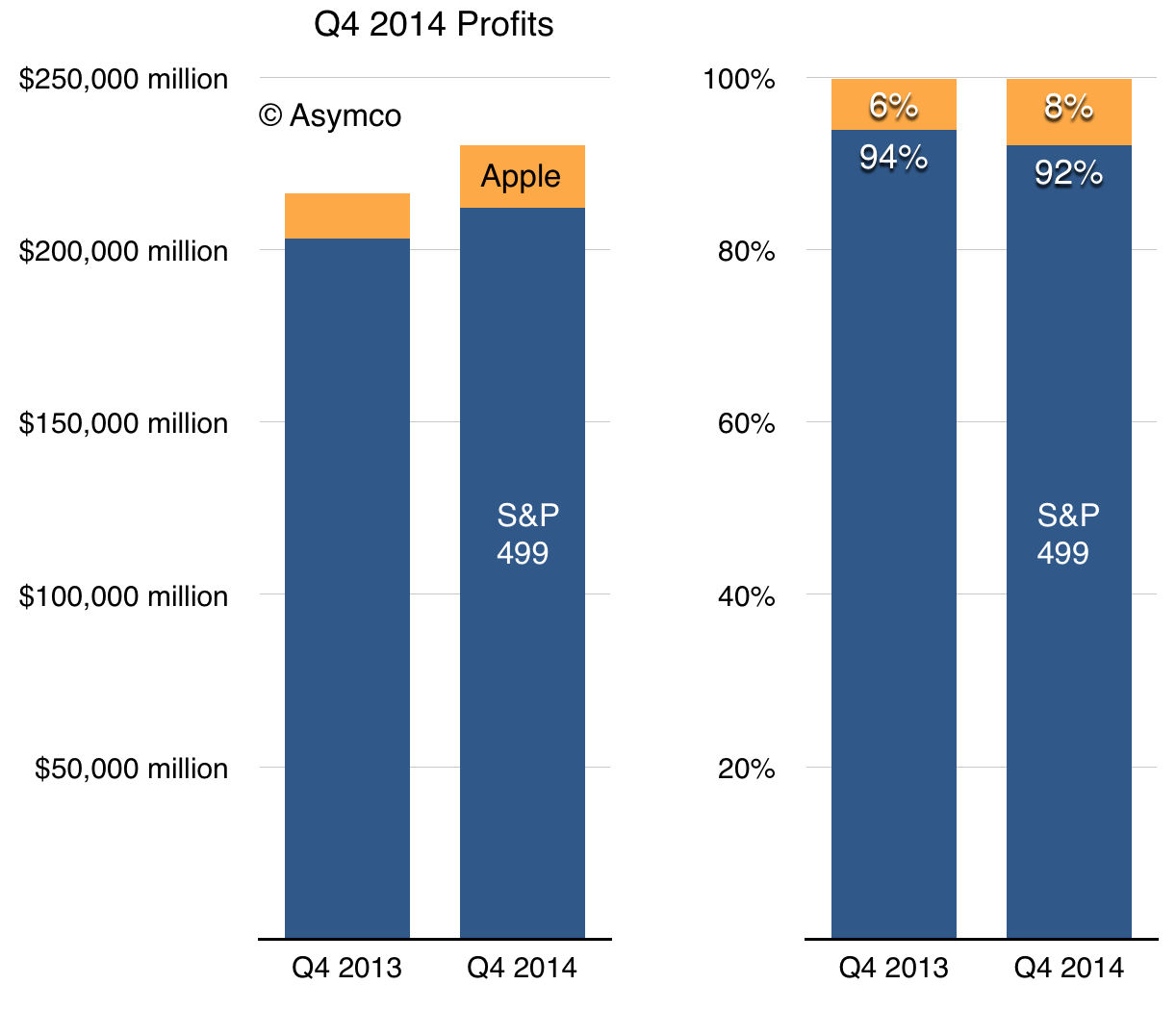
    Thomson Reuters reported that excluding Apple, the entire S&P 500 grew profits at a rate of 4.4%. Including Apple the figure is 6.4%.

    Using one weird trick ((Algebra)) I calculated the value of profits generated by the S&P 499 (i.e.the largest public companies excluding Apple) in Q4 2013 and Q4 2014.

    Apple therefore accounted for nearly 8% of the S&P 500 in the last quarter. A year earlier Apple was a mere 6%.

    Screen Shot 2015-02-08 at 8.43.53 PM


    It should therefore be obvious why Apple's P/E ratio is 16.1 while the S&P 499 P/E ratio is 19.8.

  8. How many iOS devices did/will Apple ship?

    Research · 11 comments

    Last August I wrote:

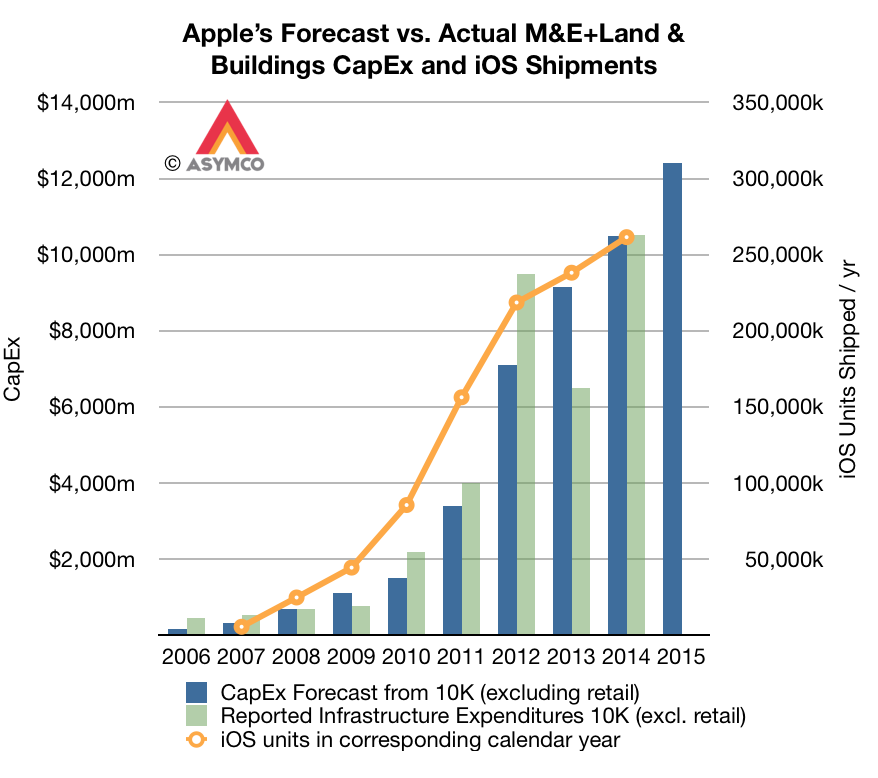
    It’s therefore reasonable to assume that calendar 2014 will see at least 250 million iOS devices sold

    The actual figure was 259.5 million.

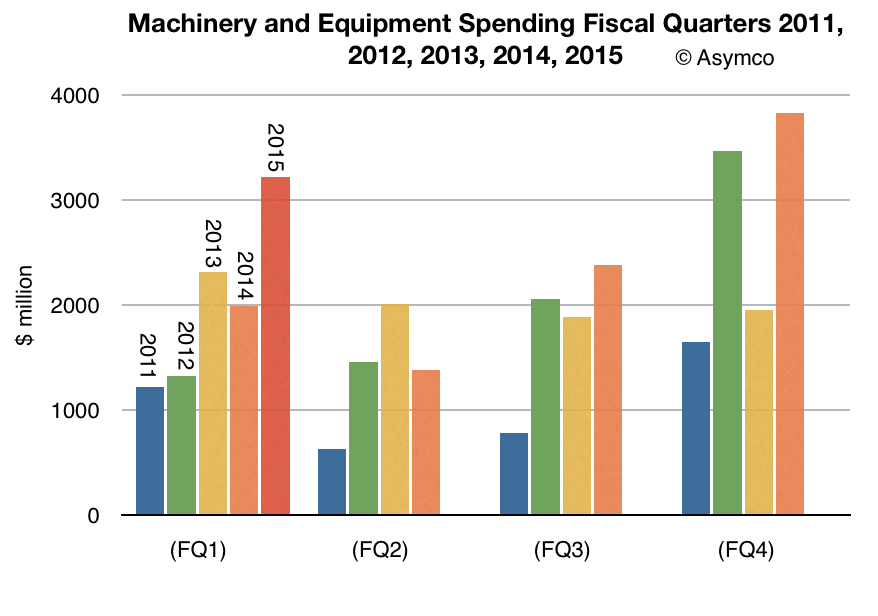
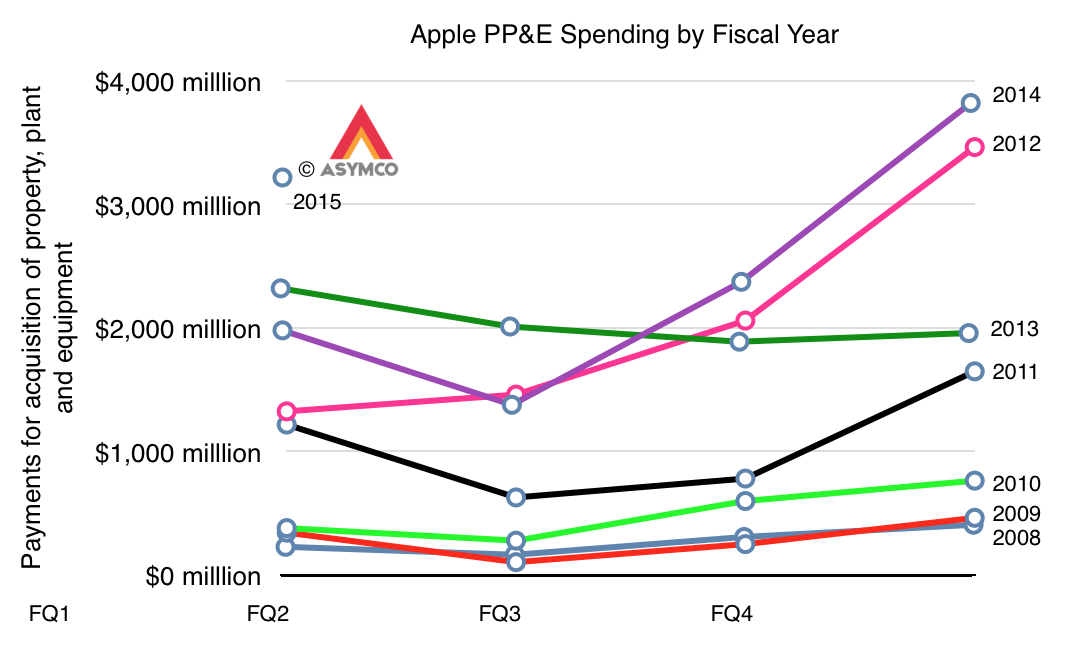
    Looking ahead, the capital spending pattern so far shows a distinct rise heading into Q1.

    Screen Shot 2015-02-08 at 7.33.14 PM

    This could be partly due to the new campus, the new Watch production ramp and perhaps new iPad models.

    Screen Shot 2015-02-08 at 7.33.27 PM

    Nevertheless, I think it's safe to predict that the company is on track to ship 310 to 320 million iOS devices in 2015.

    Screen Shot 2015-02-08 at 7.35.30 PM


  9. Apple's Growth Scorecard

    Research · 26 comments

    Apple's Net Sales grew at the rate of 30% in the last quarter. Earnings per share grew at 47%. Both of these figures are the highest since 2012.

    Screen Shot 2015-02-08 at 5.27.47 PM

    It should be noted that although the rate of growth is extraordinarily high, the company never actually stopped growing in the past three years. As the table above shows, net sales has always had positive growth.

    Compared with the fourth calendar quarter of 2011, Apple's sales are 61% higher and earnings per share are 54% share. ((Some of the expansion in earnings per share is due to the willingness of shareholders to sell their shares to Apple. 10% of the shares around in 2011 have thus disappeared.))

    This degree of growth at this stage in the history of the markets it participates in is a revelation.

    Consider:

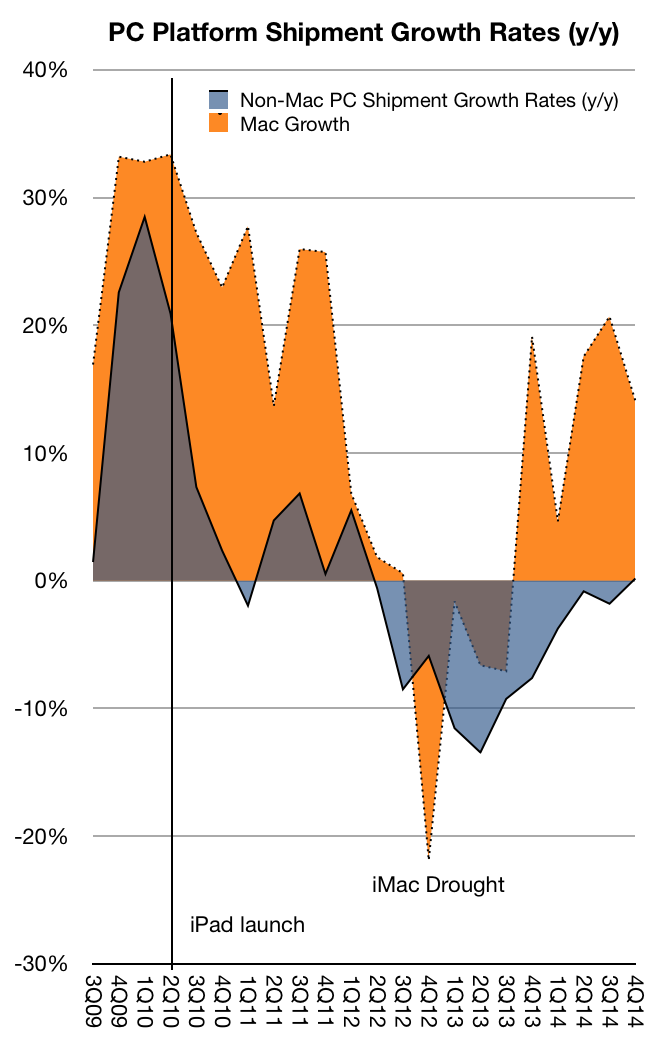
    • The PC market is more than 30 years old. In this mature market the Mac has been outgrowing the Windows platform for 34 out of the last 35 quarters.
    Screen Shot 2015-02-08 at 5.35.43 PM


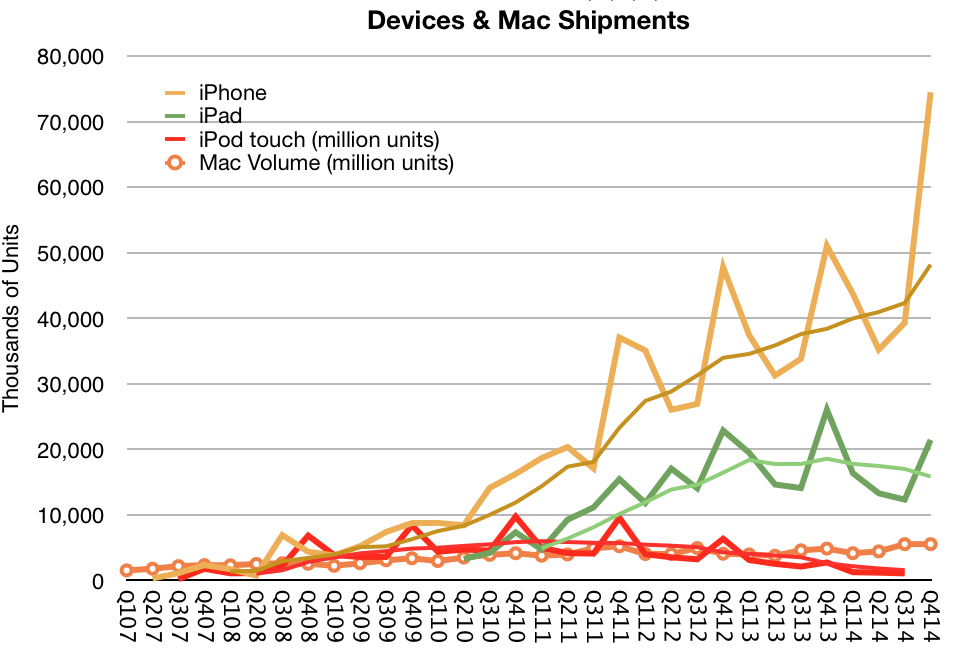
    • The iPhone was announced eight years ago and it still managed to grow at the rate of 57%.
    Screen Shot 2015-02-08 at 5.47.11 PM
    • The market shares of its Mac, iPhone and iPad products are all remarkable only for their paucity.
    • The pricing of all their products is more than double the median for their categories.
    • Regardless of extreme growth, pricing power, headroom and, most importantly, customer loyalty, the company's prospects are seen as dismal in contrast to its underperforming peers. ((As measured by P/E or FCF/EV ratios vs. direct rivals, technology companies or the S&P 500.))
    • Such is the plight of the anomalous.
  10. Asymcar 21: Where we’re going, we don’t need roads

    Research · 7 comments

    Gartner asserts that “connected cars or smart cars are poised to play a pivotal role in the Internet of Things (IoT)”. We say “Hah!”

    Also,

    • Who levies automotive platform taxes?
    • What in the world could “over serving” transportation mean?
    • Using the Automatic app in a Porsche.
    • BMW’s  “sounding the alarm” over tech companies efforts to collect auto data.
    • China’s car industry and other unimportant details relative to declining interest in driving among young people.

    via Asymcar 21: Where we’re going, we don’t need roads | Asymcar.

  11. Haunted Empire

    Research · 67 comments

    The "Stupid manager theory of company failure" (and its corollary, the "Smart manager theory of company success" ((As well as the "Smart/Stupid leader theory of national success/failure"))) remains the most popular, perhaps even the most universally accepted theory of management. Book after book, thoughtful article after article alludes to this theory and whenever a company is perceived to be under-performing, all fingers point to the leadership with demands for blood letting.

    This is not a new phenomenon. When catastrophe strikes, as a thoughtful species, we have always asked for leaders to be sacrificed. In Europe during the Iron age leaders were sacrificed when crops failed. In South and Central America leaders were ceremonially tortured for similar reasons.

    Of course most crop failures were due to weather phenomena and the anointed leadership had nothing to do with these causes. Nevertheless ancient correlation analysis would have revealed the pattern that good leadership meant good weather and bad leadership meant bad weather.

    There was a balance to the downside however. When times were good the leadership enjoyed luxuries and praise. This was the essential deal societies made: we'll keep you in riches and allow you to be idle as long as times are good but ritualistically slaughter you when times are bad. We'll declare you "chief magical officer" and place all our faith in you. But, of course, if you fail, we will will be vengeful.

    And so it goes in today's corporate world. I've often said that corporate governance is medieval, or pre-scientific in its approach to understanding causality. That may be too generous. As far as the reward/punishment system (also known as Human Resources) it's probably pre-neolithic. The luxuries and extravagance which we heap upon the leader provide abundant evidence. Leaders insist on these ironic "pay packages" and boards approve them because they know they can and will be ritualistically sacrificed if and when the mobs turn against them.

    A manager would be a fool to accept even generous pay given the risk, actually near certainty, of ritualistic slaughter. They demand and are unquestionably given absurd pay that has no relationship to performance. Such pay has no relationship to performance because it isn't designed to reward performance but to account for the risk of arbitrary and very public sacrifice. Boards (and hence shareholders) are deliberately hiring a scapegoat for sins as yet unknown. Luxury and violence are thus finely balanced in what is called "Executive Search".

    What allowed civilized society (i.e. that outside of corporations and politics) to move beyond this has been an understanding that our destinies are not necessarily tied to individuals' actions. We don't need to adulate/prostrate/dismember/defenestrate someone if our car does or does not work. People have begun to understand that there are rules about nature beyond the control of known or unknown agents. Complex systems like factories, farm  irrigation and even air traffic can be made predictably reliable without magic.

    Yet we are not willing to suggest that such rules apply to social systems. It's not just laymen who abstain. Historians and social scientists are mortified at the notion that causal statements could ever be made about society.

    Causal statements (beyond good/bad people => good/bad outcomes) are  considered non-credible in the very institutions which harness laws of nature in order to create value. Consider the recent instance of corporate defenestration  directed at Tim Cook. He was accused of failure of magic. I say this because he replaced a previous magician with many powers and the anger at his inability to match this power was at a fever pitch in 2012 and 2013. A book was even written about this failure and titled with the appropriate metaphor (See blog title).

    I know what you're saying: the sad fantasists which subscribe to these theories are wrong. Their theory is disproven almost every day. Even though we reward them as if they did, managers do not possess magical powers.

    But the author of Haunted Empire was surely well rewarded for her accusations. We rewarded her because our search for answers is otherwise unmet. What alternatives do we have?

    Think of it this way: What did ancient people have other than the Anointment/Sacrifice theory of good management? It persisted for millennia. The lack of alternatives means today we still believe as they did.