Asymco

Asymmetric Intelligence

Research

  1. Twenty Questions from Catalin Stelian Andrei

    Research · 17 comments

    Catalin Stelian Andrei, Editor of The Day, INTERNET PROTV asked me twenty questions:

    1. What phone do you have in your pocket right now? Why that model?

    I carry the iPhone 5. The last iPhone I bought was an iPhone 5C which I gave to a family member.

    2. Apple is going to launch, form all we know, an iPhone with a bigger screen, long after their market rivals. Is Apple one step behind, being forced to take this road in the fight with Android and Windows Phone devices? Because many smartphone users were hoping that an big screen iPhone, a redesigned model, will be lauched long time ago, and that didn’t happen.

    Making bigger phones is easier than making smaller phones. First because miniaturization has always been the most difficult engineering challenge, and second, because a smaller phone has a smaller battery making efficiency much more important. The larger the phone, the simpler it is. The third reason smaller is more valuable is that it’s easier to carry and use. The largest phones cannot be put in pockets and cannot be used with one hand. In the history of consumer, electronics size reduction has been the most consistent measure of performance, and the most rewarding. Usually the most exceptional reductions in dimensions create the highest price and profit bands. There have been niches for larger portable devices but they are consistently a small part of the overall market. If Apple were to introduce a larger device I hope they will be able to solve usability problems and make the category attractive to a larger audience.

    3. What do you expect from the new iPhone 6?

    I expect it to run the latest version of iOS and, with the new apps developers will ship, that should make the most impact in people’s lives. I imagine health maintenance and home automation will become valuable new franchises. Of course iOS 8 will also run on older iPhones, but I suspect the newest iPhone will somehow run the new software better and have smoother integration with services.

    4. What’s the “not to do” lesson that Apple needs to learn for the now iPhone from it’s own past experience or their competitors?

    The biggest challenge is to move rapidly with scale. The company has managed to grow from zero phones a year to hundreds of millions. That’s great but it’s still frustrating to wait one year for major improvements. The “cycle time” of innovation for Apple remains one year. I wish it could be faster but perhaps this is also too fast for some. In some services like maps and iCloud and iWork, which are independent of hardware (mostly,) speed is of the essence.

    5. The iPhone is the most expensive smartphone on the market right now. In Romania, it certainly is. But where does Apple gains it’s most money from, selling products to users or selling services, like iTunes, App Store? And having that in mind, what will be their next step: better – breakthrough products or bigger, more complete services?

    The answer to where a company “gets its profits” is best answered by asking where a buyer “gets his value” from the product. For instance you might answer the question of where a car company gets its value by saying that it’s from making people be in more than one place in a day. So the “differentiation” of a car is in answering the question slightly differently. If it’s hard to see a difference to this answer between cars then it’s hard for any one company to make a profit. For a company like Apple, we need to ask what its users value about the experience and why they are willing to pay for that. My hypothesis is that the brand's value is in making life a little bit easier. That’s what Apple competes on. Of course, some people are not willing to pay to have an easier life and some even want to make their lives more complicated so Apple’s proposal to make life easier, for a price, is not accepted by everybody—which is ok by them. But for many, paying for comfort, productivity and ease of mind is worth quite a bit. The reason Apple is able to gain a premium over the competition is that this value proposal (of paying for simplification) is either weak or non-existent for competitors. Indeed, many competitors compete on the basis of making life more complicated.

    6. What does innovation means for Apple right now? What are their options for assuring a next decade of success? A new Steve Jobs person or a Steve Jobs tipe of group thinking. How hard is that to achieve?

    Innovation is meaningful invention—bringing useful creations to a large number of people who then make use of that creation. The interesting aspect of making money from innovation is that it’s a rare phenomenon, requiring many disciplines to work together. It’s like a big movie that somehow works and becomes widely popular but costs little to make. Many movies are made, few are successful and very few of those which are successful are built at low cost. What we know about technology innovation is that it’s a combination that comes together under strong leadership but that leadership alone is not sufficient. The myth of Steve Jobs is that he was both necessary and sufficient to success. The truth is that he was necessary but not sufficient. To make successful innovations requires strong leadership and teamwork and a process of incentives and passion that is hard to create a formula for. How this works at Apple is its biggest secret.

    7. Who are the key Apple employees right now? Do they need another Jobs or do they already have him?

    All Apple employees are key. I would say that’s the magic formula. There is no chief magical officer (and there never was.)

    8. What will be the next best thing for Apple? […]

    I don’t know. It’s probably not knowable.

    … Are they capable of another breakthrough in the market?

    Yes. This is almost certainly knowable.

    9. Is the smart-home project something that will really happen in the next, let’s say, two decades?

    If the project requires replacement of existing infrastructure, it will not happen. If the project allows adding new items to existing infrastructure, it will almost certainly happen.

    10. Growth comes from the middle and low-end smartphones, according to IDC. Would or would not be a good idea for Apple to release a handset cheaper than the 5c?

    If Apple were concerned with growth then they should. But we have to ask why they avoided doing this six years ago. Not only was it obvious to do so but a portfolio strategy was the modus operandi for every competitor and had been for decades. The question isn’t why Apple does not broaden its line-up but why do the others diffuse their efforts and have such poor focus.

    11. What feature or software you think would be the main battleground in the future, in the smartphone market? Apps? Battery? Camera?

    Integration of all the above. When new experiences and services emerge those who are able to make them usable succeed. Usability requires integration.

    12. Who puts more pressure on Apple: Apple itself, Samsung, LG, HTC, Microsoft and Nokia? And how.

    I suspect competition is part of motivation but it’s not the entire story. Let’s not forget that Apple is considered to suffer from competitor pressure from software companies, services companies, media companies, hardware companies and everything in between. For instance, Apple is in competition with Microsoft, Amazon, Google and Samsung but the competition is not transitive. In other words Amazon is not perceived as being in competition with Samsung and neither is Google competing with Nokia. So somehow Apple should be sensitive to every perceived alternative to every aspect of its products. This quickly becomes an absurd idea. Apple is a system of things and systems can’t be compared with components.

    13. What is Apple’s sensitive spot today. What do you believe Apple fears the most?

    Losing people. The problem of retaining talented people is the most difficult challenge, especially when they become very wealthy due to the success of the firm.

    14. In 2012, you described the fall of Nokia in competition with Samsung at the Guardian Mobile Business Summit due to the disruption theory: the launch of the smartphone. Is Apple in danger of becoming a victim of the same story in the near future? What technology could replace the smartphone and when?

    Yes, every company is vulnerable to disruption. The defense is not to protect against it but to self-disrupt or enable self-destruction. Self-preservation is an instinct in humans so this is psychologically very difficult. The crisis comes not from a technology change but a business model change and that implies a cultural change. Companies embrace any and all technologies which sustain their business models and reject, resist and ignore any and all technologies which disrupt their business models. Changing business models is like a brain transplant; it happens so rarely that we can count it on one hand. By the way, because it’s so rare is why companies who attempt it are discounted by the market.

    15. You've been a Nokia executive. From this perspective, how do you see the deal with Microsoft and the future of Windows Phone and the Lumia brand?

    This is a long story. I can’t really do it justice now but I will say that it seems that Microsoft understands that they need to become an integrated systems company and not a component supplier. The same became evident to Nokia so they needed to merge.

    16. You've also worked with people from RIM. Do the have the capacity to innovate?

    Perhaps but scale also matters. RIM and HTC may not have the time to grow.

    17. Let’s imagine that no big company owns my personal information. If I wanted to sell that to someone, what would be the right price to ask? How valuable are individuals in the war for gaining personal information?

    The price of your personal information will be set by auction. It’s up to you to decide if you want to create a reserve price or to let the highest bidder win. As of today most people would trade all their personal information for almost zero price. This will not last and consumers will find out their value over time. I can’t predict how it will change but it will be a combination of offers being made and personal data catastrophes which will act as warnings.

    18. Do you believe in phoneblocks project from Motorola?

    Only people who want more complicated lives will want to build their own products. There are some such people (for example children) but they are not willing to spend a lot for that complication so the overall market for increasing complexity is small.

    19. The last question. What could trigger an Apple fall and when?

    The most common trigger for failure is success. To continue succeeding is very hard because motivation disappears. What can cause a crisis of motivation would be that there is a loss of belief that there are problems left to solve.

  2. Asymcar 14: Grand Prix. An interview with Ossi Oikarinen

    Research · 1 comment

    Ferrari in Montreal

    An interview with Ossi Oikarinen, Technical Director at Team Rosberg, a 30-year veteran of motorsport, Formula One TV presenter and deep insider.

    We cover Grand Prix racing and DTM touring cars from the point of view of business models, jobs to be done and technical innovations. We touch on many other fine points.

    This is a good one.

    via Asymcar 14: Grand Prix. An interview with Ossi Oikarinen | Asymcar.

  3. The greatest show on earth

    Research · 105 comments

    Dan Niles, a former analyst who is now a portfolio manager, said on a CNBC appearance that the WWDC event actually had nothing of any real meat for investors

    From Worldwide Developer's Conference Prompts Analysts to Raise Apple Price Targets - 24/7 Wall St.

    The "investors" that Dan Niles refers to are undoubtedly those who invest (or, more accurately, speculate with) money. But the audience for the event was an entirely different set of investors. These investors ((All nine million of them)) invest their passion, intellect and a substantial fraction of their lives with Apple.

    For them WWDC had a great deal of meat. Indeed, for them, it was probably the most significant event Apple ever staged.

    The path to realizing this is to imagine the world as the "D" in WWDC see it. Developers don't just build. Using an analogy of building or construction, they are architects and designers as well as contractors and craftsmen and artists as well as builders. And not of just of houses but of cities and communities. They see and think through tools and techniques for building and innovations in building materials. Innovations which allow them to imagine first and, later, to build new cities in ways that were never before possible.

    We were therefore witnesses to an event which was, in essence, a cement conference. A new building material was introduced along with the methods for using it and the tools for shaping it. Perhaps some observers expected to see skyscrapers and interstate highways presented, and thus were disappointed. But they should not have had such expectations. A cement conference is esoteric. It's about the rudiments which, when combined with imagination, ingenuity and a lot of work, generate livable spaces.

    A few spaces go beyond comfort and delight us. Fewer still enlighten and cause the sprit to soar.

    And yet it was still a cement conference.

    Perhaps the way to understand the show better would be to "play it backwards." Rather than the way it was presented, let us begin with the end:

    We were shown a new concrete formulation which when coupled with a new way of mixing, forming and curing can lead to increases in productivity of construction. This is especially true when producing shapes that are complex, intricate and built into modules.

    We were then introduced to some pre-formed kits that allow the materials to be combined for new uses such as flexibly shaped hospitals and gyms. And we would have to stretch only slightly to imagine how this might lead to better health and wellbeing.

    Then we were shown examples of new ways that this cement was used to create new work environments. We had a preview of "show homes" beautifully architected and designed. And these homes were seamlessly connected through new transportation networks and allowed for easier commutes.  Again, it did not take much to imagine how these workspaces and homes would lead to greater productivity and how other spaces could be built around them that made such a collection of communities a wonderful place to be.

    Some saw banks, and some saw art galleries and some saw warehouses, but all who were there were seeing a new world, populated by many loyal citizens.

    Perhaps not populated by all. Indeed, such a country is not for everybody, perhaps only a billion people could be resident and it would not be cheap to live there. But still, imagine.

    So this was the way I saw WWDC 2014. A cement conference cheered by cement enthusiasts but leaving Architectural Digest writers asking what the fuss was all about.


  4. Questions for Eddy Cue and Craig Federighi

    Research · 65 comments

    The Re/Code conference begins this week, and Apple executives Eddy Cue and Craig Federighi will be answering questions from Kara Swisher and Walt Mossberg.

    Here are some questions I hope they ask:

    For Eddy Cue:

    1. Why is there no app store for Apple TV? Even though the product is running essentially the same hardware and software as the iPhone and iPad and iPod touch and even though it connects to the iTunes stores, there is no option for developers to build apps for it or for consumers to use their TVs to run iOS apps. I might add that it’s been seven years since the platform launched and that’s a long time to wait.
    2. As Amazon has been granted a monopoly on the distribution of ebooks by the US federal government, why not compete by selling ebooks as apps? Apps were used as ebook containers well before the iBookstore launched and there were tens of thousands of “book apps”. Why not encourage authors and publishers to build apps by offering tools which make it easy to do so? I might add that if you do this for authors, why not do it for musicians and video producers? Why have separate stores for different media when they are all just content?
    3. YouTube is becoming the TV of choice for millions. Before it becomes that choice for billions, what are you doing to encourage user-generated video content distribution through your ecosystem?
    4. Apple’s Services revenues are growing remarkably quickly. The number of users is over 800 million. Do you see an opportunity for services to become a more independent business at Apple? In other words, why not bring iTunes to Android?

    For Craig Federighi:

    1. Marc Andreessen uses the phrase “Software is Eating the World” to describe the disruption that software-enabled businesses are having on those who don’t depend on software. You are the head of software at Apple; what’s on your plate? In other words, what do you see the opportunity for software at Apple beyond enabling device sales? I might add that although you are leading Software Engineering at Apple, Software and Services are part of Eddy’s organization. Does this separation make sense?
    2. It’s likely that iOS will be used by more people than Windows in the near future. What do you see as the obstacles to iOS replacing Windows for what most business users use daily?
    3. If you believe that iOS can replace Windows (at least in some tasks), do you think the iPad will ever replace the Mac?

    This was originally posted on LinkedIn on May 28th.

  5. Who Solved the Capitalist's Dilemma?

    Research · 14 comments

    In The Capitalist's Dilemma, Clayton Christensen and Derek van Bever introduce a powerful new theory which explains the relative paucity of growth in developed economies. They draw a causal relationship between the mis-application of capital in pursuit of innovation and the failure to grow. ((and, indirectly, in the increase in inequality and hence the destabilization of socio-political institutions))

    In particular, they observe that capital is allocated toward the type of innovations which increase efficiency or performance and not toward those which create markets (and hence long term growth and jobs.) This itself is caused by a prioritization and rewarding of performance ratios rather than cash flows and that itself is due  to a perversion of the purpose of the firm. ((That being the creation of customers not shareholder returns))

    For this statement of causality to be confirmed we need to observe whether it predicts measurable phenomena. For instance, we need to see whether companies which create markets apply capital toward market-creating innovations and whether companies which create value through efficiencies or performance improvements hoard abundant capital.

    Over the entire global economy, the pattern of capital over-abundance is easy to see. The amount of cash or securities on balance sheets is extraordinary and unprecedented (estimated at $7 Trillion, doubling over a decade). However, growing cash is not a perfect indicator of inactivity. Cash is the by-product of earnings after investment. So if operating profits are growing and investment is growing, but not as fast, then it's possible to grow cash while still growing investment.

    The better measure is investment in capital equipment or, more specifically, purchases of plant, property and equipment. ((Operating expenditures can also be measured but they cannot grow inorganically due to most of the costs being related to skilled employment which has supply constraints.)) Indeed, on a global scale, capital expenditure as a percent of sales is at a 22-year low.

    CapEx is a good proxy for non-financial "investment". It's also a measure that can be easily obtained as companies report this activity in their Cash Flow Statements.

    So the best method for assessing the theory's predictive power is to look at market creators and measure their investment in PP&E. At the same time we need to look at market sustainers and measure their (probable) lack of investment in PP&E.

    So here is my first attempt:

    Screen Shot 2014-05-27 at 5-27-3.25.43 PM

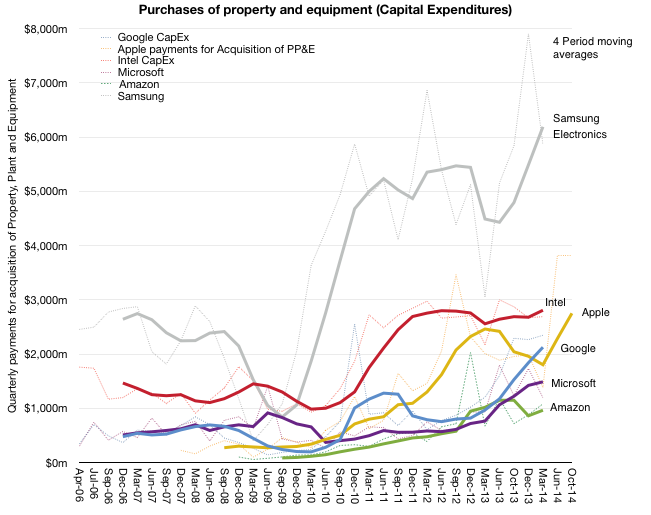
    It's an admittedly small sample of companies that are not that dissimilar. But within this group, over the time frame of about 9 years, we can see how capital expenditures are growing. ((Note that Apple's data extends to the end of their fiscal year and reflects their forecast given last October in the 10-K filing)) This sample shows that for a few companies, the amount spent on capital equipment grew dramatically. Especially since they are in businesses that might be thought of as not capital intensive.

    Consider Amazon: an Internet company if there ever was one. Their purchasing of capital equipment (in which they also classify software) went from 373 million in 2009 to $3.8 billion in last four quarters! The average spending was $84 million in the four quarters ending September 2009 and $964 million in the year ending March 2014. Amazon is investing in data centers and distribution centers and they are growing that asset base with an eye toward future growth.

    In contrast, consider Intel. Intel is in the most capital-intensive corner of the technology industry: semiconductors. They still manufacture their own so their investment in "fabs" continues. But Intel failed to create a market for mobile devices. The number of ARM processors shipped in 2013 was about 10 billion units while the number of Intel processors shipped was around 400 million.

    So despite being an innovator, Intel did not create a market. They still increased their CapEx but only by a factor of 2. Is this because Intel did not invest in market-creating innovations? Had they invested in market-creation, would they be increasing CapEx accordingly?

    Now look at Samsung. Samsung has grown CapEx by a similar factor to Intel (from pre-recession $2.5B/quarter to average of $5.5 during the last three years). Did Samsung create markets? Much of the expenditure went toward supplying components to itself and Apple (and others). In that regard, they did not create the market but filled it and optimized it.

    Then there's Google. Google increased CapEx from an average of $476 million/quarter in 2006 to $2.125 billion in the last four quarters. That's an increase of 347%. Google spends almost all CapEx on data centers and we can see a pattern where CapEx growth anticipates service growth. However, the growth is not as pronounced as Amazon's.

    Microsoft also grew CapEx. Their investment mirrors that of Google: data centers. Microsoft increased from an average of $508 million/quarter (very similar to Google) in 2006 to $1.5 billion today. That increase is about 200%, slower than Google but in the same trend. Did Microsoft create a market since 2006? In terms of cloud computing and software as a services, yes. Their spending growth reflects infrastructure that supports a new business model.

    Finally there's Apple. In this time frame Apple did create the iPhone and iPad and their growth went from less than $200 million/quarter in CapEx to over $2.5 billion/quarter. The increase is nearly 10x over 25 quarters.

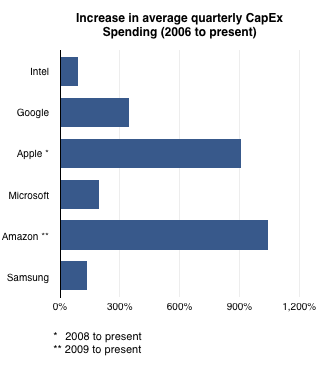
    To summarize, the following graph shows the increase in average quarterly spending (over a four quarter period) between 2006 and the present for these companies.

    Screen Shot 2014-05-27 at 5-27-3.10.40 PM

    The degree of "market creation" may be visible to the naked eye: Apple and Amazon did clearly create markets and they show highest CapEx growth while Intel and Samsung did not and they show the slowest CapEx growth. Google is continuing the expansion of a new market as is Microsoft and their CapEx growth is roughly proportional to these efforts.

    At least from this small sample the theory seems to hold. CapEx and market creation are at least correlated.  Much more analysis needs to be done, especially to discover the anomalies, but from the perspective of some of the most valuable and rapidly growing large companies, their commitment to capital expenditures is evident.


  6. Asymcar 13: Pilgrimages and Fundamental Evil

    Research

    IMG_8829

    On continental trips, diesel engines and autobahn speeds, pilgrimages to Porsche and BMW’s brand meccas.

    How to understand the world through toy cars, from Matchbox to Hot Wheels, Siku, Majorette to Tomica.

    On the business of car distribution, “channel stuffing” and the origins of state franchise regulation.

    Reflections on Apple’s routing around now-defunct computer retail channels via its highly successful stores.

    via Asymcar 13: Pilgrimages and Fundamental Evil | Asymcar.

  7. Teenager stores

    Research · 7 comments

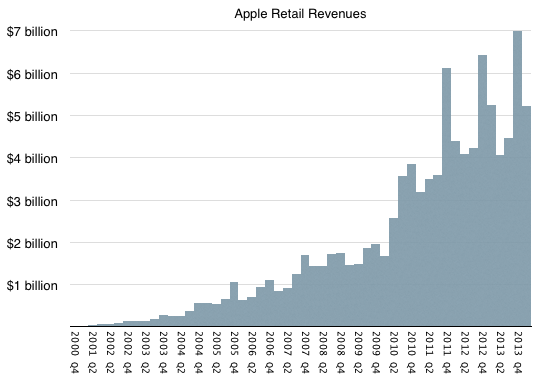
    The Apple stores are now 13 years old. ((The first store at Tysons Corner in  McLean, VA opened on May 19 2001)) In the first full year of operation (2002) the stores generated revenue of $282 million. In the last full year (2013) the revenues were $20.228 billion. Quarterly sales during the last seven years are shown below:

    Screen Shot 2014-05-20 at 5-20-11.16.21 AM

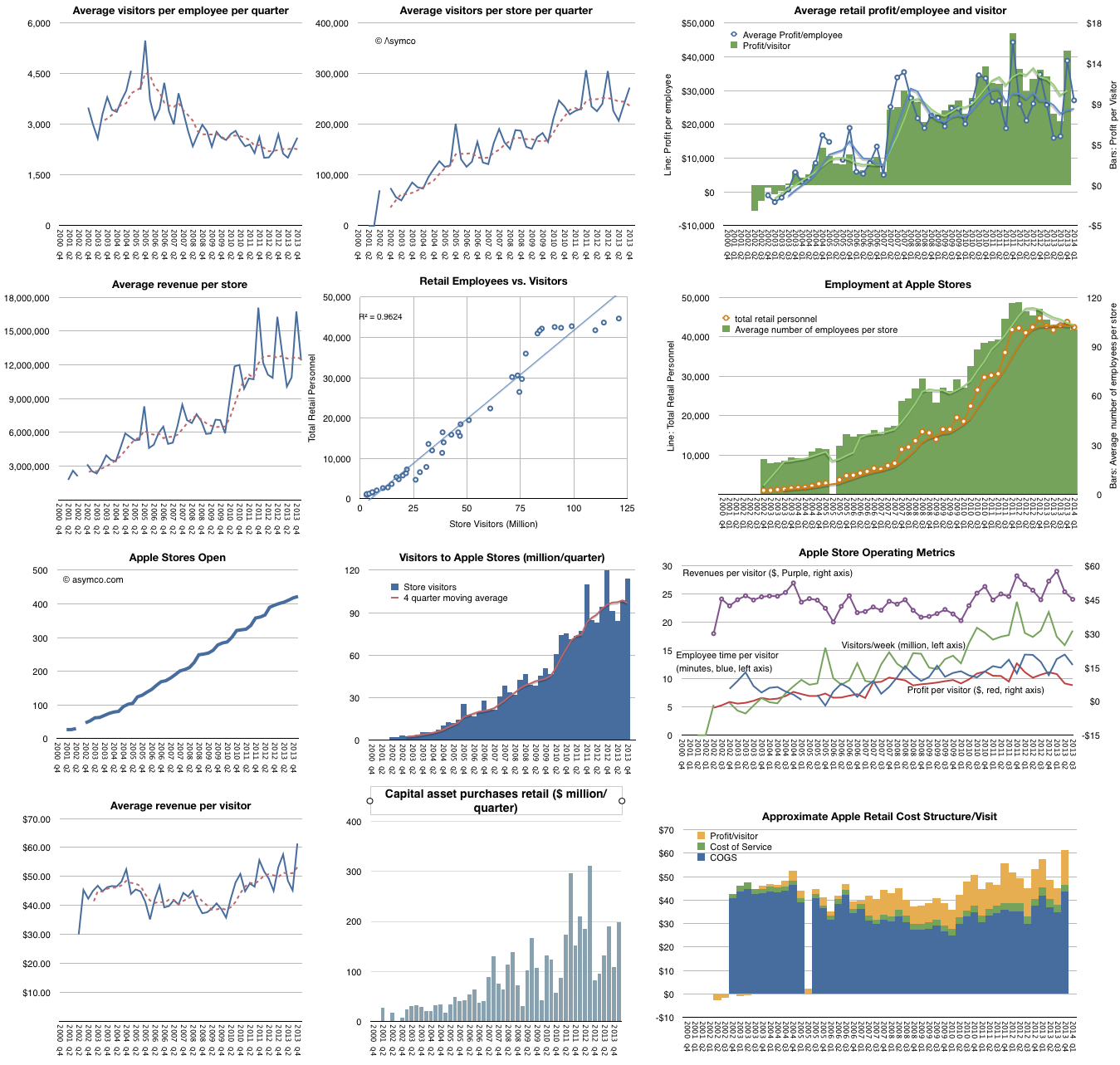
    Additional details regarding average visitors per employee per quarter, average visitors per store per quarter, average retail profit/employee and visitor, average revenue per store, employment and visits correlation, employment per store and in total, stores open over time, visitors over time, average revenue per visitor, capital asset purchases and estimated cost structure per visit are shown below:

    Screen Shot 2014-05-20 at 5-20-11.19.51 AM

    The Apple store concept has reached teenage years and it seems a good time to renew their character.

  8. Categorizing technologies

    Research · 79 comments

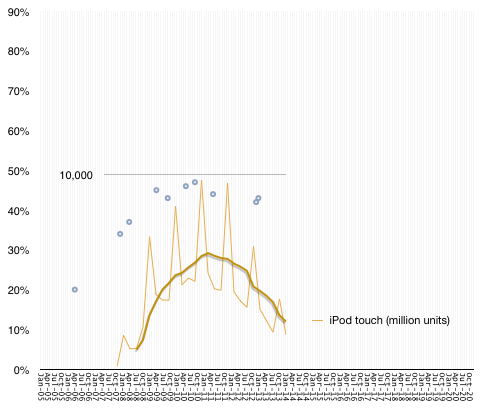
    In the graph below the grey circles represent the US penetration (percentage of households which own) MP3 players.

    Screen Shot 2014-05-19 at 5-19-7.55.22 PM

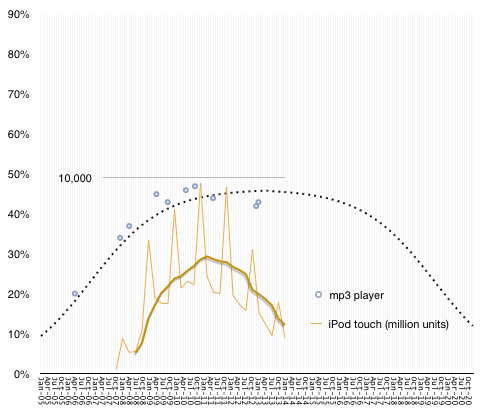
    Superimposed on this sparse sample graph is a line showing the sales of iPod touch. This second graph has a different scale, shown with a gridline at 10,000, representing millions of units shipped by Apple. To smooth out seasonality I show the trailing four quarter average with a thick line.

    The correlation is fairly evident. As iPod sales grew, penetration grew and "peak MP3" was recorded in September 2010 while peak sales occurred at the end of that year.

    It's not a stretch to say that iPod touch sales are causal to MP3 penetration, especially since the iPod has remained the market share leader in the segment for a long time (at least 70% share) and that the iPod touch is consistently half or more of the iPod.

    The absence of data for penetration beyond 2012 is therefore not a problem. We can assume that MP3 devices have a finite lifespan and, if not replaced, the penetration will decline.

    I modeled both the increase and decline with a diffusion curve as follows:

    Screen Shot 2014-05-19 at 5-19-7.02.40 PM


    As longevity goes, this is quite generous but it's safe to say that fewer than 10% of US households will have a dedicated MP3 player by the end of the decade.

    MP3 players turn out to be a "ballistic technology". Their failure is two fold: first, they did not reach saturation, gaining popularity with only half of US households; second, they were substituted and thus went out of use. Note that I kept the graph's upper bound at 90%, suggesting the limitation of the device popularity.

    There are many technologies which are in this state: camcorders, pagers, VCRs, game consoles.

    On the other hand there are some technologies which prove to be both ubiquitous and resilient. I call these "perpetual technologies". Substitution may occur but it may take decades. Examples are stoves, autos, microwave ovens, refrigerators, radios, vacuum cleaners, TV, telephones (fixed wire and cellular).

    Yet another category exists where the technology does not quite reach ubiquity but is common enough that it's refused by only about 20% of the population. I call these "Inertial technologies". They also have relatively long periods of slower growth and similar lengths of decline, sometimes substituted by services rather than equivalent objects. The Examples are washing machines, the Internet, personal computers.

    Some technologies never reach mainstream use (below 10% penetration). I call these "dud technologies". These failures are very common and can be discerned easily. Examples include the Segway, Google Glass, SPOT watches, PDAs.

    So to summarize:

    • Dud technologies: Never reach 10% penetration, are money losers, do not create an industry.
    • Ballistic technologies: Reach between 30% and 70% penetration but are substituted quickly. They are profitable but only for the duration of their ascent. Generally do not create industries, ecosystems or network effects.
    • Inertial technologies: Have steady growth but never reach ubiquity. They are bound by frictions which impede their broad adoption but also impede their substitution. They do create industries and network effects but suffer from corrosion and monopoly.
    • Perpetual technologies: They reach ubiquity, usually quickly and remain there indefinitely. Substituted only by improvements which supersede performance (e.g. Color TV vs. B&W TV). Usually solve a universal problem everybody has. Create disruptive growth and have world-changing effects.

    Knowing in advance which category a technology will reach can be very valuable. Not only can investment be directed, but career decisions, education choices and fundamental research can be better allocated.

    The question is therefore how to tell early enough where an emergent technology fits in this categorization.

    I'll be discussing a methodology for doing this, the processes for creation and covering at least twenty case studies at the Postmodern Computing Summit in June in San Francisco.


  9. Think local, act global

    Research · 20 comments

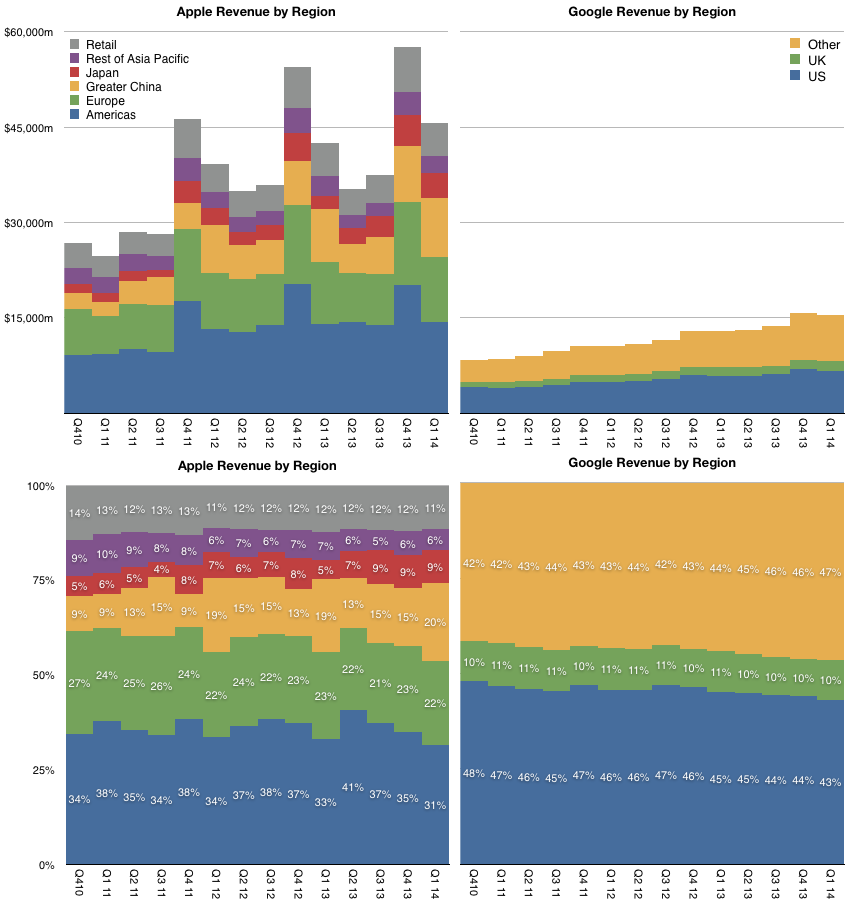
    Three years ago Apple's Greater China Q1 sales were $2.22 billion or 9% of total. This year they were $9.29 billion ((Including China retail, revenues reached "almost $10 billion")) or 20% of total. Over this time frame the growth in China was about 320%. The second fastest growing reporting segment was Japan with growth of 187%. Europe was third with 70% and Americas fourth with 53.5%. Rest of Asia/Pacific had the smallest increase of only 4.1%.

    A graph showing both the absolute and relative sales levels for the reporting regions is shown below.

    Screen Shot 2014-05-19 at 5-19-11.35.17 AM

    As overall sales have increased significantly, the revenues from the Americas and Retail combined (as most stores are in the US) ((60% of all Apple stores are in the US)) went from 51% in Q1 2011 to  42% in Q1 2014. The 11 point increase in share for China can be thus seen as mostly at the expense of the US. As Americas did not decline more appropriate statement would be that China captured much of the growth of the last three years.

    Note that I also included Google's revenue split ((Excludes discontinued operations, namely Motorola)) in the graph above. This is partly to calibrate Apple's mix and to understand if the expansion outside the US is mirrored by other companies.

    Google, in particular, is largely absent from the Chinese market and the only regional detail we have for their revenues is the US, UK and Other. That leaves an analysis of the dependency of each company on the US market.

    Google's US revenue percentage did drop from 47% to 43% but it's worth noting that not only is the drop slower than Apple's, the overall dependency of Google on the US for revenues is higher than Apple's.

    A surprising observation as Apple's concentration of users, measured as market share for various products, is likely to be higher in the US than Google's distribution of users.

    Put another way, Google is broadly popular world-wide (except for search in China, Korea and Russia) but its customers and hence profitability are highly concentrated.

  10. Postmodern Computing (Summit)

    Conference Research · 32 comments

    Screen Shot 2014-05-12 at 7.03.42 AM

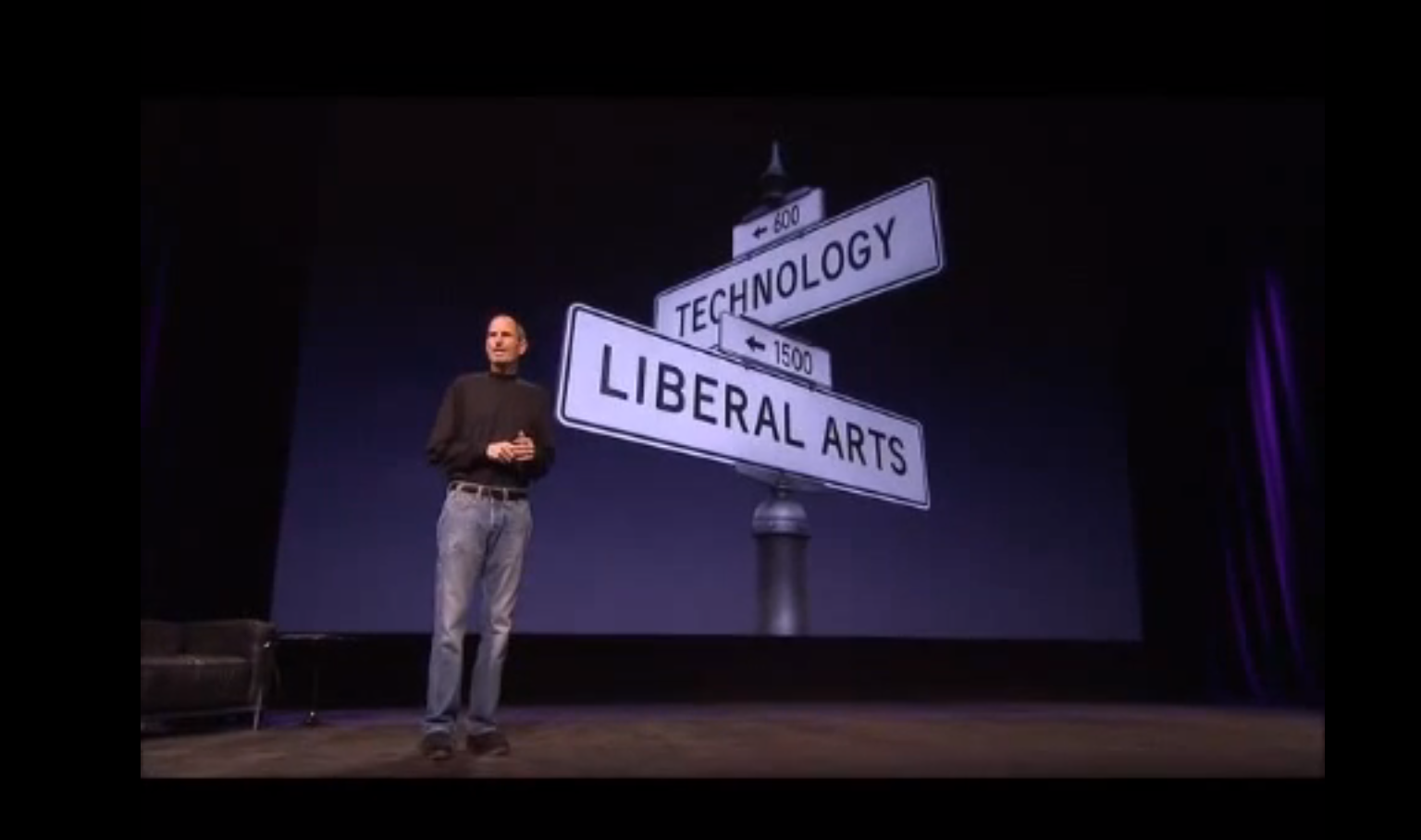
    Steve Jobs famously said that Apple stands at the intersection of of Technology and the Liberal Arts. He said it more than once because he thought it was an important distinction of the company.

    In an intuitive way, the message may have gotten through to the average person, but I don't think professional observers and managers of technology have quite grasped what he meant.

    It's not a glib throw-away marketing phrase. I can imagine many other, more evocative ways of saying that Apple blends the hard and the soft; the heart and mind, if you will.

    His choice of words makes me believe that he meant it as a fundamental blending of two disparate and considered-opposite concepts, rather like yin-yang: things which do not naturally mix but which are complementary, interconnected, interdependent, and give rise to each other.

    This interaction however is not well understood and even more rarely exploited. The reason they don't mix well in business in particular is that individuals are typically not trained in both. Our education systems (from where these phrases originate) are unwilling or incapable of providing us with a grounding in both, so individuals tend to absorb only one or the other.

    But it turns out that the interaction between these nominal opposites have determined our world to date and will continue to determine our fate. A cursory review of history shows that the "soft", perceptive and feeling-based disciplines always combined with the analytical and judgmental to create a future which neither could create alone.

    I note how Apple uses this combination to an advantage and have also used this methodology myself to understand and sense the future. Taking this method further, I would like to share it with others. I would like to recognize some faint but powerful patterns and bare some of the more audacious conclusions of my analysis.

    The method chosen is a forum we are convening called The Post Modern Computing Summit.

    It's a small gathering where we are inviting the most enlightened thinkers of the future of computing to lead us into its next age, and perhaps, tentatively, the next era of civilization. ((We'll also answer the questions of where tablets are going, and where they will takes us, what is the future of apparel computing, what does intimate computing mean and who will benefit and who won't.))

  11. Measuring Not Getting the Cloud

    Research · 137 comments

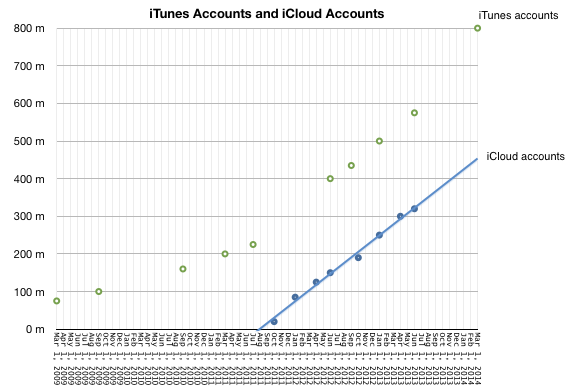
    This is what "Not getting the Cloud" looks like:

    Screen Shot 2014-05-09 at 5-9-3.30.03 PM
    Screen Shot 2014-05-09 at 5-9-4.04.33 PM


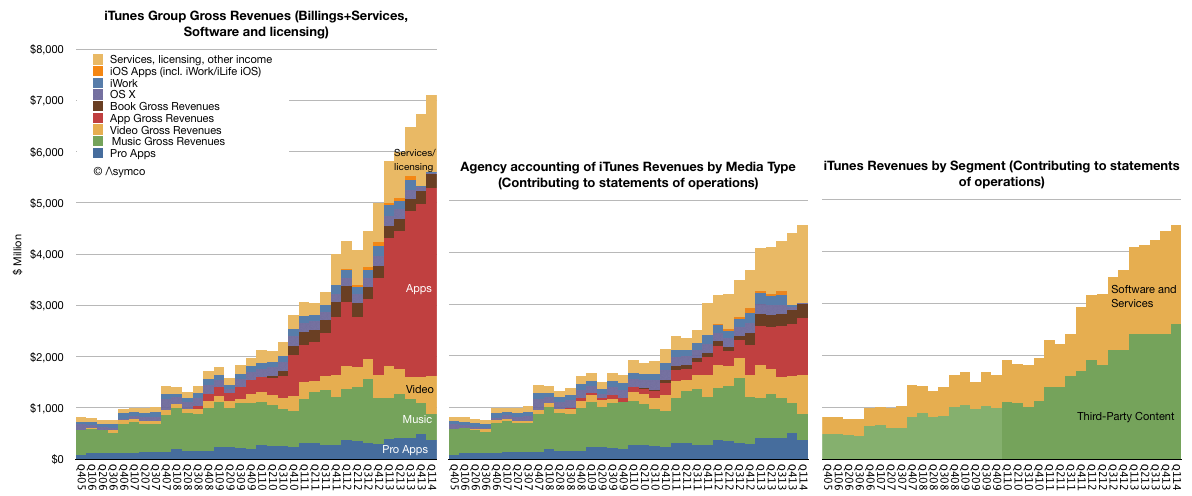
    "Not getting the cloud" means that in the last 12 months Apple obtained:

    • 800 million iTunes users and
    • an estimated 450 million iCloud users spending
    • $3 billion/yr for end-user services plus
    • $4.7 billion/yr for licensing and other income which includes
    • more than $1 billion/yr paid by Google for traffic through Apple devices and
    • $13 billion/yr in app transactions of which
    • $9 billion/yr was paid to developers and
    • $3.9 billion/yr was retained as operating budget and profit for the App Store. In addition,
    • $2.7 billion/yr in music download sales and
    • more than $1 billion/yr in Apple TV (aka Apple's Kindle) and video sales and
    • $1 billion/yr in eBooks sold

    In summary, iTunes, Software and Services has been growing between 30% and 40% for four years and is on its way to $30 billion/yr in transactions and sales for 2014.

    This is what can be deduced from a reading of Apple's financial statements of operations. If there are comparable details for companies which do get the cloud, I'll be happy to tally the comparison so we can calibrate this failure.