The iPhone 4S sold about 4 million units in the first three days of availability last year. The iPhone 4 sold about 1.7 million and iPhone 3GS about 1 million.
The main driver to growth for the initial weekend is usually upgrades for existing customers. There might be first time buyers, but the dedication required to ensure being first to have it usually means buyers are keen on the brand and are repeat customers.
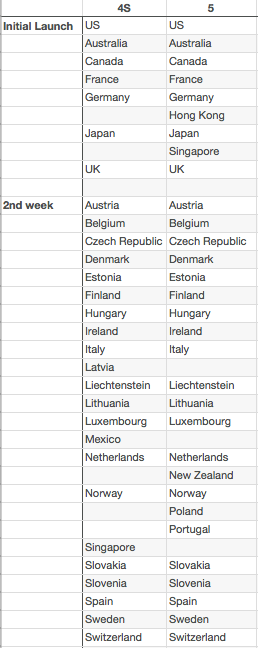
The other factor is the number of countries where the phone is available. The 4 was initially available in 5 countries. The 4S in seven and now the 5 will be in nine countries. I made a list of the differences in launch countries for the 4S and the 5 below:
I've also listed the second week launch countries for completeness and shown which countries have changed.[1]
The performance of the 5 in the first weekend should be better on a volume basis simply because there are more existing customers who wish to upgrade and because there are more initial and significant launch countries.
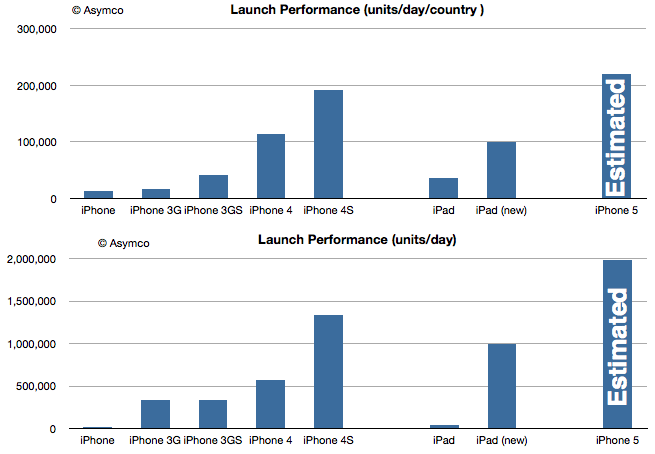
The 4S launched with an average of 1.3 million units per day but 191k units/day/country. The 4 launched with 113k units/day/country. If we assume that the 5 can capture 220k units/day/country we reach 2 million units/day for this launch footprint and a total of about 6 million units for the launch weekend.
These estimates are shown below relative the the other iPhone and the iPad launches.
The additional shipments to fulfill orders for the second week may see the iPhone 5 sell over 10 million units before the quarter is over.
---
Notes:
Hong Kong and Singapore are noteworthy initial launch additions, Poland a noteworthy second week addition and Mexico a noteworthy second week omission.
Amazon will sell as many Kindles as they make, but the number they will make will not be the most they could make.
The logic of selling a product which has a profit model unrelated to the cost of goods sold is tricky. The incentives are different. The risk is not selling too few but selling too many.
For this reason I think the total number of new Fire units to be sold has already been determined by a production order. You cannot think about the business from a demand point of view. If the product would be free then the demand would be infinite. The decision about how many will be "sold" will depend on the goodwill of the producer.
What Amazon tries to do with the brand is ensure that the Fire is in the hands of its most ravenous consumers. That is why it's not sold in all markets or through all channels. They are sold through Amazon.com in the US (limited sales in UK as well). This is because a large number of the product in the hands of users who only use it for browsing or in areas where Amazon does not have content deals or where its ads are poorly targeted (e.g. India, Indonesia or Madagascar) would be a disaster. It may not be all that helpful to Google to have Android in those markets but as you would expect it's still a profitable business for Apple.
So one way to think of the Fire is as a promotional item (aka swag) for another business (Amazon.com). Using this frame of mind, assessing its "threat" to another business which charges for the product itself is like assessing whether free t-shirts from trade shows affect the sales of clothing or apparel in general. They do, but mostly the sale of cheap t-shirts. I doubt that people stop buying more functional clothing because they have hundreds of free t-shirts. And then there's the problem of looking like an advertisement.
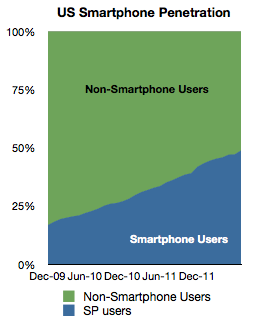
comScore data shows July penetration at 48.8% and a monthly growth in penetration of nearly 2 percentage points. Given the rate of growth, it's nearly certain that we've crossed 50% in August.
The historic growth is shown below:
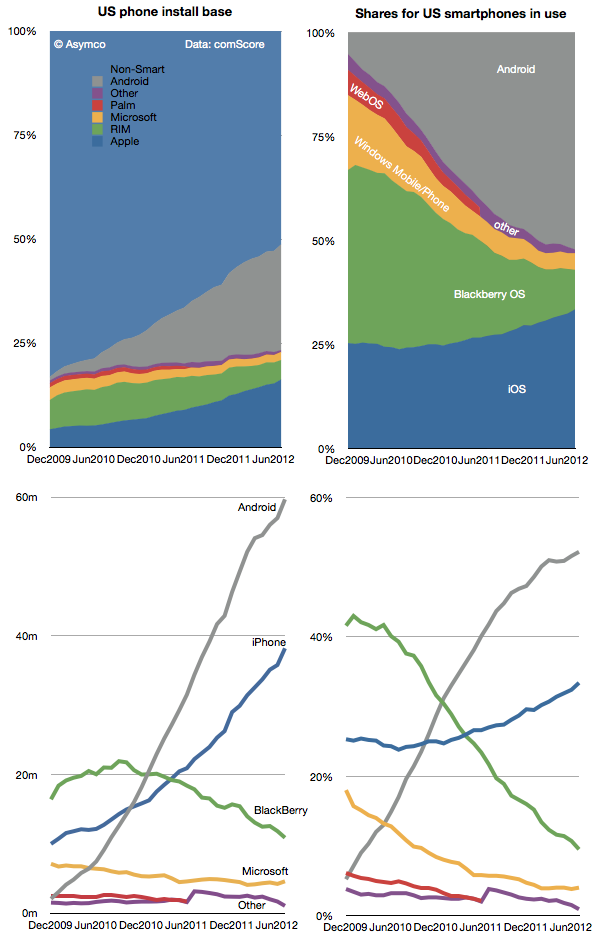
The platforms making up the smartphone market in the US have seen unequal shares of this new population of users. The following diagrams show how the install bases have changed in absolute and share terms.
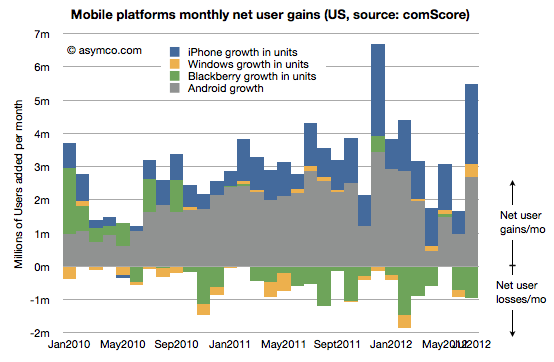
To round out the analysis, here is the net user gains for the platforms showing the net addition or loss of users since early 2010.
What I look for in this data are signs of slowing adoption (so far there aren't many), subtle shifts in platform performance (as seen in RIM's move from consistent net gains to consistent net losses) and signs of churn or the transfer of users from one platform to another (rather than from non-consumers to consumers.)
The story in the latest data seems to be that Windows Phone has turned in a first significant gain in users (378k new users). Its share seems to have stabilized at around 4%. This is in contrast to BlackBerry whose hemorrhage continues (a net of 7 million users defected from the platform in the last 12 months.)
On this occasion of reaching what I've called the tipping point, it's worth reflecting on just how far we've come. In December 2009 the total number of smartphone users in the US was 39 million whereas now it's about 115 million. That's a total of 75 million new users in a bit more than two and a half years, quite a story there.
And yet, half of the phone users still remain to be converted. It's possible that the growth in adoption will remain steady but it's also possible that it might slow down and follow the "S-curve" adoption rate that new consumer products typically follow, perhaps reaching saturation at some point below 100%.
If growth slows immediately then there will be more churn between platforms. If rapid growth can be maintained then there will be more competition with non-consumption rather than between rivals for some time still.
The changing character of competition will need to be reflected in product strategies. Non-consumption is typically an easier competitor to beat with features. Switching users from a comparable product is harder and may require pricing pressure. To solve this in a time of transition, new products will have to split into a set offered to new users and another set offered to switch users.
You can see the pressure of this on the Windows Phone platform most of all. As a late comer, does the Lumia range from Nokia fit the bill as targeting non-consumers or switchers?
In other words, has the brand been positioned as a "better" smartphone or as a "good enough" smartphone? It matters because the "good enough" position has been held by Android overall while the "better" position has been held by iPhone. However, not exclusively. We've seen "better" positioning from Samsung's Galaxy S and Verizon's Droid brand and "good enough" positioning from the older variants of iPhones.
So it's quite difficult to see where Lumia fits in the US. There is no obvious opening. The next 75 million first time US smartphone users may be attractive to Microsoft and Nokia but it's not clear why, having waited so long, those buyers will be persuaded by the new brand. Perhaps subsidies will help. As indicated with the first US Lumia launch, the product was priced at a discount to the prevailing price point for a premium smartphone. Perhaps that's the "good enough at a good price" strategy.
If so, it has not been a home run. Perhaps there is still time for this strategy to play out in 2013 but what if Lumia is not actually being marketed this way?
At launch Nokia has tried to promote the brand as something "better". Better camera, better charging, better maps, better screen, etc. They have promoted on Twitter with the #switchtolumia hashtag. Microsoft has had the "Smoked by Windows Phone" campaign targeting specifically existing smartphones.
I don't want to suggest that one positioning is more appropriate or more likely to succeed than another. That's a tough call. Either could be the right choice. What I would suggest however is that there needs to be clarity of thought and communication on the matter.
Perhaps the launch of the new Lumias (920, 820) is part of a clear positioning toward the high end. But the absence of pricing and distribution and how the operators will be engaged leaves the question open. The strongest criticism of the effort so far is this lack of clarity about how the product is intended to be perceived by the buyer.
A lack of clarity in positioning is symptomatic of a lack of clarity, or maturity in strategy.
It looks like the next iPhone will be called the iPhone 5. What's in a name? As it turns out, quite a lot.
Every hardware product that Apple has released has had a brand and a sub-brand. Macs for example use the Mac brand and a sub-brand as follows:
iMac
MacPro
Macmini
MacBook
Thus each sub-brand imparts certain meaning to the buyer. i, Pro, mini, book are all evocative. MacBook even has its own sub-brands:
MacBookPro
MacBookAir
These Mac sub-sub-brands of Pro and Air are specifically designed to also distinguish and convey meaning.
iPods as well use the iPod brand followed by a sub-brand.
iPodClassic
iPodtouch
iPodmini
iPodshuffle
iPodnano
Note how the mini sub-brand was retired from the iPod line to be used exclusively in the Mac product line. That may not be specifically necessary or desirable but it is an interesting coincidence. (The Pro sub-brand is shared between different Mac lines)
However, when we look at the iPhone and the iPad, the nomenclature has been distinctly different. Both products have been using generational naming conventions. This implies no sub-branding as the iPhone and iPad are the only identifiers of brand and hence the only meaning being imparted to the buyer. You either get an iPhone or and old iPhone.
That changed with the iPad however. The third generation iPad became just iPad. This was deliberate (why would they want to confuse buyers?) I think there is some logic to this.
Note the parallel to the convention of the original iPod. When the iPod launched it was just the iPod. Subsequent versions were identified by a generation, but not a specific sub-brand. After the third generation iPod (still called iPod), the mini version was launched, creating the sub-brand convention that remains in use to this day. The iPod therefore was born generational but switched to sub-branding in adolescence.
The possibility exists, therefore, that there will be a sub-brand for the iPad. Perhaps "mini" is being reserved for a new iPad, to distinguish it from the regular iPad (no sub-brand) that is likely to remain in production. The logic is to make room for sub-brands when the core brand begins to cover a wider array of form factors, themselves proxies for separate use cases or jobs to be done.
So what about the iPhone?
The iPhone has remained, stubbornly, after five years, stuck with a generational naming convention vis-à-vis the sub-brand convention used in every other mature product line from Apple. (Note that software from Apple adheres strictly to a generational naming convention because there is no "room" for a sub-brand under a software brand. There can be no "iWork Pro" or "Final Cut EZ". [Update: there once was Final Cut Express])
Prior to today I entertained the possibility that the new iPhone will follow the iPad in dropping generational naming in favor of sub-branding thus implying that the brand would develop into a portfolio of sub-brands (like the iPad seems about to.)
Alas, that possibility now seems moot. The launch announcement seems to clearly point to "5" being the name of the new iPhone. The brand remains iPhone and there will be no sub-branding.
This can only mean that Apple intends to preserve a single product strategy for the brand. There will be no "special" iPhone for different (e.g. low-end) markets. There will be no different form factor to accommodate different use cases. There will be no new jobs to be done for the iPhone.
What a bummer.
However, there may be something more curious happening. Note all the service brands being launched on the iOS platform. There's Siri, (as yet unnamed) Maps, GameCenter and PassBook. These are not Apps. These are services designed to be unique to iOS, perhaps even unique to the iPhone. The difference with the iPhone brand may not be that it spans a multitude of sub-brands in hardware but that it covers a multitude of new service brands. As brands imply meaning, the iPhone brand may imply that it's a platform in and of itself.
This interview was conducted with Bruno Ferrari Editor of Exame magazine in Brazil.
First, do you have forecasts for tablet market share including Microsoft for next years? (Apple, Android, Amazon etc)?
I have some guesses but I don't think it's something that is defensible. Too many things can change. Fundamentally I believe Microsoft sees the tablet as a PC and intends to migrate a substantial portion of would-be PC customers to tablet forms. If they are successful then they preserve the existing PC user base and allow it to grow a bit.
In contrast Apple sees the iPad as a new type of device that is used for things not directly related to PC style computing. In that sense the iPad competes with PC non-consumption. It means people may own both a PC and an iPad and some will own only an iPad. The iPad will expand the market while taking share from the PC. Windows tablets will try to hold the Windows share steady.
How do you analyze Microsoft’s strategy with Microsoft Surface? Don’t you think they’re admitting themselves that Apple was right since the beginning?
We don't know the strategy yet. Without pricing and an idea of how the other OEMs will respond, I have more questions than answers. The fact that they are doing their own PC hardware does indicate that they see the industry architecture changing and that a large number of vendors offering hardware "choice" is not really the basis of competition in PCs. In other words, buyers are not willing to pay a premium for Windows because the hardware it's available on is offered in a wide range of options.
Do you think MS growth at tablet market will surpass the lost at PC (desktop and notebook) market in the next years?
This is a crucial question. It's possible that Windows 8 on tablets will create new markets, like the iPad has done and it could take the leading role in expanding computing in a post-PC era. However, to do this, Windows 8 and its successors need to be optimized to solve the new jobs people may have for mobile devices. They have to do this even though they need to sustain the old use cases and business models. To succeed Microsoft needs to "fork" the business model and create new ways of profiting from hardware and software. The rumors that Windows 8 RT devices will be sold at a loss is perhaps a hint that this is the plan.
Did you see the rumor of a 199 dollars Surface? If it’s true, do you think is a good strategy?
It all depends on what will be the alternate source of revenue. I assume there will be some sort of subscription service, taking a page from the telecom industry. Perhaps a mixture of Windows Live services (media, documents in the cloud and software updates). We have to see whether subscription computing makes sense for consumers.
How do you see the problem that MS is creating with its OEM by turning itself on a tablet maker?
There is a problem, of course. However here again the question is whether they are moving to an "ecosystem subscription" model and whether they want to offer revenue share to OEMs. If they offer something then Microsoft plays the role of the operator and device makers are paid some up-front subsidy in exchange for keeping their systems locked into the network.
One more questions: did you already estimate the shipments of Samsung Galaxy Tab since its launch?
Sorry, I don't have the Galaxy Tab estimate. However, here is what I found:
A week after its release, Samsung announced that they had sold 600,000 units. On the 4 December, it was reported that the 1 million mark was reached, two months after launch. However, an executive at Lenovo claimed that Samsung had only sold 20,000 out of the 1 million Galaxy Tabs that were shipped. In January 2011 Samsung announced they had shipped 2 million units to stores. In August 2012, actual sales figures were released in the patent infringement court case against Apple showing that a total of 725,000 Galaxy Tabs were sold through Q2 of 2012.
Last September I argued against the potential of the Kindle Fire acting as a low end disruption in the tablet market.
Now that the first version of the product has reached is end of life, it's time to review the discussion.
The first problem is finding out how well the product did. Amazon just released a statement that the Fire accounted for 22% of tablet sales in the US in the nine months it was available. The challenge becomes knowing how many total tablets were sold in the US during this time frame.
Fortunately we know the vast bulk of that total based on the Samsung v. Apple trial. Both Apple and Samsung submitted as evidence sales of the iPad and the Tab product lines in the US. The iPad added up to 16.14 million units (Q4'11 through Q2'12) and the Tab was 540k units. That makes the iPad and the Tab add up to about 16.7 million units. Assuming an additional 1 million units for the other (non-Kindle) total yields an estimate of 22.7 million tablet devices sold in the nine months ending June.
Applying the 22% claim to that total gives a Kindle sales total of 4.987 million. That's awfully close to a round number of 5 million.
Since Amazon admitted that they ended production prior to launching a replacement (and presumably did so quite early in order to drain inventory,) then we can safely assume that the original production order was 5 million units.
Five million Kindle Fire units becomes the first reliable estimate of Kindle sales (based on Apple, Samsung and Amazon supplied information rather than guesses from analysts.)
So the question now is whether this is consistent with the hypothesis that the Fire is disrupting the tablet business.
Bearing in mind that this 5 million total was reached with prominent placement on Amazon.com and a loss-leading pricing, I would conclude that this is not an auspicious start for a disruptive product.
As I argued nearly a year ago, the business model for the Kindle is limited to the footprint of the Amazon franchise, which is small internationally. Amazon itself implicitly admitted that the product was a US-only phenomenon. Further worry comes from the way the company approached production. It was not planning it as a maximization of reach into the market. What they did was order a batch production and then wait for it to be sold through.
Perhaps Amazon is being patient for growth, but I don't see a hunger for profit in this strategy. We know that Kindle probably lost money at the price charged. Perhaps it's on the order of $40 per unit. Five million units would imply a charge against the business of $200 million. Did Amazon earn a profit on content sales of $40 on each of those five million units? The margins on content sold through Amazon are so low that I have a hard time imagining that Fire users are that ravenous in their consumption.
Apple Inc. v. Samsung Electronics Co., Ltd. makes for powerful courtroom drama. Calling it drama, however, is faint praise. It's entertaining and thrilling but the effects are shallow and they don't last.
I have been asked to comment on the trial that just concluded and I find it difficult. The problem for me is that I've seen too many of these dramas. From the United States v. Microsoft to NPD v. RIM and Nokia v. X, Y or Z to make sweeping conclusions. This frustrates the journalist.
The problem is that the process of litigation leads to little satisfaction for any of the parties. There is always the anticipation of catharsis, but it never comes. The expectation is understandable. We are led to believe that the law is decisive, the ultimate adjudicator. The reason it isn't is that the system was established in a different era. A time when technological change was slow, or non-existent. As a result the institutions of law move so slowly that they are nearly futile in administering justice or righting wrongs.
Here are just a few problems I can cite without any research:
Legal processes are glacial. They tend to last longer than the lives of the products being litigated. In the case of phones with shelf lives of six months to a year, the trials are unlikely to get underway before the accused infringer is already off the market.
The law is ambiguous. IP law varies and is subject to interpretation. What one jury (or judge) finds unanimously infringing another will find non-infringing. This gets even more dramatic when comparing decisions across countries and legal systems and through appeals processes and the influence of political considerations.
It's a big world. Even though patents can be internationalized, the way they are enforced varies.
The financial penalties or awards are arbitrary. As exposed during the Apple v. Samsung (US) trial, the impact of infringement can be calculated numerous ways, all hypothetical.
It is incredibly complex. The technicalities are so onerous that they baffle judges and lawyers and legal experts, not to mention company management and lay jurors.
It is costly. Only major companies or those backed by legal hit squads can participate in litigation. This means it sustains incumbents rather than facilitate entry. By necessity, entrants need to "route around IP."
But the most damning thing about the litigation process is that it's assumed to be decisive. Decisive in terms of altering the success (or failure) of companies. That rarely happens. Instead it adds friction to an existing, inevitable outcome. Sometimes it cripples the winner and rewards the loser.
Therefore strategists need to be careful to avoid placing their faith in this system. It's a lottery at best, a time and money sink at worst. Considering the analogy to litigation as drama, I would re-phrase this caution as a warning not to treat litigation as Deus ex Machina. It's not something that will get your business out of a jam or reward you for a violation, perceived or real.
Practically, these exercises in drama are used to signal. Signal to competitors, partners, customers and employees. In other words, they are used to create psychological effects. But we know that psychology can be effectively shaped with other messages. Signals that products themselves give (positioning), or that are shaped by communications via advertising. And these means for signaling are much more effective than using the legal system. So why not use traditional means of signaling?
This is the crutch of Deus ex Machina. That this artifice will help tell a story. That "a seemingly unsolvable problem is suddenly and abruptly solved with the contrived and unexpected intervention of some new event, character, ability, or object."
The first of a series of padcasts capturing the Asymconf event is ready. This presentation includes a discussion on the formation of Amsterdam and the innovations that both made, and were made by, The Dutch.
It is the story of the Netherlands as seen through a disruptive lens.
The introductory remarks are captured with audio and video mixed with data and content as presented live.
We can put all of our products on the table you’re sitting at. Those products together sell $40 billion per year. No other company can make that claim except perhaps an oil company.
We are the most focused company that I know of, or have read of, or have any knowledge of.
We say no to good ideas every day; we say no to great ideas; to keep the number of things we focus on small in number.
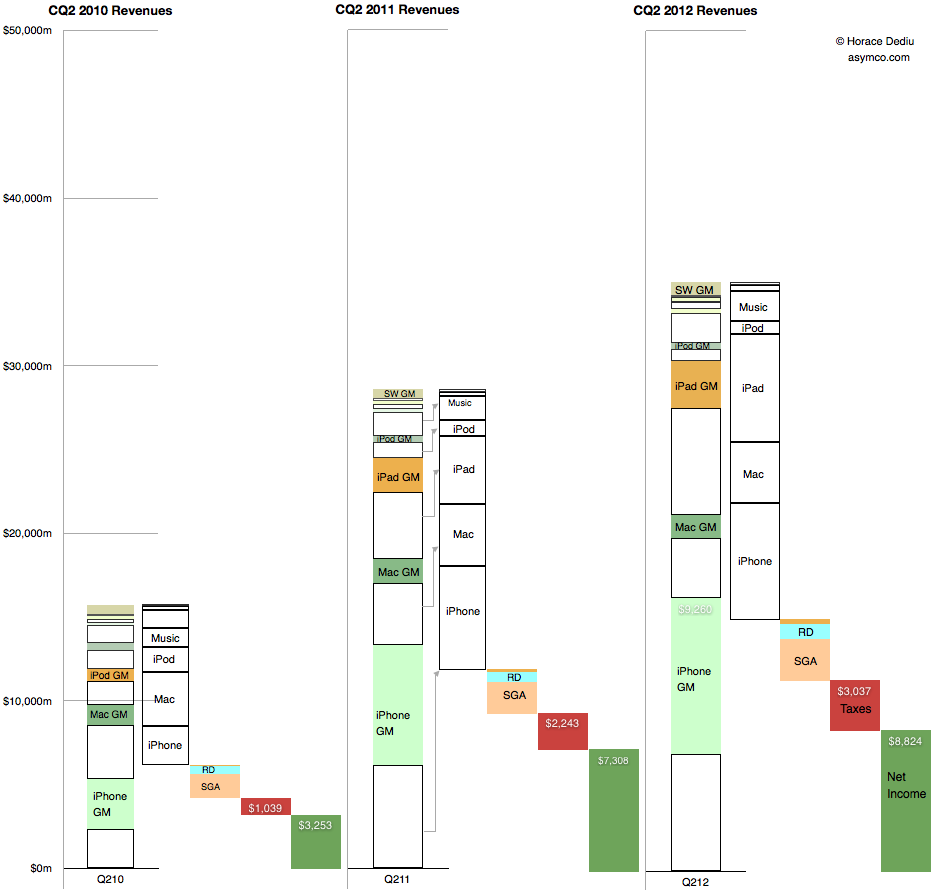
Since then the only product that has been added to the kitchen table has been the iPad. The sales level however, has increased in proportions shown in the chart below.
The revenues are shown with their contributory products and the costs of those products. The payments for costs of sales as well as R&D, SG&A and Taxes are then subtracted revealing the Net Income (in green). This is done for the second quarters of 2010, 2011 and 2012.
Since Tim Cook made the analogy, the table holding the products has not gotten any bigger but the sales level has more than doubled while profits have nearly tripled.
In his talk he cited revenues of $40 billion (for the pervious year, 2009). In the last twelve months Apple's revenues were $148 billion.
Tim Cook went on:
I think this is so ingrained in our company that this hubris you talk about that happens to companies that are successful and sole role in life is to get bigger, I can tell you the management team at Apple would never let that happen. That's not what we're about. [We have a] Small list of things to focus on.
The irony is that by thinking small, Apple became the biggest company that ever was.
The trick to thinking small is the same as that of "focusing" which means saying no, a lot. I touched on this in February 2011. Focusing is the willful rejection of the Nobel-prize winning theory of portfolios.
From the wiki link above,
Diversification eliminates non-systematic risk, but at the cost of increasing the systematic risk. Diversification forces the portfolio manager to invest in assets without analyzing their fundamentals, solely for the benefit of eliminating the portfolio’s non-systematic risk (the CAPM assumes investment in all available assets). This artificially increased demand pushes up the price of assets that, when analyzed individually, would be of little fundamental value. The result is that the whole portfolio becomes more expensive and, as a result, the probability of a positive return decreases (i.e. the risk of the portfolio increases).
This theoretical view into asset management applies in spades to product portfolio management. The idea that it's better to spread one's bets and cover all segments is "safer" has been thoroughly debunked by Apple.
Understanding the "fundamentals" of a product is far more important than having lots of products for the sake of diversification alone.
The fundamentals of a product are knowing its job to be done and thus its requirements which, when well executed, will position it precisely and unambiguously on an opportunity.
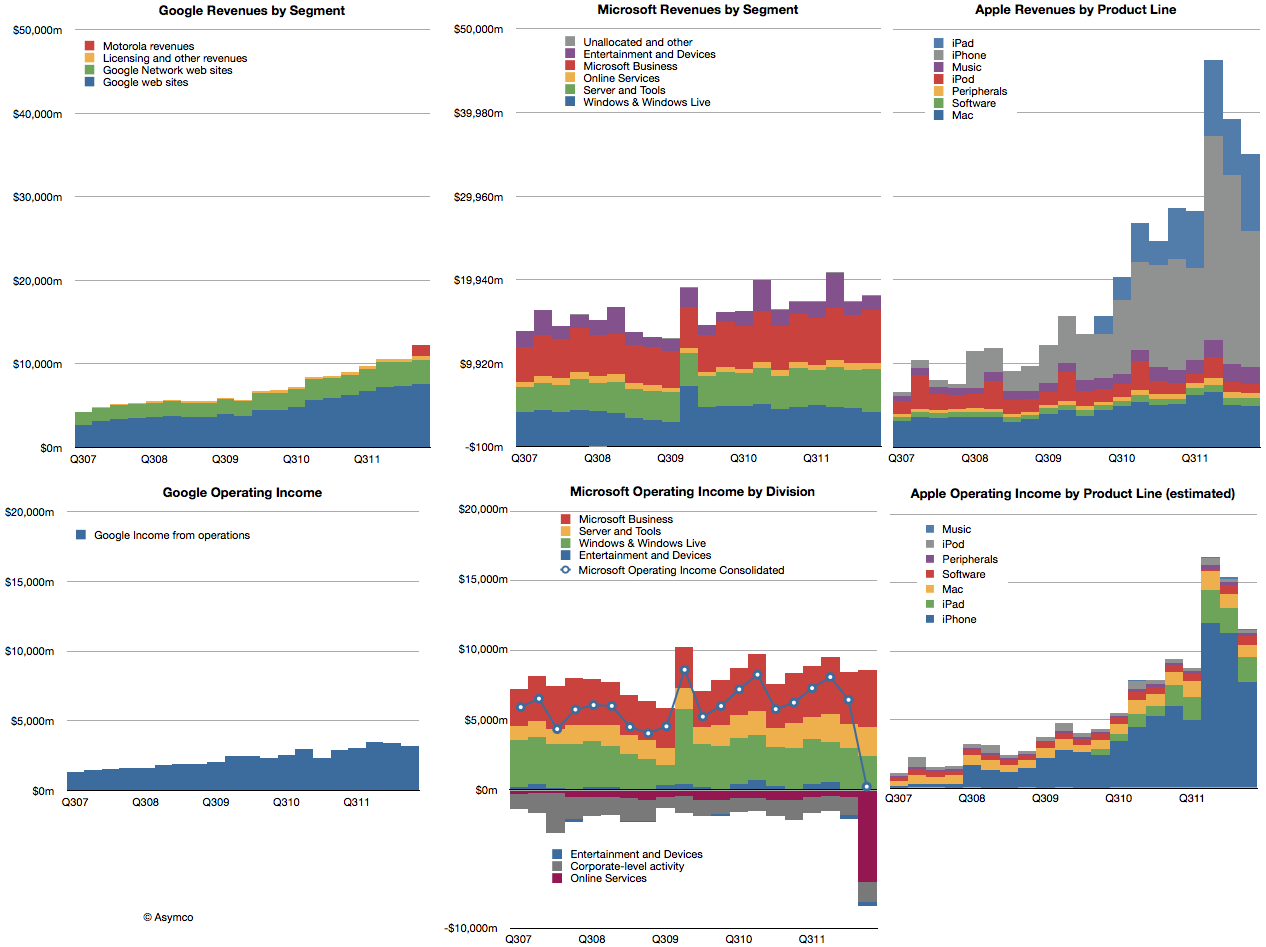
Google, Microsoft and Apple all had reasonably good second quarters. Microsoft's revenues grew by 4%, Google's by about 22% and Apple by 23%. Apple's growth was disappointing but the other companies weren't. The revenues for the three companies are shown in the following charts:
I also showed the performance of each company's operating income in the bottom three charts.
Microsoft did declare a one-time write-off of $6.2 billion which it spent on aQuantive a few years ago. That was booked as contributing to a loss of $6.67 billion for its Online Services division. Without that one-time charge consolidate operating income would have grown at about 3.6%. Google's operating income grew at a rate of 11% and Apple grew (again, disappointingly) at 23.4%.
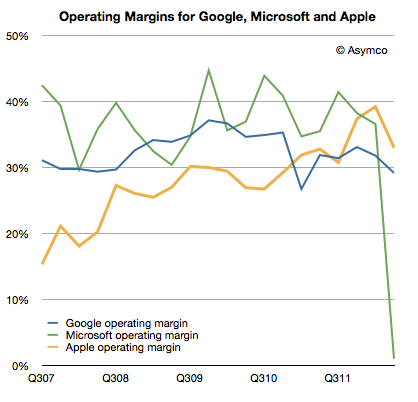
Apple's operating margin fell to 33.1% while Google's fell to 29.2%. Microsoft's margin evaporated due to the one-time charge. If we back that charge out, the margin would have slightly topped 35%.
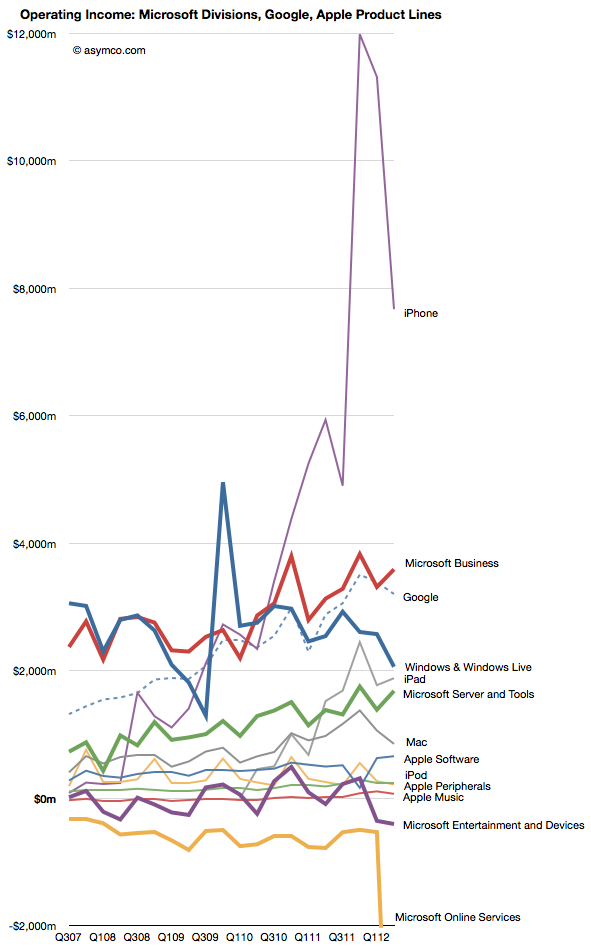
Comparing the contribution (in operating income) for each division or product line (where possible) gives the following view:
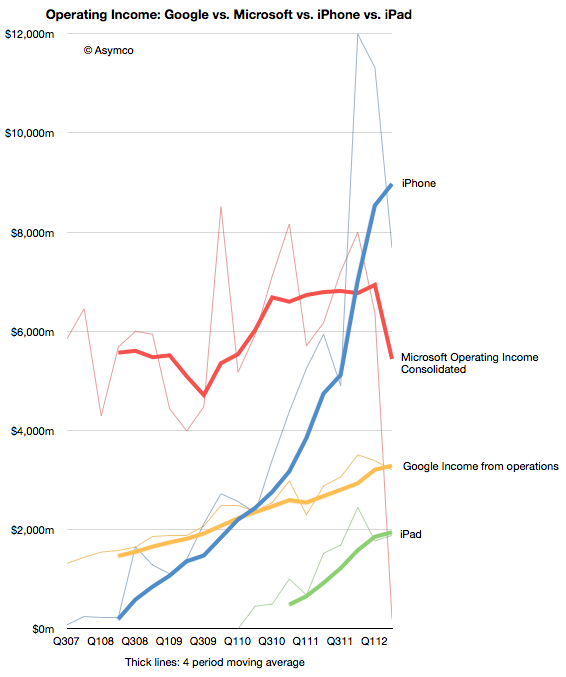
I tried to remove some noise by isolating the iPhone and iPad and consolidating Microsoft overall and Google.
By also smoothing out seasonality with a four-period moving average we can observe the pattern of growth for the iPhone and iPad relative to the other companies' overall performance.
The crucial question remains if and when the iPad will be a bigger business than Google and/or Microsoft. The iPhone climbed over both some time ago.